
INTERVIEWER: Welcome back, everyone. Today’s conversation is about one of the oldest questions there is: what actually makes things happen? My guest is Dr. Zia H. Shah. He’s a physician, board-certified in internal medicine, pulmonary disease and sleep medicine, and he writes at a website called The Glorious Quran and Science, at thequran dot love. thequran Over the last couple of years he has written a large series of essays on a nine-hundred-year-old idea from the Muslim thinker Abu Hamid al-Ghazali. thequran The idea is called occasionalism. Dr. Shah, welcome.
DR. SHAH: Thank you. It’s a pleasure to be here.
INTERVIEWER: Let’s start with you. A lung and sleep doctor writing about medieval theology and quantum physics isn’t something you hear every day. How did that happen?
DR. SHAH: [laughs] I get asked that a lot. My days are spent listening to lungs, reading sleep studies, and watching the body keep someone alive through the night. Every day I watch a patient take a breath. The diaphragm contracts, the pressure in the chest drops, air rushes in, and oxygen crosses a membrane thinner than a soap bubble into the blood. I can describe every step. I can measure it, graph it, and treat it when it fails. thequran But one day it struck me that all of that is a description of what reliably happens. It doesn’t explain why anything happens reliably in the first place. Medicine tells me the how in astonishing detail, and it says nothing about the why. thequranthequran That gap is where my writing lives. I’ve been trying to bring the Quran, modern science and philosophy into one honest conversation, and more and more of that work has come to gather around al-Ghazali, thequran because I think he answered the why better than anyone.
INTERVIEWER: So let’s define the term. What is occasionalism, in plain language?
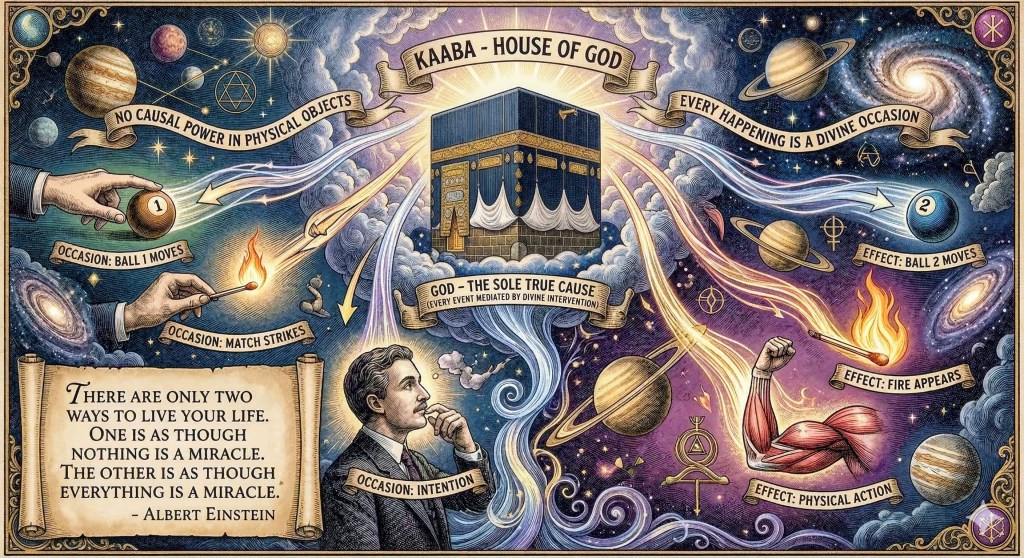
DR. SHAH: In one sentence: God is the only true cause of every event. What we call causes in nature, the fire, the medicine, the rain, are the occasions on which God creates the effects, and He does it according to a regular and reliable custom. thequran +2
Here’s an everyday picture. Think of a video game. When your character swings a sword and the dragon falls, it really looks as if the sword did it. But inside the game, the sword has no power at all. Every frame, maybe sixty times a second, the computer’s processor draws the sword, draws the dragon, and draws the dragon falling, all according to rules the programmer wrote. Turn off the console and nothing slowly winds down. The whole world just vanishes. thequran +2 Occasionalism says our universe is like that, but with no machine in the background. It’s God, sustaining every pixel of reality, moment by moment. thequran
The old theologians had a lovely image for it. Reality is like a light bulb, not a battery. A battery, once charged, runs on its own. A light bulb shines only while the current flows. Cut the divine current for one instant and the cosmos would fade into nothing. thequranthequran
One more thing, so nobody gets the wrong idea. The laws of nature are still completely real in this picture. They just aren’t chains that bind the world, and they certainly don’t bind God. They describe His habit. thequran +2 The Quran calls this sunnat Allah, the way or custom of God. thequranthequran Al-Ghazali called it ‘ada, habit. thequranthequran
INTERVIEWER: Take us back to al-Ghazali himself. What was his argument?
DR. SHAH: Al-Ghazali was born in Tus, in what is now northeastern Iran, and died there in 1111. He was a jurist, a theologian, a philosopher, and in the end a Sufi. He finished his famous book Tahafut al-Falasifa, The Incoherence of the Philosophers, in January 1095, according to the historian George Hourani. It was aimed at the Aristotelian philosophers of his day, especially Ibn Sina, whom the West knows as Avicenna. In the seventeenth of its twenty discussions he takes up causality, thequran and he opens with a sentence I consider one of the most important in the history of philosophy. In Michael Marmura’s translation it reads: “The connection between what is habitually believed to be a cause and what is habitually believed to be an effect is not necessary, according to us.”
Then comes his famous example, fire and cotton. Fire touches cotton and the cotton burns. Now ask yourself what you actually saw. You saw the burning happen with the fire, at the moment of contact. You never saw it happen by the fire, through some power flowing out of the flame. What we observe is conjunction, two things together. We never observe necessity. thequranthequran So al-Ghazali concludes that fire, which is lifeless, has no action of its own, and that the one who truly creates the burning is God. thequranthequran
He saw the obvious objection coming and raised it against himself. If nothing is necessary, couldn’t the book you left at home turn into an animal while you’re out? His answer is the heart of the matter. No, because God’s habit is constant, and its repetition, time after time, gives us a well-founded expectation. thequran The order of nature is real. It just isn’t self-made. As I like to put it, it’s a faithfulness, not a mechanism. thequran
Look how modern that is. About six centuries later, the French priest Nicolas Malebranche reached the same conclusion: there is only one true cause, because there is only one true God, and natural causes are only “occasional” causes. Then in 1748 the Scottish philosopher David Hume, who had read Malebranche carefully, made exactly al-Ghazali’s observation. We never perceive necessary connection, only “constant conjunction,” one event regularly following another. thequran +2 Hume used billiard balls where al-Ghazali used cotton. thequran And this is the pivot of my whole argument. Al-Ghazali and Hume saw the same thing. Hume drew a skeptical agnosticism from it. Al-Ghazali drew the living God. thequran The data don’t choose between them. Determinism and occasionalism describe the same observable universe. The only difference between them is God. thequran +2
INTERVIEWER: People will say this destroys science. If fire doesn’t really burn, why do experiments?
DR. SHAH: That’s a fair worry, and it’s an old one. About eighty-five years after al-Ghazali, not long after 1180, the great Andalusian philosopher and physician Ibn Rushd, Averroes, wrote a reply called The Incoherence of the Incoherence. He said that he who denies causes must deny the intellect. My answer is that science never needed necessity. It needs regularity, and occasionalism grounds that regularity in the faithfulness of God. The engineer can trust steel and I can trust penicillin precisely because God’s custom is reliable. thequran Science studies the habit, and it works perfectly well whether you think the habit rests on brute law or on a faithful God. Occasionalism takes nothing out of the laboratory. thequran It adds a foundation underneath it. thequran Science describes the how. Theology addresses the why. thequran
I should also add a scholarly note, in fairness. Historians like Frank Griffel at Yale, in his 2009 book Al-Ghazali’s Philosophical Theology, point out that in that seventeenth discussion al-Ghazali actually presents two acceptable options. One is occasionalism. The other is created causes that depend entirely on God. What he rules out absolutely is any cause that produces its effect independently of God. In my own work I lean toward the stronger occasionalist reading, but listeners should know that debate exists.
INTERVIEWER: Now the modern part. You often bring in the simulation hypothesis. Why?
DR. SHAH: Because it makes occasionalism intuitive for a generation raised on screens. In 2003 the Oxford philosopher Nick Bostrom published a paper called “Are You Living in a Computer Simulation?” It’s a trilemma, a choice among three possibilities. Either civilizations like ours almost never reach the technological stage where they could run detailed simulations of their ancestors, or civilizations that reach that stage almost never choose to run them, or we are almost certainly living in one right now. thequranthequran Elon Musk popularized it, most famously at the Code Conference in 2016. He pointed out that forty years ago we had Pong, two rectangles and a dot, and today we have photorealistic worlds with millions of people online. Project that forward, he says, and the odds that we’re in base reality are one in billions.
Now, I’m not telling anyone that we’re literally inside some alien’s computer. Bostrom’s programmer would just be another creature, and that only pushes the question back. What interests me is how precisely the metaphor maps onto al-Ghazali. thequran In a simulation the world isn’t self-sustaining. It’s rendered frame by frame. Its “laws of physics” are only code, not powers that live inside the objects. If the processor stops, the world doesn’t wind down, it freezes or disappears. thequran And a miracle is easy to understand. The programmer can change one variable or suspend a rule with a keystroke. thequranthequran What looks like a cheat code from inside the game is, for the believer, a mu’jiza, a miracle. thequran The cognitive scientist Donald Hoffman goes further in the same direction. He argues that space, time and physical objects are like icons on a computer desktop, a user interface rather than the deepest truth. thequran Philosophers like Bernardo Kastrup say mind, not matter, is fundamental. I see them as allies against crude materialism. But for me they stop short, because the occasionalist names the Mind behind the interface. thequran
INTERVIEWER: And quantum mechanics? That’s where your writing really takes off.
DR. SHAH: Yes. Let me give you the example I come back to again and again, because you can see it at any swimming pool on a sunny afternoon. thequran When sunlight hits the water, some of it bounces off, which is the shimmer on top, and some goes in, bends, and lets you see the tiles on the bottom. Light comes in tiny packets called photons, and each photon does one or the other. Richard Feynman made this the opening lesson of his little book QED, using a sheet of glass. In his words, for every 100 photons that leave the light source, 4 are reflected by the front surface, and the rest pass through. And he tells us plainly that nobody can predict which photon will do which. We can only calculate the probability. The most precisely tested theory in the history of science gives us the ratio exactly and tells us nothing at all about the individual photon.
Is that just our ignorance, some hidden gear we haven’t found yet? In 2022 Alain Aspect, John Clauser and Anton Zeilinger won the Nobel Prize in Physics, in the words of the Royal Swedish Academy of Sciences, “for experiments with entangled photons, establishing the violation of Bell inequalities and pioneering quantum information science.” In simple terms, they ruled out the simplest kind of hidden gears, little local instructions secretly tucked inside each particle. thequran
Now I have to be careful here, and I try to be careful in everything I write. Quantum mechanics does not prove God. thequran Physicists still argue about what the equations mean. thequran There’s the Copenhagen interpretation, where the outcome becomes definite only when it’s measured, and that’s the famous measurement problem. thequran There’s Hugh Everett’s many-worlds picture, where every possibility happens in a branching universe. There’s David Bohm’s pilot-wave theory, where hidden guiding waves steer particles deterministically. thequran And there’s QBism, quantum Bayesianism, which says the wave function is really an agent’s degree of belief. thequranthequran Some of these are deterministic and some aren’t. thequranthequran So my point is not that one interpretation is God’s. Occasionalism shouldn’t be held hostage to any single interpretation. thequran My point is that the old clockwork objection is gone. Physics now speaks in probabilities, amplitudes and regularities. It describes patterns. thequran It doesn’t hand us some metaphysical glue that forces one event to produce the next.
So when that photon reaches the water, there are broadly three answers to what decides its fate: blind chance, a hidden order we can’t see, or the will of God. thequranthequran Occasionalism takes the third answer, and it doesn’t change a single prediction of physics. thequran God governs every photon without disturbing the statistics of the beam. Natural law describes His habit across the whole crowd of photons. Each individual event is His act. thequran Stephen Hawking asked the right question at the end of A Brief History of Time: “What is it that breathes fire into the equations and makes a universe for them to describe?” An equation doesn’t sustain anything. It describes. Occasionalism names what breathes the fire. thequran
INTERVIEWER: Here’s the question I think most listeners are waiting for. If God creates every event, including what I do, am I a puppet? Where does free will go?
DR. SHAH: That’s the gravest charge against occasionalism, and I reject it completely. My occasionalism is emphatically not fatalism. thequranthequran Let me show you in three steps.
The first step is the classical idea called kasb, which means acquisition. God creates the act, but the human being acquires it through intention and choice, and that’s why we are accountable. thequran +2 I like to put it as two levels of explanation. Ask “What caused this act?” and there are always two true answers that don’t compete. The human agent caused it at the level of intention, and God caused it at the level of creation and actualization. thequranthequran Go back to the video game, but make it a game with real players. The person holding the controller genuinely decides to help or to harm. The engine renders every consequence. thequran The choice belongs to the player, and the rendering belongs to the system. Every analogy limps, of course, because God isn’t a machine and we aren’t outside His world. But it captures the shape. What we’re judged on is the intention and the choice, and that is really ours. thequran
The second step is what I call the Inshallah Universe. Every Muslim says inshallah, if God wills, thequran and the Quran teaches it in Surah Al-Kahf, chapter eighteen, verses twenty-three and twenty-four: “And never say of anything, ‘Indeed, I will do that tomorrow,’ except when adding, ‘If Allah wills.’” thequran Notice that the person really does say, “I will do this.” That’s a real act of intention. “If Allah wills” just acknowledges that the power to carry it out rests with God. Our will is real. It just isn’t autonomous. Our freedom, like our existence, is a gift that is continuously sustained. thequran +2 Al-Ghazali’s occasionalism is, at bottom, the metaphysics of inshallah. thequranthequran
The third step is the boldest. thequran The same quantum openness that makes room for God’s action also undercuts the neuro-determinism that says our choices were fixed before we were born. The future isn’t a closed script. And all eight billion of us carry the most immediate evidence there is: we deliberate and we choose. So I hold these together. Nature is genuinely open. Within that openness God sustains the created order, and He also grants and upholds the real freedom of the human being, whom the Quran calls His khalifa, His vicegerent. thequran God doesn’t compete with human freedom. He is its ground. The God who creates the capacity to choose, and creates the act on the occasion of the choice, hasn’t destroyed the chooser. He has constituted the chooser. thequran
There’s a saying often quoted from al-Ghazali’s tradition that I love: strive as if everything depends on you, and trust in God as if everything depends on Him. thequran +2
INTERVIEWER: Let’s go to the Quran. Which verses make you say occasionalism is the Quran’s own view?
DR. SHAH: For me occasionalism isn’t a philosophy imposed on the Quran from outside. It’s what the Quran sounds like when you read it slowly. Start with the Throne Verse, Ayat al-Kursi, Surah Al-Baqarah, chapter two, verse two fifty-five: “Allah — there is no deity except Him, the Ever-Living, the Sustainer of all existence. Neither drowsiness overtakes Him nor sleep.” And near its end: “and their preservation tires Him not.” thequran A God who never dozes and never tires of preserving is a God who is preserving right now, this second, as we talk. thequran
Then Surah Fatir, chapter thirty-five, verse forty-one: “Indeed, Allah holds the heavens and the earth, lest they cease. And if they should cease, no one could hold them in place after Him.” thequran The stability of the universe isn’t something it owns. It is held. thequranthequran That’s the light bulb, not the battery.
Surah Ar-Rahman, chapter fifty-five, verse twenty-nine: “every day He is bringing about a matter,” or as it’s often rendered, every day He is in a new state of affairs. thequran That isn’t a retired architect. That’s the Lord of every moment, our frame-by-frame Sustainer. thequran And in Surah Ya-Sin, chapter thirty-six, verse eighty-two: “His command, when He intends a thing, is only to say to it, ‘Be,’ and it is.” Kun fayakun. thequran I read that not only as the first moment of creation but as a continuous reality. At every instant, over every atom, God says “Be,” and it is. thequran
Then the verse that, more than any other, states occasionalism in a single breath. At the Battle of Badr the Prophet Muhammad, peace be upon him, threw a handful of sand toward the opposing army, and the Quran says, in Surah Al-Anfal, chapter eight, verse seventeen: “And you threw not, when you threw, but it was Allah who threw.” thequranthequran Read the grammar carefully. “When you threw” affirms the human act. The Prophet’s hand really moved. Yet the decisive effect is attributed to God. That is the exact shape of occasionalism, and of kasb too: a real human act, nested inside the creative act of God. thequranthequran
The Quran also holds both sides of freedom together. In Surah Al-Insan, chapter seventy-six, it says at the beginning, verse three: “We have truly shown him the way; he may be thankful or unthankful.” Then near the end, verse thirty: “And you do not will except that Allah wills.” The first verse affirms a real choice. The second names its condition. Freedom is real, but it isn’t sovereign. thequran +2 And in Surah Ar-Ra’d, chapter thirteen, verse eleven: “Allah does not change the condition of a people until they change what is within themselves.” thequranthequran God’s sustaining action responds to our inner choices. That’s moral responsibility built right into the way God runs the world.
And miracles become perfectly coherent. When Abraham was thrown into the fire, the Quran says in Surah Al-Anbiya, chapter twenty-one, verse sixty-nine: “O fire, be coolness and safety upon Abraham.” If fire had a necessary power of its own, that would be a contradiction. If burning is only God’s habit, then the One who ordinarily creates burning at the touch of flame simply didn’t create it that day. thequran And notice that the miracle only means something because the habit is so dependable. thequranthequran
INTERVIEWER: You make a strong claim that this is the most coherent paradigm, scientifically, philosophically and theologically, for understanding the Quran. Why the most coherent, rather than just one option among many?
DR. SHAH: Because it unifies everything under one principle, the continuous will of one conscious, purposeful God, without contradicting any established finding. thequran Look at the alternatives. Deism gives you a God who wound the clock and walked away. thequran History shows that idle God slowly becomes unnecessary and fades into atheism, and Deism can’t explain revelation, answered prayer or miracles. thequran Leibniz proposed a pre-established harmony, a universe synchronized at the start that runs without further involvement, thequran but that’s a God who is no longer present. Materialism looks simpler, but only if you accept a pile of brute facts: uncaused quantum events, a finely tuned universe or an unobservable multiverse, consciousness that somehow switches on in dead matter, and a freedom it can’t account for. Occasionalism takes each of those loose ends and ties them to one source. thequran
Theologically, it is Tawhid, the oneness of God, taken all the way down. If anything in creation had causal power entirely its own, it would quietly be a partner in God’s sovereignty. So la ilaha illallah, there is no god but God, also means there is no independent cause but God. thequran +2 Philosophically, it takes Hume’s observation seriously instead of running from it. Scientifically, it changes no prediction and respects every interpretation. And for the Quran in particular, it lets you read the verses on God’s sustaining, His knowledge of every falling leaf and every secret of the heart, and His creation of every effect at face value, without explaining them away. thequran I’m always careful to keep three things distinct: what the Quran says, what science has established, and the philosophical inference built on both. thequran Occasionalism is that inference, and I think it’s the most honest one available.
INTERVIEWER: Let’s make this practical. Someone listening is driving to work or folding laundry. What changes for them if they take this seriously?
DR. SHAH: Three things, I think. First, prayer. If the world were a sealed machine, prayer would at best be therapy for the person praying. But if every moment is freshly willed, then asking God for healing, for guidance, for rain, is asking the One who is actually deciding. As a physician, I treat my patients with the best medicine I know, and I also pray for them. Occasionalism tells me those aren’t two competing activities. They’re one. thequran
Second, trust without passivity. The tradition calls it tawakkul. thequran You do your very best, because your intention and effort are what you’re accountable for, and then you let go of the outcome, because the outcome was never in your hands alone. thequran That’s freeing. It eases anxiety without making you lazy.
Third, presence. The Quran says God is nearer to us than our jugular vein. thequran If every breath, every heartbeat, every photon at the pool is God’s act right now, then the world stops being a dead machine and becomes a continuous sign. Every breath I listen to in my clinic is a small miracle on a very reliable schedule. thequran
INTERVIEWER: Dr. Shah, this has been a fascinating conversation. Thank you so much for joining us.
DR. SHAH: Thank you for having me. If I can leave your listeners with one line, it’s this: the laws of nature are God’s faithful habit, your choices are truly yours, and every moment of the universe exists, quite literally, inshallah.



Leave a Reply