
Presented by Zia H Shah MD
Abstract
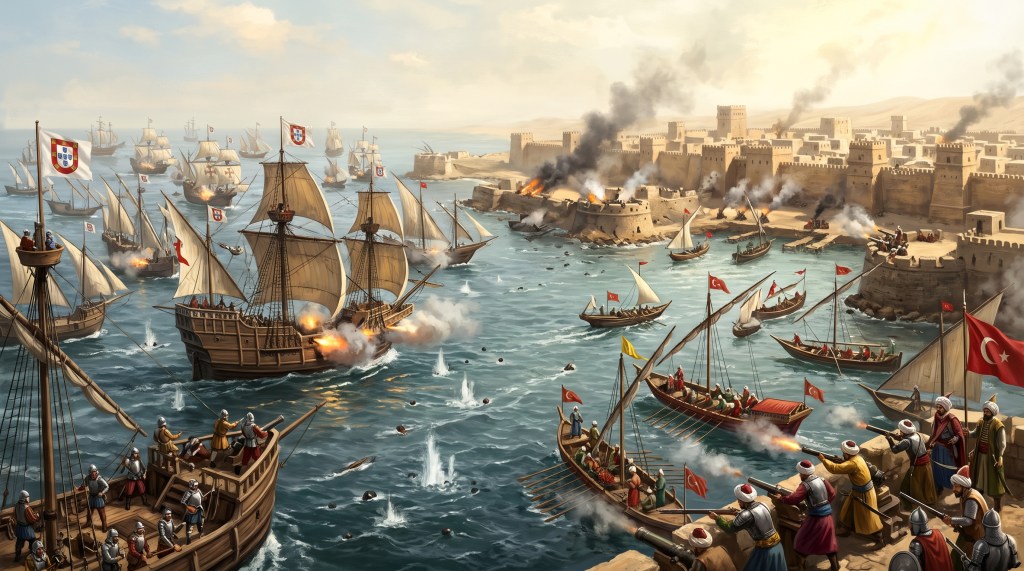
The 1517 confrontation at Jeddah was a comparatively brief military episode with consequences far larger than the scale of the fighting might suggest. In the spring of that year, a Portuguese armada commanded by Lopo Soares de Albergaria, governor of Portuguese India, penetrated deep into the Red Sea and appeared before Jeddah, the principal maritime gateway to Mecca. The expedition formed part of Portugal’s broader effort to redirect the commerce of the Indian Ocean toward the Cape route, attack the maritime infrastructure of its Muslim commercial rivals, and project royal power into the Red Sea. It arrived, however, at an extraordinary political moment: the Mamluk Sultanate, which had organized Jeddah’s defenses, had just been conquered by the Ottoman sultan Selim I. Thus the defenders who met Lopo Soares were products of a dying Mamluk military system but included Ottoman personnel, artillerymen, and the experienced commander Selman Reis, soon to become an important figure in Ottoman Red Sea strategy.
The engagement did not develop into a conventional storming of the city. Jeddah’s fortifications, coastal guns, reefs and narrow approaches, defensive vessels, difficult winds, and the Portuguese fleet’s deteriorating logistical position combined to make an assault unattractive or impossible. Muslim sources emphasize an aggressive sortie by Selman Reis and the effectiveness of the defenders’ artillery; Portuguese narratives place greater stress on the hazards of the harbor, unfavorable weather, the strength of the defenses, and the decision of Lopo Soares and his captains not to risk a landing. After lingering offshore, the Portuguese withdrew southward without taking Jeddah.
The episode is therefore best understood neither as a vast siege nor as a simple Portuguese defeat in battle, but as an aborted amphibious operation in which geography, fortification, artillery, naval technology, logistics, and political transition converged. Jeddah survived, the pilgrimage route to Mecca remained secure, and the Ottomans inherited both the Mamluk defensive establishment and the strategic problem that had created it. The confrontation helped transform the Red Sea into one of the principal maritime frontiers between Portuguese and Ottoman power during the sixteenth century.
The Road to Jeddah
The struggle over Jeddah began long before Portuguese sails appeared off its harbor in 1517. Vasco da Gama’s voyage around the Cape of Good Hope in 1497–1499 opened a direct oceanic route between Portugal and India, and within a decade the Estado da Índia had established fortified positions and naval patrols across parts of the western Indian Ocean. Portuguese policy was never reducible to commerce alone. Crown policy combined commercial ambition, armed coercion, strategic control of maritime chokepoints, and a powerful crusading conception of conflict with Muslim states. Under King Manuel I and governors such as Afonso de Albuquerque, Portuguese strategists considered the Red Sea and Persian Gulf the two principal western exits of the Indian Ocean trading system. Control, interdiction, or intimidation at these gateways could undermine established commercial routes through Egypt and the Levant while strengthening the Cape route.
The Mamluk Sultanate of Egypt had strong reasons to resist. Customs revenues from the Red Sea and eastern Mediterranean trade mattered to Cairo, while the sultanate also claimed political guardianship over the Hijaz and the holy cities of Mecca and Medina. Yet the Mamluks possessed relatively weak indigenous naval infrastructure for Indian Ocean warfare. They therefore relied heavily on imported timber, weapons, shipbuilding expertise, sailors, and especially Ottoman military specialists. Sultan Bayezid II supplied assistance, and a mixed Mamluk-Ottoman force under Amir Husayn al-Kurdi entered the Indian Ocean. It defeated a Portuguese squadron at Chaul in 1508 but suffered a decisive reverse at Diu in February 1509.
Jeddah became a central component of the Mamluk response. As the principal port serving Mecca, it was both an economic entrepôt and an extraordinarily sensitive strategic site. Husayn al-Kurdi was charged with strengthening the city. Arabic and later historical accounts describe the construction or major reinforcement of its walls, towers, ditch, and artillery positions during the first decade of the sixteenth century. The precise chronology varies in the sources, but the essential point is clear: by 1517 Jeddah had been deliberately transformed into a fortified harbor designed with the Portuguese threat in mind.
The Portuguese had already tested the Red Sea before Lopo Soares. Afonso de Albuquerque entered it in 1513 but failed to achieve his larger objectives against Jeddah and the Mamluk naval base at Suez. Portuguese difficulties were structural. Ships optimized for long ocean passages had to operate in a narrow sea filled with reefs, unfamiliar shoals, difficult winds, extreme heat, limited sources of fresh water, and coastlines where pilots possessed invaluable local knowledge. The Red Sea was not simply another stretch of the Indian Ocean; it was an operating environment capable of neutralizing important Portuguese advantages.
When Lopo Soares succeeded Albuquerque as governor, he inherited the ambition to break into this strategic space. His 1517 armada was large by the standards of Portuguese Asian warfare. Contemporary and later reconstructions differ over its exact composition and manpower. Figures commonly range from approximately thirty-six to more than forty vessels, including perhaps fifteen large naus alongside caravels, galleys and smaller craft; estimates of personnel vary even more widely. Sanjay Subrahmanyam, drawing on Portuguese material, describes an expedition carrying roughly 1,900 Portuguese, about 600 Malabaris, and perhaps 600–1,000 mariners, illustrating why simple totals such as “5,400 men” should be treated cautiously: sources counted soldiers, sailors, auxiliaries, and ship crews in inconsistent ways.
Its strategic aims were likewise broader than merely capturing one city. The armada was meant to operate against hostile naval forces in and around the Red Sea, pressure Aden and other ports, destroy or neutralize Mamluk maritime power, and demonstrate that Portuguese naval forces could penetrate the sea route on which Egypt and the Hijaz depended. A recent study of Red Sea warfare summarizes the expedition’s purpose as controlling the southern Red Sea, dealing with Aden, suppressing Mamluk power, and obstructing Muslim shipping. That interpretation accords with the larger Manueline strategy of channeling Indian Ocean commerce away from the Red Sea and toward Portuguese-controlled routes.
There is, however, an important distinction between threatening the Hijaz and proving an intention to attack Mecca itself. Later popular retellings sometimes describe the expedition as an attempt to “invade the Kaaba.” The surviving scholarly evidence supports a serious Portuguese threat to Jeddah—the maritime gate of Mecca—and wider Portuguese crusading aspirations against Islamic power, but it does not justify treating a Portuguese march on the Kaaba as the established immediate operational objective of Lopo Soares’s 1517 expedition. The defensible historical formulation is narrower and more consequential: seizure or destruction of Jeddah would have endangered the maritime access route to Islam’s holiest city and produced an enormous political and religious shock.
An Empire Changes Hands
The drama of 1517 was intensified by events far from Jeddah. While the Portuguese were preparing their expedition, the Ottoman Empire under Selim I was destroying the political order that had governed Egypt and the Hijaz for centuries. The Mamluks were defeated at Marj Dabiq in August 1516; Cairo fell after further fighting early in 1517. The Mamluk Sultanate ceased to exist as an independent imperial power just as the Portuguese armada was sailing toward one of its most strategically important ports.
This creates a problem in labeling the belligerents. The defense of Jeddah had been created under Mamluk authority, Husayn al-Kurdi was a Mamluk official, and many of the men and ships present belonged to the old Mamluk establishment. Yet Ottoman soldiers and technicians had long been embedded in that system, while Ottoman sovereignty was now replacing Mamluk sovereignty in Egypt and the Hijaz. The battle therefore occurred at the precise hinge between the Portuguese-Mamluk and Portuguese-Ottoman phases of the Indian Ocean struggle. Calling it an “Ottoman–Mamluk victory” is convenient, but the phrase should be understood as describing a transitional coalition rather than two fully functioning allied states conducting a coordinated campaign.
Selman Reis embodied this overlap. Originally associated with the Mediterranean corsair and Ottoman maritime world, he entered Mamluk service and became deeply involved in Red Sea defense. A Turkish biographical study drawing on Topkapı Palace archival documents reports that Selman was preparing to leave Jeddah for Egypt after being summoned by Selim I when news arrived that a Portuguese fleet was approaching. At the request of the inhabitants he remained and took part in the defense. His later report to the Ottoman government became one of the most valuable pieces of evidence for the confrontation.
This institutional continuity mattered. The Ottomans did not have to invent Red Sea strategy from nothing in 1517. They inherited the forts, ships, artillery, local alliances, personnel, strategic knowledge and anxieties of the Mamluk system. The same Portuguese threat that had forced Cairo to fortify Jeddah now helped persuade Istanbul that control of Egypt also entailed responsibility for the Red Sea and the holy cities. Modern scholarship therefore treats the Ottoman conquest of Egypt and the arrival of Portuguese power as interconnected developments in the formation of an Ottoman Indian Ocean policy.
Lopo Soares, meanwhile, sailed from Goa and reached Aden in March 1517. Subrahmanyam gives 14 March for the arrival before Aden and notes a striking irony: the Portuguese were initially welcomed and supplied because Aden’s authorities feared the “Rumis”—Ottoman or Ottoman-associated forces—and were maneuvering amid the collapse of Mamluk regional authority. Instead of exploiting this opening to establish a Portuguese relationship with Aden, Lopo Soares continued northward with pilots who could guide the fleet through the Red Sea.
The episode illustrates how misleading a simple “Christian versus Muslim” framework can be. Local Arab rulers, Mamluk officers, Ottoman soldiers, Gujarati interests, Portuguese commanders, Malabari auxiliaries, and merchants all pursued overlapping but distinct interests. Portuguese expansion was certainly framed in religious terms, and the defense of the holy cities rapidly acquired powerful Islamic symbolism, but sixteenth-century strategy remained full of opportunistic alliances and local antagonisms that crossed confessional boundaries. Aden’s behavior in March 1517 is one of the clearest examples.
The Encounter off Jeddah
The commonly given date for the Portuguese appearance off Jeddah is Easter Sunday, 12 April 1517, according to the Julian calendar then used by the Portuguese. Calendar conventions help explain some apparent confusion: 12 April 1517 was indeed Easter Sunday in the contemporary English/Julian ecclesiastical reckoning, whereas converting sixteenth-century dates retrospectively into other systems can generate different weekdays or dates.
The Ottoman documentary tradition introduces an additional chronological complication. The TDV İslâm Ansiklopedisi, citing Topkapı documents, states that Selman Reis learned of the approaching Portuguese fleet on 21 Rabīʿ al-Awwal 923 and subsequently reported that a Portuguese force of thirty barças and galleys besieged Jeddah on 26 Rabīʿ al-Awwal, rendered there as 18 April 1517. Rather than forcing the evidence into a single exact moment, the safest reconstruction is that the Portuguese arrived and began operations in mid-April, with different sources marking the first sighting, anchoring, engagement, or formal attack differently.
This is more than antiquarian pedantry. It warns against treating the “Siege of Jeddah” as a single, neatly bounded battle fought during a few hours on 12 April. The sources suggest an encounter extending over days, involving anchoring, reconnaissance, exchanges of fire, councils of war, weather delays, and eventual withdrawal. Portuguese narratives and Islamic reports emphasize different moments because they were written for different audiences and purposes.
The geography of Jeddah favored the defense. The offshore reef system created narrow and hazardous channels. Large naus, whose height and heavy broadside weaponry could be formidable in open water, could not maneuver with complete freedom in the approaches. To reach the city, the Portuguese had to negotiate passages already covered by shore batteries and defensive craft. The physical environment therefore fused with the fortification system: walls alone did not defend Jeddah; reefs, shoals and channel geometry formed part of the defensive architecture. This interaction between landscape and weapons is one reason military historian John F. Guilmartin chose “Jiddah, 1517” as an opening case study in Gunpowder and Galleys.
The defenders possessed galleys and smaller oared vessels, types much better suited than large sailing ships to confined waters and short tactical movements independent of the wind. Selman Reis’s own report and later Islamic accounts describe him attacking the Portuguese with several craft and using artillery against them. According to the Turkish biographical synthesis, he claimed to have sunk or destroyed two or three Portuguese vessels by cannon fire. During the action an accident damaged one of his own vessels; an account preserved by a Hadrami chronicler attributes the mishap to a gunner who supposedly tampered with the powder, after which the gunner was executed. The allegation of sabotage cannot be independently verified and should be treated as part of the narrative tradition rather than as certain fact.
The Portuguese sources, by contrast, do not present the affair as a catastrophic fleet defeat. They emphasize the formidable defenses and the imprudence of forcing the harbor. Subrahmanyam’s reconstruction states that once the captains had examined Jeddah’s position, they judged it strongly defended and abandoned the attempt. This reading is important because it shifts the explanation from a single victorious naval charge to a broader operational failure: the defenders had made the harbor sufficiently dangerous that the Portuguese command would not commit to a landing.
Weather reinforced the problem. Accounts describe storms or adverse winds, damage to ships, and shortages of water. The Portuguese were operating hundreds of miles inside a hostile or uncertain sea, far from Goa and without a secure Red Sea base. Every day spent waiting worsened the logistical equation. Fresh water was especially critical. A fleet containing thousands of men could not remain indefinitely off a fortified coast while hoping for favorable conditions. Recent scholarship on the episode consequently treats environmental and logistical constraints alongside artillery as central causes of Portuguese failure.
The defenders’ achievement was therefore fundamentally one of denial. They did not need to annihilate Lopo Soares’s armada. They needed to prevent it from entering the harbor securely, suppressing the batteries, landing troops, and reducing the city before water, weather, damage and time forced the invader to reconsider. Jeddah’s defense succeeded precisely because it imposed costs and uncertainties more quickly than the Portuguese could create a favorable tactical situation.
After several days offshore, the Portuguese abandoned the operation and turned south. They later operated around Kamaran and the African side of the Red Sea, including Zeila, but the expedition’s principal strategic ambitions had failed. Subrahmanyam describes Lopo Soares’s entire Red Sea venture as yielding essentially no lasting result; the fleet eventually passed through further storms, reached Hormuz late in the year, and returned to Cochin in December 1517.
Why the Portuguese Failed
The failure at Jeddah resulted from several mutually reinforcing factors rather than a single decisive cause.
The first was prepared fortification. The attack was not a surprise directed against an open commercial town. For roughly a decade the Mamluk authorities had expected Portuguese incursions and had invested in walls, towers, batteries and harbor defenses. A recent scholarly treatment explicitly notes that even Portuguese accounts acknowledged the effectiveness of the artillery positioned in Jeddah’s defenses.
The second was the tactical mismatch between ocean-going sailing ships and confined littoral waters. Portuguese naus derived much of their fighting power from heavy construction, sailing endurance, elevated fighting positions and artillery. Those qualities made them excellent instruments of transoceanic empire, but they did not automatically confer superiority inside reef-protected roadsteads where oared craft and fixed batteries could exploit restricted maneuver space. Guilmartin’s treatment of Jeddah was influential precisely because the encounter challenges technologically deterministic narratives in which European sailing ships inevitably defeated Mediterranean-style galleys.
The third was local knowledge. The Portuguese required pilots to navigate the Red Sea and had obtained assistance at Aden. The defenders, by contrast, operated within waters they knew. In premodern naval warfare, familiarity with reefs, channels, currents, anchorages and seasonal winds could be as important as the nominal number of ships. The harbor itself effectively multiplied the defensive value of Jeddah’s artillery and smaller vessels.
The fourth was logistics. Portuguese naval success in the Indian Ocean rested on a network of bases—from Goa and Cochin to Hormuz and Malacca—that allowed ships to refit, replenish and obtain intelligence. Inside the Red Sea, Lopo Soares possessed no equivalent secure base. Aden’s temporary hospitality could not substitute for a permanent logistical system, and once relations deteriorated the expedition became still more isolated. Water shortages, storm damage and the health of crews therefore had strategic consequences.
The fifth was command judgment. Lopo Soares chose not to gamble the expedition on a frontal assault. Whether this decision is interpreted as prudent or timid depends partly on the source tradition, but militarily it made sense. Even if Portuguese troops had forced a landing, they would have had to capture a fortified city while their ships remained exposed in difficult waters and while their supply situation worsened. A failed landing could have converted an inconclusive expedition into disaster.
Finally, Jeddah reveals the limits of numerical comparison. Modern summaries frequently place thirty-six to forty-three Portuguese vessels against nineteen defending ships and give several thousand men to each side. Such figures create the impression that the outcome ought to follow from arithmetic. Early modern naval strength, however, depended on ship type, draft, artillery placement, wind, rowing capability, available water, harbor geometry and the ability to put troops ashore. A large fleet unable to deploy its advantages could be strategically weaker than a smaller force fighting under fixed batteries in home waters.
For that reason, describing the event simply as a “naval battle” is incomplete. It was closer to a failed joint naval-amphibious operation: the Portuguese fleet reached the objective but could not create the conditions necessary for an assault. The defenders won because they denied those conditions.
The Aftermath and the Ottoman Red Sea Frontier
The immediate political significance of Jeddah’s survival was immense. A Portuguese occupation of the port would have placed a hostile European naval power astride one of the principal maritime routes used by pilgrims and merchants traveling toward Mecca. Its defense therefore acquired significance well beyond the military value of the town itself. Under Ottoman rule, protecting the Hijaz and the two holy cities became an increasingly important component of imperial legitimacy.
Selman Reis soon became a crucial advocate of a more vigorous Ottoman maritime policy. In a famous report submitted in 1525, he warned Ottoman authorities about Portuguese positions and capabilities throughout the Indian Ocean and argued for rebuilding and properly manning the Red Sea fleet. According to the surviving account, the Jeddah arsenal then contained six large bastarda-type galleys, eight galleys, three smaller vessels and hundreds of artillery pieces, although manpower deficiencies limited their usefulness. His argument was strategic: Portuguese restraint could not be assumed to last, and the Red Sea fleet itself deterred deeper enemy penetration toward Egypt and the holy cities.
The Ottoman response over the following decades was not a simple march toward maritime supremacy. Ottoman resources were divided among wars in Europe, the Mediterranean, Iran and the Indian Ocean. Control of Yemen remained difficult, while Portuguese strength around Hormuz, India and East Africa remained formidable. Yet Jeddah emerged as a permanent Ottoman naval and administrative center, and the security of the Red Sea became intertwined with Ottoman responsibility for pilgrimage, commerce and imperial prestige.
Historians now place the confrontation within a much larger Portuguese-Ottoman rivalry extending from the Mediterranean to Southeast Asia. Giancarlo Casale has characterized the sixteenth-century conflict as part of an Ottoman “age of exploration,” in which Istanbul gradually developed intelligence networks, alliances and military projects across the Indian Ocean in response to Portuguese expansion. The 1517 defense of Jeddah predates the mature form of that policy, but it helped define the strategic problem the Ottomans inherited.
Recent scholarship has also emphasized that the Red Sea subsequently developed as a carefully regulated maritime frontier. One study describes the century after 1517 as an initial phase of relative closure to European shipping, shaped directly by the Portuguese threat. Ottoman sovereignty was never absolute in the modern sense, but protection of the northern Red Sea and the Hijaz became one of the defining principles of imperial maritime policy.
The engagement also deserves attention because it complicates traditional narratives of European naval ascendancy. Portugal had achieved extraordinary victories at sea. At Diu in 1509 its fleet had shattered a major coalition and strengthened Portuguese influence across the western Indian Ocean. Yet only eight years later a large Portuguese armada could reach Jeddah and still fail to translate oceanic mobility into territorial conquest. Maritime empire depended on much more than possessing powerful ships. It required ports, water, intelligence, pilots, favorable geography, political partners and a workable amphibious strategy.
The affair likewise demonstrates that the transition from Mamluk to Ottoman rule was less abrupt at sea than dynastic chronologies imply. Jeddah’s walls were Mamluk; many defenders belonged to the Mamluk establishment; Ottoman specialists had helped sustain that establishment before 1517; Selman Reis had served within it; and the victorious defensive system passed almost immediately into Ottoman hands. The Ottomans inherited not simply territory but an unfinished strategic war.
The principal specialist monograph on the episode, Jean-Louis Bacqué-Grammont and Anne Kroell’s Mamlouks, Ottomans et Portugais en mer Rouge: L’affaire de Djedda en 1517, is particularly valuable because it juxtaposes European and Islamic documentation, including Selman Reis’s April reports and previously unpublished European letters. Contemporary scholarly reviewers have nevertheless warned that some aspects of its wider Mamluk background and Arabic-source coverage require correction or supplementation. That historiographical caution is useful: the battle survives through sources written in Portuguese, Ottoman Turkish, Arabic and European languages, and no single narrative preserves an uncontested version of events.
Several claims frequently repeated in popular accounts should consequently be qualified. The Portuguese armada was certainly large, but exact totals of ships and personnel remain uncertain. Selman Reis may well have damaged or destroyed Portuguese vessels, but the number cannot be treated as perfectly secure. The engagement began around Easter and unfolded over subsequent days, making a single “battle date” somewhat artificial. Most importantly, the Portuguese threat to Jeddah and therefore to access to Mecca was real; a specifically documented plan by Lopo Soares in 1517 to capture the Kaaba is another matter and should not be asserted without stronger evidence.
Thematic Epilogue: A Harbor at the Edge of Two Worlds
The deepest significance of Jeddah in 1517 lies in the convergence of worlds at its harbor.
One was the world of the Portuguese oceanic empire: mobile, heavily armed, ambitious, and sustained by a chain of bases stretching around Africa and across the Indian Ocean. Its ships embodied a new capacity to project violence over enormous distances. They had rounded continents, captured ports, imposed cartazes on merchants, and altered the political economy of maritime Asia. From Lisbon’s perspective, the Red Sea was one more strategic artery to be penetrated and controlled.
Another was the older but rapidly transforming Islamic maritime world linking Egypt, Arabia, East Africa, Gujarat, Yemen and Southeast Asia. Its networks did not vanish when Portuguese caravels appeared. Merchants rerouted cargoes, rulers formed coalitions, artillerymen crossed imperial borders, and Mediterranean naval techniques were adapted to the Red Sea. Jeddah’s defenses represented this adaptive response: Mamluk walls, Ottoman expertise, local pilots and sailors, fixed cannon and oared craft combined to deny the Portuguese their objective.
A third world was coming into existence at precisely the same moment: the Ottoman imperial order of the Arab lands. When Lopo Soares sailed toward Jeddah, the old Mamluk empire was collapsing. When he sailed away, the Ottoman sultan was becoming the paramount imperial authority of Egypt and, through arrangements with the Hijaz, protector of the holy cities. The cannon fire off Jeddah therefore belongs simultaneously to the last chapter of Mamluk history and the first chapter of sustained Ottoman-Portuguese confrontation in the Red Sea.
The outcome was determined not by a dramatic boarding action or a single heroic charge but by the accumulated force of preparation. Walls erected years earlier, artillery positioned ashore, vessels suited to shallow water, pilots’ knowledge, the difficulty of carrying fresh water, and the stubborn unpredictability of Red Sea winds together made conquest too costly. The battle is a reminder that early modern globalization did not abolish geography. It increased the number of powers that could reach distant places, but arrival and mastery were not the same thing.
Jeddah survived because its defenders turned a port into a strategic system. By doing so they preserved not only a city but the maritime threshold of Mecca at one of the most politically vulnerable moments in the history of the Hijaz. For Portugal, the episode exposed the limit of naval power without local bases and logistical depth. For the Ottomans, it revealed what their conquest of Egypt now required of them: safeguarding pilgrimage, commerce and imperial legitimacy in a maritime arena extending far beyond the Mediterranean.
In that sense, the Siege of Jeddah was both smaller and larger than its name implies. Smaller, because there was no prolonged encirclement, no major breach of the walls, and no bloody storming of the city. Larger, because the ships lying outside Jeddah in April 1517 represented competing visions of an emerging global order. One sought to bend Indian Ocean commerce toward an Atlantic empire; the other was beginning to bind the Mediterranean, Egypt, Arabia and the Indian Ocean into a new Ottoman strategic sphere. Between them stood a fortified harbor, reefs, batteries, galleys, and a city whose proximity to Mecca transformed an inconclusive naval operation into a moment of enduring historical consequence.



Leave a Reply