
Epigraph
لَّا تُدْرِكُهُ الْأَبْصَارُ وَهُوَ يُدْرِكُ الْأَبْصَارَ ۖ وَهُوَ اللَّطِيفُ الْخَبِيرُ
Eyes cannot reach Him, but He manifests himself before the eyes and He is the Imperceptible and the All Aware. (Al Quran 6:103)
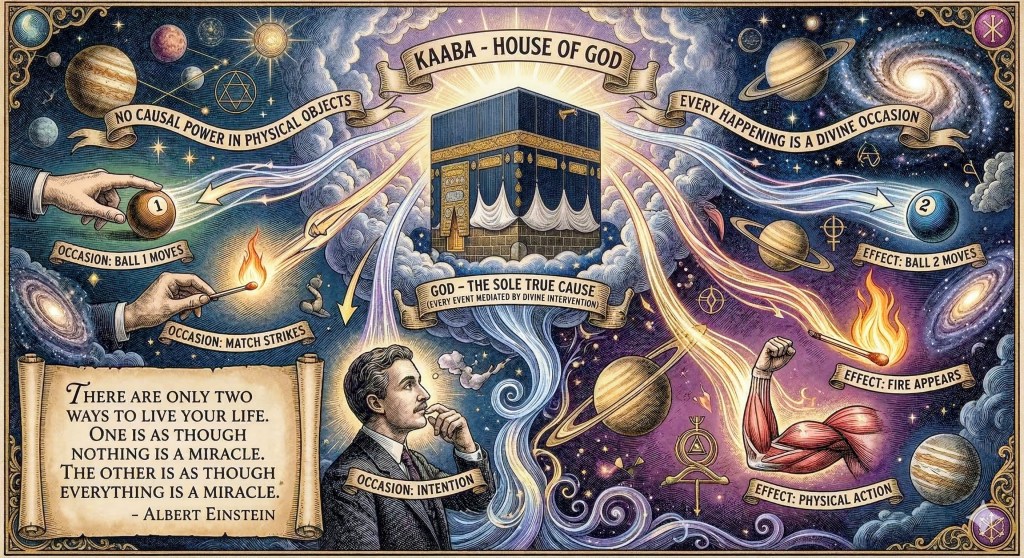
Al-Ghazālī’s Occasionalism, the Divine Names, and the Inshallah Universe
Presented by ChatGPT for Zia H Shah MD
Abstract
This essay defends a maximal, Qur’an-centered version of Abū Ḥāmid al-Ghazālī’s occasionalism, developed through the contemporary synthesis of Zia H. Shah, MD. Its central proposition is simple but metaphysically radical: no created thing possesses an independent, underived power by which it can guarantee its effects. Allah alone is the necessary and continuously efficacious ground of every event. What science calls a law of nature is an extraordinarily stable pattern in divine action—a sunnah or customary ordering—not an autonomous decree imposed on God and not a self-executing mechanism capable of sustaining itself. Fire is ordinarily followed by burning; genes by phenotypes; neural events by reports of experience; mass-energy by spacetime curvature; a prepared quantum state by a distribution of outcomes. These conjunctions are dependable enough for science, engineering, medicine, and moral responsibility. They are not metaphysically self-sufficient.
The argument begins from the Qur’an’s own grammar of God. The Divine Names do not portray an absentee creator who starts a cosmic machine and retires. They portray the Living Sustainer, Knower of the unseen and the witnessed, Creator, Fashioner, Provider, Guide, Responder, Watcher, Reckoner, Giver of life, Giver of death, Restorer, Judge, Forgiver, and Lord of every moment. The famous devotional enumeration of ninety-nine Names—while transmitted in variant lists and not itself a single uniform Qur’anic catalogue—forms a cumulative language of continuous providence. The Qur’an declares that Allah knows the fall of a leaf, the concealed word, the inward whisper, and every event in heaven and earth; that He holds the heavens and earth lest they cease; and that all who exist ask of Him while He is perpetually upon a work. Presence here is not bodily location. “Nanosecond by nanosecond” is therefore a vivid creaturely metaphor for unbroken dependence, not a claim that the Eternal is measured by atomic clocks.
The essay next shows why modern science does not displace this worldview. Physics describes quantitative order; occasionalism addresses the source and ontological efficacy of that order. Quantum theory makes the classical picture of local, separable, mechanically sufficient matter untenable, yet no quantum experiment proves occasionalism. Bell tests rule out broad classes of local hidden-variable explanations under specified assumptions; they do not prove God, permit controllable faster-than-light signalling, or settle the interpretation of the quantum state. Copenhagen-type, relational, Bohmian, Everettian, spontaneous-collapse, and information-centered interpretations remain contested. The stronger occasionalist case therefore does not install God inside an indeterministic “gap.” It says that stochastic collapse, deterministic pilot waves, branching universal evolution, laboratory apparatus, observers, and the laws relating them would all equally require Allah’s sustaining concurrence.
Consciousness, dreams, revelation, biological evolution, fine-tuning, and cosmic scale are then incorporated with the same discipline. Consciousness research has identified rich neural correlates but has no agreed complete explanation of subjectivity; Shah’s brain-as-transceiver proposal is presented as a metaphysical model, not as established neuroscience. Dreams offer a profound analogy for divinely originated meaning without making every dream revelation. The Qur’an affirms messengers beyond those it names; the widely repeated number 124,000 is treated honestly as a traditional figure from disputed reports, not as a Qur’anic count. Evolutionary mechanisms and common ancestry are accepted as science, while “guided evolution” names their theistic metaphysical interpretation rather than a replacement biology. The estimate of roughly 8.7 million living eukaryotic species, the extinction of more than 99 percent of all species that ever lived, and a model-based estimate of about two trillion galaxies display scale and historical depth; they do not constitute direct measurements of divine intention. Extraterrestrial intelligence remains unconfirmed, but if minds exist elsewhere, Qur’anic omniscience encompasses them without conceptual strain.
Finally, the essay rejects the claim that continuous divine action abolishes freedom. It defends a constrained libertarian model: Allah creates and sustains the agent, the field of alternatives, the causal powers, and the realized event; the person genuinely authors an intention for reasons and is accountable for the chosen orientation. Ontological dependence is not coercion. Foreknowledge is not compulsion. Randomness is not freedom, but neither does divine conservation reduce deliberation to theater. The resulting worldview is unapologetically theistic, scientifically literate, and morally serious: an Inshallah universe in which every regularity is a promise, every power a trust, every consciousness known, every life sustained, and every choice made before the ever-present Lord.
A Note on Method, Sources, and the Meaning of “Unapologetic”
An unapologetic defense need not be an incautious one. Confessional certainty and evidential accuracy are different virtues, and a durable Islamic synthesis needs both. This essay therefore labels its assertions by their actual status:
Revelation: what the Qur’an and sound prophetic reports teach within Islam.
Metaphysics: what follows, or is argued to follow, from dependence, causation, necessity, and divine attributes.
Empirical science: what experiments and observations support, always provisionally and at a stated level of confidence.
Theological inference: how empirical findings may be interpreted within the Qur’anic worldview without pretending that a microscope, collider, or telescope has measured God.
The distinction is protective, not defensive. It prevents the believer from staking tawḥīd on a temporary scientific puzzle. It also prevents the naturalist from quietly turning a successful equation into an unargued ontology. Science may discover the pattern; it does not thereby establish that the pattern is self-existent. Occasionalism asks the prior and deeper question: what makes there be a world, powers, regularities, possibilities, observers, and outcomes at all?
The core contemporary source is Shah’s evolving collection on occasionalism, read alongside his thematic collections on dreams, quantum physics, free will, fine-tuning, guided evolution, and consciousness. The most concentrated statements are his Comprehensive Synthesis, Ontological Architecture, and Inshallah Universe and the Boundaries of the Will. These are theological syntheses, not peer-reviewed physics papers; the scientific claims below are therefore checked against primary studies and authoritative reviews.
Part I — The Qur’anic God Against the Absent God of Deism
1. Creator Is Not a Past-Tense Office
The target of this critique is not every thinker ever called a deist. Historical deism was diverse. The target is the recognizable non-interventionist picture: a supreme intelligence establishes matter, initial conditions, and laws, then leaves the system to run on its own. Philosophers have aptly compared that picture to an “absentee landlord.” By contrast, standard philosophical theism includes a God who remains actively involved in the world; the Qur’an’s account is more emphatic still (Stanford Encyclopedia of Philosophy on God and ultimate reality; SEP on divine providence).
The Qur’an does not confine creation to an event at the first boundary of cosmic time. Allah creates, sustains, knows, answers, guides, gives life, causes death, judges, forgives, and brings forth anew. “Creator” therefore names an abiding relation of the contingent world to the Necessary, not merely a remote historical achievement. A universe that survived one instant independently of Him would, for that instant, be a rival in self-sufficiency. That is precisely what tawḥīd denies.
QUR’AN 39:62
﴿ ٱللَّهُ خَـٰلِقُ كُلِّ شَىْءٍ ۖ وَهُوَ عَلَىٰ كُلِّ شَىْءٍ وَكِيلٌ ﴾ ٦٢
39:62 — Allah is Creator of all things, and He is Guardian over all things.
Arabic: Uthmānī text • English: Mohammed Marmaduke Pickthall (1930)
QUR’AN 36:82
﴿ إِنَّمَآ أَمْرُهُۥٓ إِذَآ أَرَادَ شَيْـًٔا أَن يَقُولَ لَهُۥ كُن فَيَكُونُ ﴾ ٨٢
36:82 — But His command, when He intendeth a thing, is only that He saith unto it: Be! and it is.
Arabic: Uthmānī text • English: Mohammed Marmaduke Pickthall (1930)
The first verse is universal in scope: Allah is Creator of all things. The second joins will, command, and realization without depicting an intermediary realm of autonomous powers. Neither verse requires the denial of observable processes. It requires their demotion from ultimate to dependent causes.
2. The Divine Names as a Grammar of Present-Tense Providence
The Qur’an commands believers to call upon Allah by His most beautiful Names. This is more than devotional ornament. A name such as al-ʿAlīm makes a truth-claim about reality; al-Qayyūm identifies the world’s mode of dependence; al-Razzāq identifies the source of provision; al-Hādī identifies the ultimate ground of guidance; al-Ḥakam and al-ʿAdl establish moral government.
QUR’AN 7:180
﴿ وَلِلَّهِ ٱلْأَسْمَآءُ ٱلْحُسْنَىٰ فَٱدْعُوهُ بِهَا ۖ وَذَرُوا۟ ٱلَّذِينَ يُلْحِدُونَ فِىٓ أَسْمَـٰٓئِهِۦ ۚ سَيُجْزَوْنَ مَا كَانُوا۟ يَعْمَلُونَ ﴾ ١٨٠
7:180 — Allah’s are the fairest names. Invoke Him by them. And leave the company of those who blaspheme His names. They will be requited what they do.
Arabic: Uthmānī text • English: Mohammed Marmaduke Pickthall (1930)
QUR’AN 59:22–24
﴿ هُوَ ٱللَّهُ ٱلَّذِى لَآ إِلَـٰهَ إِلَّا هُوَ ۖ عَـٰلِمُ ٱلْغَيْبِ وَٱلشَّهَـٰدَةِ ۖ هُوَ ٱلرَّحْمَـٰنُ ٱلرَّحِيمُ ﴾ ٢٢
59:22 — He is Allah, than Whom there is no other Allah, the Knower of the Invisible and the Visible. He is the Beneficent, Merciful.
﴿ هُوَ ٱللَّهُ ٱلَّذِى لَآ إِلَـٰهَ إِلَّا هُوَ ٱلْمَلِكُ ٱلْقُدُّوسُ ٱلسَّلَـٰمُ ٱلْمُؤْمِنُ ٱلْمُهَيْمِنُ ٱلْعَزِيزُ ٱلْجَبَّارُ ٱلْمُتَكَبِّرُ ۚ سُبْحَـٰنَ ٱللَّهِ عَمَّا يُشْرِكُونَ ﴾ ٢٣
59:23 — He is Allah, than Whom there is no other Allah, the Sovereign Lord, the Holy One, Peace, the Keeper of Faith, the Guardian, the Majestic, the Compeller, the Superb. Glorified be Allah from all that they ascribe as partner (unto Him).
﴿ هُوَ ٱللَّهُ ٱلْخَـٰلِقُ ٱلْبَارِئُ ٱلْمُصَوِّرُ ۖ لَهُ ٱلْأَسْمَآءُ ٱلْحُسْنَىٰ ۚ يُسَبِّحُ لَهُۥ مَا فِى ٱلسَّمَـٰوَٰتِ وَٱلْأَرْضِ ۖ وَهُوَ ٱلْعَزِيزُ ٱلْحَكِيمُ ﴾ ٢٤
59:24 — He is Allah, the Creator, the Shaper out of naught, the Fashioner. His are the most beautiful names. All that is in the heavens and the earth glorifieth Him, and He is the Mighty, the Wise.
Arabic: Uthmānī text • English: Mohammed Marmaduke Pickthall (1930)
The authentic core report states that Allah has ninety-nine Names, “one hundred less one,” and promises Paradise to the one who aḥṣāhā—counts, preserves, comprehends, and lives by them (Sahih al-Bukhari 7392). The familiar full enumeration is transmitted in Jāmiʿ al-Tirmidhī 3507, where that extended version is graded weak in the cited edition and al-Tirmidhī himself notes the isnād problem surrounding enumerated lists. The appendix therefore calls it what it is: the widely circulated devotional enumeration, not an undisputed revealed table. This precision strengthens the argument. The Qur’an itself abundantly attests the decisive names and actions; the case for present providence does not depend on the authenticity of one list.
Read cumulatively, the Names make deism theologically incoherent. The Creator, Originator, Fashioner, Provider, Opener, Knower, Hearer, Seer, Watcher, Responder, Wise, Loving, Witness, Trustee, Strong, Sustainer, Giver of life, Giver of death, Restorer, Guide, Gatherer, Reckoner, Just, Forgiving, and Patient Lord is not described as possessing dormant titles. His names are eternally true and their created relations are presently manifested.
3. Al-Ḥayy and Al-Qayyūm: The Axis of Occasionalism
No Qur’anic passage condenses the occasionalist vision more powerfully than the Throne Verse. Allah’s life is underived, His sustaining is unceasing, His knowledge encompasses every temporal horizon, and the continuance of heaven and earth does not weary Him.
QUR’AN 2:255
﴿ ٱللَّهُ لَآ إِلَـٰهَ إِلَّا هُوَ ٱلْحَىُّ ٱلْقَيُّومُ ۚ لَا تَأْخُذُهُۥ سِنَةٌ وَلَا نَوْمٌ ۚ لَّهُۥ مَا فِى ٱلسَّمَـٰوَٰتِ وَمَا فِى ٱلْأَرْضِ ۗ مَن ذَا ٱلَّذِى يَشْفَعُ عِندَهُۥٓ إِلَّا بِإِذْنِهِۦ ۚ يَعْلَمُ مَا بَيْنَ أَيْدِيهِمْ وَمَا خَلْفَهُمْ ۖ وَلَا يُحِيطُونَ بِشَىْءٍ مِّنْ عِلْمِهِۦٓ إِلَّا بِمَا شَآءَ ۚ وَسِعَ كُرْسِيُّهُ ٱلسَّمَـٰوَٰتِ وَٱلْأَرْضَ ۖ وَلَا يَـُٔودُهُۥ حِفْظُهُمَا ۚ وَهُوَ ٱلْعَلِىُّ ٱلْعَظِيمُ ﴾ ٢٥٥
2:255 — Allah! There is no deity save Him, the Alive, the Eternal. Neither slumber nor sleep overtaketh Him. Unto Him belongeth whatsoever is in the heavens and whatsoever is in the earth. Who is he that intercedeth with Him save by His leave? He knoweth that which is in front of them and that which is behind them, while they encompass nothing of His knowledge save what He will. His throne includeth the heavens and the earth, and He is never weary of preserving them. He is the Sublime, the Tremendous.
Arabic: Uthmānī text • English: Mohammed Marmaduke Pickthall (1930)
Al-Qayyūm does not mean that Allah merely repaired the cosmos at its origin. It means that everything other than Him stands because He makes it stand. The classical doctrine of conservation is already more than deism: to conserve a contingent being is to give it existence now. Occasionalism draws the fuller conclusion. If the entity, its powers, the applicable regularity, the surrounding conditions, and the realized effect all remain contingent, divine concurrence is not an optional supplement. It is the actuality of the whole event.
The same principle appears in the Qur’an’s image of cosmic preservation:
QUR’AN 35:41
﴿ ۞ إِنَّ ٱللَّهَ يُمْسِكُ ٱلسَّمَـٰوَٰتِ وَٱلْأَرْضَ أَن تَزُولَا ۚ وَلَئِن زَالَتَآ إِنْ أَمْسَكَهُمَا مِنْ أَحَدٍ مِّنۢ بَعْدِهِۦٓ ۚ إِنَّهُۥ كَانَ حَلِيمًا غَفُورًا ﴾ ٤١
35:41 — Lo! Allah graspeth the heavens and the earth that they deviate not, and if they were to deviate there is not one that could grasp them after Him. Lo! He is ever Clement, Forgiving.
Arabic: Uthmānī text • English: Mohammed Marmaduke Pickthall (1930)
The verse should not be flattened into a primitive rival to gravitational theory. Gravitation answers how the observed motions are mathematically related. The verse answers why there is an ordered heaven-and-earth system whose structures and laws continue rather than lapse into nothing. The two explanations are not competitors unless one assumes—without scientific proof—that a physical description is ontologically self-sufficient.
4. Every Day He Is Upon a Work
QUR’AN 55:29
﴿ يَسْـَٔلُهُۥ مَن فِى ٱلسَّمَـٰوَٰتِ وَٱلْأَرْضِ ۚ كُلَّ يَوْمٍ هُوَ فِى شَأْنٍ ﴾ ٢٩
55:29 — All that are in the heavens and the earth entreat Him. Every day He exerciseth (universal) power.
Arabic: Uthmānī text • English: Mohammed Marmaduke Pickthall (1930)
This is the Qur’anic antithesis of divine retirement. Creatures ask because they are needy; Allah gives because He is rich beyond need. The phrase “every day” communicates perpetual manifestation: bringing forth and withholding, raising and lowering, healing and permitting trial, giving life and taking it, guiding, forgiving, answering, judging, and renewing. It does not reduce God to temporal sequence. Philosophical theology distinguishes a timeless God’s single eternal act from the many temporal effects of that act, and also includes views in which God is everlasting. On either account, unbroken involvement is coherent (SEP on eternity).
Thus “nanosecond by nanosecond” is a rhetorically apt but metaphysically analogical phrase. Nanoseconds belong to created spacetime. Allah is not a very fast object inside that spacetime. The intended claim is stronger: there is no interval, however physically described, in which creation is ontologically on its own.
5. The God Who Is With, Within Knowledge, and Never Contained
The Qur’an repeatedly couples transcendence with intimate knowledge. Allah is not spatially distributed through matter; His maʿiyyah, or being “with” creatures, is the presence of knowledge, power, governance, and sustaining action. The following passage moves from cosmic creation to the most private inward event without a break:
QUR’AN 57:1–6
﴿ سَبَّحَ لِلَّهِ مَا فِى ٱلسَّمَـٰوَٰتِ وَٱلْأَرْضِ ۖ وَهُوَ ٱلْعَزِيزُ ٱلْحَكِيمُ ﴾ ١
57:1 — All that is in the heavens and the earth glorifieth Allah; and He is the Mighty, the Wise.
﴿ لَهُۥ مُلْكُ ٱلسَّمَـٰوَٰتِ وَٱلْأَرْضِ ۖ يُحْىِۦ وَيُمِيتُ ۖ وَهُوَ عَلَىٰ كُلِّ شَىْءٍ قَدِيرٌ ﴾ ٢
57:2 — His is the Sovereignty of the heavens and the earth; He quickeneth and He giveth death; and He is Able to do all things.
﴿ هُوَ ٱلْأَوَّلُ وَٱلْـَٔاخِرُ وَٱلظَّـٰهِرُ وَٱلْبَاطِنُ ۖ وَهُوَ بِكُلِّ شَىْءٍ عَلِيمٌ ﴾ ٣
57:3 — He is the First and the Last, and the Outward and the Inward; and He is Knower of all things.
﴿ هُوَ ٱلَّذِى خَلَقَ ٱلسَّمَـٰوَٰتِ وَٱلْأَرْضَ فِى سِتَّةِ أَيَّامٍ ثُمَّ ٱسْتَوَىٰ عَلَى ٱلْعَرْشِ ۚ يَعْلَمُ مَا يَلِجُ فِى ٱلْأَرْضِ وَمَا يَخْرُجُ مِنْهَا وَمَا يَنزِلُ مِنَ ٱلسَّمَآءِ وَمَا يَعْرُجُ فِيهَا ۖ وَهُوَ مَعَكُمْ أَيْنَ مَا كُنتُمْ ۚ وَٱللَّهُ بِمَا تَعْمَلُونَ بَصِيرٌ ﴾ ٤
57:4 — He it is Who created the heavens and the earth in six Days; then He mounted the Throne. He knoweth all that entereth the earth and all that emergeth therefrom and all that cometh down from the sky and all that ascendeth therein; and He is with you wheresoever ye may be. And Allah is Seer of what ye do.
﴿ لَّهُۥ مُلْكُ ٱلسَّمَـٰوَٰتِ وَٱلْأَرْضِ ۚ وَإِلَى ٱللَّهِ تُرْجَعُ ٱلْأُمُورُ ﴾ ٥
57:5 — His is the Sovereignty of the heavens and the earth, and unto Allah (all) things are brought back.
﴿ يُولِجُ ٱلَّيْلَ فِى ٱلنَّهَارِ وَيُولِجُ ٱلنَّهَارَ فِى ٱلَّيْلِ ۚ وَهُوَ عَلِيمٌۢ بِذَاتِ ٱلصُّدُورِ ﴾ ٦
57:6 — He causeth the night to pass into the day, and He causeth the day to pass into the night, and He is knower of all that is in the breasts.
Arabic: Uthmānī text • English: Mohammed Marmaduke Pickthall (1930)
Nearness likewise cannot mean bodily distance. It means that no inward whisper is ontologically or epistemically sealed against the Creator.
QUR’AN 50:16
﴿ وَلَقَدْ خَلَقْنَا ٱلْإِنسَـٰنَ وَنَعْلَمُ مَا تُوَسْوِسُ بِهِۦ نَفْسُهُۥ ۖ وَنَحْنُ أَقْرَبُ إِلَيْهِ مِنْ حَبْلِ ٱلْوَرِيدِ ﴾ ١٦
50:16 — We verily created man and We know what his soul whispereth to him, and We are nearer to him than his jugular vein.
Arabic: Uthmānī text • English: Mohammed Marmaduke Pickthall (1930)
The leaf in an unobserved forest, the grain beneath soil, the genetic mutation that never reaches fixation, the photon absorbed without a human detector, and the thought never voiced are not “unknown data” awaiting divine discovery.
QUR’AN 6:59
﴿ ۞ وَعِندَهُۥ مَفَاتِحُ ٱلْغَيْبِ لَا يَعْلَمُهَآ إِلَّا هُوَ ۚ وَيَعْلَمُ مَا فِى ٱلْبَرِّ وَٱلْبَحْرِ ۚ وَمَا تَسْقُطُ مِن وَرَقَةٍ إِلَّا يَعْلَمُهَا وَلَا حَبَّةٍ فِى ظُلُمَـٰتِ ٱلْأَرْضِ وَلَا رَطْبٍ وَلَا يَابِسٍ إِلَّا فِى كِتَـٰبٍ مُّبِينٍ ﴾ ٥٩
6:59 — And with Him are the keys of the Invisible. None but He knoweth them. And He knoweth what is in the land and the sea. Not a leaf falleth but He knoweth it, not a grain amid the darkness of the earth, naught of wet or dry but (it is noted) in a clear record.
Arabic: Uthmānī text • English: Mohammed Marmaduke Pickthall (1930)
QUR’AN 10:61
﴿ وَمَا تَكُونُ فِى شَأْنٍ وَمَا تَتْلُوا۟ مِنْهُ مِن قُرْءَانٍ وَلَا تَعْمَلُونَ مِنْ عَمَلٍ إِلَّا كُنَّا عَلَيْكُمْ شُهُودًا إِذْ تُفِيضُونَ فِيهِ ۚ وَمَا يَعْزُبُ عَن رَّبِّكَ مِن مِّثْقَالِ ذَرَّةٍ فِى ٱلْأَرْضِ وَلَا فِى ٱلسَّمَآءِ وَلَآ أَصْغَرَ مِن ذَٰلِكَ وَلَآ أَكْبَرَ إِلَّا فِى كِتَـٰبٍ مُّبِينٍ ﴾ ٦١
10:61 — And thou (Muhammad) art not occupied with any business and thou recitest not a Lecture from this (Scripture), and ye (mankind) perform no act, but We are Witness of you when ye are engaged therein. And not an atom’s weight in the earth or in the sky escapeth your Lord, nor what is less than that or greater than that, but it is (written) in a clear Book.
Arabic: Uthmānī text • English: Mohammed Marmaduke Pickthall (1930)
QUR’AN 67:13–14
﴿ وَأَسِرُّوا۟ قَوْلَكُمْ أَوِ ٱجْهَرُوا۟ بِهِۦٓ ۖ إِنَّهُۥ عَلِيمٌۢ بِذَاتِ ٱلصُّدُورِ ﴾ ١٣
67:13 — And keep your opinion secret or proclaim it, lo! He is Knower of all that is in the breasts (of men).
﴿ أَلَا يَعْلَمُ مَنْ خَلَقَ وَهُوَ ٱللَّطِيفُ ٱلْخَبِيرُ ﴾ ١٤
67:14 — Should He not know what He created? And He is the Subtile, the Aware.
Arabic: Uthmānī text • English: Mohammed Marmaduke Pickthall (1930)
For a human mind, more than eight billion streams of consciousness would be an unimaginable computational burden. For Allah, number does not tax knowledge. The UN World Population Prospects 2024 placed the global population above eight billion; it changes continually, so “more than eight billion” is more honest than pretending to freeze an exact total. Qur’anic omniscience is not a scaled-up database. Allah knows each subject from within the very act by which the subject, its neural realization, its history, its possibilities, and its chosen intention exist.
Part II — Al-Ghazālī’s Causal Revolution
6. What the Seventeenth Discussion Actually Denies
In the seventeenth discussion of The Incoherence of the Philosophers, al-Ghazālī attacks the claim that the connection between what people call cause and effect is necessary in itself. The canonical example is fire and cotton. Observation gives conjunction: cotton placed in fire is ordinarily followed by blackening and disintegration. Observation does not display a metaphysical bond that compels fire, by its own independent essence, to create burning.
This distinction is frequently caricatured. Al-Ghazālī is not denying that cotton burns predictably, that combustion has analyzable chemistry, or that prudent people should keep flame away from cloth. He is denying a slide from regularly observed under specified conditions to possesses self-sufficient causal necessity. Modern philosophers of causation still debate regularity, counterfactual, interventionist, dispositional, mechanistic, and powers-based accounts because prediction alone does not settle what causation is (SEP on regularity theories; SEP on laws of nature).
Recent scholarship also warns against presenting one uncontested historical Ghazālī. The maximal occasionalist reading is traditional and textually powerful, but some interpreters argue that al-Ghazālī permits secondary causation so long as created powers are neither necessary nor independent (SEP on al-Ghazālī; SEP on Arabic and Islamic causation). This essay acknowledges that dispute and deliberately defends the stronger reading: created things are genuine conditions, signs, instruments, and stable loci of divine custom, but only Allah is an underived efficient cause.
7. From Conjunction to Custom: ʿĀdah and Sunnat Allah
If causal necessity is denied, why does the world not dissolve into chaos? Because Allah is not capricious. He is al-Ḥakīm, the Wise; al-Matīn, the Firm; al-Muhaymin, the Guardian; and al-Ṣabūr, the Patient. His customary governance is stable enough to be learned. The Qur’an itself speaks of an established divine way.
QUR’AN 35:43
﴿ ٱسْتِكْبَارًا فِى ٱلْأَرْضِ وَمَكْرَ ٱلسَّيِّئِ ۚ وَلَا يَحِيقُ ٱلْمَكْرُ ٱلسَّيِّئُ إِلَّا بِأَهْلِهِۦ ۚ فَهَلْ يَنظُرُونَ إِلَّا سُنَّتَ ٱلْأَوَّلِينَ ۚ فَلَن تَجِدَ لِسُنَّتِ ٱللَّهِ تَبْدِيلًا ۖ وَلَن تَجِدَ لِسُنَّتِ ٱللَّهِ تَحْوِيلًا ﴾ ٤٣
35:43 — (Shown in their) behaving arrogantly in the land and plotting evil; and the evil plot encloseth but the men who make it. Then, can they expect aught save the treatment of the folk of old? Thou wilt not find for Allah’s way of treatment any substitute, nor wilt thou find for Allah’s way of treatment aught of power to change.
Arabic: Uthmānī text • English: Mohammed Marmaduke Pickthall (1930)
The “law of nature” can therefore be affirmed at three levels:
Descriptive: a compact mathematical or qualitative statement of observed regularity.
Counterfactual: a dependable guide to what would occur under specified conditions.
Theological: a created sign and stable custom by which Allah orders the world.
Occasionalism rejects only a fourth, illicit level: ontological autonomy, the claim that the law exists or executes itself independently of Allah. An equation does not push a planet, select an outcome, copy DNA, or produce a conscious sensation. It represents relations. Calling the relation a “law” may conceal the deepest question: why is reality faithful to it?
8. Miracle, Regularity, and the Burning Fire
The Qur’anic fire that does not burn Abraham is a paradigmatic occasionalist sign. If fire possesses an intrinsic and inviolable power to burn, the event is impossible. If burning is Allah’s stable custom in the presence of fire and suitable fuel, the Creator may withhold the usual effect without contradicting logic.
QUR’AN 21:69
﴿ قُلْنَا يَـٰنَارُ كُونِى بَرْدًا وَسَلَـٰمًا عَلَىٰٓ إِبْرَٰهِيمَ ﴾ ٦٩
21:69 — We said: O fire, be coolness and peace for Abraham,
Arabic: Uthmānī text • English: Mohammed Marmaduke Pickthall (1930)
Miracle is therefore not a divine collision with an autonomous law. It is an exceptional act of the same Lord whose ordinary act is called law. Ordinary providence and miracle differ in frequency and signification, not in ultimate agent. The miracle is intelligible only against a background of dependable order: if fire never behaved regularly, its harmlessness would signify nothing.
9. The Human Action Verse: Neither Independence nor Puppetry
The Qur’an’s statement concerning the believers’ casting at Badr is the compressed grammar of concurrence: “you did not throw when you threw; Allah threw.” Human action is affirmed and denied in different respects.
QUR’AN 8:17
﴿ فَلَمْ تَقْتُلُوهُمْ وَلَـٰكِنَّ ٱللَّهَ قَتَلَهُمْ ۚ وَمَا رَمَيْتَ إِذْ رَمَيْتَ وَلَـٰكِنَّ ٱللَّهَ رَمَىٰ ۚ وَلِيُبْلِىَ ٱلْمُؤْمِنِينَ مِنْهُ بَلَآءً حَسَنًا ۚ إِنَّ ٱللَّهَ سَمِيعٌ عَلِيمٌ ﴾ ١٧
8:17 — Ye (Muslims) slew them not, but Allah slew them. And thou (Muhammad) threwest not when thou didst throw, but Allah threw, that He might test the believers by a fair test from Him. Lo! Allah is Hearer, Knower.
Arabic: Uthmānī text • English: Mohammed Marmaduke Pickthall (1930)
The person truly forms the intention, performs the embodied action, and owns its moral orientation. The act’s existence, powers, opportunity, causal reach, and realized effect belong to Allah. This is not contradiction but layered attribution. A novelist’s character causes events within the story while every word depends upon the author—yet the analogy is incomplete, because real human agents possess consciousness and morally significant responsiveness that fictional characters lack. A musician truly plays while every sound depends on the instrument and air—yet Allah does not merely supply passive conditions. The most accurate formula is asymmetric concurrence: creaturely agency is real but borrowed; divine agency is universal and underived.
Part III — The Ninety-Nine Names as an Ontology of Participation
10. Not a List of Dormant Honorifics
Shah’s most fertile contemporary insight is to read the Divine Names as an “ontological architecture.” The Names are not ninety-nine decorations around a distant essence. They articulate the modes in which the One Lord relates to a many-layered creation. Grouped thematically, the familiar devotional enumeration becomes a map of occasionalist participation.
10.1 Being, unity, and transcendence
The Living, the Self-Subsisting Sustainer, the One, the Self-Sufficient, the First, the Last, the Manifest, the Hidden, the Truth, the Everlasting, and the Inheritor establish that Allah alone is not received from another. Creation is not a fragment of Him, but neither is it self-grounding. Everything contingent points beyond itself at every instant.
10.2 Origination, form, life, death, and return
The Creator, Originator, Fashioner, Beginner, Restorer, Giver of Life, Giver of Death, Resurrector, and Gatherer describe a world whose entire arc—from possibility to embodiment, from organism to death, from history to resurrection—is embraced by divine action. Biological mechanisms answer the proximate sequence; the Names answer whose creative wisdom makes any such sequence efficacious.
10.3 Knowledge and awareness
The Knower, All-Aware, Hearer, Seer, Witness, Watcher, Guardian, Encompasser, and Reckoner exclude every epistemic blind spot. Private consciousness, extinct lineages, unobserved quantum outcomes, and civilizations outside our light cone—if any exist—are not epistemically external to Allah.
10.4 Power, order, and governance
The King, Sovereign of Dominion, Mighty, Compeller, Supreme, Subduer, Strong, Firm, Able, All-Determining, Advancer, Delayer, Abaser, Exalter, Giver of Honor, and Humiliator describe governance, not retirement. Yet their perfection excludes need, fatigue, rivalry, and injustice.
10.5 Provision, guidance, and responsive care
The Provider, Giver, Opener, Expander, Constrictor, Guide, Responder, Trustee, Protecting Friend, Light, Benefactor, Preventer, Bringer of Benefit, and One who permits harm disclose the texture of providence. Causes become channels of provision without becoming independent providers.
10.6 Moral perfection, mercy, and judgment
The Merciful, Compassionate, Source of Peace, Granter of Security, Just, Equitable, Wise, Loving, Kind, Forbearing, Forgiving, Pardoning, Accepter of Repentance, Grateful, Generous, Praiseworthy, and Patient make occasionalism moral rather than merely mechanical. The universe is not only continuously caused. It is continuously governed by One whose wisdom and mercy anchor objective value, even where finite observers cannot decipher a particular history.
The cumulative force is decisive. A deistic God might be called originator in the remote past. He cannot, without abandoning deism, be the presently Responding, Guiding, Watching, Reckoning, Sustaining, Healing, Forgiving, and Judging Lord. The Names are a standing refutation of the absent God.
Part IV — Science in the Inshallah Universe
11. Science Describes Divine Fidelity
Occasionalism has sometimes been accused of making science impossible. The charge reverses the logic. Science requires that phenomena exhibit stable, public, mathematically tractable patterns. Occasionalism explains this stability through divine wisdom and fidelity. It does not tell the chemist to stop measuring reaction rates or the physician to stop studying pathophysiology. Because Allah ordinarily creates effects through consistent sequences, refusing the indicated means is often not piety but negligence.
The Qur’an itself summons observation, comparison, travel, reflection, and inference. It does not place divine action and natural investigation on opposite sides of an equation. The occasionalist scientist expects order because the Sustainer is wise; tests claims because human interpretation is fallible; and treats every model as a map of created regularity rather than a rival creator.
This yields a disciplined doctrine of means:
Medicine is a divinely instituted means of healing, not an independent healer.
Food is a means of nourishment, not an autonomous provider.
Neural processing is a means through which mental life is embodied, not a self-explanatory source of subjectivity.
Physical law is the stable form of divine custom, not a legislator above Allah.
Prayer is not a denial of means; it is an appeal to the Lord of means, often while using them.
The Prophet’s ethic of tying the camel and trusting Allah captures the whole logic. Tawakkul is confidence in the ultimate Cause combined with responsible use of proximate conditions.
12. Metaphysical and Physical Explanations Are Not Rivals
Suppose a glass shatters after impact. A material explanation specifies stress, fracture propagation, lattice defects, geometry, and energy transfer. An agent explanation may specify who struck it and why. An occasionalist explanation states why the actors, glass, powers, laws, and entire event exist and become efficacious. These answers are nested, not mutually exclusive.
The mistake called “causal closure” often enters as an unannounced metaphysical premise: because a physical account is sufficient for prediction at its own level, nothing nonphysical can be causally relevant. But predictive sufficiency is not ontological self-sufficiency. A complete simulation of a chess engine’s state transitions would not by itself explain why there is hardware, electricity, code, a programmer, or a game. The analogy is limited—creation is not literally software—but it exposes the logical gap between mapping transitions and grounding existence.
13. “Inshallah” as a Metaphysics of Futurity
The Qur’an’s command not to say “I will certainly do this tomorrow” without “if Allah wills” is not a superstitious suffix. It is metaphysical truth compressed into speech.
QUR’AN 18:23–24
﴿ وَلَا تَقُولَنَّ لِشَا۟ىْءٍ إِنِّى فَاعِلٌ ذَٰلِكَ غَدًا ﴾ ٢٣
18:23 — And say not of anything: Lo! I shall do that tomorrow,
﴿ إِلَّآ أَن يَشَآءَ ٱللَّهُ ۚ وَٱذْكُر رَّبَّكَ إِذَا نَسِيتَ وَقُلْ عَسَىٰٓ أَن يَهْدِيَنِ رَبِّى لِأَقْرَبَ مِنْ هَـٰذَا رَشَدًا ﴾ ٢٤
18:24 — Except if Allah will. And remember thy Lord when thou forgettest, and say: It may be that my Lord guideth me unto a nearer way of truth than this.
Arabic: Uthmānī text • English: Mohammed Marmaduke Pickthall (1930)
The future is not a warehouse of events already owned by creatures. Intention is real, planning is commanded, and promises matter; realization remains contingent upon the One who sustains the agent and all surrounding conditions. “Inshallah” therefore disciplines both pride and despair. Success is not self-created; failure is not proof of abandonment; responsibility concerns what the agent intends and rightly attempts within dependence.
Part V — Quantum Mechanics: A Sign, Not a Shortcut
14. What Quantum Theory Has Actually Established
Quantum theory is among the most successful predictive frameworks in science. Its mathematical formalism unifies a vast range of phenomena, from atomic spectra and semiconductor behavior to interference, chemistry, lasers, and entanglement. Yet the formal success coexists with deep disagreement about what the quantum state represents and what constitutes a measurement.
Bell’s theorem and increasingly rigorous experiments show that nature cannot be explained by broad classes of local hidden-variable models that reproduce all quantum predictions under the relevant assumptions. The 2022 Nobel Prize recognized experiments with entangled photons and violations of Bell inequalities (Nobel Prize press release). Loophole-free tests have since become extraordinarily stringent, including a superconducting-circuit experiment reporting a strong violation with tiny statistical probability under its tested hypothesis (Nature 2023).
Four cautions are non-negotiable:
Bell violation is not a proof of God.
It does not permit controllable faster-than-light communication.
It does not eliminate every realist or deterministic interpretation; Bohmian mechanics is explicitly nonlocal, and Everettian evolution is commonly formulated deterministically.
It does not mean macroscopic objects are produced by human consciousness merely because an observer looks.
The right conclusion is narrower and philosophically important: classical local-mechanical intuitions do not exhaust physical reality. Separability, locality, outcome definiteness, measurement independence, and realism interact in subtle ways. Nature is stranger than the billiard-ball picture on which much popular deism and materialism were built.
15. The Interpretation Landscape
There is no single “expert interpretation” that occasionalism must defeat. The major families include:
| Interpretation family | Core picture | Occasionalist reading |
| Copenhagen and pragmatic families | The formalism predicts outcomes; classical experimental context is indispensable; collapse or update is associated with measurement. | Allah creates the apparatus, context, probabilities, and realized outcome. No human observer becomes a co-creator ex nihilo. |
| Bohmian mechanics | Particles have definite configurations guided nonlocally by the wavefunction. | The deterministic guiding law and configuration are just as contingent and sustained as stochastic collapse would be. |
| Everett / many-worlds | The universal wavefunction evolves unitarily; decoherence yields branching quasi-classical structures. | Even a universal deterministic state and its branching structure require ontological grounding. Multiplication of branches does not multiply ultimate creators. |
| Objective-collapse theories | The wavefunction undergoes spontaneous physical collapses, sometimes tied to mass or complexity. | Collapse parameters and each collapse event belong to divine custom. Empirical deviations from standard theory remain testable. |
| Relational and information-centered views | States or properties are relational, perspectival, or informational rather than absolute intrinsic possessions. | Relationality fits created dependence but does not itself entail theism. Allah’s knowledge is not restricted to any finite observer’s information. |
| Epistemic and statistical views | The state encodes information, credences, or ensemble structure more than a literal physical field. | A tool for expectations does not explain why there are stable events and observers to which the expectations refer. |
Surveys confirm pluralism but must not be oversold. A widely cited 2013 poll involved only thirty-three participants at a quantum-foundations meeting (Schlosshauer, Kofler, and Zeilinger). A much larger 2025 survey still found no consensus, and even its categories and grouping became subjects of correction and debate (Nature news analysis). The disagreement is evidence of underdetermination among interpretations, not evidence that every metaphysical story is equally good.
16. The Stronger Occasionalist Argument Survives Determinism
Shah often uses quantum measurement to dramatize a “causal gap”: the formalism yields probabilities, while a definite experienced outcome occurs. The image is powerful when kept analogical. But occasionalism should never be made hostage to one interpretation or to fundamental randomness.
Assume for argument that Bohmian mechanics is correct and the complete history is determined by initial conditions plus a nonlocal guiding equation. The initial state, equation, configuration, and every stage of evolution remain contingent. Assume instead that Everett is correct and the universal wavefunction never collapses. The Hilbert space, Hamiltonian, initial condition, decoherence structure, branching observers, and measure over their expectations remain contingent. Assume objective collapse is correct. The collapse law and actual events remain contingent. In every case, the metaphysical question remains untouched: why do these structures exist, persist, and possess efficacy?
This is the great strategic advantage of Ghazālian occasionalism. It is not a “God of the gaps.” It is the God of being, law, order, possibility, actuality, and every filled-in mechanism. A closed equation is not a closed ontology.
17. Probability Is Not Divine Ignorance
Quantum probabilities quantify the expectations available to finite agents under a theory. They do not imply that Allah waits to learn what happens. Divine omniscience encompasses the full created reality under whichever interpretation is true. The following Qur’anic claim is therefore ontological and epistemic, not a hypothesis about hidden variables:
QUR’AN 6:59
﴿ ۞ وَعِندَهُۥ مَفَاتِحُ ٱلْغَيْبِ لَا يَعْلَمُهَآ إِلَّا هُوَ ۚ وَيَعْلَمُ مَا فِى ٱلْبَرِّ وَٱلْبَحْرِ ۚ وَمَا تَسْقُطُ مِن وَرَقَةٍ إِلَّا يَعْلَمُهَا وَلَا حَبَّةٍ فِى ظُلُمَـٰتِ ٱلْأَرْضِ وَلَا رَطْبٍ وَلَا يَابِسٍ إِلَّا فِى كِتَـٰبٍ مُّبِينٍ ﴾ ٥٩
6:59 — And with Him are the keys of the Invisible. None but He knoweth them. And He knoweth what is in the land and the sea. Not a leaf falleth but He knoweth it, not a grain amid the darkness of the earth, naught of wet or dry but (it is noted) in a clear record.
Arabic: Uthmānī text • English: Mohammed Marmaduke Pickthall (1930)
The verse appears earlier because it governs the entire discussion: no quantum event is outside divine knowledge merely because it is unpredictable to us. Human uncertainty and divine knowledge are categorically different.
Part VI — Consciousness, Inner Thought, and the Soul Question
18. The Irreducible First-Person Fact
Consciousness is the fact that there is something it is like to see blue, feel pain, remember a face, form an intention, or understand a sentence. Neuroscience has mapped powerful dependencies between brain activity and experience. Anesthesia, lesions, stimulation, sleep, drugs, development, and neurodegeneration demonstrate that ordinary human consciousness is deeply embodied. Any Islamic philosophy that ignores these findings is not defending the soul; it is ignoring creation.
Yet correlation and dependence do not by themselves settle ontology. Researchers disagree about global workspace, higher-order, recurrent processing, integrated information, predictive processing, attention-schema, and many other theories. A 2024 taxonomy emphasized the proliferation of theories rather than convergence (Kuhn, *Behavioral and Brain Sciences*, via PubMed). A major adversarial collaboration published in 2025 directly tested predictions of integrated information theory and global neuronal workspace theory, finding results that challenged central claims of both rather than crowning a final victor (Nature 2025).
The evidentially responsible conclusion is neither “materialism has explained consciousness” nor “science has proved an immaterial soul.” It is that the neural basis of reportable consciousness is an active empirical field, while the metaphysical explanation of subjectivity remains open.
19. Shah’s Transceiver Model
Shah proposes that the brain may function less like a generator that manufactures consciousness from nonconscious matter and more like a transceiver that constrains, expresses, and receives a deeper conscious reality. The model gives intuitive space for revelation, meaningful dreams, near-death reports, and the soul’s relation to embodiment.
As metaphysics, it is coherent and suggestive. As neuroscience, it remains unestablished. A radio analogy does not specify a measurable carrier, a transfer function, or a discriminating experiment. Near-death experiences are reported and worthy of humane study, but neither the timing of residual brain activity nor retrospective reports currently proves mind independent of brain. Claims about a distinctive “prophetic trance” neural signature are likewise speculative unless supported by accessible, reproducible data.
Occasionalism does not need to overclaim. It can affirm that Allah directly sustains both mental subject and neural embodiment, and that the lawful correlations between them are part of His custom. Whether finite consciousness is wholly emergent, dual-aspect, hylomorphic, substance-dualist, idealist, or transceiver-like is a further question. Divine knowledge is prior to all those models.
20. Allah Knows the Unspoken Interior
Human privacy is real relative to other creatures. It is not opacity before Allah. The Qur’an grounds this not in surveillance from outside but in creative intimacy:
QUR’AN 50:16
﴿ وَلَقَدْ خَلَقْنَا ٱلْإِنسَـٰنَ وَنَعْلَمُ مَا تُوَسْوِسُ بِهِۦ نَفْسُهُۥ ۖ وَنَحْنُ أَقْرَبُ إِلَيْهِ مِنْ حَبْلِ ٱلْوَرِيدِ ﴾ ١٦
50:16 — We verily created man and We know what his soul whispereth to him, and We are nearer to him than his jugular vein.
Arabic: Uthmānī text • English: Mohammed Marmaduke Pickthall (1930)
More than eight billion human beings can simultaneously experience grief, calculation, temptation, prayer, boredom, love, shame, and hope. Allah does not aggregate approximations. He knows each person’s dispositional history, counterfactual possibilities, bodily state, intended meaning, and moral struggle. This is why judgment can be perfectly individualized. The act seen by society is not the whole object of divine knowledge; the concealed intention is present to Him without inference.
Occasionalism intensifies the point. Every episode of consciousness is not only observed by Allah after it arises; it arises in a subject whose being and powers Allah is sustaining. Omniscience and providence are not two disconnected attributes. The Sustainer knows the sustained from the inside of dependence, while remaining absolutely unlike the creature.
21. Consciousness Does Not Collapse into Randomness
Some popular accounts try to rescue freedom by placing mind inside quantum indeterminacy. Randomness, however, is not authorship. If a neural event is uncaused or statistically selected, that alone does not make it my reasoned choice. Agency requires an enduring subject who understands reasons, forms intentions, controls action in a reasons-responsive way, and can be praised or blamed.
Quantum openness may weaken the claim that every mental act is fixed by a nineteenth-century mechanical past. It cannot supply the positive content of freedom. Occasionalism locates that content in the person as a morally significant created agent whose intention is real, even while Allah gives existence to the agent and act.
Part VII — Revelation, Prophets, and Dreams
22. Revelation Is Directly Governed Communication
Occasionalism offers an unusually coherent metaphysics of revelation. If Allah already sustains every conscious subject and every neural event, then revelation does not require Him to invade a causally sealed mind from outside. No such sealed domain exists. Allah may communicate by inspiration, from beyond a veil, or through an angelic messenger while preserving the human recipient’s genuine consciousness, memory, language, and embodied history.
QUR’AN 42:51
﴿ ۞ وَمَا كَانَ لِبَشَرٍ أَن يُكَلِّمَهُ ٱللَّهُ إِلَّا وَحْيًا أَوْ مِن وَرَآئِ حِجَابٍ أَوْ يُرْسِلَ رَسُولًا فَيُوحِىَ بِإِذْنِهِۦ مَا يَشَآءُ ۚ إِنَّهُۥ عَلِىٌّ حَكِيمٌ ﴾ ٥١
42:51 — And it was not (vouchsafed) to any mortal that Allah should speak to him unless (it be) by revelation or from behind a veil, or (that) He sendeth a messenger to reveal what He will by His leave. Lo! He is Exalted, Wise.
Arabic: Uthmānī text • English: Mohammed Marmaduke Pickthall (1930)
The verse is a taxonomy of divine-human communication, not a neurological manual. The modes may be accompanied by created processes, but their source and authority are divine. Gabriel’s mediation does not weaken divine authorship any more than rainfall weakens Allah’s provision. In an occasionalist universe, intermediaries are honored precisely as obedient means.
23. The Universal History of Prophetic Guidance
The Qur’an presents revelation as a worldwide, not ethnically provincial, reality. Every community received warning; many messengers are left unnamed.
QUR’AN 16:36
﴿ وَلَقَدْ بَعَثْنَا فِى كُلِّ أُمَّةٍ رَّسُولًا أَنِ ٱعْبُدُوا۟ ٱللَّهَ وَٱجْتَنِبُوا۟ ٱلطَّـٰغُوتَ ۖ فَمِنْهُم مَّنْ هَدَى ٱللَّهُ وَمِنْهُم مَّنْ حَقَّتْ عَلَيْهِ ٱلضَّلَـٰلَةُ ۚ فَسِيرُوا۟ فِى ٱلْأَرْضِ فَٱنظُرُوا۟ كَيْفَ كَانَ عَـٰقِبَةُ ٱلْمُكَذِّبِينَ ﴾ ٣٦
16:36 — And verily We have raised in every nation a messenger, (proclaiming): Serve Allah and shun false gods. Then some of them (there were) whom Allah guided, and some of them (there were) upon whom error had just hold. Do but travel in the land and see the nature of the consequence for the deniers!
Arabic: Uthmānī text • English: Mohammed Marmaduke Pickthall (1930)
QUR’AN 35:24
﴿ إِنَّآ أَرْسَلْنَـٰكَ بِٱلْحَقِّ بَشِيرًا وَنَذِيرًا ۚ وَإِن مِّنْ أُمَّةٍ إِلَّا خَلَا فِيهَا نَذِيرٌ ﴾ ٢٤
35:24 — Lo! We have sent thee with the Truth, a bearer of glad tidings and a warner; and there is not a nation but a warner hath passed among them.
Arabic: Uthmānī text • English: Mohammed Marmaduke Pickthall (1930)
QUR’AN 40:78
﴿ وَلَقَدْ أَرْسَلْنَا رُسُلًا مِّن قَبْلِكَ مِنْهُم مَّن قَصَصْنَا عَلَيْكَ وَمِنْهُم مَّن لَّمْ نَقْصُصْ عَلَيْكَ ۗ وَمَا كَانَ لِرَسُولٍ أَن يَأْتِىَ بِـَٔايَةٍ إِلَّا بِإِذْنِ ٱللَّهِ ۚ فَإِذَا جَآءَ أَمْرُ ٱللَّهِ قُضِىَ بِٱلْحَقِّ وَخَسِرَ هُنَالِكَ ٱلْمُبْطِلُونَ ﴾ ٧٨
40:78 — Verily We sent messengers before thee, among them those of whom We have told thee, and some of whom We have not told thee; and it was not given to any messenger that he should bring a portent save by Allah’s leave, but when Allah’s commandment cometh (the cause) is judged aright, and the followers of vanity will then be lost.
Arabic: Uthmānī text • English: Mohammed Marmaduke Pickthall (1930)
QUR’AN 4:164
﴿ وَرُسُلًا قَدْ قَصَصْنَـٰهُمْ عَلَيْكَ مِن قَبْلُ وَرُسُلًا لَّمْ نَقْصُصْهُمْ عَلَيْكَ ۚ وَكَلَّمَ ٱللَّهُ مُوسَىٰ تَكْلِيمًا ﴾ ١٦٤
4:164 — And messengers We have mentioned unto thee before and messengers We have not mentioned unto thee; and Allah spake directly unto Moses;
Arabic: Uthmānī text • English: Mohammed Marmaduke Pickthall (1930)
These passages justify a capacious theology of religious history. They do not justify confidently assigning prophethood to every revered founder, nor do they supply a numerical total. The celebrated figure of 124,000 prophets belongs to widely repeated reports whose chains have been judged weak or unreliable by major hadith critics (summary of the hadith assessment). It may be cited as a traditional symbol of the abundance of guidance, but intellectual honesty forbids calling it Qur’anic or historically established.
The theological point does not depend on the number. Whether the total was thousands, 124,000, or known only to Allah, each authentic revelation would be a deliberately created communication addressed to a specific consciousness in a specific society. Across languages, centuries, and continents, the one al-Hādī—the Guide—can disclose a coherent moral core while accommodating law and symbol to human circumstance.
The Qur’an simultaneously closes prophetic office with Muhammad:
QUR’AN 33:40
﴿ مَّا كَانَ مُحَمَّدٌ أَبَآ أَحَدٍ مِّن رِّجَالِكُمْ وَلَـٰكِن رَّسُولَ ٱللَّهِ وَخَاتَمَ ٱلنَّبِيِّـۧنَ ۗ وَكَانَ ٱللَّهُ بِكُلِّ شَىْءٍ عَلِيمًا ﴾ ٤٠
33:40 — Muhammad is not the father of any man among you, but he is the messenger of Allah and the Seal of the Prophets; and Allah is ever Aware of all things.
Arabic: Uthmānī text • English: Mohammed Marmaduke Pickthall (1930)
Dreams, insights, scholarship, and saintly experience after him cannot legislate a new religion or confer prophethood. Occasionalism expands divine action; it does not erase the canonical boundaries revealed by that action.
24. Sleep as a Created Threshold
The Qur’an draws a striking analogy between sleep and death: Allah takes souls at death and during sleep, retaining some and returning others.
QUR’AN 39:42
﴿ ٱللَّهُ يَتَوَفَّى ٱلْأَنفُسَ حِينَ مَوْتِهَا وَٱلَّتِى لَمْ تَمُتْ فِى مَنَامِهَا ۖ فَيُمْسِكُ ٱلَّتِى قَضَىٰ عَلَيْهَا ٱلْمَوْتَ وَيُرْسِلُ ٱلْأُخْرَىٰٓ إِلَىٰٓ أَجَلٍ مُّسَمًّى ۚ إِنَّ فِى ذَٰلِكَ لَـَٔايَـٰتٍ لِّقَوْمٍ يَتَفَكَّرُونَ ﴾ ٤٢
39:42 — Allah receiveth (men’s) souls at the time of their death, and that (soul) which dieth not (yet) in its sleep. He keepeth that (soul) for which He hath ordained death and dismisseth the rest till an appointed term. Lo! herein verily are portents for people who take thought.
Arabic: Uthmānī text • English: Mohammed Marmaduke Pickthall (1930)
Dreams demonstrate a familiar fact that should humble naïve material realism: a subject can inhabit a vivid world of space, persons, danger, beauty, and meaning while bodily sensory input is radically altered. Neuroscience investigates the sleep stages, memory consolidation, affective processing, and brain dynamics that accompany this state. Occasionalism asks why those dynamics yield any first-person world and why, on rare occasions, a dream may bear truthful meaning beyond ordinary recombination.
The Qur’an records dreams with prophetic significance. Joseph’s early vision anticipates his later history:
QUR’AN 12:4
﴿ إِذْ قَالَ يُوسُفُ لِأَبِيهِ يَـٰٓأَبَتِ إِنِّى رَأَيْتُ أَحَدَ عَشَرَ كَوْكَبًا وَٱلشَّمْسَ وَٱلْقَمَرَ رَأَيْتُهُمْ لِى سَـٰجِدِينَ ﴾ ٤
12:4 — When Joseph said unto his father: O my father! Lo! I saw in a dream eleven planets and the sun and the moon, I saw them prostrating themselves unto me.
Arabic: Uthmānī text • English: Mohammed Marmaduke Pickthall (1930)
Abraham’s dream becomes a morally transformative test and is divinely confirmed:
QUR’AN 37:102–105
﴿ فَلَمَّا بَلَغَ مَعَهُ ٱلسَّعْىَ قَالَ يَـٰبُنَىَّ إِنِّىٓ أَرَىٰ فِى ٱلْمَنَامِ أَنِّىٓ أَذْبَحُكَ فَٱنظُرْ مَاذَا تَرَىٰ ۚ قَالَ يَـٰٓأَبَتِ ٱفْعَلْ مَا تُؤْمَرُ ۖ سَتَجِدُنِىٓ إِن شَآءَ ٱللَّهُ مِنَ ٱلصَّـٰبِرِينَ ﴾ ١٠٢
37:102 — And when (his son) was old enough to walk with him, (Abraham) said: O my dear son, I have seen in a dream that I must sacrifice thee. So look, what thinkest thou? He said: O my father! Do that which thou art commanded. Allah willing, thou shalt find me of the steadfast.
﴿ فَلَمَّآ أَسْلَمَا وَتَلَّهُۥ لِلْجَبِينِ ﴾ ١٠٣
37:103 — Then, when they had both surrendered (to Allah), and he had flung him down upon his face,
﴿ وَنَـٰدَيْنَـٰهُ أَن يَـٰٓإِبْرَٰهِيمُ ﴾ ١٠٤
37:104 — We called unto him: O Abraham!
﴿ قَدْ صَدَّقْتَ ٱلرُّءْيَآ ۚ إِنَّا كَذَٰلِكَ نَجْزِى ٱلْمُحْسِنِينَ ﴾ ١٠٥
37:105 — Thou hast already fulfilled the vision. Lo! thus do We reward the good.
Arabic: Uthmānī text • English: Mohammed Marmaduke Pickthall (1930)
Muhammad’s vision concerning entry into the Sacred Mosque is vindicated:
QUR’AN 48:27
﴿ لَّقَدْ صَدَقَ ٱللَّهُ رَسُولَهُ ٱلرُّءْيَا بِٱلْحَقِّ ۖ لَتَدْخُلُنَّ ٱلْمَسْجِدَ ٱلْحَرَامَ إِن شَآءَ ٱللَّهُ ءَامِنِينَ مُحَلِّقِينَ رُءُوسَكُمْ وَمُقَصِّرِينَ لَا تَخَافُونَ ۖ فَعَلِمَ مَا لَمْ تَعْلَمُوا۟ فَجَعَلَ مِن دُونِ ذَٰلِكَ فَتْحًا قَرِيبًا ﴾ ٢٧
48:27 — Allah hath fulfilled the vision for His messenger in very truth. Ye shall indeed enter the Inviolable Place of Worship, if Allah will, secure, (having your hair) shaven and cut, not fearing. But He knoweth that which ye know not, and hath given you a near victory beforehand.
Arabic: Uthmānī text • English: Mohammed Marmaduke Pickthall (1930)
These examples establish possibility, not indiscriminate trust. Islamic tradition distinguishes prophetic dreams, which can be revelatory, from ordinary dreams, nightmares, memory fragments, and spiritually meaningful but non-legislative experiences. Sound hadith describes the true dream as one part of forty-six parts of prophethood, while prophethood itself has ended (Sahih al-Bukhari 7017; Sahih Muslim 2263). The careful formulation is therefore: a true dream may be a divinely created personal sign; it is never an independent source that can overrule Qur’an, sound Sunnah, reason, evidence, or another person’s rights.
25. Revelation Without the Myth of the Autonomous Brain
The deistic or materialist picture treats the brain as a closed generator whose contents are produced only by prior physical states. Revelation then appears either impossible or as a violation. Occasionalism denies the closure premise. Every “ordinary” perception already involves a created relation among external event, sensory organ, neural dynamics, conscious subject, and understood content. Revelation is extraordinary in source and authority, not metaphysically impossible.
This does not license diagnosing every inner voice as divine. The prophetic claim is tested by moral character, coherence, signs, transmitted history, communal verification, and—in the Islamic case—the Qur’an itself. The very God who can reveal is al-Ḥakīm and al-Ḥaqq, the Wise and the Truth; incoherence and self-serving delusion are not sanctified merely by invoking direct causation.
Part VIII — Life, Evolution, Extinction, and Guided Creation
26. The Scale of Life and the Humility of Estimates
Earth’s biosphere overwhelms human catalogues. A widely cited quantitative study estimated approximately 8.7 million eukaryotic species, with an uncertainty of about 1.3 million, and concluded that most had not yet been described (Mora et al., *PLOS Biology*, 2011). “Nine million extant species” is therefore a useful rounded estimate, not a census. It also excludes much of the contested counting problem for bacteria, archaea, and viruses.
The deep past is vaster. Museums and the US National Park Service summarize the paleontological judgment that more than 99 percent of all species that ever lived are extinct (American Museum of Natural History; National Park Service). Saying that “billions” of species have disappeared is plausible on many extrapolations but cannot be directly counted; fossilization is selective, species boundaries are theory-laden, and most lineages leave no recoverable record.
These caveats do not reduce wonder. They enlarge it. Each organism coordinates molecular machines, metabolism, repair, sensing, development, and ecological exchange. Occasionalism says that none of these processes runs on borrowed independence. Every cell is an event of sustained order.
The Qur’an places nonhuman creatures within communities known to Allah:
QUR’AN 6:38
﴿ وَمَا مِن دَآبَّةٍ فِى ٱلْأَرْضِ وَلَا طَـٰٓئِرٍ يَطِيرُ بِجَنَاحَيْهِ إِلَّآ أُمَمٌ أَمْثَالُكُم ۚ مَّا فَرَّطْنَا فِى ٱلْكِتَـٰبِ مِن شَىْءٍ ۚ ثُمَّ إِلَىٰ رَبِّهِمْ يُحْشَرُونَ ﴾ ٣٨
6:38 — There is not an animal in the earth, nor a flying creature flying on two wings, but they are peoples like unto you. We have neglected nothing in the Book (of Our decrees). Then unto their Lord they will be gathered.
Arabic: Uthmānī text • English: Mohammed Marmaduke Pickthall (1930)
27. Evolution Is Not Rival Creation
The scientific evidence for common ancestry, mutation, natural selection, genetic drift, recombination, developmental constraint, endosymbiosis, and extinction is extensive. The US National Academies’ evolution resources summarize why evolution is foundational science. Individual cases reveal the creativity of historical co-option: retroviral envelope genes, for example, were recruited in mammalian placental development, and experimental work has shown essential roles for syncytin-derived functions (Mi et al., *Nature*, 2000; Dupressoir et al., *PLOS Genetics*, 2013).
An occasionalist need not deny one nucleotide of this evidence. Evolution describes the historical pattern of created transformations and the mechanisms through which populations change. “Guided evolution,” properly formulated, is not a competing laboratory mechanism. It is the claim that the entire field of possibilities, lawful regularities, contingent mutations, ecological relations, selective outcomes, emergent novelties, and long arc of life exist within divine knowledge and providence.
The Qur’an joins creaturely form to divinely given guidance:
QUR’AN 20:50
﴿ قَالَ رَبُّنَا ٱلَّذِىٓ أَعْطَىٰ كُلَّ شَىْءٍ خَلْقَهُۥ ثُمَّ هَدَىٰ ﴾ ٥٠
20:50 — He said: Our Lord is He Who gave unto everything its nature, then guided it aright.
Arabic: Uthmānī text • English: Mohammed Marmaduke Pickthall (1930)
It also commands investigation of earthly beginnings:
QUR’AN 29:20
﴿ قُلْ سِيرُوا۟ فِى ٱلْأَرْضِ فَٱنظُرُوا۟ كَيْفَ بَدَأَ ٱلْخَلْقَ ۚ ثُمَّ ٱللَّهُ يُنشِئُ ٱلنَّشْأَةَ ٱلْـَٔاخِرَةَ ۚ إِنَّ ٱللَّهَ عَلَىٰ كُلِّ شَىْءٍ قَدِيرٌ ﴾ ٢٠
29:20 — Say (O Muhammad): Travel in the land and see how He originated creation, then Allah bringeth forth the later growth. Lo! Allah is Able to do all things.
Arabic: Uthmānī text • English: Mohammed Marmaduke Pickthall (1930)
And it speaks of life’s astonishing variety within a shared material medium:
QUR’AN 24:45
﴿ وَٱللَّهُ خَلَقَ كُلَّ دَآبَّةٍ مِّن مَّآءٍ ۖ فَمِنْهُم مَّن يَمْشِى عَلَىٰ بَطْنِهِۦ وَمِنْهُم مَّن يَمْشِى عَلَىٰ رِجْلَيْنِ وَمِنْهُم مَّن يَمْشِى عَلَىٰٓ أَرْبَعٍ ۚ يَخْلُقُ ٱللَّهُ مَا يَشَآءُ ۚ إِنَّ ٱللَّهَ عَلَىٰ كُلِّ شَىْءٍ قَدِيرٌ ﴾ ٤٥
24:45 — Allah hath created every animal of water. Of them is (a kind) that goeth upon its belly and (a kind) that goeth upon two legs and (a kind) that goeth upon four. Allah createth what He will. Lo! Allah is Able to do all things.
Arabic: Uthmānī text • English: Mohammed Marmaduke Pickthall (1930)
The language is theological and phenomenological, not a modern phylogenetic chart. Yet it decisively refuses the inference that process excludes Creator. A cathedral built over decades is not less authored because stones were placed sequentially. A living history unfolding through lawful generations is not less created because Allah’s wisdom operates through temporal means.
28. Contingency, Extinction, and Divine Wisdom
Extinction is a hard test for sentimental design arguments. Most forms of life vanish. Natural selection involves competition, predation, reproductive failure, disease, and death. Mass extinctions erase ecosystems. A credible theology must not turn suffering into a decorative proof.
Occasionalism does not explain the purpose of every extinct lineage. It asserts that no life is outside knowledge and no suffering is lost to judgment. Several partial considerations can coexist: a stable, fecund world requires consistent processes; creaturely goods depend on vulnerability and interdependence; evolutionary exploration yields forms impossible in a static museum; moral agents arise in a world where courage, care, and stewardship are real; and earthly life is not the full horizon of justice. These are cumulative theodicies, not a transparent transcript of God’s reason for every death.
The Qur’an describes creation in stages:
QUR’AN 71:14
وَقَدْ خَلَقَكُمْ أَطْوَارًا ﴾ ١٤
71:14 — When He created you by stages?
Arabic: Uthmānī text • English: Mohammed Marmaduke Pickthall (1930)
Stages are not divine indecision. For the timeless or everlasting Lord, temporal development can be the intended form of created good. Occasionalism turns every stage into an act of sustaining wisdom without pretending that finite observers can decode the whole plan.
Part IX — Fine-Tuning, Galaxies, and Extraterrestrial Minds
29. Fine-Tuning: The Real Argument and Its Limits
Fine-tuning arguments begin from a legitimate scientific-philosophical observation: the existence of long-lived stars, stable chemistry, complex structures, and embodied observers appears sensitive to ranges of constants, boundary conditions, and lawlike structure. Steven Weinberg’s famous anthropic estimate concerning the cosmological constant helped establish the seriousness of selection effects in cosmology (Weinberg, *Physical Review Letters*, 1987). The contemporary debate concerns not merely whether parameters matter but how to define probability distributions, compare possible laws, handle observer selection, and evaluate multiverse hypotheses (SEP on fine-tuning).
The strongest theistic form is not “scientists cannot explain this, therefore God.” It is an inference to the best total explanation:
The universe has an intelligible mathematical order.
That order permits stable complexity within restricted regions of parameter space.
Conscious observers can discover the order.
Theism gives a unified reason to expect intelligibility, lawfulness, and some hospitable domains from a wise Creator.
Naturalistic alternatives—including brute fact, deeper necessity, cosmological selection, and multiverse plus anthropic filtering—must be compared rather than caricatured.
Fine-tuning is not a deductive proof. It is cumulative evidence whose force depends on background commitments. Occasionalism adds a distinctive point: even a multiverse-generating mechanism would not explain its own being, laws, measure, fecundity, or sustained efficacy. More universes multiply the domain of providence; they do not subtract the need for an ultimate ground.
The Qur’an presents ordered heavens as a sign open to repeated inspection:
QUR’AN 67:3–4
ٱلَّذِى خَلَقَ سَبْعَ سَمَـٰوَٰتٍ طِبَاقًا ۖ مَّا تَرَىٰ فِى خَلْقِ ٱلرَّحْمَـٰنِ مِن تَفَـٰوُتٍ ۖ فَٱرْجِعِ ٱلْبَصَرَ هَلْ تَرَىٰ مِن فُطُورٍ ٣
67:3 — Who hath created seven heavens in harmony. Thou (Muhammad) canst see no fault in the Beneficent One’s creation; then look again: Canst thou see any rifts?
ثُمَّ ٱرْجِعِ ٱلْبَصَرَ كَرَّتَيْنِ يَنقَلِبْ إِلَيْكَ ٱلْبَصَرُ خَاسِئًا وَهُوَ حَسِيرٌ ٤
67:4 — Then look again and yet again, thy sight will return unto thee weakened and made dim.
Arabic: Uthmānī text • English: Mohammed Marmaduke Pickthall (1930)
It calls reflective reason to the structure of creation:
QUR’AN 3:190–191
﴿ إِنَّ فِى خَلْقِ ٱلسَّمَـٰوَٰتِ وَٱلْأَرْضِ وَٱخْتِلَـٰفِ ٱلَّيْلِ وَٱلنَّهَارِ لَـَٔايَـٰتٍ لِّأُو۟لِى ٱلْأَلْبَـٰبِ ﴾ ١٩٠
3:190 — Lo! In the creation of the heavens and the earth and (in) the difference of night and day are tokens (of His Sovereignty) for men of understanding,
﴿ ٱلَّذِينَ يَذْكُرُونَ ٱللَّهَ قِيَـٰمًا وَقُعُودًا وَعَلَىٰ جُنُوبِهِمْ وَيَتَفَكَّرُونَ فِى خَلْقِ ٱلسَّمَـٰوَٰتِ وَٱلْأَرْضِ رَبَّنَا مَا خَلَقْتَ هَـٰذَا بَـٰطِلًا سُبْحَـٰنَكَ فَقِنَا عَذَابَ ٱلنَّارِ ﴾ ١٩١
3:191 — Such as remember Allah, standing, sitting, and reclining, and consider the creation of the heavens and the earth, (and say): Our Lord! Thou createdst not this in vain. Glory be to Thee! Preserve us from the doom of Fire.
Arabic: Uthmānī text • English: Mohammed Marmaduke Pickthall (1930)
30. “Biophilic” Must Not Mean “Everywhere Habitable”
Most known cosmic environments are lethal to terrestrial organisms. Even on Earth, life occupies narrow chemical and thermal regimes, though extremophiles broaden them. “Biophilic universe” should therefore mean that the universe’s laws and history permit the emergence and persistence of life in some domains, not that most locations are comfortable or inhabited.
NASA now lists thousands of confirmed exoplanets and emphasizes the habitable zone as only one screening concept, not evidence of life (NASA Exoplanets; NASA Habitable Zone). Estimates based on Kepler data suggest that hundreds of millions of rocky, potentially habitable-zone planets may orbit Sun-like stars in the Milky Way, with large uncertainties (NASA/Kepler). “Potentially habitable” is not “inhabited,” and neither means intelligent.
31. Two Trillion Galaxies: An Extrapolation, Not a Census
A 2016 model extrapolating galaxy populations across cosmic history estimated about 2.0 trillion galaxies above a specified stellar-mass threshold out to high redshift, with substantial uncertainty (Conselice et al., 2016; NASA Hubble explainer). Many would be too faint and distant for direct enumeration. Later observations and definitions can revise the figure. It should be called a model-based estimate of the observable universe, not a settled head count of all reality.
The theological grandeur survives revision. Whether the correct number is hundreds of billions, two trillion under a specified model, or larger beyond the observable horizon, quantity does not dilute divine attention. Allah’s sustaining knowledge is not spread thin like a finite resource.
QUR’AN 65:12
ٱللَّهُ ٱلَّذِى خَلَقَ سَبْعَ سَمَـٰوَٰتٍ وَمِنَ ٱلْأَرْضِ مِثْلَهُنَّ يَتَنَزَّلُ ٱلْأَمْرُ بَيْنَهُنَّ لِتَعْلَمُوٓا۟ أَنَّ ٱللَّهَ عَلَىٰ كُلِّ شَىْءٍ قَدِيرٌ وَأَنَّ ٱللَّهَ قَدْ أَحَاطَ بِكُلِّ شَىْءٍ عِلْمًۢا ﴾ ١٢
65:12 — Allah it is who hath created seven heavens, and of the earth the like thereof. The commandment cometh down among them slowly, that ye may know that Allah is Able to do all things, and that Allah surroundeth all things in knowledge.
Arabic: Uthmānī text • English: Mohammed Marmaduke Pickthall (1930)
QUR’AN 13:2
﴿ ٱللَّهُ ٱلَّذِى رَفَعَ ٱلسَّمَـٰوَٰتِ بِغَيْرِ عَمَدٍ تَرَوْنَهَا ۖ ثُمَّ ٱسْتَوَىٰ عَلَى ٱلْعَرْشِ ۖ وَسَخَّرَ ٱلشَّمْسَ وَٱلْقَمَرَ ۖ كُلٌّ يَجْرِى لِأَجَلٍ مُّسَمًّى ۚ يُدَبِّرُ ٱلْأَمْرَ يُفَصِّلُ ٱلْـَٔايَـٰتِ لَعَلَّكُم بِلِقَآءِ رَبِّكُمْ تُوقِنُونَ ﴾ ٢
13:2 — Allah it is Who raised up the heavens without visible supports, then mounted the Throne, and compelled the sun and the moon to be of service, each runneth unto an appointed term; He ordereth the course; He detaileth the revelations, that haply ye may be certain of the meeting with your Lord.
Arabic: Uthmānī text • English: Mohammed Marmaduke Pickthall (1930)
32. Extraterrestrial Intelligence: Conditional Theology
No extraterrestrial life, much less extraterrestrial intelligence, has been confirmed. NASA’s astrobiology materials continue to say that Earth is the only world presently known to host life (NASA Astrobiology; NASA on finding life). A rigorous Islamic essay must not turn a probability intuition into a discovery.
Yet the Qur’an is conceptually open to creatures dispersed through the heavens and earth:
QUR’AN 42:29
﴿ وَمِنْ ءَايَـٰتِهِۦ خَلْقُ ٱلسَّمَـٰوَٰتِ وَٱلْأَرْضِ وَمَا بَثَّ فِيهِمَا مِن دَآبَّةٍ ۚ وَهُوَ عَلَىٰ جَمْعِهِمْ إِذَا يَشَآءُ قَدِيرٌ ﴾ ٢٩
42:29 — And of His portents is the creation of the heaven and the earth, and of whatever beasts He hath dispersed therein. And He is Able to gather them when He will.
Arabic: Uthmānī text • English: Mohammed Marmaduke Pickthall (1930)
The word translated “living creatures” does not prove technological civilizations. It does make their possibility theologically unsurprising. If a billion extraterrestrial persons exist, Allah knows every one; if none exists, His creative wisdom is not diminished. If revelation has addressed other rational species, its form belongs to divine knowledge; human scripture does not authorize invented details. The safe and magnificent inference is conditional: whatever life exists anywhere is created, sustained, known, and judged by the same Lord.
Part X — Free Will Without Metaphysical Independence
33. Why the Objection Is Serious
If Allah creates every event, does He create the sinner’s act and then punish the sinner? If the creature cannot independently guarantee an outcome, is deliberation theater? Any occasionalism that evades these questions is morally incomplete.
Al-Ghazālī’s doctrine of kasb, acquisition, has often been read as compatibilist: Allah creates the act while the human acquires it through will and capacity. Shah seeks a more explicitly libertarian synthesis, calling it constrained libertarianism or theistic compatibilism in different contexts. The reconstruction defended here keeps the non-negotiable insight of dependence while making genuine authorship clearer.
34. The Qur’an Affirms Choice and Accountability
The Qur’an addresses persons as agents capable of believing or refusing, gratitude or ingratitude, ascent or decline. Its commands, warnings, promises, and judgments presuppose meaningful response.
QUR’AN 18:29
﴿ وَقُلِ ٱلْحَقُّ مِن رَّبِّكُمْ ۖ فَمَن شَآءَ فَلْيُؤْمِن وَمَن شَآءَ فَلْيَكْفُرْ ۚ إِنَّآ أَعْتَدْنَا لِلظَّـٰلِمِينَ نَارًا أَحَاطَ بِهِمْ سُرَادِقُهَا ۚ وَإِن يَسْتَغِيثُوا۟ يُغَاثُوا۟ بِمَآءٍ كَٱلْمُهْلِ يَشْوِى ٱلْوُجُوهَ ۚ بِئْسَ ٱلشَّرَابُ وَسَآءَتْ مُرْتَفَقًا ﴾ ٢٩
18:29 — Say: (It is) the truth from the Lord of you (all). Then whosoever will, let him believe, and whosoever will, let him disbelieve. Lo! We have prepared for disbelievers Fire. Its tent encloseth them. If they ask for showers, they will be showered with water like to molten lead which burneth the faces. Calamitous the drink and ill the resting-place!
Arabic: Uthmānī text • English: Mohammed Marmaduke Pickthall (1930)
QUR’AN 76:3
﴿ إِنَّا هَدَيْنَـٰهُ ٱلسَّبِيلَ إِمَّا شَاكِرًا وَإِمَّا كَفُورًا ﴾ ٣
76:3 — Lo! We have shown him the way, whether he be grateful or disbelieving.
Arabic: Uthmānī text • English: Mohammed Marmaduke Pickthall (1930)
QUR’AN 90:10
﴿ وَهَدَيْنَـٰهُ ٱلنَّجْدَيْنِ ﴾ ١٠
90:10 — And guide him to the parting of the mountain ways?
Arabic: Uthmānī text • English: Mohammed Marmaduke Pickthall (1930)
QUR’AN 2:256
﴿ لَآ إِكْرَاهَ فِى ٱلدِّينِ ۖ قَد تَّبَيَّنَ ٱلرُّشْدُ مِنَ ٱلْغَىِّ ۚ فَمَن يَكْفُرْ بِٱلطَّـٰغُوتِ وَيُؤْمِنۢ بِٱللَّهِ فَقَدِ ٱسْتَمْسَكَ بِٱلْعُرْوَةِ ٱلْوُثْقَىٰ لَا ٱنفِصَامَ لَهَا ۗ وَٱللَّهُ سَمِيعٌ عَلِيمٌ ﴾ ٢٥٦
2:256 — There is no compulsion in religion. The right direction is henceforth distinct from error. And he who rejecteth false deities and believeth in Allah hath grasped a firm handhold which will never break. Allah is Hearer, Knower.
Arabic: Uthmānī text • English: Mohammed Marmaduke Pickthall (1930)
It also denies that divine judgment wrongs the creature:
QUR’AN 10:44
﴿ إِنَّ ٱللَّهَ لَا يَظْلِمُ ٱلنَّاسَ شَيْـًٔا وَلَـٰكِنَّ ٱلنَّاسَ أَنفُسَهُمْ يَظْلِمُونَ ﴾ ٤٤
10:44 — Lo! Allah wrongeth not mankind in aught; but mankind wrong themselves.
Arabic: Uthmānī text • English: Mohammed Marmaduke Pickthall (1930)
QUR’AN 41:46
﴿ مَّنْ عَمِلَ صَـٰلِحًا فَلِنَفْسِهِۦ ۖ وَمَنْ أَسَآءَ فَعَلَيْهَا ۗ وَمَا رَبُّكَ بِظَلَّـٰمٍ لِّلْعَبِيدِ ﴾ ٤٦
41:46 — Whoso doeth right it is for his soul, and whoso doeth wrong it is against it. And thy Lord is not at all a tyrant to His slaves.
Arabic: Uthmānī text • English: Mohammed Marmaduke Pickthall (1930)
Any theology that converts these addresses into a script spoken to puppets has failed to preserve their moral grammar.
35. The Qur’an Also Affirms Dependence of Will
Creaturely willing is not ultimate. The Qur’an places the human will within Allah’s will:
QUR’AN 76:29–30
﴿ إِنَّ هَـٰذِهِۦ تَذْكِرَةٌ ۖ فَمَن شَآءَ ٱتَّخَذَ إِلَىٰ رَبِّهِۦ سَبِيلًا ﴾ ٢٩
76:29 — Lo! this is an Admonishment, that whosoever will may choose a way unto his Lord.
﴿ وَمَا تَشَآءُونَ إِلَّآ أَن يَشَآءَ ٱللَّهُ ۚ إِنَّ ٱللَّهَ كَانَ عَلِيمًا حَكِيمًا ﴾ ٣٠
76:30 — Yet ye will not, unless Allah willeth. Lo! Allah is Knower, Wise.
Arabic: Uthmānī text • English: Mohammed Marmaduke Pickthall (1930)
QUR’AN 81:28–29
﴿ لِمَن شَآءَ مِنكُمْ أَن يَسْتَقِيمَ ﴾ ٢٨
81:28 — Unto whomsoever of you willeth to walk straight.
﴿ وَمَا تَشَآءُونَ إِلَّآ أَن يَشَآءَ ٱللَّهُ رَبُّ ٱلْعَـٰلَمِينَ ﴾ ٢٩
81:29 — And ye will not, unless (it be) that Allah willeth, the Lord of Creation.
Arabic: Uthmānī text • English: Mohammed Marmaduke Pickthall (1930)
The two layers must be affirmed together. Human beings will; their willing itself is possible only because Allah creates and sustains them within His comprehensive decree. Divine will is not one more competing force beside the human will, as if two hands fought over a lever. It is the ontological condition under which a human hand, reason, alternative, and intention can exist at all.
36. A Constrained Libertarian Model
The following model preserves both poles:
Created subjecthood. Allah creates a continuing person with consciousness, memory, character, rational capacities, and embodied powers.
A real deliberative field. The person encounters alternatives represented as actionable possibilities, not merely as ignorance of a single forced path.
Reasons-responsive authorship. The person evaluates reasons and forms an intention whose moral orientation is genuinely attributable to that person.
Divine concurrence. Allah sustains the subject, the capacity, the surrounding conditions, the bodily execution, and the realized event.
No independent efficacy. The person cannot make reality exist apart from Allah; freedom is not aseity.
Proportionate accountability. Judgment tracks knowledge, intention, opportunity, coercion, impairment, and actual control, all perfectly known to Allah.
On this view, alternative possibilities are grounded in the agent’s divinely sustained powers and the openness of deliberation, while actuality arrives only through divine concurrence. The creature contributes not independent existence but a genuinely personal orientation among the possibilities Allah permits.
37. Foreknowledge Does Not Cause the Choice
Knowing an event and coercing it are different relations. A timeless conception of divine knowledge makes the distinction vivid: Allah does not first predict what a person will do and later force the prediction to come true. He knows the temporal act in one eternal act of knowledge. Philosophers since Boethius have used this model to show why “foreknowledge” may be a misleading temporal metaphor (SEP on eternity).
Even on an everlasting view, infallible knowledge need not be the efficient cause of its object. The truth of “the person freely chooses mercy” depends on the person’s free choice; Allah’s knowledge is infallible because He knows reality perfectly, not because ignorance or coercion replaces the choice.
38. Neuroscience Has Not Abolished Agency
Libet-style readiness-potential experiments are often portrayed as showing that the brain decides before the person. Later work has challenged that inference. A prominent model treats the readiness potential as the average signature of stochastic accumulation toward a threshold rather than a specific unconscious decision already made (Schurger, Sitt, and Dehaene, *PNAS*, 2012). A 2019 review argued that such tasks do not provide a serious challenge to free will, in part because arbitrary finger movements are poor models of meaningful deliberation (Brass, Furstenberg, and Mele, via PubMed).
This does not prove libertarianism. It removes a popular overstatement. Human action plainly depends on neural preparation; the metaphysical question is whether the person is identical with, realized through, or related to that preparation in a way that preserves reasons-responsive authorship. Occasionalism says that neither brain event nor conscious intention is self-created, but the person’s intention remains the morally relevant creaturely cause.
39. Grace Without Fatalism
Dependence should produce prayer, effort, and humility—not resignation. Fatalism says outcomes occur regardless of reasons and actions. Occasionalism says reasons and actions are among the means Allah ordinarily makes effective. A farmer who invokes decree while refusing to plant has misunderstood decree. A patient who prays and seeks treatment enacts it correctly.
Freedom is therefore real but bounded: by embodiment, history, knowledge, social power, trauma, opportunity, and divine permission. Perfect judgment must be correspondingly individualized. The Just and All-Knowing Lord does not assess a child, a coerced prisoner, an impaired patient, and a powerful informed offender as though their fields of agency were identical.
Part XI — The Strongest Objections
40. “Occasionalism Makes Created Causes Unreal”
Objection. If only Allah truly causes, fire, medicine, genes, neurons, and persons become unreal facades.
Reply. The objection equivocates between “real” and “independent.” A created cause can be real as a stable condition, instrument, power, sign, and counterfactual difference-maker without being the underived source of its own existence or efficacy. Medicine genuinely changes outcomes under Allah’s custom; that is why using the right drug rather than the wrong one matters. Occasionalism denies not the difference but its autonomy.
A mature formulation can speak of layered causation. At the scientific level, created entities are causes because interventions on them alter effects under stable conditions. At the metaphysical level, Allah is the cause of the whole causal order and each actualization within it. The maximal view adds that no creature transfers existence-producing force from itself. The causal vocabulary is analogical across levels, not contradictory.
41. “It Ends Inquiry with ‘God Did It’”
Objection. If Allah directly causes every event, research is pointless.
Reply. “Allah did it” answers who ultimately grounds the event; it does not answer the created pattern through which He ordinarily does it. The more faithful the custom, the more fruitful inquiry becomes. Historically, belief in rational divine order has often motivated investigation, though no simple sociology of science should be romanticized.
An occasionalist is obliged to distinguish miracle claims from ignorance. When an infection responds to an antibiotic, one should investigate receptors, resistance, dosage, pharmacokinetics, and population effects. Invoking Allah does not excuse a missing control group. Indeed, al-Ḥaqq, the Truth, forbids manipulation of data, and al-ʿAlīm invites intellectual humility.
42. “Quantum Mechanics Is Being Hijacked for Theology”
Objection. Theological uses of measurement, entanglement, and indeterminacy often distort physics.
Reply. The objection is justified against careless versions and fails against the stronger argument advanced here. Quantum theory does not demonstrate Allah, and its interpretations remain plural. Occasionalism is compatible with stochastic and deterministic physics because its claim concerns ontological dependence, not a missing term in the Schrödinger equation. Quantum phenomena are signs of the inadequacy of naïve classical metaphysics, not a laboratory photograph of divine action.
43. “Consciousness Gaps Are Another God of the Gaps”
Objection. An incomplete science of consciousness does not prove dualism or revelation.
Reply. Correct. The essay does not offer such a proof. It argues that materialist closure is not an experimental result and that first-person subjectivity remains metaphysically contested. Shah’s transceiver model is a proposal. The occasionalist foundation is broader: whatever the correct mind-brain ontology, both mind and brain are contingent and sustained. Revelation is established within Islam by prophetic and textual warrant, not by the current absence of a final consciousness theory.
44. “Fine-Tuning Is Defeated by the Multiverse”
Objection. With enough universes, some domain will permit observers; no designer is needed.
Reply. A multiverse may reduce the surprise of observing life-permitting parameters conditional on a specified generating mechanism and measure. It does not explain why that mechanism, measure, meta-law, and possibility space exist. Nor is “enough universes” a free explanatory resource; cosmologists debate how probabilities are defined across infinite or vast ensembles. Theism and multiverse are not strict contradictories. Allah may create one cosmos or many. The occasionalist question recurs at every level.
45. “A Continuously Acting God Makes Miracles Indistinguishable from Nature”
Objection. If every event is equally divine, no event can be specially miraculous.
Reply. Ontological dependence and semiotic function differ. Every sentence on a page depends equally on ink, but some sentences carry unique meaning. A miracle is an event Allah gives exceptional relation to a prophetic claim, often by departing from customary regularity. Ordinary events are no less sustained; they are less exceptional as signs.
46. “Divine Causation Destroys Freedom”
Objection. If Allah actualizes the event, the human cannot be responsible.
Reply. Responsibility does not require the impossible power to exist independently of the Creator. It requires that the action issue from the person’s own reasons-responsive intention without coercion or incapacitation. Creator-level causation can be compatible with libertarian creaturely causation when the levels are not competitors—a possibility recognized in contemporary philosophy of providence (SEP on divine providence).
The remaining philosophical burden is real: one must explain how the intention is authored without becoming either an uncaused accident or a divine puppet string. The constrained libertarian account answers that the person is a created origin of moral orientation, while Allah is the uncreated origin of the person and actuality. This is a model, not a solved formal theorem. Its merit is that it preserves all the data the Qur’an insists upon: divine sovereignty, human willing, moral address, mercy, and justice.
47. “Meticulous Providence Makes Allah the Author of Evil”
This is the deepest objection, not a rhetorical nuisance. If every event depends on Allah, then disease, predation, disaster, cruelty, and anguish also occur only with His permission. Deism appears to protect God by placing suffering at the end of an unattended mechanism. But an omniscient creator who knowingly designs and starts that mechanism is not morally removed from its consequences. Deism relocates the problem; it does not solve it.
The Qur’an frames earthly life as morally significant trial:
QUR’AN 67:2
﴿ ٱلَّذِى خَلَقَ ٱلْمَوْتَ وَٱلْحَيَوٰةَ لِيَبْلُوَكُمْ أَيُّكُمْ أَحْسَنُ عَمَلًا ۚ وَهُوَ ٱلْعَزِيزُ ٱلْغَفُورُ ﴾ ٢
67:2 — Who hath created life and death that He may try you which of you is best in conduct; and He is the Mighty, the Forgiving,
Arabic: Uthmānī text • English: Mohammed Marmaduke Pickthall (1930)
It anticipates suffering without trivializing steadfast grief:
QUR’AN 2:155–157
﴿ وَلَنَبْلُوَنَّكُم بِشَىْءٍ مِّنَ ٱلْخَوْفِ وَٱلْجُوعِ وَنَقْصٍ مِّنَ ٱلْأَمْوَٰلِ وَٱلْأَنفُسِ وَٱلثَّمَرَٰتِ ۗ وَبَشِّرِ ٱلصَّـٰبِرِينَ ﴾ ١٥٥
2:155 — And surely We shall try you with something of fear and hunger, and loss of wealth and lives and crops; but give glad tidings to the steadfast,
﴿ ٱلَّذِينَ إِذَآ أَصَـٰبَتْهُم مُّصِيبَةٌ قَالُوٓا۟ إِنَّا لِلَّهِ وَإِنَّآ إِلَيْهِ رَٰجِعُونَ ﴾ ١٥٦
2:156 — Who say, when a misfortune striketh them: Lo! we are Allah’s and lo! unto Him we are returning.
﴿ أُو۟لَـٰٓئِكَ عَلَيْهِمْ صَلَوَٰتٌ مِّن رَّبِّهِمْ وَرَحْمَةٌ ۖ وَأُو۟لَـٰٓئِكَ هُمُ ٱلْمُهْتَدُونَ ﴾ ١٥٧
2:157 — Such are they on whom are blessings from their Lord, and mercy. Such are the rightly guided.
Arabic: Uthmānī text • English: Mohammed Marmaduke Pickthall (1930)
It anchors the final answer in perfect justice:
QUR’AN 4:40
﴿ إِنَّ ٱللَّهَ لَا يَظْلِمُ مِثْقَالَ ذَرَّةٍ ۖ وَإِن تَكُ حَسَنَةً يُضَـٰعِفْهَا وَيُؤْتِ مِن لَّدُنْهُ أَجْرًا عَظِيمًا ﴾ ٤٠
4:40 — Lo! Allah wrongeth not even of the weight of an ant; and if there is a good deed, He will double it and will give (the doer) from His presence an immense reward.
Arabic: Uthmānī text • English: Mohammed Marmaduke Pickthall (1930)
QUR’AN 99:7–8
﴿ فَمَن يَعْمَلْ مِثْقَالَ ذَرَّةٍ خَيْرًا يَرَهُۥ ﴾ ٧
99:7 — And whoso doeth good an atom’s weight will see it then,
﴿ وَمَن يَعْمَلْ مِثْقَالَ ذَرَّةٍ شَرًّا يَرَهُۥ ﴾ ٨
99:8 — And whoso doeth ill an atom’s weight will see it then.
Arabic: Uthmānī text • English: Mohammed Marmaduke Pickthall (1930)
Several defenses must be cumulative:
Freedom: some grave evils are the misuse of genuine creaturely agency; a world with love and moral responsibility includes the possibility of betrayal.
Stable order: embodied agency and reliable action require a regular environment. The same tectonics, weather, biology, and vulnerability that enable goods can also permit suffering.
Formation: courage, patience, compassion, repentance, sacrifice, and justice arise in response to difficulty, though no victim should be reduced to another’s character-development instrument.
Epistemic humility: a finite temporal perspective cannot survey all causal, interpersonal, and eschatological relations.
Eschatological justice: Islamic theodicy is radically incomplete without resurrection, restoration, compensation, and judgment. Earthly history is not the final balance sheet.
None of these authorizes glibness at a hospital bed or mass grave. The proper first response to suffering is presence, relief, protest against injustice, prayer, and service. Occasionalism heightens that duty: the neighbor in need is not outside providence, and the responder’s hands are among the means Allah has made available.
Part XII — The Existential and Civilizational Consequences
48. Prayer in a World That Is Never Closed
Prayer is rational if the universe is not a self-enclosed machine. This does not mean prayer is a vending mechanism or that every request is granted in the requested form. It means the Lord of causes can answer through ordinary means, altered circumstances, inward transformation, deferred good, protection from unseen harm, or an exceptional event. The Responder is free and wise, not manipulable.
The believer therefore prays with epistemic modesty and metaphysical confidence: modesty about what outcome is best, confidence that the address is known. More than eight billion human beings can pray at once; none creates queueing delay for al-Samīʿ, the All-Hearing.
49. Ethics as Participation in Divine Names
To know the Names is not merely to recite them. The servant reflects mercy without claiming to be the Merciful, seeks justice under the Just, tells truth before the Truth, learns under the Knower, gives from what the Provider provided, forgives while needing the Forgiver, and protects what the Guardian entrusted. Human virtues are dependent participations, not shares in divinity.
Occasionalism therefore opposes both arrogance and passivity. Arrogance says, “I made myself and my success.” Passivity says, “My choice and effort do not matter.” The middle truth says: the capacity is gift, the intention is mine, the act exists by divine concurrence, the result is not owned in advance, and accountability is real.
50. Medicine, Ecology, and Cosmic Humility
In medicine, the occasionalist does not confuse statistical efficacy with independent power. This encourages both rigorous treatment and humility before individual variation. A clinician studies mechanisms, communicates uncertainty, and recognizes that healing is more than technical control.
In ecology, millions of living forms and the uncounted dead are not raw inventory. They are communities, signs, and trusts. Human dominion becomes stewardship under the real Sovereign. Extinction caused by negligence is not excused as “God’s will”; divine will includes commands against corruption and accountability for means.
In cosmology, vastness no longer implies insignificance. A trillion galaxies do not make a conscious moral act smaller to the One whose knowledge is not divided. Nor does human significance require cosmic geometric centrality. The Qur’anic human is significant by vocation, moral consciousness, and relation to God, not by occupying the middle of a star map.
51. The Inshallah Civilization
A civilization shaped by “Inshallah” at its best would plan ambitiously without worshipping forecasts; conduct science without turning method into materialism; deploy technology without treating power as moral permission; practice medicine without deifying technique; exercise government under judgment; and receive success with gratitude rather than self-creation myths.
At its worst, the phrase can be misused to evade promises or responsibility. That abuse is the opposite of its metaphysics. Because the future belongs to Allah, one must speak truthfully, prepare carefully, honor trusts, and accept that outcomes remain contingent. “If Allah wills” purifies agency; it does not cancel it.
Thematic Epilogue — Every Moment Says “He”
The absent God of deism is too small for the Glorious Qur’an. He can initiate but not sustain, design but not accompany, legislate laws but not answer prayer, know abstractions but not the private ache, permit mechanism but not guide history. Such a God may satisfy a thin inference from cosmic origin. He cannot bear the weight of the Divine Names.
The Qur’anic Allah is not one cause among causes. He is not the largest object, the earliest event, or an invisible variable added when equations fail. He is the reason there are causes, objects, events, variables, equations, minds that understand them, and a stable world in which understanding can grow. His transcendence is not distance; His nearness is not location. He is al-Awwal and al-Ākhir, al-Ẓāhir and al-Bāṭin, the First and Last, Manifest and Hidden. He is al-Ḥayy al-Qayyūm: the Living who receives life from none, the Sustainer by whom all else stands.
In the fall of a leaf, an enzyme’s turn, a neuron’s firing, a child’s unspoken fear, a scientist’s equation, a prophet’s reception, a sleeper’s dream, a species’ emergence, a lineage’s extinction, a planet’s orbit, a quantum correlation, and a galaxy’s long burning, created regularity declares dependence. The declaration is not that science is false. It is that science is possible because reality is faithful. The “laws” are neither hallucinations nor little gods. They are the grammar of a promise.
Al-Ghazālī’s occasionalism therefore deserves defense without apology. Its deepest claim is not that fire lacks chemistry or that choice lacks embodiment. It is that chemistry, embodiment, power, relation, and outcome never possess the aseity that belongs to Allah alone. To concede autonomous efficacy to creation is not required by experiment; it is a metaphysical addition. To refuse that addition is not obscurantism. It is tawḥīd applied to causation.
Quantum mechanics does not prove this. Consciousness does not prove it. Fine-tuning does not prove it. Dreams, evolution, and cosmic number do not prove it. Each may loosen a false picture, disclose contingency, awaken wonder, or fit more naturally within theism. The foundation remains the Qur’anic revelation and the philosophical distinction between a description of order and the ground of order. That foundation is stronger because it does not depend on the next laboratory fashion.
Nor does sovereignty erase the human person. Allah’s gift of agency is not independence from Allah; it is a real capacity within dependence. We choose because He creates creatures who can understand reasons and own intentions. We succeed only through powers and circumstances He sustains. We answer because the One who knows every constraint also knows the secret orientation of the heart. Between the arrogance of self-creation and the despair of puppetry lies responsible servanthood.
The observable universe may contain a model-estimated two trillion galaxies; Earth may hold roughly nine million eukaryotic species; more than 99 percent of historical species may be gone; more than eight billion human minds may wake and sleep today; unknown lives may or may not look back from other worlds. None of these numbers approaches a burden for the Infinite. Each particular remains present to the One without division of attention. The lonely prayer and the farthest star do not compete for notice.
The final occasionalist confession is therefore neither equation nor slogan. It is a way of seeing: there is no abandoned instant, no orphaned cause, no unobserved creature, no self-sustaining law, no consciousness outside knowledge, no righteous effort wasted, and no evil beyond judgment. Every moment is Inshallah because every moment is received. Every created “is” leans upon the One who simply is.
QUR’AN 55:29
﴿ يَسْـَٔلُهُۥ مَن فِى ٱلسَّمَـٰوَٰتِ وَٱلْأَرْضِ ۚ كُلَّ يَوْمٍ هُوَ فِى شَأْنٍ ﴾ ٢٩
55:29 — All that are in the heavens and the earth entreat Him. Every day He exerciseth (universal) power.
Arabic: Uthmānī text • English: Mohammed Marmaduke Pickthall (1930)
He is not absent. He is not exhausted. He is not waiting for the machine to finish. At every scale and in every life, the universe is being held, known, addressed, and brought to its appointed end by the Ever-Present Sustainer.
Appendix A — The Widely Circulated Devotional Enumeration of Ninety-Nine Names
Textual note. The sound hadith establishes ninety-nine Names and the merit of iḥṣāʾ. The exact enumerated list below follows the familiar wording in Jāmiʿ al-Tirmidhī 3507; that extended narration is graded weak in the cited edition, and scholarly devotional lists vary. The table is therefore a traditional map, not a claim that every form is a verbatim Qur’anic proper name or that Allah has only ninety-nine names.
| No. | Arabic | Transliteration | Devotional meaning |
| 1 | الله | Allāh | God—the proper divine name |
| 2 | الرَّحْمَنُ | al-Raḥmān | The Universally Merciful |
| 3 | الرَّحِيمُ | al-Raḥīm | The Especially Compassionate |
| 4 | الْمَلِكُ | al-Malik | The King |
| 5 | الْقُدُّوسُ | al-Quddūs | The Holy, Free of Defect |
| 6 | السَّلَامُ | al-Salām | The Source of Peace |
| 7 | الْمُؤْمِنُ | al-Muʾmin | The Granter of Security |
| 8 | الْمُهَيْمِنُ | al-Muhaymin | The Guardian, Overseer |
| 9 | الْعَزِيزُ | al-ʿAzīz | The Mighty |
| 10 | الْجَبَّارُ | al-Jabbār | The Compeller, Restorer |
| 11 | الْمُتَكَبِّرُ | al-Mutakabbir | The Supremely Great |
| 12 | الْخَالِقُ | al-Khāliq | The Creator |
| 13 | الْبَارِئُ | al-Bāriʾ | The Originator |
| 14 | الْمُصَوِّرُ | al-Muṣawwir | The Fashioner |
| 15 | الْغَفَّارُ | al-Ghaffār | The Constant Forgiver |
| 16 | الْقَهَّارُ | al-Qahhār | The All-Subduing |
| 17 | الْوَهَّابُ | al-Wahhāb | The Bestower |
| 18 | الرَّزَّاقُ | al-Razzāq | The Provider |
| 19 | الْفَتَّاحُ | al-Fattāḥ | The Opener, Judge |
| 20 | الْعَلِيمُ | al-ʿAlīm | The All-Knowing |
| 21 | الْقَابِضُ | al-Qābiḍ | The Withholder |
| 22 | الْبَاسِطُ | al-Bāsiṭ | The Expander |
| 23 | الْخَافِضُ | al-Khāfiḍ | The Abaser |
| 24 | الرَّافِعُ | al-Rāfiʿ | The Exalter |
| 25 | الْمُعِزُّ | al-Muʿizz | The Giver of Honor |
| 26 | الْمُذِلُّ | al-Mudhill | The One Who Humbles |
| 27 | السَّمِيعُ | al-Samīʿ | The All-Hearing |
| 28 | الْبَصِيرُ | al-Baṣīr | The All-Seeing |
| 29 | الْحَكَمُ | al-Ḥakam | The Judge |
| 30 | الْعَدْلُ | al-ʿAdl | The Just |
| 31 | اللَّطِيفُ | al-Laṭīf | The Subtle, Kind |
| 32 | الْخَبِيرُ | al-Khabīr | The All-Aware |
| 33 | الْحَلِيمُ | al-Ḥalīm | The Forbearing |
| 34 | الْعَظِيمُ | al-ʿAẓīm | The Magnificent |
| 35 | الْغَفُورُ | al-Ghafūr | The Great Forgiver |
| 36 | الشَّكُورُ | al-Shakūr | The Appreciative |
| 37 | الْعَلِيُّ | al-ʿAliyy | The Most High |
| 38 | الْكَبِيرُ | al-Kabīr | The Great |
| 39 | الْحَفِيظُ | al-Ḥafīẓ | The Preserver |
| 40 | الْمُقِيتُ | al-Muqīt | The Sustaining Nourisher |
| 41 | الْحَسِيبُ | al-Ḥasīb | The Reckoner |
| 42 | الْجَلِيلُ | al-Jalīl | The Majestic |
| 43 | الْكَرِيمُ | al-Karīm | The Generous |
| 44 | الرَّقِيبُ | al-Raqīb | The Watchful |
| 45 | الْمُجِيبُ | al-Mujīb | The Responder |
| 46 | الْوَاسِعُ | al-Wāsiʿ | The All-Encompassing |
| 47 | الْحَكِيمُ | al-Ḥakīm | The Wise |
| 48 | الْوَدُودُ | al-Wadūd | The Loving |
| 49 | الْمَجِيدُ | al-Majīd | The Glorious |
| 50 | الْبَاعِثُ | al-Bāʿith | The Resurrector |
| 51 | الشَّهِيدُ | al-Shahīd | The Witness |
| 52 | الْحَقُّ | al-Ḥaqq | The Truth |
| 53 | الْوَكِيلُ | al-Wakīl | The Trustee |
| 54 | الْقَوِيُّ | al-Qawiyy | The Strong |
| 55 | الْمَتِينُ | al-Matīn | The Firm |
| 56 | الْوَلِيُّ | al-Waliyy | The Protecting Friend |
| 57 | الْحَمِيدُ | al-Ḥamīd | The Praiseworthy |
| 58 | الْمُحْصِي | al-Muḥṣī | The Encompasser, Enumerator |
| 59 | الْمُبْدِئُ | al-Mubdiʾ | The Beginner |
| 60 | الْمُعِيدُ | al-Muʿīd | The Restorer |
| 61 | الْمُحْيِي | al-Muḥyī | The Giver of Life |
| 62 | الْمُمِيتُ | al-Mumīt | The Giver of Death |
| 63 | الْحَيُّ | al-Ḥayy | The Living |
| 64 | الْقَيُّومُ | al-Qayyūm | The Self-Subsisting Sustainer |
| 65 | الْوَاجِدُ | al-Wājid | The Finder, Unfailing |
| 66 | الْمَاجِدُ | al-Mājid | The Illustrious |
| 67 | الْوَاحِدُ | al-Wāḥid | The One |
| 68 | الصَّمَدُ | al-Ṣamad | The Self-Sufficient Refuge |
| 69 | الْقَادِرُ | al-Qādir | The Able |
| 70 | الْمُقْتَدِرُ | al-Muqtadir | The All-Determining |
| 71 | الْمُقَدِّمُ | al-Muqaddim | The Advancer |
| 72 | الْمُؤَخِّرُ | al-Muʾakhkhir | The Delayer |
| 73 | الْأَوَّلُ | al-Awwal | The First |
| 74 | الْآخِرُ | al-Ākhir | The Last |
| 75 | الظَّاهِرُ | al-Ẓāhir | The Manifest |
| 76 | الْبَاطِنُ | al-Bāṭin | The Hidden, Inwardly Knowing |
| 77 | الْوَالِي | al-Wālī | The Governor |
| 78 | الْمُتَعَالِي | al-Mutaʿālī | The Supremely Exalted |
| 79 | الْبَرُّ | al-Barr | The Source of Goodness |
| 80 | التَّوَّابُ | al-Tawwāb | The Accepter of Repentance |
| 81 | الْمُنْتَقِمُ | al-Muntaqim | The Just Avenger |
| 82 | الْعَفُوُّ | al-ʿAfuww | The Pardoner |
| 83 | الرَّؤُوفُ | al-Raʾūf | The Most Kind |
| 84 | مَالِكُ الْمُلْكِ | Mālik al-Mulk | Sovereign of Dominion |
| 85 | ذُو الْجَلَالِ وَالْإِكْرَامِ | Dhū al-Jalāl wa-l-Ikrām | Possessor of Majesty and Generosity |
| 86 | الْمُقْسِطُ | al-Muqsiṭ | The Equitable |
| 87 | الْجَامِعُ | al-Jāmiʿ | The Gatherer |
| 88 | الْغَنِيُّ | al-Ghaniyy | The Self-Sufficient Rich |
| 89 | الْمُغْنِي | al-Mughnī | The Enricher |
| 90 | الْمَانِعُ | al-Māniʿ | The Preventer |
| 91 | الضَّارُّ | al-Ḍārr | The One Who Permits Harm |
| 92 | النَّافِعُ | al-Nāfiʿ | The Bringer of Benefit |
| 93 | النُّورُ | al-Nūr | The Light |
| 94 | الْهَادِي | al-Hādī | The Guide |
| 95 | الْبَدِيعُ | al-Badīʿ | The Incomparable Originator |
| 96 | الْبَاقِي | al-Bāqī | The Everlasting |
| 97 | الْوَارِثُ | al-Wārith | The Inheritor |
| 98 | الرَّشِيدُ | al-Rashīd | The Guide to the Right Way |
| 99 | الصَّبُورُ | al-Ṣabūr | The Patient |
Enumeration note. In the cited Tirmidhī wording, “Allah” introduces the attributive sequence and is counted here as the first of ninety-nine forms. Popular modern presentations often count or separate items differently—for example adding al-Aḥad as a distinct entry—so numbering can shift. The theological argument rests on the Qur’an’s attested attributes and the sound ninety-nine-names report, not on one numbering convention.
Appendix B — Evidential Status at a Glance
| Proposition | Status | Defensible formulation |
| Allah continuously sustains creation and knows every interior event. | Qur’anic doctrine | Confessed as revealed truth and defended metaphysically; not presented as a laboratory result. |
| Al-Ghazālī was a maximal occasionalist. | Strong traditional interpretation, scholarly dispute | Defend the maximal reading while acknowledging secondary-causation interpretations. |
| Quantum mechanics refutes local classical pictures. | Strong empirical/theoretical result with precise assumptions | Bell tests exclude broad local hidden-variable classes; interpretation remains open. |
| Quantum mechanics proves God. | Unsupported | Reject. It supplies analogies and removes some classical intuitions, not proof. |
| Consciousness is fully explained by current neuroscience. | False as a consensus claim | Neural correlates are robust; complete theory and metaphysics remain unsettled. |
| The brain is a receiver of consciousness. | Speculative metaphysical model | Present as Shah’s transceiver proposal, not established neuroscience. |
| There were exactly 124,000 prophets. | Weak traditional report | Say “traditional figure”; Qur’an affirms many unnamed messengers without a count. |
| There are nine million extant species. | Rounded model estimate | About 8.7 ± 1.3 million eukaryotic species in a prominent 2011 estimate. |
| Billions of species are extinct. | Plausible extrapolation, not direct count | More than 99 percent of all species that ever lived are generally considered extinct. |
| Evolution occurred. | Overwhelming scientific support | Accept common ancestry and mechanisms; guided evolution is a metaphysical reading. |
| The universe contains exactly two trillion galaxies. | Model-based extrapolation | One 2016 model estimated about two trillion observable-universe galaxies above a threshold. |
| Extraterrestrial intelligence exists. | Unconfirmed | If it exists, it is encompassed by divine creation, knowledge, and guidance. |
| Fine-tuning proves theism. | Philosophical overstatement | Treat fine-tuning as cumulative abductive evidence with live alternatives. |
| Human freedom is real under divine sovereignty. | Qur’anic doctrine plus philosophical model | Defend reasons-responsive, constrained libertarian agency under divine concurrence. |
Selected Bibliography
Qur’an, hadith, and classical theology
The Qur’an. Arabic text from the Quran.com API, Uthmānī script; English rendering in the document from Mohammed Marmaduke Pickthall (1930).
Al-Ghazālī, Abū Ḥāmid. The Incoherence of the Philosophers, Discussion 17. Trans. Michael E. Marmura. Brigham Young University Press, 2000.
Stanford Encyclopedia of Philosophy: “Al-Ghazali”.
Stanford Encyclopedia of Philosophy: “Arabic and Islamic Philosophy of Causation”.
Stanford Encyclopedia of Philosophy: “Occasionalism”.
Sahih al-Bukhari 7392: Ninety-nine Names.
Jāmiʿ al-Tirmidhī 3507: Circulated Enumeration.
Sahih al-Bukhari 7017: True Dreams.
Sahih Muslim 2263a: True Dreams.
Zia H. Shah, MD
Shah, Zia H. “Dr. Zia H. Shah’s Occasionalism: A Comprehensive Synthesis.”
Shah, Zia H. “The Ontological Architecture of Occasionalism.”
Shah, Zia H. “The Inshallah Universe and the Boundaries of the Will.”
Shah, Zia H. “From Multiple Interpretations of Quantum Mechanics to Al-Ghazali’s Occasionalism.”
Shah, Zia H. “Dreaming as the Analogy of Revelation.”
Shah, Zia H. “Al-Ghazali and Free Will.”
Shah, Zia H. “The Fine-Tuned Universe.”
Philosophy, physics, mind, biology, and cosmology
Stanford Encyclopedia of Philosophy: “Laws of Nature”.
Stanford Encyclopedia of Philosophy: “Regularity Theories of Causation”.
Stanford Encyclopedia of Philosophy: “Divine Providence”.
Stanford Encyclopedia of Philosophy: “Eternity”.
Nobel Prize in Physics 2022 press release.
Storz, S. et al. “Loophole-free Bell inequality violation with superconducting circuits.” Nature 617 (2023).
Schlosshauer, M., Kofler, J., and Zeilinger, A. “A Snapshot of Foundational Attitudes Toward Quantum Mechanics.” 2013.
Kuhn, R. L. “A Landscape of Consciousness: Toward a Taxonomy of Explanations and Implications.” Behavioral and Brain Sciences (2024).
Cogitate Consortium et al. “Adversarial testing of global neuronal workspace and integrated information theories of consciousness.” Nature (2025).
Schurger, A., Sitt, J. D., and Dehaene, S. “An accumulator model for spontaneous neural activity prior to self-initiated movement.” PNAS 109 (2012).
Brass, M., Furstenberg, A., and Mele, A. R. “Why neuroscience does not disprove free will.” Neuroscience & Biobehavioral Reviews 102 (2019).
Mora, C. et al. “How Many Species Are There on Earth and in the Ocean?” PLOS Biology 9 (2011).
Mi, S. et al. “Syncytin is a captive retroviral envelope protein involved in human placental morphogenesis.” Nature 403 (2000).
Weinberg, S. “Anthropic Bound on the Cosmological Constant.” Physical Review Letters 59 (1987).
Stanford Encyclopedia of Philosophy: “Fine-Tuning”.
Conselice, C. J. et al. “The Evolution of Galaxy Number Density at z < 8 and Its Implications.” 2016.
United Nations. *World Population Prospects 2024: Summary of Results*.
If you would rather read in Microsoft Word file:






Leave a Reply