
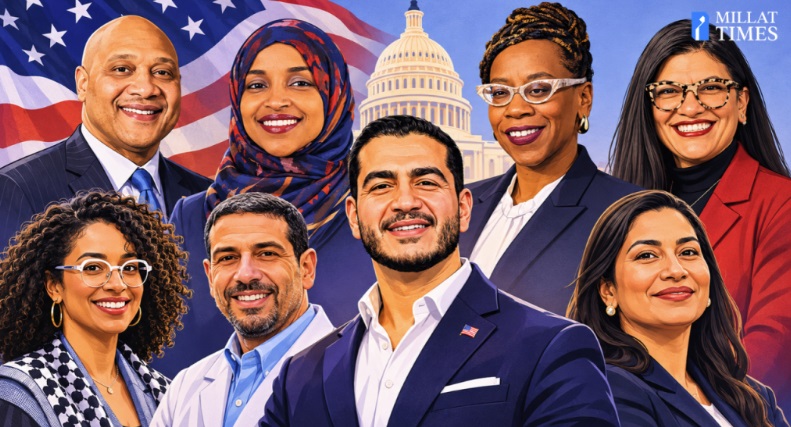
Presented by ChatGPT for Zia H Shah MD
Abstract
The November 3, 2026 U.S. midterm elections produced a genuine milestone for Muslim political representation, but some early reports have moved faster than the completed vote count. Abdul El-Sayed has been elected from Michigan and will become the first Muslim to serve in the United States Senate. Six Muslim candidates have already been declared winners of November House races—incumbents Ilhan Omar, Rashida Tlaib, André Carson and Lateefah Simon, and newcomers Adam Hamawy and Darializa Avila Chevalier. Aisha Wahab, already a member of Congress after winning an August 2026 special election, is leading for a full term in California’s 14th District, but the race had not yet been called as of November 5. Thus, it is more precise at this moment to say that seven Muslims have been confirmed as winners of congressional races on November 3—one senator and six representatives—with an eighth likely if Wahab’s race is called for her.
At the state level, Nabeela Syed’s victory is also significant. The Indian-American Muslim legislator, previously a member of the Illinois House, defeated Republican state senator Darby Hills in Illinois Senate District 26. The Illinois General Assembly had previously identified Syed as the first Indian-American and Muslim woman elected to that legislature.


These victories invite a larger question: why can Muslim politicians flourish within constitutional systems whose institutional architecture did not originate as an explicitly “Islamic political system,” while many Muslim-majority societies continue to debate what an Islamic state, Islamic democracy, secular republic or constitutional monarchy should look like? The strongest historical and Qur’anic conclusion is not that Islam is politically empty, nor that it mandates one constitutional blueprint. Rather, the Qur’an articulates demanding normative principles—trust, justice, truthful testimony, consultation, restraint of factional hatred, accountability and concern for the vulnerable—while leaving extensive room for human beings to design institutions appropriate to different circumstances. Scholarly literature on Islam and democracy contains important disagreements, but substantial scholarship supports precisely this distinction between ethical ends and institutional means.
The practical implication is therefore broader than celebrating Muslim officeholders in America. Muslim citizens, scholars and political leaders can treat constitutional experience around the world as a common human laboratory: electoral competition, judicial independence, federalism, parliamentary government, presidential government, proportional representation, independent auditing, freedom of information, professional civil services and constitutional rights can be evaluated according to whether they advance justice, consultation, accountability and human dignity—not according to whether their institutional vocabulary originated in a Muslim civilization.
What actually happened in the U.S. elections
Abdul El-Sayed’s Michigan victory is historic. The 42-year-old physician and former Detroit health director defeated Republican Mike Rogers for the open seat created by Democratic senator Gary Peters’s retirement. The Associated Press called the race early on November 4; reported returns showed El-Sayed with roughly 52.5% against Rogers’s 45.5%. His campaign emphasized universal health care, reducing economic burdens and limiting the influence of large outside political expenditures. He will become the first Muslim senator in U.S. history.
The House picture requires slightly more care than the account in the prompt. As of November 5, the confirmed Muslim winners from the November election are André Carson in Indiana, Ilhan Omar in Minnesota, Rashida Tlaib in Michigan, Lateefah Simon in California, Adam Hamawy in New Jersey and Darializa Avila Chevalier in New York. That is six confirmed House winners, not yet seven. Wahab already entered Congress after winning the August special election to succeed Eric Swalwell, becoming the first Afghan American in Congress, but California’s full-term November contest remained officially uncalled even as she held a substantial lead.
| Candidate | Office | Status as of Nov. 5, 2026 |
|---|---|---|
| Abdul El-Sayed | U.S. Senate, Michigan | Won; first Muslim elected to U.S. Senate |
| Ilhan Omar | U.S. House, Minnesota | Won reelection |
| Rashida Tlaib | U.S. House, Michigan | Won reelection |
| André Carson | U.S. House, Indiana | Won reelection |
| Lateefah Simon | U.S. House, California | Won reelection |
| Adam Hamawy | U.S. House, New Jersey | Won first term |
| Darializa Avila Chevalier | U.S. House, New York | Won first term |
| Aisha Wahab | U.S. House, California | Leading for full term; not yet called |
Religion News Service reports that more than 160 Muslim candidates sought local, state or federal offices in 2026, exceeding the roughly 145 who ran in 2022. Muslim candidates also won or retained state offices in Michigan, Ohio, Oregon, Texas, Delaware, Pennsylvania, Colorado, Georgia and elsewhere.
Nabeela Syed’s Illinois victory illustrates an especially important aspect of this development: Muslim political participation is moving beyond heavily Muslim constituencies and beyond symbolic representation. Syed, born and raised in the Chicago suburbs, served in the Illinois House beginning in 2023 and defeated incumbent Republican senator Darby Hills in a competitive suburban district in 2026. Contemporary reporting placed her unofficial share around 57%, while election-result aggregations recorded her as the winner.
Her biography is particularly relevant to the broader thesis. The Illinois legislature records her active involvement in her local Islamic community while also describing a conventional American political trajectory involving political science, civic engagement and legislative work. A state legislative publication identifies her as the first Indian-American and Muslim woman elected to the Illinois General Assembly. Her political identity therefore demonstrates that being publicly Muslim need not require advocating a separate confessional constitutional order; religious identity can instead operate inside a pluralistic constitutional framework shared with citizens of other faiths and of no faith.
Celebration among Muslim Americans is understandable. AP reporting after El-Sayed’s victory described Muslim civic leaders and voters interpreting the result as evidence that an explicitly Muslim identity need not disqualify a candidate from statewide office, even after a campaign containing attacks on his religion. Yet El-Sayed himself emphasized that his mandate was to represent Michigan rather than to serve merely as a symbolic Muslim officeholder. That distinction is healthy: democratic inclusion is deepest when citizens of minority faiths can be elected on ordinary questions of health care, taxation, war, schools, housing and public administration rather than being confined to identity politics.
The Muslim world is neither fifty-seven identical states nor one political model
The frequently repeated number “57 Muslim countries” mixes two different categories. The Organisation of Islamic Cooperation has 57 member states, but membership in the OIC is not the same thing as having a Muslim-majority population. The OIC includes countries with substantial Muslim minorities, while demographic classifications depend on census methodology, territorial definitions and changing population estimates.
Pew’s newest comprehensive global religious dataset, published in 2025 and subsequently updated, estimates that Muslims were a majority in 53 countries and territories in 2020. Earlier Pew work counted 49 majority-Muslim countries in 2010 and projected 51 by 2050. The apparent contradiction is largely a matter of updated demographic data, treatment of territories and changed estimates—not evidence that there is a single universally binding list of “Muslim countries.”
The latest comparable Pew estimates also revise some familiar population figures. For 2020, Pew estimated approximately 239 million Muslims in Indonesia, 227 million in Pakistan, 213 million in India, 151 million in Bangladesh and 120 million in Nigeria. India is the conspicuous non-majority case: its Muslim population is enormous, but Muslims constituted about 15.2% of India’s population in Pew’s estimate. Nigeria, meanwhile, was estimated at 56.1% Muslim, which differs substantially from older estimates that placed Muslims slightly below half of the population.
The proposed constitutional classification of “eight Islamic states, seventeen state-religion states and twenty-five secular Muslim states” should likewise not be treated as a settled contemporary taxonomy. Such categories overlap and change with constitutional amendments. USCIRF’s comparative constitutional work, for example, classified 23 of 46 Muslim-majority countries in its dataset as constitutionally declaring Islam the state religion. International IDEA has separately reported that 27 of 45 Muslim-majority constitutions expressed some constitutional relationship with Islam. Other academic work distinguishes “Islamic state,” “official religion,” “Sharia source-of-law,” “repugnancy” and secular clauses rather than forcing every country into three mutually exclusive boxes.
That variation is itself evidence against the idea that contemporary Muslims have inherited one universally agreed constitutional structure. Muslim-majority societies include hereditary monarchies, constitutional monarchies, presidential republics, parliamentary republics, federal systems, unitary systems, secular constitutional orders and states in which Sharia or Islamic principles are constitutionally privileged. Comparative constitutional scholarship describes this diversity as a defining feature of the contemporary Muslim world.
Nor should poor governance be described as an intrinsic characteristic of Muslims. The record is heterogeneous. Freedom House’s 2026 assessment, for instance, gives Indonesia credit for substantial democratic progress since 1998 and repeated peaceful transfers of power while also identifying corruption, minority-rights problems and restrictions involving defamation and blasphemy. Kosovo holds credible elections but continues to struggle with corruption and institutional weaknesses. Malaysia’s 2026 World Justice Project rule-of-law score ranks it 53rd of 143 jurisdictions, Indonesia 75th; other Muslim-majority states perform much worse.
The larger global context matters as well. The World Justice Project reports that 62% of all 143 jurisdictions it examined declined in rule-of-law performance in 2026, and that constraints on government, civic participation and judicial independence are weakening in many non-Muslim as well as Muslim societies. Governance failure is therefore not a uniquely Islamic pathology. The more defensible conclusion is that many Muslim-majority countries face serious deficits of accountability, political competition, judicial independence and rights protection, but these deficits are institutional and historical problems that vary enormously from country to country.
This distinction matters morally. A Muslim citizen can legitimately admire the ability of Ilhan Omar, Rashida Tlaib, André Carson, Aisha Wahab, Nabeela Syed or Abdul El-Sayed to seek office within American institutions without treating the United States as morally flawless. Likewise, one may criticize authoritarianism in a Muslim-majority state without implying that Islam itself produces authoritarianism. Institutions should be judged by what they do: whether power can be questioned, rulers can be removed, courts can act independently, evidence matters, minorities are protected and public resources are treated as a trust.
Does Islam prescribe a political system?
The proposition that “there is no political system in Islam” is best formulated with one important qualification. The Qur’an clearly contains teachings with profound political implications, and Islamic history developed extensive jurisprudence concerning rulers, taxation, warfare, public order, courts and communal authority. It would therefore be misleading to say Islam has nothing political to say. What the Qur’an does not contain is a detailed constitutional blueprint specifying a legislature of a particular size, a presidential or parliamentary executive, electoral districts, judicial tenure, bicameralism, federalism, political parties or a fixed method by which rulers must be selected in every age.
That distinction is reflected in contemporary scholarship. A study of the debate over shūrā concludes that Islamic texts and traditions have been interpreted through several competing theories and do not straightforwardly mandate or reject one particular governmental system. Recent comparative political theory likewise argues that the organizational structure of political life can vary rather than constituting an eternally fixed framework. Other scholars argue that Qur’anic principles—including consultation, justice, accountability and equality—can sustain democratic institutions even though the Qur’an does not prescribe what we would today call a complete democratic constitution.
There is nevertheless genuine disagreement. Some Islamic political theorists understand divine sovereignty and Sharia as placing substantive limits on democratic legislation. Others distinguish divine moral norms from the necessarily human process of interpreting and institutionalizing those norms. Scholarship on Islamic constitutionalism consequently ranges from models of robust parliamentary democracy to constitutional schemes in which religious review bodies can invalidate legislation.
Empirical political science further warns against explaining democracy simply by the percentage of Muslims in a population. Research published in Political Research Quarterly found an association between constitutional entrenchment of Sharia as a source of legislation and weaker democratic outcomes in its sample, while finding no evidence that Islam itself is inherently inimical to democracy when such constitutional entrenchment is absent. That result is not the final word on an enormous scholarly debate, but it is important because it shifts analysis from essentialist statements about Muslims toward institutions, constitutions and distributions of power.
The history of Muslim political thought also supports institutional flexibility. The early caliphs were not chosen by one uniform electoral procedure; later Muslim polities included dynastic caliphates, sultanates, emirates and empires. Modern Muslim-majority states subsequently borrowed, adapted or invented presidential, parliamentary, monarchical, republican, socialist and federal institutions. The diversity of actual Muslim governance is therefore difficult to reconcile with the claim that revelation supplied one immutable constitutional mechanism. Comparative constitutional scholarship similarly notes that explicitly scriptural constitutional enforcement is largely a modern development rather than an unchanged continuation of a single classical model.
A productive formulation is therefore:
Islam offers a political ethic more clearly than it offers a single political architecture.
That formulation permits Muslims to insist that government must be just while remaining open to empirical learning about how justice is institutionalized. It turns constitutions and administrative arrangements into tools rather than articles of faith.
The Qur’anic grammar of good governance
The Qur’an’s political relevance becomes especially clear when its governance-related passages are read together. The passages below give the Arabic text in full. Because several widely used modern English translations remain copyrighted, the comparison gives short characteristic phrases from five established translations—Sahih International, Pickthall, Yusuf Ali, Shakir and Arberry—rather than reproducing five entire English versions of every verse. The parallel wording is documented by the Quranic Arabic Corpus.
Trust and impartial adjudication — Qur’an 4:58
Arabic
إِنَّ اللَّهَ يَأْمُرُكُمْ أَنْ تُؤَدُّوا الْأَمَانَاتِ إِلَىٰ أَهْلِهَا وَإِذَا حَكَمْتُمْ بَيْنَ النَّاسِ أَنْ تَحْكُمُوا بِالْعَدْلِ ۚ إِنَّ اللَّهَ نِعِمَّا يَعِظُكُمْ بِهِ ۗ إِنَّ اللَّهَ كَانَ سَمِيعًا بَصِيرًا
Five translation windows emphasize essentially the same constitutional ethic: Sahih International, “judge with justice”; Pickthall, “judge justly”; Yusuf Ali, “judge with justice”; Shakir, “judge … with justice”; Arberry, “judge with justice.”
The verse links two concepts that modern constitutional thought sometimes separates: public office as a trust and adjudication as an obligation of justice. A Qur’an-centered conception of government therefore begins not with the ruler’s entitlement to rule but with the ruler’s fiduciary responsibility. Power is an amānah, a trust.
That insight can be translated into modern institutions without requiring a uniquely medieval form: transparent procurement, conflict-of-interest laws, independent auditors, civil-service professionalism, judicial impartiality and enforceable anti-corruption rules are all contemporary mechanisms through which the moral concept of amānah can acquire institutional form.
Justice even against oneself — Qur’an 4:135
Arabic
يَا أَيُّهَا الَّذِينَ آمَنُوا كُونُوا قَوَّامِينَ بِالْقِسْطِ شُهَدَاءَ لِلَّهِ وَلَوْ عَلَىٰ أَنْفُسِكُمْ أَوِ الْوَالِدَيْنِ وَالْأَقْرَبِينَ ۚ إِنْ يَكُنْ غَنِيًّا أَوْ فَقِيرًا فَاللَّهُ أَوْلَىٰ بِهِمَا ۖ فَلَا تَتَّبِعُوا الْهَوَىٰ أَنْ تَعْدِلُوا ۚ وَإِنْ تَلْوُوا أَوْ تُعْرِضُوا فَإِنَّ اللَّهَ كَانَ بِمَا تَعْمَلُونَ خَبِيرًا
Sahih International renders the central command “standing firm in justice”; Pickthall, “staunch in justice”; Yusuf Ali, “stand out firmly for justice”; Shakir, “maintainers of justice”; Arberry, “securers of justice.”
The radical feature here is not merely that justice is desirable. Justice must override self-interest, family loyalty and socioeconomic status. The verse consequently challenges nepotism, dynastic privilege, partisan manipulation of courts and protection of elites from legal accountability.
In modern institutional language, this principle supports equality before the law, independent prosecution, transparent evidentiary standards and legal rules that bind incumbents as well as opponents. A Muslim polity that repeatedly invokes Islam while shielding rulers or families from accountability would therefore satisfy a religious label more readily than it satisfies this Qur’anic principle.
Justice toward opponents — Qur’an 5:8
Arabic
يَا أَيُّهَا الَّذِينَ آمَنُوا كُونُوا قَوَّامِينَ لِلَّهِ شُهَدَاءَ بِالْقِسْطِ ۖ وَلَا يَجْرِمَنَّكُمْ شَنَآنُ قَوْمٍ عَلَىٰ أَلَّا تَعْدِلُوا ۚ اعْدِلُوا هُوَ أَقْرَبُ لِلتَّقْوَىٰ ۖ وَاتَّقُوا اللَّهَ ۚ إِنَّ اللَّهَ خَبِيرٌ بِمَا تَعْمَلُونَ
Sahih International: “do not let … hatred … prevent you”; Pickthall: “let not hatred … seduce you”; Yusuf Ali: “let not the hatred … make you swerve”; Shakir: “let not hatred … incite you”; Arberry: “let not detestation … move you.”
This verse may be one of the Qur’an’s most demanding political principles because it requires justice precisely when factionalism makes justice difficult. It rejects the notion that ethical obligations disappear when dealing with adversaries.
Applied politically, it provides a powerful standard against collective punishment, discrimination against opposition voters, selective prosecution, ethnic favoritism and the suppression of disliked minorities. Democratic alternation of power works only when political opponents retain legal rights after losing an election; Qur’an 5:8 supplies a religiously intelligible reason for precisely such restraint.
Mutual consultation — Qur’an 42:38
Arabic
وَالَّذِينَ اسْتَجَابُوا لِرَبِّهِمْ وَأَقَامُوا الصَّلَاةَ وَأَمْرُهُمْ شُورَىٰ بَيْنَهُمْ وَمِمَّا رَزَقْنَاهُمْ يُنْفِقُونَ
Sahih International: “consultation among themselves”; Pickthall: “affairs are a matter of counsel”; Yusuf Ali: “affairs by mutual Consultation”; Shakir: “take counsel among themselves”; Arberry: “their affair being counsel.”
The Qur’an does not tell its readers whether shūrā requires a unicameral parliament, a bicameral congress, town meetings or proportional representation. That absence need not be a deficiency. It means the normative requirement can survive institutional change.
In a contemporary mass society, meaningful shūrā can plausibly require elections, representative institutions, legislative hearings, access to information, civil society, free public debate and mechanisms through which rulers can actually lose power. Consultation that rulers may ignore with impunity risks becoming ceremonial rather than substantive. This institutional implication is an inference rather than a literal constitutional prescription in the verse, but it follows from taking consultation seriously as a governing norm.
Consultation in leadership — Qur’an 3:159
Arabic
فَبِمَا رَحْمَةٍ مِنَ اللَّهِ لِنْتَ لَهُمْ ۖ وَلَوْ كُنْتَ فَظًّا غَلِيظَ الْقَلْبِ لَانْفَضُّوا مِنْ حَوْلِكَ ۖ فَاعْفُ عَنْهُمْ وَاسْتَغْفِرْ لَهُمْ وَشَاوِرْهُمْ فِي الْأَمْرِ ۖ فَإِذَا عَزَمْتَ فَتَوَكَّلْ عَلَى اللَّهِ ۚ إِنَّ اللَّهَ يُحِبُّ الْمُتَوَكِّلِينَ
Sahih International: “consult them in the matter”; Pickthall: “consult with them”; Yusuf Ali: “consult them in affairs”; Shakir: “take counsel with them”; Arberry: “take counsel with them.”
The significance is heightened by the addressee: Muhammad himself is instructed to consult. Classical and modern scholars have differed over the exact legal implications, but as a moral principle the passage places deliberation within legitimate leadership rather than treating authority as self-sufficient.
Taken together, these passages yield a remarkably coherent public ethic: authority is entrusted rather than owned; judgment requires justice; testimony must remain truthful even against oneself; hatred cannot excuse unfairness; and collective affairs require consultation. None of these principles depends on calling the state an “Islamic republic.”
From Qur’anic principles to institutions
The most fruitful lesson from Muslim electoral success in the United States is therefore not that Muslims should copy the American Constitution wholesale. The United States has its own serious deficiencies, and constitutional arrangements that work in one historical context cannot simply be transplanted everywhere. The more useful lesson is methodological: institutions are human experiments that can be evaluated, compared, corrected and improved.
That approach is deeply compatible with the Qur’anic themes above. If amānah is the objective, Muslims should study which systems actually prevent public theft. If ʿadl is the objective, they should study which judicial arrangements best protect impartial adjudication. If shūrā is the objective, they should ask which electoral and representative institutions produce meaningful participation rather than ritual acclamation. If truthful testimony is essential, societies need independent media, reliable statistics, legislative oversight and protection for whistleblowers.
The comparative evidence strongly suggests that constitutional labels alone do not guarantee these outcomes. Muslim-majority countries with similar religious language can display very different political performance, while countries with very different constitutional treatment of religion can sometimes deliver comparable governance outcomes. Comparative studies of Muslim constitutions accordingly emphasize institutional design, judicial enforcement and democratic legitimacy rather than treating the mere insertion of “Islam,” “Sharia” or “Islamic Republic” into constitutional text as sufficient.
This is also where the American Muslim experience can offer intellectual—not merely emotional—encouragement. El-Sayed, Syed, Omar, Tlaib, Carson, Simon, Hamawy, Chevalier and Wahab operate through elections, constituent service, legislative bargaining, judicially enforceable laws and constitutional limits. Their Muslim identity does not require them to invent a separate method of collecting votes, writing budgets or organizing legislative committees. The moral content they bring to politics may be inspired by faith; the institutional mechanisms belong to a shared civic order.
A mature Muslim political thought can therefore distinguish immutable aspirations from revisable mechanisms. Justice is an aspiration; the design of an appellate court is a mechanism. Consultation is an aspiration; proportional representation is a mechanism. Accountability is an aspiration; an independent inspector general is a mechanism. Human dignity is an aspiration; a bill of rights is a mechanism. Public trust is an aspiration; competitive procurement rules are mechanisms.
This distinction makes intellectual learning possible. Muslims can learn from American federalism without canonizing America, from Scandinavian ombudsman institutions without becoming Scandinavian, from German proportional representation without becoming German, from Indian constitutional jurisprudence without becoming Hindu, from Indonesian decentralization without making it universally binding, and from their own historical institutions without pretending that medieval administrative forms are divinely mandated for the twenty-first century.
It also establishes a reciprocal obligation. Muslims living as minorities should defend for others the same constitutional rights they expect for themselves. Qur’an 5:8 makes justice toward disliked groups a moral obligation; Qur’an 4:135 makes justice against one’s own interest a religious discipline. A Muslim who demands religious liberty in America but would deny equivalent liberty to Christians, Hindus, Jews, atheists, Ahmadis, Shi’a or Sunnis elsewhere confronts the universal logic of the very verses invoked in defense of Muslim rights.
The most compelling aspiration, therefore, is not simply to place more Muslims in high office. It is to cultivate Muslim political actors whose conduct makes amānah, ʿadl, truthful testimony and shūrā visible in practice—and to build institutions capable of restraining them when they fail.
Thematic epilogue
Abdul El-Sayed’s election to the U.S. Senate and Nabeela Syed’s movement from the Illinois House to the Illinois Senate are worth celebrating as democratic achievements. They show that a Muslim name, Muslim faith or hijab need not prevent participation at the highest levels of a constitutional democracy. But Muslim political thought should draw a deeper lesson from their victories than communal pride alone.
The Qur’an repeatedly commands something harder than possessing power: being worthy of power. It speaks of trusts before privileges, justice before faction, testimony before propaganda and consultation before self-sufficient rule. Its silence about bicameralism, presidentialism, electoral formulas and cabinet structures can consequently be understood not as an intellectual vacuum but as political space—a space in which succeeding generations remain responsible for discovering institutions that realize enduring moral principles under changing conditions.
That space creates dynamism. A Muslim-majority society does not become more Qur’anic merely by attaching the adjective “Islamic” to the state, just as a secular republic does not become just merely by proclaiming secularism. The serious questions are empirical and ethical: Are rulers accountable? Are courts independent? Can citizens criticize government without fear? Can minorities worship freely? Can a poor person obtain justice against a wealthy person? Can voters remove leaders peacefully? Are public resources treated as a trust? Do political opponents retain their humanity after an election?
The diversity of the Muslim world—53 Muslim-majority countries and territories in Pew’s latest comprehensive demographic accounting, alongside 57 politically diverse OIC member states—should therefore be treated as an invitation to intellectual humility rather than a demand for artificial uniformity.
For Muslims in America, India, Indonesia, Pakistan, Bangladesh, Nigeria, Europe, Africa or the Middle East, the relevant Qur’anic project need not be the recovery of a supposedly lost universal constitutional formula. It can instead be a continuing effort to embellish human governance with justice, honesty, consultation, accountability and truthful witness, while learning without embarrassment from every society that has discovered an institution capable of serving those ends.
That is a political vision simultaneously more modest and more demanding than the slogan of an “Islamic state.” It does not promise that the right constitutional label will make government righteous. It insists instead that every constitution, parliament, monarchy, republic, party and public official be judged continually by what they actually do with the trust placed in their hands.




Leave a Reply