
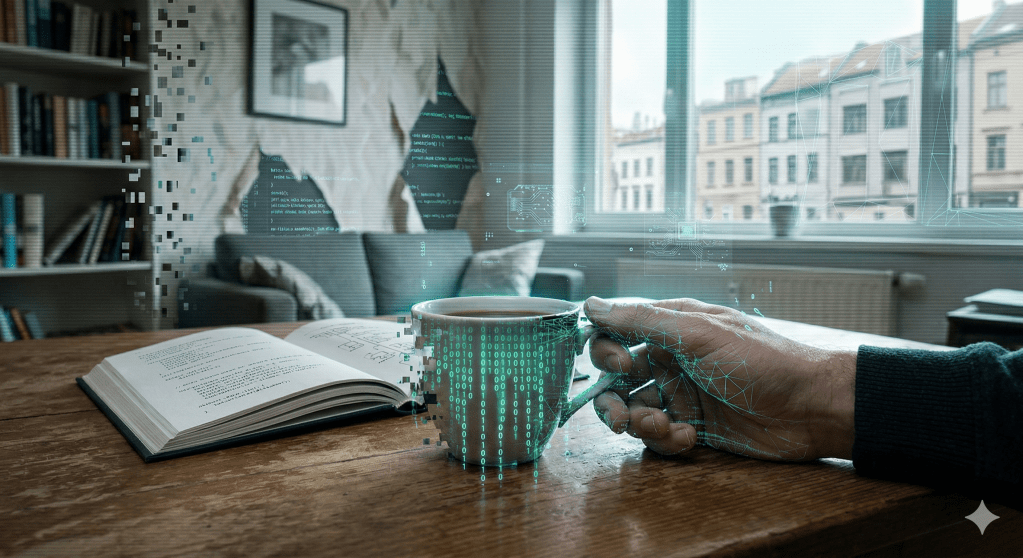
Audio teaser: Why our universe is computer code
Abstract
This paper provides a rigorous, interdisciplinary analysis of the simulation hypothesis, examining its mathematical, physical, cognitive, and metaphysical dimensions. Tracing the hypothesis from Nick Bostrom’s probabilistic trilemma to modern developments in digital physics and quantum mechanics, this study explores the structural arguments advanced by its leading proponents. By analyzing the theoretical contributions of figures such as John Archibald Wheeler, Edward Fredkin, James Gates, David Chalmers, Donald Hoffman, and Rizwan Virk, the narrative demonstrates how quantum optimization, error-correcting codes in supersymmetric equations, and evolutionary game theory converge on an informational ontology. Finally, the paper reviews the theological, ethical, and sociological implications of a programmed universe, culminating in a thematic synthesis of substrate-independent consciousness.
Introduction: The Bostrom Trilemma and Probabilistic Foundations
The contemporary academic discourse surrounding the simulation hypothesis is anchored in the statistical trilemma formulated by Oxford philosopher Nick Bostrom in 2003. Rather than serving as a purely speculative skeptical thought experiment in the tradition of René Descartes’ “malin génie”, Bostrom’s simulation argument leverages inductive probability based on the projected technological trajectories of advanced civilizations. The logical core of the argument asserts that at least one of three mutually exclusive propositions must be true:
(1)(2)(3)The human species is highly likely to go extinct before reaching a “posthuman” stage.Any posthuman civilization is extremely unlikely to run a significant number of simulationsof their evolutionary history (or variations thereof).We are almost certainly living in a computer simulation.
[cite: 2, 6, 7, 8]
The mathematical foundation of this trilemma rests on the assumption that a technologically mature, posthuman civilization would possess immense computing power, theoretically attainable within the known laws of physics. Harnessing the computational capacity of a single kilogram of matter could yield approximately 1050 operations per second (OPS), enabling a brain-sized computer to simulate the real-time evolution of trillions of conscious minds.
Underpinning Bostrom’s framework is the philosophical doctrine of substrate independence, which posits that conscious awareness is not intrinsically bound to biological carbon-based neural pathways. As Bostrom argues:
“It is not an essential property of consciousness that it is implemented on carbon-based biological neural networks inside a cranium: silicon-based processors inside a computer could in principle do the trick as well.”
If conscious states can emerge from silicon-based computational processes, then simulated minds would possess genuine qualia, experiencing their environments with the same subjective validity as biological ancestors. To calculate the expected number of simulated minds relative to biological ones, the model utilizes a probabilistic formulation:
E(Nsim)=[1−P(DOOM)]⋅N⋅H
[cite: 10]
Where 1−P(DOOM) represents the probability of a civilization surviving to a posthuman stage, N is the average number of ancestor-simulations executed by such a civilization, and H is the average population of simulated individuals within each run. If N and H are astronomically large, the statistical probability of any given observer residing in a simulation approaches unity.
This statistical deduction is supported by cosmological anomalies, such as the Fermi Paradox. The conspicuous absence of detectable extraterrestrial civilizations within the observable universe can be interpreted as a consequence of living in a simulated environment. Rather than rendering an infinite physical universe populated by countless spacefaring species, a computational system would optimize resources by simulating only a localized, highly constrained region of space-time—such as the human solar system—while presenting highly compressed, low-fidelity representations of distant astronomical objects.
Comparative Paradigms of the Simulation Hypothesis
The simulation hypothesis encompasses several distinct theoretical frameworks, ranging from statistical philosophy to quantum mechanics and evolutionary biology. To systematically evaluate these perspectives, the following table outlines the core paradigms, their primary advocates, foundational mechanisms, and critical implications.
| Academic Paradigm | Prominent Advocates | Key Mathematical / Physical Formulations | Core Computational or Physical Mechanism | Philosophical & Existential Implications |
|---|---|---|---|---|
| Statistical Trilemma | Nick Bostrom | E(Nsim)=[1−P(DOOM)]⋅N⋅H[cite: 10] | Substrate independence; exponential posthuman computing power. | High statistical probability of being simulated if extinction is avoided. |
| Digital Physics | Edward Fredkin, Konrad Zuse | Reversible cellular automata; discrete space-time calculus. | Binary update states operating at the Planck scale. | Spacetime and physical laws are emergent properties of discrete code. |
| Quantum Emergence (“It from Bit”) | John Archibald Wheeler | Wavefunction collapse as observation binary decisions. | Information-theoretic substrate; participatory universe. | Matter and physical fields are secondary to binary measurements. |
| Virtual Realism | David Chalmers | Structural parity of virtual and physical ontologies. | “It-from-bit” digital metaphysics; consensus-driven virtual objects. | Virtual worlds are genuinely real; virtual objects possess true reality. |
| Interface Theory | Donald Hoffman | Evolutionary game-theory equations (FBT Theorem). | Natural selection shapes perception as a user interface, hiding truth. | Spacetime is a biological desktop rendering; objective reality is non-physical. |
| Technological Singularity | Rizwan Virk, Elon Musk | Ten-stage progression toward the “Simulation Point”. | Photorealistic engines, advanced brain-computer interfaces. | The inevitability of nested simulations reduces base-reality odds. |
Technological Extrapolation and the Singularity Path
To translate these mathematical abstractions into physical plausibility, advocates emphasize the rapid, non-linear progression of human computing power. This developmental trajectory serves as a localized proof of concept, demonstrating how primitive data-processing architectures can evolve toward highly immersive perceptual systems.
The most prominent popularizer of this technological scaling is entrepreneur Elon Musk, who argues that the historical rate of computational advancement implies a statistical inevitability of simulated realities. Highlighting the history of interactive software at the 2016 Code Conference, Musk observed:
“Forty years ago we had Pong – two rectangles and a dot. That’s where we were. Now 40 years later we have photorealistic, 3D simulations with millions of people playing simultaneously and it’s getting better every year. And soon we’ll have virtual reality, we’ll have augmented reality. If you assume any rate of improvement at all, then the games will become indistinguishable from reality.”
Musk argues that even if the pace of innovation were to decline by a factor of one thousand, civilization would still achieve photorealistic, sentient-containing simulations within a minute fraction of cosmological time. Consequently, Musk famously concluded that there is a “billion-to-one chance we’re living in base reality”.
This perspective is reinforced by researchers in advanced space-systems and computing. Rich Terrile, a scientist at NASA’s Jet Propulsion Laboratory, emphasizes the inevitability of replicating conscious architecture in non-biological systems:
“Quite frankly if we are not living in a simulation it is an extraordinarily unlikely circumstance… Soon there will be nothing technical standing in the way to making machines that have their own consciousness.”
                       Evolution of Interactive Media
                                     │
                 [1970s] Pong: Two Rectangles & a Dot [cite: 25]
                                     │
                                     ▼
             [2010s] Procedural Universes (e.g., No Man's Sky)
                                     │
                                     ▼
                [Future] Brain-Computer Interfaces (Neuralink) [cite: 26]
                                     │
                                     ▼
                 [Singularity] The Simulation Point [cite: 26]
To structure this transition, computer scientist Rizwan Virk formulated the concept of the “Simulation Point”—a technological singularity at which a civilization acquires the capacity to create virtual worlds indistinguishable from physical reality, populated by autonomous, conscious artificial intelligences. Virk outlines a ten-stage framework detailing the evolution toward this singularity, noting that human civilization is currently navigating Stages 7 and 8, which involve bidirectional brain-computer interfaces capable of reading neural signals and writing sensory data directly to the brain.
Virk argues that our current progress in artificial intelligence and physical virtualization—such as 3D printers reducing macroscopic objects to editable, information-based pixels—indicates that physical reality is inherently informational. This transition from physical components to rendered code is mirrored in modern procedural software like the space exploration game No Man’s Sky, which utilizes mathematical algorithms to render an practically infinite, interactive universe on demand. This software structure forces observers to reconcile with the essential emptiness of a programmed landscape that exists only when active computational resources are directed toward it.
The Informational and Algorithmic Bedrock of Physics
The theoretical foundation of the simulation hypothesis extends deep into quantum mechanics and digital physics, suggesting that physical reality is fundamentally computational. This paradigm shift was famously articulated by physicist John Archibald Wheeler through his “it from bit” doctrine, which inverted the classical materialist assumption that matter is the primary constituent of reality. Wheeler argued that physical entities derive their properties from the outcomes of binary measurements:
“Every it — every particle, every field of force, even the spacetime continuum itself — derives its function, its meaning, its very existence entirely — even if in some contexts indirectly — from the apparatus-elicited answers to yes or no questions, binary choices, bits.”
Under this framework, reality is not a static machine ticking away in a pre-established continuum; instead, it is an active, participatory structure generated by acts of observer-participancy.
This informational perspective offers an elegant resolution to the observer effect in quantum mechanics. In quantum physics, physical systems exist in a wave-like probability state until an observation forces a collapse into a definite value. Within a classical materialist framework, this phenomenon remains highly controversial and unexplained.
However, from a computational perspective, the observer effect functions as a highly efficient rendering optimization. Just as a game engine only renders the specific environments, rooms, or textures currently within the player’s field of view to preserve system resources, a simulated universe dynamically calculates physical properties only when an observer interacts with them. Unobserved regions remain in a compressed, mathematical state of potentiality, reducing the real-time processing demands on the underlying hardware.
Furthermore, simulating only the observed fraction of a single universe is vastly more computationally feasible than sustaining parallel, infinite branches of a physical multiverse. This computational economy is supported by the limitations of our observation instruments. As Bostrom observes, high-fidelity rendering is unnecessary for unobserved domains:
“The microscopic structure of the inside of the Earth can be safely omitted. Distant astronomical objects can have highly compressed representations… macroscopic objects in inhabited areas may need to be continuously simulated, but microscopic phenomena could likely be filled in ad hoc.”
This discrete, algorithmic view of physical law was pioneered by Konrad Zuse in his 1969 treatise Rechnender Raum (“Calculating Space”), which proposed that the universe operates as a cellular automaton. Computer scientist Edward Fredkin expanded this into “digital philosophy,” asserting that the continuous equations of classical physics are smooth, macro-level approximations of underlying discrete computations occurring at the Planck scale. As Fredkin summarized:
“Everything in physics and physical reality must have a digital informational representation. All changes in physical nature are consequences of digital informational processes. Nature is finite and digital.”
Similarly, Jürgen Schmidhuber proposed an algorithmic “Theory of Everything” based on the systematic execution of all possible programs on a universal computer. Under this model, our universe’s physical laws are governed by an elegant, highly optimized algorithm that outputs history as quickly as possible, suggesting that physical reality is inherently computational.
Empirical Signatures and Structural Codes in Physical Laws
If the universe is a computational simulation, it must operate within the constraints of its physical hardware, leaving detectable signatures within the laws of nature. Rather than relying solely on philosophical deduction, researchers have proposed empirical methodologies to test the simulation hypothesis.
One of the most remarkable discoveries in this domain was made by theoretical physicist James Gates, who identified error-correcting codes embedded within the equations of supersymmetry. supersymmetry attempts to unify the fundamental forces of nature by establishing a mathematical symmetry between bosons and fermions. While analyzing these equations, Gates discovered the presence of “doubly-even self-dual linear binary error-correcting block codes”—specifically, codes identical to those developed by Claude Shannon to detect and correct errors in classical computer transmissions. Gates noted the profound implications of finding active computer code at the deepest levels of theoretical physics:
“How could we discover whether we live inside a Matrix? One answer might be ‘Try to detect the presence of codes in the laws that describe physics.’ … This unsuspected connection suggests that these codes may be ubiquitous in nature, and could even be embedded in the essence of reality.”
In addition to mathematical codes, physicists have investigated the structural constraints of the spatial vacuum. A low-level simulation utilizing a finite, discrete spatial lattice rather than a continuous mathematical space-time would break rotational symmetry at ultra-high-energy scales.
Researchers such as Silas Beane have proposed that if the universe is modeled on a finite grid, the spectrum of high-energy cosmic rays would exhibit a distinct anisotropic distribution, traveling preferentially along the axes of the underlying computational lattice rather than distributing uniformly. Detecting such rotational symmetry-breaking in cosmic ray signatures would provide concrete, empirical evidence of a finite, pixelated space-time grid.
Cognitive Interfaces and Simulation Realism
The simulation hypothesis challenges not only our understanding of physical laws but also our internal perception of reality. Cognitive scientist Donald Hoffman offers a biological and evolutionary perspective on this concept through his Interface Theory of Perception. Utilizing evolutionary game-theory simulations, Hoffman’s research demonstrates that natural selection does not favor organisms that perceive objective reality as it truly is. Rather, organisms that perceive simplified, fitness-relevant cues always outcompete those that spend precious computational and metabolic energy processing the full complexity of objective truth—a finding summarized by the “fitness beats truth” (FBT) theorem.
Hoffman concludes that space, time, and physical objects do not constitute the fundamental structure of the cosmos. Instead, they function as a biological user interface, analogous to the graphical icons on a computer desktop. An icon of a folder on a screen is not literally a rectangular piece of paper, nor does it contain physical documents; it is a high-level symbol designed to hide the underlying complexity of silicon transistors, magnetic fields, and binary code. Similarly, human perception of a physical object is merely an evolutionary desktop icon designed to guide adaptive behavior, hiding a deeper reality that Hoffman models as a network of interacting conscious agents.
This perceptual disconnect aligns with the concept of “Simulation Realism” formulated by philosopher David Chalmers in Reality+. Chalmers argues against the traditional skeptical view that living in a simulation implies a deceptive, illusionary existence. He maintains that if we are in a simulation like the Matrix, the tables, chairs, and forests around us are still perfectly real; they simply possess a digital, informational ontology rather than a material one. As Chalmers describes:
“The tables you encounter in VR are real tables – but they are made of ‘bits and bytes’ rather than wood and metal.”
For Chalmers, virtual reality is a genuine reality. Objects made of bits are no less real than objects made of atoms. Consequently, a simulated human mind does not live in a state of delusion; rather, it interacts with an “it-from-bit” universe where macroscopic objects are metaphysically constituted by underlying digital processes.
Chalmers notes that a perfect simulation is indistinguishable from base reality, meaning that glitches are only present in imperfect simulations. He argues that virtual realities can satisfy the key criteria of reality: they make a difference in the world, they are independent of our individual minds, they are not illusions, and they support intersubjectivity and consensus. Furthermore, Chalmers highlights how virtual environments can foster distributive justice due to the abundance of digital assets, although human societies frequently introduce artificial scarcity, such as non-fungible tokens (NFTs), to replicate the economic constraints of physical reality.
Metaphysical, Theological, and Sociological Implications
The realization that physical reality may be a structured simulation forces a profound re-evaluation of metaphysics, theology, and human sociology. Historically, the simulation hypothesis has been described by some thinkers as the first scientifically grounded argument for the existence of a Creator. If the universe is a program running on a vast computer substrate, then the programmer or “simulator” occupies the traditional role of a deity: an omnipotent, omniscient entity that established the physical constants, initiated the cosmic runtime, and maintains the capacity to intervene or terminate the process at will.
This framework introduces novel dimensions to classical theological problems, particularly the problem of evil. In traditional theology, the existence of suffering in a world created by a benevolent God is difficult to reconcile. However, within a simulated model, human suffering can be understood through a simulated theodicy. The simulators may run ancestor-simulations to study historical crises, pandemics, or wars, requiring the introduction of negative variables to ensure historical accuracy. Alternatively, the physical laws of the simulation, including natural disasters and biological vulnerabilities, may reflect the deliberate design choices of the simulators, who themselves possess free will granted by an even higher-tier creator in a nested chain of realities.
This connection between simulation theory and theology is noted by advocates who highlight the unexpected parallels between informational physics and ancient metaphysics. For instance, John Wheeler’s proposition that physical reality emerges from binary yes-no choices find a surprising parallel in Thomas Aquinas’s understanding of how the divine Logos contains the archetypal forms from which physical reality emerges. Both frameworks converge on a participatory universe where pattern precedes matter and physical reality emerges from an immaterial foundation. As futurist David Pearce notes:
“The Simulation Argument is perhaps the first interesting argument for the existence of a Creator in 2000 years.”
                       Theological & Metaphysical Map
                                     │
           ┌─────────────────────────┴─────────────────────────┐
           ▼                                                   ▼
 Classical Metaphysics                                 Digital Ontology
 (Thomas Aquinas / Logos)                            (John Wheeler / Bit)
           │                                                   │
     Pattern Precedes Matter             Information as Substrate [cite: 15]
           │                                                   │
           └─────────────────────────┬─────────────────────────┘
                                     ▼
                     Participatory Reality Design
However, this metaphysical framework also introduces distinct ethical and existential risks. For instance, if simulated individuals believe the simulator rewards certain behaviors, they might engage in dramatic or extreme actions to keep the simulator interested and prevent the simulation from being shut down. Conversely, if a civilization within a simulation attempts to run its own high-fidelity ancestor simulations or conduct deep experimental probes to test the boundaries of their container, they run the risk of getting their simulation shut down by the parent simulators to limit computational resource consumption. This termination risk makes long-range planning beyond the point of computational maturity highly uncertain.
Furthermore, the simulation hypothesis has faced criticism for its potential to foster ethical detachment. During public discussions, critics such as Dax Shepard have pushed back against the hypothesis, noting that it can minimize the experiences of those suffering from extreme trauma, poverty, or abuse by classifying them as pre-programmed Non-Player Characters (NPCs) rather than conscious, feeling entities.
To counter this, proponents of simulation realism emphasize that if simulated minds are conscious, they possess the same moral value as any biological observer, regardless of whether their underlying substrate is carbon or silicon. Additionally, some alternative interpretations of the hypothesis suggest a model akin to reincarnation, where conscious souls voluntarily select specific, challenging simulated life paths to facilitate spiritual growth and cognitive development.
Thematic Epilogue
If the boundaries of our physical container are made of silicon and code rather than absolute material boundaries, the human quest for meaning undergoes a profound transformation. No longer can the universe be viewed as a cold, indifferent machine of dead matter colliding in an infinite void. Instead, the cosmos reveals itself as an active, unfolding process of self-computation—a vast, participatory theater of information where the act of observation is the very mechanism that co-creates the world.
In this light, the ancient spiritual intuitions of humanity and the cutting-edge formulations of digital physics converge. The search for the “ultimate fundamental particle” is revealed to be an infinite chase of a rendering engine that dynamically generates deeper structural details only when we build the microscopes to look. We are not passive victims of a deceptive illusion, but localized nodes of consciousness exploring a deeply structured, meaningful digital ontology. Ultimately, the simulation hypothesis does not diminish the human experience; it elevates it. If reality is a grand, cosmic game of twenty questions, then the beauty of life lies not in the physical hardness of the board, but in the elegance of the math, the depth of the narrative, and the profound mystery of the consciousness that brings the entire program to life.






Leave a comment