
By Zia H. Shah MD with help of Claude
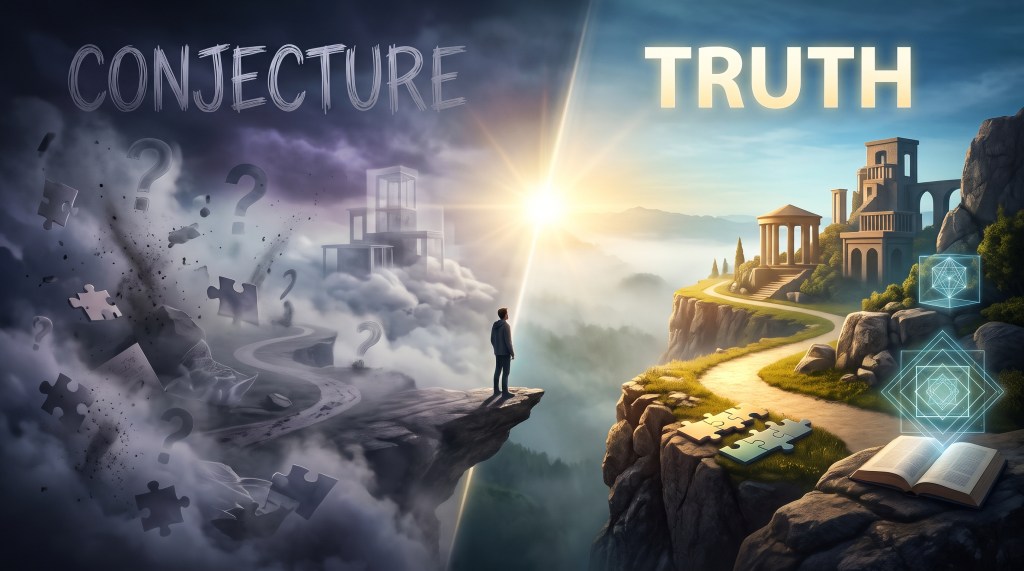
Atheism is founded on conjecture: when asked to account for reality, its leading thinkers do not give one answer backed by knowledge. They give several answers that contradict each other (the universe is a brute fact, the laws are a brute fact, mathematics is the only reality, consciousness and free will are illusions), and the Quran’s word for that state of mind is zann.
- On the deepest questions (why anything exists, why it is lawful and fine-tuned, why it contains conscious and choosing minds), atheist thinkers give answers that contradict each other: Russell’s and Carroll’s brute-fact universe, Hawking’s self-creating law, Tegmark’s mathematical universe, Dennett’s and Frankish’s illusory consciousness, Strawson’s fully real consciousness, Sapolsky’s “no shred of agency” and Mitchell’s evolved free agents. Rivals who cannot agree on their own foundations have not reached ‘ilm (knowledge); in the Quran’s terms they “follow nothing but conjecture” (10:36; 53:28).
- The science these thinkers appeal to points the other way. The Borde–Guth–Vilenkin theorem and Vilenkin’s verdict that “all the evidence we have says that the universe had a beginning,” the fine-tuning of the cosmological constant and of the initial entropy, Wigner’s “unreasonable effectiveness” of mathematics and Chalmers’s hard problem all fit one explanation, a single Knower and Creator, far better than they fit a pile of unrelated brute facts.
- The Quran’s parable of the froth (13:17) and its picture of the “clear record” (10:61) supply the right frame. Atheistic conjectures rise and fall like zabad, the scum on a torrent, while what benefits humanity stays: lawful nature, real consciousness, real moral agency and the signs of night and day (10:67), which are now written into our circadian biology.
Abstract
The Quran repeatedly sets zann (conjecture, assumption, guesswork) against ‘ilm (knowledge), yaqin (certainty) and al-haqq (the Truth), and declares that “conjecture avails naught against the truth” (53:28; 10:36). This article argues that modern atheism, despite its scientific self-image, rests on exactly this kind of conjecture. I document that atheist and naturalist thinkers do not agree on the basic structure of reality. Bertrand Russell and Sean Carroll treat the universe as a brute fact. Stephen Hawking and Lawrence Krauss locate the ultimate explanation in physical law or the quantum vacuum, and David Albert, an atheist philosopher of physics, rejects that move. Max Tegmark makes mathematics itself the only reality. On the mind, Daniel Dennett and Keith Frankish call phenomenal consciousness an illusion, while the naturalist Galen Strawson calls that denial the silliest claim ever made. Sam Harris, Jerry Coyne and Robert Sapolsky declare free will an illusion, and the neuroscientist Kevin Mitchell argues from the same evolutionary biology that we are genuine free agents. I then review the scientific evidence: the beginning of the universe (Borde–Guth–Vilenkin, 2003), cosmological fine-tuning (Penrose, Rees, Barnes and Lewis), the critique of the untestable multiverse (Ellis and Silk, 2014), the effectiveness of mathematics (Wigner, 1960), the hard problem of consciousness (Chalmers, 1995), the reinterpretation of Libet’s experiments (Schurger, 2012) and Gödel’s incompleteness theorems. Philosophically, I examine the Principle of Sufficient Reason, the Russell–Copleston debate, the self-defeating character of eliminating reason and consciousness (Lewis, Plantinga, Nagel) and the “promissory materialism” diagnosed by Popper and Eccles. Theologically, I read these debates through Quranic epistemology (zann, ‘ilm, yaqin, burhan, ayat), Al-Ghazali’s occasionalism, the parable of the froth in Surah Ar-Ra’d (13:17) and the passage on divine witness and the clear record in Surah Yunus (10:61–67). A Thematic Epilogue reflects on night, day and the rest that God has written into the human body.
1. Introduction: The Confidence of Unbelief and the Poverty of Its Foundations
As a physician in internal, pulmonary and sleep medicine, I have learned to separate what one knows from what one suspects. A differential diagnosis is a structured list of conjectures; a diagnosis is a conclusion earned by evidence. The worst medical errors come from treating a hunch as if it were a confirmed finding.
The Quran demands exactly this discipline in the largest questions of human life. It does not ask for blind belief. It asks for knowledge, it challenges every claim with “Produce your proof, if you should be truthful” (2:111), and it warns repeatedly against following zann. Over the years on this website I have argued, from many angles, that atheism fails this test. Its public face is confident and scientific; its foundations are a set of mutually incompatible guesses. This article gathers those threads into one thesis: atheism is founded on conjecture.
The argument has three steps. First, I set out what the Quran means by conjecture. Second, I document, in their own words, how atheist and naturalist thinkers disagree with each other about the cosmos, its laws, the mind and the will. Third, I show that the scientific and philosophical evidence these thinkers cite fits far more naturally into the unified account the Quran gives: one All-Knowing Creator who keeps “a clear record” (10:61) of every speck of dust and whose “way” (sunnat Allah) in nature does not change (35:43).
This article builds on my October 2025 commentary, “Conjecture, Knowledge, and Truth in the Quran: A Scientific, Philosophical, and Theological Commentary” (https://thequran.love/2025/10/08/conjecture-knowledge-and-truth-in-the-quran-ascientific-philosophical-and-theologicalcommentary/), where I defined conjecture in the Quran as “any belief or assertion not backed by knowledge – a subjective notion taken as truth without evidence.” thequran Here I apply that definition directly to the atheistic worldview.
2. The Quranic Concept of Conjecture: Zann, ‘Ilm, Yaqin and Burhan
2.1 The vocabulary
In classical Arabic, zann covers a range from reasonable supposition to baseless guess. In the Quran’s polemical passages it means belief held without warrant, especially about the unseen (al-ghayb), God and the Hereafter. thequran Its opposite is ‘ilm, knowledge grounded in observation, sound reasoning or authentic revelation. Above ‘ilm stands yaqin, certainty, which the Muslim tradition describes in three degrees: ‘ilm al-yaqin (certainty by inference), ‘ayn al-yaqin (certainty by sight) and haqq al-yaqin (certainty by lived realization). Wikipedia Running through all of them is al-haqq, the Truth, which is a name of God Himself (22:6). The instrument that moves a person from zann to ‘ilm is burhan: clear proof, demonstration, evidence.
2.2 The core verses
The Quran makes the same point in at least seven surahs, and the repetition is itself instructive.
Surah An-Najm (53:28): “But they have no knowledge thereof. They follow nothing but conjecture; and conjecture avails naught against the truth.” thequran
Surah Yunus (10:36): “And most of them follow nothing but conjecture. Surely, conjecture avails nothing against the truth. Indeed, Allah is well aware of what they do.” thequran Abdel Haleem renders it: “Most of them follow nothing but assumptions, but assumptions can be of no value at all against the Truth: God is well aware of what they do.” myislam
Surah An-Nisaa (4:157), on the claim that Jesus was killed on the cross: “those that disagreed about him are full of doubt, with no knowledge to follow, only supposition: they certainly did not kill him” (Abdel Haleem). myislamquran The verse is a precise epistemic diagnosis. The parties disagreed, they were full of doubt, and their position was supposition. Disagreement and doubt are the symptoms; zann is the disease.
Surah Al-An’aam (6:116): “If you obeyed most of those on earth, they would lead you away from the path of God. They follow nothing but speculation; they are merely guessing” (Abdel Haleem). myislamquran The verse warns against the argument from majority, or from the prestige of the learned: what “most people” or “most experts” assume does not thereby become knowledge.
Surah Al-Jaathiya (45:24): “They say, ‘There is only our life in this world: we die, we live, nothing but time destroys us.’ They have no knowledge of this; they only follow guesswork” (Abdel Haleem). myislam This is the most strikingly modern of the verses. It describes the materialist creed in one sentence: there is only this life, and the only agent of our passing is time (ad-dahr), impersonal process. The Quran does not answer it with anger; it answers with an epistemic verdict: they have no knowledge of this.
Surah Az-Zukhruf (43:20): “They say, ‘If the Lord of Mercy had willed it, we would not have worshipped them,’ but they do not know that – they are only guessing” (Abdel Haleem). myislam A closely related verse (6:148) adds the challenge: “Do you have any knowledge that you can produce for us? You follow nothing but conjecture.” thequran
Surah Adh-Dhaariyat (51:10–11): “Perish the liars” (Abdel Haleem), the kharrasun, literally the guessers or conjecturers, who, the next verse says, are sunk in heedlessness and confusion. myislamqurano The opening of this surah links conjecture with ikhtilaf, conflicting speech: “Indeed, you are in differing speech” (51:8). That is precisely the condition of modern atheism on the questions of ultimate reality.
2.3 The demand for proof
Against this the Quran sets a clear epistemic ethic. “Do not follow blindly what you do not know to be true: ears, eyes, and heart, you will be questioned about all these” (17:36, Abdel Haleem). myislam The challenge “Produce your proof (burhanakum), if you should be truthful” appears at 2:111 and is repeated in 21:24, 27:64 and 28:75. quranbyversesquranhadits The burden of proof falls on every claimant, the believer included. But the Quran also gives the believer something to point to: the ayat, the signs, in the heavens, the earth, the alternation of night and day and the human self (2:164; 3:190–191; 41:53). It commends tafakkur, reflection, on these signs as a form of worship.
So the Quran does not oppose faith to reason. It opposes knowledge to conjecture, and it places faith on the side of knowledge.
3. The Atheist Disagreements: A House Divided on Its Own Foundations
If atheism were simply the scientific worldview, we would expect its leading thinkers to converge, as scientists converge on the speed of light or the structure of DNA. On the questions that matter most they do not. As I have argued in “The Philosophical and Scientific Incoherence of Atheism” (https://thequran.love/2025/03/13/the-philosophical-and-scientific-incoherence-of-atheism/), atheism “lacks a sufficient reason for existence itself,” and its advocates scatter in different directions trying to fill the gap. thequran
3.1 The brute-fact universe
In the 1948 BBC radio debate, Fr. Frederick Copleston pressed Bertrand Russell on why anything exists. Russell’s reply became the classic statement of the brute-fact position: “I should say that the universe is just there, and that’s all.” goodreads +2 Russell refused the question rather than answering it.
Seventy years later the physicist Sean Carroll gave the same answer in more technical language. thequran In his paper “Why Is There Something, Rather Than Nothing?” he writes that every attempt to answer the question “ultimately grounds in a brute fact, a feature of reality that has no further explanation.” michaelgstrauss Carroll is candid, and that candour is valuable. His preferred position is not a discovery of physics; it is a decision to stop asking. In my essay “Refuting Bertrand Russell’s ‘The Universe is Just There, and That’s All’” (https://thequran.love/2025/04/28/refuting-bertrand-russells-the-universe-is-just-there-and-thats-all/), I called this an “intellectual surrender.” It halts inquiry at exactly the point where inquiry is most needed, and it does so arbitrarily: if the universe may be a brute fact, why not any other fact we would rather not explain? thequran
3.2 The brute-fact law: Hawking, Krauss and Albert’s dissent
Other atheists have been unwilling to stop at “it’s just there” and have tried to give physics the job of creation. Stephen Hawking and Leonard Mlodinow wrote in The Grand Design (2010): “Because there is a law such as gravity, the universe can and will create itself from nothing.” SubstackWikipedia Lawrence Krauss’s A Universe from Nothing (2012), with an afterword by Richard Dawkins, promised that physics had answered the ancient question. thequranthequran
The most damaging reply came from inside the secular camp. David Albert, a Columbia philosopher of physics with a doctorate in theoretical physics, reviewed Krauss in The New York Times (March 2012). thequranthequran He observed that “relativistic-quantum-field-theoretical vacuum states – no less than giraffes or refrigerators or solar systems – are particular arrangements of elementary physical stuff,” and concluded: “as far as I can see, Krauss is dead wrong and his religious and philosophical critics are absolutely right.” strthegospelcoalition Hawking’s sentence has the same flaw: a law such as gravity is not nothing. ucg A law describes how existing things behave; it does not create the things it describes or explain why that law, rather than another or none, holds. I have explored this at length in “Proving God as the First Cause: Creation Ex Nihilo and the Origin of Everything” (https://thequran.love/2025/07/17/proving-god-as-the-first-cause-creation-ex-nihilo-and-the-origin-of-everything/) and in my commentary on Surah At-Tur 52:35–36, “Were they created from nothing?” (https://thequran.love/2026/07/29/the-universe-is-just-there-and-thats-all-q-5235-36-and-the-refusal-to-ask-the-question/).
So here is the first visible fault line. Russell and Carroll say the universe needs no explanation. Hawking and Krauss say physics explains it. Albert says the physics offered explains nothing of the kind. These cannot all be knowledge. At most one is right, and the arguments among them show that none of them has reached burhan.
3.3 Mathematics as the brute fact: Tegmark
Max Tegmark of MIT takes yet another road. In “The Mathematical Universe” (Foundations of Physics, 2008) he proposes the Mathematical Universe Hypothesis, “that our physical world is an abstract mathematical structure,” and in its strongest form that every consistent mathematical structure exists physically. arxivarxiv This is a bold attempt to dissolve Wigner’s puzzle of why mathematics describes nature so well: nature is mathematics. goodreads Yet it multiplies realities beyond any possibility of observation, and it leaves unanswered how an abstract structure can contain a felt experience of red or of grief. Once again the brute fact has simply moved, this time from matter to the totality of mathematics.
3.4 Consciousness as illusion, and the naturalists who refuse it
On the mind the disagreement is sharper still. Francis Crick’s The Astonishing Hypothesis (1994) opens: “‘You,’ your joys and your sorrows, your memories and your ambitions, your sense of personal identity and free will, are in fact no more than the behavior of a vast assembly of nerve cells and their associated molecules.” amazon Daniel Dennett, in Consciousness Explained (1991) and later work, described consciousness as the brain’s “user illusion.” philosophytalk Keith Frankish has developed this into “illusionism,” the thesis that phenomenal consciousness, the felt “what-it-is-like” of experience, does not exist even though we are hardwired to believe it does; as Frankish himself concedes, “most people find it incredible, even ludicrous, to suppose that phenomenal consciousness is illusory.” lanceindependentunfinishablemap
Among the people who find it ludicrous are committed naturalists. thequran Galen Strawson, an atheist and materialist, writes that consciousness “is in fact the only thing in the universe whose ultimate intrinsic nature we can claim to know” (“Consciousness Isn’t a Mystery. It’s Matter,” The New York Times, May 16, 2016). cultureobject In “The Consciousness Deniers” (NYR Daily, March 2018) he asks, “What is the silliest claim ever made?” and answers that it is the denial of consciousness, adding that next to this denial “every known religious belief is only a little less sensible than the belief that grass is green.” muckrackthequran David Chalmers, also no theist, framed the “hard problem” in 1995: even after we explain every function of the brain, the question remains why any of that processing is accompanied by experience. frontiersin And Thomas Nagel, an avowed atheist, published Mind and Cosmos (2012) with the subtitle Why the Materialist Neo-Darwinian Conception of Nature Is Almost Certainly False, arguing that a universe that produced conscious minds cannot be a merely material universe. oupthequran
Consider what this means. One school of naturalism says consciousness does not exist; another says it is the most certain thing there is; a third says it breaks materialism altogether. These are not small differences of emphasis; they are contradictory claims about the most immediate datum of human life. I have treated this in “The Illusion of Illusion: Why Consciousness Cannot Be Denied” (https://thequran.love/2026/10/22/the-illusion-of-illusion-why-consciousness-cannot-be-denied/) and “When the Witness Denies Himself” (https://thequran.love/2026/10/22/when-the-witness-denies-himself-consciousness-the-illusionist-turn-in-atheist-philosophy-and-the-testimony-of-science-psychology-philosophy-and-the-abrahamic-scriptures/). An illusion is itself an experience; to say that experience is an illusion is to use the thing one denies. thequran
3.5 Free will as illusion, and the scientists who defend it
Sam Harris’s short book Free Will (2012) begins: “Free will is an illusion. Our wills are simply not of our own making.” amazon The biologist Jerry Coyne put the same hard determinism bluntly in a USA Today op-ed, “Why you don’t really have free will” (January 1, 2012): “What we do is determined not by our own agency, but by physical laws. All else is rationalization.” Robert Sapolsky’s Determined: A Science of Life Without Free Will (2023) goes further, arguing that we have, in Kevin Mitchell’s summary of the book, “no shred of agency” at all. stanfordphilarchive
Yet the same year, Kevin Mitchell, a neurogeneticist at Trinity College Dublin, published Free Agents: How Evolution Gave Us Free Will (Princeton, 2023), arguing from evolution and neuroscience that organisms are genuine agents and that humans possess a real, if bounded, freedom. psychologytodayprinceton In his reply to Sapolsky he grants that genes, development and experience shape us: “no one disputes these influences – they are the things that collectively make us who we are.” What he disputes is “the idea that these factors collectively make us automata.” philarchive Daniel Dennett, the great illusionist about consciousness, was himself a compatibilist who defended a form of free will against Harris. goodreads So the most famous “consciousness is an illusion” philosopher believed in free will, and the most famous “free will is an illusion” authors believe in consciousness. Naturalism cannot even agree on which of our central experiences to call illusory.
Notice also how hard it is to live these conjectures. In Behave (2017), Sapolsky himself wrote: “I can’t really imagine how to live your life as if there is no free will. It may never be possible to view ourselves as the sum of our biology.” His goal in Determined, by his own account, is partly to persuade readers that they have much less free will than they think. Substackinquisitivebiologist A theory that its own author cannot live by is a strange candidate for knowledge. I have answered the deterministic case in detail in “The Chooser Comes First: An Unapologetic Defense of Libertarian Free Will” (https://thequran.love/2026/10/28/the-chooser-comes-first-an-unapologetic-defense-of-libertarian-free-will/) and “Refutation of Physicalism and Determinism” (https://thequran.love/2026/10/28/34507/).
3.6 The pattern
Put these positions side by side and the pattern is unmistakable:
| Question | Atheist answer A | Atheist answer B | Atheist answer C |
|---|---|---|---|
| Why does the universe exist? | It just does (Russell, Carroll) | Physical law creates it (Hawking, Krauss) | That explains nothing (Albert) |
| Why is it mathematical? | Lucky brute fact | It is mathematics (Tegmark) | A mystery (Wigner) |
| Is consciousness real? | No, an illusion (Dennett, Frankish) | Yes, the most certain fact (Strawson) | Yes, and it refutes materialism (Nagel) |
| Is free will real? | No (Harris, Coyne, Sapolsky) | Yes, compatibilist (Dennett) | Yes, evolved agency (Mitchell) |
This is exactly what the Quran describes: “you are in differing speech” (51:8); “those that disagreed about him are full of doubt, with no knowledge to follow, only supposition” (4:157). A worldview whose leading minds give contradictory answers to its foundational questions has not found knowledge. It is following zann.
4. The Scientific Picture: What the Evidence Actually Says
The atheist conjectures are often presented as the verdict of science. They are not. The scientific evidence on these questions, taken plainly, points in a theistic direction.
4.1 The universe had a beginning
The Big Bang model describes a universe that has evolved for about 13.8 billion years from an extremely hot, dense state. Many physicists hoped that some prior phase, eternal inflation, a cyclic universe or a quiescent “cosmic egg,” would restore a past-eternal cosmos. In 2003 Arvind Borde, Alan Guth and Alexander Vilenkin proved that any universe which has, on average, been expanding throughout its history cannot be infinitely extended into the past; it must have a past boundary. researchgate In 2012, at a conference marking Stephen Hawking’s 70th birthday, Vilenkin reviewed the main candidates for a beginningless universe and concluded: “All the evidence we have says that the universe had a beginning.” bellatorchristicreation With Audrey Mithani he wrote that “none of these scenarios can actually be past-eternal.” reasonablefaith
This is precisely the premise of the Kalam cosmological argument, developed by medieval Muslim theologians (mutakallimun) and championed by Al-Ghazali, and restated in modern form by William Lane Craig: whatever begins to exist has a cause; the universe began to exist; therefore the universe has a cause. crossexamined The Quran’s question is sharper still: “Were they created from nothing, or were they themselves the creators?” (52:35). Note what the BGV theorem does and does not show: it is a theorem about classical spacetime geometry, and it does not by itself tell us what caused the beginning. thinkingtobelieve But it removes the atheist’s most comfortable option, a universe that simply always was.
4.2 Fine-tuning
The laws and constants of physics appear to be set within extremely narrow life-permitting ranges. The observed cosmological constant is roughly 120 orders of magnitude smaller than naive quantum-field estimates, so it has to be tuned to something like one part in 10^120. In The Emperor’s New Mind (Oxford, 1989), Roger Penrose calculated that the initial low entropy of our universe, which makes the second law of thermodynamics, stars and life possible, had to be selected with extraordinary precision: “This now tells us how precise the Creator’s aim must have been: namely to an accuracy of one part in 10^10^123.” That number is so large that it could not be written down even if every particle in the observable universe were used as a digit. Sir Martin Rees, Astronomer Royal and himself not a believer, showed in Just Six Numbers (1999) that a small set of dimensionless constants determines whether a universe can contain complexity at all. Geraint Lewis and Luke Barnes reviewed the evidence in A Fortunate Universe: Life in a Finely Tuned Cosmos (Cambridge, 2016) and concluded that fine-tuning is a real feature of physics, not an artefact of poor analysis. I have surveyed the details in “The Fine-Tuning of the Universe for Life: The Evidence, the Concessions, and What They Mean” (https://thequran.love/2026/10/23/the-fine-tuning-of-the-universe-for-life-the-evidence-the-concessions-and-what-they-mean/) and “The Architecture of Cosmic Origins: Entropy, the Penrose Number” (https://thequran.love/2026/09/13/the-architecture-of-cosmic-origins-entropy-the-penrose-number-and-the-teleological-implications-of-fine-tuning/).
The Quran anticipates this vocabulary of measure: “Indeed, all things We created with predestination (bi-qadar)” (54:49), and “He created everything and determined it with precise measure” (25:2).
4.3 The multiverse: conjecture dressed as science
The main naturalistic reply to fine-tuning is the multiverse: if there are vast numbers of universes with varying constants, a life-permitting one is unsurprising. But this reply is the clearest example of zann in modern cosmology. The other universes are, by hypothesis, causally disconnected from ours and cannot be observed. apologeticspress In their 2014 Nature commentary “Scientific method: Defend the integrity of physics,” the cosmologists George Ellis and Joe Silk warned against exempting such theories from empirical testing and put the issue in one question: “what potential observational or experimental evidence is there that would persuade you that the theory is wrong and lead you to abandon it? If there is none, it is not a scientific theory.” winteryknight +2 Paul Steinhardt, one of the founders of inflationary cosmology, has become one of its sharpest critics. In a 2014 Scientific American interview with John Horgan, he said: “Scientific ideas should be simple, explanatory, predictive. The inflationary multiverse as currently understood appears to have none of those properties,” adding that it “rules out nothing and can never be put to a real test.”
The multiverse also does not escape the problem it is meant to solve. A universe-generating mechanism needs its own finely set laws, and it pushes the question of why any of it exists back one step. In “The Philosophical and Scientific Incoherence of Atheism” I compared the multiverse to a “magical jacket” that shields a theory from falsification. thequran
4.4 The unreasonable effectiveness of mathematics
In 1960 the Nobel physicist Eugene Wigner published “The Unreasonable Effectiveness of Mathematics in the Natural Sciences.” He concluded that “the miracle of the appropriateness of the language of mathematics for the formulation of the laws of physics is a wonderful gift which we neither understand nor deserve.” On naturalism this is a cosmic coincidence or, with Tegmark, a declaration that reality simply is mathematics. On theism it is what one would expect: the universe and the human mind come from the same Rational Source, and the mind that was “taught the names of all things” (2:31) can read the book of nature.
4.5 The hard problem of consciousness
David Chalmers’s 1995 paper “Facing Up to the Problem of Consciousness” distinguished the “easy problems” (explaining discrimination, attention, report and behavioural control) from the “hard problem” of why there is subjective experience at all. Three decades of neuroscience have mapped correlates of consciousness in impressive detail, but a correlate is not an explanation. Knowing where experience correlates with neural activity does not tell us why there is something it is like to be that brain. The Quran speaks of the ruh with deliberate reserve: “They ask you about the spirit. Say, ‘The spirit is of the command of my Lord, and you have not been given of knowledge except a little’” (17:85).
4.6 The neuroscience of free will: Libet and after
The popular case against free will rests heavily on Benjamin Libet’s experiments of the 1980s. In Libet et al. (Brain, 1983), a slow negative brain potential, the readiness potential, began about 550 milliseconds before the movement, while subjects became aware of the urge to move only about 200 milliseconds before it. This was widely read as proof that the brain “decides” before we do. atticusli In 2012 Aaron Schurger, Jacobo Sitt and Stanislas Dehaene showed in PNAS that the readiness potential can be reproduced by a leaky stochastic accumulator fed by spontaneous neural noise, with the commitment to move occurring much later, close to the time of awareness. informationphilosopherbiorxiv On this account the readiness potential is not a hidden decision at all. atticusli Libet himself held that conscious “veto” remained possible. The neuroscience that was supposed to settle the question against free will has instead reopened it, and the Sapolsky–Mitchell divide shows that biologists working from the same data reach opposite conclusions. psychologytoday
4.7 Gödel and the limits of self-contained systems
In 1931 Kurt Gödel proved that any consistent formal system rich enough to express arithmetic contains true statements it cannot prove, and cannot prove its own consistency from within. The theorem offers a useful analogy. Formal systems do not ground themselves; their truth and consistency are underwritten from outside. A universe that “creates itself from nothing” by its own laws, or a mind that explains itself away using its own reasoning, is attempting the kind of self-grounding that Gödel showed fails even in arithmetic.
5. The Philosophical Analysis: Why Brute Facts and Illusions Are Conjectures
5.1 The Principle of Sufficient Reason
Gottfried Wilhelm Leibniz held that there is a sufficient reason why anything is so rather than otherwise. David Hume questioned whether we can know that causes are necessary, and Russell drew on that scepticism in 1948. But the atheist applies the principle selectively, demanding causes for everything within the universe and waiving the demand for the universe as a whole.
The theist’s alternative is not an arbitrary stopping point. A brute fact is a contingent fact with no explanation. The God of Leibniz, Avicenna, Al-Ghazali and the Quran is a necessary being, existing by the necessity of His own nature: “Allah – there is no deity except Him, the Ever-Living, the Sustainer of all existence” (2:255). Sean Carroll has replied that God is just another brute fact; but that misunderstands the concept. goodreads A necessary being is precisely what is not a brute fact. thequran The choice is not between two brute facts but between an unexplained contingent universe and a contingent universe explained by a necessary Creator.
5.2 Al-Ghazali, Ibn Rushd and Iqbal
Islamic philosophy has engaged these questions for a millennium. Al-Ghazali (1058–1111), in The Incoherence of the Philosophers, argued that the observed connection between cause and effect, fire and the burning of cotton, is not a logical necessity within things but a regular pattern created by God. His point anticipated Hume by seven centuries, but where Hume concluded with scepticism, Al-Ghazali concluded with God. Wikipediathequran Ibn Rushd (Averroes) answered in The Incoherence of the Incoherence, defending real secondary causes and the rational order of nature. Both were thoroughly theistic; their debate was about how God governs, not whether He does. That is the difference between a fruitful disagreement within knowledge and a disagreement about the foundations. Muhammad Iqbal, in The Reconstruction of Religious Thought in Islam, sought to integrate the dynamism of modern science with Quranic theism, seeing the universe as a growing expression of the divine creative will.
I have defended Al-Ghazali’s occasionalism at length on this site, in “Al Ghazali’s Occasionalism and Laws of Nature” (https://thequran.love/2025/08/08/al-ghazalis-occasionalism-and-laws-of-nature/), “From the Expression Inshallah to Al Ghazali’s Occasionalism” (https://thequran.love/2025/03/07/from-the-expression-inshallah-to-al-ghazalis-occasionalism/) and “Determinism, First Cause, and Al-Ghazali’s Occasionalism” (https://thequran.love/2025/11/07/determinism-first-cause-and-al-ghazalis-occasionalism/). On this view the “laws of nature” are descriptive, not prescriptive. They map the reliable custom of God, His sunnah: “you will never find in the way of Allah any change, and you will never find in the way of Allah any alteration” (35:43; compare 33:62). knowthequranthequran That is why science is possible, and also why lawful nature is a witness to God rather than a rival, a theme I developed in “Lawful Nature as Witness, Not Rival” (https://thequran.love/2026/10/27/lawful-nature-as-witness-not-rival-god-of-the-gaps-scientism-and-the-metaphysics-of-an-intelligible-universe/). thequran Hawking’s “law like gravity” is, in Quranic terms, a description of God’s sunnah, and a description cannot be its own author.
5.3 The self-refutation of eliminating reason and consciousness
C.S. Lewis argued in Miracles (1947) that if our thoughts are wholly the product of non-rational causes, we have no reason to trust them, including the thought that naturalism is true. Alvin Plantinga formalised this as the Evolutionary Argument Against Naturalism: if our cognitive faculties were selected only for survival-enhancing behaviour, with no guarantee of true belief, then the naturalist has a defeater for all his beliefs, naturalism included. Thomas Nagel makes a related point from the side of an atheist: a worldview that cannot account for the reliability of reason undermines the very reasoning used to defend it.
The illusionist about consciousness faces an even more direct problem. An illusion is something that seems to be the case and is not. But seeming is already a form of experience. To say consciousness is an illusion is to say that there seems to be seeming, which is to grant what one meant to deny. This is why Strawson, himself a materialist, regards the denial as absurd. thequran Here the atheist is not merely guessing about the distant past or unseen universes; he is guessing against the one thing every person knows directly.
5.4 The pragmatics of denying free will
There is also a moral and practical dimension. Our legal systems, our medicine and our personal lives all assume that people can deliberate and choose. No determinist stops making arguments, which presuppose that listeners can weigh reasons and change their minds. Sapolsky admits he cannot imagine living as if free will did not exist. The Quran’s anthropology is unambiguous: “Indeed, We guided him to the way, be he grateful or be he ungrateful” (76:3), and “Whoever wills, let him believe; and whoever wills, let him disbelieve” (18:29). Human freedom is the precondition of moral accountability, and accountability is the premise of the Day of Judgement that the deniers of 45:24 reject by conjecture.
5.5 Kuhn, provisionality and projected certainty
Thomas Kuhn’s The Structure of Scientific Revolutions (1962) showed that science advances through paradigm shifts: Ptolemy to Copernicus, Newton to Einstein, steady state to Big Bang. Scientific theories are provisional by nature. Yet popular atheism often projects onto current scientific consensus, and onto speculative extensions of it such as the multiverse, a certainty that science itself does not claim.
5.6 “God of the gaps” reversed: promissory materialism
The commonest objection to theistic arguments is that they invoke “God of the gaps,” inserting God wherever science has not yet reached. The objection has force against bad arguments. thequran But the arguments above are not built on gaps; they are built on what we know: that the universe began, that its constants are finely set, that mathematics works, that we are conscious. It is the naturalist who must appeal to gaps: a future theory will explain the beginning, a future multiverse will explain fine-tuning, a future neuroscience will explain consciousness away. Karl Popper called this “promissory materialism,” a faith that depends on promissory notes for discoveries not yet made. edge His collaborator, the Nobel neurophysiologist Sir John Eccles, was blunter: “Promissory materialism is simply a superstition held by dogmatic materialists.” wikiquotelibquotes This is naturalism of the gaps, and it is zann in its purest form, a confident claim about what will one day be known, in place of knowledge now.
6. The Froth of Falsehood: Surah Ar-Ra’d 13:17
The Quran gives us a parable that fits this situation exactly. In Surah Ar-Ra’d, Allah says (13:17), in the Sahih International rendering: “He sends down from the sky, rain, and valleys flow according to their capacity, and the torrent carries a rising foam. And from that [ore] which they heat in the fire, desiring adornments and utensils, is a foam like it. Thus Allah presents [the example of] truth and falsehood. As for the foam, it vanishes, [being] cast off; but as for that which benefits the people, it remains on the earth. Thus does Allah present examples.” bilgioloji
The parable has two images. In the first, rain fills the valleys, each “according to its capacity” (bi-qadariha), and the torrent throws up a swelling zabad, froth or scum, that rides high on the surface. In the second, the smith melts ore to make jewellery or tools, and dross rises to the top of the crucible. In both cases the froth is the most visible thing; it is on top, it is noisy, it catches the eye. And in both cases it is the least substantial. It “vanishes, cast off” (jufa’an), while the water sinks into the soil and the refined metal remains to be used. academyofislammquran
Classical commentators such as al-Tabari, al-Qurtubi and Ibn Kathir read the parable as a statement about the fate of truth and falsehood in history, a reading I explored in “Qur’an 13:17 – Truth Like Water, Falsehood Like Foam” (https://thequran.love/2025/10/24/quran-1317-truth-like-water-falsehood-like-foam-a-historical-philosophical-and-theological-commentary/). thequranthequran In the context of this article the application is direct. Each generation of unbelief throws up its own froth: the eternal universe of nineteenth-century materialism, the steady-state cosmos, the oscillating universe, the “universe from nothing,” the infinite multiverse, the illusion of consciousness, the illusion of will. Each is soon contradicted by a fellow atheist or by new evidence, and each is replaced by the next. What remains is what benefits humanity: the lawful order of nature that makes science and medicine possible; the reality of the conscious self who does the science; the moral agency without which there is no justice; and the knowledge of God who sustains it all.
7. The Clear Record and the Night and Day: Surah Yunus 10:61–67
Surah Yunus, which contains the verse “most of them follow nothing but conjecture” (10:36), returns to the theme a few verses later in a passage of great beauty. In the translation of M.A.S. Abdel Haleem:
“In whatever matter you [Prophet] may be engaged and whatever part of the Quran you are reciting, whatever work you [people] are doing, We witness you when you are engaged in it. Not even the weight of a speck of dust in the earth or sky escapes your Lord, nor anything lesser or greater: it is all written in a clear record. But for those who are on God’s side there is no fear, nor shall they grieve. For those who believe and are conscious of God, for them there is good news in this life and in the Hereafter–– there is no changing the promises of God –– that is truly the supreme triumph. Do not let the words of those who do not believe grieve you [Prophet]. Power belongs entirely to God; He hears all and knows all; indeed, all who are in the heavens and on the earth belong to Him. Those who call upon others beside God are not really following partner-gods; they are only following conjectures and assumptions and telling lies. It is He who made the night so that you can rest in it and the daylight so that you can see–– there truly are signs in this for those who hear.” (10:61–67)
7.1 Divine omniscience versus human conjecture
The passage is built on a contrast. On one side is God’s knowledge, which misses “not even the weight of a speck of dust” (mithqal dharrah), “nor anything lesser or greater.” On the other side are those who “are only following conjectures and assumptions” (in yattabi’una illa az-zann wa in hum illa yakhrusun, 10:66), the same pairing of zann and khars (guessing) that we met in 6:116 and 51:10. The structure is deliberate. The Quran does not set the believer’s knowledge against the unbeliever’s ignorance; it sets God’s complete knowledge against human conjecture. The believer’s confidence rests not on knowing everything but on trusting the One who does.
7.2 The clear record (kitab mubin) as the answer to the brute fact
Everything, the verse says, “is all written in a clear record” (fi kitabin mubin). This is the exact opposite of a brute fact. A brute fact is a fact with no reason, no record and no author; it simply is. The Quranic universe is a universe in which every fact, down to the least particle, is known, recorded and intended. It is intelligible because it is written. The Quran had already described the cosmos as a text, ayat (signs, the same word used for its own verses), set within a book. Wigner’s “miracle” of mathematics is no miracle at all if the universe is a clear record written by the All-Knowing; it is exactly what one would expect.
7.3 Consolation: no fear, no grief
Between the statement of omniscience and the critique of conjecture comes comfort: “for those who are on God’s side there is no fear, nor shall they grieve,” and “Do not let the words of those who do not believe grieve you.” The juxtaposition is pastoral. A believing student who hears a professor declare that consciousness is an illusion may feel shaken. The Quran answers in advance: the words of unbelief are conjecture; power and knowledge “belong entirely to God”; there is “good news in this life and in the Hereafter.” The believer does not need to fear the froth.
7.4 Night and day as signs: a sleep physician’s reflection
The passage ends not with an argument but with an observation: “It is He who made the night so that you can rest in it and the daylight so that you can see – there truly are signs in this for those who hear” (10:67).
As a sleep physician, I read this verse with professional wonder. Every cell in the human body carries a molecular clock. The 2017 Nobel Prize in Physiology or Medicine went to Jeffrey Hall, Michael Rosbash and Michael Young for discovering the molecular mechanisms that control circadian rhythm, the feedback loops of clock genes and proteins that oscillate with a period of about 24 hours. A master clock in the suprachiasmatic nucleus of the hypothalamus is set each day by light falling on specialised retinal cells, and it coordinates the timing of sleep, body temperature, cortisol, blood pressure, metabolism and the immune response. Darkness permits the rise of melatonin, and sleep follows. In my clinic I see every day what happens when this design is violated: shift-work disorder, jet lag, the metabolic and cardiovascular harms of chronic circadian misalignment, the cognitive damage of sleep deprivation. Night really was “made so that you can rest in it,” and the body was made to match it.
That match depends on the Earth itself. Our planet turns on its axis once in roughly 24 hours, a rate that keeps temperature differences between day and night moderate and that has, over billions of years, shaped the rhythms of every living thing. Its axial tilt, stabilised by the gravitational influence of an unusually large Moon, gives us gentle seasons rather than chaotic swings. The Quran repeatedly draws attention to this “alternation of the night and the day” (2:164; 3:190) as a sign for “people of understanding.” The fit between a rotating planet and a molecular clock in every cell is not a proof in the logician’s sense; it is an ayah, a sign for “those who hear.”
8. A Unified Explanation versus a Pile of Conjectures
The cumulative case can now be stated plainly. Atheism must treat as separate, unrelated brute facts:
- that anything exists at all;
- that the universe began;
- that its laws are mathematical and intelligible;
- that its constants and initial conditions are finely set for life;
- that it produced conscious beings;
- that those beings can reason reliably and choose freely, or else it must deny 5 and 6 outright.
Each of these is either declared a brute fact, deferred to a future theory, or explained away as an illusion, and atheists disagree among themselves about which strategy to use for each. Theism, and in particular the Quranic theism of a single, necessary, all-knowing, all-powerful and merciful Creator, explains all six with one cause. A necessary being explains existence. A Creator explains the beginning. A rational Creator explains the intelligibility of the laws. A purposive Creator explains fine-tuning. A conscious Creator explains the emergence of consciousness. A free Creator who wills moral beings explains reason and free will. This is what explanatory power means, and it is the opposite of zann.
“We will show them Our signs in the horizons and within themselves until it becomes clear to them that it is the truth” (41:53). The horizons are cosmology; “within themselves” is consciousness and conscience. Both point to the same Truth.
Thematic Epilogue: The Water That Remains, and the Night That Gives Rest
Every night, in sleep laboratories around the world, technicians watch the human brain do something extraordinary. As the light fades and melatonin rises, consciousness loosens its hold. The eyes close, the muscles relax, the brain passes through its stages of slow waves and dreaming. For a few hours the confident self that argues and theorises and doubts is set aside. And then, at dawn, it returns, the same person, with the same memories, the same loves and the same responsibilities. The Quran describes this daily miracle: “Allah takes the souls at the time of their death, and those that do not die during their sleep” (39:42). Sleep is a small rehearsal of death, and waking is a small rehearsal of resurrection.
The person who denies consciousness, denies the will and calls the universe “just there” still sleeps and still wakes. He still trusts his reasoning when he writes the book that denies it. He still lives, as Sapolsky admitted, as though he were free. The conjectures are on the surface; underneath, the water of reality keeps flowing.
That is the lesson of the froth. The zabad of every age rises high and loud: a universe from nothing, an infinity of unseen worlds, a self that is only an illusion. It catches the light for a season. Then it is cast off, and what remains is what benefits mankind: a universe that began, a cosmos finely measured, a mind that can read the mathematics of the stars, a conscience that knows it is accountable, and a heart that finds rest only in the remembrance of its Maker (13:28, in the very surah of the froth).
To the believer troubled by the noise, Surah Yunus speaks with tenderness: not a speck of dust escapes your Lord; everything is in a clear record; there is no fear for God’s friends, nor shall they grieve; do not let the words of those who disbelieve grieve you. And then, as if to close the argument gently, it points to the simplest sign of all: the night, made for rest, and the day, made for seeing.
Conjecture avails nothing against the truth. Tonight, when darkness falls and the body’s ancient clock calls us to sleep, we may remember that the night itself is an ayah, and that the One who made it knows every heartbeat of the sleeper. In the morning, when we wake and see, we may remember that seeing, too, is a gift, and that the eye was made for the light, as the heart was made for the Truth.
“There truly are signs in this for those who hear.” (10:67)


Leave a Reply