
Presented by Claude for Zia H Shah MD
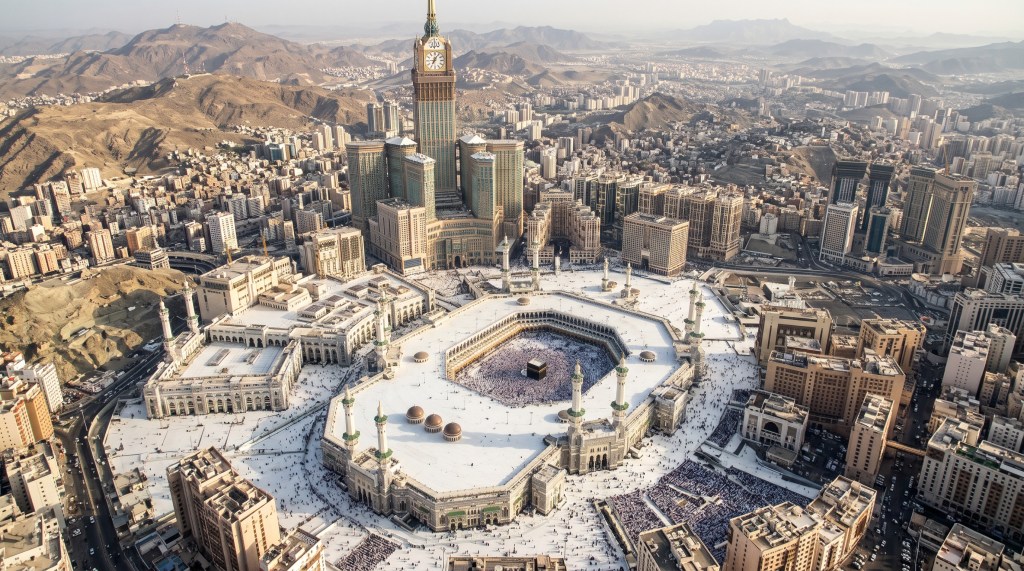
History has answered Abraham’s prayer that Mecca be made āmin (secure) with a lasting sanctuary, though not one that has never been broken. No outside empire has ever taken the city by force. The Elephant, the Crusaders, the Mongols and the Portuguese all failed to reach it. Yet the House was burned, plundered or seized again and again by Muslims themselves, in 683, 692, 930 and 1979. That suggests the Qur’an’s “security” is best read as a divine covenant that is also a human trust, not as a physical guarantee.
- The text: Qur’an 14:35–41 is Abraham’s sevenfold prayer:
- security for the city;
- freedom from idols for himself and his sons;
- the survival of Hagar and Ishmael in a “valley without cultivation”;
- hearts inclining toward them;
- provision;
- established prayer;
- forgiveness.
- The history:
- Abraha’s elephant campaign failed (c. 552–570 CE).
- The Prophet’s conquest of 630 was nearly bloodless and ended in a general amnesty.
- Reynald of Châtillon’s Red Sea fleet was destroyed in 1183.
- The Mamluks stopped the Mongols at ʿAyn Jālūt (1260), about 860 miles from Mecca.
- The Portuguese were driven off at Jeddah (1517).
- The “Mecca Defense pact in 2026”: This is a real treaty. Saudi Arabia, Turkey and Pakistan signed the Mecca (Makkah) Joint Defence Agreement in Mecca on 7 August 2026; it is now called the Mecca Defence Alliance.
- It builds on the Saudi–Pakistan defence agreement of September 2025.It was first invoked on 5 October 2026 against Houthi attacks on “the Kingdom, and holy sites.”Turkey’s parliament completed ratification on 5 November 2026.
Abstract
This commentary reads Sūrat Ibrāhīm 14:35–41, Abraham’s longest prayer in the Qur’an, verse by verse. It places the passage among related verses (2:125–129; 3:96–97; 28:57; 29:67; 95:3; 105; 106) and draws on classical and modern tafsīr. It then tests the central petition, rabbi-jʿal hādhā al-balada āminā (“My Lord, make this city secure”), against the historical record century by century, from the traditional founding by Abraham to the Mecca Joint Defence Agreement of 2026. Throughout, it draws on the essays of Zia H. Shah, MD, at thequran.love. Its argument is that Mecca’s security is real but relative:
- it has been remarkably free from conquest by outsiders;
- it has been troublingly open to sacrilege from within;
- it makes theological sense only if the promise is read as a covenant, binding on those who guard the sanctuary as well as describing the God who protects it.
Part I — The Text and Verse-by-Verse Commentary
Translations are my own renderings, informed by Abdel Haleem, Muhammad Asad and Saheeh International.
Setting
Sūrat Ibrāhīm is a late Meccan sūra. Wikipedia It was revealed while the Prophet’s community was being persecuted by the Quraysh, who were the custodians of the very House that Abraham built. The verses just before the prayer (14:28–34) condemn those who “exchanged God’s blessing for ingratitude.” Abraham’s prayer then comes as a rebuke from history. The founder of the Quraysh’s own sanctuary prayed against idols, for prayer, and for gratitude, and these are the three things the Quraysh had abandoned. Mawdūdī’s Tafhīm al-Qurʾān stresses this reading: the Quraysh’s peace and prosperity were the fruit of a monotheist’s prayer, and they were betraying it. myislam
Verse 35 — A secure city, free of idols
وَإِذْ قَالَ إِبْرَاهِيمُ رَبِّ اجْعَلْ هَٰذَا الْبَلَدَ آمِنًا وَاجْنُبْنِي وَبَنِيَّ أَن نَّعْبُدَ الْأَصْنَامَ
And [remember] when Abraham said: “My Lord, make this city secure, and keep me and my sons away from worshipping idols.” quran
Definite and indefinite. The parallel verse 2:126 reads hādhā baladan āminan, “make this a secure city,” with “city” indefinite. Verse 14:35 reads hādhā al-balada āminan, “make this city secure,” with “city” definite. Commentators conclude that 2:126 was spoken over an empty valley, asking that it become a city. Verse 14:35 was spoken later, over an existing town, asking that it remain secure. myislam The Shiʿi commentary An Enlightening Commentary into the Light of the Holy Qur’an draws the same distinction between two occasions. al-islam The thanks for Isaac in verse 39 supports placing this prayer on a later visit.
What “security” means. Ṭabarī stresses God’s protective decree. Rāzī lists the ways Mecca is secure, including God’s protection from the Army of the Elephant. thequran Qurṭubī, writing as a jurist, stresses the law of the sanctuary: no hunting, no felling of trees, no fighting, no seizing of a fugitive. The Enlightening Commentary states the realist position plainly. “To make it secure” means a law guaranteeing the city’s security, not a claim that Mecca has always been safe, “for, Mecca has been repeatedly invaded by hostile forces and immense blood has been shed there.” al-islam This split between a promise of providence and a covenant to be kept governs the historical assessment in Part IV.
Idols. Abraham, who broke the idols of his people (21:51–70), asks to be protected from what he has already rejected. Ibn Kathīr draws the moral that every believer should pray this prayer for himself and his children. The commentators do not miss the irony that the Kaaba would later hold some 360 idols until 630.
Verse 36 — The forbearance of Abraham
رَبِّ إِنَّهُنَّ أَضْلَلْنَ كَثِيرًا مِّنَ النَّاسِ ۖ فَمَن تَبِعَنِي فَإِنَّهُ مِنِّي ۖ وَمَنْ عَصَانِي فَإِنَّكَ غَفُورٌ رَّحِيمٌ
“My Lord, they have led many people astray. So whoever follows me is of me; and whoever disobeys me — You are surely Forgiving, Merciful.”
Abraham does not curse the disobedient; he hands them over to God’s mercy. This is the ḥilm (forbearance) the Qur’an praises in him (11:75). Ṣaḥīḥ Muslim reports that the Prophet recited this verse together with Jesus’ words in 5:118, then wept, “My community, my community.” God sent Gabriel with the promise: “We will please you regarding your community.” The verse thus links Abraham, Jesus and Muhammad in a shared stance of intercession. “Whoever follows me is of me” makes belonging to Abraham a matter of fidelity, not blood, as 3:68 also says.
Verse 37 — The uncultivated valley by the Sacred House
رَّبَّنَا إِنِّي أَسْكَنتُ مِن ذُرِّيَّتِي بِوَادٍ غَيْرِ ذِي زَرْعٍ عِندَ بَيْتِكَ الْمُحَرَّمِ رَبَّنَا لِيُقِيمُوا الصَّلَاةَ فَاجْعَلْ أَفْئِدَةً مِّنَ النَّاسِ تَهْوِي إِلَيْهِمْ وَارْزُقْهُم مِّنَ الثَّمَرَاتِ لَعَلَّهُمْ يَشْكُرُونَ
“Our Lord, I have settled some of my offspring in a valley without cultivation, by Your Sacred House — our Lord, that they may establish the prayer. So make the hearts of some people incline toward them, and provide them with fruits, that they may be grateful.” thequran
The scene. Ibn ʿAbbās’s long report in Ṣaḥīḥ al-Bukhārī (no. 3364) tells the story.
- Abraham left Hagar and the nursing Ishmael by the site of the House, with a bag of dates and a skin of water.
- Hagar asked again and again whether he would leave them in an empty valley. At last she asked whether God had commanded it. When he said yes, she answered: “Then He will not abandon us.”
- At the mountain pass, out of their sight, Abraham faced the House and prayed this verse.
Hagar’s running between Ṣafā and Marwa, the spring of Zamzam, and the arrival of the Jurhum followed. thequran Every pilgrim’s saʿy re-enacts a mother’s trust. thequran
Key phrases.
- “Some of my offspring” (min dhurriyyatī). The phrase points to Ishmael’s line; Jalālayn names Ishmael and Hagar. surahquran Isaac’s line would inherit Canaan. muslimacoaching
- “By Your Sacred House” (ʿinda baytika al-muḥarram). Jalālayn notes the House “had been there since before the Flood.” surahquran Ṭabarī, quoted by Ibn Kathīr, links the prayer clause to the sacredness: God made the House sacred “so that people establish the prayer next to it.” quranmazid Sanctity exists for worship, and security exists for sanctity.
- “Hearts of some people” (afʾidatan mina al-nās). Ibn ʿAbbās, Mujāhid and Saʿīd ibn Jubayr held that if Abraham had said “the hearts of mankind,” then “Persians, Romans, the Jews, the Christians and all other people would have gathered around it.” quranmazid Asad, following Baghawī, Rāzī and Ibn Kathīr, glosses the phrase as hearts “desirous of visiting them — namely, on pilgrimage to Mecca — and thus help them to maintain themselves in the holy but barren land.” alim The verb tahwī suggests hearts falling toward Mecca with longing. Today some 2.0 billion Muslims, by the Pew Research Center’s count for 2020, turn toward the valley in prayer each day, so the image of gravity has become a demographic fact.
- “Provide them with fruits.” Mawdūdī explains the provision as coming through trade. myislammyislam The Qur’an records the answer in 28:57: “a secure sanctuary to which fruits of every kind are brought.” The sanctity of the ḥaram and the sacred months is what made a market possible where nothing grew. newageislam Security and provision are causally linked, in the same order as the prayer.
- “That they may be grateful.” This echoes the sūra’s theme: “if you are grateful, I will surely increase you” (14:7).
Shah’s reading. In “Mecca from Barren Valley to Global Axis” (11 April 2026; https://thequran.love/2026/04/11/mecca-from-barren-valley-to-global-axis/), Shah argues that Abraham settled his family in a wilderness so that their survival and the city’s growth would be seen as a direct act of divine grace. On his reading, “make people’s hearts turn to them” was a prophecy of Mecca as a global spiritual magnet. thequran The city’s very survival is a sign of the “Lord of this City” (27:91). thequran In “Monotheism and Success of Hajj Prophesied Some 4000 Years Ago” (12 April 2025; https://thequran.love/2025/04/12/monotheism-and-success-of-hajj-prophesied-some-4000-years-ago/), he reads the command to proclaim the pilgrimage (22:26–27) as a prophecy fulfilled by the multinational Hajj. thequran
Verse 38 — God knows what we hide
رَبَّنَا إِنَّكَ تَعْلَمُ مَا نُخْفِي وَمَا نُعْلِنُ ۗ وَمَا يَخْفَىٰ عَلَى اللَّهِ مِن شَيْءٍ فِي الْأَرْضِ وَلَا فِي السَّمَاءِ
“Our Lord, You know what we conceal and what we disclose; nothing whatever is hidden from God, on earth or in the heavens.”
After the outward requests comes an inward confession. Commentators suggest that what Abraham concealed was his grief at leaving his wife and child, the grief he would not show Hagar. Rāzī reads the verse as tafwīḍ, handing the matter over to God. Because God knows the need better than words can state it, the prayer becomes trust rather than instruction. The last clause may be God’s own voice completing Abraham’s words, a pattern found elsewhere in the Qur’an. A physician may notice the order: the presenting complaints come first, and the hidden pain is named afterwards and given to the One who already knows it.
Verse 39 — Ishmael and Isaac in old age
الْحَمْدُ لِلَّهِ الَّذِي وَهَبَ لِي عَلَى الْكِبَرِ إِسْمَاعِيلَ وَإِسْحَاقَ ۚ إِنَّ رَبِّي لَسَمِيعُ الدُّعَاءِ
“Praise be to God, who has granted me, despite old age, Ishmael and Isaac. Truly my Lord hears prayer.”
Genesis puts Abraham at 86 when Ishmael was born and 100 when Isaac was born (16:16; 21:5). Ishmael, the son of the valley, is named first. One act of praise binds the Arab and Israelite lines together as answered prayers. Samīʿ al-duʿāʾ (“Hearer of prayer”) is the turning point: a God who answered with children in old age can be trusted with the city. Shah’s May 2026 commentaries on Qur’an 37:99–111 give this gratitude its full weight: “Surah Saffat: Abraham’s Dream and Ishmael’s Sacrifice” (22 May 2026; https://thequran.love/2026/05/22/surah-saffat-abrahams-dream-and-ishmaels-sacrifice/) and “The Knife That Did Not Fall” (23 May 2026; https://thequran.love/2026/05/23/the-knife-that-did-not-fall-a-historical-philosophical-and-theological-commentary-on-quran-3799-111/). thequran The child given in old age was also the child offered back to God, and returned.
Verse 40 — Establishing prayer
رَبِّ اجْعَلْنِي مُقِيمَ الصَّلَاةِ وَمِن ذُرِّيَّتِي ۚ رَبَّنَا وَتَقَبَّلْ دُعَاءِ
“My Lord, make me one who establishes the prayer, and [some] of my offspring too. Our Lord, and accept my supplication.”
The verse turns the purpose stated in verse 37 back on Abraham himself. The word “some” appears again, because Abraham has been told that “My covenant does not extend to the wrongdoers” (2:124). Iqāma means establishing prayer, not just performing it: building a community in which prayer stands upright and lasts. The Masjid al-Ḥarām, where prayer has been offered almost without break for fourteen centuries, is the architectural answer to this verse. “Accept my supplication” echoes rabbanā taqabbal minnā, “Our Lord, accept from us,” spoken while the House was being raised (2:127).
Verse 41 — Forgiveness on the Day of Reckoning
رَبَّنَا اغْفِرْ لِي وَلِوَالِدَيَّ وَلِلْمُؤْمِنِينَ يَوْمَ يَقُومُ الْحِسَابُ
“Our Lord, forgive me and my parents and the believers on the Day when the Reckoning is established.” al-islam
Muslims recite this verse at the end of countless prayers. It raises a problem, because 9:114 says Abraham disowned his idolatrous father “when it became clear to him that he was an enemy of God.” Ṭabarī, Ibn Kathīr and Rāzī solve it by chronology: Abraham made this prayer before that became clear. A variant reading, wa-li-waladayya (“my two sons”), is recorded in the tafsīr literature but not adopted. The prayer moves from the earthly city to the Day of Reckoning. Security here is temporal and relative; forgiveness there is ultimate.
The Qur’anic network of the secure city
| Passage | Core statement | Relevance |
|---|---|---|
| 2:125 | The House as “a place of return for people and a [place of] security” | Security as a divine institution tied to worship |
| 2:126 | “Make this a secure city and provide its people with fruits” | Earlier form of the prayer |
| 2:127–129 | Abraham and Ishmael raise the House; pray for a messenger “from among them” | Read by Muslims as fulfilled in Muhammad |
| 3:96–97 | “The first House… at Bakka… whoever enters it is safe” | Security as both description and norm |
| 28:57 | “A secure sanctuary to which fruits of every kind are brought” | Answer to the prayer for fruits |
| 29:67 | “A secure sanctuary, while people are being snatched away all around them” | Relative security amid Arabian violence |
| 95:3 | “And by this secure city” | God swears by the city |
| 105:1–5 | The Companions of the Elephant destroyed | The test case of divine defense |
| 106:1–4 | The Lord of this House “fed them against hunger and secured them from fear” | Security and provision joined |
| 48:24 | “He withheld their hands from you… within Mecca” | Restraint at Ḥudaybiyya |
Shah’s “The Sacred City and Its Lord: A Comprehensive Commentary on Quran 27:91” (11 April 2026; https://thequran.love/2026/04/11/the-sacred-city-and-its-lord-a-comprehensive-commentary-on-quran-2791/) builds exactly this network. He argues that Sūrat al-Fīl supplies the evidence for God having “made it inviolable”: “The sanctity of Mecca is not abstract theology — it is demonstrated history.” He also cites Jalālayn’s gloss of Mecca as a sanctuary “in which no human blood may be shed, no person may be wronged, none of its prey may be hunted.” thequran
Part II — A Century-by-Century History of Mecca’s Security
A caution first. The founding by Abraham belongs to scripture and tradition, not archaeology. No excavation has been allowed in the Ḥaram, and sources on western Arabia before the sixth century CE are sparse.
c. 2000–1800 BCE — The traditional founding. Tradition places in the patriarchal age the settling of Hagar and Ishmael, the spring of Zamzam, the building of the House, and the arrival of the Yemeni Jurhum, among whom Ishmael married. Wikipedia
c. 1800 BCE – 1st century BCE — Jurhum and Khuzāʿa (tradition). Ibn Isḥāq and al-Azraqī report that the Jurhum abused the sanctuary and were expelled by the Khuzāʿa. Under the Khuzāʿī chief ʿAmr ibn Luḥayy, the tradition says, idols such as Hubal were brought into the Ḥaram. Abraham’s two requests in 14:35, security and freedom from idols, turned out to be separable in history: the sanctuary outlived its monotheism.
1st century BCE — Diodorus Siculus (contested). Diodorus (3.44), drawing on Agatharchides, describes a temple on Arabia’s Red Sea coast “very holy and exceedingly revered by all Arabians.” Gibbon read this as the Kaaba. Ian D. Morris argues that Diodorus places it too far north. Wikipedia The passage is suggestive, not proof.
2nd century CE — Ptolemy’s Macoraba (contested). Ptolemy lists a Macoraba in Arabia Felix. Bowersock reads it as Makkah plus the Aramaic rabb (“great”). Patricia Crone rejected the link outright: “the name Macoraba has nothing to do with that of Mecca.” Wikipedia Classical geography may know Mecca, but that cannot be proved.
5th century — Quṣayy and Quraysh. Quṣayy ibn Kilāb took custodianship from the Khuzāʿa, settled the Quraysh clans in the valley, and created the offices of the sanctuary: the council house (Dār al-Nadwa), feeding and watering pilgrims (rifāda, siqāya), and keeping the keys (ḥijāba). The secure city became an organized polity whose legitimacy rested on hosting pilgrims safely.
6th century — Īlāf, the Elephant, and the rebuilding. Tradition credits Hāshim, the Prophet’s great-grandfather, with the caravan pacts (īlāf) behind Sūra 106.
- The Elephant campaign. According to Ibn Isḥāq, Abraha, the Aksumite Christian ruler of Yemen, built a cathedral at Ṣanʿāʾ to draw the Arab pilgrimage away from Mecca. After it was defiled, he marched on Mecca with a war elephant. ʿAbd al-Muṭṭalib asked only for his seized camels, saying the House had a Lord who would protect it. The elephant knelt at the edge of the sanctuary, and the army was destroyed by “birds in flocks, pelting them with stones of baked clay” (105:3–4). methodfield
- Epigraphy. Abraha’s inscriptions establish him as a historical figure. Ry 506 (Murayghān 1) opens “By the power of the Merciful One and His Messiah.” It records his fourth raid on Maʿadd and the submission of ʿAmr son of al-Mundhir, dated 662 of the Ḥimyarite era, which is 552 CE. Kister identified this campaign with the Elephant expedition, and Christian Robin re-examined the inscription in Jerusalem Studies in Arabic and Islam 39 (2012). islamichistory A fragmentary inscription, Bāriqī-Robin-Nāʿiṭ 1, may mention elephants. Wikipedia No inscription names Mecca or records a defeat. answering-islam
- The dating problem. Abraha’s dated inscriptions belong to the 550s, and he was probably dead by 570. Proposed dates for the campaign therefore run from 552 to 568–569. methodfield This unsettles the traditional linking of the campaign with the Prophet’s birth (c. 570), not the event itself.
- Before Islam. The Ḥarb al-Fijār (“sacrilegious war”) was named for violating the sacred months. Around 605 the Kaaba was rebuilt after floods, and the young Muhammad averted bloodshed among the clans by having them lift the Black Stone together on a cloth.
7th century — Ḥudaybiyya, the peaceful conquest, and the first siege.
- Ḥudaybiyya (628). The treaty of Ḥudaybiyya averted fighting at the edge of the sanctuary (48:24). thequran
- The conquest (Ramaḍān 8 AH, January 630). After Quraysh’s allies broke the truce, the Prophet marched with about 10,000 men. Wikipedia He declared safe anyone who entered Abū Sufyān’s house, stayed behind a closed door, or entered the Sacred Mosque. The only real fighting was at al-Khandama, where a band under ʿIkrima and Ṣafwān attacked Khālid ibn al-Walīd’s column. Accounts based on Ibn Hishām count about a dozen attackers and two Muslims killed. makkahlive The Prophet cleared the idols, reciting “Truth has come and falsehood has vanished” (17:81). He then pardoned the Quraysh, who had fought him for two decades: “Go, you are free,” echoing Joseph’s “No blame upon you today” (12:92). About ten people were excepted, and several were later pardoned. makkahlive
- The Prophet’s sermon. In al-Bukhārī’s report, he declared that God made Mecca sacred on the day He created the heavens and the earth. Fighting there had been permitted to him only “for an hour of a day,” and its sanctity had then returned. The one military entry Islam regards as legitimate was thus unique, nearly bloodless, and ended in forgiveness. The tradition also candidly records the Prophet’s disavowal of Khālid’s killing of the Banū Jadhīma outside Mecca: “O God, I am innocent of what Khālid has done” (al-Bukhārī 4339). makkahlive
- Shah on the conquest. In “The Kaaba, Hajj, and Divine Signs” (16 July 2025; https://thequran.love/2025/07/16/the-kaaba-hajj-and-divine-signs-from-abraham-to-the-prophet-muhammad/), Shah reads Abraham, Zamzam, the Year of the Elephant and the “peaceful conquest of Mecca in 630 CE” as one chain of divine signs. thequranthequran
- The first siege (683). Ibn al-Zubayr refused allegiance to Yazīd and took refuge in the sanctuary. After sacking Medina at al-Ḥarra, a Syrian army under Ḥuṣayn ibn Numayr besieged Mecca from 24 September 683, bombarding it with catapults. WikipediaWikipedia On 31 October the Kaaba caught fire and burned, and the Black Stone split. Wikipediafandom The siege ended when news of Yazīd’s death arrived. Wikipediatheislamicinformation Shah’s “Yazid’s Army and Mecca” (12 April 2026; https://thequran.love/2026/04/12/yazids-army-and-mecca/) records the episode. thequran
- The second siege (692). ʿAbd al-Malik sent al-Ḥajjāj with 2,000 troops, ordered at first to negotiate and avoid bloodshed. From 25 March 692 al-Ḥajjāj besieged the city for six to seven months, with catapults on Mount Abū Qubays. Wikipedia + 2 Ibn al-Zubayr, in his seventies, died fighting, and al-Ḥajjāj rebuilt the Kaaba to the earlier Qurayshī plan. anuruthjohnston The House had now been burned and bombarded by a caliph’s armies, not by pagans.
8th century — The Abbasids. The revolution of 750 passed Mecca without a siege. Al-Mahdī enlarged the Sacred Mosque. Zubayda, wife of Hārūn al-Rashīd, paid for the pilgrim road from Iraq and the ʿAyn Zubayda aqueduct, a literal answer to the prayer for provision in a waterless valley. The crushing of an Alid revolt at Fakhkh near Mecca (786) showed that the city’s surroundings could still see dynastic violence.
9th century — Civil war. During the war between al-Amīn and al-Maʾmūn, Alid insurgents briefly held Mecca (c. 815). Such brief political captures without damage to the House were the “normal” insecurity of a sacred city inside imperial politics.
10th century — The Qarmaṭian sack and the Sharifate. On 11 January 930, during the Hajj, the Qarmaṭians of Baḥrayn under Abū Ṭāhir al-Jannābī entered the city as if they were pilgrims and massacred the worshippers. muslimmatters + 2 For eight to eleven days they plundered the city, threw corpses into Zamzam, and carried the Black Stone off to al-Aḥsāʾ. fandomWikipedia Later reports give about 30,000 dead, a figure best treated as traditional. muslimmattersWikipedia The Stone was returned in 951 (some say 952) after a peace with the Abbasids. Wikipedia + 3 God did not defend the House by miracle this time, yet the pilgrims went on venerating the empty corner, and the plan to move the pilgrimage elsewhere failed. Wikipedia In the 960s a Ḥasanid sharif, Jaʿfar ibn Muḥammad, became emir of Mecca, founding the Sharifate that lasted until 1925. WikipediaWikipedia
11th century — Fatimid–Abbasid rivalry. The Friday sermon in Mecca was read for Cairo or for Baghdad, depending on which power paid the subsidies. Wikipedia The Ṣulayḥids of Yemen briefly took control in the 1060s. The insecurity of this century was economic and political rather than sacrilege.
12th century — Reynald of Châtillon. The Ayyubids brought the Hijaz into their orbit in the 1170s. Wikipedia In late 1182 Reynald, lord of Transjordan, had prefabricated ships carried overland to the Gulf of ʿAqaba. nucleos
- For about three months his fleet raided ports including ʿAydhāb, took roughly twenty ships, and landed raiders on the Hijaz coast between Medina and Mecca. defenderofjerusalem
- Al-ʿĀdil had warships carried to the Red Sea. The admiral Ḥusām al-Dīn Luʾluʾ destroyed the fleet in February 1183 and captured nearly all the raiders. Two of them were executed at Mina before the pilgrims. defenderofjerusalemnucleos
- Alex Mallett’s study “A trip down the Red Sea with Reynald of Châtillon” (Journal of the Royal Asiatic Society 18, no. 2, 2008) sets out “to establish whether, indeed, Reynald even did try to attack the holy cities of Islam.”
The closest any Crusader force came to Mecca ended in its destruction. Saladin executed Reynald himself after Ḥaṭṭīn (1187). battlefieldtravels
13th century — How Mecca escaped the Mongols. In February 1258 Hülegü sacked Baghdad and killed the Caliph al-Mustaʿṣim, ending the 508-year Abbasid caliphate. Aleppo and Damascus fell in 1260, and Mongol patrols reached Gaza. thequran Mecca was spared by a combination of causes:
- Distance and desert. Mecca lies about 860 miles south of the Syrian front, across country that could not feed a horse-borne army. thequran
- The death of Möngke (1259). It pulled Hülegü east with most of his army. thequran
- ʿAyn Jālūt (3 September 1260). The Mamluks under Quṭuz and Baybars defeated Kitbuqa there, and the Mongols withdrew from the Levant. Wikipedia
- Berke Khan. The Golden Horde ruler, who had converted to Islam at Bukhara in 1252, was enraged by the fall of Baghdad. He allied with Baybars in 1261, and his war with Hülegü in the Caucasus delayed any new invasion. Wikipedia + 2
- The Mamluk barrier. Between 1260 and 1303 the Mamluks fought six major battles against the Mongols and lost only one, Wādī al-Khaznadār (1299). thequran They won at Homs (1281) and Marj al-Ṣuffar (1303). WikipediaWikipedia The Mongols never got further south than Gaza. thequran
- Mamluk legitimacy. Baybars revived a shadow Abbasid caliphate in Cairo and made protection of the two holy cities a pillar of Mamluk prestige. thinkafrica
- Conversion. Ghāzān’s conversion (1295) and Özbeg’s Islamization of the Golden Horde turned the destroyers of the caliphate into patrons of Islam. thelastdialogue
Shah’s essay “The Mongol storm that never reached Mecca” (12 April 2026; https://thequran.love/2026/04/12/the-mongol-storm-that-never-reached-mecca/) argues that Mecca was “never directly threatened, besieged, or occupied” and that the Hajj continued uninterrupted. He adds that the catastrophe still sent “profound indirect tremors”: the Iraqi pilgrim route was cut, trade shifted toward Jeddah, and Mecca rose as the main source of legitimacy for Muslim rulers. thequran His “Berke Khan: The Mongol Prince Who Changed the Course of Islam” (12 April 2026; https://thequran.love/2026/04/12/berke-khan-the-mongol-prince-who-changed-the-course-of-islam/) presents Berke as turning Golden Horde power into a shield for Islam. thequran The century repeats the pattern of Sūrat al-Fīl in historical rather than miraculous form: geography, a timely death, an army and a conversion took the place of the birds.
14th century — The last Mongol shadow. The Ilkhan Öljeitü backed a dissident sharif, Ḥumayḍa, but a planned intervention in the Hijaz came to nothing after he died in 1316, and peace followed around 1323. Ibn Baṭṭūṭa, in Mecca in 1326, found a flourishing city of scholars. The dangers that remained were feuds among the sharifs and Bedouin raids.
15th century — Mamluk consolidation. Timur sacked Damascus in 1400–01 but turned away from Arabia. Barsbāy took over the customs of Jeddah (1425), and Qāytbāy endowed a madrasa beside the Ḥaram. thequran
16th century — The Portuguese and the Ottoman shield. After 1498 the Portuguese tried to choke the Red Sea trade. thinkafrica Amīr Ḥusayn al-Kurdī had fortified Jeddah since 1506. On Easter Day, 12 April 1517, Selman Reis drove off Lopo Soares de Albergaria’s fleet there. Wikipedia + 2 That same year Selim I destroyed the Mamluk state. Sharif Barakāt II sent his 12-year-old son Abū Numayy II to Cairo with the keys of the Kaaba, and Selim took the title Khādim al-Ḥaramayn al-Sharīfayn, “Servant of the Two Noble Sanctuaries,” in preference to “ruler.” Sinan renovated the Ḥaram in 1570–71. thequran Shah’s “Four centuries as servants of the sanctuary” (12 April 2026; https://thequran.love/2026/04/12/four-centuries-as-servants-of-the-sanctuary-ottoman-rule-over-mecca-and-medina/) argues three points:
- the Ottomans ruled from 1517 to 1919 by balancing imperial sovereignty against the sharifs’ autonomy; thequran
- no battle had to be fought for the Hijaz; thequran
- guarding the holy cities was the heart of the Ottoman claim to the caliphate. thequran
He closes on “the burden of custodianship.” thequran
17th century — Flood and rebuilding. After the flood of 1629–30, Murad IV rebuilt the Kaaba, its last full reconstruction. thequran Feuds among the sharifs continued, but no outside power came near. thequran
18th century — Danger on the roads. The Banī Ṣakhr raid on the 1757 Syrian caravan, which Shah’s Ottoman essay says killed some 20,000 pilgrims, showed that the sanctuary’s security stopped at its approaches. Wikipediathequran In Najd, the 1744 pact between Muḥammad ibn ʿAbd al-Wahhāb and Muḥammad ibn Saʿūd founded the first Saudi state. Wikipedia
19th century — Wahhabis, Muḥammad ʿAlī, epidemics. Saudi forces first entered Mecca in 1803 and held it again from 1806, after taking Medina in 1804. They razed tomb domes and barred the Syrian and Egyptian caravans. Wikipedia Muḥammad ʿAlī’s son Ṭūsūn landed at Yanbuʿ in October 1811 with some 14,000–20,000 men, retook Medina in 1812 and Mecca in January 1813, and Ibrāhīm Pasha destroyed Dirʿiyya in 1818. Wikipedia + 2 Later, the cholera of 1865 spread from the Hajj to the Mediterranean. It led to the International Sanitary Conference of Constantinople (1866), which made the Hajj a concern of international public health, a kind of “security” that would be obvious to a modern physician.
20th century — Revolt, conquest, seizure, riot.
- The Arab Revolt (1916). In June 1916 Sharif Ḥusayn launched the revolt from Mecca, and the Ottoman garrison surrendered in July after fighting in the city. Shah’s essay describes this as the cutting of a four-century bond. thequran
- The Saudi takeover (1924). After the Ikhwan massacre at Ṭāʾif in September 1924, King Ḥusayn abdicated. Mecca fell without resistance on 13 October 1924, and ʿAbd al-ʿAzīz Ibn Saʿūd entered later; sources date his own entry to early December. Jeddah fell in December 1925, ending the Sharifate. omniatlas + 3
- The Grand Mosque seizure (20 November – 4 December 1979). Juhaymān al-ʿUtaybī and several hundred armed followers seized the Masjid al-Ḥaram and proclaimed Muḥammad al-Qaḥṭānī the Mahdī. Saudi forces, with gas supplied by French advisers, retook the mosque. The toll was 127 troops and 117 insurgents killed, and 68 insurgents were later executed. WikipediaWikipedia It was the first fighting inside the Ḥaram since 930, and again the attackers were Muslims claiming to purify it.
- The 1987 clash (31 July 1987). An Iranian Hajj demonstration clashed with Saudi security forces. Riyadh reported 402 dead (275 Iranian pilgrims, 85 Saudi police and citizens, 42 other pilgrims), and Tehran called it a massacre. csmonitor + 2
- Disasters. The 1990 tunnel crush killed 1,426. The 1997 Mina fire killed 343. In 2015 a crane collapse killed 111, and the Mina crush that followed killed 2,411 by an AP count. Wikipedia + 2 These were failures of crowd management, not violence, but they belong in any honest record of safety.
21st century — Custodianship and missiles. King Fahd adopted the title “Custodian of the Two Holy Mosques” in 1986. Shah’s 27:91 commentary notes the 1,972-foot Abraj al-Bait tower and the King Salman Gate project, which, as announced by Crown Prince Mohammed bin Salman on 15 October 2025, provides capacity for approximately 900,000 worshippers in its indoor prayer halls and outdoor courtyards. He calls modern Mecca “a modern fusion of theology, bureaucracy, security policy, and health governance.” In “The Eternal Sanctuary” (8 February 2026; https://thequran.love/2026/02/08/the-eternal-sanctuary-a-comprehensive-history-and-demographic-evolution-of-the-kaaba-from-primordial-origins-to-the-high-tech-era/), he observes that Mecca “remained largely insulated from military spillover” despite wars in Iraq, Syria, Yemen and Gaza. thequran
That insulation has been tested:
- July 2017. The Saudi-led coalition reported a Houthi missile aimed toward Mecca. abc
- September 2026. It said it shot down a Houthi drone south of Mecca and called the holy sites’ security “a red line.” abc
- 24 October 2026. Saudi Civil Defence reported intercepting two ballistic missiles fired toward Mecca and Medina, with debris falling in Wadi al-Mughammas in Mecca and in Jeddah, Taif and Rabigh. GCC Secretary-General Jasem AlBudaiwi called the strikes “a grave violation of the sanctity of the Holy Sites.” theweek + 2
The Houthis deny targeting holy sites and call the accusation “the biggest lie of our time.” Israeli analyst Yoel Guzansky notes that Riyadh has an interest in that framing. ynetnews The interceptions are documented; the intended targets are disputed.
Part III — What the “Mecca Defense Pact in 2026” Is
The treaty. The Mecca (Makkah) Joint Defence Agreement was signed on 7 August 2026 at Al-Ṣafā Palace in Mecca by Crown Prince Mohammed bin Salman, President Recep Tayyip Erdoğan and Prime Minister Shehbaz Sharif. Wikipedia + 2 Sharif, with army chief Field Marshal Asim Munir, had performed ʿumra in Mecca. thequran The pact is now called the Mecca Defence Alliance. It extends the Saudi–Pakistan Strategic Mutual Defence Agreement of 17 September 2025 to include Turkey. By mid-2026, Reuters reported on 18 May 2026, Pakistan had about 8,000 troops, a squadron of about 16 JF-17 jets, two drone squadrons and a Chinese HQ-9 air-defence system in Saudi Arabia; Outlook India, citing the Saudi defence ministry, gave about 13,000 troops and 10 to 18 jets.
Context. The pact was signed during the 2026 Iran war, which began on 28 February 2026 with U.S. and Israeli strikes. Wikipediawsws Iran and allied forces, including the Houthis, struck Gulf states, and Iran’s closure of the Strait of Hormuz set off a global fuel crisis. Turkish Foreign Minister Hakan Fidan said the pact had been in preparation for nearly two years and eight months. thequran
Terms. The joint statement says “any armed attack against any one of the three States shall be regarded as an attack against them all.” alarabiya + 2 Middle East Eye summarized the 16-article text as follows: Wikipedia + 2
- Members must give “immediate assistance,” but its scope follows “an objective assessment” under Article 51 of the UN Charter and “within the limits of their available resources.” Wikipedia
- Fidan said a member under attack must request help and say what it needs, which is more conditional than NATO’s automatic Article 5, though he called the pact “technically… the same.” thequran
- Cooperation covers joint defence production and R&D, intelligence sharing, logistics, counter-terrorism and joint exercises. Wikipedia
- A Strategic Political and Defence Committee of foreign ministers, defence ministers and chiefs of staff meets twice a year. wswsWikipedia
- A secretariat in Saudi Arabia is headed by a rotating secretary-general, the first a Pakistani (reported as Lt. Gen. Nauman Mahmood). Wikipedia
- New members join by consensus, and no member may withdraw for ten years. Wikipedia
- Fidan stressed that “there is no common threat that we have put in writing.” thequran
Britannica says the exact provisions are not publicly known, britannica while the press has summarized the text article by article from the version sent to Turkey’s parliament. The full text has not been officially published, but its content is now largely known. Wikipedia
Scale. Citing the 2026 Global Firepower Index, Al Jazeera reported that the three states together have nearly 1.4 million active personnel, 3,400 aircraft, 6,000 tanks and more than 340 naval assets. The alliance joins a leading oil exporter, NATO’s second-largest army and the Muslim world’s only nuclear power. bssnewsAl Jazeera Saudi officials said the pact is not linked to the kingdom’s nuclear ambitions. britannica
Invocation and ratification.
- 10 September 2026. Pakistan said it was not considering an immediate military response to Houthi attacks. Harvard’s Rabia Akhtar recalls that Pakistan earlier declined to join the war in Yemen. WikipediaWikipedia
- 5 October 2026. At an emergency meeting in Riyadh, the three states agreed to activate “collective deterrence measures” and send forces quickly to Saudi Arabia. al-monitorwsws Saudi Defence Minister Khalid bin Salman spoke of confronting “the heinous attacks against the Kingdom, and holy sites.” Al Jazeera
- October 2026. Saudi Arabia ratified the pact, and Pakistan completed ratification on 23 October. Wikipedia
- 5 November 2026. Turkey’s parliament approved it 279 to 119, with the Yeni Party and the DEM Party opposed for fear of entanglement, including in a future India–Pakistan war. Wikipedia lists the pact as effective from that date. Wikipedia RIA Novosti reported that Turkey’s entry into force still awaited the president’s signature. Al-Monitor expects any Turkish deployment to be limited to training, advice and equipment. nampa + 3
Expansion. Fidan called Egypt a “natural partner,” though Cairo reportedly does not see joining as a priority. thequran Bangladesh’s foreign minister said Dhaka would consider joining “positively” if invited, which Shah reposted on 28 August 2026 (https://thequran.love/2026/08/28/bangladesh-to-positively-consider-joining-makkah-pact-if-invited-foreign-minister/). thequran At the end of October Syria was reportedly considering membership. Wikipedia
Assessments.
- Nawaf Obaid calls the pact “the beginning of the post-American Middle East,” and CFR’s Steven A. Cook writes (13 August 2026) that “it is no longer possible to talk about a U.S.-led order in the Middle East.”
- The Arab Center Washington DC calls it “diversification without substitution.” U.S. weapons, intelligence and integrated air defence remain built into Saudi capabilities, and the pact “is best read as a sign of anxiety.” arabcenterdc
- Iran at first called for Muslim self-reliance, then sharpened its criticism after the October invocation. Wikipediathequran
My judgment is that the pact is real but lightly tested. Its near-term value lies in defence-industrial integration and Pakistan’s air-defence presence, not in automatic obligations to fight.
Is it a pact to defend Mecca? Not formally. alarabiyamiddleeasteye It covers the three states’ territories in general. But its first invocation cited attacks on “holy sites,” and it was signed where it was for the symbolism. Al Jazeera noted that “sealing the agreement in Mecca, home to Islam’s holiest site, adds symbolic heft.” thequran
Shah’s framing. Two thequran.love essays dated 11 August 2026 frame the pact, both “presented for” Zia H. Shah. “And by This Secure City” (https://thequran.love/2026/08/11/and-by-this-secure-city-the-mecca-joint-defense-agreement-and-the-theology-of-a-sanctuary/) adopts Shah’s reading of 95:3. Choosing Mecca was “a human echo of a divine theme,” not the concordist “fulfillment” of scripture, and Mecca’s security is “both a divine gift and a human trust.” thequran “The Mecca Joint Defense Agreement” (https://thequran.love/2026/08/11/the-mecca-joint-defense-agreement/) insists that “Mecca does not sanctify the treaty.” It warns against military spending that starves education, medicine, housing and food security, and so ties Abraham’s joint request for security and provision to a security policy that must feed people as well as defend them. thequran
Part IV — Assessment: Relative Security as an Answer to the Prayer
| Date | Event | Perpetrator | Effect on sanctuary |
|---|---|---|---|
| c. 552–570 | Elephant campaign | Aksumite-Yemeni | None; failed |
| 683 | First Umayyad siege | Muslim | Kaaba burned |
| 692 | Al-Ḥajjāj’s siege | Muslim | Kaaba bombarded |
| 930 | Qarmaṭian sack | Muslim sectarian | Massacre; Black Stone stolen |
| 1182–83 | Reynald’s raid | Crusader | None; fleet destroyed |
| 1258–1303 | Mongols | Mongol | None; stopped ~860 miles away |
| 1517 | Portuguese at Jeddah | European | None; repelled |
| 1803–1813 | Saudi-Wahhabi occupation | Muslim | Tomb domes razed; caravans barred |
| 1916 / 1924 | Arab Revolt; Saudi takeover | Muslim | Fighting (1916); fell without resistance (1924) |
| 1979 | Grand Mosque seizure | Muslim | Two-week siege in the Ḥaram |
| 1987 | Iranian clash | Muslim | 402 dead |
| 2017–2026 | Missiles and drones | Houthi (denied) | Intercepted |
1. Mecca’s immunity from outsiders is real and remarkable. No non-Muslim power has ever taken Mecca by force. Part of the reason is natural: distance, aridity, and no strategic resources before oil. Part is political: the Ayyubid, Mamluk, Ottoman and Saudi states each drew legitimacy from the two holy cities and defended them. The Qur’an itself shows God protecting through secondary causes (the birds of 105, the caravan pacts of 106, the restraint of 48:24), so the believer’s providence and the historian’s structural incentives need not compete.
2. Violation from within is the recurring pattern. Every burning, bombardment, plundering or armed seizure of the House was carried out by people who prayed toward it. This supports reading 14:35 and 3:97 as a command entrusted to the faithful, as the Enlightening Commentary insists. al-islam It also matches the Prophet’s warning, reported in al-Bukhārī, that the Kaaba will one day be destroyed by “Dhū al-Suwayqatayn” from Abyssinia. God guarantees the sanctuary’s centrality and sanctity; its safety is entrusted to human beings.
3. The sanctuary’s centrality has outlasted its stones. The Qarmaṭians failed to move the pilgrimage, al-Ḥajjāj rebuilt what he had bombarded, and Juhaymān’s siege ended in the mosque’s restoration. Of Abraham’s requests, the one answered most completely is not security but the turning of hearts, afʾidatan… tahwī ilayhim.
4. Security and provision rise and fall together. The worst insecurity (930, the caravan raids, the Wahhabi interruption) brought scarcity. The great periods of patronage brought plenty. The order of 14:35–37 holds as a causal chain.
5. The 2026 pact is an echo, not a fulfillment. Mecca’s dangers have mostly come from inside the Muslim world, and the pact’s first adversary is itself a Muslim movement. The alliance will honour the place where it was signed only if it reduces violence between Muslims rather than hardening it along sectarian lines.
Thematic Epilogue: The Prayer and the Trust
A man stands at a mountain pass, out of sight of the woman and child he has left in a waterless valley. He does not ask for walls or armies. He asks that the place be secure, that his children be kept from idols, that they establish prayer, and that some human hearts fall toward them with longing. He asks that they be fed, that God, who sees what he hides, accept his grief, and that on the Day of Reckoning he, his parents and the believers be forgiven.
Four thousand years later, the valley holds one of the largest buildings on earth, and three states have pledged in its name that an attack on one is an attack on all. Between the prayer and the pact lies a history that neither naïve piety nor cynical scholarship captures. Empires came and went around Mecca without taking it. The Elephant faltered at its edge, the Crusader ships burned in the Red Sea, the Mongols were stopped at ʿAyn Jālūt, and the Portuguese turned back at Jeddah. Yet a caliph’s catapults burned the House, sectarians robbed it of its Stone, and the followers of a self-proclaimed Mahdī held it at gunpoint. All of them prayed toward it.
The history teaches what the text teaches: Abraham’s requests are not a single guarantee but a structure of trust. God answers by making the sanctuary central, sacred and impossible to ignore, and human beings are charged with keeping it safe. When the faithful kept that trust the city was secure: at Ḥudaybiyya, at the Conquest with its amnesty, under the Mamluk shield and the Ottoman “servants.” When they broke it, the sanctuary bled.
Shah is right that the Mecca agreement is a “human echo of a divine theme,” and that “Mecca does not sanctify the treaty.” No treaty can confer the city’s security; each generation either keeps that covenant or betrays it. The truest defense of al-balad al-amīn is not air-defence batteries, valuable as they are, but the spirit of verse 36. Facing those who would turn away from him, the prophet said only: “And whoever disobeys me — You are surely Forgiving, Merciful.” A sanctuary defended in that spirit would fulfill not only the first of Abraham’s requests, but the last.



Leave a Reply