
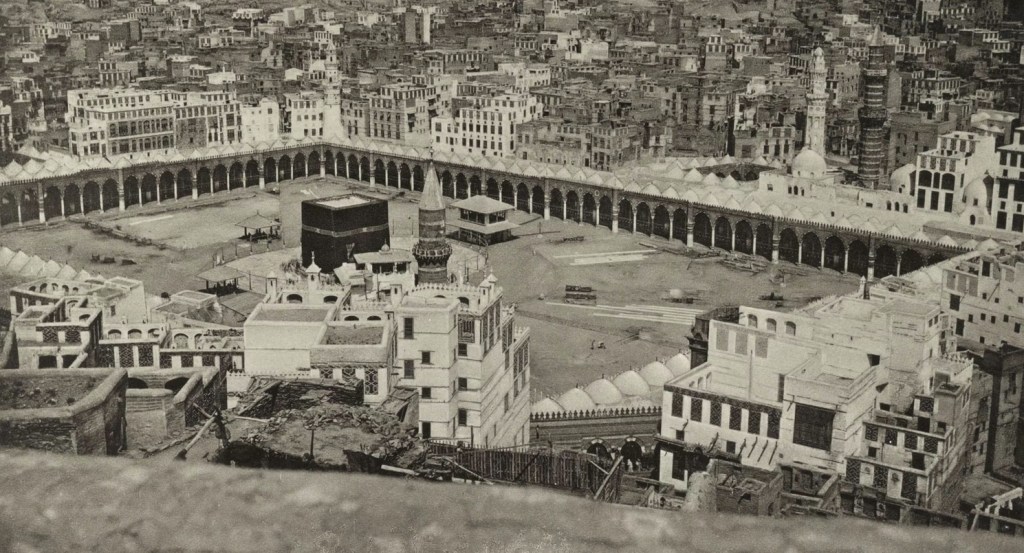
Qur’an 3:96 says that the first house set down for humanity as a place of worship is the Ka’ba at Bakkah (Mecca). It calls that house “blessed” (mubārak) and “a guidance for the worlds” (hudan lil-ʿālamīn). The verse sits in the middle of an argument about the religion of Abraham. Classical and modern commentators largely agree on four points:
- the Ka’ba is first as a house of worship, though not necessarily first among all buildings;
- Bakkah is either Mecca itself or its sacred core;
- the verse answers a dispute with the People of the Book over the qibla (the direction of prayer);
- it lays the ground for the Hajj duty stated in the next verse.
ABSTRACT
This essay studies Qur’an 3:96 (Āl ʿImrān), the verse that names the Ka’ba at Bakkah as “the first House established for mankind.” It gives:
- the Arabic text, with a transliteration and a grammatical analysis;
- ten widely read English translations, checked against online corpora, with a comparison of how they handle “Bakkah/Becca/Mecca,” “House/Sanctuary/Temple,” “men/mankind/people/humanity,” and “the worlds/all beings/all people.”
Classical sources. The classical section draws on al-Ṭabarī, al-Baghawī, al-Zamakhsharī, Fakhr al-Dīn al-Rāzī, al-Qurṭubī, Ibn Kathīr and the Jalālayn. It also uses al-Wāḥidī’s Asbāb al-Nuzūl, Ṭabāṭabāʾī’s al-Mīzān, and the esoteric commentaries of al-Tustarī, al-Qushayrī and al-Kāshānī. It addresses:
- the occasion of revelation: the Muslim–Jewish dispute over whether Jerusalem or the Ka’ba deserved precedence;
- whether awwal (“first”) is temporal or qualitative;
- how the Abū Dharr hadith (Bukhārī 3366; Muslim 520) fits with the history of the Jerusalem sanctuary;
- the etymologies of Bakkah;
- the meanings of mubārak and hudan lil-ʿālamīn.
Modern sources. The modern section covers Mawdūdī, Muftī Muḥammad Shafīʿ, Muḥammad Asad, Ibn ʿĀshūr, Ṭabāṭabāʾī and the Ahmadiyya Five Volume Commentary. It then reviews the academic and comparative debates:
- Psalm 84’s “Valley of Baca”;
- Diodorus Siculus and Ptolemy’s “Macoraba”;
- Patricia Crone’s revisionism and the replies to it;
- Christoph Luxenberg’s Syriac re-reading.
A thematic synthesis and a reflective epilogue then draw the threads together under five heads: primacy, the Abrahamic heritage, blessing, the qibla and the Hajj, and universality.
1. Text, Transliteration and Grammar
Arabic (Uthmani script):
إِنَّ أَوَّلَ بَيْتٍ وُضِعَ لِلنَّاسِ لَلَّذِي بِبَكَّةَ مُبَارَكًا وَهُدًى لِّلْعَالَمِينَ ﴿٩٦﴾
Transliteration: Inna awwala baytin wuḍiʿa lin-nāsi la-lladhī bi-Bakkata mubārakan wa-hudan lil-ʿālamīn. islamawakened
Word by word (Quranic Arabic Corpus style):
| Arabic | Gloss |
|---|---|
| inna | “indeed” |
| awwala | “(the) first” |
| baytin | “house” |
| wuḍiʿa | “was set up/placed” |
| lin-nāsi | “for mankind” |
| la-lladhī | “(is) surely the one which” |
| bi-Bakkata | “(is) at Bakkah” |
| mubārakan | “blessed” |
| wa-hudan | “and a guidance” |
| lil-ʿālamīn | “for the worlds” |
Grammatical notes that bear on translation:
- Wuḍiʿa (passive, “was set down”) describes bayt. Al-Zamakhsharī says plainly that “the one who placed it is God.” For him, God “placing a house for people” means “He made it a place of worship for them.” The sense is “the first place of worship for people is the Ka’ba.” greattafsirs The passive voice therefore points to divine institution, not human building.
- The emphatic la- in la-lladhī marks the predicate of inna. Ibn ʿĀshūr uses this to defend the plain word order of the verse. quran-tafsir
- Mubārakan is a circumstantial accusative (ḥāl). Al-Zamakhsharī and al-Rāzī both explain it through an implied verb of being settled: “which is settled in Bakkah, blessed.” greattafsirsquran-tafsir
- Wa-hudan is joined to mubārakan. Al-Zajjāj, cited by al-Rāzī, glosses it as “possessing guidance,” or “and it is guidance.” Ibn ʿĀshūr notes that describing the house with the verbal noun hudā is emphatic (mubālagha), because the house is a cause of guidance. quran-tafsirislamweb
- The same verb in the Abū Dharr hadith. The Prophet was asked ayyu masjidin wuḍiʿa fī l-arḍi awwal? (“which mosque was set down first on earth?”). That question uses wuḍiʿa, the verb of the verse. This is one reason exegetes treat the hadith as the natural gloss on the verse.
2. Ten English Translations Compared
Each rendering was checked against an online corpus: corpus.quran.com, legacy.quran.com, quran.com, alim.org/IslamAwakened, and translation aggregators.
| # | Translator | Rendering of 3:96 |
|---|---|---|
| 1 | Abdullah Yusuf Ali | “The first House (of worship) appointed for men was that at Bakka: Full of blessing and of guidance for all kinds of beings:” quranquran |
| 2 | Marmaduke Pickthall | “Lo! the first Sanctuary appointed for mankind was that at Becca, a blessed place, a guidance to the peoples;” quranquranx |
| 3 | Muhammad Asad | “Behold, the first Temple ever set up for mankind was indeed the one at Bakkah: rich in blessing, and a guidance unto all the worlds,” alimislamawakened |
| 4 | M.A.S. Abdel Haleem | “The first House [of worship] to be established for people was the one at Mecca. It is a blessed place; a source of guidance for all people;” readingislamictexts + 2 |
| 5 | Sahih International (legacy text) | “Indeed, the first House [of worship] established for mankind was that at Makkah – blessed and a guidance for the worlds.” quranquran |
| 6 | A.J. Arberry | “The first House established for the people was that at Bekka, a place holy, and a guidance to all beings.” quranquran |
| 7 | Muhsin Khan & al-Hilali | “Verily, the first House (of worship) appointed for mankind was that at Bakkah (Makkah), full of blessing, and a guidance for Al-‘Alamin (the mankind and jinns).” quranquran |
| 8 | Mufti Taqi Usmani | “The first house set up for the people is surely the one in Makkah having blessings and guidance for all the worlds.” al-hadees |
| 9 | M.H. Shakir | “Most surely the first house appointed for men is the one at Bekka, blessed and a guidance for the nations.” quranquran |
| 10 | Dr. Mustafa Khattab (The Clear Quran) | “Surely the first House ˹of worship˺ established for humanity is the one at Bakkah—a blessed sanctuary and a guide for ˹all˺ people.” quranquran |
Supplementary renderings:
- Ali Quli Qarai: “Indeed the first house to be set up for mankind is the one at Bakkah, blessed and a guidance for all nations.” quranxqurano
- Abdul Majid Daryabadi: “Verily the first House set apart unto mankind was that at Bakka, blest, and a guidance unto the worlds.” quranxquranhadits
- Ahmadiyya (Sher Ali), numbered 3:97: “Surely, the first House founded for mankind is that at Becca, abounding in blessings and a guidance for all peoples.” reviewofreligions
2.1 Notable differences in word choice
Bakkah / Becca / Bekka / Mecca. The translators fall into three groups:
- Yusuf Ali, Asad, Hilali-Khan, Khattab and Qarai transliterate the name.
- Pickthall (“Becca”), Arberry and Shakir (“Bekka”) use older English spellings.
- Sahih International’s legacy text, Abdel Haleem and Usmani substitute “Makkah/Mecca.”
Later Sahih editions read “Bakkah [i.e., Makkah].” qurano Substituting “Mecca” hides two things. The Qur’an uses Makka only once (48:24) and Bakka only here. Wikipedia Substitution also forecloses the classical debate over whether Bakkah names the sanctuary or the whole town.
House / Sanctuary / Temple. Pickthall’s “Sanctuary” and Asad’s “Temple” are interpretive choices. “Temple” invites the comparison with Solomon’s Temple that Asad’s own note draws. The bracketed “[of worship]” builds the majority reading into the text itself.
Men / mankind / people / humanity. “Men” is archaic and reads as gendered. “The people” is literal but can sound parochial. “Mankind” or “humanity” best conveys the universality that the commentators find in lil-nās.
Guidance for the worlds. Translators give it at three scales:
- “The worlds” or “all the worlds” keeps the plural.
- “All kinds of beings” (Yusuf Ali) and “all beings” (Arberry) widen it to the cosmos.
- “The peoples/nations/all people” narrows it to humanity.
Hilali-Khan’s “(the mankind and jinns)” follows a specific Sunni gloss.
Tense. “Was” frames the verse as history; “is” frames it as a standing truth. The Arabic nominal sentence has no tense.
3. Literary Context: Verses 3:93–97
The verse belongs to a passage of debate with the People of the Book about who can claim Abraham:
- 3:93–94: all food was lawful to the Children of Israel except what Israel (Jacob) forbade himself. The challenge: “bring the Torah and read it.”
- 3:95: “follow the religion of Abraham, the upright (ḥanīf).”
- 3:96: the first House.
- 3:97: “In it are clear signs — the Station of Abraham; whoever enters it is secure; and pilgrimage to the House is a duty owed to God by people — whoever is able to find a way there.”
Al-Rāzī finds four links between 3:96 and the verses before it:
- The qibla dispute. The Jews held Jerusalem to be older, the land of the Gathering (arḍ al-maḥshar), and the qibla of the prophets.
- Abrogation. The theme of abrogation (naskh) runs on from 3:93, and the change of qibla was the greatest abrogation.
- Grounding the Hajj. Pilgrimage was “the greatest sign of the religion of Abraham.” The House is therefore praised “in order to derive from it the obligation of Hajj.”
- A claim exposed. Jews and Christians claimed Abraham but did not make pilgrimage to his House. quran-tafsir
Ibn ʿĀshūr reads 3:96 as the reason (taʿlīl) for the command in 3:95: “the merits of this House establish the merit of its builder’s law.” He notes that the opening inna does the work of a causal connective, citing al-Jurjānī’s Dalāʾil al-Iʿjāz. quran-tafsir
4. Occasion of Revelation (Sabab al-Nuzūl)
Al-Wāḥidī preserves a report from Mujāhid: “The Muslims and the Jews boasted to each other; the Jews said: ‘Jerusalem is better and greater than the Ka’bah because it was the land to which the Prophets had migrated and it is also sacred’; while the Muslims said: ‘No, the Ka’bah is better.’ And so Allah… revealed this verse.” quranx
Other versions:
- Al-Qurṭubī and al-Baghawī repeat the report. In al-Baghawī’s version the Jews call Bayt al-Maqdis “our qibla… better than the Ka’ba and older.” ksu
- The Jalālayn compresses it: when the Jews said “Our qibla came before yours,” the verse was revealed. quranx
- Mawdūdī (Tafhīm, n. 79) treats it as the second of two Jewish objections, the first being dietary law. He notes that al-Baqarah 2:142 ff. had already answered the qibla objection, islamicstudies “but as the Jews persisted in their criticism, it has again been answered here.” quranx
The occasion explains the comparative framing. The verse is an argument about precedence, and therefore legitimacy.
5. Classical Commentary
5.1 Al-Ṭabarī (d. 310/923), Jāmiʿ al-Bayān
View A: first house of worship. ʿAlī was asked whether the House was the first house on earth. He answered: “No — where then were the people of Noah? Where were the people of Hūd? — but it is the first house set down for people blessed and as a guidance.” Al-Ḥasan al-Baṣrī called it “the first mosque in which God was worshipped on earth.” tafsirksu Maṭar said: “There were houses before it, but it was the first house set down for worship.” ksu
View B: first house absolutely.
- ʿAbd Allāh ibn ʿAmr: God created the House two thousand years before the earth. “When His Throne was upon the water, it was a white foam, and the earth was spread out from beneath it.” ksu
- Mujāhid and al-Suddī report similar accounts. ksual-awail
- Qatāda: the House descended with Adam, was raised to heaven at the Flood, and Abraham “built it upon an ancient foundation that was before him.” ksu
Al-Ṭabarī’s own view. He prefers “the first House blessed and as guidance set down for people is the one at Bakkah.” He bases this on the Abū Dharr hadith. ksual-awail
Bakkah. Al-Ṭabarī derives the name from bakk, “crowding”: “the place where people crowd for their circumambulation.” Since circling the Ka’ba (ṭawāf) is valid only inside the mosque, Bakkah is the area around the Ka’ba and Makkah is everything outside it. He rejects the reverse view. ksu His supporting reports:
- Abū Mālik al-Ghifārī and al-Nakhaʿī: “Bakkah is the place of the House; Makkah is what is other than that.” ksu + 2
- Mujāhid and Saʿīd ibn Jubayr: people “jostle (yatabākkūn) there, men and women.” ksuquran-tafsir
- Abū Jaʿfar al-Bāqir: “It is Bakkah — people press upon one another.” ksu
- Qatāda: there “women pray in front of men, which is valid in no other town.” ksutafsir
5.2 Al-Baghawī (d. 516/1122), Maʿālim al-Tanzīl
Al-Baghawī lists the range of opinions on “first house”:
- the first thing to appear on the water, two thousand years before the earth; ksu
- the first house built on earth; ksu
- from Zayn al-ʿĀbidīn: the earthly copy of the Bayt al-Maʿmūr beneath the Throne, built by the angels and named al-Ḍurāḥ; ksu
- the first blessed house (ʿAlī, al-Ḍaḥḥāk); ksusurahquran
- the first house of pilgrimage; ksusurahquran
- the first qibla; ksu
- the first place of worship (al-Ḥasan, al-Kalbī). ksusurahquran
On the name, some say Bakkah is Makkah itself, “for the Arabs interchange bāʾ and mīm” (lāzib/lāzim). Others say Bakkah is the site of the House. He cites Ibn al-Zubayr: it “crushes (tabukku) the necks of tyrants — no tyrant ever intended it with evil but God broke him.” Makkah is named for its lack of water, from makka al-faṣīlu ḍarʿa ummihi, “the weanling sucked its mother’s udder dry.” quranksu
5.3 Al-Zamakhsharī (d. 538/1144), al-Kashshāf
- Bakkah and Makkah. Bakkah is “a proper name of the Sacred Town; Makkah and Bakkah are two dialect forms of it.” He compares al-Nabīṭ/al-Namīṭ, rātib/rātim and mughmiṭa/mughbiṭa, a pattern he calls iʿtiqāb. greattafsirs
- Other views he records. Makkah is the town and Bakkah the mosque site. Bakkah comes from “crowding.” Ibn ʿAbbās called it “the first house of pilgrimage after the Flood.” greattafsirs
- Mubārakan. He glosses it as “abundant in good, for the reward and expiation of sins that come to whoever performs Hajj or ʿUmra… or circles it.” greattafsirsislamweb
- Hudan lil-ʿālamīn. “Because it is their qibla and their place of worship.” islamweb
- Later reception. Asad calls al-Zamakhsharī’s b/m explanation, “supported by Razi,” the most plausible. alim
(Caveat: after the opening paragraph, these passages come from search excerpts of two online editions with identical wording. They were not read in a printed edition.)
5.4 Fakhr al-Dīn al-Rāzī (d. 606/1209), Mafātīḥ al-Ghayb
On awwal. Al-Rāzī holds that “the verse’s indication of priority in excellence and honour is indispensable.” The point of mentioning priority is “to demonstrate excellence,” and priority of construction “has no effect on this purpose.” He adds that this “does not negate priority in construction.” He calls it “the more correct” view that the Ka’ba already existed in Adam’s time. His reasons:
- every prophet prostrated (Q 19:58), so each needed a qibla;
- Mecca is called Umm al-Qurā;
- Mecca was made sacred “on the day He created the heavens.” quran-tafsir
On lil-nās. A house “for people” is shared by all of them, which is possible only if it is a house of worship and the qibla for creation. quran-tafsir
The Ka’ba’s seven virtues:
- Its builders. “The one who commanded was the Majestic King, the architect was Gabriel, the builder was the Friend [Abraham], and the apprentice was Ishmael.” Solomon, by contrast, built Jerusalem’s temple.
- The Maqām Ibrāhīm, the Station of Abraham.
- The few pebbles that collect at the Jamarāt.
- Birds avoid flying over the House.
- Safety. Mecca was never wholly ruined, “whereas Bayt al-Maqdis was destroyed by Nebuchadnezzar.”
- The defeat of the army of the Elephant.
- Its barren valley, by which “God manifested the honour of poverty.” quran-tafsir
He concludes that the House is first “in every kind of virtue,” so the Jewish claim fails. quran-tafsir
On Bakkah. “There is no doubt that by Bakkah is meant Makkah… two names for one referent, for bāʾ and mīm are close in articulation.” He gives both etymologies: crowding (Saʿīd ibn Jubayr, al-Bāqir, Mujāhid, Qatāda) and breaking the necks of tyrants (Quṭrub). He also gives al-Qaffāl’s list of Mecca’s names. quran-tafsir
(Caveat: the online text attributes a site/town distinction to “the majority” in a direction that seems reversed relative to his argument. Check a printed edition before citing it.)
On mubārak. Baraka has two senses: “growth and increase” and “permanence.” For permanence, al-Rāzī argues that because “the earth is a sphere” (al-arḍ kura), it is always prayer time somewhere, so someone is always facing the House. He pictures concentric rows of worshippers whose “lights of their spirits” join together. quran-tafsir A twelfth-century exegete thus uses the earth’s sphericity to explain the qibla’s continuous blessing.
On hudan lil-ʿālamīn. He gives three senses:
- the qibla that guides prayer;
- a proof of the Maker and of Muḥammad’s truthfulness;
- guidance to Paradise. quran-tafsir
5.5 Al-Qurṭubī (d. 671/1273), al-Jāmiʿ li-Aḥkām al-Qurʾān
The Abū Dharr hadith. Al-Qurṭubī opens with it, citing Ṣaḥīḥ Muslim: “…forty years; then the earth is a mosque for you, so wherever the prayer reaches you, pray.” surahquran He contrasts Mujāhid and Qatāda (“no house was set down before it”) with ʿAlī (“there were many houses before it; … the first house set down for worship”). e-quran
The forty-year problem. He cites al-Nasāʾī’s ṣaḥīḥ hadith that Solomon built Bayt al-Maqdis. This creates “a difficulty… since between Abraham and Solomon there were… more than a thousand years.” His solution is that “Abraham and Solomon only renewed what others had founded.” On this view, Adam’s descendants or the angels may have founded Bayt al-Maqdis: “each is possible.” e-quran
Bakkah. He gives several views:
- Mālik: “Bakkah is the site of the House; Makkah the rest of the town.” e-quran
- Ibn Shihāb: “Bakkah is the mosque; Makkah the whole Ḥaram.” e-quran
- Mujāhid: Bakkah is Makkah, with mīm replacing bāʾ. e-quran
- Etymology: crowding, or pounding the necks of tyrants. e-quran
He rejects deriving “Makkah” from mukāʾ (“whistling,” 8:35) on morphological grounds. e-quran
On mubārak. God made it blessed “by the multiplication of deeds in it; baraka is abundance of good.” e-quran
5.6 Ibn Kathīr (d. 774/1373)
A universal and Abrahamic House. Ibn Kathīr calls it the House “for all people, for their acts of worship and rites.” It is “the Ka’ba built by Ibrāhīm al-Khalīl, whose religion the Jews and Christians claim they follow, yet they do not perform Hajj to the House he built.” surahquranksu
Hadith and early reports. He cites the Abū Dharr hadith through Aḥmad and both Ṣaḥīḥs. He reports ʿAlī’s “first house in which blessing was placed,” and notes that al-Suddī “claimed it was absolutely the first house on the face of the earth.” ksu
On Bakkah:
- al-Nakhaʿī: “Bakkah: the House and the mosque”; ksu
- ʿIkrima and Maymūn ibn Mihrān: “the House and what surrounds it is Bakkah; what is beyond is Makkah”; ksu
- the place makes tyrants weep and humble themselves (bukāʾ); alimksu
- people press together there. alim
He also lists Mecca’s names. alim
5.7 Tafsīr al-Jalālayn and Tanwīr al-Miqbās
The Jalālayn:
- the occasion was the Jews’ claim that their qibla came first; surahquran
- Bakkah is “a variant of Makka… so called because it crushes (tabukku) the necks of tyrants”; surahquran
- the House “was built by the angels before the creation of Adam, and after it the Aqṣā… forty years separating them”; qurano
- it is guidance “because it is their qibla.” quranx
The Tanwīr al-Miqbās. It glosses “blessed” as “contains forgiveness and mercy” and “guidance” as “a Qiblah to every prophet, messenger, veracious one and believer.” surahquranquranx Its attribution to Ibn ʿAbbās is doubtful.
5.8 Ibn Ḥajar and the hadith of Abū Dharr
The hadith appears in Bukhārī (nos. 3366, 3425), Muslim (no. 520) and Ibn Mājah (no. 753). Abū Dharr asked which mosque was first “set down on earth.” The answer: al-Masjid al-Ḥarām, then al-Aqṣā, “forty years” apart, followed by “wherever the prayer reaches you, pray.” sunnah + 2
In Fatḥ al-Bārī (6/408–409), Ibn Ḥajar reports Ibn al-Jawzī’s statement of the problem: “Abraham built the Ka’ba and Solomon built Bayt al-Maqdis, and there are a thousand years between them.” aqsapediawordpress Ibn al-Jawzī’s answer is that the hadith concerns first foundation, and Adam first built the Ka’ba. islamic-awareness Ibn Ḥajar lists other proposed founders of al-Aqṣā: the angels, Sām son of Noah, and Jacob. He prefers the Adamic view, citing Ibn Hishām’s Kitāb al-Tījān: God ordered Adam to go to Bayt al-Maqdis and build it. aqsapediawordpress
Two reconciliations result:
- Adamic: Adam or his descendants founded both mosques. dar-alifta
- Abrahamic: Abraham founded both, and Solomon later renewed al-Aqṣā. Muftī Shafīʿ and Ibn ʿĀshūr take this line. quranquran-tafsir
5.9 Shiʿi exegesis: Ṭabāṭabāʾī, al-Mīzān
The commentary. Ṭabāṭabāʾī holds that the wording “does not show that the Ka’bah was the first House built on the earth.” Rather, it “was appointed as the House of worship long before other houses like Bayt al-Maqdis were built.” al-islam He glosses mubārak as the “bestowal of abundant good.” He notes that pilgrimage was first prescribed in Abraham’s time (22:27). al-islam
The traditions he cites:
- ʿAlī’s answer, via Ibn Shahrāshūb; al-islam
- Imam Jaʿfar al-Ṣādiq: “The land on which the House stands is Bakkah; and the town is Mecca”; al-islamwordpress
- “the first plot created of the earth is the Ka’bah; then the earth was expanded from it.” al-islamhodaalquran
A contemporary Shiʿi reflection. The Academy for Learning Islam reads “first” as essential primacy, “a first that accepts no second.” It links the Ka’ba to the Bayt al-Maʿmūr and to the four pillars of the Throne. academyofislam
5.10 Sufi and esoteric commentary
Al-Tustarī. The outward meaning is the House of God in Mecca; “inwardly it implies the Messenger.” quranx
Al-Qushayrī, Laṭāʾif al-Ishārāt.
- “The House is a bit of stone and the servant is a bit of mud.”
- “The Ka’ba is the House of the Real in stone and the heart is the House of the Real in the innermost self.”
- He contrasts God’s own phrase “My House” (2:125) with “established for the people,” which he reads as alluding to ʿayn al-jamʿ (the source of gathering).
- He explains Bakka by crowding, and notes that the poor crowd around the House “by their aspirations.”
- His counsel: “Do not attach your heart to the first house established for you, but devote your innermost self to the first Beloved who chose you.” quranx
Al-Kāshānī. He takes up the “white froth on the water” tradition and reads it as describing the human being:
- the House is “the real heart”;
- its creation “2000 years before the earth” points to the heart’s precedence over the body;
- the physical heart is “the first of the organs to undergo engenderment and the first to function and the last to become still”;
- Bakka is “the breast,” where the faculties “swarm.” quranx
A physician-reader will recognize here a pre-modern embryological intuition used as a symbol of the Ka’ba.
6. Modern and Contemporary Commentary
Mawdūdī, Tafhīm al-Qurʾān
The argument from the Bible. Citing 1 Kings 6:1, Mawdūdī notes that Solomon built the Temple “some 450 years after Moses.” quranx By contrast, “the Ka’bah was constructed by Abraham who lived some eight or nine centuries before Moses,” so its greater age “was beyond dispute.” islamicstudiesislamicstudies
The “clear signs” of 3:97:
- provision in a barren site;
- security amid “chaos and disorder in the whole of Arabia for about 2500 years before the advent of Islam”;
- the sacred months of truce;
- Abraha’s defeat. quranx
Neglecting Hajj. He holds that a person who can perform Hajj but neglects it “has adopted the attitude of a disbeliever.” Even so, a Muslim judge would not declare such a person an apostate. quranx
Muftī Muḥammad Shafīʿ, Maʿārif al-Qurʾān
He draws three merits from the verse: primacy, blessing and universal guidance. quran
Primacy. “First” may mean the first house of any kind (Ibn ʿUmar, Mujāhid, Qatāda) or the first house for worship (ʿAlī). alquranaudio He cites al-Bayhaqī’s Dalāʾil al-Nubuwwa: Adam and Eve were commanded through Gabriel to build the House. quran
The history of the building:
- Adam;
- the Flood;
- Abraham;
- Jurhum;
- the Amalekites;
- Quraysh, who left out the Ḥaṭīm and raised the door;
- Ibn al-Zubayr’s restoration;
- al-Ḥajjāj’s reversal.
Imām Mālik then ruled against rebuilding, lest the House become “a plaything in the hands of rulers.” quran
The forty years. Shafīʿ writes that “the initial construction of Bayt al-Maqdis was undertaken by Sayyidna Ibrahim forty years after the construction of the Ka’bah,” and that Solomon rebuilt it on Abrahamic foundations: “Thus, there remains no contradiction.” quran
Universality and blessing. Reverence for the House “will not be limited to a particular nation or group.” Its baraka is both outward (provision) and inward (Hajj, ʿUmra, multiplied reward). quran
Muḥammad Asad, The Message of the Qurʾān, n. 75
“All authorities agree that this name is synonymous with Mecca.” Asad prefers al-Zamakhsharī’s b/m explanation. Because the Ka’ba’s prototype was built by Abraham and Ishmael, “much older than the Temple of Solomon,” taking it as the qibla implies no break with “the Abrahamic tradition (on which, ultimately, the whole Bible rests).” On the contrary, it “re-establishes the direct contact with that Patriarch.” alim
Ibn ʿĀshūr, al-Taḥrīr wa’l-Tanwīr
“First house” is not the first building on earth. Ibn ʿĀshūr points to the Tower of Babel, Egyptian and Chaldean temples, and Q 37:97. In his words: “the Qur’an is a book of religion and guidance; its aim is not to fix the beginnings of history but the beginnings of the means of guidance.” So it is “the first house of true worship set down to proclaim tawḥīd,” and “every guidance is derived from it.” quran-tafsir
Dating and the forty years. He dates the Ka’ba to about 1900 BCE and Solomon’s temple to about 1000 BCE. To square the forty-year hadith, he suggests Abraham set up a small place of prayer on the Jerusalem rock. quran-tafsir
A Chaldean etymology. He proposes that Bakkah means “town,” a name given by Abraham, and comes from Chaldean (compare Baʿlabakk, “town of Baal”). He sees choosing this archaic name exactly where primacy is claimed as part of the Qur’an’s inimitability. quran-tafsir
Why “the one at Bakkah” rather than “the Ka’ba.” The word “ka’ba” had been used for Abraha’s church in Ṣanʿāʾ, the “Yemenite Ka’ba.” quran-tafsir
These are Ibn ʿĀshūr’s own hypotheses, not consensus views.
The Ahmadiyya Five Volume Commentary
- Bakkah is “the name given to the valley of Mecca.” It derives from bakka, “pushed into a narrow and crowded place” or “broke his neck,” following the lexicon Aqrab. reviewofreligions
- Purpose of the verse: to draw the People of the Book’s attention “to the antiquity of the Ka’bah in order to point out that the real and original centre of God’s religion is the Ka’bah.” reviewofreligions
- Abraham as restorer. Mirza Bashiruddin Mahmud Ahmad reads 2:127 as “the foundations that were left of the house,” so Abraham rebuilt an existing structure. reviewofreligions
- Psalm 84. A 2026 Review of Religions article links the verse to Psalm 84’s “Valley of Baka.” reviewofreligions
Other modern voices
Sayyid Quṭb, Amīn Aḥsan Iṣlāḥī, Jāved Aḥmad Ghāmidī, ʿAbduh and Riḍā’s al-Manār, and The Study Quran all belong in a full survey. I could not check their wording on this verse against primary texts during this research, so readers should consult them directly.
7. Historical-Critical and Comparative Perspectives
7.1 Bakkah and the “Valley of Baca” (Psalm 84:6)
Psalm 84:5–6 reads: “As they pass through the Valley of Baca, they make it a place of springs.” answering-islam The Hebrew is ʿēmeq hab-bākāʾ. wordpress
The case for a link. Some Muslim writers, including Jamal Badawi, M.S.M. Saifullah and the Ahmadiyya Review of Religions, connect it with Bakkah. They cite the psalm’s pilgrimage language and Q 14:37’s “uncultivable valley.” answering-islamreviewofreligions
The case against. Christian critics reply that the pilgrimage in the psalm ends “before God in Zion” (v. 7). The International Standard Bible Encyclopedia explains the name by “trees that exuded resins or gums, perhaps several species of balsam,” and calls a Rephaim identification “uncertain.” wordpress
Assessment. The words sound alike, but the philological link is weak. The Hebrew word ends in ʾaleph, while the Arabic has a doubled kāf. The psalm’s setting is Zion. No classical exegete consulted here makes the connection. The link is best treated as a devotional or apologetic reading.
7.2 Diodorus and Ptolemy
Diodorus Siculus (1st c. BCE) mentions a temple “very holy and exceedingly revered by all Arabians.” He does not name its location. Several scholars place it in northwest Arabia, near Leuke Kome. Wikipedia
Ptolemy (2nd c. CE) lists Makoraba. livius Samuel Bochart identified it with Mecca, and that identification has been made since 1646, sometimes via South Arabian mkrb, “temple.” Patricia Crone rejected it on grounds of name and coordinates. Ian D. Morris calls the identification “arbitrary and fragile.” Wikipedia + 2 It is possible but unproven.
7.3 Crone and the replies
Crone’s Meccan Trade and the Rise of Islam (1987) argued three things:
- Mecca was off the main incense route;
- that route had declined;
- Meccan trade was in humble goods such as leather and woollens. Wikipediaeaalim
In places she located Muḥammad’s career in northwest Arabia. R.B. Serjeant called parts of her thesis polemical, Wikipediaislamichistory and later scholarship has qualified it. Dan Gibson’s Petra-qibla thesis lies outside the academic mainstream, and specialists such as David A. King have rejected it.
7.4 Luxenberg
Luxenberg (2000) reads the undotted ببكه as a Syriac verb meaning “which He has demarcated.” Livius.org calls this “a good candidate for a successful reinterpretation.” Mainstream philologists have not adopted it, however. The reading conflicts with the recitation tradition, with Makka at 48:24, and with the grammar of la-lladhī.
7.5 What history can and cannot settle
The claim that the Ka’ba is the first House of true worship, founded or renewed by Abraham, cannot be confirmed or refuted by archaeology, because excavation in the Ḥijāz has been so limited. What is clear is that the verse’s argument works rhetorically and legally (Ibn ʿĀshūr calls it khiṭābī), not chronologically in the modern sense. quran-tafsir His principle, “the beginnings of guidance, not of history,” keeps the theology without overstating the history.
8. Thematic Synthesis
8.1 Primacy (awwaliyya)
The tradition recognizes three grades of “first”:
- Temporal-absolute: primordial foam, before the earth.
- Temporal-cultic: the first house of worship. This is the verse’s most natural reading.
- Qualitative or essential: first in honour, which the comparative context of the passage requires.
8.2 “For mankind” (lil-nās)
The House belongs to everyone. Al-Rāzī says it is “shared”; Shafīʿ says it is not limited to “a particular nation.” Ibn ʿĀshūr suggests al-nās includes all the communities that revere Abraham. quran-tafsir The verse thereby turns a sectarian quarrel into a shared Abrahamic inheritance.
8.3 The Abrahamic legacy and tawḥīd
The passage moves from “the religion of Abraham” (3:95) to his House (3:96) and then to his Station and the Hajj (3:97). Pure monotheism takes form in stone and in ritual: “the King commanded, Gabriel designed, Abraham built, Ishmael assisted.”
8.4 Blessing (baraka)
Blessing here means increase and permanence: provision in a barren valley (28:57; 14:37), multiplied reward, and al-Rāzī’s prayer that never stops on a spherical earth.
8.5 Guidance, qibla and unity
“Guidance” is first of all the qibla: a single centre that gathers a scattered community. At Bakkah, as Qatāda observed, the ordinary order dissolves in the press of worship. Al-Rāzī adds two further senses, a proof of God and a road to Paradise. The Sufis add a third: guidance from the House to its Lord.
8.6 Hajj and security (3:97)
The House is praised “in order to derive from it the obligation of Hajj.” Ibn Kathīr records the consensus that Hajj is required once in a lifetime of those able to make it, alim with ability defined as “provision and a mount.” He also records that Mecca was made sacred “the day He created the heavens and the earth.” quranquranx
8.7 The universal dimension
Al-ʿālamīn can mean humanity, humans and jinn, or all beings. On the third reading, the Ka’ba is an axis mundi, where heaven’s vertical meets humanity’s horizontal.
THEMATIC EPILOGUE: The House That Was Set Down
The verse opens with inna, a word of assurance, and closes with “the worlds.” Between them stands a single house, and its first quality is priority: it was “set down,” and set down by Another.
The exegetes argued over whether that priority was of time or of rank. Whatever came first in the order of stones, the House at Bakkah comes first in the order of meaning. It is the first place where the human creature built nothing for itself and everything for God. ʿAlī’s question settles it: “Where then were the people of Noah? Where were the people of Hūd?” People had houses before. This was the first House that was not theirs.
The House belongs to Abraham. The stranger who left his son in a valley without crops became, through this verse, the host of all nations. The quarrel of 3:93–95 is not won by dismissing the other side. It is won by pointing to a common ancestor and his common House, widening the circle until it includes them all.
The House is blessed, which means increase and permanence: fruit carried to a stony valley, and a circle of prayer that, on a spherical earth, never breaks. As dawn moves westward, rank after rank turns toward the same centre. Baraka here is not a static charge held in a stone. It is a wave that moves continuously across the earth.
The House is guidance, and the first guidance is direction. Bakkah is the place of crowding (bakk) and the place that breaks the necks of tyrants. The two etymologies say one thing: before this House the proud are humbled, and the many become one.
The mystics point beyond the stone. “Do not attach your heart to the first house established for you,” says al-Qushayrī, “but devote your innermost self to the first Beloved who chose you.” Al-Kāshānī finds the Ka’ba in the chest. The heart, first to form and last to fall still, is the first house set down in every person. The House of stone teaches the house of flesh what it was made for.
The verse says “the worlds,” not “the Arabs” or “the Muslims.” The tradition imagined the House as foam on the primordial waters and as the earthly double of the angels’ House. Taken literally or as symbol, these images say the same thing. The first House was set down for everyone. Its blessing does not run out, its guidance is not confined to one tribe, and its door, like the mercy it signifies, faces every direction at once.




Leave a Reply