
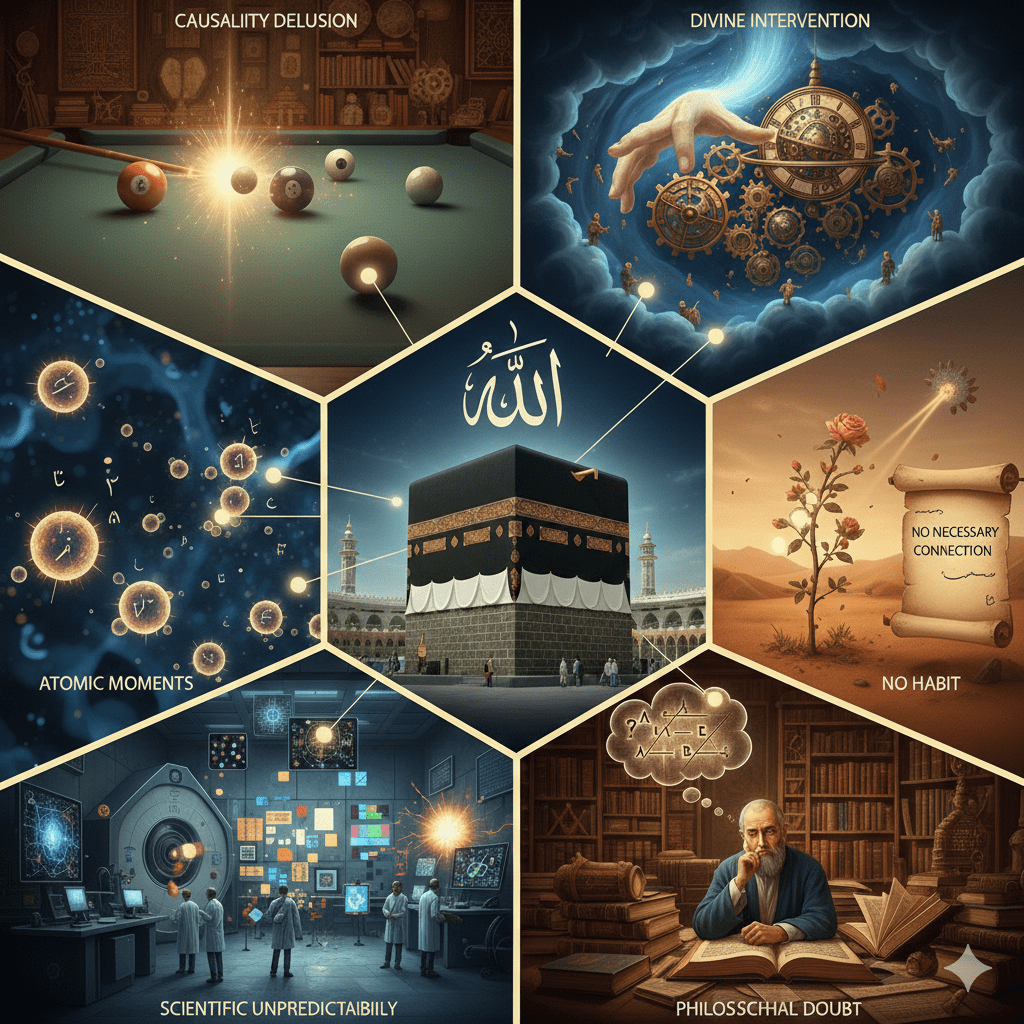
Epigraph
لَّا تُدْرِكُهُ الْأَبْصَارُ وَهُوَ يُدْرِكُ الْأَبْصَارَ ۖ وَهُوَ اللَّطِيفُ الْخَبِيرُ
Eyes cannot reach Him, but He manifests himself before the eyes and He is the Imperceptible and the All Aware. (Al Quran 6:103)
Presented by Claude for theQuran.Love
Abstract
This essay presents and unapologetically defends the seminal synthesis of Dr. Zia H. Shah, MD — physician in Upstate New York and Chief Editor of The Muslim Times — who has revived Abū Ḥāmid al-Ghazālī’s eleventh-century doctrine of Occasionalism and re-grounded it in twenty-first-century physics, biology, and philosophy of mind. The central thesis is simple and radical: the Allah of the Glorious Qur’an is not the absentee Lord of Deism who wound the cosmic clock and withdrew, but the ever-present, All-Knowing, Omnipotent Sustainer who participates in the universe nanosecond by nanosecond. His participation is validated by His ninety-nine attributes (al-asmāʾ al-ḥusnā), documented throughout the Qur’an; by the multiple, mutually irreconcilable interpretations of quantum mechanics; by the irreducibility of human consciousness; by His revelation to the 124,000 prophets; by His knowledge of the innermost thoughts of all eight billion humans; by the plausibility of intelligent life across two trillion galaxies; by the guided evolution of some 8.7 million extant species and the billions extinct; by the fine-tuning of a biophilic universe or multiverse; and by His ceaseless holding-in-being of the heavens and the earth. Occasionalism, we argue, is not the enemy of science but its most coherent metaphysical completion — and, contrary to a persistent misreading, it does not abolish libertarian human free will but locates it precisely where modern physics has re-opened the door: in the genuine indeterminacy of nature. We quote the Arabic of the key verses, rebut the standard objections, and conclude that al-Ghazālī, nine centuries on, may indeed have the last laugh.
I. The Two Gods: Against the Absentee Lord of Deism
There are, at bottom, two rival pictures of God available to the modern mind. The first is the God of Deism: a cosmic engineer who designed the machine, set the initial conditions, lit the fuse of the Big Bang, and then retired into irrelevance. This is the God of Voltaire, of Thomas Paine’s Age of Reason, of the Enlightenment watchmaker. On this view the laws of nature run autonomously; God, if He exists at all, is a hypothesis rendered idle by the very perfection of His machine.
The second picture is the God of the Glorious Qur’an. Zia H. Shah, MD, has documented across his corpus that the Qur’an does indeed make “a very lucid case for Deism or the Creator God” — some 750 verses (roughly one-eighth of the text) summon the human being to study nature and reason from the cosmos to its Author. But, Shah insists, the Qur’an never stops at Deism. It presents the Creator God and then, in verse after verse, insists that this same God is intimately, continuously, moment-to-moment present. The detail “invariably denied by strict believers of Deism” — divine revelation to the prophets, and God’s ongoing action in the world — is precisely what the Qur’an foregrounds. The Muslim Times
The Qur’anic God is al-Ḥayy al-Qayyūm, the Ever-Living, the Self-Subsisting Sustainer of all existence. He is nearer to the human being than the jugular vein. He is engaged, every single day, in some new affair. He holds the heavens and the earth lest they slip away. This is not the God who left; this is the God who never leaves. Al-Ghazālī’s Occasionalism, as Shah presents it, is nothing other than the rigorous metaphysical articulation of this God — the God of “Inshallah,” the God without whom not a leaf falls.
The Throne Verse (Āyat al-Kursī), described in authentic hadith (Ṣaḥīḥ Muslim 810) as the greatest verse of the Qur’an, is the charter of this vision:
اللَّهُ لَا إِلَٰهَ إِلَّا هُوَ الْحَيُّ الْقَيُّومُ ۚ لَا تَأْخُذُهُ سِنَةٌ وَلَا نَوْمٌ ۚ لَهُ مَا فِي السَّمَاوَاتِ وَمَا فِي الْأَرْضِ … وَلَا يَئُودُهُ حِفْظُهُمَا ۚ وَهُوَ الْعَلِيُّ الْعَظِيمُ
“Allah — there is no deity except Him, the Ever-Living (al-Ḥayy), the Self-Subsisting Sustainer (al-Qayyūm). Neither drowsiness overtakes Him nor sleep. To Him belongs whatever is in the heavens and whatever is on the earth… and their preservation tires Him not. And He is the Most High, the Most Great.” (Al-Qur’an 2:255) Qissah
A God whom “their preservation tires not” is a God actively engaged in preserving — not a God who has stepped away. Al-Ghazālī reads this as continuous conservation: at every instant, every atom and every soul persists only because God is actively keeping it in being. Reality, in the classical Ashʿarite image Shah repeats, is “like a lightbulb” that shines only while the current flows — not like a battery that, once charged, runs on its own. Cut the divine current for one instant, and the cosmos would lapse into nothing.
II. Al-Ghazālī’s Historical Argument: The Only True Cause
Abū Ḥāmid Muḥammad al-Ghazālī (1058–1111 CE), known to the Latin West as Algazel, was appointed at the age of thirty-four to head the prestigious Niẓāmiyya madrasa in Baghdad — the intellectual summit of the Muslim world. In his masterwork of philosophical critique, Tahāfut al-Falāsifa (The Incoherence of the Philosophers, c. 1095), he mounted the most rigorous assault ever written on the Aristotelianism of al-Fārābī and Ibn Sīnā (Avicenna). The seventeenth discussion, on causality, is the foundation of his Occasionalism.
Al-Ghazālī opens with a sentence that would wait nine centuries for its scientific vindication:
“The connection between what is habitually believed to be a cause and what is habitually believed to be an effect is not necessary, according to us.” thequran
His argument is logical and devastating. Cause and effect are ontologically distinct entities; no analysis of the one contains the other; therefore no logical necessity binds them. Whatever connection they display must come from outside — from the will of God, expressed in the consistent pattern of His creation. His famous illustration is fire and cotton. Why do we say fire causes the cotton to burn? Because we have always observed burning at the moment of contact. But observation shows only conjunction — the two together — never causation, the fire producing burning by its own power. “Fire, which is an inanimate thing, has no action,” al-Ghazālī writes; the true agent of the burning is God, who creates the combustion in the cotton on the occasion of contact with the flame — not because the fire compels Him, but because this is His ʿāda, His habit, His customary mode of acting. thequran
From this follow the pillars of the Ashʿarite system that Shah expounds:
- ʿĀda (habit/custom): What scientists call “the laws of nature” are, more precisely, descriptions of God’s habitual action — utterly reliable because God is rational, consistent, and faithful, but in no way binding upon Him.
- Khalq (continuous creation): God does not merely conserve existing things; He actively recreates the world at each atomic instant. Ashʿarite atomism held that accidents (properties) endure for only a single instant and must be created anew — a discrete, “frame-by-frame” cosmos.
- Kasb (acquisition): God creates the human act; the human being “acquires” it through intention and will, and is thereby morally accountable. (This is the hinge on which free will turns — Section XIII.)
Crucially, al-Ghazālī did not deny the appearance of stable causal order, and so did not undermine science. He affirmed that God’s habits are regular, which is precisely why we can farm, set bones, and build. The laws are descriptive, not prescriptive; they map the how of God’s habit, never displacing the why of God’s will. Shah calls this a theological “critical realism”: science discovers how events regularly unfold; the ultimate cause remains the divine will.
Al-Ghazālī’s motive was the protection of tawḥīd (divine unity) and the two supreme attributes: omnipotence and omniscience. If any created thing possessed genuinely independent causal power, that power would be an autonomous rival to God’s will — theologically incoherent in strict monotheism. As Shah puts it, the shahāda — lā ilāha illā Allāh, “there is no god but God” — is not merely a cultic slogan but a metaphysical claim: there is no cause but God.
III. The Ninety-Nine Attributes as the Architecture of Participation
Shah’s decisive move is to read the ninety-nine Beautiful Names (al-asmāʾ al-ḥusnā) not as a static list of honorifics but as the living architecture of a participating God — a God whose every attribute demands continuous engagement with creation. The Qur’an itself gathers the Names as an active exhibit:
هُوَ اللَّهُ الْخَالِقُ الْبَارِئُ الْمُصَوِّرُ ۖ لَهُ الْأَسْمَاءُ الْحُسْنَىٰ
“He is Allah, the Creator (al-Khāliq), the Maker (al-Bāriʾ), the Fashioner (al-Muṣawwir). To Him belong the Most Beautiful Names.” (Al-Qur’an 59:24) The Muslim Times
Consider how each Name, taken seriously, forbids the absentee God of Deism:
- Al-Ḥayy (the Ever-Living) and al-Qayyūm (the Self-Subsisting Sustainer through whom all things stand) — paired in the Throne Verse — assert that everything other than God depends on Him for its subsistence at every instant. Al-Ghazālī himself, in his treatise on the Names (al-Maqṣad al-Asnā), wrote that “man’s access to this attribute is in proportion to his detachment from everything that is not God the most high.” My Islam
- Al-Qādir, al-Qadīr, al-Muqtadir (the Powerful, the All-Determiner) — the family of omnipotence — mean, on Shah’s reading, that the power to actualize any event resides with God, not in the object.
- Al-Laṭīf (the Subtle) and al-Khabīr (the All-Aware) — God acts at the finest, most penetrating level of reality, below the resolution of any instrument, missing nothing.
- Al-Awwal, al-Ākhir, al-Ẓāhir, al-Bāṭin (the First, the Last, the Manifest, the Hidden) — the great verse of Surah al-Ḥadīd:
هُوَ الْأَوَّلُ وَالْآخِرُ وَالظَّاهِرُ وَالْبَاطِنُ ۖ وَهُوَ بِكُلِّ شَيْءٍ عَلِيمٌ
“He is the First and the Last, the Manifest and the Hidden, and He is the Knower of all things.” (Al-Qur’an 57:3)
For the occasionalist this is not poetry but ontology: God is the hidden ground beneath the manifest surface of every event. Shah reads the roughly ninety Qur’anic oaths — “By the sun,” “By the night,” “By the star when it sets” — as a jurative “ontological exhibit”: God swears by the very phenomena whose behavior He continuously wills, drawing the observer’s gaze from the visible sign to the invisible Signer.
IV. Quantum Mechanics: The Vindication al-Ghazālī Waited For
The Newtonian universe of rigid, deterministic causation was, in effect, the Aristotelian cosmos that al-Ghazālī had attacked — and for two centuries it seemed to bury him. Then quantum mechanics broke the clock. Shah’s signature argument is drawn from Richard Feynman’s QED: The Strange Theory of Light and Matter (1985): a single photon striking a boundary between air and water faces two fates — reflection or refraction. Quantum electrodynamics — the most precisely verified theory in the history of science — yields only a probability. As Feynman shows, experiments reveal that approximately 4% of photons reflect off a single front glass surface while about 96% transmit: “If photons are emitted one at a time, then the left [reflection] detector clicks in 4% of the cases and the right one in the remaining 96%; they never click simultaneously,” and “the theory cannot predict whether a given photon will be reflected… all that can be predicted is the probability.” (In his earliest essay Shah used the parallel household-mirror figure of roughly 95% reflected, 5% transmitted, drawn from Kenneth Miller’s Finding Darwin’s God.) Which fate befalls any individual photon is left radically open by physical law itself. As Feynman confessed, “I think I can safely say that nobody understands quantum mechanics.” thequranthequran
Here al-Ghazālī’s philosophical intuition becomes concrete, everyday physics. The laws describe the envelope — the range of possibilities and their statistical weights. But within that envelope, the actualization of one outcome is not fixed by any known physical mechanism. Shah identifies three possible answers to the photon’s unanswered question:
- The materialist’s answer: brute, uncaused chance.
- The determinist’s answer: hidden order (Bohmian mechanics, superdeterminism).
- The occasionalist’s answer: divine will. The 4% are reflected because God wills it; the 96% transmitted because God wills it. Natural law describes the habit of divine action in the aggregate; each individual event is a fresh divine act.
Bell’s theorem — vindicated by the experiments of Alain Aspect, John Clauser, and Anton Zeilinger — rules out local hidden variables. The Royal Swedish Academy of Sciences awarded them the 2022 Nobel Prize in Physics “for experiments with entangled photons, establishing the violation of Bell inequalities and pioneering quantum information science.” Nature, at its foundation, contains no local physical information predetermining the individual outcome. This, Shah argues in “The Nobel in Physics 2022 Also Goes to Al Ghazali,” is the empirical clearing of the ground: whatever selects the individual outcome is either genuinely random (materialism) or non-physical (divine will) — and no experiment can adjudicate between them. Karen Harding’s 1993 paper “Causality Then and Now: Al Ghazali and Quantum Theory” had already mapped the “remarkable resemblance” between al-Ghazālī’s denial of necessary connection and Niels Bohr’s Copenhagen insistence that quantum mechanics describes only measurement outcomes, not an underlying reality.
Shah is scrupulous about what the argument does not claim. Quantum mechanics does not prove God; it cannot. What it does is dismantle the certainty of materialist determinism, creating a “possibility space” in which occasionalism is “at least as rationally defensible as pure materialism.” The multiple, mutually incompatible interpretations of the quantum formalism — Copenhagen, Many-Worlds, Bohmian pilot-wave, objective collapse, superdeterminism, QBism — are themselves an exhibit: the experts cannot agree on what the theory means, precisely because the mathematics underdetermines the metaphysics. Into that underdetermination, Shah argues, the “looseness at the joints” of the physical world, divine volition operates without ever disturbing the equations.
The connections extend further. Quantum entanglement — “spooky action at a distance” — reveals coordinated outcomes with no local causal link, echoing al-Ghazālī’s vision of a single cosmos held in a single divine hand rather than a collection of independently colliding billiard balls. The Many-Worlds Interpretation, though far from Islamic theology, dramatizes the radical contingency at the heart of occasionalism: what happens need not be the only thing that could have happened. And the structural parallel between Ashʿarite atomism — a universe recreated at each discrete instant — and quantum field theory’s seething vacuum of continuous creation and annihilation is, for Shah, more than a metaphor.
V. The Contrast Sharpened: Occasionalism, Determinism, Malebranche, and Hume
Shah situates al-Ghazālī within a genealogy that runs straight into modern thought. Nicolas Malebranche (1638–1715), the French Cartesian, independently developed the most systematic Western occasionalism, teaching that God is “the only true cause” and that natural objects are mere “occasional causes” — the very language of al-Ghazālī’s ʿāda, transmitted (as Harry Wolfson showed) through the Latin translations of al-Ghazālī’s Maqāṣid al-Falāsifa and the skeptical arguments of Nicholas of Autrecourt.
David Hume (1711–1776), a “studious and astute reader of Malebranche,” secularized the insight: we never perceive causation, only the “constant conjunction” of events. Here is the pivot on which Shah’s whole argument turns: Hume and al-Ghazālī made the same epistemological observation — that experience shows only sequence, never necessary connection — but drew opposite metaphysical conclusions. Hume arrived at skeptical agnosticism; al-Ghazālī at theism. The observation is neutral; the choice between “brute conjunction” and “the habit of a faithful God” is a metaphysical one that the data cannot settle. When strong determinism — from Laplace’s Demon through Baron d’Holbach — is confronted with quantum indeterminacy, Shah shows a striking structural convergence: determinism and occasionalism describe the same empirical universe, differing only in whether God grounds it. “The only difference between them,” as Shah writes, “is God.” Contemporary theology has formalized precisely this in Robert John Russell’s Non-Interventionist Objective Divine Action (NIODA), which holds that God can determine individual quantum events without violating any law — exactly the occasionalist picture, and exactly what Qur’an 6:103 predicts. thequranthequran
VI. The God Beyond Detection: Qur’an 6:103
Why is God not simply found by the instruments of science? Shah’s answer is that the Qur’an predicted His empirical invisibility fourteen centuries ago:
لَّا تُدْرِكُهُ الْأَبْصَارُ وَهُوَ يُدْرِكُ الْأَبْصَارَ ۖ وَهُوَ اللَّطِيفُ الْخَبِيرُ
“No vision can encompass Him, yet He encompasses all vision. He is the Subtle (al-Laṭīf), the All-Aware (al-Khabīr).” (Al-Qur’an 6:103)
Every telescope, microscope, and detector operates by capturing photons — quanta of the electromagnetic field. The verse, read in the language of physics, declares that no photon carries information about God, while God perceives every photon. He is not an object within the field but the sustaining ground of the field itself. He cannot be observed because observation presupposes Him. This is the doctrine of tanzīh (radical transcendence) — laysa ka-mithlihi shayʾ, “there is nothing whatsoever like unto Him” (42:11) — that al-Ashʿarī and al-Ghazālī affirmed bilā kayf, “without asking how.” The next verse (6:104) supplies the Qur’an’s own response: baṣāʾir — insights — have come from your Lord; “whoever chooses to see, it is for their own good; whoever chooses to be blind, it is to their own loss.” The atheist reads God’s undetectability as evidence of absence; the Muslim reads it as the theological prediction of a God who transcends the created order. Both look at the same photon; the difference is God. thequran
VII. Consciousness and the Hard Problem
If matter is not self-causing, mind is even less so. Shah marshals the “hard problem of consciousness” — David Chalmers’s question of why physical processing gives rise to subjective experience at all — as a defeater for pure physicalism. The Qur’an itself counsels epistemic humility about the soul:
وَيَسْأَلُونَكَ عَنِ الرُّوحِ ۖ قُلِ الرُّوحُ مِنْ أَمْرِ رَبِّي وَمَا أُوتِيتُم مِّنَ الْعِلْمِ إِلَّا قَلِيلًا
“They ask you about the soul. Say: ‘The soul is by the command of my Lord; and of knowledge you have been given but little.’” (Al-Qur’an 17:85)
Shah draws on Sir Roger Penrose’s conviction that consciousness involves fundamental physics and quantum processes (the Penrose–Hameroff “orchestrated objective reduction” program), on Federico Faggin’s insistence that “consciousness and free will come first,” and on near-death-experience research — not to prove the soul, but to argue that modern physics, “far stranger than nineteenth-century materialism,” dismantles the materialist’s confident claim that the brain simply secretes the mind. Occasionalism supplies the natural home for this: the interface between an immaterial mind and a material body is managed by God, the universal intermediary — precisely the solution Malebranche reached for mind-body interaction. The medieval Kashani Sufi commentary on 6:103 anticipated the hard problem by centuries: “How can vision perceive Him when it cannot perceive its own soul, which is but a light from Him?” thequran
VIII. Revelation, the 124,000 Prophets, and Dreams as Divine Communication
The God who wills every photon is the same God who speaks to humanity. Islamic tradition holds that God sent 124,000 prophets across all peoples — a universal revelation that Shah, in a pluralist key (“I am a Jew, a Catholic, a Christian and a Muslim; I am Zia H. Shah”), treats as the special guidance (al-hidāyat al-khāṣṣa) complementing the general guidance woven into nature. Revelation is precisely the datum Deism denies. The Qur’an describes its modes: Thequran
وَمَا كَانَ لِبَشَرٍ أَن يُكَلِّمَهُ اللَّهُ إِلَّا وَحْيًا أَوْ مِن وَرَاءِ حِجَابٍ أَوْ يُرْسِلَ رَسُولًا فَيُوحِيَ بِإِذْنِهِ مَا يَشَاءُ
“It is not granted to any mortal that God should speak to him except through revelation, or from behind a veil, or by sending a messenger to reveal by His permission what He wills.” (Al-Qur’an 42:51)
Shah’s most original contribution here is his treatment of dreams as the analogy and vehicle of revelation. Authentic hadith (Ṣaḥīḥ al-Bukhārī 6982) record that revelation to the Prophet Muhammad began with true dreams that “came true like the break of dawn.” In “Dreaming as the Analogy of Revelation” and “Dreams, Omniscience, and Occasionalism in Surah Yusuf,” Shah reads the four dreams of Surah Yūsuf as advance knowledge of specific future states — familial, political, economic — communicated through a channel that bypasses ordinary sense perception. When a dream’s content is a precise communication whose outcome later occurs, occasionalism follows naturally: the dream is not merely correlated with later events but is an instance of God directly causing a meaningful mental event that participates in orchestrating the physical world. Shah’s neuroscientific work on the hypnagogic state (“Prophetic Visions and the Hypnagogic State”) explores the physiology of the threshold between sleep and waking where revelation may have been received — never reducing revelation to neurology, but showing the bodily “occasion” upon which God acts. ThequranThequran
IX. God’s Knowledge of Every Inner Thought
The occasionalist God knows not only every photon but every secret of every one of the eight billion human hearts now on earth:
وَلَقَدْ خَلَقْنَا الْإِنسَانَ وَنَعْلَمُ مَا تُوَسْوِسُ بِهِ نَفْسُهُ ۖ وَنَحْنُ أَقْرَبُ إِلَيْهِ مِنْ حَبْلِ الْوَرِيدِ
“We created man, and We know what his soul whispers to him, for We are nearer to him than his jugular vein.” (Al-Qur’an 50:16) Quran O
Shah’s commentary on Qur’an 64:4 (“He knows what is in the heavens and the earth, and He knows what you conceal and what you reveal”) and on 6:59 (“With Him are the keys of the unseen; none knows them but He; not a leaf falls but He knows it”) develops what he calls divine omniscience of “the inaccessible inner self.” The self is opaque even to itself — yet transparent to al-Khabīr. This is not surveillance from without but presence from within: God is “nearer than the jugular vein” not spatially but in all-encompassing knowledge and sustaining power. The same intimacy scales infinitely: the God who reads eight billion hearts on this planet reads, on Shah’s cosmology, the innermost life of every intelligent creature across the whole of creation. thequranQuran.com
X. Two Trillion Galaxies and Extraterrestrial Intelligent Life
Shah reads the Qur’an’s cosmic plurality as anticipating a universe teeming with the possibility of life. Modern cosmology now estimates at least two trillion galaxies — ten times prior estimates — following C. J. Conselice et al., “The Evolution of Galaxy Number Density at z < 8 and Its Implications,” The Astrophysical Journal (published October 13, 2016), which concluded that “the Universe contains at least two trillion galaxies” and that “over 90% of the galaxies in our universe have yet to be discovered.” The Qur’an frames cosmic plurality thus:
اللَّهُ الَّذِي خَلَقَ سَبْعَ سَمَاوَاتٍ وَمِنَ الْأَرْضِ مِثْلَهُنَّ … وَأَنَّ اللَّهَ قَدْ أَحَاطَ بِكُلِّ شَيْءٍ عِلْمًا
“It is Allah who created seven heavens and of the earth a similar number… and that Allah has encompassed all things in knowledge.” (Al-Qur’an 65:12)
وَمِنْ آيَاتِهِ خَلْقُ السَّمَاوَاتِ وَالْأَرْضِ وَمَا بَثَّ فِيهِمَا مِن دَابَّةٍ
“And among His signs is the creation of the heavens and the earth and the living creatures (dābbah) He has dispersed throughout them.” (Al-Qur’an 42:29)
“In the seventh century,” Shah writes, “seven heavens meant whatever the early Arab Muslims understood it to be. For us seven heavens mean the two trillion galaxies.” Drawing on the dābbah dispersed “throughout” the heavens and the earth, on the plural “Lord of the worlds” (Rabb al-ʿālamīn), and on classical exegetes (Ibn Kathīr, al-Ṭabarī, al-Qurṭubī) who accommodated multiple inhabited worlds — including a report attributed to Ibn ʿAbbās of earth-like worlds each with its own prophets — Shah argues the Qur’an is hospitable to intelligent extraterrestrial life. The theological payoff is directly occasionalist: the same God who wills each photon at each water surface on Earth participates identically in the life of every conscious being across the two trillion galaxies, His command descending throughout them. The Muslim Times
XI. Guided Evolution and the 8.7 Million Species
Occasionalism reframes the fiercest science-religion battleground. Shah is “unsparing” toward Muslim creationists — he names Zakir Naik and Harun Yahya (Adnan Oktar), classing their evolution-denial as “dogmatic ignorance” — while equally rejecting the materialist philosophy of blind evolution. His middle path is Guided Evolution: common ancestry is a molecular fact (he cites the shared broken GULO pseudogene in humans and chimpanzees, the ~8% of the human genome composed of endogenous retroviruses, and the fusion scar of human Chromosome 2), but natural selection is the designed physical law (taqdīr), God’s habit (sunnat Allāh), by which the Creator sculpts life toward conscious humanity. The Qur’anic charter is: ThequranThequran
الَّذِي أَحْسَنَ كُلَّ شَيْءٍ خَلَقَهُ ۖ وَبَدَأَ خَلْقَ الْإِنسَانِ مِن طِينٍ
“[He] who perfected everything He created, and began the creation of man from clay.” (Al-Qur’an 32:7)
Followed by the staged progression of 32:8–9 — from “a humble fluid” to proportioning to the in-breathing of the divine spirit — which Shah says “encapsulates the entire evolutionary process.” Earth’s extant species number approximately 8.7 million (±1.3 million SE) eukaryotes, per Mora, Tittensor, Adl, Simpson & Worm, “How Many Species Are There on Earth and in the Ocean?” (PLoS Biology 9(8):e1001127, 2011), which “predicts ∼8.7 million (±1.3 million SE) species globally, of which ∼2.2 million (±0.18 million SE) are marine,” with about 86% still undescribed — alongside the billions of species gone extinct. On Shah’s reading these are not blind accident but “a spectacular manifestation of Allah’s hidden hand,” an unfolding under al-Ẓāhir wa al-Bāṭin (57:3). What scientists call “random” mutation is random only from the creature’s limited vantage, never from God’s. Here occasionalism does its deepest work: the “randomness” of mutation is, like the randomness of the photon, the very “interface” where divine volition operates without disturbing the biology. Thequran
XII. Fine-Tuning of the Biophilic Universe or Multiverse
The occasionalist Sustainer is also the fine-tuner who set the constants that make the cosmos hospitable to life. Shah treats fine-tuning as “the biggest miracle that humanity has discovered in cosmology”: our universe is biophilic. The Qur’an frames the built and expanding heaven as an intentional act: Thequran
وَالسَّمَاءَ بَنَيْنَاهَا بِأَيْدٍ وَإِنَّا لَمُوسِعُونَ
“And the heaven We built with might, and indeed We are expanding it.” (Al-Qur’an 51:47)
The evidence Shah assembles is formidable. The cosmological constant appears fine-tuned to roughly one part in 10^120 — the “cosmological constant problem” associated with Steven Weinberg, who observed that the vacuum energy must be cancelled to about 120 decimal places for life of any kind to be possible. Roger Penrose, in The Emperor’s New Mind (1989, p. 343), calculated the precision of the initial low-entropy state at one part in 10^(10^123): “In order to produce a universe resembling the one in which we live, the Creator would have to aim for an absurdly tiny volume of the phase space of possible universes — about 1/10^(10^123) of the entire volume” — a number so vast, he noted, that it could not be written in full even with a zero on every particle in the universe. Fred Hoyle, contemplating the carbon-12 resonance necessary for stellar nucleosynthesis, concluded in “The Universe: Past and Present Reflections” (Engineering and Science 45, November 1981) that “a superintellect has monkeyed with physics, as well as with chemistry and biology, and that there are no blind forces worth speaking about in nature. The numbers one calculates from the facts seem to me so overwhelming as to put this conclusion almost beyond question.” Martin Rees’s Just Six Numbers (1999) shows six dimensionless constants — among them ε = 0.007, the efficiency of hydrogen fusion (Rees: “if ε were 0.006 or 0.008, we could not exist”), and Q ≈ 10^-5, the amplitude of cosmic density fluctuations — each poised on a knife-edge. And Paul Davies affirms that “there is now broad agreement among physicists and cosmologists that the universe is in several respects ‘fine-tuned’ for life,” distinguishing “minimally biophilic” universes, in which life is barely possible, from “optimally biophilic” ones in which it flourishes.
Shah does not shy from the multiverse. Rather than seeing an infinite ensemble of universes as a defeater for design, he treats invoking an unobserved multiverse purely to escape the design inference as “an intellectual surrender” — and, on the occasionalist reading, even a multiverse would be God’s creation, an extravagant display of the same divine will that “created the universe or the multiverse through mathematics” (bil-ḥaqq, “with truth”). Whether one universe or many, the biophilic fine-structure points to al-Khāliq, al-Bāriʾ, al-Muṣawwir.
XIII. The Reconciliation with Libertarian Free Will
The gravest charge against Occasionalism is that a God who is the only cause abolishes human freedom, reducing us to puppets and making moral accountability a cruel fiction. Shah meets this charge head-on and rejects it — insisting, remarkably for an occasionalist, on genuine libertarian free will.
His reconciliation has three moves.
First, the classical doctrine of kasb (acquisition). Every human act is created by God, but the human being acquires it through intention and will, and is thereby genuinely accountable. Shah modernizes kasb into a two-level model of explanation: to the question “What caused this act?” there are always two valid, non-competing answers — the human agent (at the level of intention and acquisition) and God (at the level of creation and actualization) — because they operate at different explanatory strata. The Qur’anic proof-text is the throw at Badr:
وَمَا رَمَيْتَ إِذْ رَمَيْتَ وَلَٰكِنَّ اللَّهَ رَمَىٰ
“You did not throw when you threw, but it was Allah who threw.” (Al-Qur’an 8:17)
The physical motion is truly the Prophet’s; the effective result is truly God’s. Both attributions hold at once.
Second, the “Inshallah universe.” Shah’s reading of the Inshallah verses grounds human agency in radical contingency:
وَلَا تَقُولَنَّ لِشَيْءٍ إِنِّي فَاعِلٌ ذَٰلِكَ غَدًا إِلَّا أَن يَشَاءَ اللَّهُ
“And never say of anything, ‘I shall do that tomorrow,’ except [with], ‘if Allah wills.’” (Al-Qur’an 18:23–24)
The human genuinely says “I will do this” — a real exercise of intention — while “if Allah wills” acknowledges that the ontological power to execute rests with God. Human volition is real; it is simply not autonomous. Our freedom, like our existence, is a gift continuously sustained.
Third, and most boldly, the quantum grounding of libertarian freedom. Here Shah parts company with those who would make occasionalism a covert determinism. In “The Freedom to Choose: A Scientific, Philosophical, and Theological Defense of Libertarian Free Will,” “The Door Eddington Opened,” and “The Testimony of Eight Billion Witnesses,” he argues that the same quantum indeterminacy that reopened space for divine action also refutes the neuro-determinism of Sean Carroll, Jim Al-Khalili, and the Laplacean tradition. Arthur Eddington had already seen that quantum indeterminism “opened the door” to freedom. Shah’s position: physical determinism is false (quantum mechanics shows the future is genuinely open); the direct introspective testimony of all eight billion humans that they deliberate and choose is the most immediate datum we possess; and libertarian free will, far from being a defeater, is itself a pointer to God, since it cannot be accommodated within pure physicalism. The occasionalist synthesis holds these together: nature is genuinely indeterminate; within that indeterminacy God sovereignly sustains the created order and grants and upholds the real, libertarian freedom of the human vicegerent (khalīfa). God does not compete with human freedom; He is its ground.
Thus Shah’s occasionalism is emphatically not fatalism. To read it so is to confuse the sustaining of freedom with the abolition of freedom. The God who creates the capacity to choose, and creates the act on the occasion of the choice, has not destroyed the chooser — He has constituted her.
XIV. Rebutting the Objections
“Occasionalism undermines science.” This was Ibn Rushd’s (Averroes’s) charge in Tahāfut al-Tahāfut: if fire need not burn cotton, all inference collapses. The reply, from al-Ghazālī through Shah, is that God’s habit is reliable precisely because God is faithful and rational. “God has created within us knowledge that He will not bring about everything that is possible.” Science studies the habit; it works flawlessly whether the habit’s ground is “brute law” or “faithful God.” Occasionalism removes nothing from the laboratory; it adds a metaphysical foundation. Frank Griffel’s “grounded occasionalism” (in Al-Ghazali’s Philosophical Theology, 2009) shows the tradition even allows genuine secondary causal powers — provided they are wholly dependent on God’s sustaining will, exactly as Aquinas held.
“It denies free will.” Answered in Section XIII: kasb, the two-level model, and quantum-grounded libertarian freedom preserve full accountability.
“Deism is simpler.” Deism’s God is idle and therefore, as history showed, dispensable — a hypothesis that withers into atheism. The Qur’anic God is not idle; He is al-Qayyūm, and the cosmos would vanish without His continuous act: “Indeed, Allah holds the heavens and the earth, lest they cease to exist” (35:41). Deism cannot account for revelation, for answered prayer, for miracles, or for the moment-to-moment dependency that both the Throne Verse and quantum contingency display.
“Materialism is more parsimonious.” Only if one is willing to accept brute, uncaused quantum events, brute fine-tuning (or an unobservable multiverse), brute consciousness, and brute libertarian freedom as inexplicable facts. Occasionalism unifies all of these under a single principle — the continuous will of one conscious, purposeful God — and is therefore, Shah argues, the more coherent worldview.
“Miracles violate science.” On occasionalism there are no autonomous laws to violate. A miracle — Abraham unburned in the fire, when God commanded, “O fire, be coolness and safety upon Abraham” (21:69) — is simply God willing differently on a particular occasion. As Shah’s simulation analogy makes vivid, what is a “bug” or “cheat code” to the programmer is a muʿjiza to the believer.
XV. Al-Ghazālī’s Last Laugh
For nine centuries al-Ghazālī was mocked — by Averroes for undermining reason, by the Enlightenment for opposing the eternal, self-sufficient universe of the philosophers. Yet modern cosmology has affirmed a cosmic beginning (against the eternal universe of the falāsifa); quantum mechanics has affirmed that the connection between cause and effect “is not a necessity” (his exact thesis); Bell’s theorem has affirmed that no local physical variable predetermines individual events; Hume independently re-derived his critique of causation; and fine-tuning has affirmed a contingent, biophilic order that “could have been otherwise.” Shah’s recurring refrain — that “each photon of light is an exhibit that al-Ghazālī may have the last laugh” — is not triumphalism but a sober reading of where the evidence points. The 2022 Nobel laureates, Shah writes, inadvertently confirmed what al-Ghazālī argued in 1095.
Epilogue: The Lake, the Photon, and the Ever-Present God
Return to the still lake. Sunlight crosses the air and reaches the water. Photon after photon arrives at the same surface, the same angle, the same conditions. The laws of quantum electrodynamics — humanity’s most precise achievement — announce the odds and then fall silent. Some are reflected; some pass through; nothing in physics says which.
In that silence, between the equation and the event, the two great worldviews part. The materialist hears nothing — brute chance, a universe that simply happens. The Muslim, with al-Ghazālī and with Zia H. Shah, hears the ceaseless creative word of al-Ḥayy al-Qayyūm: the God who neither slumbers nor sleeps, who is nearer than the jugular vein, who is engaged every day in some new affair —
كُلَّ يَوْمٍ هُوَ فِي شَأْنٍ
“Every day He is engaged in some affair.” (Al-Qur’an 55:29) Quran O
This is the God who holds two trillion galaxies in being, who reads eight billion hearts and every heart beyond them, who spoke to 124,000 prophets and speaks still through true dreams, who guided some 8.7 million species out of the clay, who tuned the constants of a biophilic cosmos, and who — at this instant, in every photon, in every synapse of every free choice — is present. Not the absentee Lord of the Deists, retired behind His finished machine, but the Sustainer whose participation is the very fabric of the real.
Occasionalism, then, is more than a medieval doctrine rescued by modern physics. It is, as Shah presents it, a spiritual discipline: to look upon the universe and say not merely “it evolved” but “He fashioned it”; to look upon the future and say not “it is uncertain” but “Inshallah.” Between the probability and the event there is either nothing — or there is God. The believer, watching the light upon the water, knows which. And so, nine centuries after Baghdad, al-Ghazālī has the last laugh — a quiet one, in the language of light.






Leave a Reply