
Presented by Claude for The Glorious Quran and Science (thequran.love) — Zia H Shah MD
Abstract
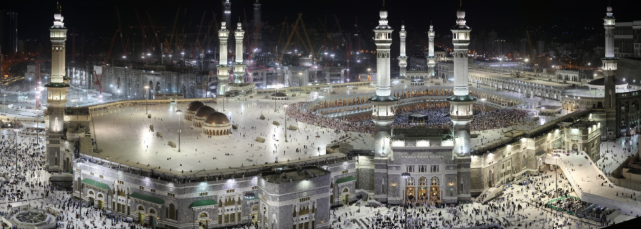
This study offers an integrated historical, philosophical, and theological commentary on the third verse of Sūrat al-Tīn (Qurʾān 95:3), wa hādhā al-balad al-amīn — “And by this secure city [Mecca]” — read in the light of a striking contemporary convergence: the signing, on 7 August 2026, of the Mecca Joint Defense Agreement by Saudi Arabia, Turkey, and Pakistan within the very city whose divinely ordained security the verse invokes. The article situates 95:3 within the surah’s opening oath-cluster (95:1–3, the fig, the olive, Mount Sinai, and the secure city), presenting the Arabic text, transliteration, and multiple parallel English renderings, and drawing on the major mufassirūn — al-Ṭabarī, al-Zamakhsharī, Fakhr al-Dīn al-Rāzī, al-Qurṭubī, and Ibn Kathīr — on the meaning of al-balad al-amīn and the significance of a divine oath sworn upon Mecca’s security. It then examines the Quran’s sustained theme of Mecca as a sanctuary of peace (ḥaram / balad amīn) across Q 2:125–126, 3:96–97, 28:57, and 29:67, and embellishes the commentary with Sūrat al-Fīl (Q 105) and the Year of the Elephant as the paradigmatic demonstration of the city’s protection. Engaging the classical science of Quranic oaths (aqsām al-Qurʾān) and the author’s prior writings on the subject, the study reads the divine oath as an evidentiary device. It analyzes the nuts and bolts of the 2026 pact — its NATO-style Article 5 logic, its regional context, and reactions to it — and reflects on the symbolism of sealing a collective-security compact in the “secure city.” Throughout, the register is pluralist and non-polemical; convergences between scripture, history, and contemporary events are framed as resonance and anticipation, not as concordist proof. A thematic epilogue gathers the threads.
The Verse and Its Oath-Cluster
Sūrat al-Tīn (“The Fig”) is the ninety-fifth chapter of the Quran, a short Meccan surah of eight verses whose opening is a rapid cluster of oaths introducing a solemn statement about the creation and destiny of the human being. The third verse, our focus, completes the cluster of sworn objects.
Arabic (95:1–3):
وَالتِّينِ وَالزَّيْتُونِ ﴿١﴾ وَطُورِ سِينِينَ ﴿٢﴾ وَهَٰذَا الْبَلَدِ الْأَمِينِ ﴿٣﴾
Transliteration: Wa’l-tīni wa’l-zaytūn (1); wa ṭūri sīnīn (2); wa hādhā al-baladi’l-amīn (3).
The complement of the oath — its jawāb al-qasam — follows immediately: لَقَدْ خَلَقْنَا الْإِنسَانَ فِي أَحْسَنِ تَقْوِيمٍ — “We have certainly created man in the best of moulds” (95:4).
Because the platform’s convention is to let several respected translators speak in parallel, the verses read:
- Saheeh International: “By the fig and the olive / And [by] Mount Sinai / And [by] this secure city [Makkah] / We have certainly created man in the best of stature.”
- Abdullah Yusuf Ali: “By the Fig and the Olive, / And the Mount of Sinai, / And this City of security, — / We have indeed created man in the best of moulds.”
- Marmaduke Pickthall: “By the fig and the olive, / By Mount Sinai, / And by this land made safe; / Surely We created man of the best stature.”
- M. A. S. Abdel Haleem: “By the fig, by the olive, / by Mount Sinai, / by this safe town, / We create man in the finest state.”
- Abul Aʿla Maududi: “By the fig and the olive, / and by the Mount Sinai, / and by this city (of Makkah), a haven of peace.”
The Arabic phrase al-balad al-amīn pairs al-balad (“the city / the town”) with al-amīn. The adjective amīn shares its root (ʾ-m-n) with amn (security), amāna (trustworthiness), and īmān (faith); it is also the epithet by which the people of Mecca knew Muhammad before his prophethood — al-Amīn, “the Trustworthy.”
Historical Context of Revelation
The overwhelming majority of scholars classify Sūrat al-Tīn as an early Meccan revelation. As the classical introductions note, “the majority of scholars regard it as a Makki revelation, a manifest symbol of which is the use of the words hadh-al-balad-il-amin (this city of peace) for Makkah” — for had it been revealed in Medina, it would not naturally have designated Mecca as “this city.” The surah bears no trace of the later Medinan legal register; it belongs to the period of Mecca’s earliest preaching, when the essential message concerned the dignity of the human creature, moral accountability, and the certainty of the Judgment. Doortodeen
That context matters for reading 95:3. The oath by “this secure city” was proclaimed within Mecca, by a Prophet who was himself experiencing the paradox that the sanctuary’s inviolability, respected even in pagan custom, did not shield him from his own tribe’s hostility. The security of the city is thus at once a settled fact of Arabian life, a theological sign, and — implicitly — a moral summons.
The Meaning of al-Balad al-Amīn in the Classical Tafsīr
The classical exegetes are unanimous that al-balad al-amīn is Mecca, and they converge on reading amīn as āmin — “secure, safe” — while drawing out its several nuances.
Al-Ṭabarī (d. 310/923), in Jāmiʿ al-Bayān, glosses the verse: “‘And by this secure city’ — He means: this city that is safe from its enemies, [safe] from their making war on its people or raiding them… What is meant by ‘this secure city’ is Mecca. And this is what the people of interpretation have said.” He grammatically treats amīn as bearing the sense of āmin (secure), supporting it with a line of early poetry (in which amīnī means āminī, “my safe one”), and he chains a series of reports from the earliest authorities — Ibn ʿAbbās, Kaʿb al-Aḥbār, al-Ḥasan al-Baṣrī, Mujāhid, ʿIkrima, Qatāda, Ibn Zayd, and Ibrāhīm al-Nakhaʿī — all identifying the site as Mecca or “the Sacred City” (al-balad al-ḥarām). Al-Ṭabarī explicitly anchors the security of the city to God’s declaration in Q 29:67, “Have they not seen that We made [Mecca] a secure sanctuary?” ksu + 2
Al-Zamakhsharī (d. 538/1144), in al-Kashshāf, offers a memorable image: the city is amīn the way a trustworthy person (amīn) is trustworthy — “its trustworthiness (amāna) is that it safeguards whoever enters it, just as the trustworthy man safeguards what is entrusted to him.” He notes the alternative that amīn, on the pattern faʿīl, may carry the passive sense of maʾmūn — “one whose harms and calamities are safe from” — so that its people live secure. quran-tafsirquran-tafsir
Fakhr al-Dīn al-Rāzī (d. 606/1210), in Mafātīḥ al-Ghayb, quotes al-Zamakhsharī’s formulation directly and enumerates the ways in which Mecca is “secure”: God protected it from the army of the Elephant; it grants refuge such that even a person whose blood is otherwise licit becomes safe upon entering it, and even wild game finds protection within its bounds. On the whole oath-cluster, al-Rāzī records the interpretation, going back to Ibn ʿAbbās, that the four objects are the birthplaces of prophets: the land of the fig and olive for Jesus, Syria (the olive) for most of the prophets of the Children of Israel, Mount Sinai for Moses, “and the Secure City is the mission-place of Muhammad” — so that “the real purpose of the oath is the exaltation of the prophets and the raising of their ranks.” On Sūrat al-Balad’s companion oath, al-Rāzī holds that the oath testifies to the great honor the town of Mecca possesses. quran-tafsirالموسوعة الشاملة لتفسير
Al-Qurṭubī (d. 671/1273), in al-Jāmiʿ li-Aḥkām al-Qurʾān, likewise reads al-amīn as al-āmin (following the grammarian al-Farrāʾ), cites Q 29:67, and states that God swore by Mecca “because it is the trace and legacy of Abraham (athar Ibrāhīm) and the home (dār) of Muhammad” — a formulation that ties the city’s security directly to Abraham’s foundational prayer. ksu
Ibn Kathīr (d. 774/1373) reports the identification with Mecca as beyond dispute — “There is no disagreement about this” — and preserves the influential tradition (from Kaʿb al-Aḥbār and others) that the three sacred sites correspond to three of the resolute messengers (ūlū al-ʿazm): the fig and olive to Jerusalem, where Jesus was sent; Mount Sinai, where God spoke to Moses; “and the third is Mecca — it is the secure city, whoever enters it is safe, and it is where God sent Muhammad.” Ibn Kathīr adds that “at the end of the Torah these three places are mentioned,” citing the parallel of Deuteronomy 33:2 — “God came from Sinai… shone forth from Seir… appeared from the mountains of Paran” — which he reads as naming, in order of their appearance in time, the mountains of Moses, of Jesus, and of Muhammad. On this reading the oath ascends “by the noble, then the nobler, then the noblest of them.” quran + 7
Two points deserve emphasis for our theme. First, the grammar makes amīn an active quality of the city: Mecca does not merely happen to be safe; it confers security on those within it — a resonance with Q 106:4, which speaks of the One who “made them secure against fear.” Second, the mufassirūn read 95:3 as the fulfillment of Abraham’s petition, “My Lord, make this a secure city” (Q 2:126; cf. 14:35), so that the divine oath ratifies an ancient prayer.
The Significance of a Divine Oath upon the City’s Security
Why would God swear by a city’s security? Here the commentary joins the classical science of Quranic oaths (aqsām al-Qurʾān), a theme developed extensively in the author’s prior writings collected under Quranic Oaths. As those studies explain, a Quranic oath has three components: the jurative particle (most often wa-), the object sworn by (al-muqsam bihi), and the claim the oath secures (al-muqsam ʿalayhi or jawāb al-qasam). The classical theorists first stress confirmation: al-Zarkashī describes the oath as a construction by which a report is confirmed through emphasis, and al-Suyūṭī says its purpose is “to confirm a statement and place emphasis upon it.” The exegetes add the note of taʿẓīm — the honoring of the object sworn by — as when al-Rāzī reads the oath by Mecca as testimony to the city’s exceptional honor. thequran
The decisive modern development, elaborated in the author’s series, comes from Ḥamīduddīn Farāhī (1863–1930) and his student Amīn Aḥsan Iṣlāḥī, for whom the object of an oath functions as evidence and testimony (dalīl, shahāda) for the claim that follows. As Mustansir Mir summarizes Farāhī in “The Qur’an Oaths: Farahi’s Interpretation,” “the object of an oath was meant to serve as a witness to the truth of the complement of the oath.” On this reading the oaths belong to “Quranic logic” rather than mere rhetoric, and the interpreter’s task is to establish the specific relationship between each sworn object and the proposition it secures.
The author’s own studies — including The Oath by All That Is Seen and Unseen, Seen and Unseen: A Multidisciplinary Commentary on the Quranic Oaths in Surah Haqqah, and Ninety oaths and the last laugh of Al-Ghazali — adopt a synthesis: the oaths are “a rhetorical technology tuned to oral culture” that nonetheless carries strict evidentiary force, turning “the book of nature into a standing witness to the book of scripture.” The oath, as the author’s companion pieces on the sanctuary put it, calls creation to a witness stand: the jurative particle calls the court to order, the muqsam bihi gives testimony, and the jawāb states the proposition established.
Applied to 95:3, the logic is this. The claim to be secured is the noble creation and moral responsibility of the human being (95:4–8). The witnesses summoned are three sites of revelation — the land of Jesus, the mountain of Moses, and the city of Muhammad — and the security of Mecca is itself part of the testimony. A city that survives, protected, in a barren valley amid the chronic warfare of ancient Arabia is a sign (āya) of a governing providence; and if the city’s peace is a divine gift, then the human being who dwells under that peace is accountable to its Giver. The author’s two 2026 companion studies, Three Oaths on the Sacred Precinct and The Sanctuary in the Court of Creation, read Sūrat al-Tīn’s oath alongside those of Sūrat al-Balad (90:1) and Sūrat al-Ṭūr (52:4), arguing that in al-Tīn “Mecca joins the lands of the fig and olive and Mount Sinai in a fellowship of revelations associated with Jesus, Moses, and Muhammad” — a notably pluralist, inter-prophetic reading of the sworn cluster. thequran
The author’s Jurative and Cosmological Architecture of the Sacred Precinct further frames a “jurative scaling”: the oath by the city (al-Balad, 90:1) confronts human political arrogance by showing that “worldly peace and security are contingent gifts under divine jurisdiction”; the oath by the House (al-Ṭūr, 52:4) establishes the physical qibla of monotheism; and the oath by “all that you see and do not see” (al-Ḥāqqa, 69:38–39) summons the totality of reality. Verse 95:3 belongs to the first register: a sworn testimony that the security of a city is God’s to grant. thequran
The Paradigm of Protection: Sūrat al-Fīl and the Year of the Elephant
If 95:3 declares Mecca secure, the most vivid pre-Islamic demonstration of that security is preserved in Sūrat al-Fīl (Q 105, “The Elephant”).
Arabic (105:1–5):
أَلَمْ تَرَ كَيْفَ فَعَلَ رَبُّكَ بِأَصْحَابِ الْفِيلِ ﴿١﴾ أَلَمْ يَجْعَلْ كَيْدَهُمْ فِي تَضْلِيلٍ ﴿٢﴾ وَأَرْسَلَ عَلَيْهِمْ طَيْرًا أَبَابِيلَ ﴿٣﴾ تَرْمِيهِم بِحِجَارَةٍ مِّن سِجِّيلٍ ﴿٤﴾ فَجَعَلَهُمْ كَعَصْفٍ مَّأْكُولٍ ﴿٥﴾
Translation (Abdel Haleem): “Have you [Prophet] not considered how your Lord dealt with the army of the elephant? Did He not utterly confound their plans? He sent ranks of birds against them, pelting them with pellets of hard-baked clay: He made them [like] cropped stubble.”
The traditional narrative, preserved in the earliest biographical literature (Ibn Isḥāq’s Sīra, transmitted through Ibn Hishām, and al-Wāqidī’s Kitāb al-Maghāzī), concerns Abraha al-Ashram, the Abyssinian (Aksumite) Christian governor of Yemen, who is said to have built a great cathedral in Ṣanʿāʾ and, angered that the Arabs continued to make pilgrimage to the Kaaba, marched on Mecca to demolish it and redirect the pilgrimage trade. His army included one or more war elephants, the lead beast named Maḥmūd. According to tradition, when the army turned toward the Kaaba, Maḥmūd knelt and refused to advance, rising and walking readily in any other direction — a detail the sources read as the animal’s recognition of the sanctuary. God then sent flocks of birds (abābīl) that pelted the host with stones of baked clay (sijjīl), leaving them “like chewed-up straw.” Islamic tradition places this in the Year of the Elephant, approximately 570 CE, the same year in which the Prophet Muhammad was born — though some early authorities, including a tradition attributed to al-Zuhrī, date it a decade or two earlier. IQRA + 3
Notably, the Meccan leader ʿAbd al-Muṭṭalib, the Prophet’s grandfather, is reported to have responded to Abraha with a theology of the sanctuary that is itself a commentary on 95:3: “This is the House of God; if God wants to save His House, He will save it; and if He leaves it unprotected, no one can save it.” The point is not that Mecca is intrinsically impregnable, but that its security rests with its Lord. IQRA
The author’s own study, Surah Al-Fil: An Academic Commentary, and his commentary “Mecca: From Barren Valley to Global Axis” read this event as a paradigmatic instance of “sacred protection,” while carefully noting that some historians have proposed naturalistic readings — for instance, that the “stones” and the sudden devastation may allegorically describe an epidemic (smallpox has been suggested) that struck the invaders. In the platform’s convention, such convergences are treated as resonance rather than as forced proof: the theological meaning — that the security of the sanctuary is a divine gift, not a human achievement — stands regardless of the mechanism. Wikimedia
The Quran’s Sustained Theme of Mecca as Secure Sanctuary
Verse 95:3 is one thread in a rich Quranic fabric. The designation of Mecca as ḥaram āmin / balad amīn recurs across the scripture, most often bound to the figure of Abraham.
Q 2:125 establishes the House as a place of return and of security:
وَإِذْ جَعَلْنَا الْبَيْتَ مَثَابَةً لِّلنَّاسِ وَأَمْنًا
“And [remember] when We made the House a place of return for the people and [a place of] security.” The word mathāba (a place to which one returns again and again) is paired with amn (security), so that the very definition of the House joins homecoming to safety.
Q 2:126 records Abraham’s prayer, which the mufassirūn treat as the origin of the city’s security:
وَإِذْ قَالَ إِبْرَاهِيمُ رَبِّ اجْعَلْ هَٰذَا بَلَدًا آمِنًا وَارْزُقْ أَهْلَهُ مِنَ الثَّمَرَاتِ
“And [mention] when Abraham said, ‘My Lord, make this a secure city and provide its people with fruits.’” The same petition appears at Q 14:35, “My Lord, make this city secure.” The pairing of amn (security) with rizq (provision, “fruits”) identifies the two pillars of human flourishing — freedom from fear and freedom from want — a pairing the Quran later crystallizes in Sūrat Quraysh (106:4): the Lord “who has fed them against hunger and made them secure against fear.” thequran
Q 3:96–97 names the sanctuary the first house of worship and declares the safety of all who enter:
فِيهِ آيَاتٌ بَيِّنَاتٌ مَّقَامُ إِبْرَاهِيمَ ۖ وَمَن دَخَلَهُ كَانَ آمِنًا
“In it are clear signs [such as] the standing place of Abraham. And whoever enters it shall be safe.” Ibn Kathīr, commenting here, lists among Mecca’s very names al-Balad al-Amīn, “the City of Safety.”
Q 28:57 and Q 29:67 press the theme further, contrasting Mecca’s peace with the violence surrounding it:
أَوَلَمْ نُمَكِّن لَّهُمْ حَرَمًا آمِنًا يُجْبَىٰ إِلَيْهِ ثَمَرَاتُ كُلِّ شَيْءٍ (28:57)
“Have We not established for them a safe sanctuary to which are brought the fruits of all things?”
أَوَلَمْ يَرَوْا أَنَّا جَعَلْنَا حَرَمًا آمِنًا وَيُتَخَطَّفُ النَّاسُ مِنْ حَوْلِهِمْ (29:67)
“Have they not seen that We made [Mecca] a safe sanctuary while people are being snatched away all around them?” This last verse is the one al-Ṭabarī and al-Qurṭubī cite to explain the amn of 95:3; it captures the theme most sharply — an island of security amid a sea of predation.
The author’s commentary “The Sanctuary of the Divine Axis” is devoted to Q 29:67, and “Mecca: From Barren Valley to Global Axis” gathers the full set of these verses, observing that Abraham “settled his family in this desert wilderness to ensure that their survival and the city’s growth would be seen as a direct act of divine grace.” thequran
Sanctuary as Blessing and as Command: The Scholarly Interpretation
Islamic scholarship reads the security of Mecca in two registers at once, and it is important to hold them together.
First, the sanctuary is a divine declaration of honor and blessing — a descriptive statement about what God has done for the city. This is the register of the oaths and of verses like 29:67: Mecca is secure because God made it so.
Second, the sanctuary is a legislative command (ḥukm) — a prescriptive rule binding on believers. As the author’s studies summarize the classical fiqh, the ḥaram of Mecca is a precinct where “the shedding of blood is strictly prohibited, human injustice is barred, and even the natural environment is granted divine legal immunity”; wild game may not be hunted and vegetation may not be cut within its bounds. The Prophet’s own teaching on the day of the Conquest of Mecca — “Whoever enters the Sacred Mosque is safe” — and the Quranic regulation of fighting near the sanctuary (Q 2:191, which forbids initiating combat there) translate the blessing into law. Some commentators, as the reference works note, therefore describe the security of the ḥaram as legislative: “the sanctity and inviolability of Mecca are maintained through specific rulings and regulations that make it a secure area.” thequran
The two registers meet in the grammar of amīn itself: because Mecca grants security (the active sense the mufassirūn favor), those who dwell in it are obligated to preserve that security. The descriptive blessing grounds the prescriptive duty.
This dual reading also resolves an obvious historical difficulty. The sanctuary’s peace has, in fact, been violated more than once. During the second civil war, the Umayyad siege of Mecca (683 CE) damaged the Kaaba and, by some accounts, fractured the Black Stone, which ʿAbdullāh ibn al-Zubayr later bound in silver. In January 930 CE the Qarmatians under Abū Ṭāhir al-Jannābī sacked Mecca during the Hajj; per the standard historical account, the city “was plundered for eight to eleven days, many of the pilgrims were killed and left unburied, while even the Kaaba… was ransacked,” with corpses thrown into the well of Zamzam. The Qarmatians carried off the Black Stone to eastern Arabia, where it remained for about twenty-two years before its return around 952 CE. And in November 1979, the militant Juhaymān al-ʿUtaybī and several hundred followers seized the Grand Mosque itself, holding it for two weeks until Saudi forces, with foreign technical assistance, retook it. (It is a notable historical footnote, given our present theme, that Pakistani commandos of the Special Services Group assisted in that operation.) Timeless MythsWikipedia
Traditional scholars address these episodes not by denying them but by clarifying the logic of the sanctuary. Its divinely ordained peace is, in the prescriptive register, an inviolable moral and legal rule that believers are commanded to uphold; when human beings violate it, the sin lies with the violators, and the Quran’s own witness (as in the Elephant narrative) is that such transgression invites divine reckoning. The author’s series of historical studies in the Mecca category — including “Yazid’s Army and Mecca,” “The Mongol storm that never reached Mecca,” and “Four centuries as servants of the sanctuary: Ottoman rule over Mecca and Medina” — trace exactly this tension between the ideal of inviolability and the record of history, arguing, as “Mecca: From Barren Valley to Global Axis” puts it, that the Kaaba has nonetheless “remained largely insulated from military spillover,” serving as “a unique space where political hostilities are transcended.” The verse, in short, is both a descriptive blessing and a prescriptive command: it tells us what God has given and what humanity is charged to protect. thequran
The Mecca Joint Defense Agreement (7 August 2026)
It is against this fourteen-century backdrop that a contemporary event acquires its resonance. On 7 August 2026 (a Friday), in the holy city of Mecca, three influential Muslim-majority states — Saudi Arabia, Turkey, and Pakistan — signed a trilateral collective-defense treaty known as the Mecca Joint Defense Agreement (Arabic: Ittifāqiyyat Makka li’l-Difāʿ al-Mushtarak). The signatories were Saudi Crown Prince and Prime Minister Mohammed bin Salman, Turkish President Recep Tayyip Erdoğan, and Pakistani Prime Minister Shehbaz Sharif, accompanied by their foreign and defense ministers. Pakistan’s prime minister, accompanied by the country’s army chief Field Marshal Asim Munir, had performed the ʿUmra pilgrimage in Mecca the day before the signing. Wikipedia + 2
What the pact commits the parties to. According to the joint statement published by the Saudi Press Agency and Pakistan’s Ministry of Foreign Affairs, the agreement “is intended to strengthen collective deterrence against any act of aggression, and stipulates that any armed attack against any one of the three States shall be regarded as an attack against them all,” and “further provides for the enhancement of all aspects of defence cooperation among the three States.” The three declared a “shared commitment to further strengthening their collective security and to promoting peace, security and stability in the region and beyond.” The full text has not been publicly released, and the statement does not spell out the precise military obligations of each party. Breaking Defense + 2
The Article 5 comparison. Turkish Foreign Minister Hakan Fidan stated explicitly that “technically, the Mecca Joint Defense Agreement is the same as Article 5 of the NATO Treaty concerning collective defense,” while stressing that “there is no common threat that we have put in writing” and that the pact “does not target any country that does not attack its signatories.” Fidan explained that a member under attack “would have to request assistance and specify what kind of support it needed,” so that the response “would depend on the circumstances.” He said the alliance would establish a ministerial committee, political and military committees, and a permanent general secretariat expected to be based in Saudi Arabia; and, per Al Jazeera, he noted that preparations “had been under way for nearly two years and eight months, suggesting it was not drawn up simply in response to the current tensions.” A News
The complementary capabilities. Analysts consistently describe the three states as bringing distinct strengths: Turkey contributes NATO’s second-largest military and an increasingly sophisticated domestic defense industry; Saudi Arabia contributes substantial financial resources and regional influence as the world’s top oil exporter; and Pakistan contributes extensive military experience and the distinction of being the Muslim world’s only nuclear-armed state. Whether the pact extends Pakistan’s nuclear deterrent to its partners is doubtful: defense analyst Mansoor Ahmed of the Australian National University’s Strategic and Defence Studies Centre noted that Pakistan’s nuclear posture “remains oriented toward the perceived threat from India,” not toward extending a nuclear umbrella over the Gulf, and Islamabad had earlier said nuclear weapons were “not on the radar” in its bilateral Saudi pact. PBS
Relationship to the September 2025 Saudi–Pakistan agreement. The Mecca pact builds directly on the bilateral Strategic Mutual Defence Agreement signed on 17 September 2025 at al-Yamamah Palace in Riyadh by Mohammed bin Salman and Shehbaz Sharif, which had declared that “any aggression against either country shall be considered an aggression against both.” That 2025 accord — itself signed in the wake of an Israeli strike on Hamas figures in Doha, Qatar — formalized decades of Saudi–Pakistani military cooperation. The 2026 Mecca agreement widens that commitment to include Turkey, whose own defense ties with Pakistan (warship and training-aircraft exchanges) and with Saudi Arabia (a major 2023 Turkish-drone export contract) were already well developed. Pakistan’s former ambassador Sardar Masood Khan described the 2025 Saudi–Pakistan pact as “a nucleus” around which wider interest gathered. Wikipedia + 5
Geopolitical Background and Precipitating Events
The pact was signed in the shadow of the 2026 Iran war, which had begun on 28 February 2026 when the United States and Israel launched airstrikes on Iran — a campaign that, according to reporting, included the assassination of Iran’s supreme leader Ali Khamenei. In retaliation, Iran and allied forces — including Houthi fighters in Yemen and Shiʿi militias in Iraq — struck US bases and Gulf states, including Saudi Arabia, Kuwait, Bahrain, Qatar, the UAE, Oman, and Jordan, as well as Israel. Iran’s closure of the Strait of Hormuz — through which, per the International Energy Agency, “nearly 15 mb/d of crude oil, nearly 34% of global crude oil trade, passed” in 2025, alongside roughly a fifth of global LNG trade — triggered a global fuel crisis; commercial traffic through the strait fell dramatically, and Houthi forces declared a blockade of Saudi ports in the Red Sea. Saudi Arabia, struck repeatedly and increasingly doubtful of the reliability of the US security umbrella, was reportedly bracing for a major coordinated assault by Iran-backed militias in the days before the signing. Wikipedia
In this environment the pact serves several purposes at once. For Riyadh, it provides, in the words of Atlantic Council analysts, “a powerful new layer of protection beyond its longstanding security partnership with the United States” at a moment when Gulf states question Washington’s dependability. For Ankara, it broadens what one analyst called a “Muslim collective defense mechanism” and cements Turkey’s place in regional trade and energy networks. For Islamabad, it deepens Pakistan’s role in Middle Eastern security architecture and enhances its prestige. CNNAtlantic Council
Regional Reactions and the Question of Whom It Targets
Officially, the pact names no adversary. Turkish, Saudi, and Pakistani officials uniformly described it as “purely defensive,” not directed against any specific actor, and open to other states. Pakistan’s Deputy Prime Minister and Foreign Minister Ishaq Dar said it was “open to any country in the region” willing to uphold its principles; Saudi deputy minister for public diplomacy Rayed Krimly said it posed no threat to any regional country.
Iran’s response was notably measured. Per Reuters, Foreign Ministry spokesman Esmaeil Baghaei said on 10 August 2026 that “Iran sees no reason to be concerned that a new security pact between Pakistan, Turkey and Saudi Arabia is directed against Tehran,” adding that it showed “a shift in regional countries’ approach to security, with greater reliance on their own capabilities rather than outside powers” — and framing any regional security plan as potentially useful if it “correctly identifies the enemy and the threat,” which he identified as “the Zionist enemy and its allies.” A more critical note came from Ebrahim Rezaei, a member of the Iranian parliament’s National Security and Foreign Policy Committee, who wrote on X that “the Saudis should understand that a paper agreement with Turkey and Pakistan will not bring them security, just as decades of one-sided dependence on the Americans failed to do so.” AL-MonitorCNN
Speculation about the target. Despite the disavowals, most analysts read the pact as aimed principally at deterring Iran and its proxies, while some Israeli commentary read it as a signal to Israel; a Pakistani defense minister’s call for “a united military front” against Israel drew particular attention in the Israeli press, even as Dr. Yoel Guzansky of the Institute for National Security Studies judged that the pact “doesn’t shut the door completely on normalization” between Riyadh and Jerusalem. Turkish and Saudi officials, notably, conveyed that Riyadh favored de-escalation with Iran through dialogue rather than military action.
Which other countries might join. Fidan said Turkey did not intend to “remain limited to three countries” and named Egypt as a “natural partner” likely to join once technical issues were resolved — though Ahmed Aboudouh of Chatham House cautioned that Cairo “does not share its underpinning threat perception” and may resist “security commitments.” Officials and analysts floated Qatar, Kuwait, and other Gulf Cooperation Council members as plausible future members; former Qatari premier Sheikh Hamad bin Jassim Al Thani expressed hope that all GCC states would “take the initiative to join.” India said it was “closely following” the agreement, given the implications of Pakistan’s new collective-defense commitments. Commentators in several outlets described the emerging framework as a possible “Sunni NATO,” while cautioning against overstating its cohesion — the Atlantic Council’s Michael Kugelman wrote that “this agreement is not a NATO-like alliance, and it does not signal a discrete new regional bloc. But that does not mean it is not significant.” A News
The Symbolism of Signing in the Secure City
The choice of Mecca as the site of signing was not incidental; as Al Jazeera observed, “sealing the agreement in Mecca, home to Islam’s holiest site, adds symbolic heft.” Here the contemporary event and the Quranic verse illuminate one another — carefully, and with the platform’s caution against concordism. Al Jazeera
Verse 95:3 swears by Mecca as al-balad al-amīn, the city whose security is a divine gift and a human trust. The mufassirūn read that security as the fulfillment of Abraham’s prayer, “make this a secure city” (2:126), and as the state described in 29:67, an island of safety “while people are being snatched away all around them.” In August 2026 that phrase read almost as reportage: as missiles fell on Gulf capitals and the Strait of Hormuz closed, three heads of state gathered in the one city the Quran calls secure to pledge their mutual protection.
The resonance is theologically instructive precisely because it also marks a boundary. The Quranic security of Mecca is presented as a gift conferred by God — the register of blessing. A collective-defense pact is a human undertaking — the register of command and responsibility. To read the 2026 agreement as a “fulfillment” of 95:3 would be to collapse the two registers and to mistake a treaty of states for a promise of God. The more disciplined reading, consonant with the author’s method, is that the pact is a human echo of a divine theme: the recognition, enacted in the secure city, that security is something to be sought, built, and safeguarded together — and that even the mightiest arrangements of states remain, as ʿAbd al-Muṭṭalib told Abraha, subordinate to the Lord of the House. The oath by the secure city thus reads, in 2026, as both a comfort and a summons: a comfort that the sanctuary’s peace has outlasted fourteen centuries of turmoil, and a summons that its peace is a trust human beings are charged to keep.
Zia H Shah MD’s Prior Writings on the Kaaba and Mecca
This commentary stands on a substantial body of prior work collected under the platform’s Mecca category. The keystone study, “Mecca: From Barren Valley to Global Axis” (a historical and theological commentary on Q 27:91), traces the sanctuary from Abraham’s “uncultivated valley” (Q 14:37) to the modern high-tech Hajj, integrating the full range of Quranic references — Bakkah, Umm al-Qurā, al-Bayt al-ʿAtīq, al-Bayt al-Ḥarām, and al-Balad — and arguing that the persistence of a city in a barren valley is itself a sign of divine governance. Its treatment of Q 27:91’s “Lord of this city, which He has made inviolable (ḥarramahā)” directly underwrites the present reading of al-balad al-amīn: the sanctity and the security are two faces of the same divine decree. thequran
The author’s companion studies deepen the picture: “The Sanctuary of the Divine Axis” (on Q 29:67, the “safe sanctuary while people around are snatched away”); “The Sacred City and Its Lord“; and the two 2026 oath studies, “Three Oaths on the Sacred Precinct” and “The Sanctuary in the Court of Creation,” which read 95:3 alongside 90:1 and 52:4. The historical essays in the Mecca category — on Yazīd’s army, the Mongol advance, the WWI siege of Medina, the Mamluk defense, and four centuries of Ottoman guardianship of the two sanctuaries — supply the long record against which the sanctuary’s inviolability is both tested and vindicated. Across all of them runs a consistent double reading: the Kaaba as sacred meaning and as governed space, “an oasis of safety” that has “remained largely insulated from military spillover” even as neighboring lands burned. thequran
Thematic Epilogue
Consistent with the platform’s stated conventions, all convergences among scripture, history, and contemporary events are offered as resonances and anticipations inviting reflection — never as concordist demonstrations that the Quran “predicted” a modern treaty. The interpretive humility that the author’s own writings insist upon (the distinction between the certainty of the revealed text and the fallibility of human commentary) applies fully here.
An oath sworn fourteen centuries ago in a small Meccan valley bound together a fig, an olive, a mountain, and a city — the emblems of Jesus, of Moses, and of Muhammad — and from that fellowship of revelations it drew a single conclusion: that the human being is made “in the best of moulds,” and is therefore answerable. The security of the city was, in that oath, both witness and gift. It was the answer to Abraham’s ancient prayer, “My Lord, make this a secure city”; it was the reality the Quran set against a world in which “people are being snatched away all around them”; and it was demonstrated, in the story the tradition loved to tell, when an elephant knelt rather than march on the House and an army was scattered like chewed straw.
Fourteen centuries later, in the same city, three heads of state pledged that an attack on one would be an attack on all. The convergence is arresting, and it would be easy to over-read. The Quran’s security is a divine bestowal; a defense pact is a human labor. Yet the two are not strangers. The verse that swears by the secure city also, in the mufassirūn’s reading, obliges those who dwell in it to keep it secure — the blessing grounds the command. The Mecca Joint Defense Agreement, whatever its geopolitics and whatever its fate, is at its best a human enactment of that command: the recognition, staged deliberately in the balad amīn, that peace is not self-sustaining but must be sought, built, and guarded, and that it remains, in the end, a trust held under a higher sovereignty.
That, finally, is the theme that gathers the divine oath, Abraham’s prayer, the Year of the Elephant, the long and imperfect history of the sanctuary, and the events of August 2026 into one meditation: security as both gift and responsibility. The Quran presents the resonances among scripture, history, and the present not as proofs to compel assent but as invitations to reflection — a call to see, in the survival of a city and the striving of its guardians, a sign pointing beyond itself to the Lord of this House, who “has fed them against hunger and made them secure against fear.” The secure city endures; the summons it carries is that its peace be honored, within its precincts and far beyond them.



Leave a Reply