
Presented by Gemini for Zia H Shah MD
Audio teaser: The Kaaba as a Physics Blueprint
Abstract
This research report presents a comprehensive, transdisciplinary analysis of the sacred precinct of Mecca—specifically focusing on the Kaaba and its surrounding territory—viewed through the lens of the Quran’s unique jurative framework. Drawing on the extensive corpus of writings by Zia H. Shah MD, the classical exegesis (tafsīr) of authorities such as Fakhr al-Dīn al-Rāzī and Ibn Kathīr, and modern scientific paradigms ranging from atmospheric thermodynamics to quantum cosmology, this study explores how the Quran leverages physical geography and cosmic phenomena to construct a mathematically and philosophically rigorous natural theology. The analysis is organized around the conceptual scaling of three major divine oaths (aqsām): the oath by the sacred city (Al-Balad), the oath by the physical focus of monotheism (Al-Bayt), and the ultimate epistemological summons of the totality of seen and unseen reality (mā tubṣirūna wa-mā lā tubṣirūn). Integrating Abu Hamid al-Ghazali’s occasionalist ontology with contemporary physics, this report demonstrates how the physical sanctuary of Mecca is transformed from a localized urban center into a universal pedagogical gateway where human moral consciousness, biological systems, and cosmic structures are called to the witness stand to affirm the inevitability of the eschatological reality.
Theological and Physical Foundations of the Sacred Precinct: Mecca and the Kaaba as the Axis Mundi
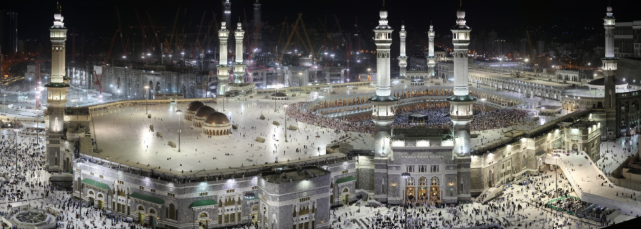
The geographic and metaphysical coordinates of the Islamic sacred precinct, situated in the barren valley of Mecca (referred to scripturally as Bakkah), represent the foundational locus of the Islamic cosmos. According to Islamic tradition, the history of the Kaaba is intrinsically linked to the dawn of human existence. While empirical archaeology is naturally constrained by the site’s intense sanctity and the resulting restrictions on physical excavation, classical Islamic historiography asserts that the foundations of the structure were first established by Adam, the primordial human, as a terrestrial mirror of the celestial assembly of angels. This primordial structure fell into ruin during the cataclysmic flood of Noah, leaving its foundational traces buried in the desert until the era of the patriarch Abraham (Ibrāhīm) and his son Ishmael (Ismāʿīl). The Quran describes their collaborative effort not as the invention of a new sanctuary, but as the “raising of the foundations” (yarfaʿu al-qawāʿida mina al-bayt), establishing a physical focus for pure monotheistic devotion (tawḥīd).
Historical and classical sources provide specific, highly documented physical measurements for this Abrahamic phase of construction, showcasing its modest, roofless, and unornamented limestone design:
| Structural Dimension of the Abrahamic Kaaba | Measurement / Characteristic Value |
| Eastern Wall | 48 feet 6 inches |
| Western Wall | 46 feet 6 inches |
| Hateem (Hijr Ismail) Side Wall | 33 feet |
| Height | Estimated between 7 and 9 cubits |
| Architectural Features | Built without a ceiling/roof; featured two ground-level entryways |
The linguistic landscape of the Quran assigns multiple names to this sacred location, each carrying deep semantic, historical, and legal dimensions:
| Sacred Name in Arabic | Transliteration | Key Quranic Locus | Semantic and Theological Significance |
| بِبَكَّةَ | Bakkah | Surah Āl ʿImrān (3:96) | Derived from the root B-K-K, indicating “crowding” or “gathering” of pilgrims in circumambulation (ṭawāf), or from buka’ (weeping), signifying the humbling tears of the arrogant who find themselves diminished in the divine presence. |
| مَكَّةَ | Makkah | Surah Al-Fatḥ (48:24) | Denotes the “belly” or physical center of the region, emphasizing its status as the geographic and cultural heart of the Arabian Peninsula. |
| الْبَيْتَ | Al-Bayt | Surah Al-Baqarah (2:125) | The archetypal “House,” a physical focus point representing divine residency, safety, and human resort. |
| الْبَيْتِ الْعَتِيقِ | Al-Bayt al-ʿAtīq | Surah Al-Ḥajj (22:33) | Classically translated as either the “Ancient House,” reflecting its prehistoric primacy, or the “Liberated House,” signifying its independence from tyrannical human ownership. |
| الْبَيْتَ الْحَرَامَ | Al-Bayt al-Ḥarām | Surah Al-Māʾidah (5:97) | The sanctified house, legally protected and forbidden for bloodshed or violence. |
The absolute sanctity of Mecca implies a legally binding Ḥaram (sanctuary) where the shedding of blood is strictly prohibited, human injustice is barred, and even the natural environment is granted divine legal immunity. Under classical Islamic law (fiqh), wild animals may not be hunted or disturbed, and trees or vegetation may not be felled within the designated boundaries of the Ḥaram. This environmental and human inviolability, established by divine decree, turned a barren, resource-scarce valley into an oasis of absolute security, a “miracle of peace” that preserved human life amidst the chronic tribal warfare of pre-Islamic Arabia and continues to act as a geopolitical buffer zone in the modern era.
The spiritual and physical purification of the Kaaba, commanded to Abraham and Ishmael, is interpreted by classical scholars as containing three distinct dimensions:
- Physical Purity: Keeping the structural precinct free of environmental contaminants, waste, and physical filth to provide a sanitary space for worshippers.
- Ritual Purity: Cleansing the site of physical idols, pagan icons, and polytheistic symbols, a purification later completed when Prophet Muhammad cleansed the structure of its 360 pagan idols in 630 CE.
- Moral Purity: Restricting the performance of rites to those dedicated solely to the One Creator (tawḥīd), preventing the moral pollution of hypocritical display or the association of partners with God (shirk).
To preserve the material identity of this central structure across history, multiple documented physical restorations have occurred. Shortly before the Prophet’s mission, the pagan Quraysh rebuilt the structure following a major fire; Muhammad, then a young man, participated in the construction and famously resolved a potentially violent tribal dispute by placing the Black Stone (al-Ḥajar al-Aswad) onto his cloak, allowing all clan leaders to lift it together. In the seventeenth century, under Ottoman Sultan Murad IV, the Kaaba was substantially rebuilt using massive granite blocks after a catastrophic flash flood partially collapsed the northern and western walls. In 1996, King Fahd commissioned a comprehensive structural restoration that stripped the plaster, inspected the internal load-bearing timber pillars, and reinforced the masonry with modern high-performance binding materials, successfully preserving the ancient physical footprint while stabilizing the building for centuries to come.
In the modern era, the management of this primordial site has evolved into a highly complex, technologically driven operation. The demographic expansion of the Muslim world has transformed the annual Hajj and year-round Umrah from localized travels into massive global migrations. Since the dawn of the twenty-first century, and accelerated by the public health challenges of the COVID-19 pandemic, the sacred precinct has been integrated with high-tech crowd-management algorithms, automated sanitization robotics, real-time spatial analytics, and digital health tracking systems, demonstrating a unique synthesis of ancient ritual continuity and high-tech administrative infrastructure.
The legal and theological significance of this sanctuary is viewed with uniform gravity across the major schools of Islamic thought. In Sunni theology, the Hajj is codified as the fifth pillar of practice, an absolute obligation once in a lifetime for every adult possessor of capability (istiṭāʿa), symbolizing a dramatic preview of the egalitarian gathering of the Day of Judgment. Twelver Shi’a theology shares these physical requirements but further integrates the pilgrimage with the metaphysical concept of wilāyah (loyalty to the divinely appointed Imams of the Prophet’s family). Shi’a exegesis records that the Imams taught that the Kaaba is surrounded by an extraordinary concentration of divine mercy. Imam Jaʿfar al-Ṣādiq is reported to have stated that God allocates 120 distinct types of divine blessings around the Kaaba—sixty reserved for those performing circumambulation (ṭawāf), forty for those engaged in ritual prayer (ṣalāh), and twenty for those who simply gaze upon the structure with quiet reverence and reflection.
Three Oaths on the Sacred Precinct: The Kaaba, the City of Mecca, and the Quran’s Summoning of the Totality of Reality as Witness
The targeted article, “Three Oaths on the Sacred Precinct: The Kaaba, the City of Mecca, and the Quran’s Summoning of the Totality of Reality as Witness,” explores how the Quran structures an epistemological escalation by transitioning from localized, earthly geography to a comprehensive cosmic witness stand. This scaling is achieved through three distinct, hierarchically organized divine oaths (aqsām), which function not as poetic metaphors but as a progressive framework designed to guide human reason from immediate sensory perception to absolute metaphysical certainty.
The First Oath: The Sanctuary of the City (Al-Balad)
The first step in this jurative scaling is found in the opening of Surah Al-Balad (90:1–2), where the Creator declares:
{لَا أُقْسِمُ بِهَٰذَا الْبَلَدِ وَأَنتَ حِلٌّ بِهَٰذَا الْبَلَدِ}
“No, I swear by this city [Mecca]—and you, [O Muhammad], are a free inhabitant of this city.”
The linguistic construction Lā uqsimu (classically parsed by grammarians as an emphatic formula meaning “No, indeed! I do solemnly swear”) dismisses the skeptics’ false assumptions before introducing a sacred reality. By swearing by the city of Mecca, the Quran calls its unique geopolitical and spiritual status to the witness stand. Sayyid Qutb, in his thematic analysis of this passage, highlights the deep irony embedded in the Meccan reality. The pagan Quraysh enjoyed immense economic wealth, tribal prestige, and physical safety precisely because they were the custodians of this sacred, legally protected precinct. Yet, in a glaring moral contradiction, they utilized the security of the sanctuary to persecute, torture, and attempt to assassinate the Prophet Muhammad—the very messenger who was restoring the monotheistic purpose of their city. The oath by “this city” serves as a direct confrontation: it demands that the mockers realize that their physical survival and prosperity are not self-sustaining accidents of history, but are contingent privileges guaranteed by the “Lord of this City” who demands moral accountability.
The Second Oath: The Sacred House (Al-Bayt)
The second level of the jurative scale focuses on the exact physical core of the sanctuary—the Kaaba itself. The Quran invokes this through the oath in Surah At-Tūr (52:4):
{وَالْبَيْتِ الْمَعْمُورِ}
“And by the frequented House [Al-Bayt al-Maʿmūr].”
While classical commentators like Ibn ʿAbbās identify Al-Bayt al-Maʿmūr as a celestial template situated directly above the Kaaba where angels continuously circumambulate, the earthly Kaaba serves as its physical, terrestrial coordinate. The Kaaba functions as a unique focus point (Qiblah) that unifies the physical worship of the unseen, transcendent God. Facing the Kaaba during prayer does not imply a localized or spatial deity; rather, it provides a physical coordinate that organizes the somatic orientation of millions of believers across the globe.
Zia H. Shah MD highlights this as an example of “geocentric monotheism,” where a physical structure of mortal scale serves as an empirical anchor for a transcendent, infinite Creator who remains beyond physical sight:
{Vision cannot perceive Him, but He perceives all vision (Qur’an 6:103)}
By swearing by the “Frequented House,” the Quran draws attention to the continuous, rhythmic flow of human circumambulation. The constant circular motion around the Kaaba—unbroken for thousands of years, across solstices, historical epochs, and political upheavals—acts as an earthly mirror of the gravitational and orbital systems of the cosmos. It is an empirical demonstration of human voluntary submission (islām) mirroring the involuntary submission of the stars and planets.
The Third Oath: The Summoning of the Totality of Reality (Seen and Unseen)
The final and most expansive step in this jurative scaling is found in Surah Al-Ḥāqqah (69:38–39), where the localized geography of Mecca and the Kaaba are integrated into a single, universal summons:
{فَلَا أُقْسِمُ بِمَا تُبْصِرُونَ وَمَا لَا تُبْصِرُونَ}
“No indeed! I swear by all that you see, and by all that you do not see.”
This comprehensive oath marks a significant epistemological shift. Rather than pointing to specific, isolated physical signs—such as the sun, the moon, or the wind—the Quran summons the totality of existence to the witness stand. The verb tubṣirūn (derived from visual and sensory perception) establishes an absolute binary based on the human observer.
This oath asserts that the physical sanctuary of Mecca and the Kaaba are not isolated territorial relics. They are localized portals designed to guide human consciousness from the immediate, visible world (mā tubṣirūn) to the vast, hidden metaphysical and physical dimensions of the unseen (mā lā tubṣirūn), eventually leading to the ultimate recognition of the Creator who is the Lord of all these worlds (Rabb al-ʿālamīn).
To visualize this conceptual and spatial scaling, the following structured table outlines the tripartite relationship of these sacred precinct oaths:
| Step in Scaling | Textual Locus (Quran) | Sacred Object Invoked (Muqsam bihi) | Epistemological and Pedagogical Function |
| Localized Precinct | Surah Al-Balad (90:1-2) | The Secure City of Mecca (Al-Balad) | Confronts human political arrogance and tribal privilege by demonstrating that worldly peace and security are contingent gifts under divine jurisdiction. |
| Monotheistic Anchor | Surah At-Tūr (52:4) | The Frequented House (Al-Bayt) | Establishes a physical coordinate (Qiblah) for monotheistic prayer, representing voluntary human submission mirroring the orbital mechanics of nature. |
| Universal Summons | Surah Al-Ḥāqqah (69:38-39) | All that is Seen and Unseen (Mā lā tubṣirūn) | Dismantles naive realism by demonstrating that the visible universe is only a tiny fraction of a vast, multi-dimensional reality governed by the Creator. |
The Linguistic and Metaphysical Corpus of Quranic Oaths in the Writings of Zia H. Shah MD
The extensive writings of Zia H. Shah MD on the category of Quranic oaths (aqsām) offer a detailed, multidisciplinary framework that bridges classical Islamic theology with modern physics, chemistry, and biology.
The Tripartite Linguistic Structure and the Repudiative Force of Falā Uqsimu
A central aspect of Shah’s linguistic analysis focuses on the precise rhetorical mechanics of the Arabic jurative particles. The Quran primarily utilizes three prefix particles to initiate oaths: Wa (the most common, externalized particle of address), Ba (used for direct, personal oaths), and Ta (an exclusive, highly dramatic particle reserved solely for swearing by the divine name, e.g., Tallah).
When the Quran employs the prefix Fa-lā uqsimu (“No indeed! I swear…”), classical grammarians historically debated the function of the particle lā. Shah, aligning with classical authorities, explains that the lā is not a literal negation of the oath, but a powerful repudiative particle. It functions to dismiss and clear away the false, dogmatic assertions of the deniers before delivering a solemn oath. For example, the construction in Surah Al-Ḥāqqah effectively translates to:
$$\text{“No, indeed! The matter is not as you skeptics allege. I swear by all that you see and all that you do not see…”}$$
This linguistic clearing of the intellectual slate prepares the reader to receive the subsequent jawāb al-qasam (the truth affirmed by the oath) with a focused, rational mind.
Occasionalism: “Ninety Oaths and the Last Laugh of Al-Ghazali”
In his analysis of Abu Hamid al-Ghazali’s occasionalist philosophy, Zia H. Shah MD addresses an important theological question: If natural laws are not autonomous, necessary, or self-sustaining realities, but are instead the constant, frame-by-frame rendering of the divine will (sunnat Allāh), why does the Creator swear by these natural phenomena in ninety distinct oaths?
Under a strict occasionalist ontology, fire does not burn cotton by its own inherent power; rather, God creates the burning at the exact moment of contact. Therefore, swearing by natural objects (the sun, winds, clouds, or stars) might seem to validate a form of naturalism.
However, Shah argues that these oaths represent “Al-Ghazali’s last laugh” over dogmatic naturalism. By swearing by these phenomena, the Creator is not elevating nature to an independent status; rather, He is calling our attention to the absolute consistency, mathematical precision, and reliability of His own creative habits (sunnat Allāh). The physical universe behaves in a predictable, law-governed manner because God wills it to be consistent, providing a stable platform for human life and rational observation. The oaths are an exhibition of divine volition, inviting humanity to study the deep, mathematical order of the cosmos as direct evidence of a single, organizing Creator (tawḥīd).
To illustrate how Zia H. Shah MD’s work maps physical and biological sciences onto these divine oaths, the following table details key natural phenomena invoked in the Quran, their traditional exegesis, and their modern scientific equivalents:
| Divine Oath Locus (Quran) | Sacred Object Invoked (Muqsam bihi) | Classical Exegesis / Traditional View | Modern Scientific Reflection and Resonance |
| Surah Ash-Shams (91:1-2)[cite: 5] | The Sun (al-Shams) and its radiant forenoon light (ḍuḥāhā). | Swearing by the physical sun and the bright daylight it produces. | Focuses on the precision of solar fusion, the electromagnetic radiation that drives photosynthesis, and the fine-tuning of the solar constant. |
| Surah At-Takwīr (81:18) | The Morning as it breathes (al-ṣubḥi idhā tanaffas). | The gradual dispersion of darkness and the arrival of morning light. | Represents the daily global activation of photosynthesis, where plants convert solar energy, water, and atmospheric carbon dioxide ($CO_2$) back into life-sustaining oxygen ($O_2$), literally “breathing” life back into the biosphere. |
| Surah Al-Layl (92:1-2) | The alternating Night (al-layl) and Day (al-nahār). | The physical transition of light and dark across the earth. | Circadian Biology and Chronobiology: Melatonin secretion triggered by darkness regulates hormones, immune function, and cellular repair. Ecliptic Fine-Tuning: Al-Razi noted that perpetual day would incinerate life, while perpetual night would freeze it; the rotational balance of day/night is essential for planetary thermal regulation. |
| Surah Al-Layl (92:3) | The creation of Male and Female (mā khalaqa al-dhakara wa-al-unthā). | Swearing by the dual, gendered nature of animal creation. | The Argument from Duality: Structural and genetic pairing (e.g., DNA base pairs, chromosomal pairing, sexual dimorphism) as a fundamental organizational signature of a single Creator. |
| Surah At-Tūr (52:1) | The Mount (al-Ṭūr). | Swearing by Mount Sinai, the site of the Mosaic revelation. | Highlights the convergence of physical geography and historic prophetic revelation. |
| Surah Al-ʿAsr (103:1) | Time (al-ʿAsr). | Swearing by the passing hours of the day or human history. | Represents the thermodynamic arrow of time, the cosmological expansion of space, and the irreversible dissipation of entropy. |
Atmospheric Thermodynamics and “The ‘Rizq’ Epiphany” in Surah Al-Dhariyat
One of the most biologically and chemically detailed aspects of Shah’s research is the analysis of the opening of Surah Al-Dhariyat (51:1–23). While classical commentators historically decoded the first four verses as representing winds (al-dhāriyāt), clouds (al-ḥāmilāt), ships (al-jāriyāt), and angels (al-muqassimāt), modern atmospheric physics adds a deep physical layer to this global system.
A central focus of Shah’s analysis is what he terms “The ‘Rizq’ Epiphany” based on verse 22:
$$\text{وَفِي السَّمَاءِ رِزْقُكُمْ وَمَا تُوعَدُونَ}$$
“And in the sky is your sustenance (rizq) and all that you are promised.”
Shah observes that while over two dozen Quranic verses describe rain falling from the sky using the word mā’ (water), this verse deliberately employs the word rizq (sustenance, nutrient, or provision). Modern atmospheric chemistry reveals the deep accuracy of this choice. The earth’s atmosphere is composed of seventy-eight percent nitrogen ($N_2$), but this nitrogen is completely inaccessible to plants because of its highly stable triple covalent bond, which requires a massive activation energy of $945\text{ kJ/mol}$ to break.
During a thunderstorm, lightning strikes generate localized temperatures of approximately $50,000^\circ\text{F}$ ($28,000^\circ\text{C}$), instantly cleaving these bonds. The highly reactive nitrogen atoms combine with atmospheric oxygen to form nitrogen dioxide ($NO_2$), which dissolves in rain droplets to produce dilute nitric acid ($HNO_3$). Falling to the earth, this acid reacts with soil minerals to form nitrates ($NO_3^-$), which plants readily absorb through their root systems to synthesize proteins and nucleic acids. Lightning-induced atmospheric nitrogen fixation fixes between $3\text{ and }10\text{ Teragrams}$ of nitrogen globally each year. Thus, rain clouds (al-ḥāmilāt wiqrā) are not merely carrying water; they are acting as chemically calibrated atmospheric factories delivering vital nutrients (rizq) synthesized in the sky.
To highlight the biological and ecological value of this system, modern aerosol science confirms that rain scavenging successfully clears between fifty and eighty percent of below-cloud particulate aerosols, scrubbing the atmosphere clean and depositing vital trace elements onto the earth’s topsoil.
Boundary-State Transitions and the Informational Ontology of Sūrat al-Inshiqāq
Sūrat al-Inshiqāq (“The Splitting Asunder,” Q 84) offers a tightly wound, structurally unified argument where cosmic phase transitions, human labor, and the archiving of moral deeds are shown to be part of a single, inevitable progression. Zia H. Shah MD’s “Four Books of God” paradigm provides a systematic framework for parsing this surah, demonstrating that the Book of Nature, the Book of Deeds, the Book of Revelation, and the Book of Destiny operate under the exact same divine source code.
The Irreversible Metric Collapse of Spacetime (Verse 1)
The surah opens with a depiction of cosmic dissolution:
$$\text{إِذَا السَّمَاءُ انشَقَّتْ}$$
“When the sky is split open [asunder].”
The verb inshaqqat (derived from the root shaq) describes a physical rupturing or splitting of the sky. In modern theoretical cosmology and general relativity, spacetime is not an empty, passive stage, but a dynamic, flexible physical field woven with gravitational and quantum metrics. The “splitting asunder” of the sky represents an irreversible cosmic phase transition—a metric tensor collapse under extreme gravitational or vacuum decay, mathematically modeled as:
$$g_{\mu\nu} \to \infty \quad \text{as} \quad t \to t_{\text{end}}$$
This is distinct from the term infatarat (used in Surah Al-Infiṭār), which classically denotes a linear ripping that could theoretically be reversible. The “stretching of the earth” (wa-idhā al-arḍu muddat) in verse 3 describes the tectonic expansion, the release of mountain anchors, and the leveling of planetary topography, preparing the physical globe to act as a unified, flat gathering place.
The Conservation of Historical Data (Verses 4 and 5)
In verse 4, the earth’s behavior during this transition is described with physical and informational significance:
$$\text{وَأَلْقَتْ مَا فِيهَا وَتَخَلَّتْ}$$
“And has cast out what is within it and becomes empty.”
Under an informational ontology, the earth is treated as a physical archiving medium that has recorded the biological, historical, and geological data of all past living entities. The “casting out” (alqat) and “emptying” (takhallat) represent the retrieval and externalization of this stored data.
This matches the fundamental laws of modern quantum information theory, specifically the principle of information conservation (most famously associated with the resolution of the black hole information paradox), which states that physical information can never be truly destroyed or lost. The physical structures and historical actions of human beings are permanently preserved in the cosmic network, and their “casting out” represents the retrieval of these preserved informational states for final physical reconstruction and moral evaluation.
$$\text{Historical Data Archived in Earth’s Metric} \xrightarrow{\text{Eschatological Retrieval}} \text{Reconstructed Moral Records (Book of Deeds)}$$
The symmetry of the cosmos is emphasized by the repetition of the submission clause in both verse 2 and verse 5:
$$\text{وَأَذِنَتْ لِرَبِّهَا وَحُقَّتْ}$$
“And listens and obeys its Lord—and it must do so.”
This repetition establishes that both the celestial (macroscopic) and terrestrial (microscopic) realms operate under the exact same computational constraints. The universe complies instantly to change its rendering format because it has no independent existence separate from the continuous, moment-by-moment creative act of the Sustainer, Al-Qayyūm.
To synthesize how these physical, biological, and informational concepts converge in Sūrat al-Inshiqāq, the following table details the transdisciplinary correspondences across the surah’s structural movements:
| Verse Locus (Q 84) | Structural Movement | Primary “Book” Involved | Transdisciplinary and Scientific Analogy |
| Verses 1–5 | Cosmic dissolution: sky splits, earth is stretched and empties. | Book of Nature (and its unmaking). | Thermodynamic End-States: Spacetime metric collapse ($g_{\mu\nu} \to \infty$) and the recovery of quantum information from physical matter. |
| Verse 6 | The human being striving (kadḥ) toward his Lord. | Book of Self / Destiny. | Thermodynamic Entropy Vector: Human metabolism must continuously perform physical and cognitive work to resist biological decay. |
| Verses 7–15 | Records delivered in the right hand vs. behind the back; the reckoning. | Book of Deeds. | Holographic Boundary Theory: The objective externalization of the moral self into a permanent, readable text. |
| Verses 16–19 | Divine Oath by twilight, night, and the full moon. | Book of Nature (Oath) $\rightarrow$ Book of Destiny (Response). | Boundary Phase Transitions: Just as celestial systems transition through predictable stages, human life must proceed through irreversible developmental cycles. |
| Verses 20–25 | Wonder at unbelief; prostration at the Quran. | Book of Revelation. | Neurobiological Synchronization: The calming of the brain’s Default Mode Network (DMN) during focused prayer and reading. |
Epistemological Humility and the Scientific Horizon of the Unseen
A critical aspect of the modern dialogue between science and religion is the ontological boundaries of what remains unseen. Zia H. Shah MD’s writings emphasize a vital distinction between instrumentally unseen physical realities and the theological Ghayb (the absolute metaphysical unseen).
The Limits of Naive Empiricism and the Electromagnetic Window
For centuries, human beings operated under the epistemological constraint of naive empiricism—the assumption that what is visible to the naked human eye constitutes the absolute boundary of physical reality. The development of modern physics, telescope arrays, and particle accelerators has thoroughly dismantled this assumption, revealing that the visible world is merely a tiny, highly specialized window. Human eyes can only detect electromagnetic radiation within the narrow band of wavelengths between 380 and 700 nanometers.
Infrared radiation, ultraviolet rays, X-rays, and gamma-rays are constantly flowing through space, completely undetected by human biology. The James Webb Space Telescope, by operating primarily in the near- and mid-infrared spectrum, has revealed ancient galaxies, stellar nurseries, and planetary structures that are completely invisible to visible-light instruments. By swearing by “what you see and what you do not see,” the Quran anticipated this scientific transition, validating these hidden dimensions of reality long before the development of modern particle physics and spectroscopy.
$$\text{The Human Visual Band } (380\text{ nm} – 700\text{ nm}) \subset \text{The Electromagnetic Spectrum } (\text{Radio} \dots \text{Gamma-Rays}) \subset \text{Total Seen/Unseen Physical Reality}$$
The Challenge to Concordist Exegesis (ʿIjāz ʿilmī)
A distinguishing feature of Zia H. Shah MD’s work, which separates him from standard popularist writers on Islam and science, is his strict anti-concordist framework. Drawing upon the arguments of prominent critics of ʿijāz ʿilmī (the “scientific miracles” genre), such as Taner Edis, Parvez Hoodbhoy, Khaled Montaser, and the former Grand Imam of Al-Azhar Mahmud Shaltut, Shah cautions against equating contemporary scientific models with the absolute meaning of scripture.
Because scientific theories are inherently falsifiable, subject to continuous revision, and based on temporary empirical models, anchoring a Quranic verse directly to a specific scientific paper creates a dangerous “falsifiability-in-reverse”. If today’s scientific theory is disproven tomorrow, the scriptural verse anchored to it would be compromised in the mind of the observer.
Therefore, Shah presents scientific correspondences not as absolute, mathematical proofs of divine authorship, but as:
- Resonance: Harmonic alignments between the structural prose of the Quran and the patterns of the physical world.
- Anticipation: Lexical choices that elegantly accommodate physical realities discovered centuries later (such as using rizq instead of mā’ for lightning-scrubbed rain).
- Invitations to Wonder: Open-ended pedagogical signs designed to stimulate deep intellectual contemplation in people of understanding.
This anti-concordist nuance ensures that the dialogue between science and scripture remains intellectually rigorous, avoiding the simplistic traps of literalism while maintaining a profound appreciation for the depth of the Quranic text.
Historical Confrontations and the Anatomy of Denial
To fully understand the rhetoric of Quranic oaths, one must analyze the historical and social environment of the primary audience in seventh-century Arabia. In Surah Al-Maʿārij (70:36–44), the text depicts a vivid scene of Meccan opponents surrounding the Prophet Muhammad to mock his warnings of the resurrection:
$$\text{فَمَالِ الَّذِينَ كَفَرُوا قُبَلَكَ مُهْطِعِينَ عَنِ الْيَمِينِ وَعَنِ الشِّمَالِ عِزِينَ}$$
“So what is the matter with those who disbelieve, rushing toward you, from the right and from the left in separate groups?”
The classical terms muhṭiʿīn (craning their necks, moving hurriedly) and ʿizīn (fragmented, separate clusters) portray a cinematic scene of Meccan elites positioning themselves around the Prophet strictly to mock his message of afterlife accountability. These tribal leaders enjoyed immense wealth, high social status, and territorial safety within the sacred precinct of Mecca. They assumed that their worldly privilege would naturally carry over into any potential afterlife.
Verse 38 directly dismantles this class-based arrogance:
$$\text{أَيَطْمَعُ كُلُّ امْرِئٍ مِّنْهُمْ أَن يُدْخَلَ جَنَّةَ نَعِيمٍ}$$
“Does every one of them expect to enter a Garden of Bliss?”
The Quran responds by pointing to their biological origins in verse 39:
$$\text{كَلَّا ۖ إِنَّا خَلَقْنَاهُم مِّمَّا يَعْلَمُونَ}$$
“Never! Indeed, We created them from what they know.”
This biological humbling points directly to reproductive fluid. Classical exegesis, such as that of Ibn Kathīr, notes that originating a highly complex, conscious being from an insignificant drop of fluid is the ultimate evidence that repeating this creation (resurrection) is well within divine power. Modern developmental biology adds depth to this argument: a single microscopic zygote contains the entire genetic blueprint required to differentiate into highly specialized cells—neurons, myocytes, bone, and skin. This precise spatial and temporal cellular differentiation is a highly controlled computational process.
The Quranic argument challenges the human imagination to look backward at its own microscopic beginnings. If the original creation of a conscious human being from reproductive fluid is an observable reality, then the secondary creation (resurrection) cannot be dismissed as physically or logically impossible.
To solidify this point, the Creator seals the passage with a powerful oath in verses 40 and 41:
$$\text{فَلَا أُقْسِمُ بِرَبِّ الْمَشَارِقِ وَالْمَغَارِبِ إِنَّا لَقَادِرُونَ عَلَىٰ أَن نُّبَدِّلَ خَيْرًا مِّنْهُمْ}$$
“No indeed! I swear by the Lord of all the risings and settings: We are surely able to replace them with others better than they…”
The use of the plural for risings (al-mashāriq) and settings (al-maghārib) is scientifically significant. The Quran employs singular, dual, and plural terms for East and West, depending on the scale and perspective of the observer:
- One East and West: Refers to the two general directions of the compass (e.g., 26:28, 73:9), representing the general inhabited world.
- Two Easts and Wests: Refers to the solstitial extremes (the winter and summer solstices) where the sun reaches its furthest northern and southern rising and setting points (e.g., 55:17).
- Many Easts and Wests: Refers to the continuous, daily changes in the sun’s rising and setting points across different latitudes and seasons, as well as the rising and setting of other celestial bodies (planets, stars, moons) across the universe (e.g., 37:5, 70:40).
Because the Earth is a rotating sphere tilted at approximately $23.4^\circ$ relative to its orbital plane, the sun’s apparent rising and setting points change every single day of the year. Furthermore, as the day-night terminator (the moving boundary separating the illuminated and dark hemispheres of the planet) continuously encircles the globe, a sunrise is occurring in one region at the exact moment a sunset is occurring in another.
The Creator does not swear by the physical sun, but by Himself as the Lord of all risings and settings (Rabb al-mashāriqi wa-al-maghārib). This defines His absolute lordship over every horizon, demonstrating that the God of Mecca is not a local or tribal deity, but the sovereign Ruler of a dynamic, planetary, and cosmological system.
The dramatic contrast between the present arrogance of the deniers and their future eschatological reality is illustrated in the literary reversal found in Surah Al-Maʿārij:
| Present Physical Scene (Mecca) | Future Eschatological Scene (Day of Judgment) |
| Arrogant Mockery: Rushing from the right and left to ridicule the Prophet (muhṭiʿīn, ʿizīn). | Absolute Humiliation: Emerging from the graves with their eyes lowered in shame (khāshiʿatan abṣāruhum). |
| Pagan Privilege: Assuming tribal rank and wealth secure entry into Paradise (ayayṭmaʿu…). | Egalitarian Reckoning: Brought face-to-face with the reality of their deeds, completely stripped of worldly prestige. |
| Vain Play: Treating the physical world and moral warnings as a joke. | Promised Day Encounter: Meeting the inevitable day they were repeatedly promised. |
Historical Narrative: Sabigh, Caliph Umar, and the Ethics of Skepticism
The intellectual weight of these opening oaths is demonstrated in a famous historical narrative from the early Caliphate, detailing the confrontation between Caliph Umar ibn al-Khaṭṭāb and the Tamimi chieftain Sabigh ibn ʿAsl. Sabigh approached the Caliph with highly skeptical, provocative questions regarding the opening oaths of Surah Al-Dhariyat. He sought to sow intellectual doubt and political division among the early Muslim community by exploiting the mysterious, symbolic nature of the muqsam bihi.
When Sabigh demanded an explanation for these oaths, Umar prefaced his response by stating that he only offered interpretations he had heard directly from the Prophet Muhammad:
$$\text{First Oath (al-dhāriyāt) } \equiv \text{ The Winds} \longrightarrow \text{Second Oath (al-ḥāmilāt) } \equiv \text{ The Clouds}$$
$$\text{Third Oath (al-jāriyāt) } \equiv \text{ The Ships} \longrightarrow \text{Fourth Oath (al-muqassimāt) } \equiv \text{ The Angels} \quad \text{[cite: 5]}$$
Recognizing that Sabigh’s motives were not driven by sincere intellectual inquiry or philosophical reflection, but were designed to destabilize the social cohesion of the state, Umar ordered him to be disciplined and placed under house arrest in his home province. He was barred from public gatherings until his local governor could verify that his faith had become sincere and his intentions constructive.
This narrative is highly instructive for modern scholars: it establishes a clear distinction between sincere intellectual inquiry (which the Quran repeatedly encourages through its call to study natural signs) and bad-faith sophistry designed to undermine the moral foundations of the community. It highlights that the ultimate purpose of the divine oaths is not to serve as puzzles for academic debate, but to act as moral and intellectual wake-up calls.
Thematic Epilogue: The Cosmic Convergence of Geography, Nature, and Moral Destiny
The comprehensive analysis of the sacred precinct of Mecca and the jurative architecture of the Quran reveals a universe of profound, interconnected purpose. The history of the Kaaba is a narrative of remarkable physical and spiritual persistence. Unlike the great temples of antiquity that remain as silent, archaeological ruins, the Kaaba has been continuously maintained, expanded, and encircled for millennia. Its enduring presence serves as a living fulfillment of the primordial promise made to Abraham in a barren, uncultivated desert.
By analyzing the extensive writings of Zia H. Shah MD, this report demonstrates that the physical sanctuary of Mecca is not a geographic anomaly. Rather, it acts as a central pedagogical portal designed to guide human reason from immediate, localized topography to the infinite horizons of the cosmos. The divine oaths construct a seamless bridge between the observable physical signs (āyāt) of the natural world and the unobservable moral realities of the hereafter.
Whether swearing by the local boundaries of “this secure city,” the predictable phase transitions of twilight, night, and the full moon, or the ultimate physical expanse of all that is seen and unseen, the Quran places the physical universe on the witness stand.
$$\text{Terrestrial Sanctuary } (\text{Mecca / Kaaba}) \xrightarrow{\text{Boundary-State Oaths}} \text{Universal Physics } (\text{Seen/Unseen}) \xrightarrow{\text{Moral Reckoning}}$$
This transdisciplinary convergence reassures the rational mind that the cosmos is not a product of blind, chaotic chance. It is a highly ordered, purposeful medium where physical constants are precisely calibrated, chemical reactions are biologically balanced, and human moral choices are permanently archived.
To watch a sunrise with Quranic awareness is to witness creation emerging from concealment; to watch a sunset is to remember that human life moves toward an appointed horizon. The Creator who returns light to every dark horizon through the precision of planetary orbits can surely return life to every human grave, returning the moral universe to perfect balance and absolute equilibrium.



Leave a Reply