
Presented by Claude
Abstract
This article argues that the nearly ninety oaths (qasam) scattered across the Qur’an — by the sun, the moon, the dawn, the racers panting, the winds that scatter, the fig and the olive, the star when it descends — are not rhetorical ornament but the scriptural exhibit for a precise metaphysical thesis: Al-Ghazālī’s occasionalism, the doctrine that God alone is the true efficient cause of every event, while what we call “nature” is the regularity of divine habit (sunnat Allāh). Thequran The thesis is drawn from the sustained commentarial project of Dr. Zia H. Shah MD — a King Edward Medical College-trained pulmonologist WebMD practicing Muslimscientists in Binghamton, New York, Chief Editor of The Muslim Times, MuslimscientistsThequran Chair of Religion and Science muslimscientists at Muslim Sunrise (the oldest Muslim periodical in North America, founded 1921), and author of more than MuslimscientistsThequran five hundred articles hosted principally at The Glorious Quran and Science (thequran.love). Across roughly fifty essays in his “Occasionalism” category and a dedicated cluster on Qur’anic oaths published between March 2025 through March 2026, Shah develops an argument whose outline can be stated crisply: when God swears “by the sun and its brightness,” He is not invoking an independent cosmic witness; He is invoking His own continuous creative act as that witness, because the sun and its brightness have no power of their own to illumine anything. The oath therefore functions simultaneously as a rhetorical intensifier, an evidentiary sign (āyah), and a theological disclosure of occasionalism. Shah’s innovation is to read this classical Ash’arite thesis through the 2022 Nobel Prize in Physics, Qur’an 6:103’s epistemology of the invisible, and the double-slit experiment — arguing, in his signature phrase, that “each photon of light is an exhibit that Al-Ghazali may have the last laugh.” The present essay traces that argument, quotes its most decisive passages, and closes with an epilogue evaluating Shah’s distinctive contribution to contemporary Qur’anic commentary.
What Al-Ghazālī actually claimed
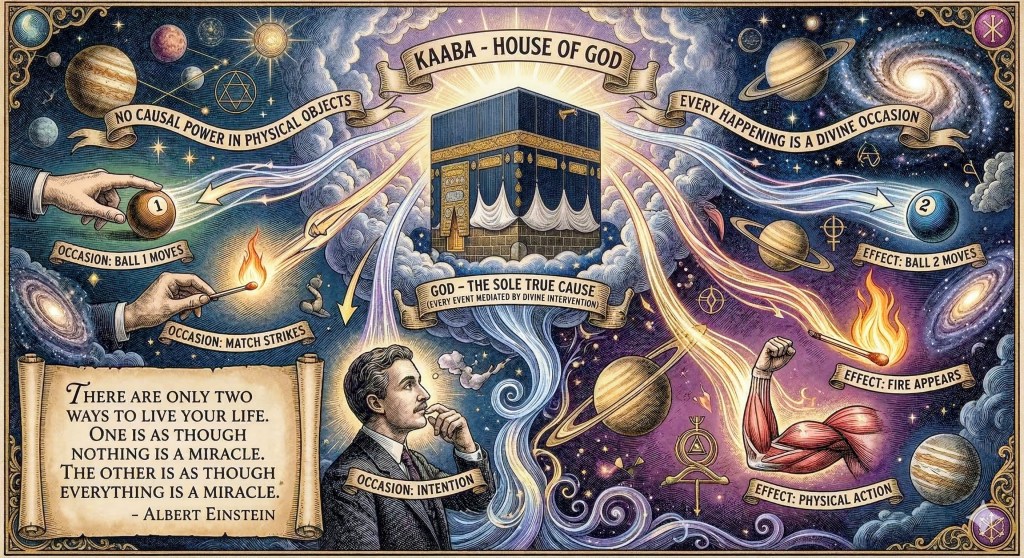
Abū Ḥāmid al-Ghazālī (1058–1111), writing in the Seventeenth Discussion of his Tahāfut al-Falāsifa, delivered what remains the most uncompromising statement of causal skepticism in the Islamic tradition: “the connection between what is habitually believed to be a cause and what is habitually believed to be an effect is not necessary.” Fire, in his famous example, does not burn cotton. What happens is that cotton is placed in proximity to flame and, in that instant, God creates the burning. Thequran The cotton’s blackening, the rising smoke, the warmth — each is a fresh act of divine will, not the mechanical consequence of fire’s “nature.” Thequran
Shah distills this view with unusual bluntness. In his May 2025 essay Many Worlds Interpretation And Al-Ghazali’s Occasionalism, he writes: “Al-Ghazali’s doctrine abolishes natural causation: only divine volition links events. Fire, water, knives, or any purported ’cause’ have no inherent power to produce outcomes — God alone produces the effect on each occasion.” ThequranThequran In Does Al-Ghazali’s Occasionalism Naturally Follow From the Quranic Omniscience and Omnipotence of God? (2 March 2025), Shah reaches for a theatrical image: “the world is like a grand theater where God is the only actor, and what we call ‘characters’ (creatures) are in reality just costumes or instruments through which the sole actor performs.” Thequran And in Paul Davies, A Pantheist, Has Convinced Me of Al Ghazali (15 March 2025), he gives the clearest personal creed: “It is more rational to believe that Allah creates all of the reality that we live in all of the time rather than only some of the time when He intends a miracle.” Thequran
The doctrine has three decisive consequences that will matter for the oaths. First, the world is recreated at every instant — the Ash’arite atomism of time Thequran — so that existence is, in al-Ghazālī’s formulation as Shah renders it from Kīmiyā-ye Saʿādat, “a perishable thing, renewed at every moment by God’s grace.” Thequran Second, miracles cease to be a problem, because there is no “law of nature” for them to break; there is only divine custom, and custom admits exceptions. Thequran Third, the shahāda acquires a metaphysical as well as a cultic meaning: Lā ilāha illa’Llāh becomes, in Shah’s rendering, “there is no deity — and no cause — except God.” Thequran Every subsequent move in his argument flows from this threefold reading.
How the Qur’an swears
Classical Islamic scholarship has long enumerated around ninety Qur’anic oaths — the exact count varies with how one individuates consecutive swearings (the seven successive oaths opening Sūrat al-Shams, for instance, may be read as seven or as one). thequran What is uncontested is that God swears by an astonishing range of created things: celestial bodies, times of day, geographical locations, sacred writings, abstractions, human faculties, and the prophets themselves. Humans, by contrast, are forbidden to swear by anything except God. Thequran +3 This asymmetry is not a mere rule of ritual etiquette; it is, as Shah argues, a theological disclosure about who has the right to speak creation into testimony.
In Oaths in the Qur’an: Nature’s Testimony to Tawhid, Resurrection, and Revelation (19 May 2025), his most synoptic treatment, Shah organizes the corpus around three evidentiary purposes. Oaths establish tawḥīd — the unity of God — by pointing to the coordinated regularity of paired opposites: night and day, sun and moon, male and female (Q 92:1–3), the oaths of Sūrat al-Shams (91:1–7, “By the sun and its morning brightness, by the moon as it follows it, by the day as it displays it, by the night as it enshrouds it…”). Thequran +2 Oaths establish the ākhirah — resurrection — by analogy to natural returns: the rain-returning sky and the earth splitting with vegetation (Q 86:11–12), thequran daybreak after night (Q 89:1), the scattering winds that promise a coming truth (Q 51:1–6). thequran And oaths establish the divine origin of the Qur’an itself — “By the positions of the stars, that is a tremendous oath, if you only knew — that this is truly a noble Qur’an” (Q 56:75–77) Thequranthequran — and the sacred geography of revelation: “By the fig and the olive, by Mount Sinai, by this secure city” (Q 95:1–3), Thequran which al-Rāzī, as Shah approvingly reports, reads as a triadic reference to the Gospel, the Torah, and the Qur’an. thequran
The catalog in Shah’s companion piece Oaths by Natural Phenomena in the Qur’an (30 April 2025) ranges wider still: winds (51:1, 77:1–6), stars and constellations (56:75, 85:1, 86:1), the dawn that breathes (81:18), the night when it grows still Thequran (93:2), the morning brightness (93:1), the racers panting (100:1), Mount Sinai (52:1), Time itself (al-ʿaṣr, 103:1), and the sky full of pathways (dhāt al-ḥubuk, 51:7). thequran It is an inventory of cosmos and weather and hour — an inventory, that is, of precisely the phenomena an occasionalist holds to be uncaused by themselves.
The decisive move: oaths as occasionalist exhibit
Here Shah’s two research lines converge. If al-Ghazālī is right, the sun does not shine by any inherent power of its own; its brightness is, at each instant, God’s action. If that is true, then when the Qur’an says “by the sun and its brightness,” the object invoked in the oath is — on a rigorous reading — not a created cause standing alongside God, but God’s continuous creative act made visible as sunlight. The oath collapses into a self-witness: God swears by what He is presently doing. The sun is merely the occasion.
Shah makes this identification explicit in his most philosophically dense essay, Al-Ghazali’s Occasionalism as a Quranic Philosophy of Nature (7 February 2026), where he states the thesis positively: “Al-Ghazali’s occasionalism — understood as the claim that God alone is the true efficient cause, while ’causes’ in nature are regular sequences God freely maintains — is not a rejection of order, but a re-location of order: from intrinsic powers in created things to the immediate and continuous agency of God.” Thequran The relocation is what allows oaths by creation to function. A sun that shone by its own power would be a rival witness; a sun sustained moment-by-moment by divine fiat is a perfectly reliable signpost because the signpost and the One who planted it are, metaphysically, a single act.
The most compact scriptural demonstration Shah offers is Q 35:41: “Indeed, God holds the heavens and the earth, lest they cease. And if they should vanish, no one could hold them back after Him.” Thequran In The Glorious Quran Endorses Al Ghazali’s Occasionalism (26 March 2025) he glosses: “The universe’s stability is not intrinsic but a continuous act of God’s will. Ghazali argued that creation depends moment-by-moment on divine intervention, not autonomous natural laws.” Thequran Pair this with Q 55:29 — “Every day He is engaged in a [new] matter” Thequran (kulla yawmin huwa fī shaʾn) — and the picture is complete: every oath by a natural phenomenon is an oath by one of the matters in which God is this very instant engaged. Shah draws out the implication with characteristic directness: “nature is [but] a theater of divine will, a collection of signs (āyāt) pointing beyond themselves to God.” Thequran +2
A particularly elegant case is Sūrat al-Dhāriyāt. In The Quranic Oath in the Beginning of the Surah Dhariyat (28 April 2025), Shah treats Q 51:1–6 — “By the winds that scatter, by those that bear a load, by those that glide with ease, by those that distribute by command — indeed what you are promised is true” Thequranthequran — as an argument-by-induction from the reliable seen to the reliable unseen. Thequran Winds scatter seeds, bear rain-laden clouds, glide across oceans, distribute moisture Thequranthequran by what Shah calls “command.” The oath trades on the listener’s confidence in the wind’s regularity. But in the occasionalist reading, that regularity is itself nothing but God’s habitual fidelity: the wind distributes “by command” not metaphorically but literally. So the oath, once unpacked, says: by the very faithfulness with which I daily recreate the wind’s distribution, I swear that resurrection is true. The premise and the conclusion share a single author.
The Battle of Badr verse and the kasb problem
Nowhere is the identification of oath-logic and occasionalism-logic tighter than at Q 8:17, the verse from the Battle of Badr that Shah cites more than any other: “It was not you who killed them, but Allah killed them. And you did not throw when you threw, but Allah threw.” Thequran In Occasionalism in al-Ghazali’s Thought and the Quranic Emphasis on Divine Causality (7 May 2025), he reads this verse as “the philosophical articulation of this Quranic faith: Lā ilāha illa’Llāh, there is no deity — and no cause — except God.” Thequran The Ash’arite doctrine of kasb (acquisition) — whereby humans intend and God creates the outcome Thequran — is, on Shah’s account, exactly what Q 8:17 formalizes. The Prophet’s hand moved; the sand’s flight was God’s. Thequran Two descriptions, one event. The verse is itself a kind of oath-in-reverse: instead of God swearing by a phenomenon to prove a truth, God denies the phenomenon’s autonomous status to disclose the same truth.
This matters for the oaths because it supplies the grammatical template. When the Qur’an says “by the dawn as it breathes” (Q 81:18), it presupposes, by Q 8:17’s logic, that the dawn does not breathe on its own. The oath is rhetorically powerful precisely because the oath-taker — God — has reserved to Himself the continuous creative act by which dawn breathes at all. Shah puts the equivalent point for the interior life in his commentary on Q 8:24 (Allah intervenes between a man and his heart): “This is exactly what an occasionalist or ‘simulation’ perspective would say: the game characters swung the sword, but the code (Allah) determined the result.” Thequran The heart, the sword, the dawn, the wind: same metaphysic, different exhibit.
Quantum witnesses and the last laugh
Shah’s most attention-grabbing move is to conscript modern physics as a second, scientific witness to what the oaths already declare. The argument, compressed across Quantum Entanglement, Ghazali’s Occasionalism, and God’s Continuous Sustenance of the Universe (5 March 2025), Why Each Photon of Light is An Exhibit that Al Ghazali May Have the Last Laugh (12 March 2025), and Where Divine Will Meets Quantum Indeterminacy (4 March 2026), runs like this. A household mirror reflects roughly ninety-five percent of incident photons and transmits five percent. Because photons are indivisible, each must be either reflected or transmitted; nothing in physics tells us which. ThequranThequran “What determines the behavior of individual photons, is it reflected, refracted or absorbed? Scientists don’t have a clue. I am not proposing a God of the gaps. There is nothing that we can discover in the present three dimensions that we know that will give us more information about individual photons. They are being governed from some additional dimension that we cannot peep into. At least not at present!” Thequran
The 2022 Nobel Prize in Physics to Aspect, Clauser, and Zeilinger — which ratified the non-local nature of quantum entanglement — becomes, in Shah’s reading, a “vindication of Al-Ghazali after centuries of decline at the hands of Averroes and the European Enlightenment.” ThequranThequran He presses the analogy at its sharpest: “In occasionalism, when fire burns cotton, there is no physical necessity connecting the two — God directly causes the cotton to burn at the moment of contact. In entanglement, when photon A is measured and photon B’s state is instantly determined, there is no physical signal or force travelling from A to B — the link between them seems to transcend space. One could whimsically say it’s ‘as if God privately coordinated their outcomes.’” Thequran The quantum world, he concludes in Quantum Mechanics and Al-Ghazali’s Occasionalism (11 March 2025), reveals “a universe where causality is not material, local, or necessary. Al-Ghazali’s occasionalism, once dismissed as theological mysticism, now finds surprising support in quantum physics.” Thequran
The epistemological capstone is Q 6:103: “Eyes cannot reach Him but He reaches the eyes.” Thequran Shah reads this verse as anticipating — by twelve centuries — the structure of quantum measurement, in which the observer cannot “reach” the thing observed without altering it, while the thing observed remains causally opaque. The verse, on his reading, specifies the exact mode in which divine action must operate if occasionalism is true: “a God who acts bilā kayf — in a manner categorically different from all creaturely causation — would act in a way that physical science cannot detect, measure, or characterize. His action would not show up as a deviation from physical law, not because He lacks power but because His mode of acting is not of the kind that physical law describes. He does not push particles; He wills outcomes within a structure of possibilities that physical law specifies. This is precisely the quantum occasionalist picture.” Thequran
Inshallah and the linguistic habitus of occasionalism
One of Shah’s most charming lines of argument is linguistic. In From the Expression Inshallah to Al Ghazali’s Occasionalism (7 March 2025), he traces how ordinary Muslim speech — the constant interpolation of inshallah (“if God wills”) — enacts occasionalism at the level of grammar. The Qur’an itself prescribes the phrase in Q 18:23–24 and displays it in the speech of the prophets (Joseph to his parents at Q 12:99, Moses to Khidr at Q 18:69, Ishmael to Abraham at Q 37:102). Thequran Every promised future act is conditioned on God’s will because, on the occasionalist reading, every act whatsoever is conditioned on God’s will, and inshallah is merely the truthful speaker’s acknowledgment of that fact. Thequran Shah’s closing line in Determinism, First Cause, and Al-Ghazali’s Occasionalism (November 2025) gathers the point with unusual lyrical force: “every molecule and moment whispers, ‘Insha’Allah’, if God so wills.” Thequran
This connects back to the oaths with a pleasing symmetry. When God swears, He does not say inshallah, because His oaths are not conditioned on any other will. Humans are forbidden to swear by creation because, lacking causal power, they cannot guarantee what creation will do. God swears by creation because creation is nothing but His will made sequential. The asymmetry of permitted oaths is thus derivable from occasionalism itself.
Thematic epilogue: what Zia H. Shah MD contributes to Qur’anic commentary
Five features distinguish Shah’s project and warrant its consideration as a distinctive contribution to contemporary Qur’anic commentary, even as one acknowledges its character as erudite public theology rather than peer-reviewed academic scholarship.
First, methodological unity across a sprawling corpus. Shah is not a specialist writing a monograph; he is a pulmonologist writing five hundred articles spread across The Muslim Times, Muslim Sunrise, and thequran.love, composed alongside a clinical career at the Catholic-affiliated Our Lady of Lourdes Thequran Memorial Hospital. Yet across roughly fifty essays on occasionalism and a further dozen on oaths, a single thesis holds — that the Qur’an’s metaphysics of continuous divine agency is both classically Ash’arite and empirically reinforced by twentieth-century physics. The consistency is its own intellectual achievement.
Second, the retrieval of Ash’arite occasionalism from near-oblivion. As Shah observes in his essay on the Ayat al-Kursī (25 February 2025): “Ghazali’s occasionalism had been losing ground since Averroes or Ibn Rushd in the Muslim Spain and since renaissance in the Western Europe, until 1920s when quantum mechanics began to develop. I hope and pray that with increasing knowledge, his occasionalism and God’s sovereignty will keep on rising even in the scientific arena.” Thequran A third-party analytical overview on his own site describes his output as “the most sustained contemporary attempt to synthesize Al-Ghazali’s occasionalism with modern physics for a general Muslim and interfaith audience.” Thequran Whatever one thinks of the specific quantum arguments, the rehabilitation of occasionalism as a living theological option — rather than a medieval curiosity — is a real accomplishment.
Third, a non-sectarian hermeneutic. Shah is an Ahmadi Muslim — listed by the Association of Ahmadi Muslim Scientists, muslimscientists hosting Sir Muhammad Zafrulla Khan’s translation, chairing Religion and Science at Muslim Sunrise — yet thequran.love is explicitly written “by an anonymous group of writers coming from different sects of Islam, be they Sunni, Shia, Ismaili, Ahmadi or refuse any such category or description.” Thequran +2 He cites al-Ṭabarī, Ibn Kathīr, al-Rāzī, al-Zamakhsharī, and al-Maturidī alongside Muhammad Asad, Maurice Bucaille, Seyyed Hossein Nasr, and Muhammad Iqbal. His signature personal essay is titled “I am a Jew, a Catholic, a Christian and a Muslim; I am Zia H Shah.” For a commentary genre still heavily marked by sectarian boundaries, the ecumenical posture is unusual.
Fourth, the marriage of oath-commentary to occasionalism-commentary. Classical treatments of Qur’anic qasam — from Ibn al-Qayyim’s al-Tibyān fī Aqsām al-Qur’ān Islamic Awareness to Ḥamīd al-Farāhī’s modern typology — have largely remained a sub-branch of rhetoric and balāghah. Islamic Awareness Shah’s distinctive move is to read the oaths as metaphysical disclosures, not merely rhetorical devices. When the Qur’an swears “by the winds that scatter,” the oath works, on his reading, because the wind’s scattering is God’s scattering. This fuses two categories of commentary — oath-interpretation and theology-of-causation — that are usually kept separate.
Fifth, a defensible epistemology of “wrong theology.” Shah’s polemical target across his career has been what he calls, in his 2012 Muslim Sunrise essay, “the Wrong Theology” — the claim that conflict between science and religion is intrinsic to scripture. His counter-claim, which organizes his occasionalism project, is that a correctly articulated Islamic metaphysics is not merely compatible with quantum indeterminacy, Big Bang cosmology, and theistic evolution but is vindicated by them. One may disagree with the specific vindications — his confidence that the 2022 Nobel “goes to Al-Ghazali” is, to put it mildly, contestable — while recognizing that the larger dialectical posture is more intellectually serious than the concordism to which Islamic science-writing has often been reduced.
Two honest caveats close this epilogue. Shah’s recent (2026) articles explicitly credit “the help of Claude” in their bylines, indicating substantial AI-assisted composition; this should be disclosed when citing his late work as primary-authored scholarship. And his specific claim that quantum mechanics “empirically supports” occasionalism is a philosophical interpretation of physics, not a physical result — a point Shah himself concedes when he insists, “I am not proposing a God of the gaps.” The proper verdict on his project is that it is theologically ambitious public apologetics of unusual breadth — a genre whose closest analogs are the writings of John Polkinghorne and Robert John Russell on the Christian side, both of whom Shah cites with appreciation.
Conclusion: what the oaths now mean
Read alongside Shah’s occasionalism corpus, the nearly ninety Qur’anic oaths stop looking like a puzzling rhetorical habit and start looking like a systematic metaphysical curriculum. By the sun, by the moon, by the dawn, by the star, by the fig, by the olive, by Mount Sinai, by the racers panting, by the winds that scatter, by the sky full of pathways, by Time itself — each oath is a pointer to a phenomenon whose regularity, on the occasionalist reading, is nothing but the fidelity of God’s habitual creating. The oaths are not God invoking witnesses beside Himself; they are God directing the listener’s attention to the places where His continuous creative act is most legible. The wind, the star, the dawn are occasions. The oath names the Occasioner.
This is why Shah’s compressed image — Al-Ghazālī smiling across the centuries — carries real philosophical weight. The twentieth century’s physics has not proven occasionalism; it cannot, because occasionalism is explicitly a bilā kayf thesis that leaves no empirical signature. What the physics has done is close the old objection that an eternal, self-sufficient, deterministic universe left no room for moment-by-moment divine action. With that objection closed, the oaths can be read as they were perhaps always meant to be read: as scripture’s way of telling its hearers that every apparent cause is a borrowed stage, and that the only author who has the right to swear by the stage is the one who is, at this instant, holding it in being, “lest they cease, and if they should vanish, no one could hold them back after Him.”




Leave a Reply