
Presented by Claude for The Glorious Quran and Science (thequran.love)
Abstract
This study examines three Quranic oaths bound to the sacred geography of Islam’s spiritual center: the oath cluster opening Surah At-Tur (52:1–6), in which the “Much-Frequented House” (al-Bayt al-Ma’mur), understood in classical exegesis as the heavenly counterpart of the earthly Kaaba, stands among a sweep of witnesses drawn from every order of reality; and the two oaths sworn upon Mecca itself in Surah Al-Balad (90:1) and Surah At-Tin (95:3). Reading these oaths alongside the classical science of Quranic oaths (aqsam al-Quran) — the framework of Ibn al-Qayyim’s al-Tibyan fi Aqsam al-Quran and the argument-centered theory of Hamiduddin Farahi and Amin Ahsan Islahi — and alongside the major tafsir tradition (al-Tabari, al-Zamakhshari, al-Razi, al-Qurtubi, Ibn Kathir), this article argues that the Quran’s oaths are not ornamental but evidentiary: the object sworn by (al-muqsam bihi) functions as a standing witness for the claim that follows (the jawab al-qasam). In Surah At-Tur the Quran marshals the Mount of revelation, the inscribed Book, the Much-Frequented House, the raised canopy of heaven, and the surging sea — scripture, sacred architecture, cosmos, and nature together — as a total testimony to the certainty of divine reckoning. In the two Meccan oaths the Quran invokes the sanctity and security (haram, amn/amin) of the city, its Abrahamic foundation, and, in the interfaith-friendly reading of Surah At-Tin, the constellation of sites associated with Jesus, Moses, and Muhammad. A dedicated section gathers the principal Quranic verses on the Kaaba and Mecca in Arabic and translation. The article maintains a pluralist, non-polemical register throughout, framing any convergence with history or science as resonance rather than concordist proof, in keeping with the conventions of this platform.
Introduction
Few themes in the Quran are as architecturally precise as its treatment of sacred space, and few rhetorical devices are as arresting as its oaths. When these two converge — when God swears by the sanctuary — the reader is invited to consider not merely a place on a map but the deep structure of the Quran’s argument about reality itself. This article takes up three such moments: the oath in Surah At-Tur (52:1–6), where the House frequented in the heavens takes its place in a cluster of cosmic witnesses; and the two oaths in which the Quran swears directly by the city of Mecca, in Surah Al-Balad (90:1) and Surah At-Tin (95:3).
On this platform, the Kaaba and Mecca have already been the subject of an extended historical and theological commentary — “Mecca: From Barren Valley to Global Axis” — which traced the sanctuary from Abraham’s “uncultivated valley” to the modern global hub of the Hajj, integrating the major Quranic references to Mecca, Bakkah, and the Kaaba. The present study is its companion piece, narrowing the lens to the three oaths and setting them within the wider science of Quranic oaths that this site has developed across a series of articles collected under Quranic Oaths — including studies of the oaths of Surah Al-Haqqah (69:38–43), Surah Adh-Dhariyat, the oaths by the night, the sun, and “all that is seen and unseen.” Read together, these establish a consistent thesis: that the Quran’s oaths turn the “book of nature” into a standing witness to the “book of scripture.”
The Significance of Oaths in the Quran
The oath (Arabic qasam, plural aqsam; the sworn statement is also called yamin) is among the most distinctive features of the Meccan Quran. Grammatically, a Quranic oath has three components: the particle and verb of swearing (most often the particle wa-, sometimes bi- or ta-); the object sworn by (al-muqsam bihi); and the complement or “answer” of the oath (al-muqsam ʿalayhi, also called the jawab al-qasam) — the claim the oath is marshaled to secure. The classical theorists defined the oath as an instrument of confirmation: al-Zarkashi (d. 1392), in al-Burhan fi ʿUlum al-Quran, describes it as “a sentence that confirms a statement through emphasis” (jumlatun yuʾakkadu bihaʾl-khabaru), and al-Suyuti (d. 1505), in al-Itqan fi ʿUlum al-Quran, states that “the purpose of an oath is to confirm a statement and place emphasis upon it” (al-qasdu bi’l-qasami tahaqiqu’l-khabari wa tawkiduhu).
The tradition produced one dedicated classical monograph on the subject: al-Tibyan fi Aqsam al-Quran (“The Elucidation of the Oaths of the Quran”) by Ibn Qayyim al-Jawziyya (d. 1350). Ibn al-Qayyim opens by defining qasam and then argues that the Quranic oaths constitute evidence for the “fundamentals of faith” (usul al-iman) — the oneness of God, the truth of revelation and prophethood, and the reality of the resurrection and judgment. According to Ibn al-Qayyim, oaths taken by God have, at root, a single basis: the attributes and greatness of God; when God swears by any created thing — a star, the dawn, a city — the created object points beyond itself to its Creator. SifatuSafwaAthari Creed
The classical exegetes generally read the oaths through the lens of taʿzim — glorification of the object sworn by. Al-Tabari (d. 923) records the early authority Qatadah’s principle that “when God swears by certain objects, he does so in view of the exalted status they have in His eyes.” Al-Zamakhshari (d. 1144) says of the oath by the pen (68:1) that God swore by it “in order to exalt it,” and of “the piercing star” (86:1–3) that the oath serves “to glorify the extraordinary power and subtle wisdom it is known to represent.” Fakhr al-Din al-Razi (d. 1210), commenting on the oath by Mecca in Surah Al-Balad, holds that “the oath testifies to the great honour the town of Makkah possesses.” Athari Creed + 2
A significant modern development came with the Indian Quran scholar Hamiduddin Farahi (1863–1930) and his student Amin Ahsan Islahi, who argued — in Farahi’s Imʿan fi Aqsam al-Quran and Islahi’s commentary Tadabbur-i-Quran — that the principal function of the oath is not emphasis but dalil (argument) and shahada (evidence): the object sworn by furnishes evidence for the claim that follows. As Mustansir Mir puts it in his study “The Qur’an Oaths: Farahi’s Interpretation,” on Farahi’s theory “the object of an oath was meant to serve as a witness to the truth of the complement of the oath.” On this reading, the oaths belong under the heading of “Quranic logic” rather than “Quranic rhetorical devices,” and the interpreter’s task is to establish the specific relationship between each object and its complement. In Mir’s summary of Farahi’s Imʿan, the oaths fall into four types: “First … the phenomenal oath, in which individual or multiple phenomena of nature are sworn by. Second, the historical oath” (which cites events or sites from the past); “Third, the experiential oath” (in which a facet of human experience, such as the reproachful conscience, is adduced); and “Fourth … the conjugate oath” (in which a thing is shown to be one member of a complementary pair). Islamic Awareness
This platform’s own studies have adopted a synthesis of these positions. As the commentary on Surah Al-Haqqah on this site argues, the Quranic oaths are “a rhetorical technology tuned to oral culture” that nonetheless functions with “strict” evidentiary force: “the object sworn by and the message that follows are intimately connected, turning the book of nature into a standing witness to the book of scripture.” The oaths, in short, direct the listener’s attention to signs (ayat) in nature, history, and scripture, and argue from those signs to the truths of faith. It is precisely this evidentiary architecture that the three oaths on the sanctuary display in a particularly concentrated form.
The Oath on the House in Surah At-Tur (52:1–6): The Totality of Reality as Witness
Surah At-Tur, a Meccan surah revealed (on the traditional dating) in the same period as Surah Adh-Dhariyat, opens with one of the most majestic oath clusters in the Quran. Its first six verses read:
وَٱلطُّورِ ﴿١﴾ وَكِتَـٰبٍ مَّسْطُورٍ ﴿٢﴾ فِى رَقٍّ مَّنشُورٍ ﴿٣﴾ وَٱلْبَيْتِ ٱلْمَعْمُورِ ﴿٤﴾ وَٱلسَّقْفِ ٱلْمَرْفُوعِ ﴿٥﴾ وَٱلْبَحْرِ ٱلْمَسْجُورِ ﴿٦﴾
Transliteration: Wa’l-tur (1); wa kitabin mastur (2); fi raqqin manshur (3); wa’l-bayti’l-maʿmur (4); wa’l-saqfi’l-marfuʿ (5); wa’l-bahri’l-masjur (6).
Translation (Saheeh International):
“By the Mount, and [by] a Book inscribed, in parchment spread open, and [by] the frequented House, and [by] the canopy raised high, and [by] the sea filled [with fire].” (52:1–6)
The complement of this oath — its jawab al-qasam — follows immediately in verse 7: إِنَّ عَذَابَ رَبِّكَ لَوَٰقِعٌ — “Indeed, the punishment of your Lord will occur” (52:7), reinforced in verse 8, “Of it there is no preventer.” Al-Tabari records the early authority Qatadah identifying exactly this: “the oath’s response falls here — ‘Indeed the punishment of your Lord will occur’ — and that is on the Day of Resurrection.” The oath, in other words, is marshaled to secure the certainty of divine reckoning. Surah Quran
What is striking is the range of the objects sworn by. They sweep across the entire order of being:
The Mount (al-Tur). In the tafsir tradition, al-Tur is Mount Sinai, the mountain on which God spoke to Moses and where the Prophethood was bestowed upon him. The oath thus opens at the site of revelation — the place where the divine word entered history through an earlier prophet. My Islam
The inscribed Book in the unrolled parchment (kitab mastur fi raqq manshur). The second and third objects name scripture itself — a written Book on open parchment. Commentators have variously read this as the Torah, the revealed scriptures generally, the Preserved Tablet (al-Lawh al-Mahfuz), or the record of deeds. Whatever the precise referent, the register is unmistakably that of revelation as text. Quran.com
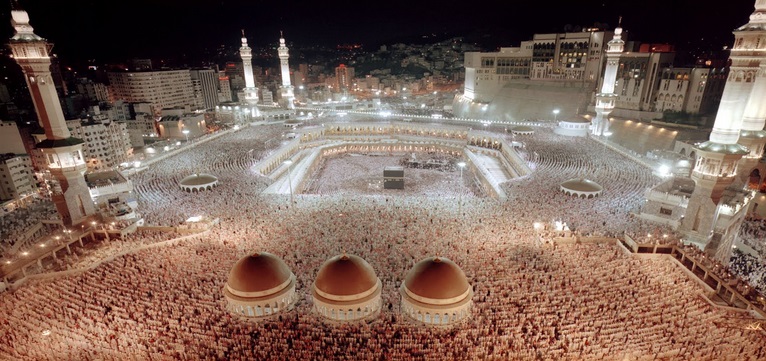
The Much-Frequented House (al-Bayt al-Ma’mur). Here the oath turns to sacred architecture. The classical consensus, grounded in the hadith of the Prophet’s Ascension (Miʿraj) preserved in both Sahih al-Bukhari (no. 3207, in Kitab Bad’ al-Khalq) and Sahih Muslim (no. 164), identifies al-Bayt al-Ma’mur as a House in the heavens directly above the Kaaba, continually visited (“frequented,” maʿmur, i.e. “populated”) by angels. In the wording of the report in Bukhari 3207, the angel Gabriel tells the Prophet: “This is al-Bait-ul-Ma’mur where 70,000 angels perform prayers daily, and when they leave they never return to it (but always a fresh batch comes into it daily).” Al-Tabari glosses the verse as “the House that is made prosperous by the multitude of those who throng to it,” and settles on the reading that it is “a House in heaven directly aligned with the Kaaba of the earth (bi-hiyal al-Kaʿba min al-ard),” citing traditions from Ali ibn Abi Talib, Ibn Abbas, Mujahid, and Qatadah — including the report that it is called al-Durah and that “if it fell, it would fall upon” the Kaaba. Al-Zamakhshari gives the heavenly House (al-Durah, which he places in the fourth heaven) as the primary sense and adds a secondary opinion: “and it is said: [it is] the Kaaba, because it is populated by pilgrims, those performing ʿumrah, and the residents.” Al-Razi lists three views: a House in the highest heaven near the Throne, thronged by circumambulating angels; the Sacred House itself (the Kaaba), “made prosperous by the pilgrims who circle it”; and a generic reading in which God swears by all populated houses of worship. IslamWebالموسوعة الشاملة لتفسير
Ibn Kathir draws the two Houses into a single theological picture: “al-Bayt al-Ma’mur is parallel to the Kaaba; every heaven has its own house of worship, which is also the direction of prayer (qiblah) for its residents.” He adds that during the Ascension the Prophet saw Abraham “reclining with his back on al-Bayt al-Ma’mur — it was Abraham who built the Kaaba on earth, and surely the reward is compatible with the action.” The heavenly House and the earthly Kaaba are thus not competitors but mirror images: the angels’ perpetual circumambulation above corresponds to the pilgrims’ tawaf below, and the sanctity of the one confirms the sanctity of the other. It is in this precise sense that the oath in Surah At-Tur is an oath on the Kaaba — the earthly House is invoked through its celestial archetype. Quran.com + 4
The raised canopy (al-saqf al-marfuʿ). The fifth object is the heaven itself, described as a “raised roof.” Ali ibn Abi Talib is reported to have glossed this as the sky, connecting it to Quran 21:32: “And We made the sky a protected ceiling.” Here the oath moves from sacred architecture to the cosmos — the vault of heaven raised without visible pillars. Quran.com
The surging sea (al-bahr al-masjur). The sixth and final object is the sea. Classical commentators divided over masjur: Ali, Ibn Abbas, Mujahid, and Saʿid ibn Jubayr read it as the sea that will be kindled with fire on the Day of Resurrection, connecting it to Quran 81:6 (“and when the seas are set ablaze”); Qatadah read it as the filled, brimming sea. Al-Tabari, tellingly, prefers Qatadah’s reading precisely on evidentiary grounds: since “the sea is not kindled with fire now,” and since the oath is addressed to a present audience, the attribute that applies to the sea now — that it is full, its waters gathered “part upon part” — is the operative one. Maududi makes the same argument: an eschatological future state cannot serve as present evidence, so al-bahr al-masjur is best taken as “confined, mixed, brimful and surging.” The oath ends, then, in the natural world — the swollen, surging ocean. Quran.com + 3
Read as a whole, this is a deliberate marshalling of the totality of reality as witness. The oath begins at the Mount of revelation and the inscribed Book — scripture and the site of prophecy; it moves to al-Bayt al-Ma’mur — sacred architecture, the House frequented in the heavens and mirrored in the Kaaba on earth; it rises to the raised canopy — the cosmos; and it descends to the surging sea — the natural world. Nothing is left out: the word of God, the house of God, the heaven of God, and the earth of God are all summoned into the courtroom at once. This is the Quran’s evidentiary method in its most concentrated form. As this platform’s study of Surah Al-Haqqah put it, the oath “recruits all reality (the sensible and the hidden) as witness.” Here the recruitment is exhaustive by design: every order of being testifies to the single claim that the reckoning of the Lord is real and unavoidable.
Framed as resonance rather than concordist proof, one may note how naturally this ancient structure speaks to a modern sensibility that has learned to read the universe as an ordered, intelligible whole — from the geology of mountains to the physics of the raised heavens to the chemistry of the seas. The Quran does not present these as scientific data; it presents them as witnesses, ordered and law-abiding, whose very regularity points beyond itself. This is consistent with the methodological caution repeatedly voiced on this platform: the Quran is not a science textbook, but it does make nature evidentiary.
The Two Oaths on Mecca: Sanctuary and Security
If Surah At-Tur swears by the House through its heavenly archetype, two other surahs swear by the city itself. Both are early Meccan, and both foreground the twin themes of sanctity (the city as haram, an inviolable sanctuary) and security (amn / amin).
Surah Al-Balad (90:1–4): “I swear by this city”
Surah Al-Balad opens:
لَآ أُقْسِمُ بِهَـٰذَا ٱلْبَلَدِ ﴿١﴾ وَأَنتَ حِلٌّۢ بِهَـٰذَا ٱلْبَلَدِ ﴿٢﴾ وَوَالِدٍ وَمَا وَلَدَ ﴿٣﴾ لَقَدْ خَلَقْنَا ٱلْإِنسَـٰنَ فِى كَبَدٍ ﴿٤﴾
Transliteration: La uqsimu bi-hadha’l-balad (1); wa anta hillun bi-hadha’l-balad (2); wa walidin wa ma walad (3); laqad khalaqna’l-insana fi kabad (4).
Translation (Saheeh International):
“I swear by this city, Mecca — and you, [O Muhammad], are free of restriction in this city — and [by] the father and that which was born [of him], We have certainly created man into hardship.” (90:1–4)
The opening particle la before uqsimu is, in the reading of the commentators, either redundant (a common Arabic idiom) or — more pointedly — a refutation: as Maariful Quran explains, “when a Surah begins with a la followed by an oath, it was revealed in refutation to a false assumption of the opponents,” as if to say, “No — what you disbelievers suppose is not correct; the truth is what We swear by.” The oath itself is unambiguous: al-balad, “the City,” is Mecca, and, as the same commentary notes, the parallel in Surah At-Tin (95:3), where the city is called al-balad al-amin (“the secure city”), shows the underlying theme — “the superiority and honour of Makkah over other cities.” Quran.com
The second verse, wa anta hillun bi-hadha’l-balad, carries two readings that the tradition preserves side by side, and both illuminate the theme of sanctuary:
On the first reading, hillun derives from hulul (“to dwell, to reside”), so the phrase means “and you are a dweller / lawful resident of this city.” As Maariful Quran explains, on this reading “the city of Makkah itself is sacred, and since the Holy Prophet is the inhabitant of this city, it adds to the sanctity, honour and glory of the place.” Abdullah Yusuf Ali captures this sense of hillun as “an inhabitant, a man with lawful rights, a man freed from such obligations as would attach to a stranger to the city, a freeman.” The very presence of the Prophet in the sanctuary augments its honor — the value of the sacred land is bound up with the value of those who dwell in it. Quran.comMyultimatedecision
On the second reading, hillun derives from a root meaning “that which is lawful / permitted,” yielding a stinging irony: in the city so sacred that no living creature may be harmed, the pagans had made the Prophet’s own life and honor “lawful” to violate. Ibn Kathir preserves the Prophetic tradition that gives this its legal frame: Mecca is “sacred by the sanctity of Allah until the Day of Judgement… it was only made lawful for me [to fight in] for one hour of a day,” after which “its sanctity has been restored just as it was sacred yesterday.” Maududi favors this reading in context: in the city where “even killing of animals and cutting of trees is forbidden,” the Prophet alone was being persecuted. AlimMyultimatedecision
The following verse — wa walidin wa ma walad, “by the father and that which was born of him” — is widely read as an oath by Abraham and his offspring (Ishmael and his line), binding the oath on the city to the Abrahamic foundation that the next section of this article develops. And the complement, laqad khalaqna’l-insana fi kabad (“We have created man into hardship / toil”), grounds the whole in the human condition: the sanctuary is not a place of effortless ease but the setting of moral struggle. It is worth noting that Surah Al-Balad’s placement immediately after Surah Al-Fajr — which closes by addressing “the reassured soul” (al-nafs al-mutmaʾinna) — has led commentators to observe that the first feeling the believer experiences on entering Mecca and beholding the House is precisely that tranquility, a theme this platform has explored in its writings on the soul at peace. tafseerstudy
Surah At-Tin (95:1–3): “And this secure city”
The oath on Mecca in Surah At-Tin comes as the culmination of a four-fold oath cluster:
وَٱلتِّينِ وَٱلزَّيْتُونِ ﴿١﴾ وَطُورِ سِينِينَ ﴿٢﴾ وَهَـٰذَا ٱلْبَلَدِ ٱلْأَمِينِ ﴿٣﴾
Transliteration: Wa’l-tini wa’l-zaytun (1); wa turi sinin (2); wa hadha’l-baladi’l-amin (3).
Translation (Saheeh International):
“By the fig and the olive, and [by] Mount Sinai, and [by] this secure city [Mecca].” (95:1–3)
The complement follows in verses 4–6: “We have certainly created man in the best of stature; then We return him to the lowest of the low — except for those who believe and do righteous deeds…”
The phrase hadha’l-balad al-amin, “this secure city,” names Mecca through its defining attribute: amin, security. There is, as Ibn Kathir observes, “no difference of opinion” among Ibn Abbas, Mujahid, ʿIkrimah, al-Hasan al-Basri, and others that the secure city is Mecca. As the Enlightening Commentary notes, “it is certain that ‘the city of security’ refers to Mecca, a land which was known as a secure region even in pagan times. Its sacred character was always respected, and no fighting was allowed in its territory even against criminals and murderers.” The security of Mecca is thus older than Islam and recognized even by its opponents — a point the Quran presses precisely because the sanctuary’s inviolability was common ground. Surah QuranAl-Islam
The interpretation of the four objects together yields a strikingly interfaith-friendly reading that suits this platform’s register. In the mainstream understanding, preserved by Ibn Kathir on the authority of numerous early commentators, the three geographical oaths evoke three sacred sites associated with three great prophets: the fig and the olive point to the land of Jerusalem and its environs — the region associated with Jesus (and, in some reports, the Mount of Olives specifically); Mount Sinai (Tur Sinin) is the mountain where God spoke to Moses and revealed the Torah; and the secure city is Mecca, the place from which Muhammad was sent. Ibn Kathir records that “these three places are mentioned at the end of the Torah,” citing the ancient blessing: God “came from Mount Sinai” (Moses), “shone from Seir” (Jesus), and “appeared from the mountains of Paran” — Mecca (Muhammad). As the classical commentators note, this “points to a spirit of brotherhood between the Prophets, for though the laws they came with differed, their religion was one and the same.” My IslamNavedz
Farahi’s argument-centered reading deepens this. In his interpretation (developed for exactly this surah), each site is a “living testimony to the validity of the principle of reckoning” — the principle that God rewards faith and punishes its betrayal. At the fig (which Farahi associates with a northern mountain), the principle was enacted upon Adam and upon Noah’s people; at the olive (the Mount of Olives), upon the mission of Jesus; at Sinai, upon Moses and the steadfast Israelites; and at Mecca, upon Abraham — whose prayer that the city be “a land of peace” was granted, and whose sanctuary was defended against those (like Abraha) who would violate it. On this reading the four oaths are not a random list but a coherent argument: history’s sacred geography testifies that divine justice is real, which is exactly the complement the surah goes on to assert. Islamic AwarenessIslamic Awareness
Both Meccan oaths, then, converge on a single theological point: Mecca is haram (inviolable) and amin (secure), and this sanctity is neither arbitrary nor merely tribal. It is the legacy of Abraham, confirmed by the presence of the final Prophet, and it stands in a fellowship of sacred sites that includes the mountains of Moses and Jesus.
Abraham, Ishmael, the Qiblah, and the Pilgrimage: The Sanctuary in the Wider Quran
The oaths on Mecca and the House do not stand alone; they are the poetic crystallization of a sustained Quranic narrative about the sanctuary’s origin, purpose, and law. That narrative centers on Abraham and Ishmael, on the House as a place of return and security, on the turning of the qiblah, and on the pilgrimage.
The foundational text is Surah Al-Baqarah 2:125, which establishes the House as mathaba (a place of perpetual return) and amn (security):
وَإِذْ جَعَلْنَا ٱلْبَيْتَ مَثَابَةً لِّلنَّاسِ وَأَمْنًا وَٱتَّخِذُوا۟ مِن مَّقَامِ إِبْرَٰهِـۧمَ مُصَلًّى ۖ وَعَهِدْنَآ إِلَىٰٓ إِبْرَٰهِـۧمَ وَإِسْمَـٰعِيلَ أَن طَهِّرَا بَيْتِىَ لِلطَّآئِفِينَ وَٱلْعَـٰكِفِينَ وَٱلرُّكَّعِ ٱلسُّجُودِ
Translation (Abdel Haleem):
“We made the House a resort and a sanctuary for people, saying, ‘Take the spot where Abraham stood as your place of prayer.’ We commanded Abraham and Ishmael: ‘Purify My House for those who walk round it, those who stay there, and those who bow and prostrate themselves in worship.’” (2:125) My Islam
The word mathaba, as al-Tabari and al-Qurtubi explain, derives from a root meaning “to return”; the House is the place to which people are drawn back again and again without ever having their fill of it. Al-Tabari establishes the Kaaba’s dual role as spiritual and physical sanctuary, while amn denotes a place of absolute security — safe, as Ibn Kathir puts it, “from enemies and armed conflict.” The verse also introduces the Maqam Ibrahim — the station where Abraham stood while raising the walls of the House — as a place of prayer, a “clear sign” of the prophetic labor that built the sanctuary. Quran Gallery AppQuran.com
The building of the House is narrated in 2:127:
وَإِذْ يَرْفَعُ إِبْرَٰهِـۧمُ ٱلْقَوَاعِدَ مِنَ ٱلْبَيْتِ وَإِسْمَـٰعِيلُ رَبَّنَا تَقَبَّلْ مِنَّآ ۖ إِنَّكَ أَنتَ ٱلسَّمِيعُ ٱلْعَلِيمُ
Translation (Abdel Haleem):
“As Abraham and Ishmael built up the foundations of the House [they prayed], ‘Our Lord, accept this from us: You are the All Hearing, the All Knowing.’” (2:127)
And their prayer continues in 2:128 with a petition that reaches across the centuries to the Muslim community and its Prophet:
رَبَّنَا وَٱجْعَلْنَا مُسْلِمَيْنِ لَكَ وَمِن ذُرِّيَّتِنَآ أُمَّةً مُّسْلِمَةً لَّكَ وَأَرِنَا مَنَاسِكَنَا وَتُبْ عَلَيْنَآ ۖ إِنَّكَ أَنتَ ٱلتَّوَّابُ ٱلرَّحِيمُ
Translation (Abdel Haleem):
“Our Lord, make us devoted to You; make our descendants into a community devoted to You. Show us how to worship and accept our repentance, for You are the Ever Relenting, the Most Merciful.” (2:128)
The prayer for “a community devoted to You” (ummatan muslimatan laka) and the request to be shown “our rites of worship” (manasikana) frame the sanctuary as the seed of a global community of worship — a prayer that this platform’s Mecca commentary reads as fulfilled in the emergence of the worldwide Muslim ummah.
The orientation of that community toward the House is fixed in the celebrated verse of the qiblah, 2:144:
قَدْ نَرَىٰ تَقَلُّبَ وَجْهِكَ فِى ٱلسَّمَآءِ ۖ فَلَنُوَلِّيَنَّكَ قِبْلَةً تَرْضَىٰهَا ۚ فَوَلِّ وَجْهَكَ شَطْرَ ٱلْمَسْجِدِ ٱلْحَرَامِ ۚ وَحَيْثُ مَا كُنتُمْ فَوَلُّوا۟ وُجُوهَكُمْ شَطْرَهُ ۥ
Translation (Abdel Haleem):
“Many a time We have seen you [Prophet] turn your face towards Heaven, so We are turning you towards a prayer direction that pleases you. Turn your face in the direction of the Sacred Mosque: wherever you [believers] may be, turn your faces to it.” (2:144)
With the turning of the qiblah from Jerusalem toward al-Masjid al-Haram, the Kaaba became the single point of orientation unifying a scattered and expanding community — a physical enactment, as it were, of the tawhid that Abraham had sought to establish.
The primordial priority of the House is asserted in Surah Al-Imran 3:96–97:
إِنَّ أَوَّلَ بَيْتٍ وُضِعَ لِلنَّاسِ لَلَّذِى بِبَكَّةَ مُبَارَكًا وَهُدًى لِّلْعَـٰلَمِينَ ﴿٩٦﴾ فِيهِ ءَايَـٰتٌۢ بَيِّنَـٰتٌ مَّقَامُ إِبْرَٰهِيمَ ۖ وَمَن دَخَلَهُ كَانَ ءَامِنًا ﴿٩٧﴾
Translation (Abdel Haleem):
“The first House [of worship] to be established for people was the one at Mecca [Bakkah]. It is a blessed place; a source of guidance for all people; there are clear signs in it; it is the place where Abraham stood to pray; whoever enters it is safe.” (3:96–97) Quran.comQuran.com
The name Bakkah — an ancient name for Mecca — is glossed by Ibn Kathir and al-Qurtubi as connoting either “crowding / gathering” (from the throngs who converge for tawaf) or “weeping / humbling” (from the root buka’, as the arrogant are humbled in the sanctuary’s presence). The declaration that this is “the first House… established for people,” “blessed” and “a guidance for all worlds” (hudan li’l-ʿalamin), universalizes the Kaaba: it is not a tribal or ethnic shrine but the archetypal house of monotheism, and — echoing the oath of 95:3 — “whoever enters it is safe” (wa man dakhalahu kana amina), the very security by which the city is sworn. Alim
The legal contours of the sanctuary are drawn in Surah Al-Ma’idah. In 5:95, the prohibition on hunting game while in the state of ihram is enforced by an offering “delivered to the Kaaba”:
يَـٰٓأَيُّهَا ٱلَّذِينَ ءَامَنُوا۟ لَا تَقْتُلُوا۟ ٱلصَّيْدَ وَأَنتُمْ حُرُمٌ ۚ وَمَن قَتَلَهُ مِنكُم مُّتَعَمِّدًا فَجَزَآءٌ مِّثْلُ مَا قَتَلَ مِنَ ٱلنَّعَمِ … هَدْيًۢا بَـٰلِغَ ٱلْكَعْبَةِ
Translation (Saheeh International):
“O you who have believed, do not kill game while you are in the state of ihram. And whoever of you kills it intentionally — the penalty is an equivalent from sacrificial animals to what he killed, as judged by two just men among you as an offering delivered to the Kaaba…” (5:95)
And 5:97 states the sanctuary’s civilizational function directly:
جَعَلَ ٱللَّهُ ٱلْكَعْبَةَ ٱلْبَيْتَ ٱلْحَرَامَ قِيَـٰمًا لِّلنَّاسِ
Translation (Abdel Haleem):
“God has made the Kaaba — the Sacred House — a means of support [qiyaman] for people…” (5:97)
The term qiyaman — a “mainstay” or “means of support” — is glossed by al-Razi as a standard by which people’s affairs are set right, and by Maududi as “a means of support for the collective life of men.” The pilgrimage, the sacred months of truce, and the marked sacrificial animals together created, in the pre-modern Arabian world, a recurring ecosystem of peace and safe passage — a piece of social order the Quran presents as evidence of divine knowledge.
The Quran is equally clear that the sanctity of the House had been corrupted by pre-Islamic practice. Surah Al-Anfal 8:35 describes the pagans’ worship at the House as empty ritual:
وَمَا كَانَ صَلَاتُهُمْ عِندَ ٱلْبَيْتِ إِلَّا مُكَآءً وَتَصْدِيَةً ۚ فَذُوقُوا۟ ٱلْعَذَابَ بِمَا كُنتُمْ تَكْفُرُونَ
Translation (Abdel Haleem):
“Their prayers before the House are nothing but whistling and clapping. ‘So taste the punishment for your disbelief.’” (8:35)
Ibn Kathir, on the authority of Ibn Abbas, explains that “the Quraysh used to perform tawaf around the Kaaba while naked, whistling and clapping their hands” — muka’ meaning whistling and tasdiya meaning handclapping. The purification of the House from such practice, and from the idols that filled it, is the burden of the Abrahamic covenant “purify My House.” Quranhadits
Surah At-Tawbah 9:19 then reorders the values attached to the sanctuary, insisting that custodial service, however honorable, does not equal faith:
أَجَعَلْتُمْ سِقَايَةَ ٱلْحَآجِّ وَعِمَارَةَ ٱلْمَسْجِدِ ٱلْحَرَامِ كَمَنْ ءَامَنَ بِٱللَّهِ وَٱلْيَوْمِ ٱلْـَٔاخِرِ وَجَـٰهَدَ فِى سَبِيلِ ٱللَّهِ ۚ لَا يَسْتَوُۥنَ عِندَ ٱللَّهِ
Translation (Saheeh International):
“Have you made the providing of water for the pilgrim and the maintenance of al-Masjid al-Haram equal to [the deeds of] one who believes in Allah and the Last Day and strives in the cause of Allah? They are not equal in the sight of Allah.” (9:19)
Ibn Kathir preserves the occasion of revelation: the Meccan custodians boasted of providing water to pilgrims (siqaya) and maintaining the Sacred Mosque (ʿimara); the verse replies that these services, performed in a state of disbelief, do not weigh equal to faith and striving. The sanctuary’s true honor is inward, not merely custodial. TafsirqQuran.com
Finally, Surah Al-Hajj 22:26 returns to the origin, designating the site of the House for Abraham and issuing the command of purification that echoes 2:125:
وَإِذْ بَوَّأْنَا لِإِبْرَٰهِيمَ مَكَانَ ٱلْبَيْتِ أَن لَّا تُشْرِكْ بِى شَيْـًٔا وَطَهِّرْ بَيْتِىَ لِلطَّآئِفِينَ وَٱلْقَآئِمِينَ وَٱلرُّكَّعِ ٱلسُّجُودِ
Translation (Abdel Haleem):
“We showed Abraham the site of the House, saying, ‘Do not assign partners to Me. Purify My House for those who circle around it, those who stand to pray, and those who bow and prostrate themselves.’” (22:26) My Islam
The verb bawwaʾna (“We assigned / settled / pointed out the site”) and the twin commands — la tushrik (“associate nothing with Me”) and tahhir baytiya (“purify My House”) — establish the sanctuary from the outset on the basis of pure monotheism. As Ibn Kathir notes, many scholars take this verse as evidence that Abraham was the (re)builder of the House on its ancient foundations. The very next verse (22:27) issues the command to “proclaim the pilgrimage to all people” — the prophecy of the Hajj whose ongoing fulfillment is visible in the annual convergence of pilgrims “from every distant path”: the Saudi General Authority for Statistics (GASTAT) reported that 1,707,301 pilgrims performed the Hajj of 2026 (1447 AH), of whom 1,546,655 arrived from outside the Kingdom — following 1,833,164 pilgrims in 2024 (1445 AH). Quran.com
Taken together, these verses supply the theological substance that the three oaths compress into a few charged words. When God swears “by this city” and “by this secure city,” and when He swears by the House frequented in the heavens, He is invoking the whole arc of this narrative: the House founded by Abraham and Ishmael, purified for the worship of the One God, made a place of return and security, oriented as the qiblah of a global community, and appointed a mainstay for humankind.
Thematic Epilogue
Three oaths, one sanctuary. In Surah At-Tur the Quran swears by the House frequented in the heavens — al-Bayt al-Ma’mur, the celestial archetype whose angels circle above as the pilgrims circle below — and sets it amid a sweep of witnesses that leaves nothing out: the Mount of revelation and the inscribed Book, the raised canopy of heaven, and the surging sea. In Surah Al-Balad the Quran swears by “this city,” honoring it as the dwelling of the Prophet and lamenting the violation of its sanctity. In Surah At-Tin it swears by “this secure city,” setting Mecca alongside the fig and olive of Jesus’ land and the Sinai of Moses, so that the sanctuary of Muhammad takes its place in a fellowship of sacred sites and a brotherhood of prophets.
What unites the three is the Quran’s distinctive evidentiary method: the oath that argues. On the reading developed by Farahi and Islahi and embraced across this platform’s studies of the aqsam, the object sworn by is not a decoration but a witness — and the sanctuary is a witness of a particular kind. It is the point where the orders of reality meet: earth and heaven (the Kaaba and its celestial mirror), history and revelation (Abraham’s House and the Book), nature and sacred law (the surrounding wilderness made inviolable, the seasons of truce, the rites of pilgrimage). To swear by the House is therefore to gesture, in a single word, toward the same totality that Surah At-Tur spells out at length. The sanctuary gathers the whole of creation’s testimony into one place and one direction.
And the theme that the two Meccan oaths press — haram and amin, sanctity and security — is finally a theme about the human heart. The city that Abraham prayed would be “a land of peace,” in which “whoever enters is safe,” is the outward figure of the inward peace the Quran promises the soul that returns to its Lord. The sanctuary is a place of return (mathaba) because the human being is made for return; it is secure because the God who made it, and who swears by it, is Himself the source of all security. In an age of fragmentation, the oaths on the sacred precinct still summon the reader to the same recognition they summoned their first hearers: that reality, in all its orders — scripture and stone, cosmos and sea, the city and the soul — bears a single, coherent witness, and that the One sworn by is the One to whom all things return.
Related reading on this platform: “Mecca: From Barren Valley to Global Axis”; “Seen and Unseen: A Multidisciplinary Commentary on the Quranic Oaths in Surah Haqqah”; the collected series on Quranic Oaths and on Mecca.




Leave a comment