
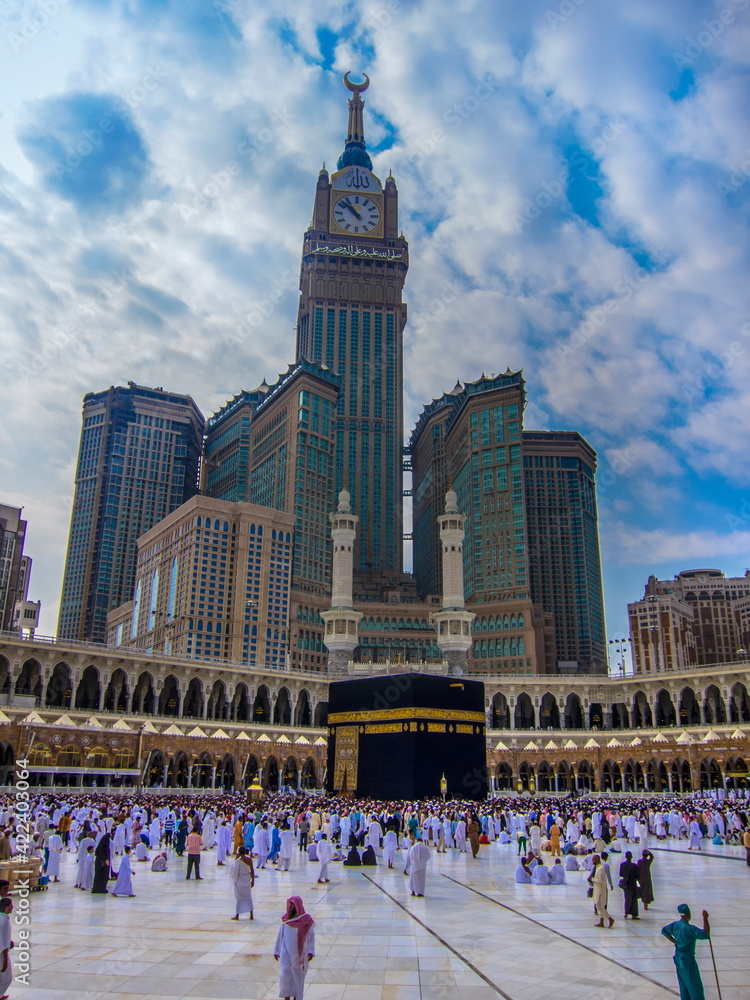
The Kaaba, Mecca, and the Qur’an’s Oath-Borne Summons of Seen and Unseen Reality
Presented by ChatGPT for Zia H Shah MD
Abstract
This expanded study examines three Qur’anic oaths bound to the sacred geography of Islam’s spiritual center: the majestic oath-cluster opening Surah al-Tur (52:1-8), in which the “Much-Frequented House” (al-Bayt al-Ma‘mur)—understood in the dominant classical interpretation as the heavenly counterpart of the earthly Kaaba—stands amid witnesses drawn from revelation, sacred architecture, heaven, and sea; the oath by “this city” in Surah al-Balad (90:1-4); and the oath by “this secure city” in Surah al-Tin (95:1-6). It preserves the full argument and detail of the original article while placing the sanctuary within the larger architecture of Qur’anic oaths developed across the entire “Quranic Oaths” series presented and collected by Zia H. Shah, MD.
The study begins with the classical science of aqsam al-Qur’an: the oath-marker, the object sworn by (al-muqsam bihi), and the proposition solemnly secured (al-muqsam ‘alayhi or jawab al-qasam). It brings together the confirmatory and honorific readings of al-Zarkashi, al-Suyuti, Ibn al-Qayyim, al-Tabari, al-Zamakhshari, and Fakhr al-Din al-Razi with the argument-centered approach of Hamiduddin Farahi and Amin Ahsan Islahi, for whom the object of the oath is not ornamental scenery but evidence and testimony. It then synthesizes the full thematic range of Shah’s oath writings: the jurative particles wa, ba, and ta; the disputed formula la uqsimu; the variable tally of approximately seventy-five to ninety oaths depending on method of counting; oaths by sun, moon, stars, night, day, dawn, twilight, winds, clouds, mountains, seas, time, the soul, sacred history, and the seen and unseen; Surah al-Dhariyat’s movement from winds and rain-bearing clouds to resurrection; Surah al-Inshiqaq’s movement from twilight, night, and full moon to successive human states; the “Four Books” of Revelation, Nature, Destiny, and Deeds; and the Ghazalian claim that natural regularities are stable divine habits rather than self-sufficient causes.
Read in this wider frame, the three sanctuary oaths summon more than a location. In Surah al-Tur, Mount Sinai, the inscribed Book, the celestial House, the raised canopy, and the filled or kindled sea constitute a comprehensive testimony to the certainty of reckoning. In Surah al-Balad, Mecca’s inviolability exposes the moral contradiction of persecuting the Prophet within the sanctuary. In Surah al-Tin, Mecca joins the lands of the fig and olive and Mount Sinai in a fellowship of revelations associated with Jesus, Moses, and Muhammad. The Qur’anic verses on Abraham and Ishmael, the mathabah of return, the amn of security, the qiblah, the first House at Bakkah, the rules of ihram, the Kaaba as a civilizational qiyam, the purification of corrupted worship, and the universal proclamation of Hajj disclose what the compact oaths contain. The article adopts a pluralist and non-polemical register and treats modern scientific parallels as illuminating resonance rather than as forced concordist proof. Its governing claim is that the sanctuary is a concentrated witness: the place where scripture and stone, cosmos and conscience, history and hope, the visible and the invisible, are gathered into one direction before the One to whom all things return.
Introduction: When Sacred Geography Becomes an Argument
Few themes in the Qur’an are handled with greater architectural precision than sacred space, and few rhetorical forms are more arresting than the divine oath. When these two converge—when God swears by the sanctuary—the reader is asked to see more than a revered coordinate on a map. The city and the House become part of an argument about the structure of reality, the truth of revelation, the moral condition of humanity, and the certainty of return.
Three passages form the center of this study. Surah al-Tur opens with an oath by the Mount, an inscribed Book on an opened parchment, the Much-Frequented House, the raised canopy, and the filled or kindled sea. Surah al-Balad begins, “I swear by this city,” and immediately places the Prophet within the paradox of a sanctuary whose sanctity his persecutors violate. Surah al-Tin culminates its oath-cluster with “this secure city,” setting Mecca beside the fig and olive and Mount Sinai. The first invokes the earthly Kaaba through its heavenly counterpart; the other two invoke Mecca directly through sanctity, prophetic presence, sacred history, and security.
The present essay remains a companion to the platform’s broader study “Mecca: From Barren Valley to Global Axis,” which followed the sanctuary from Abraham’s uncultivated valley to the worldwide convergence of Hajj. Here the lens narrows to the oaths, then widens again through the site’s complete oath archive. That wider body of writing repeatedly advances one central thesis: the Qur’an turns the “book of nature” into a standing witness to the “book of scripture.” The oath is the grammatical and rhetorical mechanism by which sun, night, wind, city, star, conscience, history, and unseen reality are summoned into testimony.
The sanctuary is uniquely suited to this evidentiary role. It is simultaneously a building and a direction, a remembered foundation and a living rite, an earthly precinct and—through al-Bayt al-Ma‘mur—the mirror of celestial worship. It belongs to the history of Abraham and Ishmael, to the ministry and suffering of Muhammad, to the rhythms of prayer and pilgrimage, to sacred law, and to the ethical demand that outward custodianship be joined to inward faith. It is a place of return because the human being is made for return; a place of security because the human soul seeks the Source of security; and a symbol of unity because the Qur’anic vision seeks to gather fragmented existence under the oneness of God.
I. The Qur’anic Oath: Grammar, Rhetoric, Evidence, and Metaphysics
1. The anatomy of a qasam
The Arabic oath is called qasam (plural aqsam); a sworn utterance may also be called a yamin. In its full Qur’anic form, it has three principal components. First comes the jurative marker: an oath-particle, sometimes accompanied by an explicit verb of swearing. Second comes the object invoked, al-muqsam bihi, the reality by which the oath is taken. Third comes the claim secured by the oath, al-muqsam ‘alayhi, also called the jawab al-qasam, the answer or complement of the oath.
The form is not merely “By X!” followed by an unrelated assertion. The recurring argument of Shah’s archive, grounded especially in Farahi and Islahi, is that X and the asserted truth are intimately related. The object is selected because it bears witness to the proposition. The sun and the morally proportioned soul illuminate the contrast between purification and corruption; the recurring rain and the splitting earth illuminate the decisive and revivifying word; the reliable winds and clouds illuminate the reliability of the promised judgment; the sacred city illuminates human dignity, struggle, security, and accountability.
The classical sciences of the Qur’an first emphasize confirmation. Al-Zarkashi describes the oath as a construction by which a report is confirmed through emphasis. Al-Suyuti similarly says that the purpose is to establish and intensify the truth of a statement. This is indispensable: the oath arrests attention and adds solemn force. Yet confirmation alone does not exhaust the form. Ibn al-Qayyim’s dedicated al-Tibyan fi Aqsam al-Qur’an treats the oaths as evidence for the fundamentals of faith—divine unity, revelation and prophethood, resurrection and judgment. When God swears by a created thing, that thing points beyond itself to divine greatness and attributes.
The exegetical tradition also speaks of ta‘zim, the honoring or magnification of the object sworn by. Qatadah’s principle, transmitted by al-Tabari, is that God swears by things because of their elevated standing in His sight. Al-Zamakhshari explains the oath by the Pen as an exaltation of the Pen and the oath by the piercing star as an exaltation of the power and wisdom displayed through it. Al-Razi reads the oath by Mecca as testimony to the city’s exceptional honor. The evidentiary reading need not cancel this honorific reading. A created sign can be honored precisely because it is a lucid witness to its Creator and to the truth that follows.
2. Wa, ba, ta, and the rarer jurative forms
The archive’s linguistic studies organize Qur’anic oaths by their particles. The most common is wa, the waw al-qasam. Grammatically it is a preposition that places the following explicit noun in the genitive. It normally cannot govern a pronoun. Its brevity gives the early Meccan surahs their rapid, incantatory sequences: “By the sun,” “by the morning brightness,” “by the moon,” “by the night,” “by the dawn,” “by the star,” “by the Mount,” “by the Pen.” The repeated wa does more than accumulate objects; it creates a procession of witnesses.
The particle ba is broader. It can accompany an explicit oath verb—most famously uqsimu, “I swear”—and can be used with nouns or pronouns. It appears in the several la uqsimu or fa-la uqsimu passages: by the stations of the stars, by what is seen and unseen, by the Day of Resurrection and the self-reproaching soul, by the retreating stars and the advancing dawn, by the twilight and the gathering night, and by “this city.” The archive calls ba the foundational or “mother” jurative particle because of this grammatical flexibility and its association with explicit, judicially forceful declarations.
The particle ta is the most restricted and emotionally charged. In Qur’anic usage it occurs in the formula ta’Llahi—“By God!”—often on the lips of created speakers in narratives of astonishment, protest, confession, threat, or firm resolve. Its dramatic register differs from the panoramic divine wa-oaths. Where wa often calls the cosmos, and ba often accompanies an explicit solemn declaration, ta lets the listener hear the shock and conviction of actors within sacred history. Shah’s linguistic synthesis therefore describes wa as engaging observation, ba as sharpening conscience and judgment, and ta as dramatizing the recurrent moral pattern of prophetic history.
Other oath forms belong to the larger jurative field. The Qur’an swears by the Prophet’s life in la-‘amruka (15:72), a construction using the jurative lam rather than wa, ba, or ta. It also contains embedded formulas such as “By your Lord” and “By My Lord.” These variations matter for counting. One archive essay speaks of roughly seventy-five oaths by focusing on major oath units and natural clusters; another catalogues approximately ninety or more distinct invocations by counting repeated clauses, embedded self-oaths, narrative formulas, and parallel objects separately. The variation is methodological, not substantive. The Qur’an contains a dense jurative corpus whose total changes according to whether one counts oath passages, individual objects, or grammatical occurrences.
3. The debated la uqsimu
Several major oaths begin with la uqsimu or fa-la uqsimu. Literally, the surface sequence can appear to mean “I do not swear,” yet the context plainly introduces a forceful oath. The majority explanations treat la as an intensifier, a rebuttal, or a discourse marker: “No indeed! I swear…” It rejects a false assumption before asserting the truth. A minority grammatical reading takes the negation more directly, as though the matter were so obvious that no oath should be necessary, though the following syntax still carries jurative force.
In Surah al-Balad, the formula can be heard as a repudiation of Meccan moral blindness: No—the city is not what its persecutors have made of it; by this city, and by the Prophet within it, human life is a grave struggle. In Surah al-Haqqah, “No indeed, I swear by what you see and what you do not see” rejects the attempt to reduce revelation to poetry or soothsaying. In Surah al-Waqi‘ah, the oath by the stations of the stars interrupts casual perception with the declaration that this is a tremendous oath, were people to comprehend its scale.
4. Omitted answers and the intelligence of the listener
Not every oath states its answer immediately. Some have a clearly expressed jawab: Surah al-Shams moves from seven great witnesses to the success of the soul that purifies itself; Surah al-Layl moves from night, day, and male-female creation to the diversity of human striving; Surah al-Duha moves from morning brightness and the still night to the assurance that God has not abandoned the Prophet. Elsewhere the answer is delayed, disputed, or omitted and left to be inferred from the surah’s argument.
Surah al-Fajr itself asks, after dawn, ten nights, even and odd, and the passing night, whether these are not sufficient oaths for a person of understanding. Its answer is often linked to the later assurance that the Lord is ever watchful. In Surah al-Buruj, interpreters debate whether the answer is suppressed or appears later in the declaration of the Lord’s severe grasp. Such ellipsis respects the listener’s intelligence. The oath is not merely a formula to be decoded mechanically; it is an invitation to inhabit the surah’s field of meaning until the connection becomes morally evident.
5. Farahi, Islahi, and the oath that argues
Hamiduddin Farahi’s decisive contribution is to treat the muqsam bihi as proof or testimony for the muqsam ‘alayhi. Amin Ahsan Islahi develops the same insight across his commentary. On this approach, the Qur’anic oath is a compressed syllogism in poetic form. It points to a reality the hearer can observe, remember, or inwardly recognize, then asks the hearer to accept a corresponding truth about God, revelation, moral responsibility, or the future.
Mustansir Mir’s exposition of this tradition usefully groups the relations into four broad types. Phenomenal oaths invoke observable nature. Historical oaths invoke events, peoples, or sacred sites whose moral pattern is remembered. Experiential oaths appeal to inward knowledge, conscience, and the human condition. Conjugate oaths join complementary pairs—sun and moon, night and day, male and female, concealment and disclosure—whose contrast illuminates the answer. These are not sealed boxes. Surah al-Tin is at once historical, geographical, inter-prophetic, and experiential; Surah al-Balad joins city, Prophet, ancestry, and hardship; Surah al-Tur joins revelation, architecture, cosmos, and eschatology.
Shah’s series repeatedly renders this method through courtroom language. Creation is summoned to the witness stand. The oath-marker calls the court to order; the muqsam bihi gives testimony; the jawab states the proposition established. The image is especially apt for the sanctuary, which functions not only as a revered object but as a repository of evidence: Abraham’s prayer, Ishmael’s labor, the persistence of pilgrimage, the protection and violation of sacred law, the unity of prayer, and the experience of return.
6. Five recurring purposes of the Qur’anic oaths
The archive’s earliest Surah al-Dhariyat study identifies five recurring purposes that later essays unfold in detail.
First, oaths establish core belief, especially divine unity. Surah al-Saffat swears by those arrayed in ranks, those who drive away, and those who recite the reminder, then declares that the God of the hearers is One (37:1-4). Multiplicity in the ranks of creation testifies to unity in command.
Second, oaths affirm the divine origin of the Qur’an. Surah al-Waqi‘ah swears by the stations or settings of the stars and calls the oath tremendous before declaring the nobility of the Qur’an (56:75-77). Surah al-Tariq swears by the returning sky and the splitting earth before declaring the revelation a decisive word, not a jest (86:11-14).
Third, oaths validate the prophetic mission. “Ya Sin. By the wise Qur’an, you are surely among the messengers” (36:1-3) makes the revealed discourse itself the witness to the messenger who bears it. “By the star when it descends,” Surah al-Najm denies that Muhammad has strayed or spoken from caprice; the setting star becomes the prelude to revelation descending into prophetic speech (53:1-4).
Fourth, oaths establish resurrection and judgment. The winds, laden clouds, gliding vessels, and distributors of command in Surah al-Dhariyat lead to the declaration that what is promised is true and judgment will occur (51:1-6). The orderly present becomes evidence that history is not morally directionless.
Fifth, oaths expose the human condition. The racing chargers of Surah al-‘Adiyat lead to the diagnosis of human ingratitude (100:1-6). Night and day lead to divergent striving (92:1-4). Time itself leads to the recognition of loss except where faith, righteous action, truth, and patient constancy rescue human life (103:1-3). In the sanctuary oaths, human hardship, stature, degradation, faith, and righteous action remain the final concern.
7. Divine freedom and the ethics of human swearing
The archive repeatedly distinguishes divine oaths from human oaths. God, as Creator and owner of all things, may swear by created realities to display their significance and His dominion over them. Human beings, by contrast, are directed in Islamic teaching to swear by God, not by created objects as independent powers. The difference guards monotheism: a divine oath honors creation as sign; a human oath must not convert the sign into a rival source of ultimacy.
The Qur’an also binds ordinary swearing to ethics and law. Deliberate oaths are not cheap verbal ornaments. False swearing corrodes trust; manipulative oaths can make divine language a cover for injustice; broken solemn oaths may require expiation. The linguistic majesty of the divine aqsam therefore has a social counterpart: truthful speech, dependable covenant, and reverence for God’s name in human society.
8. Oral power, sonic form, and the overcoming of familiarity
The oaths belong especially to the short and middle Meccan surahs, whose sound is inseparable from their force. Repeated consonants, compact cadences, parallel endings, and rapid shifts between cosmic images create what the archive calls a rhetorical technology calibrated to oral culture. A listener hears the witnesses before pausing to analyze them. The Qur’an’s sound does not replace reason; it awakens reason from what one essay calls the “anesthesia of familiarity.”
The sun rises every day, the night arrives, a cloud passes, a seed opens, the moon grows full, and the horizon brightens. Because these events are reliable, the mind can stop seeing them. The oath makes the ordinary strange again. “By the dawn” restores wonder to dawn. “By the night as it gathers” makes darkness active. “By the sun and its brightness” turns the daily source of light into a moral summons. “By this secure city” makes inherited geography answerable to a higher meaning.
9. A compact corpus map by particle
The archive’s catalogue can be gathered into one navigational view. The principal divine wa-oath complexes appear in Ya Sin (36:2-4), al-Saffat (37:1-4), Sad (38:1), Qaf (50:1), al-Dhariyat (51:1-9 and 51:23), al-Tur (52:1-8), al-Najm (53:1-4), al-Qalam (68:1-4), al-Muddaththir (74:32-37), al-Mursalat (77:1-7), al-Nazi‘at (79:1-5), al-Buruj (85:1-3), al-Tariq (86:1-4 and 86:11-14), al-Fajr (89:1-5), the continuation of al-Balad’s cluster (90:3), al-Shams (91:1-10), al-Layl (92:1-4), al-Duha (93:1-3), al-Tin (95:1-4), al-‘Adiyat (100:1-6), and al-‘Asr (103:1-2). Across these passages the witnesses include the Qur’an, angelic ranks, winds and rain-bearing clouds, Mount Sinai, the heavenly House, star and pen, moon and dawn, the promised Day, the morally proportioned soul, sacred geography, human ancestry, charging horses, and time itself. Some answers are stated immediately; others—especially in Sad, Qaf, al-Nazi‘at, and al-Fajr—are compressed or suppressed and must be inferred from the surah’s ensuing argument.
A related group swears by God’s lordship rather than by a created object: “by your Lord” or “by my Lord” at 4:65, 10:53, 15:92, 19:68, 34:3, and 64:7, together with “by the Lord of heaven and earth” at 51:23. The singular la-‘amruka at 15:72—“by your life”—uses the oath-lam rather than wa, ba, or ta and, in the dominant interpretation, invokes the Prophet’s life. Its grammatical rarity reinforces its rhetorical intimacy.
The divine ba-oaths with explicit (fa-)la uqsimu occur in seven passages: the stations of the stars and the nobility of the Qur’an (56:75-77); all that is seen and unseen and the truth of revelation (69:38-40); the Lord of the many easts and wests and divine power to replace a people (70:40-41); the Day of Resurrection and the self-reproaching soul (75:1-2); the receding celestial bodies, withdrawing night, and breathing dawn (81:15-19); twilight, gathering night, and the full moon (84:16-19); and the sacred city, the Prophet within it, parent and offspring, and the human condition of toil (90:1-4). Counting passages yields seven; counting the two separately articulated invocations in 75:1-2 yields eight explicit ba-formulas. This is one reason totals differ across thematic surveys and particle-by-particle catalogues.
The ordinary ba also governs reported human and jinn oaths. Iblis swears by divine might that he will mislead humanity (38:82); he deceitfully swears to Adam and Eve (7:21); witnesses swear in the testamentary procedure of 5:106-108; Joseph’s brothers give a solemn covenant in 12:66 and 12:80; and the Qur’an repeatedly exposes speakers who “swore by God their strongest oaths” while their conduct falsified their speech. These usages show the moral distance between a divine oath that summons truthful evidence and a human oath that may become either covenant or camouflage.
The rare ta-oath occurs nine times and almost always carries heightened emotion: protest, exasperation, confession, dismissal, resolve, regret, or rebuke. Four instances mark the Joseph narrative (12:73, 12:85, 12:91, 12:95); two occur in al-Nahl (16:56, 16:63); Abraham vows action against the idols in 21:57; and speakers register regret in 26:97 and 37:56. The particle system is therefore not a set of interchangeable prepositions. Wa most often releases a panoramic procession of witnesses; ba foregrounds the act of swearing and also serves ordinary reported oaths; ta concentrates affect into charged speech. Together with the oath-lam and embedded “by the Lord” formulas, they disclose a remarkably graded jurative rhetoric.
II. The Full Horizon of the “Quranic Oaths” Series
The sanctuary passages become clearer when read within the full range of realities invoked elsewhere. Shah’s archive is cumulative: early essays catalogue the natural phenomena; later studies refine the linguistic particles, develop Farahi’s evidentiary logic, explore night and daylight as paired testimony, read seen and unseen reality as a comprehensive epistemology, and finally integrate the oaths with the Four Books paradigm and Ghazalian occasionalism. The following synthesis gathers those contributions into a single map.
1. Nature’s testimony at three levels
The broad survey “Oaths by Natural Phenomena in the Qur’an” proposes three levels of reflection. The empirical level asks what a phenomenon is and how it works. The philosophical level asks what its order, beauty, dependence, or transience means. The theological level asks what it discloses about the Creator and about human duty. These levels are distinct but mutually illuminating. The sun can be studied as a fusion-powered star, contemplated as the source of terrestrial light and temporal rhythm, and received as an ayah of providence. The sea can be studied as a climatic and ecological system, contemplated as depth, danger, abundance, and mystery, and received as a sign of mercy, power, judgment, and knowledge.
This tripartite method is the archive’s most useful safeguard against both reductionism and credulity. A scientific description need not erase symbolic meaning; a symbolic meaning need not pretend to be a scientific prediction; a theological claim need not fear the lawful regularities disclosed by investigation. The same phenomenon may be physically intelligible, philosophically evocative, and theologically significant without those registers being collapsed into one another.
The natural-oath corpus ranges across sun, moon, stars, sky, earth, winds, clouds, mountains, seas, night, day, dawn, twilight, time, vegetation, animals, and the human soul. The archive’s governing insight is not that every item conceals a modern scientific code. It is that reality is ordered, intelligible, dependent, morally suggestive, and therefore capable of bearing witness.
2. The sun, moon, and the moral drama of illumination
Surah al-Shams contains the Qur’an’s longest continuous chain of parallel wa-oaths. It moves from sun and brightness to moon, day, night, sky, earth, and the proportioned soul, before stating the moral answer: success belongs to the one who purifies the soul; failure to the one who buries or corrupts it (91:1-10). The sequence is conjugate in Farahi’s sense. Light and concealment, cosmic proportion and psychic proportion, external order and inner freedom are placed beside one another.
Shah’s sun essay dwells on the scientific grandeur hidden by daily familiarity. The sun is not a small lamp moving across a local sky but a star whose gravitational stability, sustained fusion, radiant energy, and distance make terrestrial life possible. Photosynthesis, climate, weather, and the day-night cycle depend on its output. Yet the Qur’an simultaneously forbids worship of sun or moon and directs worship to their Creator (41:37). The oath honors without divinizing. Created magnificence is not a terminus; it is a signpost.
The moon follows the sun in Surah al-Shams and structures calendars, tides, nocturnal light, and human experience. Its phases make change visible. In the archive’s theological reading, the regular cycle becomes a witness to measured order, while its reflected light provides a natural metaphor for derivative guidance. The point is not to force a single physical meaning into “following,” but to allow classical observation and modern astronomy to deepen attention to a phenomenon the verse already presents as meaningful.
Surah al-Muddaththir joins moon, retreating night, and brightening dawn to a warning of momentous consequence (74:32-37). The visible transition from concealment to disclosure becomes a fitting witness to revelation and judgment. Surah al-Duha pairs midmorning radiance with the still night to answer a more intimate fear: the Prophet has not been abandoned or hated (93:1-3). Here the cosmic rhythm becomes pastoral theology. Night is not proof of divine absence; it is one phase in an ordered alternation whose morning returns.
3. Night, day, dawn, and the architecture of darkness
Two archive essays—“Night and Day as Divine Testimony” and “The Architecture of Darkness”—show that the Qur’an does not use “night” monotonously. It swears by night as it covers (yaghsha, 92:1), as it veils the sun (yaghshaha, 91:4), as it travels or passes (yasri, 89:4), as it grows still (saja, 93:2), as it closes or withdraws (‘as‘asa, 81:17), as it gathers what it enfolds (wasaqa, 84:17), and as it turns its back (adbara, 74:33). Each verb gives darkness a different moral and temporal contour.
Night shelters and conceals. It permits rest, cools landscapes, regulates biological rhythms, and makes the stars visible. It can signify ignorance, grief, hiddenness, or threat; yet it can also signify mercy, intimacy, contemplation, and the gestation of dawn. The archive’s appeal to circadian biology reinforces the bodily depth of the alternation: light and darkness help coordinate sleep, hormone release, metabolism, and behavior. Its reference to the darkness of the astronomical sky, sometimes placed beside Olbers’ paradox, is best received as a modern occasion for awe rather than as a lexical prediction. The Qur’anic night remains first the night known to every human being; scientific knowledge expands the field of wonder without monopolizing the verse.
Day is likewise active: it reveals, displays, and permits striving. Surah al-Layl pairs the covering night with the manifest day and male-female creation, then concludes that human endeavors diverge (92:1-4). The alternation of nature is regular; the direction of human effort is morally variable. Surah al-Shams pairs day’s disclosure with night’s covering, then moves inward to a soul capable of both fujur and taqwa. Surah al-‘Asr swears by time or the declining day, transforming duration itself into testimony that unredeemed human life leaks away.
Dawn receives several oath-forms. Surah al-Fajr invokes dawn, ten nights, even and odd, and the passing night, then asks whether this is not an oath sufficient for one possessed of restraint and understanding. Surah al-Takwir swears by the dawn as it breathes (81:18), an image in which light appears almost as a living exhalation. Surah al-Muddaththir invokes dawn as it brightens. Twilight in Surah al-Inshiqaq occupies the threshold, neither full day nor full night. These boundary moments are especially apt witnesses to resurrection because they make transformation visible without destroying continuity.
4. Every sunrise and sunset
Surah al-Ma‘arij speaks of “the Lord of the sunrises and the sunsets” in the plural and swears that He is able to replace the mockers with better than they and that they cannot frustrate Him (70:36-44). The archive’s dedicated study reads the plurals through classical geography and modern astronomy. Sunrise and sunset do not occur at one fixed point for all observers. The sun appears at different horizon points through the year; axial tilt and orbital motion alter its rising and setting positions; different latitudes and longitudes experience different times and paths; atmospheric refraction and the observer’s horizon affect appearance.
The scientific detail enlarges the old linguistic insight: there are many risings and settings, many perspectives, and one Lord. The regularity is universal, while each observer’s horizon is local. The oath rebukes the Meccan groups pressing around the Prophet in mockery. The God who continuously orders every horizon and who created human beings from humble biological beginnings is able to resurrect, judge, replace, and transform them. The plural horizons thus join cosmology to humility. What appears singular from one position becomes manifold when reality is seen from a wider frame.
5. Stars, constellations, the returning sky, and the woven heaven
The starry oaths address revelation, guardianship, judgment, and human scale. “By the star when it descends” introduces the defense of the Prophet’s guidance in Surah al-Najm. “By the sky and the night visitor—the piercing star” leads to the declaration that every soul has a guardian in Surah al-Tariq (86:1-4). Later in the same surah, the returning sky and the cleaving earth lead to the declaration that revelation is a separating word and no jest (86:11-14). Surah al-Buruj invokes the constellated sky, the promised day, the witness, and the witnessed, then unfolds the history of the People of the Pit and divine judgment.
Surah al-Waqi‘ah’s oath by the positions or settings of the stars is explicitly called tremendous. Premodern listeners knew the stars as guides, seasonal markers, and objects of awe. Modern astronomy adds the scale of stellar distances, trajectories, lifecycles, and the ancient light by which distant objects become visible. The archive insists that this enlargement should deepen humility rather than tempt interpreters to claim that a single modern theory exhausts mawaqi‘ al-nujum.
The phrase al-sama’ dhat al-hubuk in Surah al-Dhariyat (51:7) evokes a heaven of paths, woven texture, harmonious design, or beautiful construction. Classical meanings include tracks, ripples, braiding, and well-ordered adornment. Shah’s later commentary sees a striking resonance with the large-scale cosmic web—galaxies and matter arranged in immense filaments and voids—but also preserves the philological range. The proper claim is not that seventh-century Arabic secretly names a contemporary visualization. It is that the old image of a patterned, path-filled heaven remains unexpectedly fertile in an age that sees ever more structure in the cosmos.
The sky is also a “raised roof” or canopy, as in Surah al-Tur, and a returning sky, as in Surah al-Tariq. It shelters, gives rain, displays celestial order, and on the Last Day will be split, folded, or transformed. Its present stability and future obedience belong to one theology: the heavens are not autonomous divinities but created realities that listen to their Lord.
6. Earth, mountains, seas, and the life-bearing world
The Qur’anic oath-corpus repeatedly turns the hearer downward as well as upward. The earth is spread, cleaves with growth, receives rain, holds traces of history, and contains signs for those who seek certainty. In Surah al-Shams it is paired with the sky and the soul; in Surah al-Tariq its splitting answers the returning sky; in Surah al-Dhariyat it bears signs that lead into the signs within the self (51:20-21).
Mountains appear as places of revelation, forms of stability and grandeur, and witnesses to history. Mount Sinai is both geology and sacred memory: stone lifted into the register of covenant. The “Mount” in Surah al-Tur opens the sanctuary oath-cluster with Moses and revelation before the sequence moves to Book and House. The physical endurance of a mountain makes it a fitting figure of firmness, but the Qur’an’s eschatological passages also deny it ultimacy: mountains can be moved, pulverized, or made like wool. Stability is real but derivative.
The sea in Surah al-Tur is al-bahr al-masjur. Classical interpretation preserves two principal senses: the sea filled or brimming in the present, and the sea kindled or set ablaze in the eschatological future. Some reconcile them: the water-filled sea known as mercy can, by divine command, become a sign of judgment. Shah’s natural-phenomena essay expands the present sea as climate regulator, route of travel, habitat, source of food and oxygen-producing organisms, repository of largely unexplored life, and symbol of depth and human limitation. The same Qur’an that presents the sea as subjected for navigation also remembers flood, drowning, rescue, and the seas’ final upheaval. Abundance and danger, mercy and judgment, knowledge and mystery meet in one oath.
7. Winds, loaded clouds, gliding vessels, and distributors of command
Surah al-Dhariyat (51:1-6) receives the archive’s most sustained scientific, philosophical, and theological attention:
وَٱلذَّٰرِيَٰتِ ذَرْوًا ﴿١﴾ فَٱلْحَٰمِلَٰتِ وِقْرًا ﴿٢﴾ فَٱلْجَٰرِيَٰتِ يُسْرًا ﴿٣﴾ فَٱلْمُقَسِّمَٰتِ أَمْرًا ﴿٤﴾ إِنَّمَا تُوعَدُونَ لَصَادِقٌ ﴿٥﴾ وَإِنَّ ٱلدِّينَ لَوَٰقِعٌ ﴿٦﴾
By those that scatter far and wide; by those that bear a heavy load; by those that glide with ease; and by those that distribute affairs by command: what you are promised is surely true, and judgment will surely occur.
The canonical interpretation transmitted from ‘Ali, Ibn ‘Abbas, and others identifies the first four as winds, rain-bearing clouds, ships, and angels who distribute affairs by divine command. Some exegetes extend “those gliding with ease” to celestial bodies. The reports concerning ‘Umar and the questioner Sabigh underscore both the early authority of these identifications and the sensitivity surrounding speculative disruption, though the historical report must not be turned into a ban on sincere inquiry.
The winds scatter dust, moisture, pollen, seeds, spores, and mineral particles. They redistribute heat and water through planetary circulation. Shah’s essays point to Saharan dust crossing the Atlantic to replenish nutrients elsewhere, to wind pollination, and to the atmosphere’s large-scale circulation as examples of a planet-wide economy of provision. The point is less that each process is encoded in the root dh-r-w than that “scattering” opens an ecologically immense field once science teaches us to see what air currents carry.
The loaded clouds appear visually light while containing great quantities of water. The archive cites the illustrative estimate that a cubic kilometer of ordinary cumulus cloud may contain roughly 500,000 kilograms of liquid water. It also discusses lightning’s role in converting a portion of atmospheric nitrogen into biologically available compounds. These observations intensify the Qur’anic word wiqr, burden or heavy load. The sky’s apparent weightlessness conceals material abundance.
Ships glide because human ingenuity learns and uses stable physical relations—buoyancy, pressure, fluid motion, wind, and propulsion. Celestial bodies glide through ordered trajectories on another scale. The angels who distribute by command belong to the metaphysical register of classical tafsir; atmospheric cells, currents, and nutrient cycles belong to the physical register. The archive sometimes places them side by side, but they should not be conflated. Physical mechanisms describe patterns within creation; angels, in traditional theology, are unseen servants of divine command. The oath can hold both levels without reducing one to the other.
The answer of the oath is eschatological: the promise is true, and al-din—recompense, judgment, the moral settling of accounts—will occur. Shah’s argument-centered reading moves from the dependable order of provision to the dependability of divine promise. This is an analogy of governance and truthfulness, not a claim that conservation laws mechanically entail resurrection. Nature’s regularity makes a purposeless moral universe less intellectually satisfying and calls the hearer to trust the Lord whose command sustains both physical and moral order.
8. The rest of Surah al-Dhariyat: woven sky, disciplined life, world and self
The oath by the heaven of hubuk (51:7) is followed by a diagnosis of contradictory speech. The deniers are turned from truth, drowned in heedlessness, and mockingly ask when judgment will come. The surah answers not by giving a date but by shifting from chronology to certainty and preparation. The fire they demanded becomes direct experience; the righteous, by contrast, receive gardens and springs.
Their moral profile grounds cosmic theology in daily discipline. They do good, sleep only part of the night, seek forgiveness before dawn, and recognize in their wealth a haqq—a due or right—for the petitioner and the deprived (51:15-19). The word haqq joins truth to justice. The promised judgment is true; the poor possess a true claim. Metaphysical conviction without social obligation is incomplete.
The surah then says that in the earth are signs for those of certainty and in the human selves as well: will they not see? (51:20-21). The research dossier explicitly aligns this with 41:53, the signs on the horizons (afaq) and within the selves (anfus) until truth becomes clear. Classical commentators, including al-Razi, distinguish outward and inward evidence: cosmic scale and biological intimacy, public world and private consciousness. The Qur’an does not require one path alone. The road to recognition runs through sky, soil, body, mind, conscience, history, and revelation.
Verse 51:22 locates provision and what is promised “in the heaven.” The archive cautions against reducing rizq to rain alone. Sunlight, atmospheric gases, climatic systems, water, and the conditions of life all descend or are governed from above in ordinary experience. The verse’s theological reach is larger still: provision is not merely material supply but the whole sustaining order under divine command.
Finally, 51:23 intensifies certainty with an oath by the Lord of heaven and earth: it is truth as surely as the hearers speak. Speech is immediate self-experience; one ordinarily does not infer that one is speaking. The verse moves from signs to a form of experiential certainty. The archive connects this with the three classical grades of yaqin: knowledge of certainty (‘ilm al-yaqin), sight of certainty (‘ayn al-yaqin), and truth or lived reality of certainty (haqq al-yaqin). The surah’s trajectory is therefore epistemic as well as eschatological: observation, reflection, moral practice, and divine assurance converge.
9. Seen and unseen: the widest oath
Surah al-Haqqah declares:
فَلَآ أُقْسِمُ بِمَا تُبْصِرُونَ ﴿٣٨﴾ وَمَا لَا تُبْصِرُونَ ﴿٣٩﴾ إِنَّهُۥ لَقَوْلُ رَسُولٍ كَرِيمٍ ﴿٤٠﴾ وَمَا هُوَ بِقَوْلِ شَاعِرٍ قَلِيلًا مَّا تُؤْمِنُونَ ﴿٤١﴾ وَلَا بِقَوْلِ كَاهِنٍ قَلِيلًا مَّا تَذَكَّرُونَ ﴿٤٢﴾ تَنزِيلٌ مِّن رَّبِّ ٱلْعَٰلَمِينَ ﴿٤٣﴾
No indeed: I swear by what you see and by what you do not see. It is truly the speech conveyed by a noble messenger—not a poet’s composition, nor a soothsayer’s utterance, but a revelation from the Lord of all worlds.
The archive calls this perhaps the most comprehensive object of oath in the Qur’an. It recruits the totality of visible and invisible reality. Classical interpretations include all present and absent things, creation and its hidden dimensions, worldly phenomena and the unseen realities known through revelation. The answer defends the origin and genre of the Qur’an: it is not reducible to the two familiar Arabian explanations of extraordinary speech, poetry and soothsaying.
The modern essays distinguish three levels of “unseen.” First is the sensory unseen: things physically present but too small, distant, faint, fast, slow, or otherwise inaccessible to unaided senses—cells, microbes, atoms, infrared radiation, radio waves, and gravitational waves. Instruments extend perception. Second is the inferential or theoretical unseen: entities or structures known through effects and models—fields, subatomic processes, black holes, and the still-debated components called dark matter and dark energy. Third is the metaphysical ghayb: God, angels, revelation as divine act, resurrection, and final judgment. These levels should not be confused. A microbe is unseen to the eye but belongs to empirical nature; an angel belongs to a different epistemic category. Dark matter is not a modern name for the angelic realm, and quantum indeterminacy is not a direct measurement of divine intervention.
The oath therefore supports a disciplined pluralism of knowledge. Human beings know by direct observation, instrument-extended observation, causal inference, mathematical modeling, memory, rational argument, trustworthy testimony, and—within faith—revelation. Even “seeing” is mediated by light, nervous systems, interpretation, and conceptual frameworks. The world exceeds appearance. Intellectual humility is not skepticism about everything; it is recognition that reality is larger than the unaided human sensorium and that different truths require appropriate modes of access.
The surah later calls the revelation haqq al-yaqin and ends in glorification (69:51-52). Certainty does not terminate in intellectual possession but in praise. To know that the visible and invisible testify is to know that the human knower is not the measure of all being.
10. Surah al-Inshiqaq: transitions, records, and four books
Surah al-Inshiqaq begins with the sky splitting and listening to its Lord, the earth being stretched and casting out what it contains, and the human being laboring toward the Lord and destined to meet Him. Records are then given: the one who receives the book in the right hand faces an easy accounting and returns joyfully; the one who receives it behind the back calls for destruction. The cosmic order obeys; human action is recorded; judgment discloses what moral freedom has made.
The surah then swears by twilight, by the night and what it gathers, and by the moon when full:
فَلَآ أُقْسِمُ بِٱلشَّفَقِ ﴿١٦﴾ وَٱلَّيْلِ وَمَا وَسَقَ ﴿١٧﴾ وَٱلْقَمَرِ إِذَا ٱتَّسَقَ ﴿١٨﴾ لَتَرْكَبُنَّ طَبَقًا عَن طَبَقٍ ﴿١٩﴾
No indeed: I swear by the twilight, by the night and all that it gathers, and by the moon as it becomes full: you will surely pass from stage to stage.
The oath objects are transitions. Twilight passes into night; scattered creatures and activities are gathered; the moon moves through phases to fullness. Their answer is human passage from state to state—development, aging, death, resurrection, judgment, and the changing conditions of spiritual life. Scientific reflections on atmospheric scattering, circadian rhythms, lunar phases, embryological and biographical development may enrich the analogy, but the surah’s eschatological claim cannot be reduced to one physical theory.
The two al-Inshiqaq essays develop Shah’s “Four Books” paradigm. The Book of Revelation is the articulated divine address that supplies moral coordinates. The Book of Nature is the world of physical signs, lawful patterns, and embodied life. The Book of Destiny or the Preserved Tablet names the divine decree and comprehensive ordering from which the world’s conditions unfold. The Book of Deeds is the personal record of choices, intentions, harms, mercies, and acquired character. Surah al-Inshiqaq explicitly foregrounds nature, revelation, and deeds; destiny is present more implicitly in cosmic obedience and ordained return.
The “informational cosmology” essay experiments with contemporary analogies drawn from information, thermodynamics, quantum theory, and holographic or block-universe models. Its durable insight is not that one speculative model proves the surah. It is that a world intelligible through information and record makes the Qur’anic language of books, preservation, disclosure, and accounting philosophically resonant. The caution remains essential: scientific models change, while the moral force of the Book of Deeds does not depend on any one model of cosmology.
11. Al-Ghazali, occasionalism, and the “Inshallah universe”
Two April 2026 essays interpret the oath-corpus as an ontological exhibit for Abu Hamid al-Ghazali’s occasionalism. Al-Ghazali’s famous discussion of fire and cotton denies that the observed conjunction between flame and burning establishes an independently necessary power in fire. God creates the burning when fire contacts cotton according to a stable custom; He can also create otherwise. The claim is not that patterns are unreal or that inquiry is futile. It is that created things are not self-sufficient sources of existence and causal power.
The archive summarizes several occasionalist commitments: God is the immediate and continuous ground of events; what we call cause and effect is a dependable conjunction established by divine custom; creation is continuously sustained rather than metaphysically abandoned after an initial act; miracles are unusual divine actions, not the defeat of a power outside God; and human responsibility is understood through acquisition (kasb) within divine sovereignty. Shah names the resulting vision an “Inshallah universe”—a cosmos of striking regularity whose next moment remains dependent on the will of God.
The approximately ninety oath-invocations become, in this reading, repeated demonstrations that sun, wind, fire, sea, dawn, body, and history do not testify to themselves. Their order is the order of a single sustaining will. The Qur’an’s oaths therefore interrupt the habit of speaking as though “nature” were an autonomous agent. Winds do not finally scatter by their own metaphysical independence; clouds do not finally bear themselves; stars do not finally place themselves; the city does not sanctify itself. Created causes are real as ordered means and relations, but their reality is received.
This theology can coexist with serious science because science maps regularities, quantifies relations, tests predictions, and discovers the dependable structure of divine custom. Occasionalism need not license laziness or fill gaps in knowledge with arbitrary supernatural claims. Indeed, the more stable the custom, the more possible cumulative science becomes. The archive’s references to quantum indeterminacy, probabilistic events, or the limits of classical mechanism are therefore best read as invitations to causal humility, not as proofs of occasionalism. Quantum theory does not establish al-Ghazali; it merely prevents an outdated clockwork picture from presenting itself as the only rational metaphysics.
Shah’s provocative paraphrase—“no deity, and no independent cause, except God”—is an interpretive expansion of la ilaha illa Allah, not a replacement for the canonical confession. Its aim is to disclose the causal idolatry hidden in ordinary language: the tendency to treat regular created processes as self-explanatory absolutes. The oaths return every process to dependence while preserving the world as ordered, investigable, and morally meaningful.
12. Interpretive guardrails: resonance without concordist captivity
Across the archive, the most responsible methodological statements insist that the Qur’an is not a science textbook. Its oaths name phenomena in accessible, multivalent language and direct attention to their significance. Modern science can enlarge the hearer’s sense of scale: a cloud’s hidden mass, the sun’s fusion, the atmosphere’s circulation, the multiplicity of horizons, the world beyond visible wavelengths, the vast structure of the cosmos. But enlargement is not identity. A modern observation may resonate with a verse without being the verse’s sole intended referent.
Several rules follow. Classical language and early tafsir deserve priority in establishing semantic range. A scientific theory should not be smuggled into an Arabic word simply because an image is suggestive. Distinctions between physical unseen, inferential unseen, and metaphysical ghayb must be maintained. Speculative cosmology should be labeled speculative. A theological conclusion should not be made hostage to a changeable model. Scientific facts should inspire disciplined wonder, not triumphalist claims that bypass interpretation.
These guardrails strengthen rather than weaken the oath’s argument. The Qur’an’s claim is larger than any one concordance: reality is a field of signs; its order is intelligible; its beauty and dependence call for reflection; and the truths of revelation address the same human being who investigates the world. The books of Nature and Revelation are mutually illuminating because both belong, in the theological vision, to one Author—not because every verse is a compressed journal article.
III. Three Oaths, One Sanctuary
The archive’s panorama now returns us to Mecca. The three sanctuary passages differ in grammar and scale, but together they gather the entire oath theology into a single sacred center.
Surah al-Tur does not name Mecca directly. It invokes the Much-Frequented House within a sequence whose dominant classical interpretation places that House in heaven, aligned with the Kaaba. The earthly sanctuary is thus present through a celestial archetype, and the oath’s witnesses extend from Sinai and scripture to heaven and sea. Surah al-Balad names “this city” through the explicit la uqsimu bi- construction and places the Prophet’s endangered body at the center of the city’s moral meaning. Surah al-Tin names “this secure city” with the rapid wa-oath and locates Mecca within a sacred geography associated with earlier revelation.
The objects differ; the answers converge on accountability and the human vocation. In Surah al-Tur, the Lord’s judgment cannot be averted. In Surah al-Balad, the human being is created in hardship and must choose the steep path of liberation, generosity, faith, and mercy. In Surah al-Tin, the human being is created in the finest proportion yet can descend to the lowest condition except through faith and righteous work. The sanctuary is therefore not an escape from moral struggle. It is the place where the struggle is clarified.
IV. Surah al-Tur: The House amid the Totality of Reality
1. The oath-cluster and its answer
Surah al-Tur, traditionally classed among the Meccan revelations and close in period and tone to Surah al-Dhariyat, begins:
وَٱلطُّورِ ﴿١﴾ وَكِتَٰبٍ مَّسْطُورٍ ﴿٢﴾ فِى رَقٍّ مَّنشُورٍ ﴿٣﴾ وَٱلْبَيْتِ ٱلْمَعْمُورِ ﴿٤﴾ وَٱلسَّقْفِ ٱلْمَرْفُوعِ ﴿٥﴾ وَٱلْبَحْرِ ٱلْمَسْجُورِ ﴿٦﴾ إِنَّ عَذَابَ رَبِّكَ لَوَٰقِعٌ ﴿٧﴾ مَّا لَهُۥ مِن دَافِعٍ ﴿٨﴾
By the Mount; by a Book inscribed on an opened parchment; by the Much-Frequented House; by the raised canopy; and by the filled or kindled sea: your Lord’s chastisement will surely occur, and none can avert it.
Transliteration of the oath objects: wa’l-Tur; wa kitabin mastur; fi raqqin manshur; wa’l-bayti’l-ma‘mur; wa’l-saqfi’l-marfu‘; wa’l-bahri’l-masjur.
The jawab al-qasam arrives in verse 7. Qatadah, as recorded by al-Tabari, identifies it explicitly: the oath finds its answer in the certainty that the Lord’s punishment will occur on the Day of Resurrection. Verse 8 closes every imagined exit: there is no power capable of repelling it. The sequence is therefore not a catalogue of sacred curiosities. Each witness bears upon the reality of divine reckoning.
2. The Mount: revelation enters history
Al-Tur is Mount Sinai in the principal tafsir tradition: the mountain where God addressed Moses and where prophetic commission and covenant entered history. The oath begins not at the Kaaba but at an earlier Abrahamic locus of revelation. This matters for the article’s pluralist register. The Qur’an’s sacred geography is not a map on which only one prophetic memory is permitted. Sinai is honored as Sinai; Moses is honored as the recipient of divine speech; and Mecca’s sanctuary is placed in continuity rather than isolation.
As a physical mountain, the Mount belongs to creation. As Sinai, it belongs to remembered revelation. The first object therefore already joins nature and scripture, geology and history. It is a “historical oath” and a “phenomenal oath” at once. A mountain is stable, elevated, visible, and ancient; a mountain of revelation is also the site where divine command unsettles human complacency.
3. The inscribed Book on opened parchment
The second and third clauses invoke kitabin mastur fi raqqin manshur: a written Book in a parchment spread open. The exegetical proposals include the Torah, the revealed scriptures collectively, the Preserved Tablet, and the record of deeds. The passage’s grammar does not force the reader to erase this plurality. Each referent participates in the larger theology of inscription.
If the Book is the Torah, Sinai and text form an immediate pair: the site and the revelation given there. If it is scripture in general, the oath honors the divine transformation of speech into a public, transmissible record. If it is the Preserved Tablet, the visible parchment points beyond itself to comprehensive divine knowledge and decree. If it is the record of deeds, the oath anticipates the judgment affirmed in the answer. The “Four Books” paradigm later articulated in the archive is already latent: Revelation, Destiny, and Deeds converge beside the Book of Nature represented by Mount, sky, and sea.
The parchment is manshur, opened or unrolled. The image is one of disclosure rather than concealment. A closed scroll possesses content but withholds it from sight; an opened scroll invites reading and establishes public testimony. The oath by an inscribed, unfolded Book thus resonates with the Last Day as the day when records are opened, hidden actions disclosed, and disputes brought to decision.
4. The Much-Frequented House: the Kaaba’s celestial mirror
The fourth object, al-Bayt al-Ma‘mur, shifts from scripture to sacred architecture. The dominant classical interpretation, grounded in the Prophet’s Ascension reports preserved in Sahih al-Bukhari and Sahih Muslim, identifies it as a House in heaven aligned with the Kaaba and continually visited by angels. The report associated with Bukhari no. 3207 and Muslim no. 164 describes seventy thousand angels entering it each day to worship, never returning because a new multitude follows them.
Al-Tabari explains ma‘mur as made flourishing, inhabited, or frequented by the multitude that throngs to it. He prefers the heavenly House directly corresponding to the earthly Kaaba and transmits reports from ‘Ali ibn Abi Talib, Ibn ‘Abbas, Mujahid, and Qatadah. Some traditions call it al-Durah and express the vertical correspondence dramatically: were it to fall, it would fall upon the Kaaba.
Al-Zamakhshari gives the celestial House—placed in one report in the fourth heaven—as the primary meaning, while preserving the secondary interpretation that it is the Kaaba itself because pilgrims, performers of ‘umrah, and residents continually populate it. Al-Razi records three views: a heavenly House near the Throne circumambulated by angels; the Sacred House on earth, made prosperous by human pilgrims; and a generic reference to all inhabited houses of worship. The differences widen rather than dissolve the image. “Frequented House” can name the archetype, its earthly mirror, and by extension the family of spaces kept alive by worship.
Ibn Kathir draws the two Houses together. Every heaven, he says, has its house of worship and direction of prayer. During the Ascension the Prophet saw Abraham resting with his back against al-Bayt al-Ma‘mur; the one who built the Kaaba on earth is fittingly associated with its celestial counterpart. The reward corresponds to the deed. Angels circle above; pilgrims circle below. Heaven and earth perform related movements of devotion around a divinely appointed center.
It is in this precise sense that the oath in Surah al-Tur is an oath upon the Kaaba. The earthly House is invoked through the heavenly House that confirms its pattern. The relation does not require a crude physical diagram of stacked architecture. It is theological correspondence: worship above and below, celestial and terrestrial qiblah, angelic multitude and human multitude, Abrahamic building and heavenly reception.
5. The raised canopy
The fifth object, al-saqf al-marfu‘, is the lifted roof or raised canopy. ‘Ali ibn Abi Talib is reported to have explained it as the sky, in harmony with 21:32: “We made the sky a protected ceiling.” Sacred architecture expands into cosmic architecture. The House has a roof; the inhabited earth has a roof; the built sanctuary sits beneath a created canopy raised without visible support.
The archive’s broader sky studies enrich the image without narrowing it. The atmosphere protects life, moderates radiation and temperature, carries weather, and provides the medium in which daylight appears. Beyond it, gravitation and cosmic structure sustain ordered motion on scales unimaginable to the first hearers. Yet the Qur’anic force remains experiential: look upward at what appears as a vast raised ceiling and recognize dependence, order, and power. The present canopy is stable by divine command; in the surah’s eschatological continuation the sky will convulse. Creation’s obedience includes both preservation and transformation.
6. The filled or kindled sea
The sixth object, al-bahr al-masjur, closes the oath at the sea. Masjur has been read as filled, brimming, surging, restrained, or kindled. Al-Tabari and later commentators preserve the present-tense sense of a sea full of water, while other early authorities hear the future sea set ablaze at the end of the world. Maududi favors the immediate, observable sea in the logic of an evidentiary oath, though the eschatological sense remains powerful in light of passages where the seas boil over or burst into flame.
The double horizon is theologically apt. The sea now sustains life, carries ships, regulates climate, connects lands, and displays abundance. The same created element can become a sign of catastrophe when the order of the present world is withdrawn. Water and fire, mercy and judgment, fullness and upheaval are not independent domains. The One who fills the sea can transform it.
The sequence has descended from the sky’s raised roof to the earth’s vast waters, just as it began with the mountain and opened Book before ascending through the House. The whole order is enclosed: sacred history, written revelation, celestial worship, heaven, and sea.
7. A totality of witnesses
The force of Surah al-Tur lies not only in each object but in their range. The Mount represents revelation’s entry into history. The inscribed Book represents revelation as enduring text, decree, or record. The Much-Frequented House represents worship and sacred architecture, with the Kaaba mirrored in heaven. The raised canopy represents cosmic order. The filled or kindled sea represents terrestrial abundance, danger, and eschatological transformation.
Nothing essential to the article’s theology is left outside the courtroom. The word of God, the House of God, the heaven of God, and the earth’s great waters testify together. The oath “recruits all reality,” sensible and hidden, in a manner parallel to Surah al-Haqqah’s oath by what is seen and unseen. Its answer is not a minor proposition but the certainty that moral history has an appointed end.
The modern reader may hear further resonance because the universe is now studied as an ordered, mathematically describable, deeply interconnected whole—from mountains and tectonic history to atmospheric protection, celestial dynamics, and marine chemistry. Such knowledge does not convert the passage into a scientific table. It expands the witnesses’ testimony. The Qur’an is not supplying technical data; it is making nature evidentiary. The regularity, dependence, grandeur, and transformability of the world point beyond themselves.
V. Surah al-Balad: The City, the Prophet, and the Violation of Sanctuary
1. The oath and the human condition
Surah al-Balad opens:
لَآ أُقْسِمُ بِهَٰذَا ٱلْبَلَدِ ﴿١﴾ وَأَنتَ حِلٌّۢ بِهَٰذَا ٱلْبَلَدِ ﴿٢﴾ وَوَالِدٍ وَمَا وَلَدَ ﴿٣﴾ لَقَدْ خَلَقْنَا ٱلْإِنسَٰنَ فِى كَبَدٍ ﴿٤﴾
No indeed: I swear by this city—and you are hill in this city—and by a begetter and what he begot: We have certainly created the human being in toil.
Transliteration: la uqsimu bi-hadha’l-balad; wa anta hillun bi-hadha’l-balad; wa walidin wa ma walad; laqad khalaqna’l-insana fi kabad.
The city is Mecca. The demonstrative “this” makes the oath immediate, as though the speaker and hearers stand within its precinct. The answer is the creation of the human being in kabad: hardship, strain, labor, struggle, or an upright condition involving effort. The sanctuary does not abolish trial. It reveals the proper moral use of trial.
2. “No indeed, I swear”
The opening la admits the interpretations already described. It may be an idiomatic intensifier; it may refute the opponents’ false assumption before the oath. In context, the rebuttal is especially sharp. The Meccan elite possess custodial proximity to the sanctuary yet fail to recognize the prophetic and ethical meaning that gives the sanctuary honor. “No indeed” rejects their confidence that inherited status, wealth, or control of sacred space can secure them against judgment.
The parallel oath in Surah al-Tin, where Mecca is “the secure city,” confirms that honor and inviolability belong to the city’s Qur’anic identity. Al-Razi’s honorific reading is fully at home here: God swears by Mecca because of its rank. Farahi’s evidentiary reading adds that the city’s history and moral contradiction testify to the surah’s claim.
3. Wa anta hillun: two readings, one moral paradox
The phrase wa anta hillun bi-hadha’l-balad carries two major interpretations, and the original article rightly preserves both.
On the first, hill is related to dwelling or lawful residence. The Prophet is an inhabitant of the city, a person with rightful standing there. His presence adds to Mecca’s honor. Abdullah Yusuf Ali’s interpretation includes the senses of inhabitant, possessor of lawful rights, and free resident. Sacred land and sacred biography intersect: the city’s dignity is intensified by the messenger raised within it.
On the second, hill carries the sense of being made lawful or permitted. The verse exposes a brutal irony. Mecca is so inviolable that hunting, violence, and even damage to its vegetation are restricted, yet the Prophet’s persecutors treat his life and honor as though they were licit to violate. The sanctuary’s guardians preserve external taboos while licensing moral sacrilege against the bearer of revelation.
The Prophetic report gives the legal frame: Mecca was made sacred by God and remains sacred until the Day of Judgment; armed fighting was permitted to the Prophet only for a limited hour on the day of the conquest, after which the sanctity returned as before. Maududi favors the persecutory irony in context. Both readings converge: Muhammad truly belongs to Mecca, and Mecca’s treatment of him reveals its society’s contradiction.
4. The father and what he begot
The next oath, “by a begetter and what he begot,” has a broad human scope in some interpretations, but it is widely connected here with Abraham and his offspring—especially Ishmael and the line associated with Mecca. This binds the contemporary city to its Abrahamic genealogy. The Prophet is not an intruder into the sanctuary’s meaning; his monotheistic call revives the covenant of the father who built the House.
The phrase also widens from one father to generational humanity. Every human life arrives through vulnerability, dependence, and inherited history. The city’s sacred lineage does not exempt its descendants from moral struggle. Genealogy becomes testimony only when descendants embody the covenant’s purpose.
5. Humanity in kabad and the steep path
The answer, “We created the human being in hardship,” prevents a sentimental theology of sanctuary. Mecca’s spiritual peace coexists with exertion: Abraham’s migration, Hagar’s search, Ishmael’s survival, the raising of foundations, the Prophet’s persecution, the pilgrim’s journey, the discipline of ihram, the crowd, heat, sacrifice, and moral self-overcoming.
The rest of Surah al-Balad explains the worthy response to kabad. Human beings should not imagine that no one sees them or can call their wealth to account. God has given eyes, tongue, lips, and the two paths. The “steep path” is the liberation of a person from bondage, feeding in a day of hunger an orphaned relative or a destitute person in the dust, and joining faith with mutual counsel to patience and mercy. The oath by Mecca therefore leads not to civic pride but to emancipation, care, endurance, and compassion.
The original article also notes the surah’s placement after Surah al-Fajr, which ends with the divine address to the reassured soul, al-nafs al-mutma’innah: return to your Lord, pleased and pleasing. Commentators and spiritual readers have seen a suggestive sequence. The soul called home at the end of al-Fajr is followed by the oath upon the city to which believers physically return. The tranquility many pilgrims report on beholding the House is not an exemption from kabad but its reorientation: struggle gathered into surrender.
VI. Surah al-Tin: The Secure City in a Fellowship of Revelation
1. The fourfold oath
Surah al-Tin opens:
وَٱلتِّينِ وَٱلزَّيْتُونِ ﴿١﴾ وَطُورِ سِينِينَ ﴿٢﴾ وَهَٰذَا ٱلْبَلَدِ ٱلْأَمِينِ ﴿٣﴾ لَقَدْ خَلَقْنَا ٱلْإِنسَٰنَ فِىٓ أَحْسَنِ تَقْوِيمٍ ﴿٤﴾ ثُمَّ رَدَدْنَٰهُ أَسْفَلَ سَٰفِلِينَ ﴿٥﴾ إِلَّا ٱلَّذِينَ ءَامَنُوا۟ وَعَمِلُوا۟ ٱلصَّٰلِحَٰتِ فَلَهُمْ أَجْرٌ غَيْرُ مَمْنُونٍ ﴿٦﴾
By the fig and the olive; by Mount Sinai; and by this secure city: We created the human being in the finest proportion, then returned him to the lowest of the low—except those who believe and do righteous deeds, for whom there is an unending reward.
Transliteration of the oath objects: wa’l-tini wa’l-zaytun; wa turi sinin; wa hadha’l-baladi’l-amin.
The answer concerns human stature and moral descent. The human being is marvelously formed, capable of reason, conscience, worship, love, and responsible action, yet capable of falling beneath that vocation. Faith and righteous work preserve or restore the intended dignity. The sacred sites in the oath are witnesses to the historical consequences of accepting or betraying revelation.
2. Mecca as al-balad al-amin
The phrase “this secure city” identifies Mecca through amn. Ibn Kathir reports no disagreement among major early authorities—among them Ibn ‘Abbas, Mujahid, ‘Ikrimah, and al-Hasan al-Basri—that the city is Mecca. Its sacred security was recognized even before Islam; the precinct’s inviolability formed shared cultural knowledge that the Qur’an could call as evidence against the very people who violated its moral purpose.
Security here is both fact, norm, and promise. The sanctuary had legal conventions of truce and protection; the Qur’an confirms and purifies those conventions; Abraham’s prayer seeks security; the House becomes a refuge and point of return; and eschatologically, secure faith answers the possibility of descent. The oath does not claim that no violence has ever occurred in Mecca. It invokes the city’s divinely intended character and the moral obligation its inhabitants repeatedly face.
3. Fig, olive, Sinai, and Mecca: an interfaith sacred geography
The mainstream geographical reading associates the fig and olive with the lands of Jerusalem and Palestine, including the region of Jesus’ ministry and, in some reports, the Mount of Olives; Mount Sinai with Moses and the Torah; and the secure city with Muhammad and the Qur’an. The oath thus moves through a constellation of prophetic sites rather than presenting Mecca as a religious island.
Ibn Kathir relates the sequence to the ancient blessing in which God comes from Sinai, shines from Seir, and appears from the mountains of Paran. Muslim exegetical interpretation associates these with Moses, Jesus, and Muhammad, and Paran with Mecca. The point, in the source article’s non-polemical use, is a brotherhood of prophets: legal forms differ across communities, but their summons to the One God and moral responsibility shares a root.
The fig and olive may also be read as actual fruits, symbols of nourishment, beauty, cultivation, and blessed lands. The geographical and botanical readings need not be enemies. A fruit can evoke the region in which it flourishes; a region can represent the prophetic history enacted there. The Qur’an’s compactness permits natural and historical testimony to overlap.
4. Farahi’s sacred sites as historical evidence
Farahi’s argument-centered interpretation asks how each oath-object supports the answer about moral stature, fall, and recompense. The sacred places are not randomly prestigious. They are living memorials of divine judgment within history.
In Farahi’s reconstruction, the fig is associated with a northern sacred mountain and memories of Adam and Noah’s people; the olive and Mount of Olives with Jesus; Sinai with Moses and the faithful Israelites; and Mecca with Abraham, whose prayer for a land of peace was accepted. The defense of the sanctuary against Abraha becomes a later confirmation that violation meets divine response. Whatever one makes of each geographical identification, the interpretive principle is clear: landscapes can preserve moral history. Places become witnesses because events have inscribed meaning upon them.
The oath sequence thereby supports the surah’s anthropology. Human beings are created for noble alignment with revelation. Communities rise when they answer that vocation and fall when they corrupt it. The finest proportion is not only biological form; it is moral potential. The lowest condition is not mere physical aging; it is the abasement of a creature who betrays truth, justice, and worship.
5. One religion of surrender, many prophetic stations
Read alongside Surah al-Tur, Surah al-Tin forms a deliberate inter-prophetic frame around Mecca. Sinai appears in both. In al-Tur it opens the oath-cluster before Book and House. In al-Tin it stands between the lands of fig and olive and the secure city. The Qur’an honors Moses and Jesus while securing Muhammad’s place in the same history of guidance.
This does not erase doctrinal differences among Judaism, Christianity, and Islam, nor does it require polemical exploitation of shared symbols. It establishes a Qur’anic ethic of remembrance: the sanctuary of Muhammad is intelligible within a fellowship of revelations. Mecca’s universal claim is strengthened, not weakened, by its acknowledgment of earlier sacred history.
VII. Abraham, Ishmael, and the Architecture Contained within the Oaths
The three sanctuary oaths compress a much larger Qur’anic narrative. To hear “this city,” “this secure city,” or “the Much-Frequented House” is to hear, in concentrated form, the story of foundation, purification, return, prayer, direction, pilgrimage, law, and community.
1. The House as mathabah and amn — Qur’an 2:125
وَإِذْ جَعَلْنَا ٱلْبَيْتَ مَثَابَةً لِّلنَّاسِ وَأَمْنًا وَٱتَّخِذُوا۟ مِن مَّقَامِ إِبْرَٰهِـۧمَ مُصَلًّى ۖ وَعَهِدْنَآ إِلَىٰٓ إِبْرَٰهِـۧمَ وَإِسْمَٰعِيلَ أَن طَهِّرَا بَيْتِىَ لِلطَّآئِفِينَ وَٱلْعَٰكِفِينَ وَٱلرُّكَّعِ ٱلسُّجُودِ
We made the House a place to which people repeatedly return and a sanctuary of security. Take Abraham’s standing-place as a place of prayer. We entrusted Abraham and Ishmael: Purify My House for those who circle it, those who remain in devotion, and those who bow and prostrate.
The word mathabah comes from a root of returning. Al-Tabari and al-Qurtubi emphasize recurrence: people come back to the House again and again and do not exhaust their desire for it. The Kaaba is not merely a destination reached once; it is a center that produces return. The physical rite of repeated circumambulation embodies the same logic at a smaller scale: departure, circuit, return; multiplicity of bodies, unity of center.
The verse joins mathabah to amn. Return without security would be flight; security without return could become stasis. Together they define the sanctuary as a refuge that draws people home. Al-Tabari’s interpretation holds spiritual and physical dimensions together. Ibn Kathir stresses safety from enemies and armed conflict. The oath “by this secure city” in Surah al-Tin therefore invokes a theme explicitly rooted in the House’s institution.
The Maqam Ibrahim, the standing-place of Abraham, is made a site of prayer. Sacred memory becomes liturgical action. The pilgrim does not merely admire a relic of construction; the pilgrim stands where Abraham’s labor is remembered and turns memory into worship. The verse’s command to purify the House applies to architecture, ritual, doctrine, and ethics. Tawaf, retreat, bowing, and prostration require a House free from idols and a community struggling against the idols of domination, vanity, and exclusion.
2. Raising the foundations — Qur’an 2:127
وَإِذْ يَرْفَعُ إِبْرَٰهِـۧمُ ٱلْقَوَاعِدَ مِنَ ٱلْبَيْتِ وَإِسْمَٰعِيلُ رَبَّنَا تَقَبَّلْ مِنَّآ ۖ إِنَّكَ أَنتَ ٱلسَّمِيعُ ٱلْعَلِيمُ
As Abraham and Ishmael raised the foundations of the House, they prayed: Our Lord, accept this from us. You alone are the All-Hearing, the All-Knowing.
The verse places father and son together in labor. Abrahamic authority is not presented as effortless possession; it is construction joined to supplication. Even prophets do not presume that outward accomplishment guarantees acceptance. The walls rise while the builders ask that the deed be received.
The phrase “raised the foundations” permits the traditional understanding that Abraham rebuilt upon an ancient site rather than inventing sacred worship ex nihilo. This is echoed in 22:26, where God assigns or shows him the place of the House. The Kaaba’s Qur’anic identity is therefore both historical and primordial: Abrahamic in manifest construction, ancient in foundation, and universal in intended guidance.
The oath by “a begetter and what he begot” in Surah al-Balad acquires concrete form here. Father and son do not merely transmit lineage; they cooperate in a house for all people. Genealogy is sanctified by service.
3. The prayer for a devoted community and the rites — Qur’an 2:128
رَبَّنَا وَٱجْعَلْنَا مُسْلِمَيْنِ لَكَ وَمِن ذُرِّيَّتِنَآ أُمَّةً مُّسْلِمَةً لَّكَ وَأَرِنَا مَنَاسِكَنَا وَتُبْ عَلَيْنَآ ۖ إِنَّكَ أَنتَ ٱلتَّوَّابُ ٱلرَّحِيمُ
Our Lord, make both of us surrendered to You, and from our descendants make a community surrendered to You. Show us our rites and turn to us in mercy. You are the Ever-Relenting, the Merciful.
The building prayer becomes a prayer for persons. The House is not complete without a community devoted to God. Ummatan muslimatan laka asks for a people whose identity is surrender “to You,” not ethnic possession of the shrine. Arina manasikana asks to be shown the rites, joining revealed instruction to embodied action. Pilgrimage is not improvised enthusiasm; it is learned worship.
The petition for repentance is equally important. Even the founders’ prayer is framed by dependence on mercy. The sanctuary’s global community is not a community of the flawless but of those who repeatedly turn. Mathabah in space has its inward analogue in tawbah: return to the House, return to God.
The annual convergence of a worldwide Muslim ummah may be read, within the platform’s theological narrative, as an unfolding answer to this prayer. The claim need not erase the historical complexities, exclusions, or failures of Muslim societies. It identifies the ideal toward which the sanctuary summons them: one community, many peoples, devoted to one God.
4. The qiblah and the embodiment of divine unity — Qur’an 2:144
قَدْ نَرَىٰ تَقَلُّبَ وَجْهِكَ فِى ٱلسَّمَآءِ ۖ فَلَنُوَلِّيَنَّكَ قِبْلَةً تَرْضَىٰهَا ۚ فَوَلِّ وَجْهَكَ شَطْرَ ٱلْمَسْجِدِ ٱلْحَرَامِ ۚ وَحَيْثُ مَا كُنتُمْ فَوَلُّوا۟ وُجُوهَكُمْ شَطْرَهُۥ
We have seen you turning your face toward heaven. We shall turn you toward a direction that pleases you. Turn your face toward the Sacred Mosque; wherever you are, turn your faces toward it.
The change of qiblah from Jerusalem to the Sacred Mosque gives the Kaaba a global liturgical function. Scattered bodies orient toward one center. The direction does not spatially contain God; the Qur’an elsewhere denies that divine presence is confined to east or west. The qiblah disciplines a community into visible unity. Tawhid becomes posture.
The relationship to Jerusalem is not one of simple repudiation. Surah al-Tin’s sacred geography and Surah al-Tur’s invocation of Sinai keep earlier prophetic sites within the Qur’anic field of honor. The shift establishes the distinct Abrahamic center of the Muslim community while maintaining a theology in which the God of Mecca is the God who spoke at Sinai and guided prophets in the Holy Land.
The heavenly-earthly parallel in al-Bayt al-Ma‘mur deepens the qiblah. If every heaven has its house of worship and direction, the earthly Muslim community joins a cosmic liturgy. The local act of facing Mecca becomes an embodied correspondence with a universe ordered toward worship.
5. The first House at Bakkah — Qur’an 3:96-97
إِنَّ أَوَّلَ بَيْتٍ وُضِعَ لِلنَّاسِ لَلَّذِى بِبَكَّةَ مُبَارَكًا وَهُدًى لِّلْعَٰلَمِينَ ﴿٩٦﴾ فِيهِ ءَايَٰتٌۢ بَيِّنَٰتٌ مَّقَامُ إِبْرَٰهِيمَ ۖ وَمَن دَخَلَهُ كَانَ ءَامِنًا ﴿٩٧﴾
The first House established for humankind is surely the one at Bakkah—blessed and a guidance for all peoples. In it are clear signs, including Abraham’s standing-place; whoever enters it is secure.
“Bakkah” is an ancient name associated with Mecca or its central sanctuary. Ibn Kathir and al-Qurtubi preserve derivations connected with crowding and gathering—the press of bodies converging in tawaf—and with weeping or humbling, as pride is broken in the precinct. The etymologies are not mutually exclusive as spiritual images: the place gathers bodies and humbles hearts.
The House is “for humankind,” blessed, and a guidance for all worlds or peoples. These phrases universalize what could otherwise be reduced to a tribal shrine. The sanctuary’s Qur’anic title is not ownership by one ethnicity but service to humanity under monotheism. The “clear signs” include Abraham’s station and the durable fact of security. “Whoever enters it is secure” echoes the very attribute by which Surah al-Tin swears.
The original article’s central thesis is especially visible here. The sanctuary is itself an ayah composed of many signs: place, memory, rite, social convention, longing, continuity, and direction. It is not merely the object at the center of the oath; it is an archive of evidence.
VIII. Sanctuary as Law, Ethics, and Civilizational Mainstay
Sacredness is tested by what it requires. The Qur’an’s sanctuary legislation protects animal life, disciplines violence, orders communal support, criticizes empty ritual, relativizes inherited prestige, and reconnects service to faith.
1. The prohibition of hunting in ihram — Qur’an 5:95
يَٰٓأَيُّهَا ٱلَّذِينَ ءَامَنُوا۟ لَا تَقْتُلُوا۟ ٱلصَّيْدَ وَأَنتُمْ حُرُمٌ ۚ وَمَن قَتَلَهُ مِنكُم مُّتَعَمِّدًا فَجَزَآءٌ مِّثْلُ مَا قَتَلَ مِنَ ٱلنَّعَمِ … هَدْيًۢا بَٰلِغَ ٱلْكَعْبَةِ
Believers, do not kill game while you are in the consecrated state. Whoever does so deliberately must make an assessed recompense in livestock, brought as an offering to the Kaaba…
The state of ihram extends sanctuary into the pilgrim’s body and behavior. The pilgrim enters a temporary discipline in which ordinary permissions are restricted. Hunting becomes prohibited, and deliberate violation incurs restitution directed toward the Kaaba. Sacred law thereby teaches that approach to God changes one’s relation to vulnerable life.
The rule is not an antiquarian detail. It embodies the sanctuary’s logic of restraint. A person accustomed to mastery, consumption, and self-assertion enters a zone where even pursuit of game is suspended. The oath by the secure city is supported by practices that produce security for more than the pilgrim.
2. The Kaaba as qiyam — Qur’an 5:97
جَعَلَ ٱللَّهُ ٱلْكَعْبَةَ ٱلْبَيْتَ ٱلْحَرَامَ قِيَٰمًا لِّلنَّاسِ
God has made the Kaaba, the Sacred House, a sustaining mainstay for people.
The word qiyam or qiyaman suggests that by which something stands, is maintained, or is set right. Al-Razi understands the House as a standard through which human affairs receive order. Maududi calls it a support for collective life. The associated sacred months, marked sacrificial animals, pilgrimage routes, hospitality, exchange, and conventions of truce formed an ecosystem of peace and safe passage in premodern Arabia.
The civilizational function does not reduce worship to economics or politics. It shows that sacred order radiates outward. A true sanctuary affects time, travel, law, commerce, conflict, care, and collective memory. The Kaaba is a mainstay because the rites centered upon it repeatedly interrupt fragmentation and remind diverse peoples of a shared Lord.
3. The corruption of worship — Qur’an 8:35
وَمَا كَانَ صَلَاتُهُمْ عِندَ ٱلْبَيْتِ إِلَّا مُكَآءً وَتَصْدِيَةً ۚ فَذُوقُوا۟ ٱلْعَذَابَ بِمَا كُنتُمْ تَكْفُرُونَ
Their worship at the House was nothing but whistling and clapping. Taste the consequence of your denial.
The Qur’an refuses to romanticize every inherited practice at a sacred site. Ibn Kathir, transmitting from Ibn ‘Abbas, explains muka’ as whistling and tasdiyah as handclapping and reports that some Quraysh performed tawaf naked. The House’s ancient prestige had become entangled with idols, spectacle, and exclusion.
The Abrahamic command “purify My House” is therefore not merely about cleaning a building. It is a recurring criterion applied to worship. Ritual can become empty performance; custodians can confuse control with faith; inherited sacredness can be exploited. The same Qur’an that swears by Mecca also judges Meccan practice.
4. Service without faith is not enough — Qur’an 9:19
أَجَعَلْتُمْ سِقَايَةَ ٱلْحَآجِّ وَعِمَارَةَ ٱلْمَسْجِدِ ٱلْحَرَامِ كَمَنْ ءَامَنَ بِٱللَّهِ وَٱلْيَوْمِ ٱلْـَٔاخِرِ وَجَٰهَدَ فِى سَبِيلِ ٱللَّهِ ۚ لَا يَسْتَوُۥنَ عِندَ ٱللَّهِ
Do you make giving water to pilgrims and maintaining the Sacred Mosque equal to the work of one who believes in God and the Last Day and strives in God’s cause? They are not equal before God.
Providing water and maintaining the sanctuary are genuine goods. The verse does not despise them; it refuses to let them substitute for faith, moral courage, and costly commitment. Ibn Kathir preserves the occasion in which Meccan custodians boasted of siqayah and ‘imarah. The Qur’an reorders prestige: outward service divorced from truth and justice does not possess ultimate weight.
This is crucial for any theology of sacred geography. The sanctuary cannot be possessed by those who serve its infrastructure while violating its God. Honor is inward and outward, doctrinal and ethical, ritual and social. Surah al-Balad’s “steep path” supplies the positive content: freedom, feeding, faith, patience, mercy.
5. The assigned site and the command to purify — Qur’an 22:26
وَإِذْ بَوَّأْنَا لِإِبْرَٰهِيمَ مَكَانَ ٱلْبَيْتِ أَن لَّا تُشْرِكْ بِى شَيْـًٔا وَطَهِّرْ بَيْتِىَ لِلطَّآئِفِينَ وَٱلْقَآئِمِينَ وَٱلرُّكَّعِ ٱلسُّجُودِ
We assigned Abraham the site of the House, saying: Associate nothing with Me, and purify My House for those who circle it, those who stand, and those who bow and prostrate.
The verb bawwa’na can mean that God settled, designated, or showed Abraham the site. Together with “raised the foundations” in 2:127, it supports the view that Abraham rebuilt upon an ancient sacred foundation. The two commands define the sanctuary: no association with God, and purification for worshippers.
Monotheism and hospitality are inseparable. “Purify My House” is for those who come to circle, stand, bow, and prostrate. The House belongs to God and is prepared for worshippers. Any monopoly that obstructs sincere approach betrays the grammar of the verse.
6. Proclaim the pilgrimage to all people — Qur’an 22:27
The next verse commands Abraham to proclaim Hajj to humankind; people will come on foot and on lean mounts from every distant path. The summons is universal and geographic. A voice in a barren valley becomes an annual movement across continents.
The original article illustrates the continuing scale with official statistics. Saudi Arabia’s General Authority for Statistics reported 1,707,301 pilgrims for Hajj 2026 (1447 AH): 1,546,655 from outside the Kingdom and 160,646 internal pilgrims. For Hajj 2024 (1445 AH), GASTAT reported 1,833,164 pilgrims, including 1,611,310 from outside the Kingdom and 221,854 internal pilgrims. The numbers fluctuate with capacity, policy, health, economics, and circumstance, but the more important fact is continuity: generation after generation answers a proclamation attached by the Qur’an to Abraham.
Numbers alone do not prove theological fulfillment, and mass attendance is not the measure of individual acceptance. Yet the global convergence makes visible what the oath compresses. The city once described through an uncultivated valley has become a direction known in every inhabited region and a destination approached in hundreds of languages.
IX. The Sanctuary as the Convergence of the Four Books
The “Four Books” paradigm offers a final way to understand why the Kaaba can stand amid the totality of witnesses.
The Book of Revelation speaks the sanctuary’s meaning: Abraham’s prayers, commands of purification, the qiblah, the legal restrictions of ihram, the critique of corrupt worship, and the oaths themselves. The Book of Nature supplies mountain, sky, sea, sun, night, biological life, human embodiment, and the spatial conditions through which direction and journey become possible. The Book of Destiny situates the sanctuary within divine decree, preservation, historical unfolding, and the promised resurrection. The Book of Deeds records what people do with the sanctuary’s summons—whether they exploit, protect, serve, exclude, repent, feed, liberate, pray, and return.
Surah al-Tur places these books almost visibly in sequence. The inscribed Book can suggest Revelation, Destiny, or Deeds; Mount, sky, and sea display Nature; the answer announces judgment, when the record is disclosed. Al-Bayt al-Ma‘mur stands at the crossing. It is architecture filled with worship, a physical-spiritual sign that binds place to action.
Surah al-Balad makes the Book of Deeds unavoidable. The city’s honor cannot protect those who refuse the steep path. Eyes, tongue, lips, wealth, bondage, hunger, kinship, poverty, patience, and mercy are the lines of the personal record. Surah al-Tin makes human form itself a page in the Book of Nature and moral descent a page in the Book of Deeds. The sacred sites remember communities’ responses to Revelation under Destiny’s encompassing horizon.
The sanctuary is therefore not a magical object outside moral causality. It is a school in which the books are read together. Stone without revelation can become an idol. Revelation without embodied practice can remain abstraction. Nature without gratitude can be reduced to inventory. Destiny without responsibility can become fatalism. Deeds without mercy can become despair. The Kaaba’s Qur’anic architecture refuses each separation.
X. From Observable Order to Moral Certainty
The oath archive repeatedly asks how visible order can bear upon invisible promise. The answer is not a simplistic equation: because sunrise is regular, resurrection is scientifically demonstrated. Rather, the Qur’an addresses the whole reasoning person. A world of coherent law, intelligible pattern, fertile provision, conscious life, moral awareness, and prophetic history is not neutral with respect to ultimate meaning.
The oaths argue analogically and existentially. The One who creates the first life can create again. The One who transforms dead earth through rain can revive. The One who orders countless horizons can gather human beings. The One who preserves physical records and consequences can preserve moral acts. The One whose command sustains stars, clouds, seas, and bodies is not exhausted by their present configuration. The One who grants human beings conscience does not render conscience finally absurd by allowing oppression and sacrifice to end in equal nothingness.
Ghazalian occasionalism intensifies the dependence without asking science to stop at mystery. The regularity of a process is not its independence. Natural laws name the stable ways in which events occur; in theology, they can be received as divine custom. The sanctuary itself displays the same relation. Its power is not autonomous stone. Its sanctity is divine designation, prophetic history, revealed law, and generations of worship continuously sustained.
The oath by the city is therefore also an oath against idolatry of the city. Mecca does not replace God; it points to God. The Kaaba does not contain God; it orders bodies toward God. Pilgrimage does not purchase immunity; it dramatizes repentance and return. Custodianship does not guarantee righteousness; it increases responsibility. Security is not tribal privilege; it is a moral vocation.
XI. Sacred Security and the Human Heart
The paired themes haram and amin—inviolability and security—reach inward. Human beings seek a place where violence is suspended, belonging is restored, and the fragmented self is recollected. The Qur’an does not deny the world’s danger or the soul’s kabad. It creates a sacred form in which struggle is directed toward peace.
Abraham prays for a secure city. The House becomes a mathabah, a place of repeated return. Whoever enters is to be safe. The pilgrim enters ihram, shedding ordinary distinctions and accepting restraints. Tawaf gathers motion around a still center. Prayer across the world gathers directions toward one point. The external rites train an internal orientation.
This is why the adjacency of al-Fajr’s reassured soul and al-Balad’s sworn city is spiritually suggestive. “Return to your Lord” and “by this city” echo one another. The House is not the Lord, but it is an outward school of return. Its security figures the security sought in God; its centeredness figures the unity sought in the self; its purification figures repentance; its crowd figures a human family that remains diverse while sharing direction.
The city’s history also warns that sacred status can coexist with human betrayal. The Prophet was persecuted in Mecca; the sanctuary’s conventions were selectively honored; empty ritual occupied the House; later Muslim history has known its own failures. The oath does not flatter the city’s inhabitants. It establishes the city as a standard by which they are judged.
XII. A Pluralist Abrahamic Reading without Erasure
Surah al-Tin’s fig and olive, Sinai, and secure city permit a generous Abrahamic reading. Jesus, Moses, and Muhammad are not interchangeable, and their communities’ doctrinal claims are not dissolved into vague sameness. Yet the Qur’an insists that revelation has a history wider than one community’s present possession. Sacred geography remembers multiple prophetic stations.
The Mount in Surah al-Tur and Mount Sinai in Surah al-Tin honor Moses. The lands of fig and olive evoke the Holy Land and Jesus. Mecca evokes Abraham, Ishmael, and Muhammad. The inscribed Book evokes scripture as a transhistorical divine gift. In the platform’s preferred register, this constellation is an invitation to fellowship, not polemical conquest: different laws, one fundamental surrender to God; distinct missions, a shared moral demand; contested histories, yet a common accountability before the Lord of all worlds.
Such a reading also disciplines Muslim triumphalism. Mecca’s role does not authorize contempt for earlier sacred memory. The Qur’an makes Sinai part of the oath that includes the House and makes the lands associated with Jesus part of the oath that culminates in Mecca. The final sanctuary stands within a history it must honor.
XIII. The Complete Jurative Synthesis: Why the Sanctuary Can Bear the Weight of an Oath
The sanctuary can serve as muqsam bihi because it gathers the archive’s major oath categories into one sign.
It is phenomenal: stone, valley, direction, bodies, movement, water, heat, crowds, and the physical experience of journey. It is historical: Abraham and Ishmael, Hagar’s memory within pilgrimage, prophetic prayer, Meccan persecution, purification from idols, and centuries of return. It is experiential: longing, fear, awe, tranquility, hardship, repentance, and the inward pull of home. It is conjugate: earth and heaven, still center and moving multitude, security and struggle, outward rite and inward faith, universality and particular place, visible House and unseen counterpart.
It belongs to the wa-oath of al-Tin, the ba-oath of al-Balad, and the wa-cluster of al-Tur. It touches the seen and unseen: the visible Kaaba and the heavenly Bayt al-Ma‘mur. It belongs to night and day as pilgrims circle under changing skies. It belongs to every sunrise and sunset because the global qiblah is faced from every horizon. It belongs to the winds and clouds that sustain the barren valley and to the Book that interprets the place. It belongs to the Four Books and to the occasionalist confession that no created center sustains itself.
The answer to the sanctuary oath is therefore larger than any single proposition, even though each surah has its precise jawab. Judgment will occur. Human beings are created in struggle. Human beings possess noble form and can fall. Faith and righteous work matter. Security is a divine gift and human obligation. Sacred inheritance without moral fidelity is empty. The city, read truly, testifies to all of this.
Thematic Epilogue: The House toward Which All Witnesses Turn
Three oaths, one sanctuary—and around that sanctuary, a universe of witnesses.
In Surah al-Tur, the Qur’an begins at the Mount where revelation entered the history of Moses. It opens the inscribed Book, raises before the mind the House thronged by angels, lifts the canopy of heaven, and fills the horizon with the sea. The oath does not allow the reader to isolate religion in a private corner. Scripture, sacred architecture, cosmic order, and the elemental world stand together. Above, angels circle the Much-Frequented House; below, pilgrims circle the Kaaba. The movement is not two competing devotions but one correspondence: heaven and earth answering one Lord.
In Surah al-Balad, the Qur’an comes nearer. “This city” is no longer only a universal symbol. It is the place where the Prophet lives, belongs, suffers, and is treated as though his blood and honor were lawful to violate. The oath exposes the contradiction of sacred prestige without sacred ethics. A city may forbid hunting and still persecute a messenger; a custodian may water pilgrims and still refuse truth; a worshipper may circle a House while remaining captive to pride. The answer is kabad: human life is struggle. The test of the sanctuary is whether that struggle climbs the steep path—liberating the bound, feeding the hungry, protecting the orphan, standing beside the destitute, believing, persevering, and showing mercy.
In Surah al-Tin, the city is “secure.” Yet Mecca does not stand alone. The fig and olive evoke a blessed land and the memory of Jesus; Sinai evokes Moses and Torah; the secure city evokes Abraham, Ishmael, and Muhammad. Sacred geography becomes a fellowship of revelation. The human being, created in beautiful proportion, is capable of honoring that fellowship through faith and righteous action or of descending beneath the dignity with which he was formed. The sites testify because history has happened there: covenant, resistance, mercy, betrayal, rescue, judgment, and renewal.
The Qur’anic oath, in the reading developed from Ibn al-Qayyim through Farahi and Islahi and renewed across Zia H. Shah’s collected essays, is an oath that argues. It does not use creation as decoration behind a divine assertion. It calls creation to the stand. The sun testifies through light and order. Night testifies through concealment, rest, gathering, and departure. Dawn testifies through return. Winds testify through scattering and provision. Clouds bear hidden weight. Ships and worlds glide within dependable relations. The woven heaven discloses pattern. The seen and unseen rebuke the arrogance that equates reality with unaided sight. Twilight, night, and the full moon testify that passage from stage to stage belongs to the grammar of existence.
The sanctuary gathers these dispersed testimonies into place. Every sunrise and sunset defines a different earthly horizon, yet from every horizon worshippers turn toward one qiblah. The directions are many; the orientation is one. Languages, bodies, histories, and cultures remain plural; the center refuses fragmentation without demanding sameness. Tawaf is motion without dispersion: each pilgrim moves, each path differs slightly, yet the movement is held by one center.
The House also gathers the Four Books. Revelation tells its meaning. Nature gives it valley, stone, sky, body, distance, thirst, and journey. Destiny carries the ancient prayer through generations and holds the unseen measure of every arrival. Deeds record what each person brings and becomes—repentance or vanity, service or domination, mercy or indifference. At the Last Day, the opened record answers the opened parchment of Surah al-Tur. The sanctuary that taught return in space prepares the soul for return in truth.
Al-Ghazali’s occasionalist insight gives the image its deepest dependence. The Kaaba does not stand by an autonomous sacred force. The sea does not fill itself, the sky does not raise itself, the sun does not ignite itself, the city does not secure itself, and the heart does not guide itself. Created realities possess ordered functions, genuine relations, and discoverable regularities, but none is self-sufficient. Their stability is gift; their beauty is sign; their causal efficacy is dependent; their next moment is held in the divine “Be.” The universe is lawful without becoming godless, intelligible without becoming self-explanatory.
Sanctity and security—haram and amn—therefore become more than civic attributes. They are a vocation for the human heart. The heart too must become a sanctuary in which false gods are removed, violence is restrained, the vulnerable are safe, memory is purified, and every movement circles the One. The soul too must become a mathabah, a place of return. The peace felt before the House is not the end of struggle; it is the discovery of the direction in which struggle becomes worship.
This is why the oath by Mecca remains urgent in an age of fragmentation. Modern knowledge can analyze a cloud’s mass, model the sun’s fusion, trace atmospheric circulation, detect invisible radiation, and map the web of galaxies. Yet knowledge still faces the ancient question: what do these realities mean, and what kind of person should stand among them? The Qur’anic oath answers by refusing to sever fact from responsibility. The world is not silent inventory. It is ayah: sign, disclosure, summons.
Three oaths, then, and one sanctuary—but also many books, many horizons, many prophets, many forms of testimony, and one return. Scripture and stone, Sinai and Mecca, angelic worship and human tawaf, the raised sky and the surging sea, the city and the soul all face the same judgment and receive their coherence from the same Lord. The sanctuary does not contain the totality of reality. It teaches the totality where to turn.




Leave a Reply