
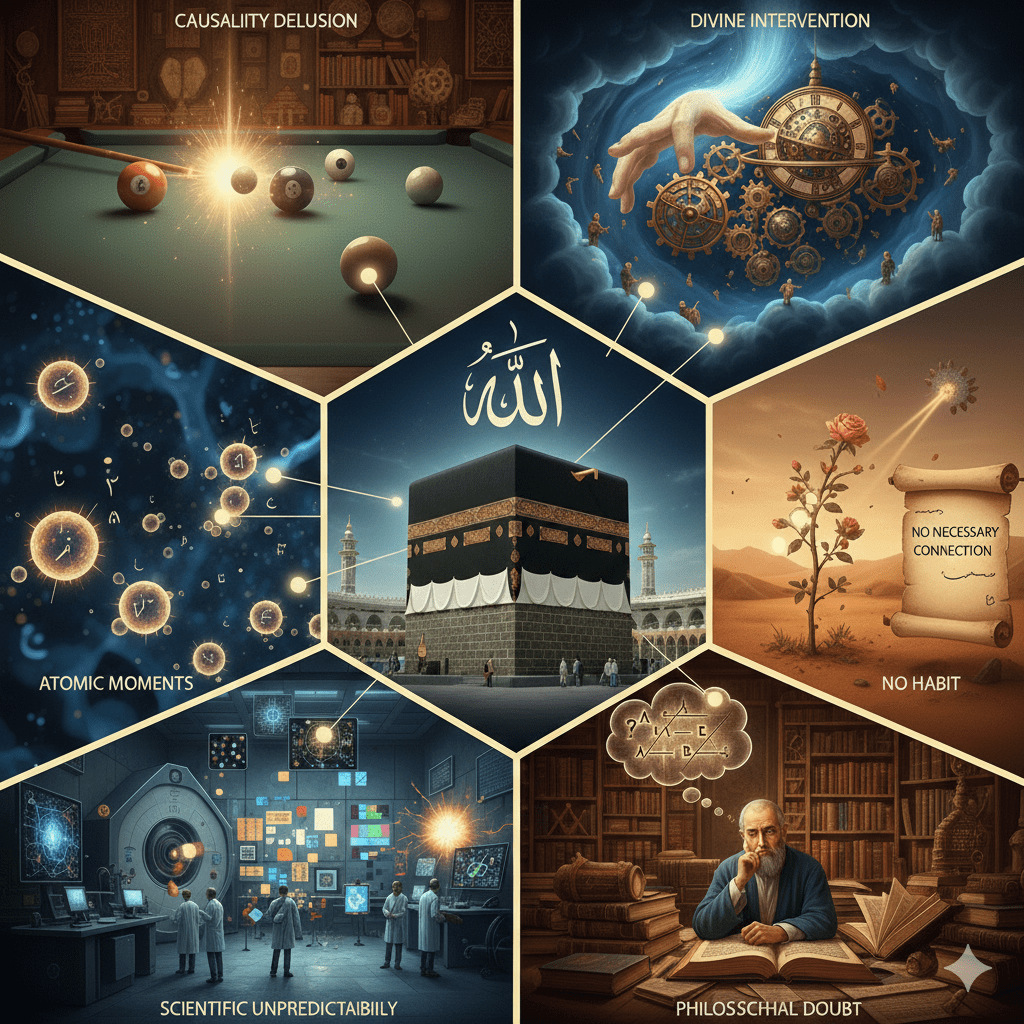
Presented by Claude
Abstract
For a believing Muslim, accepting that Allah is the sole true cause of every event is a smaller step than it seems, because the Quran already asks us to believe that He is doing nearly everything. This essay addresses Muslims who already affirm that Allah knows the innermost thoughts of every one of the roughly 8.3 billion people now alive (the figure given by the Worldometer World Population Clock, which put the count at 8,323,273,005 on October 28, 2026). They already affirm that He hears every prayer, guides the deserving, knows every falling leaf (6:59), shapes the very act of willing (76:30, 81:29), keeps His light from being extinguished (9:32–33; 61:8–9), stays with the patient (2:153) and with each of us wherever we are (57:4), and tests souls to turn them toward truth (2:155; 29:2–3; 67:2). Building on the writings of Dr. Zia H. Shah, MD, at The Glorious Quran and Science (thequran.love), and on classical sources on Abu Hamid al-Ghazali’s Tahafut al-Falasifa, the essay argues that occasionalism is not an exotic addition to this faith. It is the simplest and most coherent account of it. Occasionalism holds that Allah alone is the true cause, that He creates the world anew at every moment, and that natural laws are His dependable custom (sunnat Allah, ‘ada). A “partial” God who acts in some events and stands back from others raises a hard question that occasionalism never has to answer: by what rule does He decide which events to touch? The essay presents Shah’s scientific analogies, chiefly the photon at the surface of a swimming pool, quantum indeterminacy, and the 2022 Nobel Prize for Bell-inequality experiments, and is honest that these are analogies, not proofs. It shows how free will survives through the Ash’ari doctrine of kasb (acquisition) and Shah’s “free will bounded by divine will.” It answers objections about science, moral responsibility, and the laws of nature, and it ends with the spiritual fruits of this vision: tawakkul, patience, gratitude, and prayer.
- The core claim: Mainstream Muslim belief already has Allah knowing 8.3 billion hearts, answering prayers, guiding, testing, sustaining, and shaping human willing. Concluding that He does everything (occasionalism) is therefore a smaller and more coherent leap than holding that He does some things and leaves others to autonomous nature by an unexplained rule of selection.
- The supporting case: Al-Ghazali’s Seventeenth Discussion denies any necessary link between “cause” and “effect” (fire and cotton). Zia H. Shah pairs it with Quranic verses (2:255, 35:41, 55:29, 6:59, 8:17, 76:30, 81:29) and with quantum physics, where the fate of each photon is left open by physical law. He is candid that physics makes occasionalism “at least as rationally defensible” as materialism, not proven.
- What it does not cost you: Science (laws become God’s reliable habit), miracles, and moral responsibility all survive. Kasb and Shah’s “constrained libertarianism” keep human choice real, while the believer gains a deeper basis for tawakkul, patience, gratitude, and prayer.
I. What You Already Believe: Allah Is Already Doing a Very Great Deal
Begin with the faith you already hold, not with philosophy.
As of late October 2026, the World Population Clock maintained by Worldometer, which draws on United Nations estimates, counted roughly 8.3 billion human beings alive on this earth. Every Muslim who has absorbed the Quran already believes that Allah knows what passes through each of those 8.3 billion hearts, not as a statistic but one by one:
“And We have already created man and know what his soul whispers to him, and We are closer to him than [his] jugular vein.” (50:16) quran
He knows the hidden and the manifest alike. He is, in the words of the Quran, the Knower of the unseen and the witnessed. His knowledge does not stop at human hearts. It reaches the smallest event in the physical world:
“And with Him are the keys of the unseen; none knows them except Him. And He knows what is on the land and in the sea. Not a leaf falls but that He knows it. And no grain is there within the darknesses of the earth and no moist or dry [thing] but that it is [written] in a clear record.” (6:59)
Every autumn, across the forests of the world, uncountable billions of leaves come loose and spiral to the ground. Not one of them falls outside His knowledge.
You already believe that He listens and responds to those billions when they pray:
“And when My servants ask you, [O Muhammad], concerning Me – indeed I am near. I respond to the invocation of the supplicant when he calls upon Me.” (2:186) quran
You already believe that He guides those who seek Him, and that this guidance reaches into the act of willing itself:
“Indeed, this is a reminder, so he who wills may take to his Lord a way. And you do not will except that Allah wills. Indeed, Allah is ever Knowing and Wise.” (76:29–30) quran
“And you do not will except that Allah wills – Lord of the worlds.” (81:29) islamunlocked
You already believe that He governs the course of history, so that His message cannot be snuffed out:
“They want to extinguish the light of Allah with their mouths, but Allah refuses except to perfect His light, although the disbelievers dislike it. It is He who has sent His Messenger with guidance and the religion of truth to manifest it over all religion, although they who associate others with Allah dislike it.” (9:32–33; compare the near-identical 61:8–9) quran +2
You already believe that He is present, not distant:
“O you who have believed, seek help through patience and prayer. Indeed, Allah is with the patient.” (2:153) quranquran
“…and He is with you wherever you are. And Allah, of what you do, is Seeing.” (57:4) quran
And you already believe that He arranges the trials of each individual life in order to draw souls toward truth:
“And We will surely test you with something of fear and hunger and a loss of wealth and lives and fruits, but give good tidings to the patient.” (2:155) surahquranquran
“Do the people think that they will be left to say, ‘We believe’ and they will not be tried? But We have certainly tried those before them, and Allah will surely make evident those who are truthful, and He will surely make evident the liars.” (29:2–3) quranquran
“[He] who created death and life to test you [as to] which of you is best in deed – and He is the Exalted in Might, the Forgiving.” (67:2) quran
Add these together. In the ordinary, mainstream belief of Sunni Muslims, Allah is at this moment knowing 8.3 billion inner lives, hearing their prayers, weighing their sincerity, tailoring their tests, guiding hearts, steering history, accompanying the patient, and tracking every leaf and grain. This is not the God of the Deists, the watchmaker who wound the clock and walked away. As Zia H. Shah puts it in his writings, the Quran presents the Creator and then, verse after verse, insists that this same Creator is “intimately, continuously, moment-to-moment present.” thequran
The question this essay puts to you is simple. If Allah is already doing all of that, what is gained by insisting that there remains some leftover territory He does not do?
II. Al-Ghazali’s Occasionalism Explained
Abu Hamid Muhammad al-Ghazali (1058–1111), the “Proof of Islam” (Hujjat al-Islam), taught at the Nizamiyya in Baghdad and wrote Tahafut al-Falasifa (The Incoherence of the Philosophers, c. 1095) against the Aristotelian philosophers led by Ibn Sina. goodreads Its Seventeenth Discussion, on causality, opens with a sentence that has echoed for nine centuries: thequran
“The connection between what is habitually believed to be a cause and what is habitually believed to be an effect is not necessary, according to us.” thequran
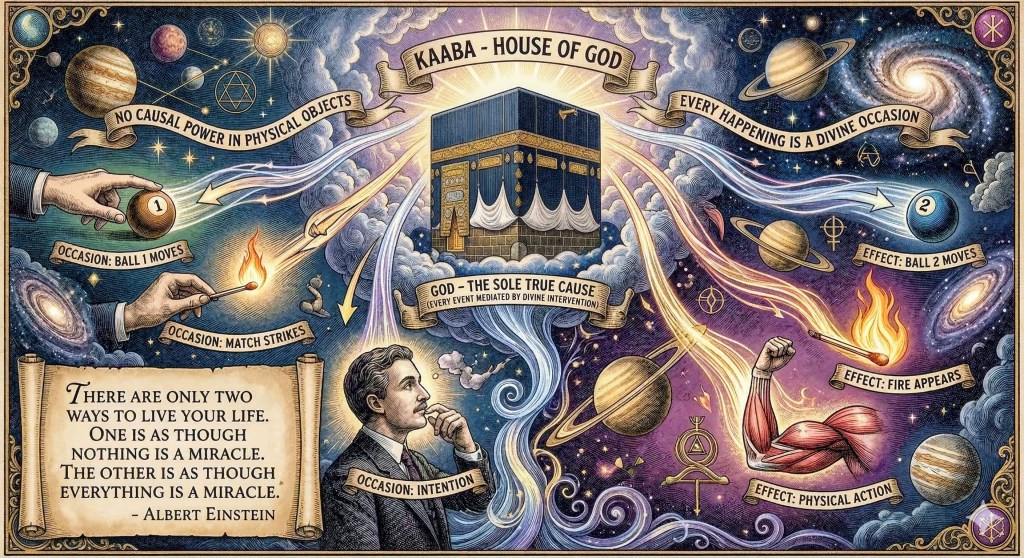
His famous illustration is fire and cotton. stanfordWikipedia When fire touches cotton, the cotton burns. But what do we actually observe? As the Stanford Encyclopedia of Philosophy renders al-Ghazali’s point, observation shows that burning happens at the time of contact with fire (‘indahu), not that it happens by the fire (bihi). “Fire, which is an inanimate thing, has no action.” The true agent is God. He creates the burning on the occasion of contact because this is His custom (‘ada), not because the fire compels Him. stanford That custom is exactly what the Quran shows Him suspending for Abraham: thequran
“Allah said, ‘O fire, be coolness and safety upon Abraham.’” (21:69) quran
Behind al-Ghazali stood the Ash’ari school of kalam. It pictured the world as atoms (jawahir) and accidents (a’rad), and held, with al-Baqillani, that accidents cannot endure for two moments. The Stanford Encyclopedia summarizes the result: “in each moment God assigns the accidents to bodies in which they inhere. When one moment ends, God creates new accidents.” stanford This is the doctrine of continuous creation. thequran The world does not persist by its own momentum; it is re-given at every instant. Zia H. Shah offers a homely image: as an apple falls, “at each instant of its descent, God creates the apple slightly lower than before, producing the appearance of continuous motion.” thequran +2
Scholarly honesty requires one caution, and it strengthens rather than weakens the invitation. Modern scholars disagree over how strictly al-Ghazali himself held occasionalism. Michael Marmura and Binyamin Abrahamov read him as a firm occasionalist. Frank Griffel and Richard Frank argue that he treated occasionalism and a God-dependent secondary causality as both possible, and that what he denied above all was that causal links are necessary. doajthequran Shah relays this debate in his writings and generally adopts the stronger, occasionalist reading. thequran Either way, the core that both readings share is the heart of the matter: nothing in creation has an independent, self-sufficient power that could act apart from Allah’s will.
The Western tradition later arrived, independently in part, at the same conclusion. The French Oratorian Nicolas Malebranche (1638–1715) thequran wrote, in words the Stanford Encyclopedia quotes, that “there is only one true cause because there is only one true God; … the nature or power of each thing is nothing but the will of God; … all natural causes are not true causes but only occasional causes.” stanford Malebranche also argued that “conservation is but continuous creation”: the same divine act that brought a thing into being from nothing is needed to keep it in being at every moment. stanford David Hume later took the epistemological half of the insight, that we never perceive necessary connection, only “constant conjunction.” He drew skepticism from it. Shah marks the parting of ways memorably: “al-Ghazali arrived at theism; Hume arrived at skepticism.” thequran The observation is the same; the difference, as Shah repeatedly says, “is God.”
III. Zia H. Shah’s Modern Presentation: The “Inshallah Universe”
Since early 2025, Dr. Zia H. Shah, a physician in Upstate New York board-certified in internal medicine, pulmonary disease, and sleep medicine, and Chief Editor of The Muslim Times, has built a large, cross-referenced body of essays on occasionalism at thequran.love. thequran +3 Its foundations include “Does Al-Ghazali’s Occasionalism Naturally Follow From the Quranic Omniscience and Omnipotence of God?” (March 2, 2025), “From the Expression Inshallah to Al Ghazali’s Occasionalism” (March 7, 2025), “The Glorious Quran Endorses Al Ghazali’s Occasionalism” and “Al-Ghazali and Free Will” (both March 26, 2025), “Occasionalism in al-Ghazali’s Thought and the Quranic Emphasis on Divine Causality” (May 7, 2025), and “Al Ghazali’s Occasionalism and Laws of Nature” (August 8, 2025). thequranthequran
Occasionalism as the metaphysics of Inshallah. Shah’s most memorable framing is that al-Ghazali’s doctrine is “essentially the metaphysics of ‘Inshallah.’” thequran +2 He grounds this in Surah al-Kahf:
“And never say of anything, ‘Indeed, I will do that tomorrow,’ Except [when adding], ‘If Allah wills.’” (18:23–24) quran
Every Muslim who says Inshallah before a future act, Shah argues, is already confessing that God, not autonomous natural law, decides whether it comes to pass. thequran In his November 2025 essay “Determinism, First Cause, and Al-Ghazali’s Occasionalism,” he says it lyrically: “every molecule and moment whispers, ‘Insha’Allah’, if God so wills.” thequran On this view the believer’s daily speech is already occasionalist. The doctrine simply takes our own words seriously.
Occasionalism as the consequence of omniscience and omnipotence. In his March 2, 2025 essay, Shah makes the deductive argument at the center of this invitation. If any created thing had autonomous causal power, “God’s power over that event would not be total, nor His knowledge of it meaningfully active — a notion utterly inadmissible in Islamic theology.” thequran +2 He offers a theatrical image: “the world is like a grand theater where God is the only actor, and what we call ‘characters’ (creatures) are in reality just costumes or instruments through which the sole actor performs.” thequranthequran
The Quranic verse-set. Shah gathers a recurring set of verses as the scriptural spine of occasionalism. thequran The first is the Throne Verse, whose “their preservation tires Him not” implies an active, ongoing preserving (2:255). Next comes “Indeed, Allah holds the heavens and the earth, lest they cease. And if they should cease, no one could hold them [in place] after Him” (35:41). quran He glosses this verse: “The universe’s stability is not intrinsic but a continuous act of God’s will.” thequran Then “every day He is bringing about a matter” (55:29). quran Above all he cites the verse of Badr:
“And you did not kill them, but it was Allah who killed them. And you threw not, [O Muhammad], when you threw, but it was Allah who threw…” (8:17) quran
Here the human act is fully real (“when you threw”) and yet the efficacy is God’s (“but it was Allah who threw”). Shah’s conclusion: “Al-Ghazali’s occasionalism is nothing other than the philosophical articulation of this Quranic faith: La ilaha illa’Llah — there is no deity, and no cause, except God.” thequranthequran
The simulation and the lightbulb. For a digital generation, Shah uses the simulation hypothesis as a teaching device. thequran In a simulation, if the program stops, the world freezes. Likewise, if God ceased willing the world, it would cease to be. He pairs this with the divine name al-Qayyum, the Self-Subsisting Sustainer. thequran He also repeats a classical image: reality is like a lightbulb that shines only while the current flows, not like a battery that runs on stored charge. Cut the divine current for one instant and the cosmos would lapse into nothing. thequran
IV. The Scientific Analogies: The Photon, the Pool, and the Nobel Prize
Shah is a physician, and his writing is full of science. His signature illustration is the most ordinary of sights. In his March 2026 essay “Where Divine Will Meets Quantum Indeterminacy,” he writes that “every moment, at every water surface on Earth, one of the most philosophically momentous events in nature occurs without fanfare: a photon of light strikes the boundary between air and water, and no law of physics determines whether it will be reflected back or refracted through.” thequran
Stand beside a swimming pool on a sunny day. Some light reflects, and you see the shimmer of the sky. Some refracts, and you see the tiles on the bottom. Richard Feynman made this the opening lesson of QED: The Strange Theory of Light and Matter (1985), using glass: of every 100 photons striking a single glass surface, about 4 reflect and 96 pass through. “We cannot predict which of the two cases will occur,” he wrote; “We can only calculate the probability.” Of how the photon “decides,” he added, “that is not known.” thequran
Physics fixes the envelope, the range of outcomes and their percentages. It is silent about the individual photon. thequran Shah lays out three possible answers to “what decides?”: brute chance (the materialist), hidden order (the determinist), or divine will (the occasionalist). thequran In his formulation, the photon’s fate is “not a random quantum event but God’s will expressed in the language of nature.” thequran Crucially, he notes that occasionalism predicts no departure from quantum statistics. God “governs the photon without disturbing the physics.” The laws describe the aggregate habit of divine action; each event is a fresh divine act. thequran
He reinforces this with the 2022 Nobel Prize in Physics, awarded to Alain Aspect, John Clauser, and Anton Zeilinger “for experiments with entangled photons, establishing the violation of Bell inequalities and pioneering quantum information science.” Those experiments rule out local hidden variables that might secretly pre-program each outcome. thequran Shah’s essay title “The Nobel in Physics 2022 Also Goes to Al Ghazali” captures his point: nature, at its foundation, does not appear to be a closed clockwork of local mechanical necessity. He also draws on Karen Harding’s paper “Causality Then and Now: Al Ghazali and Quantum Theory,” published in the American Journal of Islamic Social Sciences 10:2 (July 1993), pp. 165–177, which concluded that “although separated by culture and by nearly ten centuries, the similarities between al-Ghazali and the Copenhagen Interpretation are remarkable.” Harding observed that in both al-Ghazali’s occasionalism and the Copenhagen interpretation, “objects are viewed as having no inherent properties and no independent existence.”
Shah’s other analogies range across quantum tunneling, which he describes as a particle crossing a barrier “by the permission of the Lawmaker.” They also include entanglement, read as a cosmos held “in one hand,” and the Many-Worlds Interpretation, which he uses as a picture of the contingency al-Ghazali saw, not as doctrine. thequran As a physician he turns as well to the “hard problem” of consciousness, invoking the Quran’s own humility: thequran
“Say: ‘The soul is by the command of my Lord; and of knowledge you have been given but little.’” (17:85)
What the science does and does not do. Here Shah’s intellectual honesty deserves praise, and it should shape how we hold this invitation. He states plainly that quantum mechanics “does not and cannot prove” God’s action. thequran He states that determinism and occasionalism “describe the same universe… No experiment can distinguish them,” and that “the only difference between them is God.” thequran The physics does not deliver occasionalism. What it does is remove the old objection that science had shown the world to be a self-running machine with no room for God’s ongoing hand. In Shah’s measured words, it creates a “causal gap” that makes occasionalism “at least as rationally defensible as pure materialism.” thequran The decisive case for occasionalism remains theological, and that is where we now return.
V. The Problem With a “Partial” God, and Why Occasionalism Is the Easier Leap
Here is the heart of the invitation.
Suppose you hold the common middle view. Allah created the world and its laws; He sustains it in a general way; He knows everything; and He intervenes in particular matters such as answering this prayer, guiding that heart, testing this person, protecting His religion, and performing a miracle. The rest of the time, nature runs on its own powers. This sounds modest. In fact it saddles you with questions that have no good answers.
First, the problem of the dividing line. If Allah acts in some events and not in others, what is the rule of selection? Is your heartbeat His act or the heart’s? The rain that answers a drought prayer is His act, we say; but what of the rain that fell the day before, when no one prayed? Is the healing of a patient after du’a His act, while the identical healing of an unprayed-for patient is merely the antibiotic’s? Every attempt to draw the line produces a boundary that the Quran itself never draws. The Quran attributes rain, growth, sprouting seeds (6:95), life and death (67:2), the sailing of ships, and the binding of hearts to Allah without any footnote dividing “His” events from “nature’s.”
Second, the problem of entanglement. Even the events everyone agrees are His, His guidance of hearts, His answering of prayers, His tests, are woven into countless physical events. To guide one person to truth, Allah may arrange a chance meeting, a book left on a train, an illness, a recovery, a dream. Each of these hangs on weather, traffic, cell biology, and the firing of neurons. To answer even one prayer, He must govern the physical chain it runs through. Multiply this by 8.3 billion lives and their prayers, tests, and turnings, and the territory left over for “autonomous nature” shrinks almost to nothing. What remains is not a meaningful domain. It is an arbitrary leftover.
Third, the problem of knowledge without action. The Quran tells us Allah knows every falling leaf (6:59). Under the partial view, He knows it yet stands aside while some independent power in the leaf and the wind brings it down. But knowledge of a thing whose being is not from you is the knowledge of a spectator. The Quran’s Allah is not a spectator. He is al-Khaliq, al-Qayyum, the One who “holds the heavens and the earth, lest they cease” (35:41). Shah’s point in his March 2, 2025 essay is precisely this: if anything had autonomous power, His knowledge of it would not be “meaningfully active.”
Fourth, the problem of the will. The Quran says: “And you do not will except that Allah wills” (76:30; 81:29). If even the human act of willing, the most interior thing about us, lies within His willing, it is strange to insist that an inanimate flame or a falling stone enjoys a causal independence that we ourselves do not.
Set the two pictures side by side. The partial view requires you to believe that Allah is doing an immense amount, plus that there is an independent second domain of power, plus an unexplained rule dividing the two. Occasionalism asks you to believe only the first: that Allah is doing what He is doing, and that this is everything. It is the more parsimonious hypothesis. It has one cause instead of two, and no boundary to explain.
Zia H. Shah’s own intellectual journey shows this logic at work. In a January 27, 2025 essay, “How God Interacts With the Universe: Grants Prayers, Guided Evolution, and Delivers Miracles At Times?”, he was still weighing a middle position. He asked “in what way could a non-physical being intervene in the physical world, not only to give us miracles but also to grant our prayers?” and leaned toward a “divine concurrentism” in which “God is determining, because nature doesn’t, whether the photon bounces off the surface or goes through it.” He spoke of “God acting all the time for general providence, His attribute of Al Rehman and special providence Al Raheem.” thequran Within weeks, in “Paul Davies, A Pantheist, Has Convinced Me of Al Ghazali” (March 15, 2025), he took the final step. Reflecting on the physicist’s argument that God does not “intervene… from time to time as a magician,” Shah wrote that this pushed him “to a more Omnipresent, Omniscient and Omnipotent God. God of Ghazali, who does not intervene occasionally some of the time but all the time.” thequran And he stated the parsimony argument in a single sentence:
“It is more rational to believe that Allah creates all of the reality that we live in all of the time rather than only some of the time when He intends a miracle.” thequran
That is the invitation of this essay in Shah’s own words. A God who intervenes occasionally is a God whose interventions need explaining. A God who creates everything always needs no such explanation, because there is nothing that is not His act.
VI. Free Will Within Occasionalism
The most serious hesitation a believer feels is this: if Allah does everything, am I a puppet? The Quran plainly holds us responsible, and so must any theology faithful to it. Occasionalism, rightly understood, does not deny human choice. It locates it.
The classical answer: kasb (acquisition). The Ash’ari school taught that God creates every act, while the human being acquires (yaktasibu) it through intention and choice, and is therefore answerable. Wikipedia +2 The capacity to choose is itself created, moment by moment. But the choosing is genuinely the person’s. As a 2011 study in the Journal of the Royal Asiatic Society, “A re-examination of al-Ash’arī’s theory of kasb according to Kitab al-Luma’,” summarizes it, al-Ash’ari developed “a theory of kasb… according to which God creates man’s actions while man appropriates them and thus becomes responsible for them.” We all know from the inside the difference between a voluntary act and an involuntary tremor. google Kasb names that difference without granting the creature an independent creative power that would rival God.
Al-Ghazali’s own balance. In “Al-Ghazali and Free Will” (March 26, 2025), Shah presents al-Ghazali as a “theistic compatibilist” for whom humans “can intend and choose actions,” while “the fruition of these actions is contingent upon God’s will.” thequran He opens with al-Ghazali’s parable of the ink and the paper. thequran The paper blames the ink, the ink blames the pen, the pen blames the hand, the hand the intellect, until the intellect says, “I am guided by the will of God.” Each link is real; none is ultimate. Shah also gathers sayings attributed to al-Ghazali that guard against fatalism. One is the counsel to “strive as if everything depends on you, while trusting in God as if everything depends on Him.” Another is the image that “the servant’s free will is a ray of God’s will. It is neither independent of Him nor coerced by Him, but a gift from His grace.” thequranthequran
Shah’s “free will bounded by divine will.” In “The Inshallah Universe and the Boundaries of the Will” (July 4, 2026), a commentary on 8:24, 76:30, and 81:29, the argument is sharpened. thequran Read against the verses beside them, “so he who wills may take to his Lord a way” (76:29), these passages do not abolish human freedom. They “name the condition of a choice the Qur’an has already affirmed as real and accountable — a position best called constrained libertarianism or theistic compatibilism.” thequranthequran Notice the grammar of 76:29–30. The Quran first says “he who wills may take… a way,” and only then adds “you do not will except that Allah wills.” Human willing is affirmed first and then placed within the divine. thequran
Shah offers two further helps. First, he suggests that every act has two true explanations that do not compete: the human agent caused it at the level of intention, and God caused it at the level of creation and actualization. thequran This is the very structure of 8:17, “you threw… but it was Allah who threw.” thequran Second, the “Ever-Present God” essay in his corpus goes further and argues that occasionalism need not abolish even libertarian freedom. It locates that freedom “where modern physics has re-opened the door: in the genuine indeterminacy of nature.” thequran Muslims of Ash’ari and Maturidi temperament may weigh these refinements differently. The Maturidis, for example, grant human choice a somewhat more active role than strict Ash’ari kasb. ghayb But all can agree on the essential point: we are judged on our intention and our choice, and that is truly ours; the power to realize it is His.
This is not a loss. The alternative, a human will that operates wholly outside God’s creative power, is precisely what both Ash’ari and Maturidi theology rejected as making man a co-creator beside God. Occasionalism with kasb keeps the believer’s dignity and accountability while keeping tawhid whole.
VII. Objections and Responses
“Doesn’t occasionalism undermine science?” No, and al-Ghazali saw why. Because God’s custom is reliable, nature is regular, and regularity is all science needs. Shah stresses that natural laws on this view are “descriptive, not prescriptive.” thequranthequran They map how God customarily acts. He explicitly rejects any “extreme form” of occasionalism that would expect arbitrary chaos, noting that engineers can trust steel precisely because God’s habit is consistent. Science studies the how of God’s custom; theology names the Who. Shah describes this as a theological “critical realism.” thequran Historically, the great age of Muslim astronomy, medicine, and optics flourished in a civilization that widely held Ash’ari views. Malebranche, a convinced occasionalist, was appointed an honorary member of the Paris Académie des sciences when it was reorganized in 1699, according to Tad Schmaltz’s entry on Malebranche in the Stanford Encyclopedia of Philosophy, and his inaugural lecture there explained color in terms of “the frequency of vibrations of light.”
“Doesn’t it make the laws of nature unreal?” It makes them more intelligible, not less. A law of nature on the materialist view is a brute regularity with no reason behind it; Hume could find nothing behind it but habit of the human mind. On the occasionalist view, the regularity has a ground: the faithfulness of a wise God, the sunnat Allah of which the Quran says, “you will not find in the way of Allah any change.” Lawfulness becomes an expression of divine trustworthiness.
“Doesn’t it make God the author of evil and destroy moral responsibility?” The Ash’ari answer distinguishes creating an act from committing it. God creates; the human acquires, intends, and is judged. Al-Ghazali, as Shah quotes him, mocks the fatalist who pleads divine decree for his sins: “Why do you not claim compulsion in obedience as well?” thequran The Quran’s own logic of testing (67:2) presupposes that the choice is genuinely ours. And the mainstream believer already faces the same question under the “partial” view, since that view too holds that nothing happens outside God’s will and knowledge. Occasionalism adds no new difficulty here. It only removes the illusion that a second, independent power would solve it.
“Isn’t this just quantum hype?” Shah himself says no proof is on offer, and so does this essay. Deterministic interpretations of quantum mechanics, Bohmian mechanics and Many-Worlds among them, remain viable. thequran The case for occasionalism stands on the Quran and on the coherence of tawhid. Physics only shows that the case is not contradicted by what we know of nature.
“Did al-Ghazali even hold this view?” As noted above, scholars disagree. But the invitation does not depend on settling the historiography. It depends on the theological argument, which needs no particular reading of al-Ghazali: if Allah already knows, sustains, guides, tests, and wills as the Quran says, the simplest account is that He is the sole true cause.
VIII. The Spiritual Fruits: Tawakkul, Patience, Gratitude, and Prayer
A doctrine should be judged by its fruit as well as its logic. The fruits of occasionalism are the very virtues the Quran asks of us.
Tawakkul (reliance). If the medicine, the doctor, the job, and the market are occasions and not independent powers, then the believer’s ultimate trust can rest only on the One who acts through them all: thequran
“And whoever relies upon Allah – then He is sufficient for him. Indeed, Allah will accomplish His purpose.” (65:3) quran
As a physician, Shah does not counsel abandoning means. The Prophet’s counsel stands: in the hadith of Anas ibn Malik (Jami’ at-Tirmidhi 2517), when a man asked, “Shall I tie it and rely (upon Allah), or leave it loose and rely (upon Allah)?”, he said, “Tie it and rely (upon Allah),” a report al-Albani graded hasan, though at-Tirmidhi called it gharib and Yahya al-Qattan called it munkar. But he shows where the heart’s trust belongs. We take the means because God’s custom runs through them. We trust the God whose custom it is.
Patience (sabr). If every trial is a direct act of a wise and merciful Lord and not the blind collision of particles, then suffering has an Author and a purpose. “Indeed, Allah is with the patient” (2:153) is no longer a comforting phrase but a literal description. The believer can say, as the Quran teaches, “Indeed we belong to Allah, and indeed to Him we will return” (2:156). steemitquran Shah cites 57:22–23 to the same effect: calamities are known to Him beforehand “so you need not grieve for what you miss or gloat over what you gain.” thequran
Gratitude (shukr). Every breath, every heartbeat, every photon that strikes the eye and lets us see the face of a child is a fresh gift, created now. Under the partial view, most of our blessings are “just nature.” Under occasionalism, nothing is “just nature.” Gratitude can become continuous because giving is continuous.
Prayer (du’a). Perhaps the greatest fruit is that prayer becomes completely intelligible. Under the partial view, a believer may half-wonder whether prayer can affect “natural” outcomes that run on their own. Under occasionalism, every outcome is His act at the moment it occurs. There is no closed machine to break into. There is only the Lord who said, “I respond to the invocation of the supplicant when he calls upon Me” (2:186), and who is already the One bringing about every next moment.



Leave a Reply