
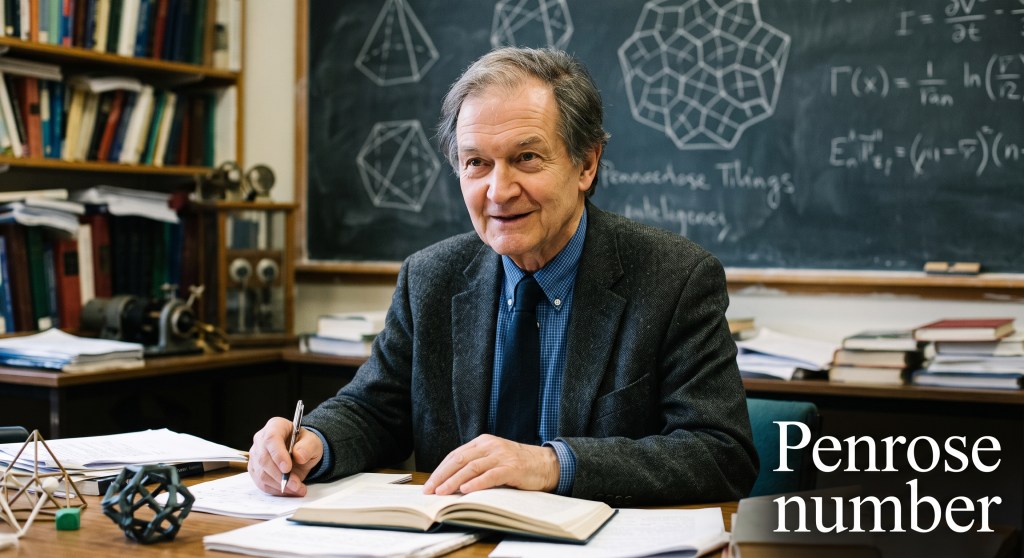
Presented by Gemini for Zia H Shah MD
Audio teaser: Entropy and the cosmic architect
Abstract
The second law of thermodynamics establishes a unidirectional arrow of time, dictating that the entropy of an isolated system must monotonically increase. Extrapolating this thermodynamic gradient backward yields a profound cosmological enigma: the universe must have originated in a state of vanishingly low entropy. Utilizing the Bekenstein-Hawking formula for black hole entropy and the phase space formulation of statistical mechanics, mathematical physicist Roger Penrose calculated the probability of the universe’s initial low-entropy configuration occurring by random chance to be approximately 1 in $10^{10^{123}}$. This staggering figure, known as the Penrose number, highlights an extraordinary degree of cosmic fine-tuning that underpins the existence of all complex structure in the universe. This report delivers an exhaustive analysis of the physical, cosmological, and philosophical dimensions of this initial low-entropy state. The analysis explores the geometric interpretation of this phenomenon via Penrose’s Weyl Curvature Hypothesis and its thermodynamic counterparts, including David Albert’s Past Hypothesis and Eddy Keming Chen’s Density Matrix Realism. The report subsequently examines the failure of alternative cosmological models—such as cosmic inflation, Conformal Cyclic Cosmology, and Loop Quantum Cosmology—to adequately resolve this fine-tuning without succumbing to the measure problem or the Boltzmann Brain paradox. Finally, the analysis transitions into the philosophical implications of the Penrose number, utilizing Bayesian confirmation theory, Robin Collins’ Restricted Likelihood Principle, and the Evolutionary Argument Against Naturalism to demonstrate how the extreme fine-tuning of the universe’s initial conditions serves as a robust teleological argument against atheistic naturalism.
1. Introduction to the Thermodynamic Arrow of Time
The macroscopic universe is governed by asymmetrical temporal processes. From the dissipation of heat and the expansion of the cosmos to the biological aging of living organisms, empirical observations confirm a unidirectional flow of time. This temporal asymmetry is formally codified in the second law of thermodynamics, which posits that the total entropy—a measure of disorder, or the number of microscopic configurations that correspond to a specific macroscopic state—of an isolated system can never decrease over time.
However, a fundamental paradox lies at the heart of statistical mechanics: the microscopic laws of physics (classical mechanics, quantum mechanics, and general relativity) are entirely time-symmetric. The dynamical equations of motion do not distinguish between the past and the future. If one were to reverse the velocities of all particles in a system, the system would retrace its evolution backward in time, completely in accordance with physical laws. Thus, the macroscopic arrow of time cannot be derived solely from the dynamical equations of motion.
To reconcile time-symmetric microscopic laws with time-asymmetric macroscopic phenomena, physicists must invoke specific boundary conditions. If the universe is evolving toward a state of maximum entropy (thermodynamic equilibrium or “heat death”), it logically necessitates that the universe in the past was in a state of lower entropy. Tracing this gradient back to the origin of the cosmos leads to a startling conclusion: the Big Bang could not have been a chaotic, random explosion. Instead, it must have been a highly structured, exceedingly special, and finely tuned state of extraordinarily low entropy.
The precision of this initial state is not a minor cosmological curiosity; it is the fundamental prerequisite for the existence of complex structures. Had the universe begun in a generic, high-entropy state—which is statistically overwhelmingly more probable—it would have immediately collapsed into a featureless sea of black holes, devoid of galaxies, stars, planets, and the biochemical complexity required for intelligent life.
| Arrow of Time | Physical Manifestation | Cosmological Implication |
| Thermodynamic | Entropy monotonically increases in isolated systems. | The universe originated in a state of extraordinarily low entropy. |
| Cosmological | The spatial metric of the universe expands over time. | The universe originated from a highly condensed singularity or bounce. |
| Electrodynamic | Radiation propagates as retarded (outward) waves rather than advanced (inward) waves. | Requires boundary conditions of no incoming radiation from the infinite past. |
| Psychological | Conscious agents remember the past but not the future. | Dependent on the thermodynamic gradient for information processing and memory formation. |
2. Phase Space and the Architecture of Microstates
To rigorously quantify the specialness of the universe’s initial state, physicists employ the concept of phase space. In statistical mechanics, phase space is an abstract, high-dimensional mathematical space where every possible state of a physical system is represented by a single point. For a system of $N$ particles, the phase space has $6N$ dimensions (three spatial coordinates and three momentum coordinates for each particle). The total volume of phase space corresponds to the total number of possible microstates accessible to the system.
To visualize this, consider an analogy involving the test scores of two students. If a chart is created where the horizontal axis represents one student’s grade (0-100) and the vertical axis represents the other’s, the chart serves as a two-dimensional phase space. Every point on the chart represents a unique combination of grades. Scaling this up to the trillions of particles in the universe requires a multi-dimensional volume, but the conceptual framework remains identical: a specific macroscopic condition corresponds to a specific volume within this phase space.
According to the Boltzmann definition of entropy, the entropy $S$ of a macrostate is proportional to the logarithm of the phase space volume $W$ of microstates that correspond to it:
$$S = k_B \ln W$$
where $k_B$ is the Boltzmann constant. High-entropy macrostates occupy exponentially larger volumes of phase space than low-entropy macrostates. In a gravitational system, the intuitive understanding of entropy is inverted compared to standard gas dynamics. For a gas in a box, a uniform distribution represents maximum entropy. However, gravity is a universally attractive force. In a gravitating system, a uniform distribution of matter represents an extremely low entropy state, as gravity naturally seeks to clump matter together into stars, galaxies, and ultimately, black holes, which represent the highest entropy configurations.
3. The Penrose Number: Quantifying Cosmic Improbability
In his seminal 1989 work, The Emperor’s New Mind, and subsequent publications, mathematical physicist Roger Penrose undertook the monumental task of calculating the phase space volume of the universe’s initial conditions to determine the probability of it arising by random chance.
Penrose’s calculation relies on the Bekenstein-Hawking formula for the entropy of a black hole, which demonstrates that gravitational entropy is overwhelmingly the dominant form of entropy in the universe. The formula is given by:
$$S_{BH} = \frac{k_B A c^3}{4 G \hbar}$$
where $A$ is the surface area of the event horizon.
Penrose estimated the total number of baryons (protons and neutrons) in the observable universe to be approximately $10^{80}$. If all the matter in the observable universe were maximally clumped together into a single, universe-sized supermassive black hole, the entropy of this system would represent the maximum possible entropy for the universe. Using the Bekenstein-Hawking formula, Penrose calculated this maximum entropy to be roughly $10^{123}$ in natural units ($k_B = 1$).
Consequently, the total available phase space volume $V$ for the universe is proportional to the exponential of its maximum entropy:
$$V \propto \exp(10^{123})$$
In stark contrast, the actual initial state of the universe at the Big Bang was remarkably smooth, devoid of black holes, and characterized by a highly uniform distribution of matter. The entropy of this initial state was microscopic compared to the maximum possible entropy. Let the phase space volume of the initial state be $W$. To determine the probability $P$ of the universe beginning in this specific low-entropy state by random chance, one must calculate the ratio of the target phase space volume $W$ to the total available phase space volume $V$:
$$P = \frac{W}{V} \approx \frac{1}{\exp(10^{123})} \approx 10^{-10^{123}}$$
Thus, the probability of the universe’s initial entropy conditions occurring by chance is 1 part in $10^{10^{123}}$.
3.1 The Absolute Magnitude of the Penrose Number
The figure $10^{10^{123}}$ is a double exponential, making it incomprehensibly vast. In standard decimal notation, $10^{123}$ is a 1 followed by 123 zeros. The Penrose number, however, is a 1 followed by $10^{123}$ zeros. To illustrate the absurdity of this magnitude: if one were to write a zero on every single proton, neutron, and electron in the entire observable universe (approximately $10^{80}$ particles), one would still fall short of writing the number down in full by over 40 orders of magnitude.
In the realm of probability theory, any odds smaller than 1 in $10^{50}$ are generally considered to represent a practical impossibility. The Penrose number dwarfs this threshold by a trillion trillion trillion times and beyond, effectively yielding a probability of zero. To borrow Penrose’s own analogy: imagine the Creator armed with a pin, aiming at the phase space of all possible universes. To create a universe capable of supporting the second law of thermodynamics (and thereby complex structure and life), the Creator’s aim must have been precise to 1 part in $10^{10^{123}}$.
| Cosmological State | Approximate Entropy (Natural Units) | Corresponding Phase Space Volume |
| Big Bang (Initial State) | $\sim 10^{88}$ (CMB radiation dominant) | $\exp(10^{88})$ |
| Current Universe | $\sim 10^{101}$ (Supermassive black holes dominant) | $\exp(10^{101})$ |
| Maximum Entropy | $\sim 10^{123}$ (Universal Black Hole/Big Crunch) | $\exp(10^{123})$ |
4. Geometric and Statistical Formalisms of the Initial State
The quantitative revelation of the Penrose number requires a rigorous physical framework to explain why the universe was constrained to this infinitesimal sliver of phase space. Physicists and philosophers of science have developed distinct but overlapping hypotheses to codify this initial condition.
4.1 The Weyl Curvature Hypothesis
Penrose sought a geometric explanation for the low initial entropy, linking it directly to the structure of spacetime in general relativity. The Riemann curvature tensor, which describes the full curvature of spacetime, can be decomposed into two distinct components: the Ricci tensor and the Weyl tensor.
- The Ricci Tensor ($R_{ab}$): Describes how the volume of a shape changes in the presence of matter and energy. It is directly coupled to the energy-momentum tensor via the Einstein field equations.
- The Weyl Tensor ($C_{abcd}$): Describes the shape-distorting tidal forces of gravity that propagate even in a vacuum (e.g., gravitational waves). It constitutes the radiative sector of the Riemann tensor and is conformally invariant.
Penrose observed that in a highly clumped, high-entropy state (such as a black hole singularity), the Weyl curvature diverges to infinity. Conversely, in a perfectly homogeneous and isotropic space (like the Friedmann-Lemaître-Robertson-Walker (FLRW) metric describing the Big Bang), the Weyl curvature identically vanishes.
To embed the thermodynamic arrow of time into the fabric of general relativity, Penrose proposed the Weyl Curvature Hypothesis (WCH) in 1979: The Weyl curvature tensor must strictly vanish at all past singularities (the Big Bang), but is unconstrained and permitted to diverge at future singularities (black holes or a Big Crunch). The WCH elegantly explains the absence of chaotic initial conditions, the suppression of white holes (which would represent anti-thermodynamic behavior), and the large-scale uniformity of the early universe. By linking the gravitational entropy directly to the Weyl tensor, Penrose translated a thermodynamic mystery into a purely geometric constraint.
4.2 The Past Hypothesis and the Mentaculus
While the WCH offers a geometric constraint, the philosopher of physics David Albert formulated the thermodynamic equivalent, termed the Past Hypothesis (PH). In his book Time and Chance, Albert argues that statistical mechanics cannot function solely on the time-symmetric dynamical laws and a standard statistical postulate that assigns uniform probabilities over phase space. Without a temporal boundary condition, standard probabilistic reasoning would incorrectly retrodict that the universe was at a higher entropy state in the past, viewing our current low-entropy state as a mere statistical fluctuation out of chaos.
Albert’s solution is a package of laws he calls the “Mentaculus,” comprising:
- The fundamental dynamical laws of physics (e.g., Newtonian mechanics or quantum mechanics).
- The Statistical Postulate (SP): A uniform probability measure over phase space regions compatible with macroscopic constraints.
- The Past Hypothesis: The explicit stipulation that the universe began in a specific, macroscopically low-entropy state.
The PH serves as the “mother of all ready conditions,” grounding not only the thermodynamic arrow of time but also the epistemic arrows—why humanity has records of the past but not the future, and why causes reliably precede effects. However, the PH is frequently criticized for being an ad-hoc stipulation rather than a derivation from fundamental principles. Philosopher Huw Price, in his work Time’s Arrow and Archimedes’ Point, emphasizes the conceptual dilemma the PH introduces: if the universe recollapses into a Big Crunch, one must either explain why entropy does not decrease (yielding a time-asymmetric universe) or accept a highly unnatural double-boundary condition where entropy is low at both ends of time.
4.3 Density Matrix Realism and the Wentaculus
In recent years, philosopher of physics Eddy Keming Chen has sought to resolve the ontological vagueness of the Past Hypothesis by extending it directly into the quantum realm. Chen proposes Density Matrix Realism (DMR) and the Initial Projection Hypothesis (IPH), collectively termed the “Wentaculus”.
Standard quantum mechanics relies on Wave Function Realism, assuming the universe is fundamentally in a pure state represented by a universal wave function $\vert{}\Psi\rangle$. However, a pure state corresponding to the Past Hypothesis is highly non-unique; there are infinitely many pure states compatible with the low-entropy macrostate, requiring the Mentaculus to invoke an additional, seemingly arbitrary statistical postulate to dictate probabilities.
Chen argues that the universe is fundamentally in a mixed state, represented objectively by a density matrix $\hat{W}$. The Initial Projection Hypothesis dictates that the initial density matrix of the universe is exactly the normalized projection operator onto the low-dimensional Past Hypothesis subspace of the total Hilbert space. By elevating the density matrix to a fundamental, objective law of nature, Chen eliminates the need for an independent statistical postulate, reducing the initial fine-tuning to a single, mathematically precise quantum boundary condition. Nevertheless, while the Wentaculus formalizes the initial state, it does not explain why the universe’s fundamental law demanded such an extraordinarily low-dimensional, low-entropy subspace in the first place, leaving the teleological implications of the Penrose number intact.
5. Evaluating Cosmological Alternatives to Fine-Tuning
The staggering improbability of the Penrose number ($10^{-10^{123}}$) has driven cosmologists to seek physical mechanisms that might naturally produce such a state, attempting to alleviate the burden of fine-tuning. However, these models invariably encounter profound theoretical and empirical hurdles, often merely shifting the fine-tuning to a different locus.
5.1 The Failure of Cosmic Inflation
Cosmic inflation—a theoretical period of exponential spatial expansion in the first fraction of a second after the Big Bang—was initially proposed to solve the horizon and flatness problems, explaining why the universe is so remarkably uniform. Many physicists assumed inflation also solved the initial entropy problem by expanding a small, chaotic region into a vast, smooth universe, diluting any initial irregularities.
Penrose has forcefully demonstrated that this is a severe misconception. Inflation does not resolve the low-entropy problem; it exacerbates it. For the inflaton field to dominate the energy density and initiate inflation, the pre-inflationary patch of space must itself be incredibly smooth and dominated by potential energy. If the pre-inflationary state were generic and high-entropy, inflation would never commence; the scalar field would be overwhelmed by thermal fluctuations, and the region would simply collapse into a black hole.
As theoretical physicist Sean Carroll corroborates, inflation shifts the fine-tuning problem back one step: to get inflation to start requires an initial state with an even lower entropy than the conventional Big Bang model implies. Consequently, inflation cannot be the ultimate explanation for the Penrose number, as it presupposes the very geometric fine-tuning (vanishing Weyl curvature) it is often erroneously claimed to explain.
5.2 Conformal Cyclic Cosmology (CCC)
Dissatisfied with inflation, Penrose proposed his own cyclocosmic model: Conformal Cyclic Cosmology (CCC). In CCC, the universe undergoes an infinite series of cycles, or “aeons,” avoiding an absolute beginning.
The mechanism relies on conformal geometry. In the remote future of our current aeon, as the universe expands exponentially due to dark energy, all matter will eventually decay into massless radiation (photons and gravitons) or fall into supermassive black holes that subsequently evaporate via Hawking radiation. Once the universe is populated exclusively by massless particles, it loses its ability to track space and time, as massless particles do not experience time and cannot serve as rulers or clocks.
Mathematically, the metric of this asymptotically infinite, cold, and empty future can be conformally rescaled: $g_{ab} \to \Omega^2 g_{ab}$. By applying a conformal factor $\Omega \to 0$ at future infinity and $\Omega \to \infty$ at the Big Bang, Penrose demonstrates that the conformal future boundary of one aeon smoothly attaches to the Big Bang singularity of the next.
Crucially, CCC attempts to reset the entropy. As black holes evaporate, they destroy the massive phase space they previously occupied. The Weyl curvature, which grew as matter clumped into black holes, vanishes at the conformal crossover, satisfying the Weyl Curvature Hypothesis and initiating the new aeon in a low-entropy state.
Penrose and his collaborators claim to have found observational evidence for CCC in the Cosmic Microwave Background (CMB) in the form of “Hawking points”—anomalous circular hot spots allegedly caused by the concentrated Hawking radiation of supermassive black holes from the previous aeon. However, the broader cosmological community remains highly skeptical. Independent analyses suggest these anomalies are not statistically significant when compared to standard $\Lambda\text{CDM}$ simulations, and the requirement that all fermions must decay in the infinite future lacks any empirical support in the Standard Model of particle physics.
5.3 Loop Quantum Cosmology and the Big Bounce
An alternative to cyclic conformal mapping is found in Loop Quantum Cosmology (LQC), a symmetry-reduced application of Loop Quantum Gravity. LQC replaces the classical Big Bang singularity with a “quantum bounce” due to holonomy corrections that generate a repulsive force at the Planck density scale.
While a bouncing cosmology must also grapple with the survival of entropy from a previous contracting phase, research suggests that the Weyl Curvature Hypothesis might be dynamically enforced by quantum backreaction. As the universe compresses toward the bounce, chaotic anisotropies (such as Misner’s mixmaster dynamics) escalate. However, the extreme curvature at the Planck scale triggers copious vacuum particle creation. The vacuum viscosity generated by these quantum field processes is theorized to act as an efficient transducer of gravitational entropy into matter entropy, violently damping geometric irregularities and ensuring that the universe emerges from the bounce in a smooth, FLRW-compatible state with near-zero Weyl curvature.
Despite this mathematical elegance, bouncing models still face a fundamental thermodynamic objection: if entropy continuously increases across bounces, the cycles cannot be infinite into the past, as the universe would have reached a state of maximum entropy long ago. The necessity for an absolute beginning, and the concomitant fine-tuning, remains intact.
| Cosmological Model | Proposed Mechanism for Low Entropy | Primary Shortcoming |
| Cosmic Inflation | Exponential expansion flattens geometry. | Requires an even lower-entropy, fine-tuned pre-inflationary patch to begin. |
| Conformal Cyclic Cosmology | Conformal rescaling after infinite mass decay resets Weyl curvature. | Lack of evidence for Hawking points; requires unproven proton/electron decay. |
| Loop Quantum Cosmology | Quantum bounce with vacuum viscosity damping anisotropies. | Cannot be past-eternal due to cumulative entropy increase across bounces. |
6. The Measure Problem, Multiverses, and the Boltzmann Brain Paradox
Recognizing the failure of single-universe mechanical models to eliminate the fine-tuning of the initial state, many naturalistic cosmologists invoke the multiverse. Under the eternal inflation paradigm, an infinite number of “pocket universes” constantly bubble into existence, exploring all possible parameter values and initial conditions. Observers naturally find themselves in one of the exceedingly rare low-entropy universes capable of supporting life, due to the anthropic principle.
6.1 The Gibbons-Hawking-Stewart Measure
To formally justify the multiverse argument, one must calculate the probability of a low-entropy universe forming. This requires a measure on the phase space of cosmological solutions. General relativity provides a canonical measure on minisuperspace known as the Gibbons-Hawking-Stewart (GHS) measure, derived from the Liouville measure of classical mechanics.
However, as physicists Robert Wald and Joshua Schiffrin have extensively documented, utilizing the GHS measure to calculate probabilities is fraught with severe pathological issues. The total phase space volume of general relativity is infinite and non-compact. Regulating this infinity to calculate finite probabilities yields highly ambiguous results that depend entirely on arbitrary choices of cutoffs and how the degrees of freedom are truncated. Thus, the “probability” of any subset of phase space is either zero, one, or entirely ambiguous. Consequently, naturalistic attempts to mathematically prove that a life-permitting universe is “probable” within a multiverse fail due to the fundamental ill-defined nature of cosmological probabilities on infinite sample spaces.
6.2 The Boltzmann Brain Catastrophe
Even if the measure problem could be circumvented, the multiverse hypothesis suffers a fatal blow from statistical mechanics: the Boltzmann Brain paradox.
In a vast, eternal multiverse dominated by high-entropy thermal equilibrium, low-entropy states are achieved exclusively through random thermal fluctuations. The probability of a fluctuation is inversely proportional to the exponential of the entropy decrease required. To produce a universe resembling ours requires a fluctuation that lowers the entropy by $10^{123}$.
However, to produce a single, conscious brain—complete with false memories of a 14-billion-year cosmic history and an illusion of an external world—fluctuating momentarily out of the quantum vacuum requires an entropy decrease of only about $10^{69}$. Because $\exp(10^{69})$ is incomprehensibly more probable than $\exp(10^{123})$, the eternal multiverse predicts that for every genuine observer evolved in a vast, low-entropy universe, there are a near-infinite number of isolated, fluctuating “Boltzmann Brains.”
If the multiverse hypothesis is true, statistical mechanics dictates that we are almost certainly Boltzmann Brains. But if we are Boltzmann Brains, our memories, our scientific observations, and the very cosmological data that led us to infer the multiverse are complete illusions. The hypothesis is therefore epistemically self-undermining. As Sean Carroll notes, any cosmological theory that predicts we are likely to be Boltzmann Brains must be rejected as cognitively unstable. The failure of the multiverse leaves the Penrose number as an unresolved, hyper-specific boundary condition of reality.
7. The Teleological Inference: The Penrose Number as an Argument Against Atheism
When the mechanisms of theoretical physics reach their explanatory limits, the discourse necessarily transcends the empirical and enters the philosophical. The Penrose number, representing an accuracy of 1 part in $10^{10^{123}}$, serves as arguably the most potent empirical foundation for the modern teleological argument—the argument from design. It forces a direct confrontation between theistic and atheistic metaphysics.
7.1 Epistemic Probability and the Restricted Likelihood Principle
A common naturalistic retort to the fine-tuning argument is the “Brute Fact” or “Single Sample Objection.” This argument posits that since humanity only has access to a single universe, it is impossible to assign probabilities to its initial conditions; the universe simply is the way it is, and observers happen to be here to observe it, rendering any search for a deeper cause meaningless.
Philosopher Robin Collins effectively dismantles this objection by distinguishing between statistical frequency and epistemic probability. Epistemic probability deals with the rational degree of belief a proposition warrants given a specific body of evidence, independent of whether the event can be repeated.
Collins employs Bayesian confirmation theory, specifically formulating the Restricted Likelihood Principle (or Prime Principle of Confirmation). This principle dictates that whenever an observation $E$ is vastly more probable under Hypothesis A than under Hypothesis B, the observation serves as strong evidence in favor of Hypothesis A over Hypothesis B.
Let $E$ be the extreme fine-tuning of the universe’s initial low entropy (the Penrose number).
Let $H_N$ be the hypothesis of atheistic single-universe naturalism.
Let $H_T$ be the hypothesis of theism (an intelligent Creator).
Under $H_N$, the parameters of the universe are determined by blind, unguided chance without teleological intent. The probability of the universe landing in the life-permitting sliver of phase space ($10^{-10^{123}}$) is practically zero. Thus, $P(E \vert{} H_N) \approx 0$.
Under $H_T$, however, it is entirely plausible that a rational, omnipotent Creator would design a universe capable of supporting complex, conscious agents capable of moral reasoning. Therefore, the probability of a low-entropy, life-permitting universe under theism is reasonably high. Thus, $P(E \vert{} H_T) \gg P(E \vert{} H_N)$.
By the strict mathematical logic of Bayes’ theorem, the Penrose number provides overwhelming, quantifiable evidence in favor of theism over naturalism. Dismissing the $10^{10^{123}}$ precision as a “brute fact” violates the fundamental scientific and rational impulse to seek explanations for highly specified, improbable patterns—just as one would intuitively reject the notion that rocks perfectly spelling out “Welcome to the mountains” at the base of a cliff were arranged by a random rockfall.
7.2 Fine-Tuning for Discoverability
Collins further advances the teleological argument by demonstrating that the initial low entropy is fine-tuned not merely for bare biological habitability, but specifically for scientific discoverability.
The universe possesses an exceptionally low entropy gradient that extends far beyond what is strictly necessary for human survival on Earth. If the goal were merely to permit biological life, a localized pocket of low entropy in an otherwise chaotic universe (a “thermal fluctuation” universe) would suffice. Instead, the entire observable cosmos is permeated by an overarching thermodynamic order. This surplus of order allows for the existence of transparent cosmological windows—enabling humanity to observe distant galaxies, the Cosmic Microwave Background, and deduce the deep history and fundamental laws of the cosmos over billions of years.
Collins defines this parameter space as the “discernable-discoverability-optimality range” (DDOR). A universe optimized for intelligibility and empirical observation is entirely inexplicable under naturalism, which has no mechanism to select for discoverability. Conversely, it is highly anticipated under a theistic framework, wherein a Creator intends for intelligent agents to comprehend the mathematical and physical beauty of the cosmos, fostering a relationship mediated through reason and discovery.
8. Epistemic Stability and the Evolutionary Argument Against Naturalism
The inference to a Creator is further bolstered when evaluating the self-defeating nature of the naturalistic alternative. Philosopher Alvin Plantinga’s Evolutionary Argument Against Naturalism (EAAN) demonstrates a fatal epistemic flaw in the atheistic worldview, directly impacting how cosmologists interpret fine-tuning.
The argument proceeds as follows: If naturalism and unguided evolution are true, human cognitive faculties evolved strictly to maximize survival and reproductive fitness, not to produce true beliefs. Natural selection acts entirely on neurophysiology and behavior; it is blind to the semantic content of beliefs. A false belief that leads to adaptive, survival-enhancing behavior will be selected for just as readily as a true belief. Consequently, the probability that our cognitive faculties are reliable engines for discovering objective truth—especially regarding highly abstract concepts disconnected from Pleistocene survival, such as multi-dimensional phase space, quantum gravity, and cosmic entropy—is either low or entirely inscrutable.
If one cannot trust their cognitive faculties under naturalism, one cannot trust the scientific theories those faculties produce, nor can they trust the belief in naturalism itself. Naturalism thus collapses in a logical contradiction, rendering it epistemically self-defeating.
Theism, by contrast, provides a coherent metaphysical grounding for the scientific enterprise. If the universe is the product of a rational Mind, and human minds are crafted in the image of that Creator to reflect that rationality, humanity has a justified basis for trusting its capacity to uncover the deep laws of nature. The mathematical legibility of the universe—expressed so profoundly in Penrose’s calculations—demands a philosophy of mind that naturalism cannot provide, further solidifying the teleological argument against atheism.
9. Thematic Epilogue
The pursuit of the cosmological arrow of time leads inexorably to a singularity of both physical and philosophical profundity. Roger Penrose’s calculation of the universe’s initial entropy—an accuracy of 1 part in $10^{10^{123}}$—stands as a monumental testament to the precision underlying cosmic architecture. It is a number so vast that it transcends human comprehension, defying the capacity of the physical universe itself to contain its digits.
From the vanishing of the Weyl curvature at the Big Bang to the projection onto a microscopic subspace of the quantum density matrix, modern physics continually reaffirms that the cosmos was born in a state of breathtaking elegance and specificity. Attempts to bypass this fine-tuning through inflationary expansion or infinite multiverse landscapes inevitably falter, either shifting the burden of precision back a step or plunging into the epistemic abyss of the Boltzmann Brain catastrophe.
When the empirical data resists all naturalistic reduction, rationality demands an inference to the best explanation. The extreme calibration of the cosmic initial conditions strongly resonates with the presence of a transcendent, intelligent Architect. The universe is not a statistical accident wandering through an infinite phase space; it is a meticulously ordered construct, finely tuned not merely to harbor life, but to be intelligible to the minds that inhabit it. In the staggering precision of the Penrose number, one perceives not just the mathematical boundary of the Big Bang, but the indelible signature of a deliberate and purposeful design.




 The Glorious Quran and Science
Leave a comment