
Presented by Claude for Zia H Shah MD
Metaphysical naturalism, the claim that nothing exists except what physics describes, fails on scientific, philosophical and Qur’anic grounds. Modern science keeps finding unseen realities and running into its own limits. Philosophy shows that naturalism cannot account for the reasoning, mathematics, morality and consciousness it relies on to argue its case. And the Qur’an’s idea of al-ghayb (the unseen) offers a more coherent and more humble picture of reality, one that recognises how far human knowledge actually reaches.
- The science: Planck 2018 data (baryon density Ω_b h² = 0.0224 ± 0.0001, with H₀ = 67.4 ± 0.5 km/s/Mpc) mean that ordinary matter is only about 4.9% of the cosmos. Physics also points toward a beginning, extreme fine-tuning, a low-entropy start, non-local entanglement and an unsolved “hard problem” of consciousness. Physics itself shows that what can be seen is not all there is. That undercuts naturalism’s claim to completeness, though it does not on its own prove God.
- The philosophy: “Only the physical exists” is either false or empty (Hempel’s dilemma). Naturalism undermines trust in the reason that produced it (Lewis, Plantinga). It cannot ground logic, numbers, intentionality, moral obligation or the regularity of nature, and scientism is not itself a scientific claim. Contingency arguments from Ibn Sina and Leibniz point to a Necessary Existent (wājib al-wujūd) outside the physical order.
- The theology: The Qur’an makes belief in al-ghayb the first mark of the God-conscious (2:3). It treats nature as signs (āyāt) to be studied with reason. It describes God as the continuous Sustainer (al-Qayyūm), beyond physical detection (6:103, 42:11). It identifies the materialism of its own day, al-dahriyya (45:24), as a position resting on conjecture, not knowledge. On this reading, naturalism is a modern dahriyya. It confuses the edge of human seeing with the edge of reality.
Abstract
This essay argues that metaphysical naturalism (physicalism) is not a neutral conclusion of science. It is a metaphysical bet, and the evidence counts against it. Part I looks at the science. The dark sector means that roughly 95% of the universe’s mass-energy is invisible to us. Constants and initial conditions appear fine-tuned. The Borde–Guth–Vilenkin result and the Kalām argument bear on whether the universe began. Mathematics is unreasonably effective in describing nature. Quantum measurement and non-locality defy classical intuitions. Origin-of-life research faces an information problem. Consciousness poses a “hard problem,” and Gödel, Heisenberg and chaos theory set formal limits on what can be known. Part II is philosophical. It covers Hempel’s dilemma, the self-defeat of evolutionary naturalism, intentionality and the normativity of logic, abstract objects, objective morality, contingency and the Principle of Sufficient Reason (Ibn Sina, Leibniz, al-Ghazali), free will and personal identity, induction, and the self-refutation of scientism. Part III develops an Islamic theological critique. It is built on the Qur’anic category of al-ghayb and the “epistemic horizon” reading of Surah al-Baqarah 2:1–7 developed by Zia H. Shah at The Glorious Quran and Science (thequran.love). Other elements are tawḥīd as the ground of nature’s unity, al-Ghazali’s occasionalism, the rūḥ (spirit), divine transcendence, the Qur’an’s three sources of knowledge (senses, reason and revelation), and its critique of the dahriyya. Throughout, the essay first states naturalism in its strongest form and then answers the standard objections: the multiverse, “promissory materialism” and the god-of-the-gaps charge. The central argument rests on what we know, not on what we do not.
Introduction: The Seen, the Unseen, and the Horizon
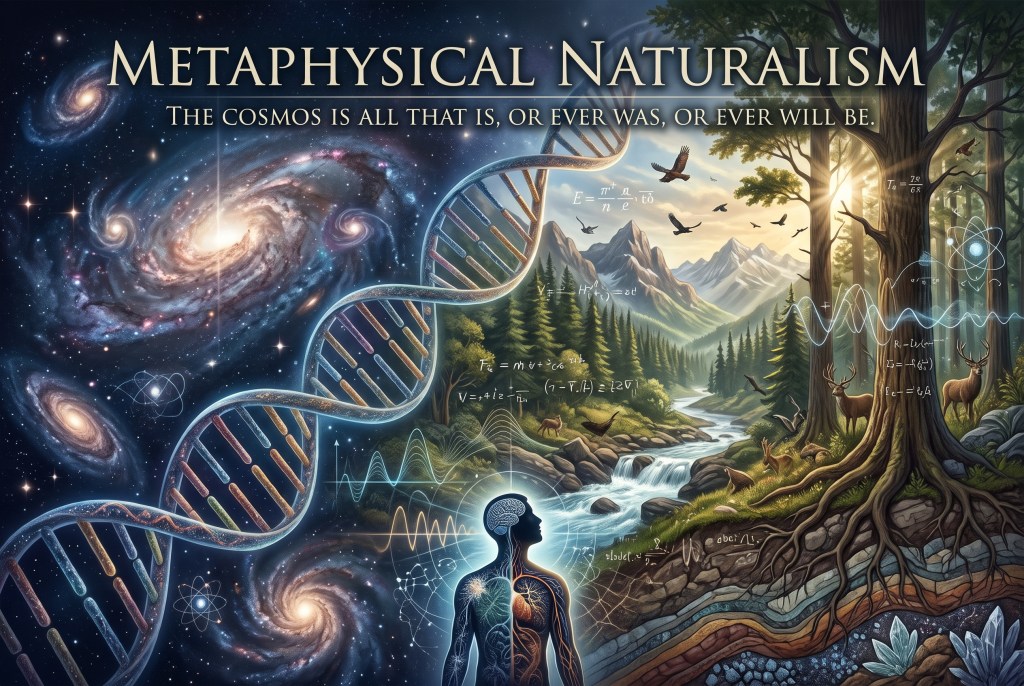
Surah al-Baqarah, the Qur’an’s longest chapter, describes those who benefit from its guidance. The first trait it names is not ritual or law. It is an epistemic posture: they “believe in the unseen” (yu’minūna bi’l-ghayb). thequran Zia H. Shah, chief editor of The Muslim Times, wrote a 2024 essay titled “‘Belief in the Unseen’ Versus Metaphysical Naturalism.” It argues that the clearest way to understand this verse is to look at its opposite. Modern atheism has precisely defined that opposite for itself, and it is called metaphysical naturalism. Shah quotes the geologist Steven Schafersman’s summary of the view. Nature is all that exists in space and time. It consists only of mass-energy. Information, ideas, values, logic, mathematics and intellect either supervene on the physical or reduce to it. The supernatural does not exist. Carl Sagan put it in one line: “The Cosmos is all that is or ever was or ever will be.” thequran
Two later essays by Shah, both titled “The Epistemic Horizon” (December 2025), develop the image this essay uses throughout. thequranthequran A horizon is the limit of what an observer can see from where they stand. It is not the edge of the world. Naturalism, in this picture, mistakes the horizon of human perception and instruments for the boundary of being. The believer accepts that the “seen” (al-shahāda) is the visible surface of a much larger “unseen” (al-ghayb). The second essay adds a diachronic point. What counts as “unseen” has kept expanding over time. In the seventh century it meant angels, jinn and the Hereafter. A twenty-first-century reader also thinks of microbes, radio waves, quantum fields and the dark sector of cosmology. thequran The theological unseen has not shrunk. What has grown is our sense of how little the visible covers.
Steelmanning naturalism. Fairness requires stating the opponent’s case at its strongest. The best naturalist argument is inductive and comes from the success of science. Again and again, phenomena once credited to spirits, vital forces or direct divine action turned out to have physical explanations: lightning, disease, heredity, planetary motion. Physics now describes a vast range of events with extraordinary precision. The “causal closure” principle holds that every physical event has a sufficient physical cause. It is supported by the fact that we have never measured a non-physical force acting on matter. Applying Ockham’s razor, the naturalist concludes that positing anything non-physical is unnecessary. This argument deserves respect. Its weakness is that it moves from a method to a metaphysic. Methodological naturalism says that science, as a discipline, looks for natural causes. Metaphysical naturalism says that natural causes are all there are. thequran The first is a rule for doing science well. The second is a philosophical claim that science cannot establish. The rest of this essay shows that it is also a poor fit with what science and reason actually reveal.
Why this is not a “god of the gaps” argument. The gaps objection says that theists put God wherever science has not yet reached, and that God retreats as science advances. The arguments below are different. They rest mainly on things we know. We know the universe is mostly unseen. We know the constants fall within narrow life-permitting ranges. We know mathematics describes nature with uncanny precision. We know entanglement violates local realism. We know we are conscious, that we reason, and that we grasp necessary truths. These are not holes in knowledge. They are positive findings, and naturalism has trouble absorbing them. Several are in-principle problems as well. A completed neuroscience of correlations would still not turn a third-person description into first-person experience. A completed physics would still not explain why there is any physics at all. As Part II argues, the gaps in this debate belong to the naturalist, whose explanations are often promissory notes: “science will one day explain it.”
Part I: The Scientific Refutation
1. The Dark Universe: 95% Unseen
The European Space Agency’s Planck satellite produced the most precise single-experiment measurement of the cosmic microwave background. aanda Its 2018 legacy results give a matter density parameter of Ω_m = 0.315 ± 0.007 and a dark-energy density parameter of Ω_Λ ≈ 0.685. Cold dark matter accounts for most of the matter (Ω_c h² = 0.120 ± 0.001), while baryonic matter is much smaller (Ω_b h² = 0.0224 ± 0.0001). harvardresearchgate Converted to percentages using Planck’s Hubble constant of H₀ = 67.4 ± 0.5 km/s/Mpc, this means about 4.9% ordinary matter, about 26–27% dark matter and about 68–69% dark energy. Everything we have ever seen, touched or been made of is roughly one-twentieth of the universe’s mass-energy. Dark matter emits, absorbs and reflects no light. We infer it from galaxy rotation curves, gravitational lensing and the growth of cosmic structure. Dark energy is detectable only through the accelerating expansion of space. thequran The Planck team’s dark-energy equation of state, w₀ = −1.03 ± 0.03, is consistent with Einstein’s cosmological constant, but nobody knows what it is. harvard
Shah’s December 2025 essays call this a “physical parable” of al-ghayb. The materialist who says “show me God” is in a similar position to a physicist who says “show me dark matter.” In both cases we do not see the thing itself. We see its effects: lensing and rotation speeds in one case, order, consciousness and revelation in the other. thequran The point is not that dark matter is the theological unseen. Shah’s own reading notes the difference between the classical exegetes’ spiritual unseen and the modern “cosmological” unseen. thequran The point is epistemic. Science has itself confirmed that “what can be seen” has never been the full inventory of reality. A worldview that equates the real with the observable has already been refuted by twentieth-century astronomy.
The naturalist will reply that dark matter is physical. It is simply physics not yet characterised, and the analogy therefore proves nothing about non-physical realities. This is fair as far as it goes. But it concedes the key point. The naturalist’s working category of “the physical” now includes things we cannot see, whose nature we do not know, and which we accept only by inference from effects. That is how the theist argues for God. Naturalism cannot treat inference from effects to unseen causes as rational in cosmology and as credulity in theology.
2. Fine-Tuning of Constants and Initial Conditions
Martin Rees’s Just Six Numbers (1999) showed that a handful of dimensionless quantities shape the universe. These include ε, the efficiency of nuclear fusion (≈0.007); N, the ratio of electrical to gravitational force (≈10³⁶); Ω; λ; Q, the amplitude of primordial ripples (≈10⁻⁵); and D, the number of spatial dimensions. Each must fall within a narrow window for stars, chemistry and observers to exist. Paul Davies’s The Goldilocks Enigma (2006) and Geraint Lewis and Luke Barnes’s A Fortunate Universe (Cambridge, 2016) review the evidence in detail. sciencemeetsreligion The most striking case is the cosmological constant. Barnes’s technical review in Publications of the Astronomical Society of Australia (2012) points out that quantum field theory predicts vacuum-energy contributions about 10¹²⁰ times larger than the observed value. He cites a standard textbook calling this “arguably the most severe theoretical problem in high-energy physics today.” arxiv Separate contributions somehow cancel to about 120 decimal places but not to the 121st. A slightly larger value would have pulled the universe apart before galaxies formed. A slightly negative one would have collapsed it. sciencemeetsreligion
The initial entropy of the universe is, if anything, more extreme. In The Emperor’s New Mind (1989), Roger Penrose estimated that the low-entropy initial state occupied about one part in 10^(10^123) of the relevant phase space. He reached this by comparing the actual early state with the Bekenstein–Hawking entropy of a universe collapsed into black holes. arxivphysicstogod Penrose’s own image is that a “Creator” would have had to aim with that precision. arxiv This was a vivid way to quantify the problem, not a theological commitment. The figure has been widely discussed in physics. Some note that the string “landscape” of perhaps 10⁵⁰⁰ vacua is negligible by comparison, so the multiverse does not explain it. arxiv
The dispute must be stated honestly. Victor Stenger argued in The Fallacy of Fine-Tuning (2011) that many parameters are tuned only to “10–20 percent.” Barnes replied in detail, and the technical consensus Barnes surveys supports the reality of fine-tuning for several parameters. arxiv Other critics, including McGrew, McGrew and Vestrup in “Probabilities and the Fine-Tuning Argument” (Mind, 2001), question whether probabilities over possible constants are even well-defined. arxiv These are serious objections. They challenge the probability calculus of the design inference more than the physics of fine-tuning.
The multiverse rescue and its cost. The leading naturalist answer combines a vast or infinite multiverse with the anthropic selection effect: we could only find ourselves in a life-permitting universe. mathscholar This has three costs.
- It is metaphysics, not observation. Other universes are, by construction, beyond our causal horizon. The naturalist who rejects God as “unobservable” now posits an unlimited number of unobservable worlds.
- It moves the tuning without removing it. Any universe-generating mechanism, such as eternal inflation plus a string landscape, needs finely specified laws of its own. It does not explain Penrose’s entropy problem either: a random fluctuation producing a single observer, a “Boltzmann brain,” is vastly more probable than one producing an ordered universe of 10⁸⁰ baryons.
- It threatens science itself. If anything that can happen does happen somewhere, it becomes hard to reason probabilistically about anything.
The theistic explanation, by contrast, posits one entity whose existence is independently supported by the other arguments here. Both views are inferences to the unseen. The real question is which unseen explains more with less.
3. The Beginning of the Universe: BGV, Kalām, and “Nothing”
Big Bang cosmology replaced the eternal, static universe of nineteenth-century materialism with a cosmos that has a finite past. The Borde–Guth–Vilenkin (BGV) theorem (Physical Review Letters 90, 151301, 2003) uses a purely kinematic argument that does not depend on a particular theory of gravity. It shows that any spacetime whose average expansion rate along a past-directed geodesic is positive is geodesically past-incomplete. arxivsemanticscholar Such a spacetime must have a past boundary, so inflation cannot be eternal into the past. Later work has extended similar arguments to some cyclic models. William H. Kinney of the University at Buffalo, in “Geodesic Completeness in General Cosmological Scenarios” (arXiv, April 2026), writes: “I show that the cyclic model proposed by Ijjas and Steinhardt is geodesically incomplete.”
Caution is required. The theorem shows that our classical description has a boundary. It does not by itself show that reality began from nothing. researchgate Some physicists explore quantum-gravity regimes, bounces or non-classical extensions that would get around its assumptions. arxivarxiv Pavlović and Sossich, for example, argue in the European Physical Journal C (2024) that “it is not possible to use the BGV theorem to conclude that physically realistic cyclic cosmologies are in general geodesically incomplete.” The honest claim is this. Our best physics points toward a finite past, and every attempt to avoid one carries its own speculative costs.
This bears directly on the Kalām cosmological argument. Al-Ghazali stated it in the Iqtiṣād fi’l-i’tiqād and the Tahāfut, and William Lane Craig revived it in modern form: (1) whatever begins to exist has a cause; (2) the universe began to exist; (3) therefore the universe has a cause. A cause of all of space, time, matter and energy cannot itself be spatial, temporal or material. Al-Ghazali’s main argument was philosophical, not empirical. An actually infinite series of past events cannot be traversed, so the world must have begun. That conclusion now has unexpected support from cosmology.
The naturalist sometimes answers that physics shows how a universe can come “from nothing.” Lawrence Krauss’s A Universe from Nothing (2012), with an afterword by Richard Dawkins, made this claim. uncommondescent The decisive critique came from a secular philosopher of physics, David Albert of Columbia University, in “On the Origin of Everything,” his New York Times Sunday Book Review essay of 23 March 2012. Albert noted that Krauss’s “nothing” is a state of relativistic quantum fields with no particles in it. That is no more “nothing” than an empty room is the absence of a room. The question of where the fields and laws come from is never addressed. On Krauss’s claim to have answered the theologians, Albert wrote that “Krauss is dead wrong and his religious and philosophical critics are absolutely right.” crossexamined The question of why there is something rather than nothing is not a physics question waiting for better data. Every physical answer presupposes something physical. thinkingtobelieve
4. The Unreasonable Effectiveness of Mathematics
In 1960 the Nobel physicist Eugene Wigner published “The Unreasonable Effectiveness of Mathematics in the Natural Sciences” (Communications on Pure and Applied Mathematics 13:1–14). He observed that the “enormous usefulness of mathematics in the natural sciences is something bordering on the mysterious.” He also said there is no rational explanation for it. He ended with a sentence that is now famous: “The miracle of the appropriateness of the language of mathematics for the formulation of the laws of physics is a wonderful gift which we neither understand nor deserve.” dartmouth Structures developed for purely aesthetic or internal reasons repeatedly turn out to govern nature. Examples include complex numbers, Riemannian geometry and group theory, which later turned out to fit quantum mechanics, general relativity and particle physics. Wigner also noted, almost in passing, that it is hard to believe our reasoning power was brought to such perfection by natural selection alone. njit That point anticipates Plantinga (Part II).
Mathematical objects are not physical. They have no location, mass or causal power, yet they are true necessarily and everywhere. Jim Holt, writing in the New York Times Book Review (January 2008) and quoted by Shah, reported that when he asked an audience of elite mathematicians at Berkeley how many were Platonists, “about three-quarters raised their hands.” On this view mathematicians are “no strangers to belief in the unseen.” A universe that is written in mathematics, to borrow Galileo’s phrase, and a mind able to read it, form a two-sided fit. For theism this fit is expected: the same Mind made the cosmos and the knower. For naturalism it is a lucky accident, twice over.
5. Quantum Mechanics: The Dissolution of Classical Matter
The “matter” of nineteenth-century materialism was hard, local and deterministic: billiard balls in a Laplacian clockwork. Quantum mechanics overturned every one of those properties.
- Non-locality. In 1964 John Bell showed that any local hidden-variable theory must satisfy certain statistical inequalities, and that quantum mechanics predicts their violation. The 2022 Nobel Prize in Physics went to Alain Aspect, John Clauser and Anton Zeilinger “for experiments with entangled photons, establishing the violation of Bell inequalities and pioneering quantum information science.” nobelprize Clauser’s 1972 experiment, Aspect’s 1982 two-channel tests and Zeilinger’s later loophole-closing and “cosmic Bell” experiments show that entangled particles “behave like a single unit even when they are separated,” in the words of the Nobel press release. nobelprize +2 Nature at its foundations is not a set of separate local bits.
- The measurement problem. The Schrödinger equation evolves superpositions smoothly and deterministically. Yet measurements yield single definite outcomes with Born-rule probabilities. Copenhagen, many-worlds, Bohmian mechanics, objective collapse and QBism each resolve this differently, and nearly a century on there is no consensus. Some, like Wigner himself at one stage, gave the observer’s consciousness a role. Most physicists today reject consciousness-caused collapse, and this essay does not rely on it. The relevant point is narrower. The most successful physical theory ever devised has no agreed account of what it is about.
- Indeterminacy. On most interpretations, individual quantum events are irreducibly probabilistic. Laplace imagined an intellect that could predict the whole future from the present state of the world. That dream is gone.
Shah’s site connects this to al-Ghazali’s occasionalism, for example in “Quantum Witnesses of Occasionalism” (December 2025) and “The Metaphysics of Divine Habit” (February 2026). thequranthequran The connection must be stated carefully. Quantum indeterminacy does not prove occasionalism, and Bohmian mechanics is a deterministic interpretation. But it removes the classical picture of a closed, self-sufficient clockwork that needed no ongoing sustainer. That picture made occasionalism seem absurd. In a world where single events are not fixed by prior physical states, the Ash’ari teaching of continuous creation (khalq jadīd) is at least as coherent with the physics as mechanism ever was. On that teaching, God re-creates the world’s accidents moment by moment according to a regular habit (‘āda, sunnat Allāh). thequran
6. The Origin of Life and the Information Problem
Living cells run on coded information. DNA’s four-letter sequences specify proteins through a translation system that depends on proteins it itself encodes. How such a system arose from chemistry is an open question. RNA-world, metabolism-first and hydrothermal-vent scenarios have made real progress on parts of the problem, such as nucleotide synthesis and self-replicating ribozymes. But no detailed, experimentally supported pathway from prebiotic chemistry to a self-replicating, coded, membrane-bound cell exists.
Antony Flew was for decades the most prominent philosophical atheist in the English-speaking world. He announced in 2004 that he had come to accept a deistic God. alor He said DNA research “has shown, by the almost unbelievable complexity of the arrangements which are needed to produce life, that intelligence must have been involved.” christianpost His 2007 book There Is a God (with Roy Abraham Varghese) gave three reasons: the laws of nature, life’s teleological organisation and the existence of the universe. alor Caveats: Flew’s God was Aristotelian and non-revealing, and Mark Oppenheimer, writing in the New York Times Magazine (2007), questioned how much of the book Flew wrote himself. Wikipediaalor Stephen Meyer’s Signature in the Cell (2009) develops the “specified information” argument at length. Mainstream origin-of-life researchers dispute it strongly, and it should be treated as a contested inference, not settled science. Similarly, the Cambrian explosion is a genuine and active research problem: the fairly rapid appearance of most animal body plans. The Cambrian begins 538.8 ± 0.6 million years ago on the International Commission on Stratigraphy’s chart, marked by the first appearance of the trace fossil Treptichnus pedum. Evolutionary biologists offer developmental, ecological and genetic explanations. It is cited here as an open question, not as proof of design.
The more modest and more defensible claim is philosophical. Even a complete chemical account of abiogenesis would show how information-bearing systems arise under laws suited to produce them. That brings us back to fine-tuning and the intelligibility of law. Mirza Tahir Ahmad’s Revelation, Rationality, Knowledge and Truth (1998) accepts the evidence for evolution, but argues that its course is more like a “game of chess” than a “game of chance.” Wikipedia Even a guided evolutionary process is a story within a created order, not an alternative to one.
7. Consciousness: The Hard Problem
Thomas Nagel’s 1974 paper “What Is It Like to Be a Bat?” set the terms of the debate. An organism is conscious if there is something it is like to be that organism. Objective, third-person physical descriptions leave out exactly that subjective character. Joseph Levine (1983), himself a materialist, named the “explanatory gap.” sciencedirect Even if pain is identical to C-fibre firing, nothing in the physical description makes it intelligible why that firing should feel like anything. David Chalmers (“Facing Up to the Problem of Consciousness,” 1995) separated the “easy problems” of explaining cognitive functions from the hard problem: “The really hard problem of consciousness is the problem of experience.” Accounts of function stay on one side of the gap. consc Frank Jackson’s “Mary’s Room” (1982) sharpens the point. A neuroscientist who knows every physical fact about colour vision, but has lived in a black-and-white room, seems to learn something new when she first sees red. If so, not all facts are physical facts.
Neuroscience has mapped detailed correlations between brain states and experiences. Correlation is not identity, and it is certainly not explanation. Naturalism’s own leading theorists are now moving away from strict physicalism. Integrated Information Theory (Tononi, Koch) treats consciousness as a basic property of certain information structures. Panpsychism (Goff, and in some moods Chalmers) puts proto-experience into matter itself. Illusionism (Frankish, the late Dennett) denies phenomenal consciousness altogether. Shah’s October 2026 essays, “The Illusion of Illusion” and “When the Witness Denies Himself,” argue that illusionism defeats itself, because an illusion is itself an experience. thequran Each option is telling. If the most rigorous naturalists must either deny the obvious or make mind fundamental to nature, physicalism as traditionally understood has given up its central claim.
Nagel’s Mind and Cosmos (Oxford University Press, 2012) draws the conclusion openly. Its subtitle reads: “Why the Materialist Neo-Darwinian Conception of Nature Is Almost Certainly False.” Nagel, an atheist, argues that if materialism cannot accommodate consciousness, intentionality, meaning and value, it must be abandoned “not just around the edges.” ouparchive Critics such as John Dupré in Notre Dame Philosophical Reviews argued that the subtitle overstated his case. ndWikipedia The critique still shows that dissatisfaction with physicalism is not just religious special pleading.
8. Science’s Self-Discovered Limits
Twentieth-century science and mathematics proved theorems about their own limits:
- Gödel’s incompleteness theorems (1931). Any consistent formal system strong enough for arithmetic contains true statements it cannot prove, and cannot prove its own consistency. Mathematical truth goes beyond formal provability. (Gödel himself was a Platonist and a theist.)
- Heisenberg’s uncertainty principle. Conjugate quantities such as position and momentum cannot both be sharply defined. This is a feature of nature, not a flaw in instruments.
- Chaos and computational irreducibility. In non-linear systems, tiny differences in initial conditions grow exponentially. For many systems, as Stephen Wolfram stressed, there is no shortcut to the outcome except running the process itself.
- Cosmic horizons. Light from regions beyond our particle horizon has never reached us. In an accelerating universe, some regions never will.
None of these limits proves God. Together they disprove the background assumption that makes naturalism seem plausible: that reality is in principle completely transparent to the methods of physics. Science has drawn its own epistemic horizon.
Part II: The Philosophical Refutation
1. What Is “Physical”? Hempel’s Dilemma
Naturalism must say what “physical” means. Carl Hempel posed the classic dilemma, as set out in the Stanford Encyclopedia of Philosophy. If physicalism is defined by current physics, it is false, “who thinks that contemporary physics is complete?” If it is defined by a future or ideal physics, it is trivial: “who can predict what a future physics contains? Perhaps, for example, it contains even mental items.” stanfordstanford Philosophers have proposed answers, including the via negativa (the physical is whatever is not fundamentally mental) and family-resemblance accounts. stanfordstanford The via negativa in effect rules out minds by definition, which begs the question. The family-resemblance account makes physicalism vague enough to absorb almost anything. Either way, the bold thesis that “there is nothing beyond what physics describes” turns out to be either refuted or empty.
2. Naturalism Defeats Itself: The Argument from Reason and the EAAN
C. S. Lewis argued in Miracles (1947, revised 1960) that if our thoughts are entirely the products of non-rational causes, we have no reason to trust them, including the thought that naturalism is true. Victor Reppert developed this in C. S. Lewis’s Dangerous Idea (2003). Alvin Plantinga formalised it as the Evolutionary Argument Against Naturalism (Warrant and Proper Function, 1993; Where the Conflict Really Lies, 2011, pp. 344–345): Wikipedia
- P(R | N & E) is low, where R means our cognitive faculties are reliable, N is naturalism and E is unguided evolution. springer
- Anyone who accepts N & E and sees that (1) is true has a defeater for R. springer
- A defeater for R is a defeater for every belief one’s faculties produce, including N & E. springer
- So N & E defeats itself and cannot rationally be accepted. springer
The key idea is that natural selection acts on behaviour, not on the truth of beliefs. SubstackWikipedia Under naturalism, belief content is either causally idle (epiphenomenal) or fitness-neutral. Either way, nothing guarantees that adaptive neurophysiology produces true content. Plantinga accepts evolution. His target is the combination of evolution with the claim that nothing guided it. cangodexist
Objections. Critics argue that true beliefs are generally more adaptive, so P(R | N & E) is high. Others argue that R has enough intrinsic warrant to resist defeat (the “maximal warrant” objection), or that the probability is merely inscrutable and so does not defeat. academia +2 Plantinga’s replies are stronger than often assumed. Where truth is adaptive, it is so only for perceptual beliefs about medium-sized objects. Our confidence in abstract metaphysics, mathematics and theories about the origins of reason itself goes far beyond anything selection would reward. The theist has a ready explanation for R: we are made “in the image of God,” or in Qur’anic terms we were taught “what [man] knew not” (96:5). The naturalist must treat R as a lucky by-product.
3. Intentionality and the Normativity of Logic
Franz Brentano called intentionality, the aboutness of thought, the mark of the mental. My thought is about Damascus, or about a prime number, or about something that does not exist, like Pegasus. Physical states have causes and effects, but there is no physical relation of “aboutness.” A pattern of neural firing is no more about Damascus than a rock is. Naturalistic theories of content (causal, teleosemantic, informational) have struggled with misrepresentation and with indeterminacy, the problem of whether a frog’s fly-detector represents “fly,” “small dark moving thing” or “food.” Nagel lists intentionality alongside consciousness and value as the central things materialism fails to explain. google
Logic poses a related problem. The laws of non-contradiction and modus ponens are not descriptions of how brains happen to behave, since brains often reason badly. They are norms for how we ought to reason, and they hold necessarily. The naturalist uses these norms in every argument for naturalism, but cannot say what in a world of particles and fields could make them binding.
4. Abstract Objects and the Indispensability Argument
Quine and Putnam’s indispensability argument runs as follows. We should be committed to the entities that are indispensable to our best scientific theories. Mathematical entities (numbers, functions, sets) are indispensable. So we should believe in mathematical entities. Notice the irony. This argument comes from the most naturalistic of philosophers, using naturalism’s own criterion, and it delivers non-physical, abstract, necessary objects. Naturalists who accept it have given up physicalism. Those who reject it (Hartry Field’s fictionalism) must reconstruct physics without numbers, a project widely judged not to have succeeded. Propositions, the bearers of truth, and universals face similar problems. The Qur’anic distinction between al-ghayb and al-shahāda already allows for real things that cannot be perceived. Naturalism must either deny them or quietly redefine “physical.”
5. Objective Morality
Most people, naturalists included, hold that some things really are wrong: torturing children for fun, genocide, slavery. They hold this regardless of what any society believes. Hume observed that no “ought” follows from an “is” alone. G. E. Moore’s open-question argument showed that for any natural property N, “Is N good?” remains an open question. That suggests goodness is not identical to any natural property. Naturalism can describe why humans evolved moral emotions. Evolutionary debunking arguments, made with particular force by Sharon Street, then suggest that such emotions track fitness, not moral truth. The naturalist faces a dilemma. Either moral realism is false, and the abolition of slavery was progress only in the sense of a change in taste. Or there are objective moral facts that naturalism cannot account for. Nagel himself, in Mind and Cosmos and The View from Nowhere, defends the reality of value as irreducible. Theism grounds moral facts in the nature and command of a perfectly good God. It also grounds accountability for them in a final reckoning, which Part III takes up.
6. Contingency, Sufficient Reason, and the Necessary Existent
The strongest argument against naturalism may be the oldest. Everything physical is contingent: it could have failed to exist, and its existence calls for explanation. Ibn Sina (Avicenna, d. 1037) gave this its classic form, the Burhān al-Ṣiddīqīn (“Proof of the Truthful”), set out in al-Shifā’, al-Najāt and al-Ishārāt wa’l-Tanbīhāt. WikipediaWikipedia Every existent is either necessary in itself (wājib al-wujūd bi-dhātihi) or possible in itself (mumkin al-wujūd). A possible existent that actually exists is “necessary through another.” The whole collection of possible existents, even an infinite one, is still possible and still needs a cause outside itself. phalsafapathofmystics So there is a Necessary Existent, one, simple and uncaused. Wikipediawikishia Ibn Sina called it the proof “of the truthful” because it moves from existence itself to God, without depending on any particular creature. Wikipediawikishia One of its strengths is that it works even if the world is eternal. A beginningless universe or an infinite causal chain would still need a necessary ground. askphilosophy
Leibniz rebuilt the same argument on the Principle of Sufficient Reason. Mulla Sadra and later Tabataba’i refined it in Islamic philosophy. wikishia
The naturalist has two main responses. The first is to make the universe itself the necessary being. But the universe is a collection of parts, has a contingent history and, on current evidence, a finite past. Ibn Sina argued that what is necessary in itself cannot be composite. askphilosophy The second response, associated with Bertrand Russell, is to say that the universe is “just a brute fact.” That gives up on explanation exactly where it is most needed. It also makes it hard to see why science’s demand for explanation should be trusted anywhere else.
7. Al-Ghazali, Causation, and the Uniformity of Nature
In the Seventeenth Discussion of the Tahāfut al-Falāsifa (The Incoherence of the Philosophers, trans. Michael Marmura), al-Ghazali wrote: “The connection between what is habitually believed to be a cause and what is habitually believed to be an effect is not necessary, according to us.” archive +3 When cotton burns on contact with fire, observation shows burning with the fire, not burning by the fire. The two events are joined by God’s prior decree. utm +2 Seven centuries later David Hume reached a similar conclusion: we observe “constant conjunction,” never necessary connection. The parallel is often drawn, though scholars rightly note differences. Hume’s view rested on his empiricist theory of meaning, whereas al-Ghazali’s was a theological claim about divine power. Substack Scholars such as Marmura and Frank Griffel also show that the Seventeenth Discussion presents more than one causal theory. One version allows God-dependent secondary causes. thequran Ibn Rushd (Averroes), in the Tahāfut al-Tahāfut, objected that denying causal natures undermines science. thequran
The modern lesson concerns induction. Every scientific inference assumes that nature is uniform, that the future will resemble the past. As Hume showed, this cannot be justified without circular reasoning: “induction has worked before, so it will work again” is itself an inductive argument. The naturalist must take uniformity as a brute, unexplained given. The theist has a ground for it. The Qur’an says nature runs on a divine custom that does not change: “you will never find in the way (sunna) of Allah any change” (33:62, 35:43, 48:23). Al-Ghazali’s occasionalism thus explains why science works. The regularities are real because God is faithful to His habit, and they are contingent because they flow from will, not from blind necessity. thequranthequran This is why the philosopher Michael B. Foster, in “The Christian Doctrine of Creation and the Rise of Modern Natural Science” (Mind, 1934), argued that a doctrine of creation encouraged empirical investigation, a thesis later supported by R. Hooykaas. If nature’s laws could not be deduced a priori, they had to be discovered by looking.
8. Free Will, the Self, and the First-Person Perspective
Naturalism faces a dilemma about libertarian free will. If physical determinism holds, every choice was fixed before we were born. If quantum indeterminism holds, our “choices” are random, which is not freedom either. Compatibilists redefine freedom so that it fits with determinism. They can do so only by giving up the ordinary sense that we could have done otherwise and are the source of our acts. Libertarian philosophers offer better accounts. Robert Kane (The Significance of Free Will, 1996) places freedom in “self-forming actions,” in which indeterminism within neural processes allows the agent to be the ultimate author of their character. Timothy O’Connor (Persons and Causes, 2000) defends agent causation: persons, as substances, directly cause their choices. That is a kind of causation physicalism does not allow for.
Personal identity raises a similar problem. In the unity of consciousness, a single subject experiences sight, sound and thought together. Physically, though, the brain is a scattered collection of processes with no central point where they all meet (the “binding problem”). The first-person perspective, “I,” cannot be translated into third-person physical description without losing what makes it first-person. The believer can say what the naturalist cannot: there is a self, a subject of experience and author of acts, and it is not merely a pattern in matter. The Qur’anic picture of a responsible agent, the nafs who “will be shown its deeds,” presupposes such a self.
9. Scientism Refutes Itself
The popular case for naturalism often relies on scientism, the claim that only science yields knowledge. That claim is not itself a scientific finding. No experiment could establish it, and no peer-reviewed paper reports it. It is a philosophical claim. If true, it would be unknowable, and so it undermines itself. This is the same fate that befell logical positivism’s verification principle. Shah’s 2025 commentary links the opening letters of Surah al-Baqarah, Alif Lām Mīm, to this point. The first word of the longest surah is a meaning held back from the reader. It is a reminder at the start of revelation that human understanding is not the measure of what is real. thequran
10. The Argument from Epistemic Humility
Finally, the history of science supports an inductive argument against naturalism’s claim to completeness. Every age’s “complete” physics has been overturned: phlogiston, caloric, the luminiferous ether, Newtonian absolute space and time, the static eternal universe, and the assumption that luminous matter is the universe. Shortly before relativity and quantum theory, Lord Kelvin is often (perhaps apocryphally) credited with saying that physics was nearly finished. Given this record, the assertion that “there is nothing beyond what physics describes” is the riskiest bet in the history of thought. It assumes that the twenty-first century, alone among all centuries, has reached the final shape of reality. Shah’s “epistemic horizon” image captures this exactly. The horizon is a limit of the observer, not a limit of existence. thequran The Qur’anic counsel is humility: “you have been given but little knowledge” (17:85). quran
Part III: The Islamic Theological Refutation
Arabic texts below follow the standard Uthmani text as presented on quran.com. English renderings are primarily Sahih International (SI), with Muhammad Asad’s rendering noted where it adds to the meaning.
1. Al-Ghayb: The First Mark of the God-Conscious
Qur’an 2:2–3 ذَٰلِكَ ٱلْكِتَـٰبُ لَا رَيْبَ ۛ فِيهِ ۛ هُدًۭى لِّلْمُتَّقِينَ ﴿٢﴾ ٱلَّذِينَ يُؤْمِنُونَ بِٱلْغَيْبِ وَيُقِيمُونَ ٱلصَّلَوٰةَ وَمِمَّا رَزَقْنَـٰهُمْ يُنفِقُونَ ﴿٣﴾ “This is the Book about which there is no doubt, a guidance for those conscious of Allah – who believe in the unseen, establish prayer, and spend out of what We have provided for them.” (SI)
Belief in the unseen comes first, before prayer and charity. Shah’s 2025 commentary on 2:2–3 draws on Sayyid Abul A’la Maududi, who wrote that “only such a person who believes in the ‘unseen’ can benefit from the guidance of the Qur’an.” By contrast, one “who believes only in those things which can be seen, tasted, smelled, or measured and weighed” cannot. It also draws on Muhammad Asad, who said the Qur’an will “remain a closed book to all whose minds cannot accept” that ultimate reality extends beyond the observable. Classical exegetes enriched the category. Fakhr al-Din al-Razi, whose tafsīr is titled Mafātīḥ al-Ghayb (“Keys of the Unseen”), distinguished the absolute unseen (ghayb muṭlaq), such as God’s essence and the timing of the Hour, from the relative unseen (ghayb nisbī). The relative unseen is what is hidden from some people but not others, or hidden now but knowable later. Al-Tabari tied belief in the unseen to trust in the Messenger. Ibn Kathir tied it to taqwā: the believer prays in private because they sense the unseen Gaze.
This distinction does important work. The relative unseen is where science operates: microbes before microscopes, dark matter before Zwicky and Rubin. Its constant growth confirms the Qur’anic stance. The absolute unseen marks the limit that no instrument will ever cross:
Qur’an 6:59 وَعِندَهُۥ مَفَاتِحُ ٱلْغَيْبِ لَا يَعْلَمُهَآ إِلَّا هُوَ ۚ وَيَعْلَمُ مَا فِى ٱلْبَرِّ وَٱلْبَحْرِ ۚ وَمَا تَسْقُطُ مِن وَرَقَةٍ إِلَّا يَعْلَمُهَا وَلَا حَبَّةٍۢ فِى ظُلُمَـٰتِ ٱلْأَرْضِ وَلَا رَطْبٍۢ وَلَا يَابِسٍ إِلَّا فِى كِتَـٰبٍۢ مُّبِينٍۢ “And with Him are the keys of the unseen; none knows them except Him. And He knows what is on the land and in the sea. Not a leaf falls but that He knows it. And no grain is there within the darknesses of the earth and no moist or dry [thing] but that it is [written] in a clear record.” (SI)
Qur’an 31:34 إِنَّ ٱللَّهَ عِندَهُۥ عِلْمُ ٱلسَّاعَةِ وَيُنَزِّلُ ٱلْغَيْثَ وَيَعْلَمُ مَا فِى ٱلْأَرْحَامِ ۖ وَمَا تَدْرِى نَفْسٌۭ مَّاذَا تَكْسِبُ غَدًۭا ۖ وَمَا تَدْرِى نَفْسٌۢ بِأَىِّ أَرْضٍۢ تَمُوتُ ۚ إِنَّ ٱللَّهَ عَلِيمٌ خَبِيرٌۢ “Indeed, Allah [alone] has knowledge of the Hour and sends down the rain and knows what is in the wombs. And no soul perceives what it will earn tomorrow, and no soul perceives in what land it will die. Indeed, Allah is Knowing and Acquainted.” (SI)
Qur’an 72:26–27 عَـٰلِمُ ٱلْغَيْبِ فَلَا يُظْهِرُ عَلَىٰ غَيْبِهِۦٓ أَحَدًا ﴿٢٦﴾ إِلَّا مَنِ ٱرْتَضَىٰ مِن رَّسُولٍۢ فَإِنَّهُۥ يَسْلُكُ مِنۢ بَيْنِ يَدَيْهِ وَمِنْ خَلْفِهِۦ رَصَدًۭا ﴿٢٧﴾ “[He is] Knower of the unseen, and He does not disclose His [knowledge of the] unseen to anyone – except whom He has approved of messengers, and indeed, He sends before each messenger and behind him observers.” (SI)
Qur’an 59:22 هُوَ ٱللَّهُ ٱلَّذِى لَآ إِلَـٰهَ إِلَّا هُوَ ۖ عَـٰلِمُ ٱلْغَيْبِ وَٱلشَّهَـٰدَةِ ۖ هُوَ ٱلرَّحْمَـٰنُ ٱلرَّحِيمُ “He is Allah, other than whom there is no deity, Knower of the unseen and the witnessed. He is the Entirely Merciful, the Especially Merciful.” (SI)
Verse 72:27 gives the third route to knowledge. Where senses and reason stop at the horizon, revelation (waḥy) can bring news from beyond it. Naturalism rules this route out in advance, without argument. The Qur’an presents it as rational trust in a truthful Messenger, which is how al-Tabari understood belief in the unseen.
2. The “Sealed Heart” and the Category Error of “Show Me God”
Shah’s exegesis of 2:7, “Allah has set a seal upon their hearts and upon their hearing”, reads the “seal” partly as cognitive closure. A mind that has tuned itself only to the “FM frequency” of matter cannot pick up the “AM signal” of revelation. That is not a lack of intelligence. It is looking for metaphysical truth with tools that are, by their nature, physical. The Qur’an records the same demand in history:
Qur’an 2:55 وَإِذْ قُلْتُمْ يَـٰمُوسَىٰ لَن نُّؤْمِنَ لَكَ حَتَّىٰ نَرَى ٱللَّهَ جَهْرَةًۭ فَأَخَذَتْكُمُ ٱلصَّـٰعِقَةُ وَأَنتُمْ تَنظُرُونَ “And [recall] when you said, ‘O Moses, we will never believe you until we see Allah outright’; so the thunderbolt took you while you were looking on.” (SI)
Similar demands appear in 4:153 and 25:21. In each case the Qur’an treats “seeing God outright” as a confused demand, not a reasonable test, because of what God is:
Qur’an 6:103 لَّا تُدْرِكُهُ ٱلْأَبْصَـٰرُ وَهُوَ يُدْرِكُ ٱلْأَبْصَـٰرَ ۖ وَهُوَ ٱللَّطِيفُ ٱلْخَبِيرُ “Vision perceives Him not, but He perceives [all] vision; and He is the Subtle, the Acquainted.” (SI)
Qur’an 42:11 فَاطِرُ ٱلسَّمَـٰوَٰتِ وَٱلْأَرْضِ ۚ جَعَلَ لَكُم مِّنْ أَنفُسِكُمْ أَزْوَٰجًۭا وَمِنَ ٱلْأَنْعَـٰمِ أَزْوَٰجًۭا ۖ يَذْرَؤُكُمْ فِيهِ ۚ لَيْسَ كَمِثْلِهِۦ شَىْءٌۭ ۖ وَهُوَ ٱلسَّمِيعُ ٱلْبَصِيرُ “[He is] Creator of the heavens and the earth. He has made for you from yourselves, mates, and among the cattle, mates; He multiplies you thereby. There is nothing like unto Him, and He is the Hearing, the Seeing.” (SI)
Qur’an 112:1–4 قُلْ هُوَ ٱللَّهُ أَحَدٌ ﴿١﴾ ٱللَّهُ ٱلصَّمَدُ ﴿٢﴾ لَمْ يَلِدْ وَلَمْ يُولَدْ ﴿٣﴾ وَلَمْ يَكُن لَّهُۥ كُفُوًا أَحَدٌۢ ﴿٤﴾ “Say, ‘He is Allah, [who is] One, Allah, the Eternal Refuge. He neither begets nor is born, nor is there to Him any equivalent.’” (SI)
This is the theological heart of the matter. A God who could be detected by a telescope or a particle detector would be one more object within the universe, “like” other things, and so not God. Physicalism’s method can in principle find only physical objects. Its failure to find God is therefore not evidence against God. It is what one would expect if 42:11 is true. Demanding a laboratory detection of the Creator is like trying to smell the colour blue.
3. The Universe as Signs: The Two Books
The Qur’an does not ask for belief instead of looking. It commands looking, again and again:
Qur’an 3:190–191 إِنَّ فِى خَلْقِ ٱلسَّمَـٰوَٰتِ وَٱلْأَرْضِ وَٱخْتِلَـٰفِ ٱلَّيْلِ وَٱلنَّهَارِ لَـَٔايَـٰتٍۢ لِّأُو۟لِى ٱلْأَلْبَـٰبِ ﴿١٩٠﴾ ٱلَّذِينَ يَذْكُرُونَ ٱللَّهَ قِيَـٰمًۭا وَقُعُودًۭا وَعَلَىٰ جُنُوبِهِمْ وَيَتَفَكَّرُونَ فِى خَلْقِ ٱلسَّمَـٰوَٰتِ وَٱلْأَرْضِ رَبَّنَا مَا خَلَقْتَ هَـٰذَا بَـٰطِلًۭا سُبْحَـٰنَكَ فَقِنَا عَذَابَ ٱلنَّارِ ﴿١٩١﴾ “Indeed, in the creation of the heavens and the earth and the alternation of the night and the day are signs for those of understanding. Who remember Allah while standing or sitting or [lying] on their sides and give thought to the creation of the heavens and the earth, [saying], ‘Our Lord, You did not create this aimlessly; exalted are You [above such a thing]; then protect us from the punishment of the Fire.’” (SI)
Qur’an 2:164 إِنَّ فِى خَلْقِ ٱلسَّمَـٰوَٰتِ وَٱلْأَرْضِ وَٱخْتِلَـٰفِ ٱلَّيْلِ وَٱلنَّهَارِ وَٱلْفُلْكِ ٱلَّتِى تَجْرِى فِى ٱلْبَحْرِ بِمَا يَنفَعُ ٱلنَّاسَ وَمَآ أَنزَلَ ٱللَّهُ مِنَ ٱلسَّمَآءِ مِن مَّآءٍۢ فَأَحْيَا بِهِ ٱلْأَرْضَ بَعْدَ مَوْتِهَا وَبَثَّ فِيهَا مِن كُلِّ دَآبَّةٍۢ وَتَصْرِيفِ ٱلرِّيَـٰحِ وَٱلسَّحَابِ ٱلْمُسَخَّرِ بَيْنَ ٱلسَّمَآءِ وَٱلْأَرْضِ لَـَٔايَـٰتٍۢ لِّقَوْمٍۢ يَعْقِلُونَ “Indeed, in the creation of the heavens and the earth, and the alternation of the night and the day, and the [great] ships which sail through the sea with that which benefits people, and what Allah has sent down from the heavens of rain, giving life thereby to the earth after its lifelessness and dispersing therein every [kind of] moving creature, and [His] directing of the winds and the clouds controlled between the heaven and the earth are signs for a people who use reason.” (SI)
Qur’an 10:101 قُلِ ٱنظُرُوا۟ مَاذَا فِى ٱلسَّمَـٰوَٰتِ وَٱلْأَرْضِ ۚ وَمَا تُغْنِى ٱلْءَايَـٰتُ وَٱلنُّذُرُ عَن قَوْمٍۢ لَّا يُؤْمِنُونَ “Say, ‘Observe what is in the heavens and earth.’ But of no avail will be signs or warners to a people who do not believe.” (SI)
Qur’an 67:3–4 ٱلَّذِى خَلَقَ سَبْعَ سَمَـٰوَٰتٍۢ طِبَاقًۭا ۖ مَّا تَرَىٰ فِى خَلْقِ ٱلرَّحْمَـٰنِ مِن تَفَـٰوُتٍۢ ۖ فَٱرْجِعِ ٱلْبَصَرَ هَلْ تَرَىٰ مِن فُطُورٍۢ ﴿٣﴾ ثُمَّ ٱرْجِعِ ٱلْبَصَرَ كَرَّتَيْنِ يَنقَلِبْ إِلَيْكَ ٱلْبَصَرُ خَاسِئًۭا وَهُوَ حَسِيرٌۭ ﴿٤﴾ “[And] who created seven heavens in layers. You do not see in the creation of the Most Merciful any inconsistency. So return [your] vision [to the sky]; do you see any breaks? Then return [your] vision twice again. [Your] vision will return to you humbled while it is fatigued.” (SI)
The same word, āya, means both a “verse” of scripture and a “sign” in nature. This is the root of the “two books” idea. God speaks both in revelation and in creation, and the two cannot truly conflict. Verse 67:3–4 is in effect an invitation to look for flaws (tafāwut, fuṭūr) in the order of nature, a kind of falsification test. It predicts that the searcher will come back “humbled.” Fine-tuning and the unreasonable effectiveness of mathematics (Part I) fit this prediction remarkably well. Ibn Rushd argued in the Faṣl al-Maqāl that the Qur’an makes philosophical and scientific study of creation obligatory for those able to do it, since knowing the craft leads to knowing the Craftsman. Ibn al-Haytham (d. c. 1040), whose Kitāb al-Manāẓir helped found experimental optics, al-Biruni and Ibn Sina pursued science as a reading of the signs. They did not see it as a replacement for the One who wrote them.
The Qur’an also contains cosmological statements that modern readers have connected with Big Bang cosmology and cosmic expansion:
Qur’an 21:30 أَوَلَمْ يَرَ ٱلَّذِينَ كَفَرُوٓا۟ أَنَّ ٱلسَّمَـٰوَٰتِ وَٱلْأَرْضَ كَانَتَا رَتْقًۭا فَفَتَقْنَـٰهُمَا ۖ وَجَعَلْنَا مِنَ ٱلْمَآءِ كُلَّ شَىْءٍ حَىٍّ ۖ أَفَلَا يُؤْمِنُونَ “Have those who disbelieved not considered that the heavens and the earth were a joined entity, and We separated them and made from water every living thing? Then will they not believe?” (SI)
Qur’an 51:47 وَٱلسَّمَآءَ بَنَيْنَـٰهَا بِأَيْي۟دٍۢ وَإِنَّا لَمُوسِعُونَ “And the heaven We constructed with strength, and indeed, We are [its] expander.” (SI). Asad: “And it is We who have built the universe with [Our creative] power; and, verily, it is We who are steadily expanding it.”
Mirza Tahir Ahmad’s Revelation, Rationality, Knowledge and Truth and Shah’s site develop these correspondences. Shah’s 2025 essay also links the “smoke” (dukhān) of 41:11 to the opaque plasma of the universe before recombination. Scholarly caution is needed. Nidhal Guessoum (Islam’s Quantum Question, 2011) has warned against a naive “scientific miracles” (i’jāz ‘ilmī) approach that reads modern theories back into the text and makes scripture hostage to theories that may change. The safer claim, and the one this essay relies on, is that the Qur’an’s orientation toward a created, ordered, intelligible and expanding cosmos fits modern cosmology far better than the eternal, static universe of nineteenth-century materialism did.
4. Signs in the Horizons and in the Self
Qur’an 41:53 سَنُرِيهِمْ ءَايَـٰتِنَا فِى ٱلْـَٔافَاقِ وَفِىٓ أَنفُسِهِمْ حَتَّىٰ يَتَبَيَّنَ لَهُمْ أَنَّهُ ٱلْحَقُّ ۗ أَوَلَمْ يَكْفِ بِرَبِّكَ أَنَّهُۥ عَلَىٰ كُلِّ شَىْءٍۢ شَهِيدٌ “We will show them Our signs in the horizons and within themselves until it becomes clear to them that it is the truth. But is it not sufficient concerning your Lord that He is, over all things, a Witness?” (SI)
This verse matches the two halves of Part I. The āfāq (horizons) are cosmology, fine-tuning and the dark universe. The anfus (selves) are consciousness, reason, moral awareness and freedom. Note the future tense, sanurīhim, “We will show them.” The verse expects the diachronic growth of evidence that Shah’s second “Epistemic Horizon” essay describes: each age sees more of the signs than the one before.
Qur’an 30:8 أَوَلَمْ يَتَفَكَّرُوا۟ فِىٓ أَنفُسِهِم ۗ مَّا خَلَقَ ٱللَّهُ ٱلسَّمَـٰوَٰتِ وَٱلْأَرْضَ وَمَا بَيْنَهُمَآ إِلَّا بِٱلْحَقِّ وَأَجَلٍۢ مُّسَمًّۭى ۗ وَإِنَّ كَثِيرًۭا مِّنَ ٱلنَّاسِ بِلِقَآئِ رَبِّهِمْ لَكَـٰفِرُونَ “Do they not contemplate within themselves? Allah has not created the heavens and the earth and what is between them except in truth and for a specified term. And indeed, many of the people, in [the matter of] the meeting with their Lord, are disbelievers.” (SI)
The phrase “for a specified term” (ajal musammā) fits a cosmos with a beginning and an end, which is exactly what BGV-type results and the thermodynamic arrow of time suggest.
5. Abraham’s Reasoning: From the Setting Stars to the Necessary Existent
Qur’an 6:75–79 وَكَذَٰلِكَ نُرِىٓ إِبْرَٰهِيمَ مَلَكُوتَ ٱلسَّمَـٰوَٰتِ وَٱلْأَرْضِ وَلِيَكُونَ مِنَ ٱلْمُوقِنِينَ ﴿٧٥﴾ فَلَمَّا جَنَّ عَلَيْهِ ٱلَّيْلُ رَءَا كَوْكَبًۭا ۖ قَالَ هَـٰذَا رَبِّى ۖ فَلَمَّآ أَفَلَ قَالَ لَآ أُحِبُّ ٱلْـَٔافِلِينَ ﴿٧٦﴾ فَلَمَّا رَءَا ٱلْقَمَرَ بَازِغًۭا قَالَ هَـٰذَا رَبِّى ۖ فَلَمَّآ أَفَلَ قَالَ لَئِن لَّمْ يَهْدِنِى رَبِّى لَأَكُونَنَّ مِنَ ٱلْقَوْمِ ٱلضَّآلِّينَ ﴿٧٧﴾ فَلَمَّا رَءَا ٱلشَّمْسَ بَازِغَةًۭ قَالَ هَـٰذَا رَبِّى هَـٰذَآ أَكْبَرُ ۖ فَلَمَّآ أَفَلَتْ قَالَ يَـٰقَوْمِ إِنِّى بَرِىٓءٌۭ مِّمَّا تُشْرِكُونَ ﴿٧٨﴾ إِنِّى وَجَّهْتُ وَجْهِىَ لِلَّذِى فَطَرَ ٱلسَّمَـٰوَٰتِ وَٱلْأَرْضَ حَنِيفًۭا ۖ وَمَآ أَنَا۠ مِنَ ٱلْمُشْرِكِينَ ﴿٧٩﴾ “And thus did We show Abraham the realm of the heavens and the earth that he would be among the certain [in faith]. So when the night covered him [with darkness], he saw a star. He said, ‘This is my lord.’ But when it set, he said, ‘I like not those that disappear.’ And when he saw the moon rising, he said, ‘This is my lord.’ But when it set, he said, ‘Unless my Lord guides me, I will surely be among the people gone astray.’ And when he saw the sun rising, he said, ‘This is my lord; this is greater.’ But when it set, he said, ‘O my people, indeed I am free from what you associate with Allah. Indeed, I have turned my face toward He who created the heavens and the earth, inclining toward truth, and I am not of those who associate others with Allah.’” (SI)
Abraham’s argument is a contingency argument in narrative form. Whatever “sets” (afala), whatever changes, depends and passes, cannot be ultimate. Star, moon and sun are each greater than the one before, and each fails the test. So the Ground of all things must be the One who originated (faṭara) the heavens and earth without being part of them. Ibn Sina’s wājib al-wujūd is a philosophical restatement of what Abraham concluded. Modern naturalism treats the physical universe as a whole as its ultimate reality, and in doing so effectively worships the “setting” stars. Thermodynamics now tells us that the universe as a whole is also among al-āfilīn: it is running down toward heat death.
6. Tawḥīd and the Unity of Natural Law
Qur’an 39:62 ٱللَّهُ خَـٰلِقُ كُلِّ شَىْءٍۢ ۖ وَهُوَ عَلَىٰ كُلِّ شَىْءٍۢ وَكِيلٌۭ “Allah is the Creator of all things, and He is, over all things, Disposer of affairs.” (SI)
Qur’an 24:35 (opening) ٱللَّهُ نُورُ ٱلسَّمَـٰوَٰتِ وَٱلْأَرْضِ ۚ مَثَلُ نُورِهِۦ كَمِشْكَوٰةٍۢ فِيهَا مِصْبَاحٌ ۖ … “Allah is the Light of the heavens and the earth. The example of His light is like a niche within which is a lamp…” (SI)
Physics hopes for unification. It has unified electricity, magnetism and light, then the electroweak force, and seeks a final theory. That hope assumes that nature is one intelligible order. Tawḥīd explains why. One Lawgiver means one law-governed cosmos, which is the meaning of 67:3’s “no inconsistency.” Polytheism or chaos would predict a patchwork. Naturalism must simply assume unity and intelligibility. Al-Ghazali’s Mishkāt al-Anwār reads 24:35 to mean that God is the Light by which all things are made manifest, the condition of anything appearing at all. That is a metaphysical idea of intelligibility, not a physical photon.
7. Al-Qayyūm: Continuous Creation and Occasionalism
Qur’an 2:255 (Āyat al-Kursī) ٱللَّهُ لَآ إِلَـٰهَ إِلَّا هُوَ ٱلْحَىُّ ٱلْقَيُّومُ ۚ لَا تَأْخُذُهُۥ سِنَةٌ وَلَا نَوْمٌ ۚ لَّهُۥ مَا فِى ٱلسَّمَـٰوَٰتِ وَمَا فِى ٱلْأَرْضِ ۗ مَن ذَا ٱلَّذِى يَشْفَعُ عِندَهُۥٓ إِلَّا بِإِذْنِهِۦ ۚ يَعْلَمُ مَا بَيْنَ أَيْدِيهِمْ وَمَا خَلْفَهُمْ ۖ وَلَا يُحِيطُونَ بِشَىْءٍ مِّنْ عِلْمِهِۦٓ إِلَّا بِمَا شَآءَ ۚ وَسِعَ كُرْسِيُّهُ ٱلسَّمَـٰوَٰتِ وَٱلْأَرْضَ ۖ وَلَا يَـُٔودُهُۥ حِفْظُهُمَا ۚ وَهُوَ ٱلْعَلِىُّ ٱلْعَظِيمُ “Allah – there is no deity except Him, the Ever-Living, the Sustainer of [all] existence. Neither drowsiness overtakes Him nor sleep. To Him belongs whatever is in the heavens and whatever is on the earth. Who is it that can intercede with Him except by His permission? He knows what is [presently] before them and what will be after them, and they encompass not a thing of His knowledge except for what He wills. His Kursi extends over the heavens and the earth, and their preservation tires Him not. And He is the Most High, the Most Great.” (SI)
Note the phrase “they encompass not a thing of His knowledge except for what He wills.” This is the epistemic horizon stated directly. Human science is real knowledge, but it is knowledge granted, within the scope He wills.
Qur’an 35:41 إِنَّ ٱللَّهَ يُمْسِكُ ٱلسَّمَـٰوَٰتِ وَٱلْأَرْضَ أَن تَزُولَا ۚ وَلَئِن زَالَتَآ إِنْ أَمْسَكَهُمَا مِنْ أَحَدٍۢ مِّنۢ بَعْدِهِۦٓ ۚ إِنَّهُۥ كَانَ حَلِيمًا غَفُورًۭا “Indeed, Allah holds the heavens and the earth, lest they cease. And if they should cease, no one could hold them [in place] after Him. Indeed, He is Forbearing and Forgiving.” (SI)
Qur’an 55:29 يَسْـَٔلُهُۥ مَن فِى ٱلسَّمَـٰوَٰتِ وَٱلْأَرْضِ ۚ كُلَّ يَوْمٍ هُوَ فِى شَأْنٍۢ “Whoever is within the heavens and earth asks Him; every day He is in [i.e., bringing about] a matter.” (SI)
Qur’an 10:4 إِلَيْهِ مَرْجِعُكُمْ جَمِيعًۭا ۖ وَعْدَ ٱللَّهِ حَقًّا ۚ إِنَّهُۥ يَبْدَؤُا۟ ٱلْخَلْقَ ثُمَّ يُعِيدُهُۥ لِيَجْزِىَ ٱلَّذِينَ ءَامَنُوا۟ وَعَمِلُوا۟ ٱلصَّـٰلِحَـٰتِ بِٱلْقِسْطِ ۚ … “To Him is your return all together. [It is] the promise of Allah [which is] truth. Indeed, He begins the [process of] creation and then repeats it that He may reward those who have believed and done righteous deeds, in justice…” (SI). Compare 30:11 and 29:19.
These verses ground the Ash’ari doctrine developed by al-Ghazali. God is not a deistic watchmaker who wound up the cosmos and left. He is al-Qayyūm, by whom all things subsist from moment to moment. Shah’s site calls this the “Inshallah universe.” Naturalism pictures matter as self-sufficient, carrying its own existence and powers. Occasionalism, and its more moderate relative, divine concurrence (the view of Aquinas and arguably of al-Ghazali’s “second theory”), pictures matter as constantly receiving existence. This is where Ibn Sina’s contingency argument (Part II) and al-Ghazali’s critique of necessary causation (Part II) meet. Neither existence nor causal connection belongs to things on their own. Both come from the Necessary Existent. As noted in Part I, quantum indeterminacy does not prove this view. It does remove the classical picture of a closed mechanism that made the view seem unnecessary.
8. The Rūḥ: Consciousness Beyond Matter
Qur’an 17:85 وَيَسْـَٔلُونَكَ عَنِ ٱلرُّوحِ ۖ قُلِ ٱلرُّوحُ مِنْ أَمْرِ رَبِّى وَمَآ أُوتِيتُم مِّنَ ٱلْعِلْمِ إِلَّا قَلِيلًۭا “And they ask you, [O Muhammad], about the soul. Say, ‘The soul is of the affair of my Lord. And mankind have not been given of knowledge except a little.’” (SI)
Qur’an 32:7–9 ٱلَّذِىٓ أَحْسَنَ كُلَّ شَىْءٍ خَلَقَهُۥ ۖ وَبَدَأَ خَلْقَ ٱلْإِنسَـٰنِ مِن طِينٍۢ ﴿٧﴾ ثُمَّ جَعَلَ نَسْلَهُۥ مِن سُلَـٰلَةٍۢ مِّن مَّآءٍۢ مَّهِينٍۢ ﴿٨﴾ ثُمَّ سَوَّىٰهُ وَنَفَخَ فِيهِ مِن رُّوحِهِۦ ۖ وَجَعَلَ لَكُمُ ٱلسَّمْعَ وَٱلْأَبْصَـٰرَ وَٱلْأَفْـِٔدَةَ ۚ قَلِيلًۭا مَّا تَشْكُرُونَ ﴿٩﴾ “Who perfected everything which He created and began the creation of man from clay. Then He made his posterity out of the extract of a liquid disdained. Then He proportioned him and breathed into him from His [created] soul and made for you hearing and vision and hearts; little are you grateful.” (SI)
The sequence in 32:7–9 matters. It begins with material origins (clay, a fluid extract) and goes through proportioning (taswiya, biological formation). Then comes a separate act, the breathing in of the spirit, and only after that the faculties of hearing, sight and af’ida (hearts or minds). The Qur’an can fully accept a material and biological account of the body, including, as Mirza Tahir Ahmad argued, a guided evolutionary one. At the same time it treats conscious subjectivity as something given, not something squeezed out of matter. This is the Qur’anic counterpart to Chalmers’s hard problem. Physical processes stay on one side of the gap, and the “materials for the bridge,” in Chalmers’s words, “must be found elsewhere.” Verse 17:85 is not anti-intellectual. It is an accurate forecast that the essence of the rūḥ would stay beyond empirical reach. Fourteen centuries later, the explanatory gap is still open, and that is consistent with the forecast.
9. The Qur’an’s Epistemology: Senses, Reason, Revelation
Qur’an 16:78 وَٱللَّهُ أَخْرَجَكُم مِّنۢ بُطُونِ أُمَّهَـٰتِكُمْ لَا تَعْلَمُونَ شَيْـًۭٔا وَجَعَلَ لَكُمُ ٱلسَّمْعَ وَٱلْأَبْصَـٰرَ وَٱلْأَفْـِٔدَةَ ۙ لَعَلَّكُمْ تَشْكُرُونَ “And Allah has extracted you from the wombs of your mothers not knowing a thing, and He made for you hearing and vision and intellect that perhaps you would be grateful.” (SI)
Qur’an 17:36 وَلَا تَقْفُ مَا لَيْسَ لَكَ بِهِۦ عِلْمٌ ۚ إِنَّ ٱلسَّمْعَ وَٱلْبَصَرَ وَٱلْفُؤَادَ كُلُّ أُو۟لَـٰٓئِكَ كَانَ عَنْهُ مَسْـُٔولًۭا “And do not pursue that of which you have no knowledge. Indeed, the hearing, the sight and the heart – about all those [one] will be questioned.” (SI)
Qur’an 96:1–5 ٱقْرَأْ بِٱسْمِ رَبِّكَ ٱلَّذِى خَلَقَ ﴿١﴾ خَلَقَ ٱلْإِنسَـٰنَ مِنْ عَلَقٍ ﴿٢﴾ ٱقْرَأْ وَرَبُّكَ ٱلْأَكْرَمُ ﴿٣﴾ ٱلَّذِى عَلَّمَ بِٱلْقَلَمِ ﴿٤﴾ عَلَّمَ ٱلْإِنسَـٰنَ مَا لَمْ يَعْلَمْ ﴿٥﴾ “Recite in the name of your Lord who created – created man from a clinging substance. Recite, and your Lord is the most Generous – who taught by the pen – taught man that which he knew not.” (SI)
These verses set out a balanced epistemology. Hearing and sight are the empirical faculties. The fu’ād is the reasoning and intuitive heart. Over both sits the teaching of the One “who taught by the pen.” Verse 17:36 is a striking command of epistemic responsibility: do not follow what you do not know. It applies both ways. It forbids credulous superstition, and it equally forbids the naturalist’s unknowing denial of everything beyond the senses. The first revealed word, iqra’ (“read” or “recite”), joined revelation and learning from the very beginning. Muhammad Iqbal’s The Reconstruction of Religious Thought in Islam (1930) argued that the Qur’an’s empirical attitude, its constant appeal to observing nature and history, helped shape the inductive spirit later inherited by modern science. The Qur’an does not reject the senses. It rejects the claim that the senses are all there is.
The verse the user cites as “21:7” belongs here as well: “So ask the people of the message (ahl al-dhikr) if you do not know” (16:43; 21:7). It shows the Qur’an’s acceptance of testimony as a source of knowledge. Every scientist relies on testimony too, trusting colleagues’ results they will never reproduce themselves. (Note: Shah’s essay titled “…Exegesis of Quran 21:7” in its URL actually treats Surah al-Baqarah 2:1–7; this essay engages it on that basis.)
10. Naturalism as Modern Dahriyya
Qur’an 45:24 وَقَالُوا۟ مَا هِىَ إِلَّا حَيَاتُنَا ٱلدُّنْيَا نَمُوتُ وَنَحْيَا وَمَا يُهْلِكُنَآ إِلَّا ٱلدَّهْرُ ۚ وَمَا لَهُم بِذَٰلِكَ مِنْ عِلْمٍ ۖ إِنْ هُمْ إِلَّا يَظُنُّونَ “And they say, ‘There is not but our worldly life; we die and live, and nothing destroys us except time.’ And they have of that no knowledge; they are only assuming.” (SI)
Qur’an 23:37 إِنْ هِىَ إِلَّا حَيَاتُنَا ٱلدُّنْيَا نَمُوتُ وَنَحْيَا وَمَا نَحْنُ بِمَبْعُوثِينَ “Life is not but our worldly life – we die and live, but we will not be resurrected.” (SI)
Ibn Kathir names the position in 45:24 as the creed of al-Dahriyya, those who held that time (al-dahr) alone, impersonal and eternal, rules all coming-to-be and passing-away. Compare 6:29: “And they say, ‘There is none but our worldly life, and we will not be resurrected.’” The match with metaphysical naturalism is close. Both say that only this world exists, that impersonal processes (time, matter, physical law) are the only causes, and that death is final. The Qur’an’s answer is not a counter-dogma. It is an epistemic verdict: wa mā lahum bi-dhālika min ‘ilm, “they have no knowledge of that; in hum illā yaẓunnūn, they only conjecture.” This is what Parts I and II found. Naturalism’s universal negative, “there is nothing beyond,” is not a result of science. It is a guess (ẓann) made in science’s name. In the Ṣaḥīḥ hadith quoted by Ibn Kathir under this verse, God says: “Do not curse time, for I am time; in My hand is the command; I turn its night and day.” Time is not an independent ultimate. It is a creature, and it has a beginning, as cosmology also suggests.
Al-Ghazali, in al-Munqidh min al-Ḍalāl, classified the dahriyyūn as the first and most radical group of philosophers, those who deny the Creator. Fakhr al-Din al-Razi wrote extensive rebuttals of the eternity of the world. Ibn Taymiyya argued in Dar’ Ta’āruḍ al-‘Aql wa’l-Naql that sound reason and authentic revelation never truly conflict, and that knowledge of the Creator is part of the innate disposition (fiṭra). Among modern Muslim writers, Seyyed Hossein Nasr has criticised the modern “desacralisation” of nature, and Hamza Tzortzis’s The Divine Reality (2016) restates the contingency and consciousness arguments for a contemporary audience. Mirza Ghulam Ahmad’s writings and Mirza Tahir Ahmad’s Revelation, Rationality, Knowledge and Truth defend the agreement of revelation, reason and science. Nidhal Guessoum adds an important note of methodological care. Non-Muslim allies reach similar conclusions from other starting points: Nagel, Plantinga, Davies, Flew (in his late deism), Keith Ward, John Lennox and Edward Feser, whose Five Proofs of the Existence of God (2017) restates classical arguments from contingency.
11. The Moral Argument and the Ākhira
Qur’an 86:5–7 فَلْيَنظُرِ ٱلْإِنسَـٰنُ مِمَّ خُلِقَ ﴿٥﴾ خُلِقَ مِن مَّآءٍۢ دَافِقٍۢ ﴿٦﴾ يَخْرُجُ مِنۢ بَيْنِ ٱلصُّلْبِ وَٱلتَّرَآئِبِ ﴿٧﴾ “So let man observe from what he was created. He was created from a fluid, ejected, emerging from between the backbone and the ribs.” (SI)
Qur’an 75:3–4 أَيَحْسَبُ ٱلْإِنسَـٰنُ أَلَّن نَّجْمَعَ عِظَامَهُۥ ﴿٣﴾ بَلَىٰ قَـٰدِرِينَ عَلَىٰٓ أَن نُّسَوِّىَ بَنَانَهُۥ ﴿٤﴾ “Does man think that We will not assemble his bones? Yes. [We are] Able [even] to proportion his fingertips.” (SI)
Qur’an 56:57–62 (selected) نَحْنُ خَلَقْنَـٰكُمْ فَلَوْلَا تُصَدِّقُونَ ﴿٥٧﴾ … وَلَقَدْ عَلِمْتُمُ ٱلنَّشْأَةَ ٱلْأُولَىٰ فَلَوْلَا تَذَكَّرُونَ ﴿٦٢﴾ “We have created you, so why do you not believe? … And you have already known the first creation, so will you not be reminded?” (SI)
The Qur’an’s argument for resurrection is an argument from what we already know. The One who brought about the “first creation” (al-nash’a al-ūlā) from almost nothing can bring about the second. The naturalist who admits the universe came into existence from no prior physical state has no principled reason to call re-creation impossible.
The moral argument comes to its conclusion here. If naturalism is true, the moral order (Part II) is a fiction. The murderer who dies unpunished and the martyr who dies unrewarded meet the same end, and “nothing destroys us except time.” Kant argued that morality rationally requires us to postulate God and immortality, so that the highest good, virtue matched with happiness, is achievable. The Qur’an grounds objective morality and ultimate justice in a reality beyond the physical. It declares that creation was not made “aimlessly” (bāṭilan, 3:191) and that “every soul will taste death” and then be recompensed in full (3:185). This is not wishful thinking. It is the only metaphysics on which moral realism, which nearly everyone lives by, makes sense.
Thematic Epilogue: The Horizon and What Lies Beyond It
Each of the three arguments has come back to the same image: the horizon.
In science, the horizon is literal. There are particle horizons, event horizons and the opaque wall of the recombination era. There is also the larger horizon of the dark sector, beyond which lies about 95% of the cosmos, whose effects we measure but whose nature we cannot see. Science has also drawn horizons around its own reach: Gödel’s undecidable truths, Heisenberg’s uncertainty, chaos, an unresolved measurement problem, and the explanatory gap between neurons and experience. Every great advance in physics has pushed the horizon back. None has abolished it, and several have shown it to be permanent.
In philosophy, the horizon is the point where naturalism’s explanations run out. They run out at existence itself, at the norms of logic and the truths of mathematics, at the aboutness of thought, at the obligations of morality, at the reliability of reason, at the uniformity that makes induction possible, and at the “I” that does the reasoning. At each of these points naturalism either borrows what it cannot supply or denies what it cannot explain. A worldview that must deny consciousness to stay consistent has refuted itself in the eyes of every conscious person.
In theology, the horizon becomes a teaching. The Qur’an does not ask the human mind to pretend there is no horizon, and it does not ask it to stop at the horizon in despair. It asks for three things. First, look (10:101): study the signs in the horizons and in the self as far as sight and reason can go. Second, acknowledge (2:3): accept that the seen is held within an unseen that the eye cannot reach (6:103) but the heart can recognise. Third, listen (72:26–27; 16:43): accept that the One who knows both the unseen and the witnessed (59:22) has sent news from beyond the horizon through His messengers. Belief in al-ghayb, on this view, is not credulity. It is the most empirically humble position available. Unlike naturalism, it does not claim that the reach of human sight is the same as the extent of reality.
The dahriyya of the seventh century said, “nothing destroys us except time,” and the Qur’an answered that “they have no knowledge of that; they only conjecture.” The dahriyya of the twenty-first century says, “nothing exists except what physics describes.” The same answer applies, now backed by fourteen centuries of science that has kept finding more unseen reality, not less. Abraham watched star, moon and sun set one after another. He concluded that whatever sets cannot be ultimate, and turned his face “toward He who created the heavens and the earth.” The modern cosmologist, watching the universe itself head toward its long setting, faces the same choice. The scientific evidence, the philosophical arguments and the Qur’an all point the same way: beyond the horizon, toward al-Ḥayy al-Qayyūm, the Living and Self-Subsisting, in whom alone everything that is seen and unseen holds together.





Leave a Reply