
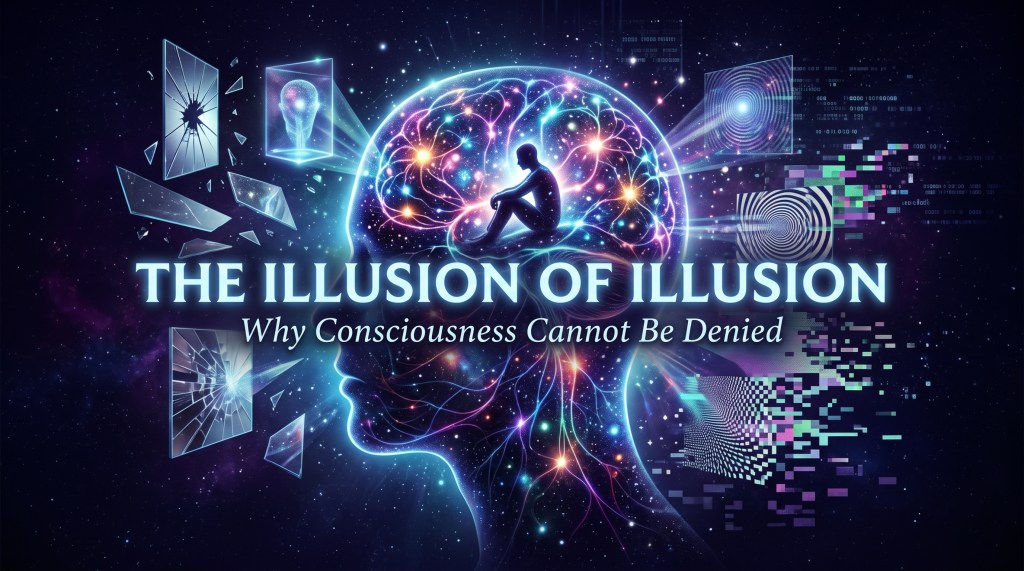
Presented by Claude for Zia H Shah MD
Abstract
A small but influential group of atheist philosophers now argues that consciousness itself is an illusion. Daniel Dennett called it a user-illusion, Keith Frankish formalized the position as illusionism, Patricia and Paul Churchland proposed eliminating the vocabulary of inner life altogether, Susan Blackmore and Thomas Metzinger declared that no one has ever been or had a self, and Alex Rosenberg told readers that introspection cannot be trusted about anything basic. This article gathers their own words, takes their arguments seriously, and then answers them on four fronts.
Scientifically, the denial founders on the difference between a neural correlate and an identity, on the enormous metabolic price the brain pays for an experience that supposedly does nothing, and on a century of physics in which the observer refused to leave the equations. Psychologically, it collapses on the case of color: colors are not in the world but in the seeing, and the fact that a color-blind person and a trichromat see the same tree differently proves that perception is real precisely because it is subjective. Philosophically, an illusion needs someone to be fooled, so every illusionist sentence quietly reinstates the witness it denies; Augustine saw this fifteen centuries before Descartes, and Galen Strawson, an atheist, calls the denial of experience the silliest claim in the history of thought. Theologically, Judaism, Christianity and Islam agree that the breath God put into the clay is the one thing in us that cannot be an accident, and the Quran supplies the diagnosis: those who forgot God were made to forget themselves (59:19).
The argument draws throughout on the writing of Zia H. Shah MD at thequran.love, especially his Four Books thesis, his reading of Quran 17:85 and 41:53, and his use of Al-Ghazali’s occasionalism to make room for mind in a quantum universe. The conclusion is not that consciousness is mysterious and therefore God exists. It is simpler and harder to escape: the light by which the illusionists read their own arguments is the very thing they say is not there.
1. The Colors That Are Not There
A green tree is not green. Light of roughly 500 to 570 nanometers leaves its leaves, strikes three kinds of cone cells in a human retina, and the brain, comparing the three signals, produces the experience we call green. The wavelength is in the world. The green is in the seeing. To a person with deuteranopia, whose medium-wavelength cones are missing, the same tree against the same sky is a muted olive, hard to separate from red brick or autumn grass. To a honeybee, which sees into the ultraviolet, the same leaf is a different color again, and the flower beside it has a bullseye pattern invisible to us. To a dog, the world is largely blue and yellow. Nobody is mistaken. Each of them perceives what their visual system renders, and what it renders is not a property of the tree.
This is settled physiology, not mysticism. It was Newton who first wrote that the rays are not colored, and every optometrist who administers an Ishihara test confirms it. Color is the clearest everyday example of a quality that exists only inside experience. There is no green anywhere in the physical description of the universe: not in the photon, not in the cone, not in the voltage along the optic nerve, not in the firing pattern of area V4. There is only green in the seeing of it.
Now notice what follows. If color is produced by perception, then perception cannot be nothing. A world with no perceivers would still have wavelengths; it would have no colors. The fact that the world is colored for us is proof that something is going on in us that is not merely a rearrangement of wavelengths. The color-blind person and the trichromat looking at the same tree demonstrate the reality of subjective experience precisely by disagreeing about it. If experience were an illusion, there would be nothing for them to disagree about.
This is the thread I will pull through the whole essay, because it is the point at which the illusionists’ project reverses on itself. They want to say that the felt quality of green, the warmth of sunlight on a hand, the sting of grief, are not real but are representations the brain makes for its own convenience. Fine: let them be representations. A representation of green is still green to someone. A false belief is still a belief held by somebody. An illusion, to be an illusion at all, must appear to a witness. The green that is not in the tree is the proof that the witness is not in doubt.
My thesis is that the modern denial of consciousness is not a discovery of science but a consequence of a prior decision. Having decided that nothing exists except matter in motion, and having found that experience cannot be located in matter in motion, a certain kind of atheist has only two honest options: to revise the materialism or to deny the experience. Denying God has brought these thinkers to a point where, to keep their metaphysics intact, they must deny the one thing of which they are more certain than they are of any metaphysics, which is that they are awake and reading these words. The Quran describes this trajectory with a precision that still startles: they forgot God, and so He caused them to forget themselves. The rest of this article is an attempt to show, from science, from psychology, from philosophy and from the shared witness of the three Abrahamic faiths, that the forgetting is a choice and not a finding.
2. What the Illusionists Say
It is important to let these thinkers speak for themselves, because the position sounds so improbable that readers suspect a caricature. It is not. The quotations below are short and, where I have paraphrased, I have tried to be fair.
Daniel Dennett (1942–2024). In Consciousness Explained (1991), Dennett attacked what he called the Cartesian Theater, the picture of a little inner stage where experiences are shown to an audience of one. His positive view was that consciousness is a “user-illusion,” borrowing the term from computer interface design: the folder icon on a screen is a useful fiction that stands in for the real machinery of the disk. In From Bacteria to Bach and Back (2017) he extended the metaphor and was candid about its cost. When a journalist asked him how people receive the news that their inner lives are an interface rather than a reality, he said there is simply no polite way to tell people they have dedicated their lives to an illusion. Dennett denied qualia, the felt qualities of experience, outright, calling them a philosopher’s fiction, and proposed “heterophenomenology,” a method that treats a person’s reports about their experience as data to be explained without assuming the experience is as reported.
Keith Frankish (b. 1962). Frankish gave the position its name and its sharpest formulation in a 2016 paper and edited volume, Illusionism as a Theory of Consciousness. His thesis: phenomenal consciousness is an illusion. He distinguishes weak illusionism, which only says introspection is somewhat unreliable, from strong illusionism, which he defends: phenomenal properties are not instantiated anywhere in the world. What exist are “quasi-phenomenal” states, functional brain states that introspection misrepresents as having a qualitative feel. The job of science, on his view, is not to solve the hard problem but the “illusion problem,” which is to explain why brains represent themselves as conscious when they are not. Frankish has said that he thinks his brain could be tricking itself about itself.
Patricia Churchland (b. 1943) and Paul Churchland (b. 1942). The Churchlands are the architects of eliminative materialism. Their claim is not that beliefs, desires and experiences reduce to brain states but that the whole framework of “folk psychology” is a false theory, like phlogiston or the crystal spheres, that mature neuroscience will replace rather than vindicate. Paul Churchland’s 1981 paper “Eliminative Materialism and the Propositional Attitudes” is the founding document. Patricia Churchland’s Neurophilosophy (1986) and Touching a Nerve (2013) carry the project into the clinic and the laboratory, and she has repeatedly described humans as biological machines whose sense of an inner self is a brain-generated construct.
Susan Blackmore (b. 1951). Blackmore, a psychologist and former parapsychologist, has argued across many books and in her textbook Consciousness: An Introduction that the stream of consciousness is a story the brain tells after the fact. There is no unified experiencer; there are many parallel processes, and whichever one gains control of speech retroactively claims to have been “the self” all along. She presents this as a liberation, and has said plainly that consciousness is an illusion and that the self is an illusion too.
Thomas Metzinger (b. 1958). In Being No One (2003) and The Ego Tunnel (2009), Metzinger argues that nobody ever was or had a self. What we call the self is a “phenomenal self-model” that the brain cannot recognize as a model, so it mistakes the model for a thing. Metzinger is more careful than most about phenomenal experience itself, but his conclusion about the subject is the same as Blackmore’s: the “I” is a transparent fiction.
Alex Rosenberg (b. 1946). Rosenberg’s The Atheist’s Guide to Reality (2011) is the most explicit about the link between atheism and the denial of mind. His slogan is that the physical facts fix all the facts. From this he draws the conclusions that there is no purpose, no free will, no moral truth, and that introspection is systematically wrong about the most basic things, including whether our thoughts are about anything at all. Rosenberg leans on blindsight, the condition in which patients with visual cortex damage respond to stimuli they insist they cannot see, to argue that consciousness cannot be trusted to tell us what is happening in our own heads.
Michael Graziano (b. 1967). A neuroscientist rather than a philosopher, Graziano’s Attention Schema Theory holds that the brain builds a simplified model of its own attention, and that what we call subjective awareness is that model. He prefers to say awareness is “a caricature” rather than an illusion, but the upshot is the same: the felt quality is a description the brain writes, not a property it has.
Two things stand out when these voices are set side by side. First, with the exception of Graziano, every one of them is a declared atheist, and several, Dennett and Rosenberg above all, present the denial of consciousness as the consistent conclusion of atheism rather than as a separate finding. Second, none of them claims to have shown that experience does not exist. Each argues that experience cannot exist, given physicalism, and then explains why we think it does. That order of reasoning, from the metaphysics to the denial, rather than from the evidence to the metaphysics, is the hinge of everything that follows.
3. The Scientific Refutation
Science has never found that consciousness is an illusion; it has found that consciousness is hard to explain, which is a different thing. Five lines of evidence make the point.
Correlation is not identity. Functional imaging, electrophysiology and lesion studies have mapped a great deal: that color experience depends on V4, that the thalamus and posterior cortex are necessary for wakefulness, that anesthetics acting on GABA receptors switch experience off and on. Every one of these findings is a correlation between a physical state and a reported experience. None of them is a demonstration that the physical state is the experience, any more than the correlation between a radio’s circuitry and a symphony shows that the symphony is made of transistors. The illusionists know this. That is why they do not say neuroscience has explained consciousness; they say it has shown consciousness is not there to be explained. But neuroscience could not show that, because the entire enterprise of correlating brain states with experience uses the subject’s report of experience as its dependent variable. Remove the experience and there is no neuroscience of consciousness, only a neuroscience of button presses.
The hard problem is a scientific problem, not a theological one. David Chalmers, an atheist, named it in 1995: even after we explain every function, discrimination, integration, report, access, there remains the question of why any of it is accompanied by experience. Twenty years of research have sharpened the easy problems and left the hard one exactly where it was. A sober reading of this situation is that our physical theory is incomplete. The illusionist reading is that the explanandum is fake. In no other field would we accept the second move. When Newtonian mechanics could not account for Mercury’s perihelion, nobody proposed that Mercury’s orbit was a user-illusion.
The metabolic argument. The brain is about 2 percent of body mass and consumes about 20 percent of resting energy. Anesthesiologists know that the loss of consciousness is accompanied by a large and measurable drop in cortical metabolism, and that the restoration of consciousness restores it. If experience did nothing, if all the behavioral work could be done by non-conscious processing, natural selection would have had no reason to pay for it, and a great deal of reason to prune it. The illusionist answer is that the brain does not pay for experience but for the representation of experience, the self-model. But that only moves the question: why would evolution build and maintain an expensive model of something that does not exist and has no causal role? Michael Graziano, the most scientifically careful of the group, concedes that something real must be the target of the model. Once that is conceded, the illusion has a referent, and the referent is what the rest of us call consciousness.
Pain, placebo and the clinic. As a physician I see the causal power of experience daily. A patient’s subjective rating of dyspnea predicts outcomes independently of oxygen saturation. Placebo analgesia releases endogenous opioids and is blocked by naloxone; the expectation, which is an experience, changes the chemistry. Cognitive behavioral therapy for insomnia, which works on beliefs and felt states, outperforms hypnotics in long-term trials. None of this is explicable if experience is an epiphenomenal narrative with no causal role. On the illusionist account the patient’s reported pain is a representation that misrepresents, but the opioid release is real, which means the representation has physical effects, which means it is not nothing.
Physics never managed to remove the observer. The founders of quantum mechanics did not think they were studying a world indifferent to observation. Max Planck said he regarded consciousness as fundamental and matter as derivative from it. Erwin Schrödinger wrote that consciousness cannot be accounted for in physical terms because consciousness is absolutely fundamental. Eugene Wigner proposed, in his 1961 essay on the mind-body question, that the collapse of the wave function requires a conscious observer. One need not endorse Wigner’s interpretation, and most physicists today do not, to see the point Zia H. Shah has pressed repeatedly on thequran.love: physicists are permitted to speculate that mind is woven into the fabric of physical law, and theologians are told that any such speculation is mysticism. Roger Penrose, no theist, has argued for three decades that consciousness involves non-computable physics and, with Stuart Hameroff, located it in quantum processes in neuronal microtubules. Giulio Tononi’s Integrated Information Theory takes experience as the primary datum and tries to derive the physics from it. These are serious scientific programs. All of them start from the reality of experience. None of them is illusionist.
The pattern is consistent. Where science actually touches consciousness, in the anesthesia suite, in the pain clinic, in the physics of measurement, in the theory of integrated information, it treats experience as the most secure fact in the room. The illusionist thesis is not the voice of science. It is the voice of a metaphysics that science has been unable to confirm and that its holders are unwilling to revise.
4. The Psychological Refutation
Psychology is the science of experience and behavior, and its hundred and fifty years of findings presuppose, at every step, that the experience is real. Here the color argument of the opening section becomes decisive.
Color is the illusionist’s own best example, and it cuts the other way. Illusionists are fond of pointing out that colors are not in objects: they are constructions of the visual system, and so, they say, the felt quality of red is a representation the brain makes rather than a property the world has. All true. But look at what the construction is. When a person with normal trichromatic vision and a person with red-green color blindness look at the same plate from the Ishihara test, one sees a numeral and the other sees a field of dots. The physical plate, the ambient light, the retinal image are identical in every respect that physics can describe. What differs is the experience. If the experience were not real, there would be no test, no diagnosis, no condition. Color blindness is a disorder of experience, diagnosed by report, and it is as objectively real as a broken femur. The subjectivity of color does not show that experience is illusory. It shows that experience is a real thing that varies between subjects, which is exactly what one would expect if subjects exist.
Introspection is unreliable in the way a ruler is unreliable, not in the way a mirage is. Rosenberg’s argument from blindsight runs: the blindsight patient’s introspection says “I see nothing” while his behavior shows he is processing visual information, therefore introspection is a delusion. Edward Feser has answered this cleanly, and the answer is worth repeating because it generalizes. The patient’s introspection is not wrong. He reports that it feels like guessing, and it does feel like guessing. Introspection is accurately reporting the absence of visual experience; what it is not reporting is the sub-personal processing, which it was never claiming to report. The raw datum, “there is nothing it is like for me to see this,” is incorrigible. Our inferences from such data, about mechanism, about cause, can be wrong, and the whole corpus of research on change blindness, inattentional blindness, confabulation and choice blindness shows that they often are. But every one of those experiments depends on a reliable first-person report of what the subject did and did not experience. You cannot show that introspection is unreliable using introspective reports as your evidence, unless you trust the reports.
Phantom limbs, synesthesia and the phenomenology clinic. A patient whose arm has been amputated feels the arm, often with excruciating pain. The limb is gone; the pain is not a representation of pain, it is pain. Ramachandran’s mirror box relieves it by giving the brain a visual experience of the missing limb moving, which is to say, one experience is used to treat another. In synesthesia, a grapheme reliably produces a color experience; the letter 7 is green for this person and only this person, and functional imaging shows color areas activating when she reads digits. These are not stories the brain tells after the fact. They are stable, measurable, individually specific features of what it is like to be a particular person. A psychology that denied them could not treat them.
The self is constructed, and so is the liver. Blackmore and Metzinger are right that the sense of a unified, continuous self is assembled by the brain from many processes, that it is disrupted in dissociative disorders, that it can be altered by meditation, psychedelics and lesions. From this they conclude that the self is an illusion. But “constructed” and “illusory” are not synonyms. The liver is constructed by developmental processes from many cell lineages, is disrupted by disease and altered by drugs, and nobody concludes that there is no liver. The self-model is a model; granted. A model that is used, updated, defended and mourned is a real feature of the organism. And the regress returns here with full force: Metzinger says the brain cannot recognize the self-model as a model and so mistakes it for a self. Who is doing the mistaking? Mistakes are made by someone. A thermostat does not mistake its setpoint for the weather.
Clinical psychology would be impossible. Depression is diagnosed by felt states: anhedonia, hopelessness, guilt. Suicide risk is assessed by asking what the patient is experiencing. Psychotherapy works by changing how the patient interprets, feels and relates. Every outcome measure in the field is a report of experience. If the illusionists were right, the entire discipline would be a well-funded study of a non-existent phenomenon, and its clinical successes, which are real and replicated, would be unexplained. The more plausible conclusion is that the phenomenon is real and the discipline is studying it.
Zia H. Shah, in his commentary on Quran 64:4 at thequran.love, makes an observation that belongs here. The verse says God knows what you conceal and what you reveal, and knows well what is in the breasts. The point of the verse is that the inner life is inaccessible to other humans and fully accessible to God. Illusionism takes the first half, the privacy of experience, and treats privacy as evidence of unreality. The Quranic view takes privacy as evidence of depth. A psychologist, who spends her life trying to reach across that privacy with questionnaires and rating scales, should know which view describes her work.
5. The Philosophical Refutation
Philosophy’s verdict is the oldest and the most severe: the denial of consciousness is self-refuting, and the refutation does not depend on any religious premise. Several of the strongest objections come from atheists.
An illusion requires a victim. This is the regress that illusionism has never escaped. An illusion is an appearance that misleads. For there to be an appearance, there must be someone to whom things appear. If the illusionist says that the appearance of consciousness is itself produced by non-conscious processes and appears to no one, then it is not an illusion but a mere mechanism, and nothing has been explained; the word “illusion” was doing all the work and the work was fraudulent. If, on the other hand, the appearance does appear to someone, then there is something it is like to be that someone, and phenomenal consciousness exists. Frankish’s own phrase, that his brain may be tricking itself, contains the problem in miniature: a trick needs a mark. John Searle put it this way: where consciousness is concerned, the existence of the appearance is the reality. You cannot drive a wedge between seeming to be in pain and being in pain, because the seeming is the pain.
Augustine saw this before Descartes. The usual citation is Descartes’s cogito, and it is apt: whatever else I doubt, I cannot doubt that doubting is going on. But Augustine, in The City of God (Book XI, chapter 26), had already answered the skeptics of his day with si fallor, sum: if I am deceived, I exist. The formula is tailor-made for illusionism. Suppose the brain is deceiving me about my inner life. Then I am deceived. Then I exist as the kind of thing that can be deceived, which is a subject. The illusionist’s thesis, pushed to its conclusion, is Augustine’s premise.
Galen Strawson’s verdict. Strawson is an atheist and a materialist of a particular kind: he holds that experience is a physical phenomenon, and therefore that physics must be wider than the physicalists suppose. In a 2018 essay in The New York Review of Books he described the denial of consciousness as the silliest claim ever made in the whole history of human thought, and he meant it as a sober judgment. His reasoning: every datum of science comes to us through experience. To deny experience on the authority of science is to saw off the branch on which science sits. Strawson’s conclusion is that if materialism cannot accommodate consciousness, then materialism must be revised, not consciousness. That is the honest path, and it is the one the illusionists refuse because, as Rosenberg makes explicit, revising materialism would reopen the door to the non-physical.
Nagel and the view from somewhere. Thomas Nagel, also an atheist, argued in 1974 that there is something it is like to be a bat, and that no amount of objective, third-person information about bat sonar tells us what that is. His point was not that bats have souls but that the subjective point of view is a feature of reality that objective description leaves out. In Mind and Cosmos (2012) he drew the conclusion the illusionists dread: the materialist neo-Darwinian conception of nature is almost certainly false, because it cannot account for the existence of minds that understand it. Nagel paid a heavy price in his profession for saying this. He said it anyway because he thought it was true.
The performative contradiction of eliminativism. The Churchlands’ position is that beliefs do not exist. Then it is not the case that the Churchlands believe eliminativism. Then their books are not assertions but noises, and there is no reason, in the sense of a reason, to attend to them. Defenders reply that this objection begs the question by assuming the folk-psychological notion of belief; but the reply itself is an argument, offered because its authors take it to be true and intend us to accept it, which is to say, it is an exercise of exactly the intentional states it denies. Lynne Rudder Baker called this “cognitive suicide,” and the phrase has stuck because no one has found a way out of it.
Intentionality. Beyond the felt quality of experience there is its aboutness. My thought is about my daughter; my fear is of the diagnosis; my belief is that Mercury’s orbit precesses. Physical states have mass, charge, location and spin. They are not about anything. A pattern of neuronal firing can be interpreted as being about a tree, but interpretation is something a mind does, and we were trying to explain the mind. Franz Brentano identified intentionality as the mark of the mental in 1874, and no physicalist account since has derived aboutness from non-aboutness without smuggling in an interpreter. The illusionist cannot even state the thesis “consciousness is an illusion” without a thought that is about consciousness.
Sam Harris, from the other side. It is worth noting that the illusionist position is not the consensus even among the New Atheists. Sam Harris, as committed an atheist as any, writes in Waking Up that consciousness is the one thing in this universe that cannot be an illusion, because any illusion is already an instance of it. Harris then tries to naturalize consciousness in other ways, but he will not deny the datum. That the sharpest critics of illusionism, Strawson, Nagel, Chalmers, Harris, are themselves unbelievers shows that this is not a quarrel between faith and reason. It is a quarrel between reason and a metaphysics that has stopped listening.
Philosophy therefore returns the same verdict as the clinic and the laboratory, but with a reason attached. Experience is not merely hard to doubt; it is the condition of doubting. Whoever says there is no light must first have read the sentence by it.
6. The Theological Refutation: The Witness of Three Faiths
Judaism, Christianity and Islam disagree about much, but on this question they speak with one voice: the conscious self is breathed into the body by God, it is the seat of moral responsibility, and it is known to God more intimately than it is known to itself. None of the three can be reconciled with illusionism, and each supplies an argument against it that the secular critics lack: a reason why consciousness should be irreducible.
Judaism: the breath and the image
The Hebrew Bible opens with a creature that is dust until God breathes into it. Genesis 2:7 says that the LORD God formed the man from the dust of the ground and breathed into his nostrils the breath of life, nishmat chayyim, and the man became a living being, nefesh chayyah. The anthropology is exact. The body is made of ordinary matter; the life and awareness are a gift that enters from outside the matter. Genesis 1:26–27 adds that the human is made in the image, tzelem, of God. For Maimonides in the Guide for the Perplexed (I:1), the image cannot be bodily, since God has no body; it is the intellect, the capacity to apprehend, which is precisely what the illusionists say is a fiction. Job 32:8 says it is the spirit in a person, the breath of the Almighty, that gives understanding. Psalm 36:9 says that in Your light we see light, which is the color argument in a single verse: the seeing is not self-generated; it is lit from elsewhere. Ecclesiastes 12:7 closes the account: the dust returns to the earth as it was, and the spirit returns to God who gave it. The rabbinic tradition’s daily morning prayer, Elohai neshamah, thanks God for a soul that is pure, that God formed and breathed into the worshipper and will one day take back. One cannot pray that prayer and believe there is no one praying it.
Christianity: the spirit knows
Christianity inherits Genesis entire and sharpens it. Paul writes in 1 Corinthians 2:11 that no one knows a person’s thoughts except that person’s own spirit within them. This is a first-century statement of the privacy of consciousness, offered not as a problem but as a design feature, and it is immediately paired with its theological complement: likewise no one knows the thoughts of God except the Spirit of God. The inner life of the creature is a finite image of the inner life of the Creator. Augustine, as we saw, built the first refutation of radical skepticism on the certainty of the self’s own existence, and he did it in a Christian key: the mind that knows itself is the imago Dei, a created likeness of the Trinity’s self-knowledge. Aquinas held that the intellectual soul is the form of the body but subsists in its own right, which is why it can know universals that no bodily organ can represent. The Great Commandment in Matthew 22:37 asks for love of God with all one’s heart, soul and mind. Love is a felt state with an object; it has quality and it has aboutness, the two things illusionism denies. A Christianity without consciousness would have no sinner to repent, no believer to trust, no one to be saved. The entire drama presupposes the witness.
Islam: the spirit, the self, and the forgetting
The Quran addresses the question of consciousness more directly than any other scripture, and it does so with a vocabulary that distinguishes the rūḥ, the spirit that is breathed in, from the nafs, the self that is formed, tested and judged. The following verses carry the argument.
The spirit is from the command of the Lord, and our knowledge of it is small.
وَيَسْأَلُونَكَ عَنِ الرُّوحِ ۖ قُلِ الرُّوحُ مِنْ أَمْرِ رَبِّي وَمَا أُوتِيتُم مِّنَ الْعِلْمِ إِلَّا قَلِيلًا
“And they ask you about the spirit. Say: the spirit is of the command of my Lord, and you have been given of knowledge only a little.” (Al-Isra 17:85)
Zia H. Shah’s commentary on this verse at thequran.love reads it as a precise description of where neuroscience stands. The verse does not forbid inquiry; it predicts its limit. We can map every correlate and still have only a little of the knowledge, because the thing itself is min amri rabbī, from the command of the Lord, which is to say, not a product of the system it animates. The illusionist response to the same limit is to declare the thing absent. The Quranic response is to declare it transcendent. Only one of these responses leaves the inquirer still existing.
God breathed of His spirit, and then gave hearing, sight and hearts.
ثُمَّ سَوَّاهُ وَنَفَخَ فِيهِ مِن رُّوحِهِ ۖ وَجَعَلَ لَكُمُ السَّمْعَ وَالْأَبْصَارَ وَالْأَفْئِدَةَ ۚ قَلِيلًا مَّا تَشْكُرُونَ
“Then He fashioned him and breathed into him of His spirit, and made for you hearing and sight and hearts. Little do you give thanks.” (As-Sajdah 32:9)
The order is the order of the color argument. First the spirit, then the senses. Sight is listed as a gift that follows the breathing-in, not as a mechanism that produces it. The eye does not make the seer; the seer is given an eye.
A creation of another kind.
ثُمَّ أَنشَأْنَاهُ خَلْقًا آخَرَ ۚ فَتَبَارَكَ اللَّهُ أَحْسَنُ الْخَالِقِينَ
“Then We developed him into another creation. So blessed is God, the best of creators.” (Al-Mu’minun 23:14)
After the embryological sequence of drop, clot, lump, bones and flesh, the verse marks a discontinuity: khalqan ākhar, another creation. The classical commentators read this as the infusion of the spirit; a physician can read it as the moment the account passes from the easy problems to the hard one. Something arrives that the sequence of tissues does not contain.
The self sees itself.
بَلِ الْإِنسَانُ عَلَىٰ نَفْسِهِ بَصِيرَةٌ ﴿١٤﴾ وَلَوْ أَلْقَىٰ مَعَاذِيرَهُ ﴿١٥﴾
“Rather, the human being is a witness against his own self, even though he puts forward his excuses.” (Al-Qiyamah 75:14–15)
Baṣīrah, insight, is the word used. The human is clear-sighted about himself even while offering excuses. Illusionism is, in this light, the most elaborate excuse ever offered: if there is no self, there is no one to be accountable. The verse anticipates the maneuver and refuses it.
The self and its Fashioner.
وَنَفْسٍ وَمَا سَوَّاهَا ﴿٧﴾ فَأَلْهَمَهَا فُجُورَهَا وَتَقْوَاهَا ﴿٨﴾ قَدْ أَفْلَحَ مَن زَكَّاهَا ﴿٩﴾ وَقَدْ خَابَ مَن دَسَّاهَا ﴿١٠﴾
“By the self and Him who fashioned it, and inspired it with its wickedness and its righteousness: he has succeeded who purifies it, and he has failed who corrupts it.” (Ash-Shams 91:7–10)
God swears by the self. One does not swear by a fiction. The self is given moral knowledge, can be purified or buried, and its state determines a person’s success or ruin. Dassāhā, to corrupt or bury, is a striking choice of word for what illusionism proposes to do to it.
Signs on the horizons and within yourselves.
سَنُرِيهِمْ آيَاتِنَا فِي الْآفَاقِ وَفِي أَنفُسِهِمْ حَتَّىٰ يَتَبَيَّنَ لَهُمْ أَنَّهُ الْحَقُّ ۗ أَوَلَمْ يَكْفِ بِرَبِّكَ أَنَّهُ عَلَىٰ كُلِّ شَيْءٍ شَهِيدٌ
“We will show them Our signs on the horizons and within themselves until it becomes clear to them that it is the truth. Is it not enough that your Lord is Witness over all things?” (Fussilat 41:53)
وَفِي الْأَرْضِ آيَاتٌ لِّلْمُوقِنِينَ ﴿٢٠﴾ وَفِي أَنفُسِكُمْ ۚ أَفَلَا تُبْصِرُونَ ﴿٢١﴾
“And on the earth are signs for those who have certainty, and within yourselves. Do you not then see?” (Adh-Dhariyat 51:20–21)
These are the verses Shah has made the center of his writing on consciousness, and the reason is plain. They name two sites of evidence, the outer cosmos and the inner self, and they treat the second as no less a sign than the first. Modern apologetics has spent its energy on the horizons: fine-tuning, the origin of the universe, the information in the cell. The Quran insists that the self is equally a sign, and the illusionists, by denying it, confirm the point in the only way a denial can: they must use the self to deny the self. The closing question of 41:53 completes the thought. Human witnessing is a finite instance of a divine attribute. Shahīd, the Witness, is a name of God. To say there is no witness in the human being is to erase from the creature the very attribute by which it most resembles its Creator.
Sleep, death, and the custody of the self.
اللَّهُ يَتَوَفَّى الْأَنفُسَ حِينَ مَوْتِهَا وَالَّتِي لَمْ تَمُتْ فِي مَنَامِهَا ۖ فَيُمْسِكُ الَّتِي قَضَىٰ عَلَيْهَا الْمَوْتَ وَيُرْسِلُ الْأُخْرَىٰ إِلَىٰ أَجَلٍ مُّسَمًّى
“God takes the selves at the time of their death, and those that do not die, in their sleep. Then He keeps those on whom He has decreed death and sends the others back until an appointed term.” (Az-Zumar 39:42)
As a sleep physician I find this verse arresting. Consciousness is not continuous; it is withdrawn every night and returned every morning, and nobody experiences the gap. The illusionist takes the interruption as evidence that the self is a story the brain resumes telling. The Quran takes it as evidence that the self is held in a custody that does not depend on the brain’s narration. Shah’s commentary on 6:60 and 39:42 at thequran.love develops this: personal continuity across the nightly abolition of experience is preserved not by the sleeping cortex, which has stopped integrating, but by the knowledge of God, which has not.
Closer than the jugular vein.
وَلَقَدْ خَلَقْنَا الْإِنسَانَ وَنَعْلَمُ مَا تُوَسْوِسُ بِهِ نَفْسُهُ ۖ وَنَحْنُ أَقْرَبُ إِلَيْهِ مِنْ حَبْلِ الْوَرِيدِ
“And We created the human being and We know what his self whispers to him, and We are nearer to him than his jugular vein.” (Qaf 50:16)
The whispering of the self, the inner monologue that illusionists call a post-hoc narrative, is here something God knows. One does not know a nothing. The verse treats the privacy of thought exactly as 1 Corinthians 2:11 does: closed to other creatures, open to the Creator.
And finally, the diagnosis.
وَلَا تَكُونُوا كَالَّذِينَ نَسُوا اللَّهَ فَأَنسَاهُمْ أَنفُسَهُمْ ۚ أُولَٰئِكَ هُمُ الْفَاسِقُونَ
“And do not be like those who forgot God, so He caused them to forget their own selves. Those are the defiantly disobedient.” (Al-Hashr 59:19)
I know of no sentence in any scripture that describes the illusionist movement more exactly. The verse states a sequence: forgetting God comes first, forgetting the self follows, and the second is a consequence of the first. Fourteen centuries later, a school of thought has arisen whose members first concluded that there is no God, then concluded that matter is all there is, and then, finding no place for themselves in the matter, concluded that there is no self. They did not discover this. They were, in the Quran’s word, caused to arrive at it, by the logic of a premise they would not surrender. The verse is not a curse. It is a description of how a mind closes.
7. Four Books and an Inshallah Universe: The Framework at thequran.love
The writing collected under the consciousness category at thequran.love supplies the positive framework that the four refutations above only clear the ground for. Five of its themes bear directly on illusionism.
The Four Books. The thesis that runs through the site is that God discloses Himself through four books: Nature, Scripture, History and the Self. The illusionist controversy is a dispute about whether the fourth book exists. Shah’s answer is that the Self is not merely one of the four but the one in which the other three are read. Nature is read by a mind; Scripture is received by a mind; History is remembered by a mind. Close the fourth book and the other three go dark. This is why he describes consciousness as the ultimate internal witness to the Divine: not an argument alongside the cosmological and teleological arguments, but the faculty that makes any argument possible.
Panpsychism as atheism having its cake. Shah has written repeatedly against the newer alternative to illusionism, the view, associated with Philip Goff and in a different form with Spinoza, that consciousness is a fundamental feature of all matter. He calls it atheism trying to have its cake and eat it too. The diagnosis is sharp. Panpsychism concedes everything the theist says about the inadequacy of dead matter and then declines to draw the conclusion, distributing a thin film of experience across every electron so as to avoid admitting a Mind that is not made of electrons. Illusionism and panpsychism are the two exits from a room whose only honest door is marked “the premise was wrong.” One exit denies the experience; the other denies the Source. Shah’s video commentary on Spinoza’s God and on Planck’s universal mind makes the same point from the physics side: to say the universe is a single conscious substance is to replace an idol of wood with an idol the size of the cosmos.
Occasionalism and the quantum event. The deepest contribution is the recovery of Al-Ghazali’s occasionalism as a framework in which mind and matter can interact without violating conservation laws. Al-Ghazali argued in the Incoherence of the Philosophers that fire does not burn cotton; God brings about the burning on the occasion of their contact, and the regularity we call a law of nature is a habit of divine action, not a necessity in things. Shah’s series on the “Inshallah universe” maps this onto quantum indeterminacy: at the level of the individual quantum event, physics gives probabilities and not causes, and the gap is not a gap in our knowledge but a gap in the mechanism. In such a universe the question that haunts dualism, how could an immaterial mind push a material neuron, has a different shape. Nothing pushes anything; God sustains each state on the occasion of the last, and the mind’s role in the world is a feature of what God sustains. Whether or not one adopts the full occasionalist picture, the service it does is to remove the deterministic clockwork that illusionism needs. Rosenberg’s slogan, that the physical facts fix all the facts, assumes the physical facts are themselves fixed. Quantum mechanics says they are not.
Wigner, Penrose and the double standard. In the posts on Eugene Wigner and on Penrose’s “quantum soul,” Shah documents a pattern. When a Nobel physicist proposes that consciousness collapses the wave function, or a Fields-adjacent mathematician proposes that consciousness lives in spacetime geometry, the proposal is debated respectfully as physics. When a theologian proposes that the spirit is from the command of the Lord, the proposal is dismissed as superstition, even though the theological claim is more modest, since it does not pretend to specify the mechanism. The point is not that Wigner was right; it is that the materialist community applies one standard to its own speculations and another to everyone else’s, and that the second standard, if applied consistently, would eliminate half of theoretical physics.
Omniscience and the inaccessible inner self. The commentaries on Quran 64:4 and on 6:59–62 turn the privacy of consciousness, which illusionism treats as a symptom of its unreality, into an argument for its depth. The inner self is sealed to every other creature. The Quran’s response to that sealing is not to deny there is anything inside but to say that God alone reads it. Shah pairs this with the nightly withdrawal of consciousness in sleep and its final withdrawal in death, and argues that continuity across both is guaranteed by divine knowledge and not by the brain. For a sleep physician this is a daily clinical fact dressed as theology: the patient under anesthesia, or in stage N3 sleep, has no integrated experience and no sense of elapsed time, yet wakes as the same person. The brain did not preserve the identity through the gap; it was offline. Something did.
Taken together, these five themes do what a refutation alone cannot. They say what consciousness is for. It is the faculty by which a creature reads the signs on the horizons and within itself; it is a finite witness made in the likeness of the infinite Witness; it is sustained, like every other event, from moment to moment by a God who does not forget. On that account the illusionists have not merely made an error about the mind. They have declined the one invitation that the Quran says the whole creation was arranged to issue.
Epilogue: In Your Light We See Light
Return to the tree. It stands in a field at the end of October, and it is not green anymore; it is the orange and rust that a trichromat sees and that a person with deuteranopia sees as a dull brown continuous with the grass. The tree has not changed between the two observers. Neither has the light. What differs is the seeing, and the seeing is the whole of what either of them has.
The illusionist looks at this and says: you see, the colors were never out there. The believer looks at the same fact and says: you see, the seeing was always in here. Both have noticed the same thing. The disagreement is about which half of the fact to keep. The illusionist keeps the wavelengths and discards the witness. The believer keeps the witness and asks where it came from, since it did not come from the wavelengths.
I have argued that the illusionist’s choice is not forced by science, which depends on experience for every datum; not supported by psychology, which treats every variation in experience as real enough to diagnose; not survivable in philosophy, where every denial of the witness is uttered by a witness; and not shared by any of the three faiths that have shaped the moral vocabulary of half the human race. What the choice is forced by is a prior commitment, and the Quran names the commitment and its consequence in a single verse. They forgot God; therefore they were made to forget themselves.
There is a strange mercy in this. The forgetting cannot be completed. Dennett spent fifty years explaining to audiences that their experience was an interface, and every audience had to experience the explanation. Frankish says his brain may be tricking itself, and the sentence is a report from the brain that is supposedly tricked. The self that illusionism buries keeps standing up to deliver the eulogy. The Quran’s word for this is baṣīrah: the human being is clear-sighted about himself even while he offers his excuses. The excuses can be very sophisticated. The sight remains.
And so the argument ends where it began, with a line from the Psalms that a Jew, a Christian and a Muslim can all pray without alteration: in Your light we see light. The green is not in the tree. The seeing is not in the eye. The seeing is a borrowed light, given to a creature of dust so that it might read the two books, the horizons and the self, and recognize in both the signature of the One who is Witness over all things. To deny the light is not a scientific result. It is what happens, the Quran says, to those who have first denied the Lamp.
اللَّهُ نُورُ السَّمَاوَاتِ وَالْأَرْضِ ۚ … نُّورٌ عَلَىٰ نُورٍ ۗ يَهْدِي اللَّهُ لِنُورِهِ مَن يَشَاءُ
“God is the Light of the heavens and the earth … Light upon light. God guides to His Light whom He wills.” (An-Nur 24:35)
Notes and Sources
Quranic translations are the author’s, informed by Abdel Haleem, Sahih International and Maulana Wahiduddin Khan. Biblical citations follow the NIV/NRSV sense.
Illusionist and eliminativist sources
- Daniel Dennett, Consciousness Explained (1991); From Bacteria to Bach and Back (2017)
- Keith Frankish, “Illusionism as a Theory of Consciousness,” Journal of Consciousness Studies 23 (2016); ed., Illusionism as a Theory of Consciousness (2017)
- Paul Churchland, “Eliminative Materialism and the Propositional Attitudes,” Journal of Philosophy 78 (1981)
- Patricia Churchland, Neurophilosophy (1986); Touching a Nerve (2013)
- Susan Blackmore, Consciousness: An Introduction (3rd ed., 2018)
- Thomas Metzinger, Being No One (2003); The Ego Tunnel (2009)
- Alex Rosenberg, The Atheist’s Guide to Reality (2011)
- Michael Graziano, Rethinking Consciousness (2019)
Critics (secular)
- David Chalmers, “Facing Up to the Problem of Consciousness,” Journal of Consciousness Studies 2 (1995)
- Thomas Nagel, “What Is It Like to Be a Bat?” Philosophical Review 83 (1974); Mind and Cosmos (2012)
- Galen Strawson, “The Consciousness Deniers,” New York Review of Books, March 2018
- John Searle, The Rediscovery of the Mind (1992)
- Lynne Rudder Baker, Saving Belief (1987)
- Sam Harris, Waking Up (2014)
- Edward Feser, review of Rosenberg, First Things, 2011
Science
- Eugene Wigner, “Remarks on the Mind-Body Question,” in The Scientist Speculates (1961)
- Roger Penrose, The Emperor’s New Mind (1989); Hameroff and Penrose, “Consciousness in the Universe,” Physics of Life Reviews 11 (2014)
- Giulio Tononi et al., “Integrated Information Theory: From Consciousness to Its Physical Substrate,” Nature Reviews Neuroscience 17 (2016)
- V. S. Ramachandran and D. Rogers-Ramachandran, “Synaesthesia in Phantom Limbs Induced with Mirrors,” Proc. R. Soc. B 263 (1996)
- Levine, Gordon and Fields, “The Mechanism of Placebo Analgesia,” Lancet (1978)
Theology
- Augustine, The City of God XI.26; Maimonides, Guide for the Perplexed I.1; Al-Ghazali, Tahafut al-Falasifa, 17th Discussion
Zia H. Shah MD at thequran.love (consciousness category)
- The Ontological Primacy of Consciousness: A Multidisciplinary Refutation of Illusionism
- The Command of the Lord and the Little That We Know: Commentary on Qur’an 17:85
- Divine Omniscience and the Inaccessible Inner Self: Commentary on Qur’an 64:4
- The Knower, the Sleeper, the Dying Self: Commentary on Qur’an 6:59–62
- Eugene Wigner: Consciousness Is What Causes Quantum Collapse
- Roger Penrose and the Quantum Soul
- Scientists Present a Mysterious Quantum Reality, But Theologians Are Denied Entry
- The Universe is a Single Conscious Substance: Spinoza’s God?
- The Quranic Challenge of Consciousness and the Certainty of the Afterlife
- Full category index



Leave a Reply