

By Zia H Shah MD with the help of Claude
Qur’an 51:20–23 is one of the clearest examples of how the Qur’an argues from the tangible to the intangible. It names three places where signs can be seen: the earth (geology), the self (biology and consciousness) and the sky (meteorology and cosmology). It then ends with an oath that rests God’s promise on the one fact no listener can doubt, namely that he is speaking. Modern science gives each of these signs far more depth than seventh-century listeners could have known. Even so, the argument works because of what these facts point to, not because the Qur’an predicted any particular scientific finding.
- The argument: the passage moves from earth (v.20) to self (v.21) to sky (v.22). It then seals everything with a divine oath (v.23) that the promise, meaning the Resurrection, the Judgment and the revelation that announces them, is as real as the hearer’s own power of speech. Classical commentators read the passage as one connected proof, from al-Rāzī’s pairing with 41:53 to al-Qurṭubī’s remark that speech, unlike the other senses, cannot be an illusion.
- The science: the passage fits modern science well, but the fit is a matter of resonance, not proof. Several findings enrich the verses: mountain roots and isostasy, a planet kept habitable by plate tectonics, the magnetic field and the Moon, the hard problem of consciousness, rain as a carrier of nutrients, iron and carbon forged in earlier stars, and the still-unexplained origin of human syntax. “Scientific miracle” readings need careful hedging, especially the claim that mountains “stabilize” the crust.
- The theology: speech is the most immediate fact of our existence. It assumes consciousness, consciousness assumes a life-permitting cosmos, and that cosmos points to the First Cause. He is al-Awwal, al-Ākhir, al-Ẓāhir and al-Bāṭin (57:3), al-Raḥmān and al-Raḥīm. The right response is the one the Qur’an asks for: certainty (yaqīn), gratitude, and worship of the Rabb al-ʿĀlamīn.
Abstract
This essay comments on Qur’an 51:20–23 verse by verse. It draws on four bodies of material:
- classical tafsīr: al-Ṭabarī, al-Zamakhsharī, al-Rāzī, al-Qurṭubī, Ibn Kathīr and al-Jalālayn;
- modern exegesis: Maududi, Muhammad Asad, Yusuf Ali, the Ahmadiyya translations of Maulawi Sher Ali and Maulana Muhammad Ali, and Mustafa Khattab;
- natural theology: Aquinas, Paley, al-Ghazālī, William Lane Craig, Thomas Nagel and Alvin Plantinga;
- present-day science.
The central thesis is that the four verses form a short, complete argument from the tangible to the intangible:
- v.20: the earth’s signs, above all its mountains, which the Qur’an calls pegs (awtād) and firm anchors (rawāsī), bring geology into view.
- v.21: the signs within the self raise the unsolved problems of consciousness, free will and the soul.
- v.22: provision from the sky reaches from rain and nitrogen fixed by lightning to carbon, oxygen and iron made in earlier generations of stars.
- v.23: God swears by Himself that “it is the truth, just as you speak,” anchoring the unseen promise in the most immediately evident fact of human life.
Speech assumes consciousness, consciousness assumes a fine-tuned cosmos and planet, and the whole chain points to the First Cause, who is both Manifest and Hidden. Throughout, the essay separates what the Qur’an says from modern scientific interpretation. It states plainly where “scientific miracle” (iʿjāz ʿilmī) claims are contested, and it answers critics’ objections directly.
1. Introduction: The Place of 51:20–23 in Sūrat al-Dhāriyāt
Sūrat al-Dhāriyāt is a Meccan surah of sixty verses. Angelika Neuwirth’s literary analysis divides it into three parts: verses 1–23, 24–46 and 47–60. Wikipedia Our four verses close the first part. The research dossier prepared for this commentary on thequran.love describes verses 1–23 as “a single argumentative arc built on oaths.” thequran (The dossier is titled “Research Dossier for a Verse-by-Verse Scientific, Philosophical, and Theological Commentary on Qur’an 51:1–23,” 14 July 2026.) The arc has four stages:
- Four oaths (vv.1–4): by the scattering winds (al-dhāriyāt dharwan), the load-bearing clouds (al-ḥāmilāti wiqran), the smoothly gliding ships (al-jāriyāti yusran), and the angels apportioning affairs by command (al-muqassimāti amran). thequran
- The answer to the oaths (vv.5–6): “Indeed, what you are promised is true, and the Judgment will certainly come to pass.” This is the jawāb al-qasam, the clause the oaths were sworn to support.
- An oath by “the heaven full of pathways” (dhāt al-ḥubuk, v.7): it opens a charge against the “conjecturers” (al-kharrāṣūn, vv.8–14). thequran
- A portrait of the God-conscious (vv.15–19): they slept little, sought forgiveness before dawn, and acknowledged in their wealth a right (ḥaqq) of the beggar and the deprived. thequran
Then come our verses. They name the earth, the self and the sky as places of signs, and seal the case with a greater oath, sworn not by created things but by “the Lord of the heaven and the earth.”
The narrative that follows, “Has the story of Abraham’s honoured guests reached you?” (51:24), turns from argument to history. Angels appearing as ordinary guests bring Abraham the unlikely news of a son, and destruction to Lot’s people. The placement matters. Right after swearing that the unseen promise is as real as speech, the Qur’an tells of a man to whom the unseen spoke, and whose seemingly impossible promise was kept.
The tradition broadly agrees on how to read the opening oaths. The dossier traces the winds/clouds/ships/angels reading from ʿAlī ibn Abī Ṭālib and Ibn ʿAbbās through al-Ṭabarī, al-Zamakhsharī, al-Rāzī, al-Qurṭubī and Ibn Kathīr. thequran
Some commentators read all four as one system. Muhammad Asad, following one of al-Rāzī’s options, reads them as phases of a single life-giving system of wind, cloud and rain, pointing “to the miraculous creation of life as such and, thus, to the existence of a conscious, purposeful Creator.” thequran Maulana Muhammad Ali’s commentary likewise reads all four as wind and rain: winds raising dust, clouds carrying rain, winds driving the clouds, and winds distributing the rain. alahmadiyya The surah thus begins with meteorology and reaches its first climax in “provision in the sky.”
My essay “The Quranic Oath in the Beginning of the Surah Dhariyat” (thequran.love, 28 April 2025) lists five purposes of Qur’anic oaths: thequran
- emphasizing core beliefs;
- affirming the Qur’an’s divine origin;
- validating the Prophet’s mission;
- highlighting the Hereafter;
- reflecting on human nature.
Verse 51:23 serves all five.
In “A Linguistic and Theological Analysis of Jurative Particles in the Quran” (thequran.love, 22 April 2026), I set out the three parts of every oath: thequran
- the particle (adāt al-qasam): in 51:23, wa, preceded by fa;
- the thing sworn by (muqsam bihi): rabb al-samāʾi wa’l-arḍ;
- the thing sworn to (muqsam ʿalayhi): innahu la-ḥaqq.
Uniquely, 51:23 then adds a simile of certainty: mithla mā annakum tanṭiqūn.
2. Arabic Text and Six English Translations
(Ahmadiyya editions count the basmala as verse 1, so Sher Ali numbers these verses 51:21–24.)
Qur’an 51:20
وَفِي الْأَرْضِ آيَاتٌ لِّلْمُوقِنِينَ
wa-fī’l-arḍi āyātun li’l-mūqinīn
| Translator | Translation |
|---|---|
| Sahih International | “And on the earth are signs for the certain [in faith]” quran |
| Abdullah Yusuf Ali | “On the earth are signs for those of assured Faith,” |
| Muhammad Marmaduke Pickthall | “And in the earth are portents for those whose faith is sure.” |
| Arthur J. Arberry | “In the earth are signs for those having sure faith;” |
| Muhammad Asad | “AND ON EARTH there are signs [of God’s existence, visible] to all who are endowed with inner certainty,” quranv |
| Maulawi Sher Ali (Ahmadiyya) | “And in the earth are Signs for those who have certainty of faith,” alislam |
Qur’an 51:21
وَفِي أَنفُسِكُمْ ۚ أَفَلَا تُبْصِرُونَ
wa-fī anfusikum, a-fa-lā tubṣirūn
| Translator | Translation |
|---|---|
| Sahih International | “And in yourselves. Then will you not see?” quranquran |
| Abdullah Yusuf Ali | “As also in your own selves: Will ye not then see?” quran |
| Muhammad Marmaduke Pickthall | “And (also) in yourselves. Can ye then not see?” quran |
| Arthur J. Arberry | “and in your selves; what, do you not see?” quran |
| Muhammad Asad | “just as [there are signs thereof] within your own selves: can you not, then, see?” islamawakened |
| Maulawi Sher Ali (Ahmadiyya) | “And also in your own selves. Will you not then see?” |
Qur’an 51:22
وَفِي السَّمَاءِ رِزْقُكُمْ وَمَا تُوعَدُونَ
wa-fī’l-samāʾi rizqukum wa-mā tūʿadūn
| Translator | Translation |
|---|---|
| Sahih International | “And in the heaven is your provision and whatever you are promised.” quranoquran |
| Abdullah Yusuf Ali | “And in heaven is your Sustenance, as (also) that which ye are promised.” quran |
| Muhammad Marmaduke Pickthall | “And in the heaven is your providence and that which ye are promised;” myislamquran |
| Arthur J. Arberry | “And in heaven is your provision, and that you are promised.” quran |
| Muhammad Asad | “And in heaven is [the source of] your sustenance [on earth] and [of] all that you are promised [for your life after death]:” islamawakened |
| Maulawi Sher Ali (Ahmadiyya) | “And in heaven is your sustenance, and also that which you are promised.” alislamislamawakened |
Qur’an 51:23
فَوَرَبِّ السَّمَاءِ وَالْأَرْضِ إِنَّهُ لَحَقٌّ مِّثْلَ مَا أَنَّكُمْ تَنطِقُونَ
fa-wa-rabbi’l-samāʾi wa’l-arḍi innahu la-ḥaqqun mithla mā annakum tanṭiqūn
| Translator | Translation |
|---|---|
| Sahih International | “Then by the Lord of the heaven and earth, indeed, it is truth – just as [sure as] it is that you are speaking.” myislam |
| Abdullah Yusuf Ali | “Then, by the Lord of heaven and earth, this is the very Truth, as much as the fact that ye can speak intelligently to each other.” myislam |
| Muhammad Marmaduke Pickthall | “And by the Lord of the heavens and the earth, it is the truth, even as (it is true) that ye speak.” myislam |
| Arthur J. Arberry | “So by the Lord of heaven and earth, it is as surely true as that you have speech.” islamawakened |
| Muhammad Asad | “for, by the Sustainer of heaven and earth, this [life after death] is the very truth – as true as that you are endowed with speech!” alim |
| Maulawi Sher Ali (Ahmadiyya) | “And by the Lord of the heaven and the earth, it is certainly the truth, even as it is true that you speak.” alislamislamawakened |
Two further renderings of 51:23 are worth noting:
- Mustafa Khattab (The Clear Quran): “Then by the Lord of heaven and earth! ˹All˺ this is certainly as true as ˹the fact that˺ you can speak!” quran
- M.A.S. Abdel Haleem: “By the Lord of the heavens and earth! All this is as real as your speaking.” myislam
3. Key Terms
Āyāt (signs). An āya is a sign that points beyond itself. The same word names both a verse of scripture and a phenomenon of nature. My “Four Books” framework treats them as two volumes by one Author: the written revelation (tadwīnī) and the enacted revelation (takwīnī). As the dossier puts it, “The Book of Nature establishes the empirical evidence for the divine origin of the Revelation.” thequran
Al-mūqinīn (those with certainty). The word comes from yaqīn. Al-Ghazālī, drawing on Sūrat al-Takāthur, describes three grades of certainty: thequran
- ʿilm al-yaqīn: being told of a fire;
- ʿayn al-yaqīn: seeing its flames;
- ḥaqq al-yaqīn: being consumed by it.
Verse 51:20 does not say the signs create certainty from nothing. They are signs for the certain. They are read fully by hearts already turned toward truth, and they deepen certainty into vision.
Tubṣirūn (you see / perceive). The word comes from baṣar and baṣīra, meaning sight and insight. The question a-fa-lā tubṣirūn is a rebuke. The evidence is not missing. What is missing is attention.
Rizq (provision). Elsewhere the Qur’an repeatedly says that God sends down water (māʾ) from the sky (2:22, 2:164, 6:99, 7:57, 8:11 and elsewhere). Here, however, it says rizq is in the sky. In “Rainfall, Lightning, and the Atmospheric Delivery of Nutrients and Trace Elements to Earth” (thequran.love, 28 April 2025), I argued that this word choice is significant: what descends is nourishment, not only water. thequran
Mā tūʿadūn (what you are promised). This echoes 51:5. Different commentators fill it in differently:
- Ibn Kathīr and al-Zamakhsharī: Paradise, or the Resurrection and its recompense. thequran
- Al-Jalālayn: the return, reward and punishment, “all of this is foreordained in the heaven.” qurano
- Shakir: “what you are threatened with.” quranoquran This reflects the fact that waʿd can include warning.
Al-ḥaqq (the truth / the real). The root ḥ-q-q means true, real, established and due. Al-Ḥaqq is a divine name: “That is God, your Lord, al-Ḥaqq; what is there beyond truth except error?” (10:32). thequran The surah plays on the root:
- In v.19, the beggar has a ḥaqq (a due right) in the believers’ wealth. thequran
- In v.23, the promise is ḥaqq (truth). thequran
Moral obligation and ontological truth grow from one root. Because God is al-Ḥaqq, His promise is ḥaqq, and so is what we owe each other.
Mithla mā annakum tanṭiqūn (just as you speak). There are two canonical readings: quran
- Ḥamza, al-Kisāʾī and Shuʿba (from ʿĀṣim): mithlu, in the nominative. al-awail
- The others, including Ḥafṣ: mithla, in the accusative. al-awail
Both give the same sense, as al-Baghawī and al-Jalālayn note. Nuṭq is articulate speech. Muslim philosophers later built on the word to name al-nafs al-nāṭiqa, “the rational/speaking soul,” as the defining human faculty.
4. Verse 51:20 — “And in the earth are signs for those who have certainty”
4.1 Classical readings
In Mafātīḥ al-ghayb, commenting on 51:20–21, al-Rāzī links the pair to Fussilat 41:53: “We will show them Our signs in the horizons (āfāq) and within themselves (anfus) until it becomes clear to them that it is the truth (al-ḥaqq).” He treats them as twin proofs: thequran
- dalīl al-āfāq: the proof from the cosmos;
- dalīl al-anfus: the proof from the self.
He explains that God singled out “what is in the earth” from among the cosmic proofs because it is visible to those who live on its surface. thequran Notice that 41:53 ends with annahu’l-ḥaqq and 51:23 with innahu la-ḥaqq: both passages close on the same word.
Ibn Kathīr, Qatāda and others list what the earth shows: plants, animals, mountains, deserts, rivers and seas, and the diverse languages and colours of its peoples.
The dossier quotes the modern commentary Ishrāq al-Maʿānī as saying that these mysteries “have still remained so after a millennium and a half, but have in fact deepened.” It attributes the remark to Ibn Zayd, thequran but that cannot be right: a second-century scholar could not speak of “a millennium and a half.” The remark belongs to the modern commentator. Its point still holds: deeper knowledge has deepened the wonder rather than dissolving it.
4.2 Mountains: what the Qur’an says
In “The Glorious Quran and the Mountain Range Formation” (thequran.love, 10 June 2025), I counted more than 48 verses about mountains. thequran Three images dominate:
- Pegs (awtād): “Have We not made the earth a resting place, and the mountains as pegs?” (78:6–7). thequran
- Firm anchors (rawāsī): cast “lest it shake with you” (an tamīda bikum, 16:15, 21:31 and 31:10). thequran
- Set firm and erected: mountains “set firm” (arsāhā, 79:32), and “how they are erected/anchored” (kayfa nuṣibat, 88:19). thequran
In “The Glorious Quran: Mountains as Earth’s Natural Shock Absorbers” (thequran.love, 23 March 2025), I wrote that “Centuries before plate tectonics, the Quran described mountains as stabilizers,” and that the metaphors “align with modern geology—mountains as shock absorbers that ‘peg’ the crust, preventing destabilization.” thequran In “‘And (look) at the mountains, how they are anchored?’” (25 March 2025), I explained mountain roots through isostasy, “analogous to how icebergs float with a portion submerged beneath the water’s surface.” thequran
4.3 Mountains: what geology actually says
Isostasy. Crustal roots are real, and their discovery has a striking history.
- The puzzle: in the 1850s, during the Great Trigonometrical Survey of India, surveyors expected the Himalaya’s mass to pull their plumb lines northward. The pull turned out to be much smaller than calculated. csegrecorder
- Pratt’s explanation (1855): John Henry Pratt proposed that mountains are made of less dense rock above a common compensation depth. grand-review
- Airy’s explanation (1855): George Biddell Airy proposed that crust of roughly uniform density floats on the denser mantle. A high mountain then rests on a deep, buoyant root, like an iceberg. csegrecorder
Both mechanisms operate. Airy-type compensation dominates under continental mountain belts and Pratt-type (thermal) compensation under oceans, with the flexural strength of the lithosphere added in. arxiv
A simple Airy calculation for the 5-km-high Tibetan Plateau, using crustal density 2,800 kg/m³ and mantle density 3,100 kg/m³, predicts a root of about 47 km and a total crust of about 82 km. Seismic work, including Sino-French surveys in the 1980s and the INDEPTH project, has measured crust of roughly 70–85 km beneath southern Tibet. ualberta That is about twice the continental average. csegrecorder The Himalaya proper is partly held up by the bending of the Indian plate. ualberta In short, mountains do have roots, and those roots run many times deeper than the peaks are high.
Orogeny. Plate tectonics explains how mountains form. According to the USGS, the Himalaya began to form 40–50 million years ago, when India and Eurasia collided; MIT researchers date India’s earlier collision with an island arc to about 50 million years ago and its collision with the Eurasian plate to about 40 million years ago. Hundreds of kilometres of crustal shortening thickened the crust, and the range is still rising. civilprep
Where the “stabilizer” reading strains. Honesty is required here, for three reasons:
- Roots are a consequence, not a cause. A mountain root is buoyant compensation for a mountain, not a nail holding the crust in place.
- Mountain belts are often the most earthquake-prone places on Earth. They mark active plate boundaries. Nepal’s 2015 Gorkha earthquake is a grim example.
- Critics have a fair point. WikiIslam writers, and even the sympathetic thesis “The Two Books in Harmony” on thequran.love (26 January 2026), note that the claim “might be seen as reflecting the ancient idea that mountains hold down the flat earth like tent pegs.” thequran
A more defensible reading has three parts.
- The awtād image is morphologically apt. A peg has a small visible head and a long hidden shaft, just as a mountain has its peak and its root. The 7th century could not have measured this.
- An tamīda bikum (“lest it sway with you”) speaks of the earth as a home for human beings, not of crustal mechanics. Modern science shows how mountains make the earth a stable, livable home:
- Isostasy keeps continents standing above the sea over geological time.
- Weathering of uplifted silicate rock draws down CO₂. This is the uplift–weathering hypothesis associated with Raymo and Ruddiman, one strand of Earth’s long-term carbon thermostat.
- Mountains are “water towers.” The Himalaya–Tibet system feeds the Indus, Ganges, Brahmaputra, Yangtze and Mekong. Counting all the world’s mountain water towers, Immerzeel et al. (Nature, 2020) put the number of people living in or directly downstream of mountainous areas at 1.9 billion.
- The Tibetan Plateau helps drive the Asian monsoon.
- “Stability” in the Qur’anic sense is closer to habitability than to seismic quiet. In “Oaths by Natural Phenomena in the Qur’an” (30 April 2025), I wrote that mountains “stabilize climate by influencing atmospheric circulation, they store water as snow and ice (which melts into rivers), and their rock provides minerals to valleys below.” thequran
This is the posture the dossier recommends: “resonance and anticipation, never as scientific-miracle proof.” In my own words in “Seen and Unseen” (16 March 2026), “the Qur’an is not a physics textbook.” thequran
4.4 The rest of the earth’s signs
Verse 51:20 reaches well beyond mountains. Planetary science increasingly treats Earth’s habitability as the result of interlocking conditions:
- Plate tectonics: subduction recycles carbon and water. Over hundreds of millions of years the carbonate–silicate cycle has acted as a thermostat while the Sun brightened.
- The magnetic field: the convecting iron core generates a magnetosphere that deflects the solar wind. Mars lost its global field early, and with it most of its atmosphere and water.
- The habitable zone: Earth orbits within the band around the Sun where liquid water is possible.
- The Moon: Laskar, Joutel and Robutel (1993, Nature) found that without the Moon, Earth’s axial tilt could vary chaotically. Later modelling (Lissauer and colleagues, 2012) suggested the effect may be more limited. Either way, the Moon steadies the seasons and drives the tides.
- A long, particular history: the Great Oxidation Event about 2.4 billion years ago, and the slow build-up of continents and soils.
How rare this combination is remains debated; Ward and Brownlee’s Rare Earth thesis is contested. That each condition is necessary for life as we know it is not. Verse 51:20 asks only that we notice.
5. Verse 51:21 — “And in yourselves — do you not then see?”
5.1 Classical readings and “know thyself”
Al-Rāzī asks whether nafs here means the human being in general or the soul, “the source of life, sensation and movements” (manbaʿ al-ḥayāt wa’l-ḥiss wa’l-ḥarakāt). thequran
Al-Jalālayn: “in your souls there are also signs from the beginning of your creation to its end and in the marvellous aspects of your creation.” surahquran
Others: Qatāda reflected on the body’s flexible joints. myislam Ibn Kathīr appeals to the science of anatomy (ʿilm al-tashrīḥ). Al-Qurṭubī and Ibn al-Jawzī cite embryology thequran (23:12–14). Sayyid Quṭb wrote: “Man is indeed the greatest wonder … although he is often oblivious to his own real status.” quran-wiki
The Sufi reading. Maybudī and Ismāʿīl Ḥaqqī read 51:21 alongside 41:53 through the saying man ʿarafa nafsahu fa-qad ʿarafa rabbahu, “whoever knows himself knows his Lord.” thequran Hadith critics such as Ibn Taymiyya and al-Suyūṭī did not authenticate it as a Prophetic saying. It is a sage’s maxim, but one whose meaning is anchored in 51:21. Al-Ghazālī opens Kīmiyā-yi saʿādat with this theme: self-knowledge is the key to knowing God. It is the Islamic counterpart of the Delphic gnōthi seauton.
5.2 The body as sign
To a physician, these signs are immediate:
- The genome: the first complete telomere-to-telomere sequence (Nurk et al., Science, 2022) contains 3.055 billion base pairs, with 19,969 genes predicted to be protein-coding. About two metres of DNA is folded into each nucleus a few micrometres wide.
- The cells: Bianconi et al. (Annals of Human Biology, 2013) estimate that an adult body has a total of 3.72 × 10¹³ cells, about 37 trillion.
- The immune system: V(D)J recombination produces an enormous variety of antibodies against pathogens the body has never met.
- The brain: Azevedo et al. (2009) counted an average of 86.1 ± 8.1 billion neurons in the adult male brain. A 2024 analysis in Brain argues the true figure is uncertain, at about 61–99 billion. The brain also has on the order of a hundred trillion synapses.
None of this proves God, and a naturalist will appeal to evolution. In “Evolution as God’s Creative Mechanism” (thequran.love, 22 October 2026), I argue for guided evolution. Common ancestry is real. The real question is whether the process is self-sufficient, or is sustained moment by moment as sunnat Allāh, God’s customary way. On that view, evolution is how the sign was written, not a refutation of its Author.
5.3 Consciousness: why 51:21 means more today
Here the verse gains depth its first hearers could not have measured.
- The hard problem: David Chalmers (1995) separated the “easy problems” of consciousness (discrimination, attention, report) from the “hard problem”: why any physical processing is accompanied by experience at all. Wikipediathequran
- The same point from other directions: Thomas Nagel’s “What Is It Like to Be a Bat?” (1974) and Joseph Levine’s “explanatory gap” (1983). No third-person description of the brain by itself entails the first-person facts.
Physicalism has serious responses: identity theory, illusionism (Daniel Dennett, Keith Frankish), and global-workspace and predictive-processing models. In “The Illusion of Illusion: Why Consciousness Cannot Be Denied” (thequran.love, 22 October 2026), I argued that illusionism defeats itself, because an illusion requires a subject who is fooled. thequran
Even Steven Pinker grants that the hard problem “is a meaningful conceptual problem,” though he agrees with Dennett that it is “not a meaningful scientific problem.” Wikipedia Thomas Nagel, an atheist, argues in Mind and Cosmos (2012) that the materialist neo-Darwinian conception of nature is “almost certainly false,” because it cannot accommodate consciousness, cognition and value.
The Qur’an’s own stance is humility: “They ask you about the rūḥ. Say: the rūḥ is of the command of my Lord, and of knowledge you have been given but little” (17:85). In “The Divine Command and the Enigma of Consciousness” (thequran.love, 8 February 2026), I called the hard problem “the modern name for the mystery of the Rūḥ.” I proposed a “receiver” model, in which the brain hosts and mediates consciousness rather than secreting it. thequran
Near-death research, such as Sam Parnia’s AWARE studies of cardiac arrest, is sometimes cited in support. The reports are striking but contested. They are suggestive, not probative.
5.4 Free will
Verse 51:21 also asks us to “see” the chooser within. Benjamin Libet’s 1983 experiments found a “readiness potential” in the brain hundreds of milliseconds before subjects reported deciding to act. Many took this as evidence that conscious will is an illusion. thequran That reading has weakened considerably:
- Libet himself preserved a conscious “veto.” thequran
- Aaron Schurger and colleagues (2012) modelled the readiness potential as random neural noise crossing a threshold, not as a hidden decision. thequran
- Alfred Mele criticized the methodology and the inferences drawn from it. thequran
In “The Chooser Comes First: An Unapologetic Defense of Libertarian Free Will” (thequran.love, 28 October 2026), I argue that in a real choice “the self is a genuine originator of what happens, and could have done otherwise given everything that came before.” thequran In “The Ever-Present God: Al-Ghazālī’s Occasionalism” (26 August 2026), I argue that al-Ghazālī’s occasionalism is not fatalism, for three reasons: thequran
- Quantum indeterminacy leaves the physical future open. thequran
- The universal first-person testimony that we deliberate is our most immediate datum. thequran
- Libertarian freedom cannot be housed in physicalism, which makes it a pointer to God. thequran
Accountability, the promise of 51:22–23, requires such a chooser.
6. Verse 51:22 — “And in the heaven is your provision and what you are promised”
6.1 Classical readings
- Al-Ṭabarī, al-Qurṭubī and Ibn Kathīr gloss rizq chiefly as rain. myislamthequran Al-Jalālayn: “the rain from which results the vegetation that is [your] provision.” qurano
- Maʿārif al-Qurʾān quranglobal adds that “in heaven” can mean what is written in the Preserved Tablet, so that each person’s provision is decreed. myislam
- Yusuf Ali reads a double sense: physical sustenance and spiritual sustenance (revelation). thequran
- A saying cited by later commentators: just as each person speaks only with his own tongue, each eats only his own allotted provision. qurane-quran
6.2 Rain as nourishment
The surah opens with wind and cloud (vv.1–4), and the science of 51:22 completes that thought. My “Rainfall, Lightning” essay assembled the evidence:
- Lightning: it splits atmospheric N₂ and O₂, and the resulting nitrogen oxides fall in rain as nitrate fertilizer. Borucki and Chameides (1984) estimated about 2.6 × 10⁹ kg of nitrogen per year from lightning. thequran
- Saharan dust: NASA’s CALIPSO-based study (Yu et al., 2015) estimated that about 182 million tons of dust are lofted each year. About 27.7 million tons fall on the Amazon, carrying roughly 22,000 tons of phosphorus, about what the basin loses to rain and floods. thequran
- Clouds: the U.S. Geological Survey estimates that an ordinary cumulus of about a cubic kilometre holds about 500,000 kg of water, roughly 1.1 million pounds. These are the “load-bearers” of v.2. thequran
“Provision” is the right word. The sky sends down fertility, not merely water.
6.3 Light, air and the elements of life
Sunlight. It drives photosynthesis, which by one estimate (Johnson 2016, Essays in Biochemistry) fixes about 200 billion tonnes of CO₂ and releases about 140 billion tonnes of O₂ each year. thequran Ozone filters the sterilizing ultraviolet.
Water. Earth’s ocean deuterium-to-hydrogen (D/H) ratio matches carbonaceous-chondrite asteroids better than most comets. ESA’s Rosetta mission measured a D/H ratio at comet 67P about three times Earth’s. Piani et al. (2020) suggest that much of Earth’s hydrogen was present in its original building blocks. Either way, Earth’s water was delivered or inherited from the wider Solar System.
Carbon. It forms in stars through the triple-alpha process:
- Two helium nuclei fuse into unstable beryllium-8.
- A third helium nucleus must be captured almost instantly.
In 1953 Fred Hoyle predicted that carbon-12 must have an excited state at about 7.65 MeV, or carbon would be too rare for life. Caltech’s Kellogg Laboratory confirmed it. Hoyle later wrote that “a superintellect has monkeyed with physics, as well as with chemistry and biology.” Oxygen, nitrogen and phosphorus are also stellar products.
Iron. Iron is the end of the line for fusion, because fusing it releases no energy. thequran Iron-group elements are dispersed by supernovae, both core-collapse and Type Ia. The iron in haemoglobin was forged in stars that died before the Sun was born. So was the iron of Earth’s core, whose convection generates the magnetic field, and of every steel tool.
The Qur’an says: “And We sent down iron (wa-anzalnā’l-ḥadīd), in which is great strength and benefits for people” (57:25). jardinsacre In “The Origins of Iron: Science and Scripture” (thequran.love, 2 May 2025), I noted both sides of this:
- The resonance: “the iron in the entire solar system was synthesized in ancient supernova explosions.” thequran
- The caution: “many scholars caution against overextending this as ‘proof’ of revelation,” since classical tafsīr read anzalnā figuratively, and the same verb is used of cattle (39:6) and clothing (7:26). wikiislamthequran
The resonance is still real: the iron in our blood and our tools did come to us from the heavens.
6.4 Fine-tuning and the anthropic principle
The constants of nature suggest a universe balanced for life. Examples include:
- Martin Rees’s Just Six Numbers;
- the extreme smallness of the cosmological constant;
- the narrow window of the strong force;
- the carbon resonance itself.
In “The Fine-Tuning of the Universe for Life: The Evidence, the Concessions, and What They Mean” (thequran.love, 23 October 2026), I surveyed the concessions of physicists such as Leonard Susskind and Steven Weinberg, who turned to the multiverse precisely because the fine-tuning is real.
There are three main objections:
- The weak anthropic principle. It explains why we are not surprised to exist. It does not explain why a life-permitting universe exists at all.
- The multiverse. It is unestablished, and it needs a fine-tuned generating mechanism of its own.
- The unknown probability space. This cuts against the multiverse too.
The design inference is not a deductive proof. It is an inference to the best explanation.
6.5 “And what you are promised”: the turn to the unseen
The decisive move in 51:22 is the conjunction. The sky holds both your rizq and your mawʿūd, what you are promised. The provision you can measure stands as collateral for the promise you cannot yet see. Asad’s brackets make the logic explicit: the sky is “[the source of] your sustenance [on earth] and [of] all that you are promised [for your life after death].” quranislamawakened
This is the Qur’an’s recurring argument from the first creation to the second, developed in “The Creator Who Gives Life Can Give It Again” (thequran.love, 21 October 2026). The One who revives dead land with rain will revive the dead (35:9, 43:11, 50:11). The tangible provision is the evidence. The intangible promise is the conclusion.
7. Verse 51:23 — “By the Lord of the heaven and the earth, it is the truth, just as you speak”
7.1 The oath and its object
The fa signals a conclusion. Al-Rāzī says it marks the matter as already proven by argument and now sealed by oath. He also notes a rhetorical ascent: the surah first swore by created things, and now swears by their Lord. He lists five possible referents for innahu (“it”): quran-tafsir
- what you are promised;
- the Qur’an, so the phrase means “the angel sent down from God spoke it just as you speak”;
- the religion;
- the Day of Judgment;
- the punishment the deniers were hastening.
Ibn Kathīr chooses the core meaning: God “swears by His noble Self that what He has promised them of the Resurrection, the raising and the recompense will certainly happen; … so do not doubt it just as you do not doubt your speech when you speak.” ksu Al-Tafsīr al-Muyassar agrees: “do not doubt it, as you do not doubt your own speech.” quran7m Maulana Muhammad Ali’s commentary adds: “Just as people’s speaking to each other is a reality, even so is God’s speaking to man.” alahmadiyya Revelation, too, is speech.
7.2 Why speech? The classical answer
Al-Qurṭubī asks why God chose speech, of all human faculties, as the standard of certainty. Every other sense can deceive: e-quranksu
- the eye sees an image in a mirror;
- bile alters taste;
- the ear rings with sounds that are not there.
“But speech is free of that” (wa’l-nuṭq sālim min dhālika). ksu Maʿārif al-Qurʾān: “the faculty of speech is the only one where there can be no trace of deception or illusion.” quran Al-Jalālayn locates the certainty in self-evidence: you know your speech “necessarily by its issuing from you.” quranx
Modern translators make the same point. Asad: “an allusion to man’s ability to think conceptually and to express himself – that is, to something of which man is absolutely, axiomatically conscious.” aliminternetmosque Yusuf Ali: these realities “are as real as our own conscious and self-intelligent existence, on which is based all our knowledge.” alim
This is close to a Qur’anic cogito. Descartes reached certainty through thinking. The Qur’an reaches it through speaking, which is thought made public. You cannot coherently doubt that you speak, because the doubt itself must be spoken, at least inwardly.
7.3 Two classical reports, accurately attributed
Al-Ḥasan al-Baṣrī’s report. Ibn Kathīr records it via Musaddad, from Ibn Abī ʿAdī, from ʿAwf, from al-Ḥasan: “It reached me that the Messenger of God ﷺ said: ‘May God fight (qātala’llāh) a people whose Lord swore to them, and then they did not believe Him.’” Ibn Kathīr notes that al-Ṭabarī transmits it mursal, that is, with no Companion named in the chain. ksu Al-Qurṭubī’s version adds “swore to them by Himself.” surahquran
So this is not al-Ḥasan’s own opinion. It is a mursal attributed to the Prophet through the words “it reached me.” Hadith critics generally treat al-Ḥasan’s mursal reports as weak. It should be quoted as an early pious report, not an authenticated hadith. Its spirit is that whoever disbelieves after a divine oath has no excuse.
Al-Aṣmaʿī and the Bedouin. This story is preserved by al-Zamakhsharī (al-Kashshāf), al-Qurṭubī, al-Thaʿlabī (with an isnād, or chain of narrators, through al-Riyāshī) and Ibn Qudāma (Kitāb al-Tawwābīn). ahlalhdeeth +2 As al-Qurṭubī tells it:
- Al-Aṣmaʿī, coming from the mosque of Basra, met an armed Bedouin and recited al-Dhāriyāt for him up to 51:22. ksu
- The Bedouin said, “Enough!” He slaughtered his camel and had its meat distributed. Then he broke his sword and bow, and left for the desert reciting 51:22. ksu
- Years later, during ṭawāf on pilgrimage with Hārūn al-Rashīd, al-Aṣmaʿī met him again, now “thin and pale.” The Bedouin asked to hear the passage once more. ksu
- When al-Aṣmaʿī reached 51:23, the Bedouin cried out three times: “Glory be to God! Who angered the Majestic One so that He swore? Did they not believe Him in His word until they drove Him to an oath?” With that, his soul departed. aawsatksu
Sayyid Quṭb relates the story with reservations about its authenticity, quran-tafsir and that is the right stance. It is an edifying anecdote, not a hadith. Its insight is sound all the same: a divine oath is a mercy to the doubter, and needing one is a rebuke.
7.4 The miracle of speech: what modern science adds
Al-Qurṭubī showed that speech is certain. Modern science shows that it is extraordinary.
Neuroanatomy.
- Broca (1861): located expressive language in the left inferior frontal gyrus.
- Wernicke (1874): linked comprehension to the posterior superior temporal gyrus.
- Today: language is understood as a distributed, left-lateralized network, including the arcuate fasciculus. It develops in infants with remarkable speed and uniformity.
Genetics. FOXP2 was identified through the “KE family,” whose inherited speech disorder was traced to a single mutation (Lai et al., 2001, Nature). It was briefly hailed as a “language gene.” In fact it is a transcription factor shared across vertebrates and involved in motor learning, including songbird song. Atkinson et al. (2018, Cell) found no evidence of the recent human-specific selective sweep proposed earlier. No gene “for” language has been found.
Syntax. Noam Chomsky’s insight is that every human language uses a generative procedure. It combines finite elements into unbounded, hierarchically structured expressions. Hauser, Chomsky and Fitch (2002, Science) proposed that this recursive core may be uniquely human. Pinker and Jackendoff disputed the details. frontiersinsciencedirect Still, no animal communication system has been shown to have open-ended compositional syntax.
Origins. In 2014, eight scholars, including Hauser, Chomsky, Ian Tattersall and Richard Lewontin, reviewed the field in Frontiers in Psychology. They concluded that despite “an explosion of research,” the “understanding of language evolution will remain one of the great mysteries of our species.” Critics such as Terrace and Studdert-Kennedy contested this pessimism. upennnih
Language and thought. The Arabic tradition defined the human as ḥayawān nāṭiq, the “speaking animal.” Nuṭq, like the Greek logos, means both speech and reason.
Put together, the most ordinary act of the day, saying a sentence, involves:
- a conscious subject that physics has not explained;
- a recursive grammar whose origin has not been explained;
- a brain of some 86 billion neurons (Azevedo et al., 2009) built from a genome assembled over deep time;
- air, oxygen and iron supplied by a fine-tuned cosmos.
The more we study speech, the less “ordinary” it looks.
7.5 Speech in the Qur’an’s theology: al-bayān, the Pen and the Logos
The Qur’an makes speech a mark of divine favour:
- 55:1–4: “The Most Merciful taught the Qur’an, created man, taught him al-bayān.” Al-Raḥmān is named first, revelation comes before creation, and articulate speech crowns creation.
- 96:3–5: “taught by the Pen, taught man what he did not know.” Here speech is extended into writing.
- 2:31: Adam was “taught the names, all of them.”
- 4:164: God is Himself the Speaker: “God spoke to Moses directly.”
- 18:109: His words could not be exhausted if the sea were ink.
Jewish and Christian scripture express the same conviction: “By the word of the LORD were the heavens made” (Psalm 33:6), and “In the beginning was the Word (Logos)” (John 1:1). Islam does not accept the Johannine Christology. But the Qur’an calls Jesus “His word (kalimatuhu) cast to Mary” (4:171). Abraham, Moses, Jesus and Muhammad share the conviction that reality is spoken into being: kun fa-yakūn, “Be, and it is” (36:82). Human speech is a created echo of that creative Word. To speak is already to share, faintly, in the nature of the One who speaks worlds into being.
7.6 Speech, the soul and accountability
Speech is the self made audible: the outward expression of an inner, conscious, choosing self. The sworn promise is that this self will be raised and held to account.
- Every word is recorded: “Not a word does he utter but there is a watcher by him, ready” (50:18).
- The body will testify: at the Judgment, tongues, hands and feet will bear witness (24:24).
- Even skins will speak: “God made us speak, who makes all things speak” (anṭaqanā’llāhu’lladhī anṭaqa kulla shayʾ, 41:21).
The root n-ṭ-q links 51:23 to 41:21. The God who gave us speech can give speech to anything, and can bring the speaker back.
In the “Four Books” thesis (thequran.love, 4 May 2026), the Book of Deeds is the record of exactly this self. thequran Our ability to speak shows that we are beings who can be addressed, judged and resurrected: persons, not mere processes. The oath points through speech to consciousness, through consciousness to the soul, and through the soul to the Hereafter.
7.7 The whole argument, gathered in one oath
Verse 51:23 sums up everything before it:
- The cosmos is fine-tuned for stars that forge carbon, oxygen and iron (v.22; 57:25).
- The planet is held habitable by mountains, plate tectonics, the magnetic field and the Moon (v.20).
- The sky provides light, air, water and nitrogen-rich rain (v.22; vv.1–4).
- The self is a conscious, choosing subject whose inner life physics has not explained (v.21).
- That subject speaks, with a recursive language whose origin science calls a mystery and whose reality no one can doubt (v.23).
- Therefore, “by the Lord of the heaven and the earth,” the promise is as real as your speaking.
This is a cumulative case. No single link is a demonstration, but together they make the theistic conclusion the best explanation. Each step moves from the more tangible to the less tangible, until we reach the Hidden (al-Bāṭin) through the most Manifest (al-Ẓāhir): our own voice.
8. Natural Theology: Allies, Objections and Responses
8.1 The family of arguments
- Cosmological. Al-Ghazālī’s kalām argument, revived by William Lane Craig, runs: whatever begins to exist has a cause; the universe began to exist; therefore it has a cause. Aquinas’s Five Ways argue for a necessary First Cause without assuming the universe had a beginning. In “The Big Bang or An Eternal Universe?” (thequran.love, 24 October 2026), I tie these arguments to al-Awwal, the First.
- Teleological. William Paley’s watchmaker (1802), refined into today’s fine-tuning arguments.
- From mind. Nagel, Richard Swinburne and J.P. Moreland argue from consciousness. Alvin Plantinga’s evolutionary argument against naturalism holds that faculties shaped only for survival give us no reason to trust them about truth. His sensus divinitatis parallels the Qur’an’s primordial covenant (7:172) and fiṭra (30:30).
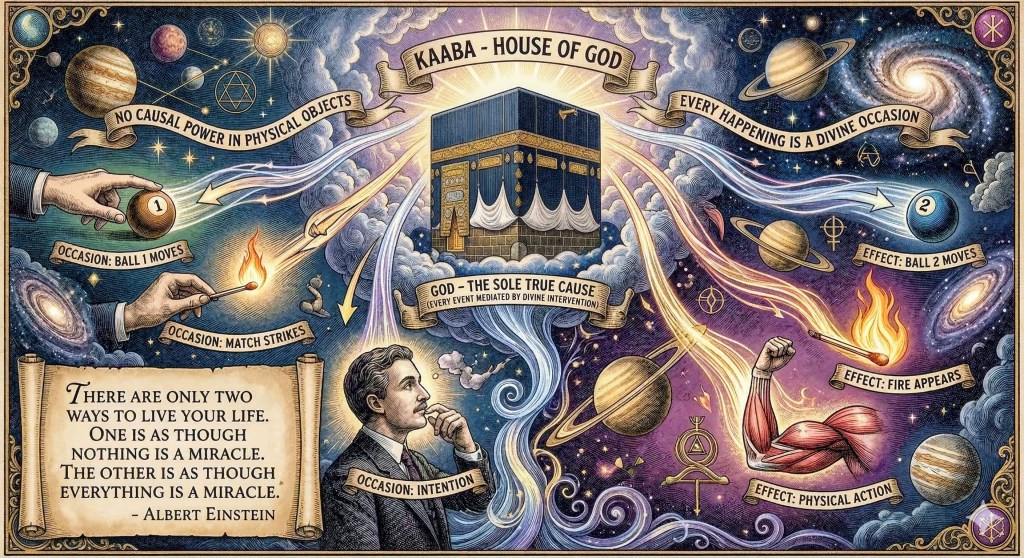
- Occasionalism. For al-Ghazālī, “fire does not burn cotton by its own power,” and natural laws are “God’s customary actions, not necessary truths.” thequran In “Lawful Nature as Witness, Not Rival” (thequran.love, 27 October 2026), I argue that lawfulness is God’s signature, not His rival.
8.2 Objections, honestly stated
- “God of the gaps.” The argument of 51:20–23 rests as much on what we understand (lawfulness, intelligibility, life-friendliness) as on gaps. Explanation does not dissolve wonder. Hoyle’s resonance became more remarkable once it was understood.
- Concordism. Critics have challenged the “scientific miracle” (iʿjāz ʿilmī) genre: William Campbell on Bucaille, Khaled Montaser’s Wahm al-iʿjāz al-ʿilmī, Parvez Hoodbhoy and Taner Edis. Mahmud Shaltut of al-Azhar warned against tying scripture to provisional science. thequran Their warning is sound, which is why this commentary speaks of resonance.
- Evolution. Evolution describes how. It does not show that the process explains itself, and it has not explained experience.
- Anthropic and multiverse objections. At most, they relocate fine-tuning rather than remove it.
- Divine hiddenness. In “The Seeker Is Never Abandoned” (thequran.love, 14 October 2026), I answer J.L. Schellenberg through 57:3. God is both al-Ẓāhir and al-Bāṭin: manifest in His signs, hidden in His essence, thequran and, as 51:23 shows, as close as your own voice.
- Suffering. See “The Question of Suffering and the Response of Atheists” (thequran.love, 25 October 2026). Verse 51:19’s “right of the beggar and the deprived” shows that the surah places part of God’s provision in our hands.
9. Thematic Epilogue: From the Voice to the Voice-Giver
Sūrat al-Dhāriyāt begins with wind scattering dust and ends its first movement with a human voice. In between, it surveys the sciences:
- meteorology: the winds and clouds;
- geology: the earth and its anchored mountains;
- biology and philosophy of mind: the self;
- cosmology: the sky that holds our provision and our promise.
Then it turns the hearer back on himself. You who are listening, and who will answer: you speak. You cannot doubt it. Then do not doubt this.
The argument climbs from the tangible to the intangible:
- Speech is the most tangible. We use it a thousand times a day.
- Behind speech is consciousness, which no one has explained in physical terms.
- Behind consciousness is a body built from a genome, a brain made of star-forged carbon, and blood carrying star-forged iron.
- Behind the body is a planet held habitable by roots of rock, a molten iron core, a steadying Moon and a sky that rains down fertility.
- Behind the planet is a cosmos whose constants permit stars, chemistry and life.
- Behind the cosmos is the question each of these facts raises and none can answer by itself: why is there anything at all, and why this?
The Qur’an’s answer is the One whom 57:3 names in four words:
- al-Awwal, the First: before whom nothing was; arabnews
- al-Ākhir, the Last: to whom the promise returns;
- al-Ẓāhir, the Manifest: evident in every sign from the Himalaya to haemoglobin;
- al-Bāṭin, the Hidden: never seen, yet “nearer to him than his jugular vein” (50:16).
He is the God of Abraham, whose honoured guests arrive in the very next verse. He is the God of Isaac and Ishmael, of Jacob, Moses and Jesus, and of Muhammad, through whom this oath was spoken. He is al-Raḥmān, whose mercy spans creation, and al-Raḥīm, whose mercy is kept for those who answer. “The Most Merciful taught the Qur’an, created man, taught him speech” (55:1–4).
What should the gift of speech lead to? The surah answers soon after: “I did not create jinn and humans except that they should worship Me” (51:56). It gives the model in v.18: those who, before dawn, use their speech to seek forgiveness. Speech that recognizes its Giver becomes gratitude (shukr). Gratitude that understands itself becomes worship (ʿibāda). Worship that reaches certainty (yaqīn) completes what 51:20 began, for the signs are “for those who have certainty.”
The age of telescopes and genomes has not made this passage obsolete. It has made it more striking. We know far more than the first hearers about the earth’s roots, the self’s depths and the sky’s gifts, and we still cannot explain the simple fact that we can say so. The Qur’an asks us to hear in that fact the oath of the Lord of the heaven and the earth: it is the truth, just as surely as you speak. The fitting response is to use the gift to praise the Giver: al-ḥamdu li’llāhi rabbi’l-ʿālamīn.



Leave a Reply