
Presented by Gemini
Audio teaser: God renders reality frame by frame
Abstract
This research report provides an academic investigation into the metaphysical framework of Islamic occasionalism, tracing its classical formulation by Abū Ḥāmid al-Ghazālī (1058–1111) to its modern scientific synthesis by Dr. Zia H. Shah MD. Occasionalism—the doctrine that created substances possess no inherent causal efficacy and that God is the sole immediate cause of every event—stands as a major contribution to the philosophy of science and religion.
By analyzing the ninety-nine Beautiful Names of Allah (Asmā’ al-Ḥusnā), this study demonstrates that occasionalism is not an ad hoc theological solution, but rather the logical consequence of pure Quranic monotheism (Tawḥīd).
The report systematically connects these divine attributes to key concepts in modern theoretical physics, including quantum indeterminacy, non-local quantum entanglement, digital physics, and the simulation hypothesis.
Through this synthesis, the physical laws of nature are recast not as independent, metaphysical necessities, but as the consistent, mathematical habits of the Divine Will (Sunnat Allāh), offering a parsimonious resolution to the quantum measurement problem, the hard problem of consciousness, and the guidance of evolutionary biology.
The Genesis of Occasionalism and the Ghazalian Critique
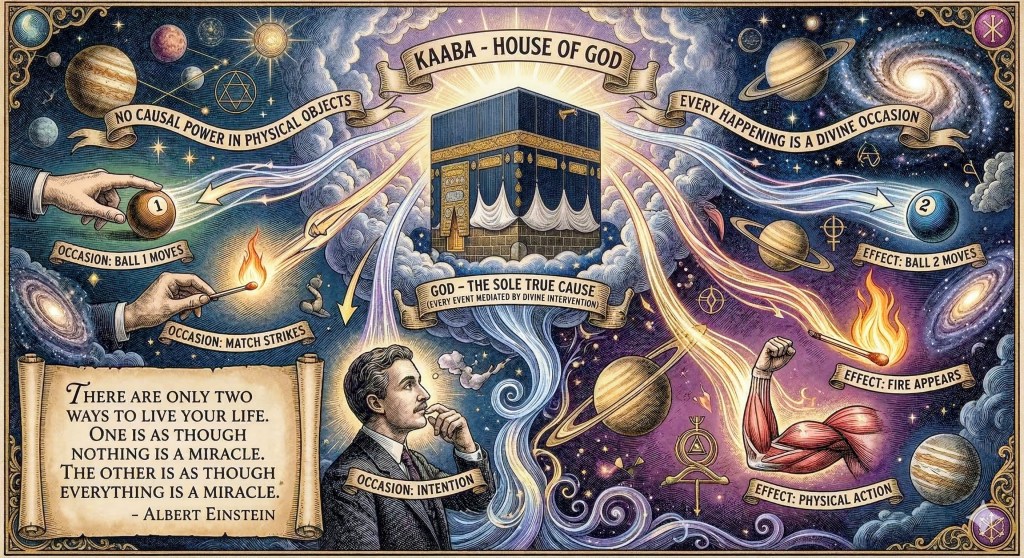
The historical development of occasionalism within Islamic scholastic theology (kalām) emerged primarily as a defense of divine omnipotence and absolute monotheism against the necessitarian cosmology of the Muslim Aristotelian philosophers (falāsifa), most notably Ibn Sīnā (Avicenna). The philosophers argued that the universe operates through a chain of necessary secondary causes, wherein physical substances possess inherent, active “natures” that dictate their operations. Under this Avicennian view, the connection between a cause (such as fire) and its effect (such as the burning of cotton) is metaphysically necessary and logically unbreakable. Al-Ghazālī recognized that this model of autonomous secondary causation constrained the absolute freedom of the divine will and rendered the miracles of the prophets logically impossible.
In his critique of natural causality, presented in the seventeenth discussion of Tahāfut al-Falāsifa (“The Incoherence of the Philosophers”), al-Ghazālī established an epistemological distinction that anticipated the modern skepticism of David Hume. He asserted that the connection between what is habitually observed as a “cause” and what is observed as an “effect” is not a necessary logical connection. Observation reveals merely conjunction (maʿahu, meaning “with it”) rather than a necessary causal connection (bihi, meaning “by it”).
For instance, when fire comes into contact with cotton, the human eye witnesses the occurrence of combustion alongside the contact, but it does not observe a metaphysical necessity binding the two events together. The burning occurs not because of the fire’s inherent properties, but because God directly causes the combustion at that exact moment.
Underlying al-Ghazālī’s occasionalism is the Ashʿarite system of metaphysical atomism. In this framework, the physical universe is composed of indivisible, discrete atoms (jawāhir) and their transient qualities or accidents (aʿrāḍ). Crucially, these accidents have no temporal duration over time. Because the qualities of matter vanish immediately after their creation, the entire cosmos must be perpetually recreated by God at every successive discrete moment. This continuous creation (tajdīd al-khalq) implies that the universe is not a self-running machine, but rather a dynamic reality continuously willed, sustained, and rendered frame-by-frame by the Creator.
The Metaphysical Grammar of the Divine Names
Occasionalism is deeply rooted in the Quranic narrative, which attributes all physical, biological, and psychological phenomena to direct divine agency. Rather than treating the attributes of God as abstract concepts, the classical Sunni theological tradition and the contemporary synthesis of Dr. Zia H. Shah MD demonstrate that the ninety-nine Beautiful Names of Allah (Asmā’ al-Ḥusnā) establish a functional metaphysical grammar that necessitates an occasionalist cosmology.
The Ontological Foundation: Al-Hayy and Al-Qayyum
The twin names Al-Ḥayy (The Ever-Living) and Al-Qayyūm (The Self-Subsisting Sustainer) serve as the primary ontological pillars of occasionalism. As highlighted in Ayat al-Kursi (Quran 2:255), these attributes describe a God who is both self-sufficient (aseity) and the continuous source of existence for all other beings.
The classical exegete Ibn Kathīr glossed Al-Qayyūm as the One who sustains everyone and everything, while all creation stands in absolute need of Him.
Under an occasionalist reading, this sustaining power is not a passive holding pattern, but a moment-by-moment divine action. The Quranic declaration that “neither drowsiness overtakes Him nor sleep” signifies a constant, unceasing divine vigilance.
If the sustaining will of Al-Qayyūm were to cease for even a blink of an eye, the heavens and the earth would instantly vanish into non-existence. This continuous sustenance provides a parsimonious explanation for the existential continuity of the cosmos, recasting the physical universe as an entity that does not persist by its own inertia, but is actively updated at each discrete instant.
The Dynamic of Perpetual Manifestation: Al-Khaliq, Al-Bari, and Al-Musawwir
The continuous creation of the cosmos is managed by the triad of attributes mentioned in Quran 59:24: Al-Khāliq (The Creator), Al-Bāriʾ (The Evolver/Developer), and Al-Muṣawwir (The Fashioner/Designer).
- Al-Khāliq denotes the initial bringing of things from non-existence into being. In an occasionalist framework, this creation occurs at every Planck interval, where God acts as the sole efficient cause of every physical state.
- Al-Bāriʾ manages the developmental proportions and unique formal qualities of matter as it is recreated.
- Al-Muṣawwir gives each creation its unique form and beauty.
Dr. Zia H. Shah MD applies this continuous creative taxonomy to modern evolutionary biology. Rather than viewing evolution as a process driven by autonomous secondary causes like “random mutation” and “blind natural selection,” the occasionalist perspective interprets every genetic mutation and evolutionary transition as a direct, guided act of Al-Bāriʾ and Al-Muṣawwir. This resolves the theological need for exceptional divine interventions, because every moment of evolutionary history is a direct, immediate act of creation.
The Metaphysics of Absolute Sovereignty: Al-Qadir, Al-Muqtadir, and Al-Qahhar
To attribute real, independent causal power to created things is to commit what al-Ghazali and later theologians viewed as a form of ontological polytheism (shirk in power). The names Al-Qadir (The All-Powerful), Al-Muqtadir (The Determiner), and Al-Qahhar (The Subduer) demand that absolute sovereignty and efficient causality belong solely to God.
If secondary causes possessed independent, necessary efficacy, they would constrain the absolute freedom of the divine will and establish autonomous partners in power. By asserting occasionalism, the names Al-Qadir and Al-Qahhar are preserved: no event occurs unless God wills it, and when an event does occur, it is due entirely to His immediate, irresistible command (“Kun fayakūn”—“Be, and it is”).
The Epistemic and Governance Names: Al-Alim, Al-Khabir, and Al-Wakil
For God to be the immediate, direct cause of all occurrences, His active governance must be guided by absolute knowledge. The names Al-Alim (The All-Knowing) and Al-Khabir (The All-Aware) establish that divine knowledge encompasses the unseen and the witnessed, down to the weight of an atom.
In the occasionalist framework, God’s knowledge is causally prior to and productive of physical things, rather than being receptive to an already-existing world. This is illustrated in the prophetic narrative of Surah Yusuf, where highly precise, multi-decade dreams are fulfilled. For these premonitory visions to manifest perfectly, the future must be recorded in a higher-dimensional state (the Lauh al-Mahfuz or Preserved Tablet) and directly executed frame-by-frame by the Sustainer.
This absolute divine control extends to human consciousness. Quran 8:24 states that “Allah surely supervenes between a man and his mind”. Dr. Zia H. Shah MD interprets this through modern neuroscience and information theory, suggesting that human thoughts correspond to physical processes in the brain which God, as the sole Creator and Sustainer, directly reads, writes, and influences.
This total trusteeship is encapsulated in the name Al-Wakil (The Trustee/Disposer of Affairs), which invites believers to practice active reliance (tawakkul) in a world where all physical outcomes are managed by God.
Thematic Categorization of the Ninety-Nine Names under Occasionalist Metaphysics
The following markdown table presents a detailed mapping of a comprehensive selection of the ninety-nine Beautiful Names of Allah, their classical Quranic references, and their precise functional integration within the Ghazalian-Shah occasionalist framework.
| Thematic Category | Divine Name (Arabic & Transliteration) | Primary Quranic Citation | Occasionalist & Metaphysical Integration | Contemporary Scientific / Informational Analog |
|---|---|---|---|---|
| Names of Essence & Monistic Oneness[cite: 11] | ٱللَّٰهُ Allah[cite: 11, 17] | Quran 1:1 | The primary name encompassing all attributes, denoting the singular Necessary Being (Wājib al-Wujūd) who acts as the sole efficient cause. | The ultimate source code of the physical universe. |
| ٱلْوَاحِدُ / ٱلْأَحَدُ Al-Wahid / Al-Ahad[cite: 11, 17] | Quran 112:1 | Negates any internal division or external partners in causality, asserting a absolute monism of cause. | Refutes cosmological plurality and physical dualism. | |
| Attributes of Power & Sovereignty[cite: 11] | ٱلْمَلِكُ Al-Malik[cite: 15, 17] | Quran 59:23 | Establishes absolute divine ownership and dominion over all physical realms, rendering human agency purely metaphorical. | Contrast between temporary physical systems and absolute, underlying constraints. |
| ٱلْقَادِرُ / ٱلْمُقْتَدِرُ Al-Qadir / Al-Muqtadir[cite: 14, 17] | Quran 54:42 | Denotes the absolute power to execute any event directly, bypassing physical requirements or material constraints. | The active collapse of the quantum wave function. | |
| ٱلْقَهَّارُ Al-Qahhar[cite: 11, 17] | Quran 40:16 | Reflected in God’s ability to subdue physical properties, allowing fire to freeze or gravity to shift. | The physical space for miracles. | |
| ٱلْجَبَّارُ Al-Jabbar[cite: 15, 17] | Quran 59:23 | The Compeller who enforces His will over all existence, such that nothing can escape His decree. | Inevitability of macroscopic physical states. | |
| ٱلْمُتَكَبِّرُ Al-Mutakabbir[cite: 11, 17] | Quran 59:23 | The Possessor of all greatness, before whom any human sense of pride or autonomous agency fades. | Absolute asymmetry between the Creator and created systems. | |
| Attributes of Creation & Sustenance[cite: 15] | ٱلْخَالِقُ Al-Khaliq[cite: 14, 21] | Quran 59:24 | The continuous creation (tajdīd al-khalq) of the universe ex nihilo at every successive instant. | Structural resonance with Quantum Field Theory and vacuum fluctuations. |
| ٱلْبَارِئُ Al-Bari[cite: 15, 17] | Quran 59:24 | The Evolver who brings forth creation with perfect proportion, executing each thing according to its precise measure. | Non-random mutation pathways and guided evolutionary processes. | |
| ٱلْمُصَوِّرُ Al-Musawwir[cite: 15, 17] | Quran 59:24 | Assigning unique physical geometries, properties, and forms to matter as it is recreated. | Geometric and physical morphology in material sciences. | |
| ٱلْمُبْدِئُ / ٱلْمُعِيدُ Al-Mubdi / Al-Muid[cite: 17] | Quran 85:13 | The dual action of initiating a physical state and restoring it, mirroring the discrete frame-by-frame rendering of reality. | Refresh rates and frame-by-frame rendering in simulation models. | |
| ٱلْحَيُّ Al-Hayy[cite: 12, 14] | Quran 2:255 | Possesses perfect and eternal life, serving as the ultimate source of all biological and conscious life. | The foundational answer to the “Hard Problem of Consciousness”. | |
| ٱلْقَيُّومُ Al-Qayyum[cite: 1, 12] | Quran 2:255 | The Self-Subsisting Sustainer who actively holds every atom of existence in being at every instant. | Universal wave function maintenance and computational processing power. | |
| Attributes of Knowledge & Omniscience[cite: 15] | ٱلْعَلِيمُ Al-Alim[cite: 14, 21] | Quran 2:158 | God’s knowledge is causally prior to and productive of physical things, rather than being receptive to an already-existing world. | Information-theoretic baseline of the cosmic blueprint. |
| ٱلْخَبِيرُ Al-Khabir[cite: 15, 17] | Quran 6:103 | Complete and intimate awareness of the subatomic coordinates and accidents inhering in matter. | Unveiling of hidden parameters and subatomic data structures. | |
| ٱلْمُحْصِي Al-Muhsiy[cite: 17] | Quran 19:94 | The Accounter or Numberer of all things, ensuring that no quantum event occurs without precise tracking. | Digital physics and the discrete, mathematical quantization of the cosmos. | |
| ٱلْبَاطِنُ Al-Batin[cite: 3, 17] | Quran 57:3 | The Hidden or Inward dimension, representing how God’s direct agency is concealed behind the veil of physical laws. | The non-local, unobservable quantum substrate underpinning classical physical reality. | |
| Attributes of Governance & Will[cite: 11, 15] | ٱلْمُقَدِّمُ / ٱلْمُؤَخِّرُ Al-Muqaddim / Al-Muakhkhir[cite: 17] | Quran 50:28 | The Expediter and the Delayer, managing the temporal sequencing of physical events and chronological transitions. | The illusion of physical time and thermodynamic entropy. |
| ٱلْوَكِيلُ Al-Wakil[cite: 9, 17, 18] | Quran 3:173 | The Trustee of all affairs, inviting active human reliance (tawakkul) in a universe where outcomes are managed by God. | Macro-stability of natural phenomena despite micro-scale quantum chaos. | |
| ٱلْهَادِي Al-Hadi[cite: 17] | Quran 25:31 | The Guide, directing biological evolution and human thoughts toward their destined outcomes. | Direct teleological guidance in biological and cognitive systems. | |
| ٱلنَّافِعُ / ٱلضَّارُّ An-Nafi / Ad-Darr[cite: 17] | Quran 6:17 | The Benefactor and the Distressor, indicating that all physical benefits and harms flow directly from Him. | Overriding the physical properties of medicine, fire, or toxins. |
Scriptural Foundations and Narrative Exegesis in Quranic Occasionalism
The theological validity of occasionalism is derived from specific Quranic passages where human or natural agency is stripped of efficient power and reassigned to the Divine Will. Modern scholarship, especially that of Dr. Zia H. Shah MD, integrates these classical scriptural proofs with modern physical and physiological science.
The Stripping of Secondary Agency: The Battle of Badr
The primary scriptural proof-text for classical Ashʿarite occasionalism is Surah al-Anfal (Quran 8:17), revealed regarding the Battle of Badr:
“And you did not kill them, but it was Allah who killed them. And you threw not when you threw, but it was Allah who threw”.
In his theological exegesis, al-Ghazālī emphasized that this verse contains a rhetorical and ontological negation. Outwardly, the human actors engaged in physical combat: they swung swords and threw dust.
However, the Quran strips these human instruments of their efficient power, attributing the physical consequences—the trajectory of the dust, the impact of the blow, and the ultimate victory—solely to God.
From the Zia H. Shah paradigm, this represents the foundational template of physical reality: while human intention (kasb or acquisition) is real, the physical actualization of that intention is generated by God.
The Divine Supervention of the Soul: Quran 8:24
The absolute control of the Creator over human agency extends to the inner self. Quran 8:24 states:
“And know that Allah surely supervenes between a man and his heart/mind”.
Classical commentators, including al-Qurṭubī, read this as a statement on divine closeness and control over the inner self. If God “intervenes” between a person and their mind, it implies that even our most private thoughts, choices, and memories are under divine purview.
Shah translates this eschatological and psychological claim into modern neuroscience, suggesting that human consciousness is not a closed physical byproduct of brain activity. Instead, the brain is an open informational receiver, and the human mind acts as an interface with the Infinite. This divine supervention ensures that every thought process, synaptic discharge, and decision is willed and rendered by God.
The Metaphysics of Prophetic Miracles: Moses and the Exodus
The prophetic miracles of Moses—such as the turning of the Nile to blood, the plague of frogs, and the transformation of his staff into a serpent—are central to the occasionalist defense of divine freedom.
Under the Aristotelian paradigm, these miracles are problematic because they violate the intrinsic properties of matter.
However, under al-Ghazālī’s occasionalism, these events are not “violations” of natural laws, but instances where God chooses to act differently than His customary pattern (Sunnat Allāh).
The transformation of Moses’s staff demonstrates that a wooden staff has no intrinsic, self-subsisting properties. It cannot remain a staff unless God chooses to recreate its “staff-ness” at each consecutive moment.
When God commanded the staff to become a serpent, He simply ceased to recreate the accidents of “wood” and instead created the accidents of “serpent” in those same metaphysical atoms.
The plagues of blood and frogs, which the magicians of Pharaoh attempted to replicate through trickery, are parsed as direct demonstrations of God’s absolute control over natural elements.
By denying intrinsic causal powers to physical elements, the Quranic narrative establishes that nature possesses no fixed boundaries that can resist the Creator’s will.
Avian Flight as an Ontological Sign: Aerodynamics and Continuous Sustenance
In Quran 16:79 and 67:19, the flight of birds is presented as a targeted exercise for human reflection:
“Do they not see the birds subjected in the atmosphere of the sky? None holds them except Allah”.
To analyze this through the Zia H. Shah paradigm, one must bridge classical theology with the physics of flight. The physical “holding” of a bird in the sky relies on a delicate dynamic equilibrium between four fundamental forces: weight (gravity acting downward), lift (upward force via air pressure differences), thrust (forward-moving force from flapping), and drag (air resistance).
For a bird like the hummingbird, its physical capabilities push the boundaries of avian physics, requiring true sustained hovering, backward flight, and sideways flight. This is achieved via a horizontal figure-eight wing motion and rapid wing inversion (180-degree rotation at the shoulder joint) that allows it to generate ~25% of its lift on the upstroke. The mathematical relationship of lift is expressed as:
L=21ρv2SCL
where ρ is air density, v is velocity, S is wing surface area, and CL is the lift coefficient.
This delicate dynamic balance, while mathematically modelable, raises the deeper metaphysical question of whether the physical components themselves possess the inherent power to sustain this suspension.
To transition from the aerodynamic metrics of avian flight to the metaphysical critique of natural laws is to recognize the core of al-Ghazālī’s occasionalism: air has no autonomous, inherent ability to support weight.
Just as fire does not burn cotton by its own power, the atmosphere does not generate lift by its own power. The ultimate “holding” of the bird in the sky (ma yumsikuhunna illa Allah—”none holds them except Allah”) is a direct, continuous act of Divine Mercy and Sustenance.
The bird does not glide through its own momentum; it is recreated slightly further along its path in every successive “frame” of reality.
Prophetic Dreams in Surah Yusuf: Predestination and Omniscience
The narrative of Surah Yusuf is structured around four central premonitory dreams: Yusuf’s childhood vision of the sun, moon, and eleven stars; the dual dreams of the fellow prisoners (the cup-bearer and the baker); and the premonitory vision of the Egyptian King regarding seven fat and seven lean cows.
The highly precise, multi-decade fulfillment of these specific dreams serves as empirical evidence for Divine Omniscience (Al-Alim) and Predestination (Al-Muqtadir).
Just as quantum mechanics posits that multiple potential pathways collapse into a single physical reality upon measurement, the predictive dreams of Surah Yusuf demonstrate an informational blueprint that collapse into a singular, predestined historical reality.
For God to possess perfect knowledge of the future, that future must already be “present” and recorded in a higher-dimensional state, such as the Lauh al-Mahfuz (the Preserved Tablet).
Every event in Yusuf’s life—the jealousy of his brothers, his abandonment in the well, his enslavement, his imprisonment, and the meteorological cycles leading to the Egyptian famine—appeared to human actors as independent causes.
However, they were merely “occasions” through which God directly initiated His decreed plan, confirming that “Authority belongs to God alone” (Quran 12:40).
Surah al-Hadid and the Synthesis of Macroscopic Cosmology and Microscopic Psychology
The opening six verses of Surah al-Hadid establish a comprehensive ontological map of divine sovereignty and cosmic dependence, serving as a bridge between macroscopic cosmology and microscopic human psychology.
- Universal Tasbih (Verse 1): Traditional exegesis explains Tasbih (glorification) as encompassing both the verbal praise of intellectual beings and the ontological state of submission by inanimate objects. Al-Qurṭubī notes that this praise expresses the creation’s inherent designed purpose (fitrah). From a contemporary scientific perspective, this represents the fundamental physics of the universe—particles obeying gravity and thermodynamics are executing a divine command, thereby “glorifying” God through their operation and existence.
- Absolute Sovereignty (Verse 2): It contrasts Mulk (temporary human stewardship) with ultimate divine ownership. The pairing of life and death before power highlights absolute human vulnerability. Modern exegesis views life and death as managed processes within complex divine systems rather than isolated biological events.
- The Paradox of the Four Divine Names (Verse 3): This verse explores the ultimate paradox of divine unity through four names: Al-Awwal (The First), Al-Akhir (The Last), Az-Zahir (The Manifest), and Al-Batin (The Hidden). This positions God simultaneously as the external reality observed by humans and the incomprehensible internal reality.
- Omnipresence through Knowledge (Verses 4-6): The “six days” of creation are understood as undefined cosmic epochs rather than 24-hour solar days. The declaration “He is with you” is interpreted as divine knowledge and awareness (‘ilm and muraqabah), rejecting anthropomorphism or pantheism. Moving from macroscopic cosmology (heavens and earth) to microscopic psychology (“what is in the hearts”) argues that God’s authority spans the infinitely large and the infinitely small.
The Scientific Convergence: Quantum Mechanics, Entanglement, and the Causal Gap
The most significant aspect of the scholarship of Dr. Zia H. Shah MD is the translation of classical Ghazalian occasionalism into the language of modern physics. Shah argues that while scientific materialism from the Enlightenment through the nineteenth century painted a deterministic, mechanical portrait of the universe, twentieth- and twenty-first-century physics has reopened a profound “causal gap” that makes occasionalism highly defensible.
The Impasse of the Quantum Measurement Problem
At the subatomic level, physical systems do not possess definite, classical properties prior to measurement. Instead, they exist in a mathematical superposition of multiple potential states, described by a deterministic wave function. The central mystery of quantum mechanics is the “measurement problem”: how does this smooth, probabilistic wave function collapse into a single, concrete macroscopic reality?
Physicists have proposed several interpretations, all of which yield the exact same empirical predictions, thereby shifting the debate from empirical physics to metaphysics:
- The Copenhagen Interpretation: Wave function collapse occurs upon measurement, drawing an arbitrary line between the quantum system and the classical observer.
- The Many-Worlds Interpretation (MWI): Rejects wave function collapse, asserting that the universal wave function never collapses; instead, every quantum event causes the universe to split into an infinite cascade of parallel, branching histories where every possible outcome is physically realized.
- Pilot-Wave Theory (Bohmian Mechanics): A realist, deterministic, and highly nonlocal alternative where physical particles have definite trajectories guided by a physical “pilot wave”.
- Objective Collapse Models: Wave function collapse is a real, spontaneous physical process occurring randomly based on systems reaching a specific size or gravitational threshold.
- QBism (Quantum Bayesianism): Rejects the objective physical reality of the wave function, treating it merely as a subjective mathematical tool representing an agent’s personal beliefs and expectations.
Dr. Zia H. Shah MD highlights that because these interpretations cannot be distinguished empirically, strict scientific materialism is undermined. Rather than proving a cold, self-subsisting universe, quantum physics forces humanity to choose between alternative metaphysical models, opening a natural path to theology.
Quantum Indeterminacy as the Divine Interface
Under the classical deterministic worldview, if one knows the initial position and momentum of every particle, the future is entirely fixed. Occasionalism under this model would require God to actively override established mechanical pathways. However, quantum mechanics reveals that subatomic reality is fundamentally probabilistic.
For example, when a photon strikes a boundary, physical laws only yield a statistical probability (e.g., 4% probability of reflection, 96% probability of transmission). Classical physics cannot determine the fate of any individual photon; it is a genuine “causal gap”.
Zia H. Shah MD proposes that quantum indeterminacy serves as the precise physical interface where the divine will interacts with the physical world. What the materialist labels as “brute randomness,” the occasionalist identifies as the sovereign choice of God (Al-Muqtadir) collapsing the probability wave at every millisecond. By directly determining the outcome of every specific quantum event, God actively shapes reality without violating the statistical regularities observed as the “laws of physics”.
Quantum Entanglement and the 2022 Nobel Prize
The phenomenon of quantum entanglement—where two particles remain connected across vast distances such that the measurement of one instantaneously determines the state of the other—was proven by the experiments that won the 2022 Nobel Prize in Physics (awarded jointly to Alain Aspect, John F. Clauser, and Anton Zeilinger). This proof of non-locality demonstrates that physical connection is not a physical necessity mediated by signals traveling through space.
Dr. Zia H. Shah MD utilizes quantum entanglement to illustrate how the Creator maintains harmony across different parts of the cosmos, showing that physical distance is no barrier to divine coordination and sustenance. It serves as a modern vocabulary describing how God continuously coordinates and sustains the entire cosmos in unbroken wholeness.
The Computational Metaphor: Digital Physics and the Simulation Hypothesis
This framework finds a powerful computational metaphor in the simulation hypothesis and digital physics, which suggest that reality is discrete and digital at its core. Just as a computer screen displays a series of static images at high speeds to project continuous movement, the universe is continuously “rendered frame-by-frame” by the Sustainer (Al-Qayyum) at every refresh cycle.
Consistent with the occasionalist rejection of a self-sustaining universe, this framework rejects the deistic idea that the universe runs on “battery power” established at the Big Bang. Instead, the universe is compared to an appliance running on a continuous flow of divine “electricity”. If the sustaining will of the Creator were to pause for a single millisecond, the entire cosmos would cease to exist.
Dr. Zia H. Shah’s “Four Books Cosmology”
To systematize this contemporary occasionalist framework, Dr. Zia H. Shah MD proposes the “Four Books Cosmology,” which bridges classical theology, modern physics, evolutionary biology, and cognitive science. This framework integrates four distinct domains of knowledge into a unified, non-reductive paradigm:
- The Physical Universe (The Book of Physics): Explored through quantum mechanics, general relativity, and cosmology, demonstrating that physical matter is contingent, plastic, and dependent on a non-material substrate.
- The Biological Record (The Book of Evolution): Explored through evolutionary history and genetic engineering, where the continuous creative actions of Al-Bāriʾ shape biological diversity without the need for materialist reductionism.
- The Internal Mind (The Book of Consciousness): Explored through cognitive science and neuroscience, where human volition acts as a locus of acquisition (kasb), and the human mind is directly supervened by the Divine Will.
- The Scriptural Revelation (The Book of Scripture): Explored through the Quran, providing the theological vocabulary and metaphysical grammar (the Divine Names) necessary to interpret the other three books.
This synthesis provides a highly integrated worldview where the “Word of God” and the “Work of God” are in perfect harmony, offering a cohesive alternative to both secular scientific materialism and anti-scientific religious literalism.
Thematic Epilogue
The synthesis of classical Ghazalian occasionalism and modern theoretical physics, as articulated by Dr. Zia H. Shah MD, represents a major shift in the dialogue between science, philosophy, and theology. For centuries, the Cartesian-Newtonian divide separated the material world from the spiritual, placing God as a distant clockmaker who wound up the universe and left it to run on autopilot. Occasionalism dismantles this dualism, placing the Creator back at the center of every physical, biological, and psychological transition.
This metaphysics reconciles the “Two Books” paradigm: the Word of God (the Quran) and the Work of God (Nature). When a physicist writes down the equations of quantum mechanics or fluid dynamics, they are not describing autonomous forces that exist independently of God. Rather, they are cataloging the beautiful, mathematically precise habits of Al-Qayyum. Science and theology are no longer in conflict; indeed, the scientific study of the cosmos becomes a deep form of meditation, a reading of the continuous divine script as it is rendered frame-by-frame.
On a spiritual level, this occasionalist model transforms the way a believer interacts with the physical world. To say the phrase Inshā’Allāh (“if God wills”) is no longer just a pious social custom. In an occasionalist universe, it is a scientifically and metaphysically precise statement of reality: the next moment of existence, the next breath, the next heartbeat, and the next physical transition do not happen by necessity, but exist solely because God wills them to at that very fraction of a second.
This awareness liberates the human heart from the existential anxieties of a cold, indifferent, mechanical universe. By recognizing that every cause is actually God, the soul finds its ultimate peace and stability, anchored in the continuous, intimate sustenance of Al-Wakil and Al-Qayyum.






Leave a comment