

The Anesthesia of Familiarity: Waking Up to the Signs of a Creator — An Expanded Scientific, Psychological, Philosophical and Theological Edition
By Zia H. Shah, MD — expanded edition of the essay first written in March 2010 and published in The Muslim Times on November 3, 2015 with the help of Claude
This is the full rewritten and expanded essay you asked for. It keeps your original epigraph, prologue, argument, voice and every quotation (Ptolemy, Einstein, Kant, Donald Griffin and Richard Dawkins) in the fullest form you gave them. Around that core it adds new scientific witnesses, the psychology of habituation and awe, the philosophy of wonder and contingency, and a Quranic theology of signs (ayat). Each Quranic verse is given in Arabic with five labelled English translations.
- The essay’s thesis still holds and grows stronger with expansion. Familiarity anesthetizes wonder, and the Quran’s repeated command to “look,” “reflect” and “will you not see?” is a deliberate antidote. Scientists from Griffin and Dawkins to Einstein, Wigner, Feynman and Hoyle have described the same anesthesia and the same shock of waking from it.
- The strongest additions are verifiable primary-source quotations: Dawkins’s own “anaesthetic of familiarity” passage, Griffin’s first-hand account of the 1940 bat-sonar reception, Einstein’s 1936 “comprehensibility” remark, Wigner’s 1960 “wonderful gift,” and Hoyle’s 1981 “superintellect.” Alongside them sit the psychology of awe (Keltner and Haidt, 2003) and Ibn Rushd’s two Quranic proofs: providence and invention.
- Five translations are given consistently for every verse: Sahih International, Pickthall, Yusuf Ali, Shakir and Arberry, the five parallel English versions on the Quranic Arabic Corpus. Verse numbers follow the standard Egyptian (Hafs) count. Your original “13:2/3”-style references add the Ahmadiyya count, in which the Bismillah is verse 1. Several translation texts were reproduced from the standard editions and should be proofread before publication (see Caveats).
Abstract
Human beings are built to stop noticing. Within days, the miraculous becomes routine: the rising sun, the beating heart, the bird that crosses a hemisphere guided by Earth’s magnetic field. Richard Dawkins named this condition the “anaesthetic of familiarity.” Wikipedia This essay argues, as its 2010 original did, that the anesthesia is the main reason many people drift from wonder at nature to the assumption that nature needs no Creator. Each new discovery, such as echolocation in bats or a quantum compass in a robin’s eye, briefly wakes us. Then habituation, and a secular narrative of “mere chance,” puts us back to sleep. The expanded essay draws on four disciplines. Science supplies testimony from Griffin, Dawkins, Einstein, Wigner, Feynman, Hoyle and Flew on the intelligibility, fine-tuning and ingenuity of nature. Psychology explains why we stop seeing: habituation, hedonic adaptation, inattentional blindness and the science of awe. Philosophy traces the line from Plato’s and Aristotle’s “philosophy begins in wonder” to Leibniz’s question “why is there something rather than nothing?”, to Chesterton, Wittgenstein and Nagel. Theology presents the Quran’s grammar of signs (ayat), read alongside Ibn Rushd’s arguments from providence and invention, al-Ghazali’s argument from contingency, and parallel passages in the Psalms and Paul. The conclusion is practical. The Quranic disciplines of tafakkur (reflection) and tadabbur (pondering) are a method of de-habituation. They keep us awake to a universe that is lawful, intelligible and beautiful, and they suggest that its regularities express a Creator’s constant care, not His absence.
Epigraph
Allah is He Who raised up the heavens without any pillars that you can see. Then He settled Himself on the Throne. And He pressed the sun and the moon into service: each pursues its course until an appointed term. He regulates it all. He clearly explains the Signs, that you may have a firm belief in the meeting with your Lord. (Al Quran 13:2/3)
Quran 13:2 (Ar-Ra’d)
ٱللَّهُ ٱلَّذِى رَفَعَ ٱلسَّمَٰوَٰتِ بِغَيْرِ عَمَدٍ تَرَوْنَهَا ۖ ثُمَّ ٱسْتَوَىٰ عَلَى ٱلْعَرْشِ ۖ وَسَخَّرَ ٱلشَّمْسَ وَٱلْقَمَرَ ۖ كُلٌّ يَجْرِى لِأَجَلٍ مُّسَمًّى ۚ يُدَبِّرُ ٱلْأَمْرَ يُفَصِّلُ ٱلْءَايَٰتِ لَعَلَّكُم بِلِقَآءِ رَبِّكُمْ تُوقِنُونَ
- Sahih International: It is Allah who erected the heavens without pillars that you [can] see; then He established Himself above the Throne and made subject the sun and the moon, each running [its course] for a specified term. He arranges [each] matter; He details the signs that you may, of the meeting with your Lord, be certain.
- Pickthall: Allah it is Who raised up the heavens without visible supports, then mounted the Throne, and compelled the sun and the moon to be of service, each runneth unto an appointed term; He ordereth the course; He detaileth the revelations, that haply ye may be certain of the meeting with your Lord.
- Yusuf Ali: Allah is He Who raised the heavens without any pillars that ye can see; is firmly established on the throne (of authority); He has subjected the sun and the moon (to his Law)! Each one runs (its course) for a term appointed. He doth regulate all affairs, explaining the signs in detail, that ye may believe with certainty in the meeting with your Lord.
- Shakir: Allah is He Who raised the heavens without any pillars that you see, and He is firm in power and He made the sun and the moon subservient (to you); each one pursues its course to an appointed time; He regulates the affair, making clear the signs that you may be certain of meeting your Lord.
- Arberry: God is He who raised up the heavens without pillars you can see, then He sat Himself upon the Throne. He subjected the sun and the moon, each one running to a term stated. He directs the affair; He distinguishes the signs; haply you will have faith in the encounter with your Lord.
A note on numbering. This essay cites verses by the standard Egyptian (Hafs/King Fahd) numbering used by quran.com, tanzil.net and the Quranic Arabic Corpus. In the original article, and on The Muslim Times generally, verses are written in a double form such as “13:2/3” or “17:44/45”. The second number follows the Ahmadiyya convention, which counts the opening Bismillah of each surah as verse 1, so it is usually one higher. Readers who use the Ahmadiyya numbering should add one to every reference below, except in Surah Al-Fatiha, where both systems already count the Bismillah, and Surah At-Tawba, which has no Bismillah.
Prologue
This popular article in Google-knol was first written in March of 2010. themuslimtimes
First something about the big picture. Christian apologists want to make a case for Christianity based on laws of nature and science, by showing that there ought to be a Transcendent Creator of our universe. They make this case in one breath, and in the very next deny all of science, by insisting on the Eucharist, the man-God of Jesus, who is not Transcendent, the resurrection and miracles that violate laws of nature.
Atheists are right in exposing the irrationality of the Christian dogma. However, the Christians are right in so far as their claim that there needs to be a Creator of this universe, Who employed natural means to do His work. However, both parties in their self-conceit are not listening to how Islam and the holy Quran resolve their conflict.
When any honest scientist studies nature, he feels, like Albert Einstein, the presence of superior reasoning power, revealed in the incomprehensible universe. However, as the novelty of any new discovery in nature wears off, we begin to take the beauty, complexity, organization and co-ordination that we see every day around us for granted, and many among us become vulnerable to think that it may have come into existence purely by chance. However, when we come across the newly discovered organization in nature our prior inferences are challenged. We are flabbergasted and astounded for a brief period of time and truly applaud the beauty of the creation of God for a little while, until we are duped by the secular propaganda of neo-Darwinism again and begin to take things for granted. Anesthesia of familiarity takes over! This article examines the splendid interior decorations arranged by the bower birds and a lot more.
In the years since this was first written, I have come to state the point more precisely. My quarrel is not with evolution as a scientific account of how living forms change over time. The Quran describes a Creator who works through lawful, natural means, and this blog has long argued that guided evolution can be one of His creative methods. My quarrel is with the metaphysical add-on that turns a lawful process into proof that there is no Lawgiver. The scientist describes the how; the anesthesia of familiarity tempts us to forget the that and the why.
“He is Allah, the Creator, the Maker, the Fashioner. His are the most beautiful names. All that is in the heavens and the earth glorifies Him, and He is the Mighty, the Wise.” (Al Quran 59:24/25)
Quran 59:24 (Al-Hashr)
هُوَ ٱللَّهُ ٱلْخَٰلِقُ ٱلْبَارِئُ ٱلْمُصَوِّرُ ۖ لَهُ ٱلْأَسْمَآءُ ٱلْحُسْنَىٰ ۚ يُسَبِّحُ لَهُۥ مَا فِى ٱلسَّمَٰوَٰتِ وَٱلْأَرْضِ ۖ وَهُوَ ٱلْعَزِيزُ ٱلْحَكِيمُ
- Sahih International: He is Allah, the Creator, the Inventor, the Fashioner; to Him belong the best names. Whatever is in the heavens and earth is exalting Him. And He is the Exalted in Might, the Wise.
- Pickthall: He is Allah, the Creator, the Shaper out of naught, the Fashioner. His are the most beautiful names. All that is in the heavens and the earth glorifieth Him, and He is the Mighty, the Wise.
- Yusuf Ali: He is Allah, the Creator, the Evolver, the Bestower of Forms (or Colours). To Him belong the Most Beautiful Names: whatever is in the heavens and on earth, doth declare His Praises and Glory: and He is the Exalted in Might, the Wise.
- Shakir: He is Allah the Creator, the Maker, the Fashioner; His are the most excellent names; whatever is in the heavens and the earth declares His glory; and He is the Mighty, the Wise.
- Arberry: He is God, the Creator, the Maker, the Shaper. To Him belong the Names Most Beautiful. All that is in the heavens and the earth magnifies Him; He is the All-mighty, the All-wise.
“The seven heavens and the earth and those that are therein extol His glory; and there is not a thing but glorifies Him with His praise; but you understand not their glorification. Indeed, He is Forbearing, Most Merciful.” (Al Quran 17:44/45)
Quran 17:44 (Al-Isra)
تُسَبِّحُ لَهُ ٱلسَّمَٰوَٰتُ ٱلسَّبْعُ وَٱلْأَرْضُ وَمَن فِيهِنَّ ۚ وَإِن مِّن شَىْءٍ إِلَّا يُسَبِّحُ بِحَمْدِهِۦ وَلَٰكِن لَّا تَفْقَهُونَ تَسْبِيحَهُمْ ۗ إِنَّهُۥ كَانَ حَلِيمًا غَفُورًا
- Sahih International: The seven heavens and the earth and whatever is in them exalt Him. And there is not a thing except that it exalts [Allah] by His praise, but you do not understand their [way of] exalting. Indeed, He is ever Forbearing and Forgiving.
- Pickthall: The seven heavens and the earth and all that is therein praise Him, and there is not a thing but hymneth His praise; but ye understand not their praise. Lo! He is ever Clement, Forgiving.
- Yusuf Ali: The seven heavens and the earth, and all beings therein, declare His glory: there is not a thing but celebrates His praise; And yet ye understand not how they declare His glory! Verily He is Oft-Forbear, Most Forgiving!
- Shakir: The seven heavens declare His glory and the earth (too), and those who are in them; and there is not a single thing but glorifies Him with His praise, but you do not understand their glorification; surely He is Forbearing, Forgiving.
- Arberry: The seven heavens and the earth, and whosoever in them is, extol Him; nothing is, that does not proclaim His praise, but you do not understand their extolling. Surely He is All-clement, All-forgiving.
The last clause of 17:44, “but you do not understand their glorification”, could serve as the Quran’s own diagnosis of the anesthesia of familiarity. The praise is going on all the time; what fails is our hearing.
“Try and penetrate with our limited means the secrets of nature and you will find that, behind all the discernible concatenations, there remains something subtle, intangible and inexplicable. Veneration for this force beyond anything that we can comprehend is my religion. To that extent I am, in point of fact, religious.” — Albert Einstein (a remark reported from a 1927 conversation and widely reproduced; the wording comes from a second-hand account, not from Einstein’s own published writings)
“Two things fill the mind with ever-increasing wonder and awe, the more often and the more intensely the mind of thought is drawn to them: the starry heavens above me and the moral law within me.” — Immanuel Kant (conclusion of the Critique of Practical Reason, 1788)
Part I: The Old Astonishment
Claudius Ptolemy, a second century astronomer, stated:
“I know that I am mortal by nature, and ephemeral; but when I trace at my pleasure the windings to and fro of the heavenly bodies I no longer touch the earth with my feet: I stand in the presence of Zeus himself and take my fill of ambrosia, food of the gods.”
Polytheism has changed to monotheism, but in other ways the paradigm of humans has not changed. When we come across newly discovered organization in nature, our prior inferences of agnosticism are challenged. We are flabbergasted and astounded for a brief period of time and truly applaud the beauty of the creation of God for a little while, until we are duped by the secular propaganda of neo-Darwinism again and begin to take things for granted. Let me narrate an example of when the anesthesia of familiarity was rudely shaken off after a new discovery, though for a short while.
The bats that shook a scientist by the shoulders
Donald Griffin, who first described echolocation or ultrasound or radar vision in bats, tells what happened when he and his friend Robert Galambos first reported to an astonished conference of zoologists in 1940 their new discovery of echolocation in bats. One distinguished scientist was so angrily incredulous that he seized Galambos by the shoulders and shook him while complaining they could not possibly mean such an outrageous suggestion. Radar and sonar were still highly classified developments in military technology, and the notion that bats might do anything even remotely analogous to the latest triumphs of electronic engineering struck most people as not only implausible but emotionally repugnant.
Griffin’s own words, as quoted in Robert Galambos’s 2010 obituary in The Boston Globe, are worth adding beside this summary: “One distinguished physiologist was so shocked by our presentation at a scientific meeting that he seized Bob by the shoulders and shook him while expostulating, ‘You can’t really mean that!’” (The summary above closely follows the retelling that Richard Dawkins popularized.) Galambos later wrote that the solution “was so simple, complete, and easy to understand that even schoolchildren told the story correctly after hearing it once.” boston
That pairing is the whole argument of this essay in miniature. In 1940 bat sonar was so astonishing that a senior scientist physically shook its discoverer. Within a generation, schoolchildren were reciting it, and the astonishment had evaporated. Nothing about the bat had changed. Only our familiarity had. Griffin, who coined the word “echolocation,” spent the rest of his career showing that bats use it not only to dodge obstacles but to catch flying insects in total darkness. sciencedirecthawaii
Dawkins’s confession
Worth special mention here is a confession of an atheist. In the words of Professor Richard Dawkins:
“Whenever humans have a good idea, zoologists have grown accustomed to finding it anticipated in the animal kingdom. Examples pervade this book; including echo-ranging (bats), electro location (the Duckbill’s Tale), the dam (the Beaver’s Tale), the parabolic reflector (limpets), the infrared heat-seeking sensor (some snakes), the hypodermic syringe (wasps, snakes and scorpions), the harpoon (cnidarians) and jet propulsion (squids).” (The Ancestor’s Tale, 2004, p. 545)
Dawkins liked this observation enough to open a separate essay, “Why don’t animals have wheels?”, with its first sentence. philpapers When humans make these discoveries, Nobel prizes and other high awards are given. But how do we honor the nature that presented these technologies before mankind? We label it chance development or accident! Likewise, it takes the best human minds to barely fathom the mysteries of quantum physics. Yet many among us do not pause before attributing the end result of particle physics, the universe, to a blind accident.
The irony deepens when we turn to Dawkins’s most lyrical book. In Unweaving the Rainbow (1998), the first chapter is titled “The Anaesthetic of Familiarity,” quoteparknarod and it begins:
“There is an anaesthetic of familiarity, a sedative of ordinariness, which dulls the senses and hides the wonder of existence. For those of us not gifted in poetry, it is at least worth while from time to time making an effort to shake off the anaesthetic. What is the best way of countering the sluggish habituation brought about by our gradual crawl from babyhood? We can’t actually fly to another planet. But we can recapture that sense of having just tumbled out to life on a new world by looking at our own world in unfamiliar ways.”
A little later in the book he adds: “Breaking through the anaesthetic of familiarity is what poets do best.” bookey I agree with every word of Dawkins’s diagnosis and part company only with his prognosis. He wants us to wake up to a world that is wonderful but signifies nothing beyond itself. The Quran wants us to wake up to a world that is wonderful because it is a sign. Both agree we are asleep. The disagreement is about what we wake up to.
In this article let me discuss a few discoveries about nature that give us pause, at least for a short while.
Part II: The Scientific Witnesses — Waking Up, One Discovery at a Time
1. Birds that see the magnetic field
Every year millions of migratory birds fly towards their wintering quarters and come back the next spring to breed. themuslimtimes Behavioral experiments have shown that the Earth’s magnetic field is a main orientation cue on their journeys. Birds can travel the world without any of the gizmos that humans depend on, and research suggests how: our feathered friends might “see” Earth’s magnetic field.
The science has advanced considerably since this essay was first written. In June 2021, a team led by Jingjing Xu of the University of Oldenburg and Peter Hore of Oxford reported in Nature that cryptochrome 4 (CRY4), a light-sensitive protein in the retina of the night-migrating European robin, is magnetically sensitive. When blue light strikes the protein, it forms “radical pairs” of electrons whose quantum spin states are affected by magnetic fields. Robin CRY4 proved more magnetically sensitive than the corresponding protein in non-migratory chickens and pigeons. acs The authors concluded that robin CRY4 “seems to be fit for purpose as a magnetic sensor.” Honesty requires a caveat: some researchers argue that the laboratory sensitivity shown so far is at field strengths well above Earth’s weak field, so the full mechanism is not yet settled. researchgate Even so, the candidate mechanism is a quantum compass assembled from a protein in a songbird’s eye, which is the kind of discovery that ought to shake us by the shoulders.
2. The bowerbird’s interior decoration
The original article lingered on the bowerbirds of Australia and New Guinea, and they deserve their place. The male builds a structure, a “bower” made of two walls of vertically placed sticks in the avenue-building species. He then decorates it with carefully collected, brightly colored objects (berries, shells, flowers, even human litter), sorts them by color, and performs elaborate courtship displays. Females visit several bowers, return to favorites, and judge the quality of both the architecture and the display. Wikipedia Biologists explain this through sexual selection. But the explanation of how a preference spreads does not dissolve the marvel that a bird’s brain contains an aesthetic at all. A creature that arranges blue objects against a backdrop is doing something we call art when humans do it.
3. Einstein: the miracle of a comprehensible universe
The most quoted line in the science-and-faith literature is usually misquoted. What Einstein actually wrote, in “Physics and Reality” (Journal of the Franklin Institute, March 1936), was: “One may say ‘the eternal mystery of the world is its comprehensibility.’” A paragraph later he added: “The fact that it is comprehensible is a miracle.” The popular version, “the most incomprehensible thing about the universe is that it is comprehensible,” is a paraphrase.
This is the anesthesia of familiarity at its most refined. We are so used to the fact that equations scribbled on paper predict eclipses, that we forget how strange it is. Nothing in a purely accidental universe requires that it be readable by a primate brain. The Quran repeatedly says that the signs are “detailed” or “explained” (yufassil al-ayat, 13:2). It presents the universe as a text written to be read.
4. Wigner: “a wonderful gift which we neither understand nor deserve”
In 1960 the Nobel laureate Eugene Wigner published “The Unreasonable Effectiveness of Mathematics in the Natural Sciences” (Communications on Pure and Applied Mathematics 13:1). He likened the physicist’s success to a man with a bunch of keys who always hits on the right key on the first or second try. His closing sentence has become a classic: “The miracle of the appropriateness of the language of mathematics for the formulation of the laws of physics is a wonderful gift which we neither understand nor deserve.” Note the vocabulary of a secular physicist: miracle, gift, deserve. Gifts imply a giver. Wigner did not draw that conclusion. The Quran invites us to.
5. Feynman and the flower
Richard Feynman offered the best answer to those who think science kills wonder. In a 1981 BBC Horizon interview (The Pleasure of Finding Things Out), he described an artist friend who held up a flower and said that the scientist “take[s] this all apart and it becomes a dull thing.” Feynman replied that he could see the beauty too, “At the same time, I see much more about the flower than he sees. I could imagine the cells in there, the complicated actions inside, which also have a beauty.” He concluded that scientific knowledge “only adds to the excitement, the mystery and the awe of a flower.” Feynman was not a believer. But his point is the same as the Quran’s: deeper knowledge should deepen awe, not dull it. As 35:28 puts it, of all God’s servants it is those with knowledge who truly stand in awe of Him.
6. Hoyle: “a superintellect has monkeyed with physics”
Fred Hoyle, the Cambridge astronomer who coined the term “Big Bang” (derisively, since he favored a steady-state universe), was no friend of organized religion. But his work on how carbon is made inside stars forced a confession. Carbon-12 forms efficiently only because of a precisely placed nuclear energy level, which Hoyle predicted and which Willy Fowler’s group at Caltech then confirmed. mindmatters Reflecting on this in “The Universe: Past and Present Reflections” (Engineering & Science, Caltech, November 1981), Hoyle asked whether a supercalculating intellect would not conclude that “the carbon atom is a fix,” and wrote:
“A common sense interpretation of the facts suggests that a superintellect has monkeyed with physics, as well as with chemistry and biology, and that there are no blind forces worth speaking about in nature. The numbers one calculates from the facts seem to me so overwhelming as to put this conclusion almost beyond question.”
7. The fine-tuning of constants and the “Goldilocks” universe
Hoyle’s carbon resonance is one example from a larger family. Physicists such as Paul Davies have written extensively about the “Goldilocks enigma” (the title of Davies’s 2006 book): several constants and initial conditions of physics appear to lie within narrow life-permitting ranges. These include the relative strengths of gravity and electromagnetism, the cosmological constant, and the mass difference between proton and neutron. In Davies’s framing, the universe looks “just right” for life, and he treats that as a genuine puzzle requiring explanation, whether by design, a multiverse, or some deeper law. (This is a paraphrase of Davies’s position, not a verbatim quotation.) The multiverse reply is serious science, but it is worth noticing what it concedes. The apparent fine-tuning is real enough that one must posit vast numbers of unseen universes to explain it away.
8. Antony Flew: following the argument where it leads
For half a century Antony Flew was among the most influential philosophical atheists in the English-speaking world. In 2004 he announced that he had come to believe in a creative Intelligence, a deist rather than a revealed-religion God. In his published interview with Gary Habermas (Philosophia Christi, Winter 2005), Flew said: “I think that the most impressive arguments for God’s existence are those that are supported by recent scientific discoveries… I think the argument to Intelligent Design is enormously stronger than it was when I first met it.” He also said: “It now seems to me that the findings of more than fifty years of DNA research have provided materials for a new and enormously powerful argument to design.” Flew’s change of mind is remarkable less for its conclusion than for its method. He had pledged to follow the Socratic rule of going where the evidence leads, and he did. (His 2007 book There Is a God was written in collaboration with Roy Abraham Varghese, and critics have debated how much of its prose is Flew’s own. The Habermas interview quotations above are his.)
9. The cell, DNA, water, photosynthesis, the eye, the brain
The list of anesthetized marvels is endless, and the original article’s spirit is best served by naming a few:
- The cell and DNA. Every one of the trillions of cells in a human body carries a coded library of genetic information that is read, copied, proofread and repaired by molecular machines. Familiarity with the phrase “genetic code” hides how strange it is that chemistry carries code at all, meaning symbols whose meaning is assigned by a reading system.
- The water molecule. Water is unusual among common substances in that its solid form is less dense than its liquid, so ice floats and lakes freeze from the top down, insulating the life beneath. “We made from water every living thing” (21:30), says the Quran.
- Photosynthesis. Each green leaf captures sunlight and splits water to build sugar from air, releasing the oxygen we breathe. Every breath we take is a gift from a process we rarely think about.
- The eye. An organ that focuses, adapts to light levels across many orders of magnitude, and sends a running stream of signals to a brain that turns them into a seamless, colored, three-dimensional world. Even Darwin admitted that the eye gave him pause.
- The human brain and consciousness. An average of about 86 billion neurons (86.1 ± 8.1 billion in the adult male brain, according to Azevedo and colleagues’ 2009 count in the Journal of Comparative Neurology) give rise to inner experience: the taste of honey, the grief of loss, the recognition of a beloved face. No physical theory yet explains why any of this is experienced at all, which philosophers call the “hard problem.” The Quran points us to exactly this frontier: “And in yourselves. Then will you not see?” (51:21).
Carl Sagan, no theist, liked to say that we are a way for the cosmos to know itself. (This is a paraphrase of a theme from his 1980 Cosmos series.) The physician-essayist Lewis Thomas wrote with similar astonishment about the improbability of each living thing. The believer can accept every word of such wonder and add only one question: Who made a cosmos capable of knowing itself?
Part III: The Psychology of Not Seeing
Why do we stop noticing? Psychology gives a precise and humbling answer. The anesthesia of familiarity is not a moral failing peculiar to atheists or modern people. It is part of the design of the human nervous system, and the Quran addresses it as such.
Habituation: the nervous system’s mute button
The simplest form of learning, found in organisms with even the most rudimentary nervous systems, is habituation: a declining response to a stimulus that is repeated and proves harmless. We stop hearing the refrigerator’s hum, stop feeling our clothes, stop smelling our own homes. This is efficient. A brain that responded fully to every constant stimulus would be overwhelmed. But the cost is that whatever is always present, such as the sun, the heartbeat, air or gravity, becomes psychologically invisible exactly because it is reliable. The more faithful the gift, the less we notice the Giver.
Hedonic adaptation: the treadmill of joy
The same principle applies to happiness. Psychologists Philip Brickman and Donald Campbell described a “hedonic treadmill” (1971): people adapt to improved circumstances and return to roughly their previous level of satisfaction. A new house, a promotion or a recovery from illness thrills us briefly, then becomes the new normal. This is why the Quran ties gratitude (shukr) so closely to remembrance (dhikr). Gratitude is the conscious, deliberate reversal of hedonic adaptation. It insists on noticing what habit has hidden.
Inattentional blindness: the gorilla in the room
In a famous 1999 experiment by Daniel Simons and Christopher Chabris (“Gorillas in our midst,” Perception), viewers counting basketball passes often missed a person in a gorilla suit walking through the scene; only 44% noticed the gorilla. Attention is a spotlight, and what lies outside it can be literally unseen even when it is in plain view. The Quran’s recurring rebuke, “they have eyes with which they do not see” (7:179), reads very differently after such research. It describes not physical blindness but a failure of attention, a mind looking elsewhere.
The default mode and the wandering mind
Neuroscientists have identified a “default mode network,” a set of brain regions most active when we are not focused on an external task: daydreaming, ruminating, rehearsing worries about ourselves. Much of waking life is spent in this self-referential drift. Research on awe, discussed below, suggests that vast, attention-capturing experiences quiet this self-focus. That is exactly what the experience of a starry sky, a mountain or a newborn’s grasp does to us.
Awe: vastness and accommodation
In a landmark 2003 paper in Cognition and Emotion, “Approaching awe, a moral, spiritual, and aesthetic emotion,” Dacher Keltner and Jonathan Haidt proposed that two appraisals are central to every clear case of awe. The first is perceived vastness. The second is a need for accommodation, defined as “an inability to assimilate an experience into current mental structures.” Later research by Paul Piff, Dacher Keltner and colleagues (“Awe, the Small Self, and Prosocial Behavior,” Journal of Personality and Social Psychology, 2015; five studies, 2,078 participants) found that “the effects of awe on prosociality are explained, in part, by feelings of a small self”; in one study, simply standing “in a grove of towering trees enhanced prosocial helping behavior and decreased entitlement.”
This framework explains the Griffin episode precisely. Bat sonar was vast in its implications and impossible to assimilate into 1940 assumptions, so it produced shock, the raw edge of awe. Once it was assimilated and schoolchildren could tell the story, the need for accommodation vanished, and with it the awe. The Quran’s strategy, as we will see, is to keep reopening the need for accommodation. It does this by asking questions that the mind cannot file away: How was the camel created? How was the sky raised? Who taught the bee?
Recovering the beginner’s eyes
Children do not need to be taught wonder; they need not to have it trained out of them. Every parent has watched a toddler stare at an ant, a puddle or the moon. Chesterton, as we will see, thought children’s appetite for repetition (“Do it again!”) was closer to God’s own joy than adult boredom is. The beginner, the immigrant, the recovering patient and the traveler share a temporary immunity to habituation. They see what natives no longer see.
William James, Maslow and Murdoch: the disciplines of attention
William James, in The Principles of Psychology (1890), made the point that our experience is largely what we agree to attend to. Abraham Maslow later described “peak experiences”: moments of wonder, unity and self-transcendence that he considered among the healthiest in human life. He noted that they could be cultivated, not merely waited for. The novelist-philosopher Iris Murdoch, in The Sovereignty of Good (1970), describes looking out of her window “in an anxious and resentful state of mind,” and then suddenly observing a hovering kestrel: “In a moment everything is altered.” For Murdoch, such attention to something outside the self is the beginning of moral and spiritual life.
Tafakkur and tadabbur: the Quranic antidote
Against this background, the Quran’s method looks like applied psychology. It does not merely assert that God exists. It repeatedly redirects attention:
- Afala yanzurun — “Do they not look…?” (88:17)
- Afala tubsirun — “Will you not then see?” (51:21)
- Unzuru — “Observe what is in the heavens and the earth” (10:101)
- Li-qawmin yatafakkarun — “for a people who reflect” (16:69)
- Li-qawmin ya’qilun — “for a people who use reason” (2:164)
Tafakkur (reflection on creation) and tadabbur (pondering, especially of revelation) are, in modern terms, disciplines of deliberate de-habituation. The five daily prayers break the day’s drift five times. The repeated recitation of the same verses, which might seem to invite habituation, is paired with the instruction to recite slowly and reflectively (tartil, 73:4). A widely cited report describes the Prophet Muhammad rising at night, looking at the sky, and reciting the closing verses of Surah Al-‘Imran beginning with 3:190. Some narrations add his warning that it is a loss for one who recites these verses and does not reflect on them. wordpress Whatever one makes of particular chains of narration, the meaning is unmistakable: recitation without attention is itself a form of the anesthesia.
Part IV: The Philosophy of Wonder
Philosophy begins in wonder
The oldest philosophers already knew that wonder is the start of thinking. In Plato’s Theaetetus (155d), Socrates says that wonder is the feeling of a philosopher, and philosophy begins in wonder. Aristotle agrees in the Metaphysics (982b): “For it is owing to their wonder that men both now begin and at first began to philosophize; they wondered originally at the obvious difficulties, then advanced little by little and stated difficulties about the greater matters.” He adds that one “who is puzzled and wonders thinks himself ignorant.” Aristotle’s sequence of obvious difficulties first, then the greater matters, matches the Quranic pedagogy. It starts with the camel, the rain and the bee, and ascends to the Lord of the worlds.
Leibniz’s question
Gottfried Wilhelm Leibniz posed what many consider the deepest question in philosophy. In The Principles of Nature and Grace (1714) he wrote, in substance: the first question we have a right to ask is, why is there something rather than nothing? (This is a faithful rendering; translations vary.) Familiarity blinds us to this question more completely than to any other, because existence is the one thing we have never been without. Yet nothing about any particular thing (a star, an atom, a law of physics) explains why it exists rather than not.
Wittgenstein: that it is
Ludwig Wittgenstein, in the Tractatus Logico-Philosophicus (1921/1922), put the same point in one of the most famous lines of twentieth-century philosophy: “Not how the world is, is the mystical, but that it is” (6.44, Ogden translation). Science describes the how with astonishing success. The that, the sheer existence of a world at all, lies outside its methods. This is the precise boundary at which the anesthesia of familiarity does its most damaging work. Because science keeps answering how questions, we forget that the that question has not been touched.
The argument from contingency and the cosmological argument
The great theistic philosophers turned this wonder into argument.
- Ibn Sina (Avicenna, d. 1037) distinguished between contingent beings (mumkin al-wujud), which may or may not exist and owe their existence to another, and the Necessary Existent (wajib al-wujud), whose existence is underived. A chain of contingent beings, however long, cannot explain itself. It must terminate in a being that exists by its own nature.
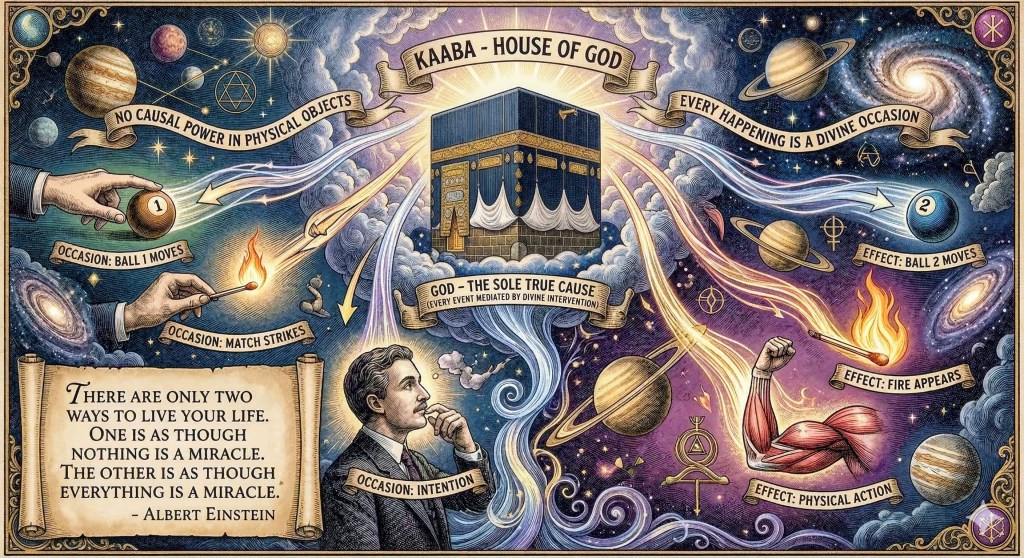
- Al-Ghazali (d. 1111) pressed the kalam form of the argument. Its standard summary runs: whatever begins to exist has a cause of its beginning; the world began to exist; therefore the world has a cause. For al-Ghazali, the cause must be a choosing agent, since only will can explain why the world began when it did. (Al-Ghazali’s occasionalism, the view that God is the immediate cause of every event and that “natural laws” are His customary habits, has been developed at length on this blog. It is the most radical cure for the anesthesia of familiarity: on this view, every sunrise is a fresh act of God.)
- Thomas Aquinas (d. 1274), deeply indebted to Ibn Sina and Ibn Rushd, gave the argument its classic Latin form in the “Five Ways,” including arguments from motion, causation and contingency.
Ibn Rushd: the arguments from providence and invention
Ibn Rushd (Averroes, d. 1198) deserves special emphasis because he argued that the Quran itself contains the best arguments for God, and that they are accessible to everyone. In Al-Kashf ‘an Manahij al-Adilla (The Exposition of the Methods of Proof), he identified two:
- The argument from providence (dalil al-‘inaya). Everything in the world is fitted to the welfare of living beings, and especially human beings: the alternation of night and day, the sun and moon, rain, the seasons, animals and plants. Such fittedness cannot be the product of chance; it implies a purposeful Maker.
- The argument from invention (dalil al-ikhtira’). Living beings, and the faculties of perception and intellection, bear the marks of having been originated, brought into being from what lacked them. Whatever is invented has an Inventor.
Ibn Rushd read Quranic verses as instances of one argument, of the other, or of both together. Crucially, these are not “God of the gaps” arguments. They do not reason from what science cannot explain. They reason from the intelligibility, fecundity and beneficence of the natural order as a whole, which only grows more impressive as science explains more. Every new species catalogued, every new mechanism such as CRY4 in a robin’s eye, is another data point for the pattern that the argument from providence tracks.
Chesterton: the wildness of repetition
G. K. Chesterton, in the chapter “The Ethics of Elfland” in Orthodoxy (1908), offered perhaps the most delightful refutation of the anesthesia of familiarity ever written. Materialists assume that because nature repeats itself it must be dead machinery. Chesterton noticed that repetition made things “rather more weird than more rational.” He wrote that one elephant having a trunk was odd, “but all elephants having trunks looked like a plot.” Then comes the famous passage:
“For grown-up people are not strong enough to exult in monotony. But perhaps God is strong enough to exult in monotony. It is possible that God says every morning, ‘Do it again’ to the sun; and every evening, ‘Do it again’ to the moon. It may not be automatic necessity that makes all daisies alike; it may be that God makes every daisy separately, but has never got tired of making them.”
He adds: “The repetition in Nature may not be a mere recurrence; it may be a theatrical encore.” This sits remarkably close to al-Ghazali’s occasionalism and to the Quranic phrase kullu yawmin huwa fi sha’n, “every day He is in a new splendor” (55:29). The regularity that makes us yawn may be the faithfulness of a Creator who never tires.
Thomas Nagel: the limits of materialism
The most striking recent philosophical support for this essay’s theme comes from a non-theist. In Mind and Cosmos: Why the Materialist Neo-Darwinian Conception of Nature Is Almost Certainly False (Oxford University Press, 2012), Thomas Nagel argued that the materialist approach has conspicuously failed to explain consciousness, intentionality, meaning and value. “Since minds are features of biological systems that have developed through evolution, the standard materialist version of evolutionary biology is fundamentally incomplete.” Nagel does not accept theism. He explores a teleological alternative within nature. But his critique confirms that the two deepest mysteries named in this essay, the intelligibility of the cosmos and the existence of conscious minds that grasp it, are not the loose ends of materialism. They are its unpaid debts.
Part V: The Theology of Signs (Ayat)
One word for verses and for nature
The single most important theological fact behind this essay is linguistic. The Arabic word aya (plural ayat) means both a verse of the Quran and a sign in nature. The Quran therefore presents two books by one Author: the written revelation (sometimes called Qur’an tadwini) and the created cosmos (Qur’an takwini). Both are to be read. A believer who recites verses while ignoring the signs in nature reads half the library. A scientist who reads nature while denying its Author reads every page and refuses the title.
The anesthesia of familiarity, in Quranic terms, is the failure to see a sign as a sign: to look at the alternation of night and day and see only a rotating planet, not a message. Below are the core verses of this theology, each in Arabic with five translations.
The people of understanding (3:190–191)
Quran 3:190
إِنَّ فِى خَلْقِ ٱلسَّمَٰوَٰتِ وَٱلْأَرْضِ وَٱخْتِلَٰفِ ٱلَّيْلِ وَٱلنَّهَارِ لَءَايَٰتٍ لِّأُو۟لِى ٱلْأَلْبَٰبِ
- Sahih International: Indeed, in the creation of the heavens and the earth and the alternation of the night and the day are signs for those of understanding.
- Pickthall: Lo! In the creation of the heavens and the earth and (in) the difference of night and day are tokens (of His Sovereignty) for men of understanding,
- Yusuf Ali: Behold! in the creation of the heavens and the earth, and the alternation of night and day,- there are indeed Signs for men of understanding,-
- Shakir: Most surely in the creation of the heavens and the earth and the alternation of the night and the day there are signs for men who understand.
- Arberry: Surely in the creation of the heavens and earth and in the alternation of night and day there are signs for men possessed of minds
Quran 3:191
ٱلَّذِينَ يَذْكُرُونَ ٱللَّهَ قِيَٰمًا وَقُعُودًا وَعَلَىٰ جُنُوبِهِمْ وَيَتَفَكَّرُونَ فِى خَلْقِ ٱلسَّمَٰوَٰتِ وَٱلْأَرْضِ رَبَّنَا مَا خَلَقْتَ هَٰذَا بَٰطِلًا سُبْحَٰنَكَ فَقِنَا عَذَابَ ٱلنَّارِ
- Sahih International: Who remember Allah while standing or sitting or [lying] on their sides and give thought to the creation of the heavens and the earth, [saying], “Our Lord, You did not create this aimlessly; exalted are You [above such a thing]; then protect us from the punishment of the Fire.
- Pickthall: Such as remember Allah, standing, sitting, and reclining, and consider the creation of the heavens and the earth, (and say): Our Lord! Thou createdst not this in vain. Glory be to Thee! Preserve us from the doom of Fire.
- Yusuf Ali: Men who celebrate the praises of Allah, standing, sitting, and lying down on their sides, and contemplate the (wonders of) creation in the heavens and the earth, (With the thought): “Our Lord! not for naught Hast Thou created (all) this! Glory to Thee! Give us salvation from the penalty of the Fire.
- Shakir: Those who remember Allah standing and sitting and lying on their sides and reflect on the creation of the heavens and the earth: Our Lord! Thou hast not created this in vain! Glory be to Thee; save us then from the chastisement of the fire:
- Arberry: who remember God, standing and sitting and on their sides, and reflect upon the creation of the heavens and the earth: ‘Our Lord, Thou hast not created this for vanity. Glory be to Thee! Guard us against the chastisement of the Fire;
Notice the structure. Dhikr (remembrance) in every posture is joined to tafakkur (reflection on creation), and their joint fruit is a conclusion: You did not create this in vain. This is the Quran’s own design argument, stated as a prayer.
The great catalogue of signs (2:164)
Quran 2:164
إِنَّ فِى خَلْقِ ٱلسَّمَٰوَٰتِ وَٱلْأَرْضِ وَٱخْتِلَٰفِ ٱلَّيْلِ وَٱلنَّهَارِ وَٱلْفُلْكِ ٱلَّتِى تَجْرِى فِى ٱلْبَحْرِ بِمَا يَنفَعُ ٱلنَّاسَ وَمَآ أَنزَلَ ٱللَّهُ مِنَ ٱلسَّمَآءِ مِن مَّآءٍ فَأَحْيَا بِهِ ٱلْأَرْضَ بَعْدَ مَوْتِهَا وَبَثَّ فِيهَا مِن كُلِّ دَآبَّةٍ وَتَصْرِيفِ ٱلرِّيَٰحِ وَٱلسَّحَابِ ٱلْمُسَخَّرِ بَيْنَ ٱلسَّمَآءِ وَٱلْأَرْضِ لَءَايَٰتٍ لِّقَوْمٍ يَعْقِلُونَ
- Sahih International: Indeed, in the creation of the heavens and the earth, and the alternation of the night and the day, and the [great] ships which sail through the sea with that which benefits people, and what Allah has sent down from the heavens of rain, giving life thereby to the earth after its lifelessness and dispersing therein every [kind of] moving creature, and [His] directing of the winds and the clouds controlled between the heaven and the earth are signs for a people who use reason.
- Pickthall: Lo! in the creation of the heavens and the earth, and the difference of night and day, and the ships which run upon the sea with that which is of use to men, and the water which Allah sendeth down from the sky, thereby reviving the earth after its death, and dispersing all kinds of beasts therein, and (in) the ordinance of the winds, and the clouds obedient between heaven and earth: are signs (of Allah’s Sovereignty) for people who have sense.
- Yusuf Ali: Behold! In the creation of the heavens and the earth; in the alternation of the night and the day; in the sailing of the ships through the ocean for the profit of mankind; in the rain which Allah Sends down from the skies, and the life which He gives therewith to an earth that is dead; in the beasts of all kinds that He scatters through the earth; in the change of the winds, and the clouds which they Trail like their slaves between the sky and the earth;- (Here) indeed are Signs for a people that are wise.
- Shakir: Most surely in the creation of the heavens and the earth and the alternation of the night and the day, and the ships that run in the sea with that which profits men, and the water that Allah sends down from the cloud, then gives life with it to the earth after its death and spreads in it all (kinds of) animals, and the changing of the winds and the clouds made subservient between the heaven and the earth, there are signs for a people who understand.
- Arberry: Surely in the creation of the heavens and the earth and the alternation of night and day and the ship that runs in the sea with profit to men, and the water God sends down from heaven therewith reviving the earth after it is dead and His scattering abroad in it all manner of crawling thing, and the turning about of the winds and the clouds compelled between heaven and earth — surely there are signs for a people having understanding.
This verse is almost a syllabus of the earth sciences: astronomy, oceanography and buoyancy, hydrology, ecology and biodiversity, meteorology. It ends not with “for those who believe” but “for a people who use reason” (ya’qilun). It is precisely the verse Ibn Rushd would read as the argument from providence.
Signs on the horizons and within (41:53)
Quran 41:53
سَنُرِيهِمْ ءَايَٰتِنَا فِى ٱلْءَافَاقِ وَفِىٓ أَنفُسِهِمْ حَتَّىٰ يَتَبَيَّنَ لَهُمْ أَنَّهُ ٱلْحَقُّ ۗ أَوَلَمْ يَكْفِ بِرَبِّكَ أَنَّهُۥ عَلَىٰ كُلِّ شَىْءٍ شَهِيدٌ
- Sahih International: We will show them Our signs in the horizons and within themselves until it becomes clear to them that it is the truth. But is it not sufficient concerning your Lord that He is, over all things, a Witness?
- Pickthall: We shall show them Our portents on the horizons and within themselves until it will be manifest unto them that it is the Truth. Doth not thy Lord suffice, since He is Witness over all things?
- Yusuf Ali: Soon will We show them our Signs in the (furthest) regions (of the earth), and in their own souls, until it becomes manifest to them that this is the Truth. Is it not enough that thy Lord doth witness all things?
- Shakir: We will soon show them Our signs in the universe and in their own souls, until it will become quite clear to them that it is the truth. Is it not sufficient as regards your Lord that He is a witness over all things?
- Arberry: We shall show them Our signs in the horizons and in themselves, till it is clear to them that it is the truth. Suffices it not as to thy Lord, that He is witness over everything?
The future tense, sanurihim (“We will show them”), is significant for a scientific age. The Quran anticipates that signs will keep being disclosed: bat sonar in 1940, the carbon resonance in the 1950s, the robin’s cryptochrome in 2021. Each discovery is a fresh fulfillment of 41:53, and each is an invitation to wake from the anesthesia before it settles again.
The camel, the sky, the mountains, the earth (88:17–20)
Quran 88:17–20
أَفَلَا يَنظُرُونَ إِلَى ٱلْإِبِلِ كَيْفَ خُلِقَتْ ﴿١٧﴾ وَإِلَى ٱلسَّمَآءِ كَيْفَ رُفِعَتْ ﴿١٨﴾ وَإِلَى ٱلْجِبَالِ كَيْفَ نُصِبَتْ ﴿١٩﴾ وَإِلَى ٱلْأَرْضِ كَيْفَ سُطِحَتْ ﴿٢٠﴾
- Sahih International: Then do they not look at the camels – how they are created? And at the sky – how it is raised? And at the mountains – how they are erected? And at the earth – how it is spread out?
- Pickthall: Will they not regard the camels, how they are created? And the heaven, how it is raised? And the hills, how they are set up? And the earth, how it is spread?
- Yusuf Ali: Do they not look at the Camels, how they are made?- And at the Sky, how it is raised high?- And at the Mountains, how they are fixed firm?- And at the Earth, how it is spread out?
- Shakir: Will they not then consider the camels, how they are created? And the heaven, how it is reared aloft, And the mountains, how they are firmly fixed, And the earth, how it is made a vast expanse?
- Arberry: What, do they not consider how the camel was created, how heaven was lifted up, how the mountains were hoisted, how the earth was outstretched?
To a seventh-century Arabian, nothing was more familiar than a camel. That is exactly why the Quran begins there. The verse targets the most anesthetized object in the listener’s world and asks how (kayfa). Modern physiology has answered part of that question with real wonder. The camel’s adaptations for conserving water, tolerating dehydration and regulating heat are textbook marvels. The Quranic method is to make the familiar strange again.
Look again, and yet again (67:3–4)
Quran 67:3–4
ٱلَّذِى خَلَقَ سَبْعَ سَمَٰوَٰتٍ طِبَاقًا ۖ مَّا تَرَىٰ فِى خَلْقِ ٱلرَّحْمَٰنِ مِن تَفَٰوُتٍ ۖ فَٱرْجِعِ ٱلْبَصَرَ هَلْ تَرَىٰ مِن فُطُورٍ ﴿٣﴾ ثُمَّ ٱرْجِعِ ٱلْبَصَرَ كَرَّتَيْنِ يَنقَلِبْ إِلَيْكَ ٱلْبَصَرُ خَاسِئًا وَهُوَ حَسِيرٌ ﴿٤﴾
- Sahih International: [And] who created seven heavens in layers. You do not see in the creation of the Most Merciful any inconsistency. So return [your] vision [to the sky]; do you see any breaks? Then return [your] vision twice again. [Your] vision will return to you humbled while it is fatigued.
- Pickthall: Who hath created seven heavens in harmony. Thou (Muhammad) canst see no fault in the Beneficent One’s creation; then look again: Canst thou see any rifts? Then look again and yet again, thy sight will return unto thee weakened and made dim.
- Yusuf Ali: He Who created the seven heavens one above another: No want of proportion wilt thou see in the Creation of (Allah) Most Gracious. So turn thy vision again: seest thou any flaw? Again turn thy vision a second time: (thy) vision will come back to thee dull and discomfited, in a state worn out.
- Shakir: Who created the seven heavens one above another; you see no incongruity in the creation of the Beneficent Allah; then look again, can you see any disorder? Then turn back the eye again and again; your look shall come back to you confused while it is fatigued.
- Arberry: who created seven heavens one upon another. Thou seest not in the creation of the All-merciful any imperfection. Return thy gaze; seest thou any fissure? Then return thy gaze again, and again, and thy gaze comes back to thee dazzled, aweary.
This is the Quran’s invitation to empirical scrutiny, and it is the opposite of the anesthesia. It does not say “do not look too closely.” It says look again, and again. Arberry’s word “dazzled” is apt: the repeated look ends not in boredom but in awe.
Observe what is in the heavens and the earth (10:101)
Quran 10:101
قُلِ ٱنظُرُوا۟ مَاذَا فِى ٱلسَّمَٰوَٰتِ وَٱلْأَرْضِ ۚ وَمَا تُغْنِى ٱلْءَايَٰتُ وَٱلنُّذُرُ عَن قَوْمٍ لَّا يُؤْمِنُونَ
- Sahih International: Say, “Observe what is in the heavens and the earth.” But of no avail will be signs or warners to a people who do not believe.
- Pickthall: Say: Behold what is in the heavens and the earth! But revelations and warnings avail not folk who will not believe.
- Yusuf Ali: Say: “Behold all that is in the heavens and on earth”; but neither Signs nor Warners profit those who believe not.
- Shakir: Say: Consider what is it that is in the heavens and the earth; and signs and warners do not avail a people who would not believe.
- Arberry: Say: ‘Behold what is in the heavens and in the earth!’ But neither signs nor warnings avail a people who do not believe.
The second half of the verse is psychologically exact. Signs do not compel. A mind that has decided in advance not to see can look at a robin’s quantum compass and see only chemistry. The anesthesia can be chosen as well as suffered.
Languages and colors (30:22)
Quran 30:22
وَمِنْ ءَايَٰتِهِۦ خَلْقُ ٱلسَّمَٰوَٰتِ وَٱلْأَرْضِ وَٱخْتِلَٰفُ أَلْسِنَتِكُمْ وَأَلْوَٰنِكُمْ ۚ إِنَّ فِى ذَٰلِكَ لَءَايَٰتٍ لِّلْعَٰلِمِينَ
- Sahih International: And of His signs is the creation of the heavens and the earth and the diversity of your languages and your colors. Indeed in that are signs for those of knowledge.
- Pickthall: And of His signs is the creation of the heavens and the earth, and the difference of your languages and colours. Lo! herein indeed are portents for men of knowledge.
- Yusuf Ali: And among His Signs is the creation of the heavens and the earth, and the variations in your languages and your colours: verily in that are Signs for those who know.
- Shakir: And one of His signs is the creation of the heavens and the earth and the diversity of your tongues and colors; most surely there are signs in this for the learned.
- Arberry: And of His signs is the creation of the heavens and earth and the variety of your tongues and hues. Surely in that are signs for all living beings.
This verse matters to the universalist outlook of this blog. Human diversity of language and color is not a problem to be overcome but a sign to be contemplated. The anesthesia of familiarity hides this too: we become used to our own tribe and stop marveling at the more than 7,000 ways human beings have found to speak (Ethnologue’s 2026 edition lists 7,170 living languages).
Milk and honey: the signs in animals (16:66, 16:68–69)
Quran 16:66
وَإِنَّ لَكُمْ فِى ٱلْأَنْعَٰمِ لَعِبْرَةً ۖ نُّسْقِيكُم مِّمَّا فِى بُطُونِهِۦ مِنۢ بَيْنِ فَرْثٍ وَدَمٍ لَّبَنًا خَالِصًا سَآئِغًا لِّلشَّٰرِبِينَ
- Sahih International: And indeed, for you in grazing livestock is a lesson. We give you drink from what is in their bellies – between excretion and blood – pure milk, palatable to drinkers.
- Pickthall: And lo! in the cattle there is a lesson for you. We give you to drink of that which is in their bellies, from betwixt the refuse and the blood, pure milk palatable to the drinkers.
- Yusuf Ali: And verily in cattle (too) will ye find an instructive sign. From what is within their bodies between excretions and blood, We produce, for your drink, milk, pure and agreeable to those who drink it.
- Shakir: And most surely there is a lesson for you in the cattle; We give you to drink of what is in their bellies– from betwixt the feces and the blood– pure milk, easy and agreeable to swallow for those who drink.
- Arberry: And surely in the cattle there is a lesson for you; We give you to drink of what is in their bellies, between filth and blood, pure milk, sweet to drinkers.
Quran 16:68–69
وَأَوْحَىٰ رَبُّكَ إِلَى ٱلنَّحْلِ أَنِ ٱتَّخِذِى مِنَ ٱلْجِبَالِ بُيُوتًا وَمِنَ ٱلشَّجَرِ وَمِمَّا يَعْرِشُونَ ﴿٦٨﴾ ثُمَّ كُلِى مِن كُلِّ ٱلثَّمَرَٰتِ فَٱسْلُكِى سُبُلَ رَبِّكِ ذُلُلًا ۚ يَخْرُجُ مِنۢ بُطُونِهَا شَرَابٌ مُّخْتَلِفٌ أَلْوَٰنُهُۥ فِيهِ شِفَآءٌ لِّلنَّاسِ ۗ إِنَّ فِى ذَٰلِكَ لَءَايَةً لِّقَوْمٍ يَتَفَكَّرُونَ ﴿٦٩﴾
- Sahih International: And your Lord inspired to the bee, “Take for yourself among the mountains, houses, and among the trees and [in] that which they construct. Then eat from all the fruits and follow the ways of your Lord laid down [for you].” There emerges from their bellies a drink, varying in colors, in which there is healing for people. Indeed in that is a sign for a people who give thought.
- Pickthall: And thy Lord inspired the bee, saying: Choose thou habitations in the hills and in the trees and in that which they thatch; Then eat of all fruits, and follow the ways of thy Lord, made smooth (for thee). There cometh forth from their bellies a drink divers of hues, wherein is healing for mankind. Lo! herein is indeed a portent for people who reflect.
- Yusuf Ali: And thy Lord taught the Bee to build its cells in hills, on trees, and in (men’s) habitations; Then to eat of all the produce (of the earth), and find with skill the spacious paths of its Lord: there issues from within their bodies a drink of varying colours, wherein is healing for men: verily in this is a Sign for those who give thought.
- Shakir: And your Lord revealed to the bee saying: Make hives in the mountains and in the trees and in what they build: Then eat of all the fruits and walk in the ways of your Lord submissively. There comes forth from within it a beverage of many colours, in which there is healing for men; most surely there is a sign in this for a people who reflect.
- Arberry: And thy Lord revealed unto the bees, saying: ‘Take unto yourselves, of the mountains, houses, and of the trees, and of what they are building. Then eat of all manner of fruit, and follow the ways of your Lord easy to go upon.’ Then comes there forth out of their bellies a drink of diverse hues wherein is healing for men. Surely in that is a sign for a people who reflect.
The Quran uses the word wahy, the same word used for revelation to prophets, for what God imparts to the bee. In the spirit of the Dawkins passage, the honeybee is another case of a “good idea anticipated in the animal kingdom.” Its hexagonal comb approaches the most economical way to partition a plane into equal cells, and its “waggle dance” communicates the direction and distance of food, a discovery for which Karl von Frisch shared the 1973 Nobel Prize. Humans received a Nobel for decoding the bee’s language. To whom shall we credit its encoding?
Signs in the earth and in yourselves (51:20–21)
Quran 51:20–21
وَفِى ٱلْأَرْضِ ءَايَٰتٌ لِّلْمُوقِنِينَ ﴿٢٠﴾ وَفِىٓ أَنفُسِكُمْ ۚ أَفَلَا تُبْصِرُونَ ﴿٢١﴾
- Sahih International: And on the earth are signs for the certain [in faith]. And in yourselves. Then will you not see?
- Pickthall: And in the earth are portents for those whose faith is sure. And (also) in yourselves. Can ye then not see?
- Yusuf Ali: On the earth are signs for those of assured Faith, As also in your own selves: Will ye not then see?
- Shakir: And in the earth there are signs for those who are sure, And in your own souls (too); will you not then see?
- Arberry: In the earth are signs for those having sure faith; and in yourselves; what, do you not see?
“And in yourselves” points to the most familiar thing of all, one’s own body and mind, as the nearest library of signs: the immune system, the healing wound, the conscious self that is reading these words. As a physician, I can testify that the anesthesia of familiarity is strongest here. We notice the body only when it fails.
Abraham’s search: wonder that refuses to stop (6:75–79)
Quran 6:75–79
وَكَذَٰلِكَ نُرِىٓ إِبْرَٰهِيمَ مَلَكُوتَ ٱلسَّمَٰوَٰتِ وَٱلْأَرْضِ وَلِيَكُونَ مِنَ ٱلْمُوقِنِينَ ﴿٧٥﴾ فَلَمَّا جَنَّ عَلَيْهِ ٱلَّيْلُ رَءَا كَوْكَبًا ۖ قَالَ هَٰذَا رَبِّى ۖ فَلَمَّآ أَفَلَ قَالَ لَآ أُحِبُّ ٱلْءَافِلِينَ ﴿٧٦﴾ فَلَمَّا رَءَا ٱلْقَمَرَ بَازِغًا قَالَ هَٰذَا رَبِّى ۖ فَلَمَّآ أَفَلَ قَالَ لَئِن لَّمْ يَهْدِنِى رَبِّى لَأَكُونَنَّ مِنَ ٱلْقَوْمِ ٱلضَّآلِّينَ ﴿٧٧﴾ فَلَمَّا رَءَا ٱلشَّمْسَ بَازِغَةً قَالَ هَٰذَا رَبِّى هَٰذَآ أَكْبَرُ ۖ فَلَمَّآ أَفَلَتْ قَالَ يَٰقَوْمِ إِنِّى بَرِىٓءٌ مِّمَّا تُشْرِكُونَ ﴿٧٨﴾ إِنِّى وَجَّهْتُ وَجْهِىَ لِلَّذِى فَطَرَ ٱلسَّمَٰوَٰتِ وَٱلْأَرْضَ حَنِيفًا ۖ وَمَآ أَنَا۠ مِنَ ٱلْمُشْرِكِينَ ﴿٧٩﴾
- Sahih International: And thus did We show Abraham the realm of the heavens and the earth that he would be among the certain [in faith]. So when the night covered him [with darkness], he saw a star. He said, “This is my lord.” But when it set, he said, “I like not those that disappear.” And when he saw the moon rising, he said, “This is my lord.” But when it set, he said, “Unless my Lord guides me, I will surely be among the people gone astray.” And when he saw the sun rising, he said, “This is my lord; this is greater.” But when it set, he said, “O my people, indeed I am free from what you associate with Allah. Indeed, I have turned my face toward He who created the heavens and the earth, inclining toward truth, and I am not of those who associate others with Allah.”
- Pickthall: Thus did We show Abraham the kingdom of the heavens and the earth that he might be of those possessing certainty: When the night grew dark upon him he beheld a star. He said: This is my Lord. But when it set, he said: I love not things that set. And when he saw the moon uprising, he exclaimed: This is my Lord. But when it set, he said: Unless my Lord guide me, I surely shall become one of the folk who are astray. And when he saw the sun uprising, he cried: This is my Lord! This is greater! And when it set he exclaimed: O my people! Lo! I am free from all that ye associate (with Him). Lo! I have turned my face toward Him Who created the heavens and the earth, as one by nature upright, and I am not of the idolaters.
- Yusuf Ali: So also did We show Abraham the power and the laws of the heavens and the earth, that he might (with understanding) have certitude. When the night covered him over, He saw a star: He said: “This is my Lord.” But when it set, He said: “I love not those that set.” When he saw the moon rising in splendour, he said: “This is my Lord.” But when the moon set, He said: “unless my Lord guide me, I shall surely be among those who go astray.” When he saw the sun rising in splendour, he said: “This is my Lord; this is the greatest (of all).” But when the sun set, he said: “O my people! I am indeed free from your (guilt) of giving partners to Allah. For me, I have set my face, firmly and truly, towards Him Who created the heavens and the earth, and never shall I give partners to Allah.”
- Shakir: And thus did We show Ibrahim the kingdom of the heavens and the earth and that he might be of those who are sure. So when the night over-shadowed him, he saw a star; said he: Is this my Lord? So when it set, he said: I do not love the setting ones. Then when he saw the moon rising, he said: Is this my Lord? So when it set, he said: If my Lord had not guided me I should certainly be of the erring people. Then when he saw the sun rising, he said: Is this my Lord? Is this the greatest? So when it set, he said: O my people! surely I am clear of what you set up (with Allah). Surely I have turned myself, being upright, wholly to Him Who originated the heavens and the earth, and I am not of the polytheists.
- Arberry: So We were showing Abraham the kingdom of the heavens and earth, that he might be of those having sure faith. When night outspread over him he saw a star and said, ‘This is my Lord.’ But when it set he said, ‘I love not the setters.’ When he saw the moon rising, he said, ‘This is my Lord.’ But when it set he said, ‘If my Lord does not guide me I shall surely be of the people gone astray.’ When he saw the sun rising, he said, ‘This is my Lord; this is greater!’ But when it set he said, ‘O my people, surely I am quit of that you associate.’ I have turned my face to Him who originated the heavens and the earth, a man of pure faith; I am not of the idolaters.
Abraham is the patron of everyone who refuses the anesthesia. His contemporaries had grown used to worshipping the heavenly bodies. Abraham looked at the same star, moon and sun freshly, and noticed what habit had hidden: they all set. They are contingent, changing, dependent. His reasoning is Ibn Sina’s argument from contingency in narrative form: whatever comes and goes cannot be the ultimate ground of being. He ends by turning to “Him Who originated (fatara) the heavens and the earth.” Because Jews, Christians and Muslims all honor Abraham, this passage is also a natural meeting point for the interfaith conversation this blog has long championed.
The heavens and earth joined, and life from water (21:30)
Quran 21:30
أَوَلَمْ يَرَ ٱلَّذِينَ كَفَرُوٓا۟ أَنَّ ٱلسَّمَٰوَٰتِ وَٱلْأَرْضَ كَانَتَا رَتْقًا فَفَتَقْنَٰهُمَا ۖ وَجَعَلْنَا مِنَ ٱلْمَآءِ كُلَّ شَىْءٍ حَىٍّ ۖ أَفَلَا يُؤْمِنُونَ
- Sahih International: Have those who disbelieved not considered that the heavens and the earth were a joined entity, and We separated them and made from water every living thing? Then will they not believe?
- Pickthall: Have not those who disbelieve known that the heavens and the earth were of one piece, then We parted them, and we made every living thing of water? Will they not then believe?
- Yusuf Ali: Do not the Unbelievers see that the heavens and the earth were joined together (as one unit of creation), before we clove them asunder? We made from water every living thing. Will they not then believe?
- Shakir: Do not those who disbelieve see that the heavens and the earth were closed up, but We have opened them; and We have made of water everything living, will they not then believe?
- Arberry: Have not the unbelievers then beheld that the heavens and the earth were a mass all sewn up, and then We unstitched them and of water fashioned every living thing? Will they not believe?
Many Muslim readers, including writers on this blog, have found in this verse a resonance with Big Bang cosmology, in which the universe expanded from an extremely hot, dense early state. That resonance should be held with humility: the verse is not a physics textbook, and its meaning does not depend on any particular cosmological model. Its second half is beyond dispute: all known life depends on liquid water.
Only those with knowledge truly stand in awe (35:28)
Quran 35:28
وَمِنَ ٱلنَّاسِ وَٱلدَّوَآبِّ وَٱلْأَنْعَٰمِ مُخْتَلِفٌ أَلْوَٰنُهُۥ كَذَٰلِكَ ۗ إِنَّمَا يَخْشَى ٱللَّهَ مِنْ عِبَادِهِ ٱلْعُلَمَٰٓؤُا۟ ۗ إِنَّ ٱللَّهَ عَزِيزٌ غَفُورٌ
- Sahih International: And among people and moving creatures and grazing livestock are various colors similarly. Only those fear Allah, from among His servants, who have knowledge. Indeed, Allah is Exalted in Might and Forgiving.
- Pickthall: And of men and beasts and cattle, in like manner, divers hues? The erudite among His bondmen fear Allah alone. Lo! Allah is Mighty, Forgiving.
- Yusuf Ali: And so amongst men and crawling creatures and cattle, are they of various colours. Those truly fear Allah, among His Servants, who have knowledge: for Allah is Exalted in Might, Oft-Forgiving.
- Shakir: And of men and beasts and cattle are various species of it likewise; those of His servants only who are possessed of knowledge fear Allah; surely Allah is Mighty, Forgiving.
- Arberry: men too, and beasts and cattle — diverse are their hues. Even so only those of His servants fear God who have knowledge; surely God is All-mighty, All-forgiving.
Read in context, the preceding verse (35:27) speaks of rain, fruits of varied colors, and mountains streaked white, red and jet-black. The “knowledge” (‘ilm) meant here therefore includes knowledge of nature. The ‘ulama’ who stand in awe are not only jurists but anyone who studies creation deeply. This is the Quranic version of Feynman’s flower: knowledge, rightly held, adds to awe.
The same witness in other scriptures
The Quran explicitly affirms that God sent guidance to every people (35:24), and the theology of signs is not unique to Islam.
- Psalm 19:1 (KJV): “The heavens declare the glory of God; and the firmament sheweth his handywork.” The psalm goes on to say that day unto day utters speech, though “there is no speech nor language” in the ordinary sense. This is a striking parallel to 17:44’s “you do not understand their glorification.”
- Romans 1:20 (KJV): “For the invisible things of him from the creation of the world are clearly seen, being understood by the things that are made, even his eternal power and Godhead; so that they are without excuse.” Paul’s argument is essentially Ibn Rushd’s argument from invention.
- Job 12:7–9 invites the reader to “ask now the beasts, and they shall teach thee; and the fowls of the air, and they shall tell thee.”
- The Sufi poet Jalal al-Din Rumi and countless Hindu, Sikh and Buddhist contemplatives have, in their own idioms, described the world as a veil through which the Real shines for those who look with attention.
The universalist conclusion is the one this blog has always drawn. Every tradition that has preserved the practice of contemplative attention to nature has preserved a door to the Creator. The quarrel is not between religions so much as between wakefulness and anesthesia.
Part VI: Answering the Objection — “Isn’t This the God of the Gaps?”
A fair critic will say: you marvel at bat sonar and robin compasses, but science has explained them. Isn’t your God just a placeholder for ignorance, shrinking as knowledge grows?
The answer is no, and the reason is central to this essay. The “God of the gaps” argument says: we cannot explain X, therefore God. The argument of this essay, Ibn Rushd’s argument and the Quran’s argument say: we can explain X, and the very explicability, lawfulness, fine-tuning and beneficence of X point to a Creator. Einstein’s miracle of comprehensibility, Wigner’s unreasonable effectiveness and Hoyle’s fixed carbon resonance are not gaps in knowledge. They are what knowledge found. Explaining how a robin’s cryptochrome works does not explain why the universe contains laws under which quantum spin chemistry in a protein can guide a bird across a continent. Nor does it explain why the human mind can discover those laws.
In this light, the anesthesia of familiarity is the real “gap” argument in reverse. It assumes that once a thing is familiar and explained, it no longer needs a ground. But familiarity is a fact about us, not about the world. The sun did not become less of a sign when we learned it was a fusion reactor. It became a more detailed one.
Epilogue: Seeing the World Afresh
Dawkins asks how we can counter “the sluggish habituation brought about by our gradual crawl from babyhood,” and answers that we can recapture the sense of having “just tumbled out to life on a new world by looking at our own world in unfamiliar ways.” The Quran answered that question fourteen centuries ago, and its answer is more demanding than poetry and more durable than the next discovery.
Its answer is a practice. Five times a day the believer stands, bows and prostrates, physically breaking the day’s drift. In every posture, “standing, sitting and on their sides” (3:191), the believer is asked to remember and to reflect. The recitation is meant to be slow and attentive. The text itself keeps asking questions that resist filing away: How was the camel created? Who taught the bee? Have you seen the water you drink? It keeps repeating afala ta’qilun, “will you not reason?”, and afala tubsirun, “will you not see?”. These are not rhetorical flourishes. They are alarm bells set at intervals throughout the Book, designed to wake a sleeper who will otherwise sink back into the anesthesia.
The scientists in this essay are, in a sense, unwitting commentators on 41:53, “We will show them Our signs on the horizons and within themselves.” Griffin was shown the bat. Hoyle was shown the carbon atom. Xu and Hore were shown the robin’s eye. Einstein was shown the comprehensibility of the world, and Wigner the gift of mathematics. Each was, for a moment, shaken by the shoulders like Robert Galambos in 1940. The Quran’s question is whether we will let each new sign wear off, as all novelty does, or whether we will let it change how we see the old ones too: the sunrise, the heartbeat, the rain.
Chesterton suggested that God may say “Do it again” to the sun every morning, never tiring of His work. Al-Ghazali taught that every event is a fresh act of the Creator, “every day He is in a new splendor” (55:29). If either is right, then familiarity is not just a psychological habit. It is a theological error. It mistakes faithfulness for mechanism and constancy for absence. The cure is not to wait for the next astonishing discovery but to practice the discipline the Quran prescribes: to look again, and yet again (67:3–4), until our sight comes back to us, in Arberry’s word, dazzled.
Then the starry heavens above us and the moral law within us, Kant’s two wonders, become what the Quran says they always were: ayat, signs, verses of a single Author. Our glorification can join that of the seven heavens and the earth, whose praise, the Quran says, we have simply failed to hear (17:44).



Leave a Reply