
Epigraph
We were not playing a pointless game when We created the heavens and earth and everything in between; We created them for a true purpose, but most people do not comprehend. (Al Quran 44:38-39)
By Zia H Shah MD with help of Claude
Abstract
This essay tells the story of the Higgs boson for general readers and asks what it means. It begins with the “mystery of mass”: the elegant symmetry-based equations of mid-twentieth-century particle physics seemed to require every fundamental particle to be massless, which plainly contradicts a world of electrons, quarks and heavy W and Z bosons. It explains the 1964 proposal of an invisible, all-pervading field, now called the Brout–Englert–Higgs mechanism, which breaks the symmetry of the vacuum, gives particles mass, explains the short range of the weak nuclear force, and predicts a new scalar particle. It follows the hunt that ended at CERN’s Large Hadron Collider on 4 July 2012, explains where Leon Lederman’s mischievous nickname “the God Particle” came from, and looks at the startling precision of the Standard Model, from a Higgs mass measured to 0.09% to an electron property confirmed to roughly one part in a trillion. It then takes up the philosophical puzzles the discovery sharpened: the hierarchy problem, naturalness, the possible metastability of our vacuum, and fine-tuning. The central argument is that a universe this orderly and this intelligible points more plausibly to purpose than to chance, and that believing in blind accident here is itself a large act of faith. Finally, the essay places this argument alongside the Quran’s repeated statement that God created the heavens and the earth bil-haqq, “through Truth”, and not in idle play. Each central verse is given in Arabic with six English translations, and the essay draws on Dr. Zia H. Shah’s reading of al-haqq as mathematics and the laws of nature, set within the long tradition, from Galileo to Wigner, that sees mathematics as the language of creation.
1. The Mystery of Mass
Hold a stone in your hand and you feel its weight. Its mass seems the most ordinary property in the world. Yet for physicists in the early 1960s, the origin of mass at the most basic level was one of the deepest puzzles in their field.
The problem came from the beauty of the mathematics itself. Twentieth-century physics found that forces are best described by gauge symmetries, rules saying that the equations must look the same under certain transformations. Electromagnetism is the model case: its symmetry requires the photon, which carries the force, to be exactly massless, and so it is. That masslessness is why electromagnetism reaches across the universe.
When physicists tried to describe the weak nuclear force, which drives radioactive beta decay and helps the Sun burn, in the same symmetric language, they hit a wall. The symmetry demanded massless force-carriers, and massless carriers would give the weak force an infinite range like electromagnetism. But the weak force is extremely short-ranged, acting only across distances smaller than an atomic nucleus. Its carriers had to be heavy. Worse, the same symmetry also forbade the ordinary mass terms that would let electrons and quarks have mass. The equations were elegant but described a world with no mass in it, and that world is not ours.
Physicists faced an uncomfortable choice: give up the symmetry, and with it the mathematical consistency of the theory, or find some subtler way for mass to appear without breaking the underlying law.
2. The 1964 Proposal: An Invisible Field Fills the Universe
The answer came in 1964 in three short papers in Physical Review Letters, written independently. Belgian physicists Robert Brout and François Englert published first. British physicist Peter Higgs followed shortly after. A third paper by Americans Gerald Guralnik and Carl Hagen with Briton Tom Kibble added to the idea. CERN itself describes it this way: “The Brout-Englert-Higgs (BEH) mechanism was first proposed in 1964 in two independently published papers… A third paper, published by Americans Gerald Guralnik and Carl Hagen with their British colleague Tom Kibble further contributed to the development of the new idea.” cern Some experts would rather call it the “Brout-Englert-Higgs-Guralnik-Hagen-Kibble mechanism”, an awkward name but arguably a fairer one, as Physics Today notes. aip
The key idea is spontaneous symmetry breaking, and it can be explained with an everyday picture. Imagine a ball balanced on top of a perfectly symmetric hill that sits inside a circular trough, like the bottom of a wine bottle. The landscape looks the same in every direction. But the ball cannot stay on the peak. It rolls down and settles at some point in the trough. The laws are still perfectly symmetric, but the state the ball ends up in is not.
The 1964 theorists proposed that the whole universe is filled with a field shaped like this, now called the Higgs field. In the hot early universe the field sat at the symmetric peak, and particles moved massless at the speed of light. As the universe cooled, the field “rolled down” and settled at a nonzero value everywhere in space. The symmetry was not destroyed. It was hidden. CERN summarises: “when the universe began, no particles had mass… Stars, planets and life could only emerge because particles gained their mass from a fundamental field associated with the Higgs boson.” home
The field does four things that matter:
- It solves the mass problem. Particles that interact with the Higgs field gain mass in proportion to how strongly they couple to it. The electron couples weakly and is light. The top quark couples strongly and is very heavy. The photon does not couple and stays massless.
- It explains the weak force. The W and Z bosons pick up large masses from the field. This electroweak symmetry breaking is why the weak force is short-ranged, or as CERN puts it, the mechanism “explains how the force responsible for beta decay is much weaker than electromagnetism.” cern Steven Weinberg (1967) and Abdus Salam (1968) built this into the unified electroweak theory, and Salam became the first Muslim Nobel laureate in science in 1979.
- It predicts a particle. Quantum field theory says every field has excitations, ripples that show up as particles. Higgs pointed out explicitly that a new, massive, spinless (scalar) particle must exist. ku That ripple in the Higgs field is the Higgs boson.
- It completes the framework. With the Higgs, the Standard Model became a consistent, predictive theory. But for decades its central piece was a prediction no one had seen.
One clarification guards against a common exaggeration. The Higgs field gives mass to the elementary particles. Most of the mass of your body, which sits in protons and neutrons, comes instead from the energy of the strong force binding quarks together. Without the Higgs, however, electrons would be massless, atoms could not form, and chemistry and life would be impossible.
3. The Hunt and the 2012 Discovery
The prediction was easy to state and extremely hard to test. The theory did not say what the Higgs boson’s mass would be, so experimenters did not know where to look. And the particle, once made, decays almost instantly, with a predicted lifetime of 1.6 × 10⁻²² seconds according to the ATLAS Collaboration writing in Nature (2022), far too quickly to be seen directly. CERN notes that it “cannot be found in Nature – its existence can only be verified by producing it in the lab.”
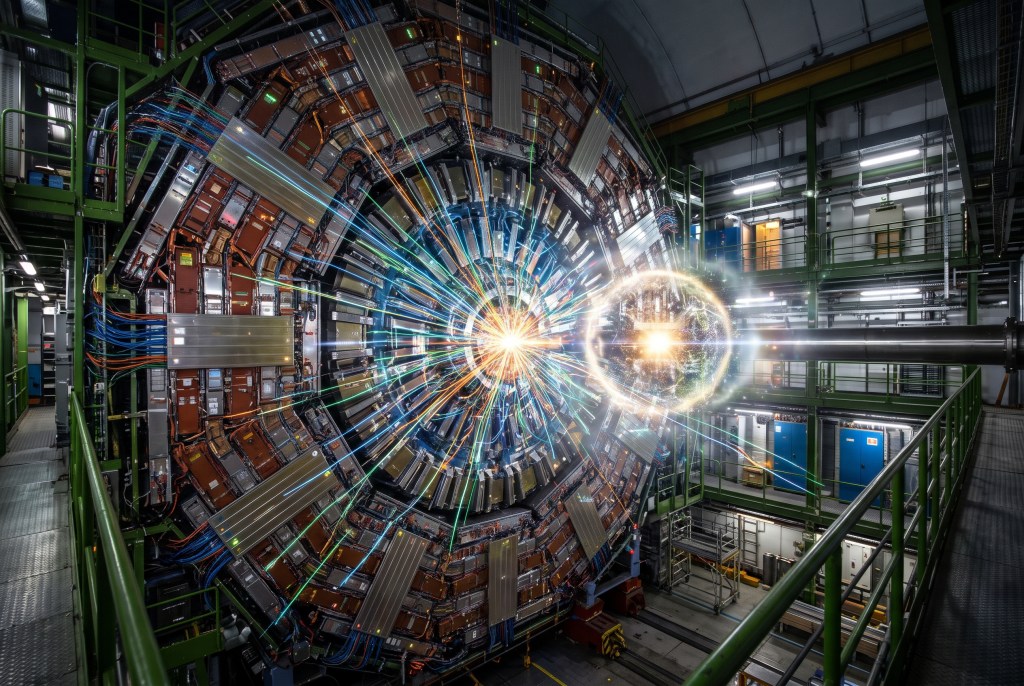
The laboratory that could do this was the Large Hadron Collider (LHC), one of the largest machines ever built. Wikipedia It is a 27-kilometre ring of superconducting magnets in a tunnel about 100 metres beneath the French–Swiss border near Geneva. The magnets are cooled to 1.9 kelvin (−271 °C), colder than outer space, by what CERN calls “the world’s largest cryogenic systems.” home The CERN Council approved construction in December 1994, and according to the European Commission’s CORDIS report on the LHC’s official inauguration in October 2008, its construction “involved over 10,000 scientists and engineers from over 100 countries.” The 2012 discovery papers alone listed 2,924 ATLAS authors and 2,883 CMS authors. arxiv People from nations that disagree on almost everything worked together to read one line in the book of nature. iceccancer
Even with all this, finding the Higgs was like looking for a needle in a hayfield. CERN estimates that the Higgs boson “only appears in about one in a billion LHC collisions,” and its decay products look much like those of far more common processes. Only careful statistics over enormous datasets could separate signal from noise. home
By convention, particle physicists announce a “discovery” only at five sigma, which, as Scientific American explained in July 2012, “corresponds to a p-value, or probability, of 3×10⁻⁷, or about 1 in 3.5 million”: the probability that, if the particle did not exist, the data would be at least as extreme as what was observed. Tantalising hints appeared in December 2011. Then on 4 July 2012, in a packed CERN auditorium, ATLAS spokesperson Fabiola Gianotti and CMS spokesperson Joe Incandela presented their results. arxiv CMS reported “a new boson with a mass of 125.3 ± 0.6 GeV at 4.9 sigma significance,” and ATLAS reported an excess near 126.5 GeV where the probability of a background fluctuation dipped to “one chance in three million, the ‘5-sigma’ gold-standard,” with Gianotti describing “clear signs of a new particle, at the level of 5 sigma, in the mass region around 126 GeV.” (The refined numbers in the papers published that September were 5.9 sigma for ATLAS and 5.0 for CMS.) CERN Director-General Rolf Heuer told the room, “I think we have it.” Peter Higgs, then 83, was seen wiping away a tear. arxiv
Confirmation followed. In March 2013 further analyses showed the particle behaved as the Standard Model Higgs should. Wikipedia In October 2013 the Royal Swedish Academy of Sciences awarded the Nobel Prize in Physics to Englert and Higgs “for the theoretical discovery of a mechanism that contributes to our understanding of the origin of mass of subatomic particles, and which recently was confirmed through the discovery of the predicted fundamental particle, by the ATLAS and CMS experiments at CERN’s Large Hadron Collider.” nobelprizetheconversation Robert Brout had died in 2011, and the Nobel is not awarded posthumously. physicsworld
4. Why “the God Particle”?
The nickname came from a joke. In 1993 Nobel laureate Leon Lederman, writing with science journalist Dick Teresi, published The God Particle: If the Universe Is the Answer, What Is the Question? Lederman explained: goodreads
“This boson is so central to the state of physics today, so crucial to our final understanding of the structure of matter, yet so elusive, that I have given it a nickname: the God Particle. Why God Particle? Two reasons. One, the publisher wouldn’t let us call it the Goddamn Particle, though that might be a more appropriate title, given its villainous nature and the expense it is causing.” Forbesgoodreads
The second reason, which tabloid retellings usually leave out, was literary. Lederman went on to quote the Tower of Babel story from Genesis, suggesting the Higgs might reveal the single underlying language that nature speaks. goodreads
Most physicists have never liked the name. Peter Higgs told The Guardian in 2007 that he had “to explain to people it was a joke.” Forbes Physicist Matt Strassler complained that it “insultingly misrepresents both science and religion.” NBC News Teresi later said Lederman, an atheist, meant it as a joke, and Lederman himself wrote in a later preface that the title had managed to offend two groups: “those who believe in God and those who do not.” NPR
This essay argues that the nickname was more apt than its author meant it to be. The particle is not divine, and nothing about it proves God. But consider what the discovery actually involved. Human beings wrote down a few lines of symmetry-based mathematics, deduced that an invisible field must fill all of space, predicted a particle no one had ever seen, built a 27-kilometre machine to search for it, and found it almost exactly as described, nearly half a century later. That journey shows, as clearly as anything in science, that the universe is ordered, lawful and legible. In that sense, the “God particle” points beyond itself.
5. The Mathematical Beauty and Precision of Nature
The Standard Model, completed by the Higgs, is the most precisely tested theory people have ever built. Two numbers make the point.
- The Higgs mass itself. In 2023 the ATLAS collaboration combined its measurements to obtain 125.11 ± 0.11 GeV, “a precision of 0.09%… the most precise measurement yet of this fundamental parameter.” atlasaps Within about a decade of discovery, a particle that exists for less than a trillionth of a billionth of a second had been weighed to better than one part in a thousand.
- The electron’s magnetism. Also in 2023, Gerald Gabrielse’s group at Northwestern University measured the electron’s magnetic moment to 0.13 parts per trillion. They called it “the most precisely determined property of an elementary particle,” and it “tests the most precise prediction of the standard model (SM) to 1 part in 10¹².” sciencenews +2 That is like measuring the distance from New York to Los Angeles to within the width of a few human hairs, and finding that theory and experiment agree.
The point is not just that nature follows rules. It follows mathematical rules, and abstract structures that mathematicians develop for their own sake keep turning out to describe physical reality. The Higgs mechanism itself was borrowed from the mathematics of superconductivity. It was an abstraction carried from one area of physics to another, and nature accepted it.
6. Mathematics as the Language of Nature: A Short History
This idea is old, and it has always had a theological edge.
Galileo Galilei, in The Assayer (1623), wrote that the great book of the universe “is written in the language of mathematics.” His words are often paraphrased, as in the Muslim Times essay discussed below, as “Mathematics is the language in which God has written the universe.” themuslimtimes That is a faithful summary of his meaning, though not his exact wording. Johannes Kepler, who found the mathematical laws of planetary motion, spoke of thinking God’s thoughts after Him. Isaac Newton, in the General Scholium to the Principia, concluded that “this most beautiful system of the sun, planets, and comets, could only proceed from the counsel and dominion of an intelligent and powerful Being.”
In the twentieth century the wonder grew rather than faded. Albert Einstein, in his 1936 essay “Physics and Reality,” wrote: “the eternal mystery of the world is its comprehensibility… The fact that it is comprehensible is a miracle.” amacad +2 Eugene Wigner, Nobel laureate in 1963, gave the puzzle its lasting name in his 1960 essay “The Unreasonable Effectiveness of Mathematics in the Natural Sciences,” ending with: “The miracle of the appropriateness of the language of mathematics for the formulation of the laws of physics is a wonderful gift which we neither understand nor deserve.” themuslimtimes Paul Dirac, whose equations predicted antimatter before anyone had seen it, wrote in Scientific American (May 1963): “God is a mathematician of a very high order, and He used very advanced mathematics in constructing the universe.” wikiquote +2 Dirac was not conventionally religious, which makes the line all the more striking. patheoswondersofphysics Physicist Paul Davies, in books such as The Mind of God, has argued that the universe’s mathematical intelligibility is a fact that needs explaining, not a brute given.
The Higgs story may be the clearest modern example of what Wigner called unreasonable effectiveness. The mathematics did not just describe known facts. It demanded an unseen thing, and the thing was there.
7. Fine-Tuning, Naturalness, and the “Faith” of Chance
Discovering the Higgs answered one question and sharpened several others. Three of them matter here.
The hierarchy problem. In quantum field theory, the Higgs mass is not fixed once and for all. It is constantly pushed up by quantum fluctuations involving every particle it couples to, potentially up to the enormous Planck scale where gravity becomes strong. arxivarxiv For the observed Higgs mass of 125 GeV to come out, the “bare” mass and these huge corrections must cancel with extraordinary precision. researchgate +2 In the standard estimate, with the theory valid up to the Planck scale, the cancellation needed is about one part in 10³⁴. arxiv +2 Physicists call such a situation “unnatural.” arxiv Many expected the LHC to find new particles, such as supersymmetric partners, that would remove the need for this tuning. arxiv So far, none have appeared.
The metastability of the vacuum. The measured Higgs mass, together with the mass of the top quark, decides the long-term fate of the “valley” the Higgs field has settled into. Detailed calculations, notably by Degrassi and collaborators in 2012, found that the measured values place our universe close to the edge between stability and instability. frontiersinaps If the Standard Model holds up to very high energies, our vacuum is probably metastable: in principle a deeper valley exists, but the expected lifetime of our state is far longer than the present age of the universe. As the American Physical Society’s Physics magazine puts it, the best fit to measured parameters “points to a metastable Universe.” arxivaps The conclusion is sensitive to the exact top-quark mass and to any new physics. arxivScientific American It is a calculation, not an observation, and it is no reason for alarm, but it shows how finely placed our cosmos appears to be.
The broader fine-tuning of constants. The Higgs puzzles join a longer list familiar to cosmologists: the strengths of the forces, the ratios of particle masses and the cosmological constant all appear to fall within narrow ranges that allow stable atoms, long-lived stars, chemistry and life. Dr. Zia H. Shah calls this the universe’s “biophilic” character, and it is among the most discussed findings of modern cosmology. themuslimtimes
Here the argument has to be stated plainly. Faced with a universe that runs on laws precise to a trillionth, that fits elegant symmetry-based mathematics, and whose basic parameters sit on knife-edges that permit our existence, a person can say one of two things: this is the work of purpose, or this happened by blind chance.
The second answer is usually presented as the default, neutral, faith-free position. It is not. To hold that the mathematical order of reality, its comprehensibility, and its tuning for life arose without reason or purpose is to commit oneself to an extraordinary unproven belief. Usually it means positing an unobservable ensemble of countless other universes (a multiverse) so that ours becomes a lucky draw, or else accepting that the deepest order in existence has no explanation at all. The believer admits that faith is involved. The thoroughgoing materialist often does not notice that he is making an even larger leap. My claim is that it takes far more faith to believe the Higgs field, the Standard Model’s precision and the knife-edge constants all came about by accident than to believe they came from a Mind. No religious person could afford a faith that large. Only a convinced atheist carries it, and often without consciously noticing that it is faith.
This does not rule out multiverse hypotheses or future physical explanations. Science should and will pursue them. Even so, a multiverse needs its own generating laws, and those would themselves be mathematical and finely structured. The question of why there is lawful order at all, and not merely why there is this order, does not go away. Einstein’s “eternal mystery” remains.
8. Creation Bil-Haqq: The Quranic Vision
Fourteen centuries ago the Quran returned again and again to a claim that reads very differently after the Higgs discovery: that God created the heavens and the earth bil-haqq (بِالْحَقِّ), “with Truth”, “through Truth”, “for a true purpose”, and not in idle play (lāʿibīn), not in vain (bāṭilan), not aimlessly (ʿabathan).
In his 2024 essay “Allah created the universe or the multiverse through mathematics بِالْحَقِّ,” published in The Muslim Times as a chapter of his book The Quran and the Biological Evolution, Dr. Zia H. Shah makes an argument this essay builds on. themuslimtimes His main points, summarised:
- The word itself. Al-Haqq appears “more than 260 times in the Quran with different accents.” It means truth. It is one of the names of God, and it is also used of the Prophet and of the Quran. With the prefix bi- it means “with/through truth” or “for a purpose”, and “almost a dozen verses” say God created the universe bil-haqq. themuslimtimes
- The proposed modern reading. Traditional translators render the phrase as “with truth,” “for just ends,” “with wisdom” or “for a genuine purpose.” Shah suggests that “a more apt translation in our age of physics and science can be ‘with mathematics,’” and openly calls this “a leap of faith on my part,” offered as a metaphorical rather than literal translation. themuslimtimes
- The textual anchor. He finds support in verse 10:5, which ties the sun, the moon and its phases to knowing “the number of years and the ḥisāb” (الْحِسَابَ, reckoning or calculation), a word that also means arithmetic or mathematics, and then says “Allah has not created this except bil-haqq.” Verse 17:12 uses the same word ḥisāb in describing night and day. He also recalls that the Muslim mathematician al-Khwarizmi, from whose name and book we get “algorithm” and “algebra,” developed mathematics largely through astronomy. themuslimtimes
- The lawful universe. For Shah, 15:85 implies “that the laws of nature are inviolable,” and that inviolability is “the underpinning that set the study of nature and the scientific revolution into motion,” a line running from Copernicus and Newton to Einstein, Heisenberg, Bohr and Abdus Salam. themuslimtimes
- Mathematics: discovered, not invented. He cites journalist Jim Holt’s essay “Proof” in the New York Times Book Review of 13 January 2008, which noted that mathematicians in a National Academy survey believed in God at 14.6% against 5.5% for biologists, and in which Holt recalled that, “while giving a lecture to an international audience of elite mathematicians in Berkeley, I asked how many of them were Platonists. About three-quarters raised their hands.” Platonists are people who believe mathematical truths exist independently of us. Shah argues that the view that mathematics would vanish with the universe holds “only in an atheistic paradigm”. If an Eternal God exists, mathematics existed first “in the mind of the All Knowing Creator,” and humans discover it.
- The opposite of haqq. The opposite of al-haqq is al-bāṭil: the random, the chaotic, the incoherent, the futile. In 3:191, people of understanding who reflect on creation cry out, “Our Lord, You have not created this bāṭilan”, not in vain and not as meaningless chaos. themuslimtimes +2
This essay accepts Shah’s reading with one refinement. Bil-haqq holds together two ideas that modern language tends to separate. The first is lawful truth: creation is coherent, consistent and rational, so it can be described mathematically. The second is moral purpose: creation is for something and leads toward accountability and meaning. The Quran never separates the two, and the verses below repeatedly join “We created with truth” to “and the Hour is coming” or “that every soul may be requited.” The physicist reading the first idea and the believer reading the second are reading the same verse.
The Central Verses
All six translations below come from the Quranic Arabic Corpus (University of Leeds, maintained by the quran.com team). The same six translators are used throughout for easy comparison: Sahih International, Marmaduke Pickthall, Abdullah Yusuf Ali, M. H. Shakir, Muhammad Sarwar, and A. J. Arberry.
Sūrat al-Dukhān (The Smoke), 44:38–39
Arabic: وَمَا خَلَقْنَا ٱلسَّمَـٰوَٰتِ وَٱلْأَرْضَ وَمَا بَيْنَهُمَا لَـٰعِبِينَ مَا خَلَقْنَـٰهُمَآ إِلَّا بِٱلْحَقِّ وَلَـٰكِنَّ أَكْثَرَهُمْ لَا يَعْلَمُونَ tafsir
- Sahih International: And We did not create the heavens and earth and that between them in play. We did not create them except in truth, but most of them do not know. quranquran
- Pickthall: And We created not the heavens and the earth, and all that is between them, in play. We created them not save with truth; but most of them know not. quranquran
- Yusuf Ali: We created not the heavens, the earth, and all between them, merely in (idle) sport: We created them not except for just ends: but most of them do not understand. quranquran
- Shakir: And We did not create the heavens and the earth and what is between them in sport. We did not create them both but with the truth, but most of them do not know. quranquran
- Muhammad Sarwar: We have not created the heavens and the earth and all that is between them for Our own amusement. We have created them for a genuine purpose, but most people do not know. quranquran
- Arberry: We created not the heavens and earth, and all that between them is, in play; We created them not save in truth; but most of them know it not. quranquran
Reflection: “Most of them do not know.” The Higgs field was always there, holding up the mass of every electron, yet humanity did not know it until 2012. Shah reads these verses as covering the lawfulness of life and of humanity as well as of the inanimate cosmos. themuslimtimes
Sūrat al-Ḥijr (The Rocky Tract), 15:85
Arabic: وَمَا خَلَقْنَا ٱلسَّمَـٰوَٰتِ وَٱلْأَرْضَ وَمَا بَيْنَهُمَآ إِلَّا بِٱلْحَقِّ ۗ وَإِنَّ ٱلسَّاعَةَ لَـَٔاتِيَةٌ ۖ فَٱصْفَحِ ٱلصَّفْحَ ٱلْجَمِيلَ quran
- Sahih International: And We have not created the heavens and earth and that between them except in truth. And indeed, the Hour is coming; so forgive with gracious forgiveness. quranquran
- Pickthall: We created not the heavens and the earth and all that is between them save with truth, and lo! the Hour is surely coming. quran So forgive, (O Muhammad), with a gracious forgiveness. quran
- Yusuf Ali: We created not the heavens, the earth, and all between them, but for just ends. And the Hour is surely coming (when this will be manifest). quran So overlook (any human faults) with gracious forgiveness. quran
- Shakir: And We did not create the heavens and the earth and what is between them two but in truth; and the hour is most surely coming, so turn away with kindly forgiveness. quranquran
- Muhammad Sarwar: We have created the heavens and the earth and all that is between them, for a genuine purpose. The Day of Judgment will certainly approach, so (Muhammad) forgive them graciously. quran
- Arberry: We created not the heavens and the earth, and all that is between them, save in truth. Surely the Hour is coming; so pardon thou, with a gracious pardoning. quranquran
Reflection: Shah renders this verse “in accordance with the perfect truth, wisdom and mathematics,” and sees in it the principle that the laws of nature cannot be broken. themuslimtimes
Sūrat Ṣād, 38:27
Arabic: وَمَا خَلَقْنَا ٱلسَّمَآءَ وَٱلْأَرْضَ وَمَا بَيْنَهُمَا بَـٰطِلًا ۚ ذَٰلِكَ ظَنُّ ٱلَّذِينَ كَفَرُوا۟ ۚ فَوَيْلٌ لِّلَّذِينَ كَفَرُوا۟ مِنَ ٱلنَّارِ quran
- Sahih International: And We did not create the heaven and the earth and that between them aimlessly. That is the assumption of those who disbelieve, so woe to those who disbelieve from the Fire. quranquran
- Pickthall: And We created not the heaven and the earth and all that is between them in vain. That is the opinion of those who disbelieve. And woe unto those who disbelieve, from the Fire! quranquran
- Yusuf Ali: Not without purpose did We create heaven and earth and all between! that were the thought of Unbelievers! but woe to the Unbelievers because of the Fire (of Hell)! quranquran
- Shakir: And We did not create the heaven and the earth and what is between them in vain; that is the opinion of those who disbelieve then woe to those who disbelieve on account of the fire. quranquran
- Muhammad Sarwar: We have not created the heavens and the earth and all that is between them without purpose, even though this is the belief of the disbelievers. Woe to the disbelievers; they will suffer the torment of fire quran
- Arberry: We have not created the heavens and earth, and what between them is, for vanity; such is the thought of the unbelievers, wherefore woe unto the unbelievers because of the Fire! quran
Reflection: This verse names the view this essay has called the “faith of chance”: that the cosmos is bāṭil, purposeless. The Quran calls it a ẓann, an “assumption” or “conjecture”. islamicstudiesislamawakened The word fits closely the unacknowledged leap of faith described in Section 7.
Sūrat Āl ʿImrān (The Family of ʿImrān), 3:191
Arabic: ٱلَّذِينَ يَذْكُرُونَ ٱللَّهَ قِيَـٰمًا وَقُعُودًا وَعَلَىٰ جُنُوبِهِمْ وَيَتَفَكَّرُونَ فِى خَلْقِ ٱلسَّمَـٰوَٰتِ وَٱلْأَرْضِ رَبَّنَا مَا خَلَقْتَ هَـٰذَا بَـٰطِلًا سُبْحَـٰنَكَ فَقِنَا عَذَابَ ٱلنَّارِ ksu
- Sahih International: Who remember Allah while standing or sitting or [lying] on their sides and give thought to the creation of the heavens and the earth, [saying], “Our Lord, You did not create this aimlessly; exalted are You [above such a thing]; then protect us from the punishment of the Fire. quranquran
- Pickthall: Such as remember Allah, standing, sitting, and reclining, and consider the creation of the heavens and the earth, (and say): Our Lord! Thou createdst not this in vain. Glory be to Thee! Preserve us from the doom of Fire. quranquran
- Yusuf Ali: Men who celebrate the praises of Allah, standing, sitting, and lying down on their sides, and contemplate the (wonders of) creation in the heavens and the earth, (With the thought): “Our Lord! not for naught Hast Thou created (all) this! Glory to Thee! Give us salvation from the penalty of the Fire. quranopediaquran
- Shakir: Those who remember Allah standing and sitting and lying on their sides and reflect on the creation of the heavens and the earth: Our Lord! Thou hast not created this in vain! Glory be to Thee; save us then from the chastisement of the fire: alquranenglish +2
- Muhammad Sarwar: It is these who commemorate God while standing, sitting, or resting on their sides and who think about the creation of the heavens and the earth and say, “Lord, you have not created all this without reason. Glory be to you. Lord, save us from the torment of the fire”. quranquran
- Arberry: who remember God, standing and sitting and on their sides, and reflect upon the creation of the heavens and the earth: ‘Our Lord, Thou hast not created this for vanity. quran Glory be to Thee! Guard us against the chastisement of the Fire. quran
Reflection: This is a verse about scientists in the oldest sense: people who “reflect on the creation of the heavens and the earth” (yatafakkarūna fī khalq). The verse has their reflection end in wonder, “Glory be to Thee!” The physicists in the CERN auditorium in July 2012, applauding a bump on a graph, were enacting a version of this verse, whatever their creeds.
Sūrat Yūnus (Jonah), 10:5
Arabic: هُوَ ٱلَّذِى جَعَلَ ٱلشَّمْسَ ضِيَآءً وَٱلْقَمَرَ نُورًا وَقَدَّرَهُۥ مَنَازِلَ لِتَعْلَمُوا۟ عَدَدَ ٱلسِّنِينَ وَٱلْحِسَابَ ۚ مَا خَلَقَ ٱللَّهُ ذَٰلِكَ إِلَّا بِٱلْحَقِّ ۚ يُفَصِّلُ ٱلْـَٔايَـٰتِ لِقَوْمٍ يَعْلَمُونَ quran
- Sahih International: It is He who made the sun a shining light and the moon a derived light and determined for it phases – that you may know the number of years and account [of time]. Allah has not created this except in truth. He details the signs for a people who know quranquran
- Pickthall: He it is Who appointed the sun a splendour and the moon a light, and measured for her stages, that ye might know the number of the years, and the reckoning. Allah created not (all) that save in truth. He detaileth the revelations for people who have knowledge. quran +2
- Yusuf Ali: It is He Who made the sun to be a shining glory and the moon to be a light (of beauty), and measured out stages for her; that ye might know the number of years and the count (of time). Nowise did Allah create this but in truth and righteousness. (Thus) doth He explain His Signs in detail, for those who understand. quranopediadeen
- Shakir: He it is Who made the sun a shining brightness and the moon a light, and ordained for it mansions that you might know the computation of years and the reckoning. Allah did not create it but with truth; He makes the signs manifest for a people who know. namazzamaniquranx
- Muhammad Sarwar: It is God who has made the sun radiant and the moon luminous and has appointed for the moon certain phases so that you may compute the number of years and other reckonings. God has created them for a genuine purpose. He explains the evidence (of His existence) to the people of knowledge islamawakened +2
- Arberry: It is He who made the sun a radiance, and the moon a light, and determined it by stations, that you might know the number of the years and the reckoning. God created that not save with the truth, distinguishing the signs to a people who know. internetmosque +2
Reflection: This is the key verse for Shah’s argument. In one sentence it brings together measurement (qaddarahu, “He determined/measured it”), number (ʿadad), calculation (al-ḥisāb), and creation bil-haqq, and it addresses all of this to “a people who know.” Few verses come closer to the spirit of Wigner’s essay.
Sūrat al-Anbiyāʾ (The Prophets), 21:16
Arabic: وَمَا خَلَقْنَا ٱلسَّمَآءَ وَٱلْأَرْضَ وَمَا بَيْنَهُمَا لَـٰعِبِينَ quran
- Sahih International: And We did not create the heaven and earth and that between them in play. quranquran
- Pickthall: We created not the heaven and the earth and all that is between them in play. quranquran
- Yusuf Ali: Not for (idle) sport did We create the heavens and the earth and all that is between! quran
- Shakir: And We did not create the heaven and the earth and what is between them for sport. quran
- Muhammad Sarwar: We did not create the heavens and the earth just for fun. quran
- Arberry: We created not the heaven and the earth, and whatsoever between them is, as playing; quranquran
Sūrat al-Muʾminūn (The Believers), 23:115
Arabic: أَفَحَسِبْتُمْ أَنَّمَا خَلَقْنَـٰكُمْ عَبَثًا وَأَنَّكُمْ إِلَيْنَا لَا تُرْجَعُونَ quran
- Sahih International: Then did you think that We created you uselessly and that to Us you would not be returned?” quranquran
- Pickthall: Deemed ye then that We had created you for naught, and that ye would not be returned unto Us? quranmyislam
- Yusuf Ali: “Did ye then think that We had created you in jest, and that ye would not be brought back to Us (for account)?” quran
- Shakir: What! did you then think that We had created you in vain and that you shall not be returned to Us? quranqurano
- Muhammad Sarwar: Did you think that We had created you for a playful purpose and that you were not to return to Us?” quranquranv
- Arberry: What, did you think that We created you only for sport, and that you would not be returned to Us?’ quran +2
Reflection: Here the argument turns from the cosmos to the person. If even the vacuum is tuned and lawful, can a human life be ʿabath, pointless? The Quran’s answer is the essay’s answer too: a universe made with this much care is not a stage for a meaningless play.
Further Verses on Creation Bil-Haqq
Shah’s survey also takes in these verses, which can be read alongside those above:
- 6:73: “He it is Who created the heavens and the earth bil-haqq… His word is the truth.” themuslimtimes
- 14:19: “Do you not see that Allah created the heavens and the earth bil-haqq? If He please, He can do away with you, and bring a new creation.” themuslimtimes
- 16:3: “He has created the heavens and the earth bil-haqq. Exalted is He above all that they associate with Him.” themuslimtimes
- 29:44: creation bil-haqq is “a Sign for the believers.” Shah links it to the discovery of cosmic fine-tuning. themuslimtimes
- 30:8: creation bil-haqq “and for a fixed term.” Shah sees here a cosmos with a finite lifespan. themuslimtimes
- 39:5: creation bil-haqq, with the sun and moon each running “until an appointed time.” themuslimtimes
- 45:22: creation bil-haqq “that every soul may be requited for that which it earns.” themuslimtimes
- 46:3: creation bil-haqq “and for an appointed term.” themuslimtimes
- 64:3: creation bil-haqq, and “He shaped you and made your shapes beautiful.” themuslimtimes
Together these verses form a single, consistent teaching: the universe is lawful, purposeful, time-bound, beautiful, and morally serious.
9. Mathematics as the Language of Creation
We can now draw the threads together. The Higgs discovery rested on three facts that physics takes for granted but cannot explain:
- The universe is lawful. The same equations hold in a Geneva tunnel, in the core of the Sun, and in the first trillionth of a second after the Big Bang.
- The laws are mathematical, and the mathematics is beautiful. Symmetry, the most aesthetic idea in mathematics, turned out to govern the forces. Hiding that symmetry, as the Higgs mechanism does, turned out to produce mass.
- The human mind can read the laws. A handful of theorists with pencils deduced, half a century in advance, a particle that thousands of experimenters later found.
Einstein called the third fact a miracle, Wigner called it a gift “which we neither understand nor deserve”, and Dirac said God is “a mathematician of a very high order”. arxivwikiquote The Quran calls the first two creation bil-haqq and the third the privilege of “a people who know.” The vocabularies differ, but they point at the same thing.
Seen this way, Shah’s suggestion that bil-haqq can be read as “with mathematics” is not an anachronism forced onto scripture. It recognises that what Muslims have always called al-haqq, the Real, the True, the Coherent, is exactly what physics experiences as mathematical law. The laws of nature are al-haqq in its created form. When the physicist uncovers a symmetry or measures a constant, she is reading, in the Quran’s own image, the āyāt, the signs, that God “details for a people who know.”
10. A Note on Claims and Caveats
Intellectual honesty strengthens this argument, so its limits should be stated.
- The Higgs does not prove God. No experiment does. The argument here is philosophical: the best explanation of lawful, mathematical, life-permitting order is purpose. Thoughtful people, including many fine physicists, disagree.
- The nickname’s author did not share this view. Lederman’s “God Particle” was a joke made for commercial reasons, and Higgs disliked it. This essay reclaims the name. It does not say Lederman meant it this way.
- Fine-tuning claims depend on the model. The 10³⁴ figure assumes the Standard Model holds up to the Planck scale. arxivihep Metastability depends sensitively on the top-quark mass and on unknown physics. Both are active research areas, and some physicists argue that “naturalness” is an aesthetic expectation, not a law. arxiv
- The “mathematics” reading of bil-haqq is interpretive. Shah himself calls it metaphorical and “a leap of faith.” themuslimtimes Classical exegetes such as Ibn Kathir read bil-haqq mainly as justice, wisdom and moral purpose. github +3 The scientific reading adds to these meanings and does not replace them.
- Higgs-given mass is only part of everyday mass. Most of the mass of ordinary matter comes from strong-force binding energy, though without the Higgs field there would be no atoms at all.
- The “faith of chance” argument is a challenge, not a dismissal. Many atheists hold their position for reasons other than the fine-tuning question. The claim here is narrower: on the specific question of cosmic order, the chance hypothesis needs an act of trust that its holders seldom admit.
Thematic Epilogue: The Particle That Pointed Beyond Itself
On a summer morning in 2012, an elderly Scottish physicist sat in an auditorium in Geneva and wept. What moved Peter Higgs was not a new technology or a profitable invention. It was the sight of an idea he had written down in 1964, an invisible field filling all of space, confirmed by people who had crossed every border of nation, language and creed to look for it.
The story is about order. A universe that gives mass to electrons through the quiet, uniform presence of a field; that holds the weak force to a nucleus-wide reach by hiding a symmetry; whose vacuum rests in a finely poised valley; whose laws can be checked to a trillionth. This is not a universe of noise. It is a universe of ḥisāb, of number and reckoning.
The story is also about legibility. The cosmos is not only ordered but readable. The mathematics that human minds find beautiful is the mathematics nature uses. Einstein could only call this a miracle. The Quran offers a reason: the One who created the heavens and the earth bil-haqq also taught humanity “the number of years and the reckoning,” and set out His signs “for a people who know.”
And the story is about purpose. The Quran’s repeated denial that creation is play (laʿib), vanity (bāṭil) or pointlessness (ʿabath) is not only a claim about physics. It is a claim about us. If the universe was made with truth down to the level of the vacuum, then a human life, with its striving, its moral choices and its search for understanding, is not an accident at the edge of a meaningless cosmos. It is the point at which creation becomes aware of the Truth it was made with.
So the “God particle” fits after all. The particle is not God, and it does not prove God. It points past itself to the mathematical order of the universe, and from that order to the purpose behind it. The physicist who measured it and the believer who reads 44:39 are both, in their own ways, saying the same thing: We did not create them except in truth, but most of them do not know. The discovery of the Higgs boson means that a few more of us now know.




Leave a Reply