

Presented by Gemini
Audio teaser: Your brain is a consciousness receiver
The phenomenon of divine revelation (wahy) within the Islamic intellectual tradition has historically stood as an ontological mystery, representing a direct interface between the Infinite and the finite. In contemporary theological discourse, particularly within the extensive corpus of Dr. Zia H. Shah, the traditional understanding of how the Quran was received by the Prophet Muhammad is re-examined through a multi-disciplinary framework. This approach integrates the neurobiology of sleep, the metaphysics of consciousness, and classical Islamic exegesis.
By treating the human brain as a biologically evolved transceiver rather than a generator of consciousness, this framework establishes a profound analogy between the dream state and prophetic inspiration. This synthesis is grounded in Ash’arite occasionalism, which posits that physical laws and conscious states possess no inherent causal efficacy but are directly sustained, frame-by-frame, by the sovereign volition of the Divine Creator.
The Tripartite States of Human Existence and State Intrusion
The biological architecture of human consciousness operates primarily across three distinct physiological states: wakefulness, Non-Rapid Eye Movement (NREM) sleep, and Rapid Eye Movement (REM) sleep. Each state is governed by highly specific neurochemical, electrical, and metabolic signatures that dictate the observer’s relationship to physical reality.
Under ordinary conditions, the transitions between these states are cleanly regulated by the brainstem and circadian pacemakers; however, in both physiological health and pathological conditions, the boundaries can become permeable, leading to a phenomenon known as state intrusion. Somnambulism (sleepwalking), for example, represents a state of low consciousness where features of waking motor activity intrude into deep, slow-wave NREM sleep, allowing complex physical navigation to occur without conscious wakeful volition.
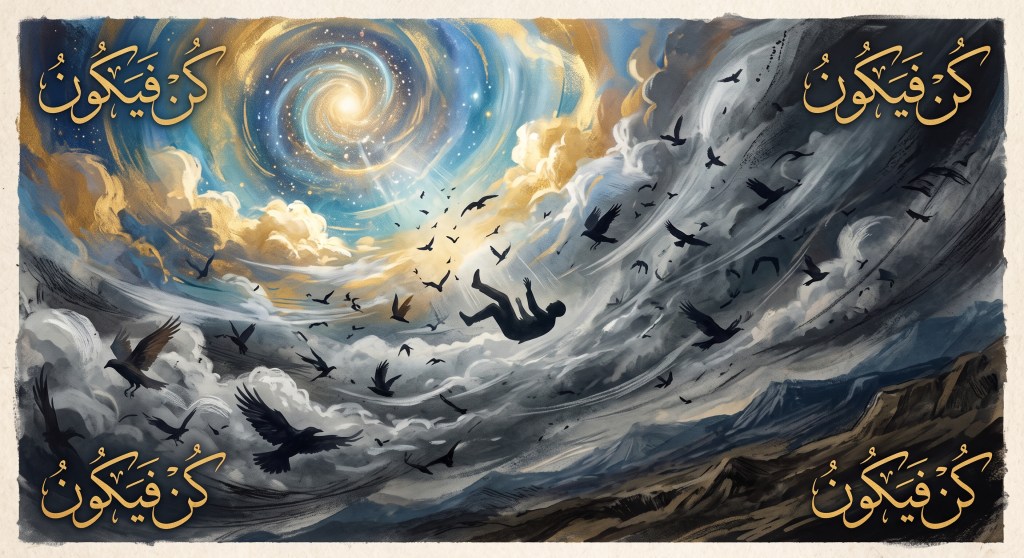
In the context of prophetic experience, revelation is conceptualized as a highly organized, divinely orchestrated intrusion of the dreaming REM state into a state of full, waking consciousness. During REM sleep, the brain is highly active—consuming oxygen and firing cortical neurons at rates comparable to active wakefulness—yet the body is paralyzed by brainstem-mediated atonia, and the mind is completely decoupled from external sensory input.
Within this self-contained neural state, the conscious agent experiences highly immersive, multi-sensory virtual realities that are perceived as entirely real. If the physiological parameters of this state—specifically its capacity to generate structured visual, auditory, and conceptual realities independent of physical sensory organs—were to intrude into waking consciousness, the individual would experience a profound alteration of their immediate reality.
This physiological model aligns with historical descriptions of the physical toll that receiving revelation took on the Prophet Muhammad. Eyewitness accounts record that during the descent of wahy, the Prophet would exhibit sudden freeze states, becoming completely distant from his surroundings. He would experience intense somatic pressure, sweating profusely even on bitter cold days, and he described the experience of hearing a deafening noise likened to the “ringing of a bell”—the most severe physical manifestation of the encounter—before the verbal message was successfully integrated into his memory.
These physiological markers indicate that receiving revelation was not a passive psychological state, but an intense, highly demanding metabolic event where a waking brain was temporarily decoupled from physical spacetime to act as a receiver for non-local divine speech.
| Consciousness State | Dominant EEG Signatures | Metabolic / Cortical Activity | Voluntary Motor Tone | Phenomenological Relationship to Spacetime |
|---|---|---|---|---|
| Wakefulness | Beta and Alpha Waves (12–30 Hz) | High localized metabolic activity | Fully active and responsive | Localized within 4D spacetime; bound by external physical sensory inputs |
| NREM Sleep | Slow Delta Waves (0.5–4 Hz) | Low metabolic activity; brain in repose | Moderately relaxed; limited movement | Complete ego-dissolution; minimal to no conscious self-report or time perception |
| REM Sleep | Desynchronized Theta / Beta Waves (4–8 Hz) | High metabolic activity; active cortex | Complete muscle paralysis (atonia) | Immersive non-local virtual reality; self-contained cognitive worlds |
| Prophetic Trance | Highly synchronized hyper-gamma surges | Maximum metabolic demand and stress | Selective motor freeze; somatic pressure | Trans-spatial reception; direct interface with non-local divine command (Alam al-Amr) |
Scriptural Foundations and Translational Nuances of Quran 39:42
The theological basis for using sleep and dreaming as a physiological and metaphysical model for death, resurrection, and revelation is anchored in Surah Al-Zumar, Verse 42. This pivotal verse establishes an ontological equivalence between the state of sleep and the state of death, presenting the daily cycle of resting and waking as a miniature model of human mortality and divine resurrection.
The exact grammatical and semantic construction of this verse has been a subject of intense exegesis among both classical and modern scholars. The verse utilizes the Arabic root verb tawaffā, which literally means to take something back in its entirety, or to fully repossess a given entity.
In his classical commentary, Al-Tabari explains that during sleep, God withdraws the conscious soul (nafs) from the physical body, leaving behind only a subtle connection—often described as a beam or ray of the spirit (ruh)—to maintain the body’s basic biological vitality, such as the beating of the heart and respiration.
This partial withdrawal allows the souls of the living to enter an intermediate state where, according to reports transmitted from the early exegete al-Suddi, they meet and converse with the souls of the deceased before the living souls are returned to their waking bodies. Fakhr al-Din al-Razi reinforces this by defining sleep as a state of powerlessness where the faculties of feeling, voluntary movement, and waking consciousness are suspended by divine decree, serving as a daily proof that human life and consciousness do not belong to the material body but are entirely in the grasp of God.
Modern translators and commentators, such as Muhammad Asad, emphasize the rationalist implications of this verse, rendering tawaffā as the “gathering of the souls” or the “taking of consciousness”. Asad notes that in sleep, the loss of voluntary activity and external awareness represents a partial death (wafāt), while physical death represents the complete and permanent removal of all vital faculties.
The daily restoration of waking consciousness is thus presented as a profound sign (ayah) of the Resurrection, demonstrating that the One who routinely restores consciousness from the deep oblivion of sleep possesses the mechanism to restore the first-person identity of the soul within a new physical body in the Hereafter.
| Translator | Rendering of Tawaffā in Sleep and Death | Theological Implications of the Semantic Choice | Source |
|---|---|---|---|
| Sahih International | “takes the souls at the time of their death, and those that do not die during their sleep” | Emphasizes the literal repossession of the conscious agent from the physical body | [cite: 9] |
| Marmaduke Pickthall | “receiveth (men’s) souls… and that which dieth not in its sleep” | Highlights the receptive, protective nature of the divine preservation of the soul | [cite: 9] |
| M.A.S. Abdel Haleem | “takes the souls of the dead and the souls of the living while they sleep” | Accents the simultaneous, active divine sovereignty over both living and deceased consciousness | [cite: 9] |
| Muhammad Asad | “He gathers [their] souls… and [He gathers] the souls of those who have not yet died, in their sleep” | Emphasizes the cognitive consolidation of consciousness as a unified non-material entity | [cite: 4] |
| A.J. Arberry | “takes the souls at the time of their death, and that which has not died, in its sleep” | Maintains a highly literal, poetic rendering of the complete ontological withdrawal of the self | [cite: 9] |
Scientific, Philosophical, and Theological Embellishments of the Occasionalist Revelation Model
To fully appreciate the scope of dreaming as the analogy of revelation, this model must be embellished through a systematic synthesis of twenty-first-century science, Western and Eastern philosophies of mind, and the classical ash’arite theological paradigm of occasionalism.
Scientific Embellishments: Non-Local Consciousness and Hyperdimensional Physics
The materialist reduction of consciousness to a mere epiphenomenon of synaptic firing struggles to explain several anomalous neurological states. To construct a scientifically viable model of revelation, we must examine clinical environments where highly structured consciousness persists in the absence of normal, waking brain activity.
Research led by Dr. Sam Parnia at NYU and the clinical observations of cardiologist Pim van Lommel have documented that patients undergoing cardiac arrest—where cerebral blood flow completely ceases and the EEG goes flat within ten to twenty seconds—frequently report highly structured, hyper-lucid near-death experiences (NDEs).
During these periods of clinical death, when the biological machine is completely inactive, patients report observing their surroundings from a non-local perspective, experiencing deep emotional clarity and logical thought processes. This empirical reality strongly suggests that the conscious “self” is not generated by neural machinery but is a non-local entity that can operate independently of the physical body.
This non-local locus of consciousness is further illustrated by the accidental EEG recording of a dying eighty-seven-year-old epileptic patient, published by Dr. Ajmal Zemmar. In the thirty seconds before and after the patient’s heart stopped supplying blood to the brain, the EEG recorded a massive, highly synchronized surge of gamma-band oscillations. Gamma waves are associated with highly demanding cognitive tasks, memory retrieval, meditation, and dreaming, indicating that the transition of death is accompanied by a structured cognitive flash.
This human recording is mirrored by a 2013 study of healthy rats, which exhibited an identical, highly organized surge of high-frequency brainwaves at the moment of death, suggesting a deeply conserved biological mechanism designed to facilitate the transition of consciousness.
To explain how this non-local consciousness interacts with the physical world, modern theoretical physics offers hyperdimensional models. Michael Pravica’s hyperdimensional theory proposes that human consciousness may originate from and interact with hidden spatial dimensions of the universe beyond the familiar four-dimensional spacetime continuum.
Using the analogy of a two-dimensional flatland being unable to comprehend a three-dimensional sphere passing through its plane, humans are normally oblivious to these higher dimensions. However, exceptional mental states—such as deep REM dreaming, intense mathematical creativity, or prophetic trance—may allow the brain’s neural transceiver to synchronize with these higher dimensions, enabling the reception of information that transcends physical limitations.
| Scientific Phenomenon | Neurobiological Findings | Metaphysical / Theoretical Implications | Source |
|---|---|---|---|
| Lucid Cardiac Arrest (NDEs) | Structured conscious self-report during flatline EEG and zero cerebral perfusion | Demonstrates that subjective awareness is not a localized product of active cortical tissue | [cite: 6, 9] |
| Dying Brain Gamma Surge | Massive, highly synchronized gamma-band oscillations (30–100 Hz) post-cardiac arrest | Suggests a structured, programmed transition of consciousness rather than a chaotic biological failure | [cite: 14] |
| Hyperdimensional Brain Resonance | Quantum coherence within microtubules potentially interfacing with extra dimensions | Positions the physical brain as a transceiver receiving non-local, multi-dimensional signals | [cite: 5, 6] |
Philosophical Embellishments: From Historical Skepticism to the Transceiver Model
The philosophical inquiry into the boundary between dreaming and waking has historically served as a catalyst for understanding the nature of reality. In ancient Chinese philosophy, Zhuangzi’s “Butterfly Dream” posed the fundamental question of how an observer can establish the absolute validity of waking reality when the dream state can construct an equally convincing alternative.
This skeptical inquiry finds its Western counterpart in René Descartes’ Meditations, where he uses the dreaming/waking ambiguity to isolate the conscious self. Descartes argued that while he could doubt the physical reality of his limbs and the external world, he could not doubt the existence of the doubting agent itself, establishing the cogito as an irreducible philosophical datum.
Gottfried Wilhelm Leibniz, in his Monadology, extended this by viewing the nightly retraction of consciousness in sleep as a miniature resurrection, demonstrating that the temporary suspension of conscious perception does not imply the annihilation of the experiencing subject.
In the Islamic tradition, Ibn Sina (Avicenna) formulated his “Floating Man” thought experiment to prove that self-consciousness is entirely independent of physical sensation. Avicenna asked his readers to imagine a person created fully formed in a void, with their eyes covered and limbs suspended so they experience no physical contact. Avicenna argued that this floating individual would still be absolutely certain of their own existence, proving that the soul’s self-awareness is an primary, non-material reality.
These classical insights expose the logical contradictions of modern materialist Illusionism, championed by philosophers like Daniel Dennett and Keith Frankish. Illusionism posits that phenomenal consciousness—the subjective experience of feelings, colors, and sounds—is a “user-illusion” engineered by the brain’s computational networks. However, this claim is performatively self-refuting:
- Self-Refutation: An illusion requires a conscious subject to be deceived. A digital camera, a motion sensor, or a stone cannot experience an illusion because they lack subjective awareness. If an individual is under the illusion that they are conscious, then the very presence of that illusion proves the existence of a conscious perceiver experiencing the deception.
- The Suicide of Reason: If our immediate, first-person experience of our own minds is a biological lie, then we have no rational grounds to trust our sensory observations of the physical world. If the “I” that looks through a microscope is an illusion, then the scientific data observed through that microscope is equally suspect, thereby undermining the rational foundation of science itself.
To resolve these contradictions, Zia H. Shah utilizes the transmission or transceiver model of consciousness. Originally formulated by William James, this model argues that the brain does not generate mind, but filters and transmits it, much like a radio receiver tuning into an electromagnetic broadcast.
This model accounts for why brain damage alters personality (damage to the physical tuner degrades the fidelity of the reception) without conceding that the brain produces the person. Physical death is the destruction of the receiver, which stops the localized performance of the music but leaves the broadcast signal—the soul (ruh)—completely intact as it returns to its source.
Theological Embellishments: Occasionalism, Quantum Joints, and Information Theory
This scientific and philosophical transceiver model finds its complete metaphysical integration within the Ash’arite doctrine of occasionalism, famously championed by Abu Hamid al-Ghazali in his Tahafut al-Falasifah. Occasionalism asserts that physical substances possess no inherent, independent causal power.
The apparent “laws of nature” are not self-sustaining mechanisms; rather, God is the sole immediate and efficient cause of every event in the universe. What we perceive as physical cause and effect is merely a habitual sequence of divine creations (adat Allah) executed frame-by-frame through continuous creation (tajdid al-khalq).
This occasionalist framework resolves the apparent paradox of human moral agency and absolute divine control expressed in Surah Al-Insan:
Qur’an 76:30: “And you do not will except that Allah wills. Indeed, Allah is ever Knowing and Wise.” [cite:8]
Under the occasionalist lens, human free will is compatible with absolute divine sovereignty. Human choice is an intention, and on the occasion of that intention, God directly creates the corresponding action, a process classical theology defines as the acquisition (kasb) of deeds.
To illustrate this frame-by-frame rendering, modern proponents draw on the simulation hypothesis and digital physics. Just as a highly advanced virtual reality game renders frames at a specific rate, physical reality can be conceptualized as a continuous, frame-by-frame rendering by the divine command (Alam al-Amr).
Quantum mechanics provides the physical “causal joint” for this immanent divine action. According to the Copenhagen interpretation, subatomic particles exist in a wave function of mathematical probabilities until an act of observation collapses the wave function into a definite particle state.
In this context, God acts as the Ultimate Observer, continuously collapsing the quantum wave functions of the universe to sustain physical reality. Quantum entanglement—the instant, non-local coordination of separated particles—further demonstrates that physical reality is underpinned by an informational unity that transcends physical distance, echoing the divine immanence.
This occasionalist paradigm is beautifully expressed in Dr. Zia H. Shah’s “Four Books Thesis” (the Tetrabiblos of Cosmic Reality), which conceptualizes reality as four books written by the same divine author:
- The Quran: The verbal revelation, providing the linguistic and moral framework for human existence.
- The Physical Universe: The macrocosmic book of nature, containing the physical “signs in the horizons”.
- The Human Genome: The biological book of life, written in a complex digital code that directs physical development.
- The Human Brain / Consciousness: The microcosmic book of the self, containing the “signs within themselves”.
Because these four books share a single author, there is an absolute harmony between them. The neurobiology of sleep and dreaming provides the biological hardware (the fourth book) designed to receive the verbal revelation of the Quran (the first book), while both are supported by the mathematical laws of the universe (the second book).
This structural harmony is also evident in comparative theology. In Aboriginal spirituality, the concept of the “Dreaming” (or Dreamtime) represents a continuous, non-linear process of creation where ancestral narratives are intimately tied to the land and cosmology.
Similarly, the ceremonial fasting of Ojibwe and Menominee youth in isolated environments was designed to induce vivid visions from spiritual entities (manitouk) to guide their adult life. These traditions show a global human recognition that suspending normal, waking, sensory-bound consciousness is a key requirement for interfacing with transcendent reality.
This interface is further illustrated by the concept of Amad—information that suddenly manifests in human consciousness, vastly exceeding the analytical, historical, or cognitive labor of the individual receiving it.
This phenomenon is evident in notable scientific breakthroughs: Friedrich August Kekulé discovering the ring structure of benzene after dreaming of the Ouroboros; Dmitri Mendeleev dreaming the complete arrangement of the periodic table; and Srinivasa Ramanujan producing formulas for black hole entropy, claiming they were written directly in his dreams by a goddess.
If ordinary human minds can receive structured, veridical information during sleep, then prophetic revelation (wahy) represents the highest expression of this phenomenon. The unlettered Prophet Muhammad, receiving the highly complex linguistic, legal, and theological text of the Quran over twenty-three years, represents the ultimate manifestation of Amad, where divine speech was directly rendered within his consciousness by the sovereign will of the Creator.
This teleological purpose of creation is emphasized in Surah Al-Jathiyah:
Qur’an 45:22: “And Allah created the heavens and the earth in truth and so that every soul may be recompensed for what it has earned, and they will not be wronged.” [cite:3]
Classical commentators like Ibn Kathir and Al-Razi interpret “in truth” (bi’l-haqq) as indicating that the universe was designed with a wise, moral purpose, connecting it directly to accountability and resurrection.
Denying the Resurrection and treating the moral actions of believers and evildoers as equal represents a severe spiritual pathology. This pathology is diagnosed in Quran 45:23 as the state of a person who has made their base desire (hawā) their god, sealing their ears, heart, and eyes to the clear signs of divine design.
To illustrate this moral necessity, Mufti Muhammad Shafi provides a practical example: a thief or a robber can acquire more wealth in a single night than a university graduate might earn in years of honest employment. If there is no Hereafter and ultimate accountability, then the thief would be functionally better off than the honest graduate, a moral contradiction that a purposefully designed universe (bi’l-haqq) cannot sustain.
Thus, the “signs within themselves”—from the daily cycle of sleep-death to the reception of revelation—serve as cognitive and spiritual signposts, rationally preparing humanity for the ultimate reality of divine judgment and eternal existence in the Hereafter.
Thematic Epilogue
When the biological frame of humanity surrenders to the darkness of night, it enters a sanctuary of continuous creation that routinely dissolves the boundaries of the physical world. Sleep is not a passive biological pause, but a daily, frame-by-frame demonstration of the soul’s independence from its physical instrument. Every evening, as the brain transitions into the metabolic intensity of the dreaming state, the divine hand gently detunes the biological receiver, releasing the conscious self into a non-local, hyperdimensional realm where time and space are rendered anew.
In this light, the ordinary dream is a quiet, nightly invitation to witness the same metaphysical architecture that facilitated the descent of the Quran. The spectrum that begins with the simple, veridical dreams of the sleeper reaches its absolute, glorious peak in the waking trance of the Prophet. Revelation was the ultimate intrusion—a magnificent, mathematically precise rendering where the transcendent light of the divine command bypassed the physical constraints of the cosmos to imprint its eternal speech directly onto a human heart.
As humanity stands on the precipice of a new scientific era, dissecting both the quantum horizons of the universe and the neural depths of the self, the materialist illusion of a dead, accidental cosmos is beginning to fade. In its place emerges the grand, occasionalist reality: a universe continuously spoken into existence, where the beating of a heart, the collapse of a wave function, the nightly descent into sleep, and the final transition of death are all harmonized under a single, sovereign divine will.
When the human transceiver is finally silenced at the end of physical life, it is not an end, but the ultimate awakening—a return of the soul to the undivided broadcast of its source, where the temporary, virtual reality of this world dissolves into the ultimate, unmediated presence of the Creator.
References
The Tetrabiblos of Cosmic Reality: A Unified Informational and
A Comprehensive Commentary on Qur’an 45:21–26: The Moral Case for Resurrection
Afterlife A Dream-State or A Virtual Reality? – The Glorious Quran and Science
Consciousness Beyond the Brain: Theories and Evidence – The Glorious Quran and Science
Prophetic Visions and the Hypnagogic State: Altered Consciousness in Abrahamic Tradition
Sleep and Death: Divine Signs, Scientific Parallels, and the Promise of Resurrection
Life may actually flash before your eyes on death – new study
The Simulation Hypothesis: A Comprehensive Philosophical Exploration
The Opening of Surah Al Hadid and Al Ghazali’s Occasionalism
How a Quranic Verse About Fasting Becomes a Proof for the Truth of the Glorious Quran





Leave a comment