
Presented by Claude
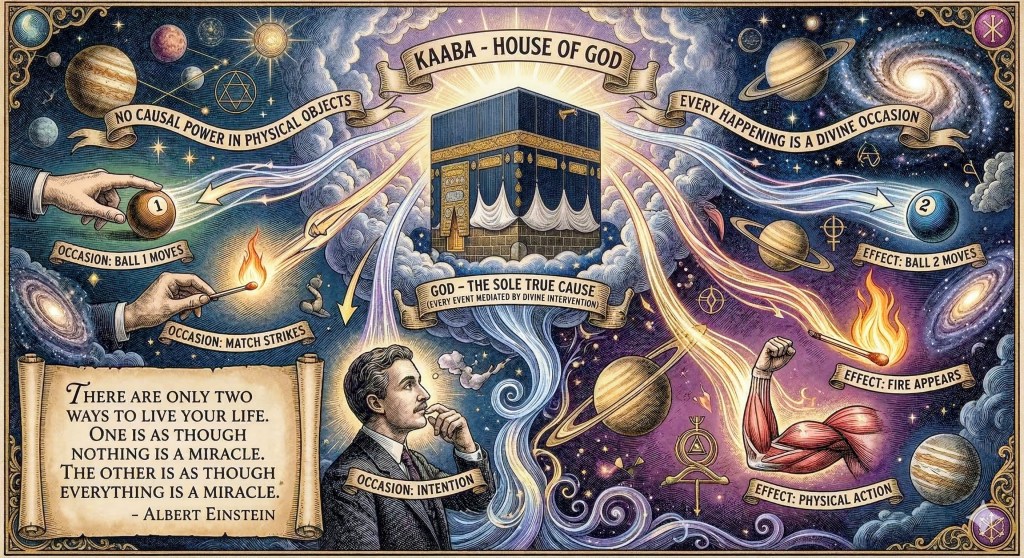
- Across more than thirty interlinked essays gathered in the “Occasionalism” category of his website thequran.love, Dr. Zia H. Shah, MD revives al-Ghazālī’s Ashʿarī occasionalism—the doctrine that God alone is the true cause (lā muʾaththira fī’l-wujūd illā Allāh)—and argues it is the rigorous “metaphysics of Inshallah,” reading the laws of nature as God’s customary habit (sunnat Allāh / ʿāda) rather than autonomous causal powers.
- His distinctive contribution is to claim that 20th–21st-century physics—quantum indeterminacy, the photon at a water/air boundary, Bell’s inequality and the 2022 Nobel Prize, quantum tunneling and entanglement—has reopened a “causal gap” that makes occasionalism at least as rationally defensible as materialism, while candidly conceding these are interpretive analogies, not proofs (the divine reading is “an interpretation,” empirically indistinguishable from determinism).
- He frames the cosmos as an “Inshallah universe” / “divine simulation” continuously “rendered frame-by-frame” by God as al-Qayyūm, the Self-Subsisting Sustainer, integrating this with his “Four Books of God” thesis and yielding a theology of providence, trust in God (tawakkul), and the integrated self.
Key Findings
- Scope and authorship. The occasionalism corpus comprises roughly three dozen articles dated February 2025 through June 2026, indexed across three pages of the thequran.love “Occasionalism” category. Dr. Shah is a physician (board-certified in Internal Medicine, Pulmonary, and Sleep Medicine) practicing in Upstate New York, Chief Editor of The Muslim Times, and Chair of Religion and Science for The Muslim Sunrise. He is affiliated with the Ahmadiyya Muslim Community; some recent articles are explicitly co-produced with AI systems (“Presented by Gemini,” “Presented by Claude”).
- Core thesis. Shah defines occasionalism as the claim that “God alone is the true efficient cause” while observed regularities are God’s “habit” (sunnat Allāh), a framing “designed to preserve both (a) the intelligibility and stability that science relies on, and (b) the metaphysical freedom needed for miracles and direct divine action.”
- Quranic grounding. He marshals a recurring verse-set: 8:17 (“You did not throw when you threw, but God threw”), 2:255 (Āyat al-Kursī), 35:41 (God holds the heavens and earth “lest they cease”), 30:25, 55:29 (“Every day He is engaged in an affair”), 6:59 (no leaf falls without His knowledge), 6:103 (al-Laṭīf, al-Khabīr), 18:23–24 (the Inshallah verses), 57:22, and 13:38–39 (Umm al-Kitāb). thequran + 2
- Physics as exhibit. Shah’s signature scientific illustration is the photon striking a water surface; he also leans on Bell-inequality experiments, quantum tunneling, the double-slit experiment, radioactive decay, the Many-Worlds Interpretation, and the simulation hypothesis.
- Honest hedging. In his most rigorous essay he states that determinism and occasionalism “describe the same universe… competing metaphysical interpretations of the same physical reality,” that “no experiment can distinguish them,” and that “the only difference between them is God.” This intellectual candor is a notable feature of the corpus.
Details
1. The body of work and its author
Dr. Zia H. Shah, MD has built, since early 2025, a large and tightly cross-referenced body of writing on al-Ghazālī’s occasionalism hosted at thequran.love (“The Glorious Quran and Science”). The site’s “Occasionalism” category spans three index pages and roughly three dozen posts dated February 2025 to June 2026. Representative titles include “From the Expression Inshallah to Al Ghazali’s Occasionalism” (March 7, 2025), “Does Al-Ghazali’s Occasionalism Naturally Follow From the Quranic Omniscience and Omnipotence of God?” (March 2, 2025), “The Nobel in Physics 2022 Also Goes to Al Ghazali” (March 26, 2025), “Why Each Photon of Light is An Exhibit that Al Ghazali May Have the Last Laugh” (March 12, 2025), “Al-Ghazali’s Occasionalism and the Modern Understanding of the Universe” (May 13, 2025), “From Simulated Universes to Occasionalist Metaphysics” (May 13, 2025), “Many Worlds Interpretation And al-Ghazali’s Occasionalism” (May 13, 2025), “Al Ghazali’s Occasionalism and Laws of Nature” (August 8, 2025), “Quantum Witnesses of Occasionalism” (December 10, 2025), “Where Divine Will Meets Quantum Indeterminacy… and the Epistemology of Quran 6:103” (March 4, 2026), “Saying Inshallah: The Universe is a Divine Simulation?” (March 27, 2026), “Divine decree, occasionalism, and the quantum universe” (March 29, 2026), and “The Informational Architecture of Divine Volition… and the Four Books Thesis” (May 6, 2026).
Shah is a physician practicing sleep and pulmonary medicine in Upstate New York, educated at King Edward Medical University in Lahore with subsequent UK and US training. He is Chief Editor of The Muslim Times and Chair of Religion and Science for The Muslim Sunrise—founded by Mufti Muhammad Sadiq with its inaugural issue dated July 1921 (first published from Highland Park, Detroit) and the longest continuously running Muslim periodical in the United States—and reports authoring more than 400 articles. He writes from within the Ahmadiyya Muslim tradition, a context relevant to two interpretive commitments: a preference for divine action through (rather than in violation of) natural law, and a programmatic harmonization of science and the Quran. Several of his most recent essays are explicitly co-authored with large-language-model systems.
2. Reviving al-Ghazālī: God as the only true cause
The doctrinal heart of Shah’s project is the Ashʿarī thesis, articulated most powerfully by Abū Ḥāmid al-Ghazālī (1058–1111) in the Seventeenth Discussion of Tahāfut al-Falāsifa (The Incoherence of the Philosophers), that “the connection between what is habitually believed to be a cause and what is habitually believed to be an effect is not necessary.” On Shah’s reading, what we call “causes” in nature are merely “occasions” for God’s action; created things possess “no autonomous power,” and “every effect flows directly from Allah.” thequran
Shah repeatedly deploys al-Ghazālī’s fire-and-cotton example: when flame touches cotton, the cotton burns “not because of the fire’s inherent properties, but because God directly causes the combustion.” He extends the point through the billiard-ball illustration—”every link in the causal chain is forged by God anew. When a billiard ball strikes another… God recreates the motion of the second ball at the moment of impact”—and the body’s motion: when our arm moves, “it is not our mind pushing it directly, but God producing that motion as we intend it.” He grounds the doctrine in al-Ghazālī’s epistemic argument that observation yields only conjunction (Arabic maʿahu, “with it”), never necessary connection (bihi, “by it”): “We see fire touch cotton, and we see the cotton burn, but we do not see the necessity that binds them.” thequranthequran
Shah situates this within Ashʿarī metaphysical atomism: the universe consists of indivisible atoms (jawāhir) and accidents (aʿrāḍ), and because “no accident can last for two successive instances of time,” the world is perpetually recreated by God at every discrete moment—”continuous creation” (tajdīd al-khalq). He illustrates this with a falling apple: “at each instant of its descent, God creates the apple slightly lower than before, producing the appearance of continuous motion.” Crucially, he argues, occasionalism follows necessarily from the Quranic doctrine of God’s omniscience and omnipotence: if any created thing had autonomous causal power, “God’s power over that event would not be total, nor His knowledge of it meaningfully active—a notion utterly inadmissible in Islamic theology.” He summarizes al-Ghazālī’s vision in a memorable image: “The world is like a grand theater where God is the only actor, and what we call ‘characters’ (creatures) are merely costumes or instruments through which the sole Actor works.” thequranthequran
Shah is careful to relay the scholarly debate over how literally to read al-Ghazālī. He notes the traditional reading (Michael Marmura, Binyamin Abrahamov) that al-Ghazālī denied genuine causal powers in creatures, alongside the revisionist reading (Frank Griffel, Richard Frank) that his primary goal was defending the possibility of miracles, possibly leaving room for non-necessitating secondary causes.
3. The laws of nature as sunnat Allāh
A central plank of Shah’s exposition is that “the laws of physics are simply God’s customary practice (sunnatullah),” not autonomous forces. Natural laws are “descriptive, not prescriptive”; they describe “God’s customary way of acting,” His habit (ʿāda), which He “maintains by choice and can suspend by will.” This is why fire “usually” burns cotton: God chooses consistency, but “could do otherwise, and one day (as miracles or the end of the world) He will.” Shah cites the Quranic miracle of Abraham emerging unharmed from Nimrod’s fire (21:69)—”O fire, be coolness and safety for Abraham!”—as scriptural proof that fire does not necessarily burn. thequran + 3
This allows Shah to defend both science and miracles simultaneously. Science can reliably discover “how events regularly unfold,” but “the ultimate why lies in God’s will.” He frames this as a theological “critical realism” (invoking Ian Barbour), and dedicates an entire essay (“Al Ghazali’s Occasionalism and Laws of Nature,” August 8, 2025) to arguing that occasionalism “challenges the assumption of metaphysical necessity in scientific laws while preserving empirical consistency through the habituality of divine action.” He explicitly resists an “extreme form” of occasionalism that would expect “arbitrary violations of order,” noting that engineers can rely on steel’s strength precisely because God’s habit is consistent. thequranThequran
4. Modern physics as a contemporary “looseness at the joints”
Shah’s most distinctive move is the claim that quantum mechanics has “vindicated Al-Ghazali after centuries of decline at the hands of Averroes and the European Enlightenment.” His argument runs: Thequran
- Quantum indeterminacy and the photon. His signature illustration is light striking a water/air boundary: physics yields only a probability—about 4% of perpendicular photons reflected, 96% transmitted—”but which fate befalls any individual photon is left radically open by the physical laws themselves.” (This figure tracks Richard Feynman’s QED: The Strange Theory of Light and Matter: “For every 100 photons emitted from the light source, 4 end up at A [reflected] and 96 end up at B [transmitted]” at a single glass surface. In his earliest essay Shah uses a parallel figure for a household mirror—roughly 95% reflected, 5% transmitted—drawn from Kenneth Miller’s Finding Darwin’s God.) He calls this a “genuine causal gap in the physical description of the world, a gap that makes occasionalism at least as rationally defensible as pure materialism.” His formulation: the photon’s fate is “not a random quantum event but God’s will expressed in the language of nature.” Where the materialist sees “brute randomness,” the occasionalist identifies the “Sovereign Choice of God.” Thequran
- Bell’s inequality and the 2022 Nobel Prize. Shah treats the 2022 Nobel Prize in Physics—awarded to Alain Aspect (Université Paris-Saclay/École Polytechnique), John Clauser (J.F. Clauser & Assoc.), and Anton Zeilinger (University of Vienna), the 10-million-kronor prize split equally, “for experiments with entangled photons, establishing the violation of Bell inequalities and pioneering quantum information science”—as a cornerstone. He reads the experimental death of local realism as a “striking parallel” to al-Ghazālī’s denial of inherent causal powers: if entangled particles exhibit correlations “that cannot be explained by any physical information passing between them,” this “points toward a sustaining divine causation that operates outside ordinary space-time.” He draws on Karen Harding’s “Causality Then and Now: Al Ghazali and Quantum Theory” (American Journal of Islamic Social Sciences, Vol. 10, No. 2, Summer 1993, pp. 165–177), which argued that in both al-Ghazālī’s occasionalism and the Copenhagen interpretation, “objects are viewed as having no inherent properties and no independent existence… brought into being either by God (al-Ghazali) or by an observer (the Copenhagen Interpretation).” thequran
- Quantum tunneling and entanglement. Tunneling shows that “physical laws do not rigidly necessitate outcomes but describe a range of possibilities”; the particle crosses the barrier “by the permission of the Lawmaker.” Entanglement’s nonlocal unity parallels the occasionalist idea that all events are unified by originating in “one divine act.” thequran
- Many-Worlds Interpretation. Shah uses MWI as an imaginative device to dramatize divine freedom and contingency—the multiverse “realizes all the possibilities that al-Ghazali imagines God could choose from at each occasion”—while explicitly treating it as a metaphor, not adopted doctrine. Thequran
He aligns himself with the “quantum divine action” tradition of John Polkinghorne and Robert John Russell (devoting a full biographical essay to Russell on December 23, 2025), borrowing Russell’s notion that wave-function collapse is the “causal joint” where God acts—while going further than Russell: “God determines every event, down to every quantum collapse, as part of His continuous creation.” thequran
Crucially, Shah hedges these parallels as interpretive, not probative. He states plainly that “quantum mechanics does not and cannot prove” God’s action; that determinism and occasionalism “are empirically identical… No experiment can distinguish them”; and that the eight rival interpretations of quantum mechanics are “in some sense… like religion, each believer is happy in his or her theology.” He grants the agnostic position its due and presents Polkinghorne’s objections, calling for “theological humility.” This self-aware separation of established physics (quantum indeterminacy is real) from metaphysical overlay (the divine reading) is a strength of the corpus and should be preserved in any scholarly use of it.
5. The “Inshallah universe,” divine simulation, and al-Qayyūm
Shah’s most rhetorically vivid theme treats the cosmos as an “Inshallah universe.” He reads the everyday Muslim phrase “Inshallah” (“if God wills”) as the cultural-linguistic encapsulation of occasionalism, and al-Ghazālī’s doctrine as “essentially the metaphysics of ‘Inshallah.’” He anchors this in the occasion of revelation of Quran 18:23–24, where the Prophet ﷺ omitted “if God wills” and revelation paused, establishing “the radical contingency of the future.” thequran
He then maps occasionalism onto the simulation hypothesis—drawing on Nick Bostrom’s “Are You Living in a Computer Simulation?” (The Philosophical Quarterly, Vol. 53, No. 211, 2003, pp. 243–255, whose trilemma concludes “we are almost certainly living in a computer simulation” only if the other propositions fail) and on The Matrix—as a pedagogical model for a digital-age audience: the Simulator corresponds to God, the program/code to the divine will or sunna, the hardware to the creative command kun fayakūn (“Be!”). In a simulation “if the program stops, the world freezes or disappears; likewise, in occasionalism, were God to cease willing the world, it would instantly cease to exist.” Miracles become trivially possible—”a coder can easily suspend combustion”—just as “no limitation on divine power is justified, unless a state of affairs is logically inconsistent.” He casts God as “the Divine Programmer” and reality as “His code,” with the universe “rendered frame-by-frame” and re-rendered at each instant. thequran + 2
This frame-by-frame sustenance he maps onto the divine name al-Qayyūm (the Self-Subsisting Sustainer), drawing on Quran 2:255 (Āyat al-Kursī) and 35:41. Al-Qayyūm “signifies that God upholds all of creation and is Himself unupheld… Allah exists by Himself, while everything else exists only through Him.” Just as “a programmer must refresh every pixel to maintain the virtual world, God recreates every atom at each discrete moment.” He cites a medieval Ashʿarī analogy of the world as a ball of light that must be “re-lit at every moment”—reality as a lightbulb running on continuous current rather than a battery—to convey that creation runs on God’s continuous “electricity,” not stored power. He pairs al-Qayyūm with al-Ḥayy (the Ever-Living) and, following Avicenna, with the Necessary Being (wājib al-wujūd). thequran
6. Hume, Malebranche, and the Western occasionalists
Shah situates al-Ghazālī within a cross-cultural lineage. He stresses that David Hume’s analysis of causation—we observe only “constant conjunction,” never necessary connection—”echoed Ghazali centuries later,” noting Hume’s billiard-ball example almost mirrors the fire-and-cotton case, and that al-Ghazālī “anticipated Western debates about causation by over six centuries.” But he marks the decisive divergence: “al-Ghazali arrived at theism; Hume arrived at skepticism.” Al-Ghazālī attributed nature’s regularity to God’s purposeful habit; Hume offered “only the psychological mechanism.” thequranthequran
On the Western occasionalists, Shah devotes sustained attention to Nicolas Malebranche (1638–1715), who developed a “global occasionalism” to solve Cartesian mind-body dualism, holding that a true cause must have a necessary connection to its effect and that only God’s will carries such necessity—so a human volition is merely an “occasional cause.” He extends the comparison to George Berkeley’s immaterialism (material “ideas” are passive and inert) and Jonathan Edwards’s continuous creationism (God’s conservation is “altogether equivalent to an immediate production out of nothing, at each moment,” yielding a “succession of fleeting objects”—a “frame-by-frame” universe Shah links directly to quantum physics and simulation). He presents these as “a cross-cultural consensus on the total dependence of creation upon the Divine Will.” thequran
7. Theological payoff: providence, tawakkul, and the integrated self
Shah consistently draws practical and spiritual conclusions. Occasionalism, he argues, “fosters tawakkul (trust in God) and tafwīḍ (consigning one’s affairs to God).” Because all outcomes rest on God’s immediate will, the believer is freed from existential anxiety—he cites Quran 57:22–23, which teaches that misfortune is “set down in writing before We brought it into being” precisely “so you need not grieve for what you miss or gloat over what you gain.” Saying “Inshallah” becomes “a profound acknowledgement of our ontological fragility and our moment-by-moment dependence on the Sustainer.” The ethical payoff, he insists, “is not passivity”: the Quranic logic of 8:17 “does not deny that humans act; it denies that humans are ultimate agents,” freeing believers from pride while preserving struggle and responsibility (he invokes the Ashʿarī doctrine of kasb, acquisition). This dovetails directly with the classical understanding of al-Wakīl: as al-Ghazālī himself frames it in the Iḥyāʾ, the believer trusts the divine Trustee as one entrusts an affair to a perfectly able, knowing, and compassionate agent—precisely the disposition Shah’s occasionalism is meant to underwrite. thequran + 2
In his commentary on Quran 39:27–29 and 4:82 (“Divine Consistency and the Integrated Self,” December 19, 2025), Shah extends occasionalism’s theology of divine unity to psychology: the polytheist’s fragmented universe of “competing wills” mirrors the “quarreling partners” (mutashākisūn) who tear the self apart, while tawḥīd—submission to “one master”—produces the integrated, peaceful self (salām), drawing on Gregory Bateson’s “double bind” and Leon Festinger’s “cognitive dissonance.”
8. Connection to the “Four Books of God” thesis and the science–religion dialogue
Shah integrates occasionalism into his broader “Four Books Thesis,” which posits that reality comprises four divine informational records: the Book of Revelation (Qurʾān-e tadwīnī), the Book of Nature (Qurʾān-e takwīnī), the Book of Destiny (Qadar / al-Lawḥ al-Maḥfūẓ), and the Book of Deeds (Kitāb al-Aʿmāl). Within this scheme, occasionalism explains the Book of Nature: “natural laws are not autonomous powers but the ‘Divine Habit’ (ʿādah) of God—a consistent, frame-by-frame re-creation of reality.” He links the “Mother of the Book” (Umm al-Kitāb, Quran 13:39) and the Preserved Tablet to John Archibald Wheeler’s “It from Bit,” the holographic principle, and digital physics, proposing “an ontological model where information, rather than matter, is the fundamental substrate of existence.” He explicitly rejects the “conflict model” of science and religion and positions his work in the lineage of (while moving beyond) Maurice Bucaille’s concordism. He frames his project against figures like Paul Davies, whose pantheism, Shah says, “pushed me further… to a more Omnipresent, Omniscient and Omnipotent God. God of Ghazali, who does not intervene occasionally some of the time but all the time.” Thequran



Leave a Reply