

By Zia H Shah MD with the help of ChatGPT
Abstract
Qur’an 51:20–23 forms one of the most concentrated epistemological passages in Sūrat al-Dhāriyāt. Its movement is deliberate: from the earth beneath our feet, to the human self, to the heaven from which provision descends, and finally to an oath by the Lord of heaven and earth that the promised reality is as certain as our own speech. Classical exegetes already recognized this as an argument from signs: al-Ṭabarī described the earth as containing observable lessons for those who travel through it, while Ibn Kathīr included among these signs plants, animals, valleys, mountains, deserts, rivers, oceans, human diversity, and the organization of the body. The modern sciences enormously enlarge the empirical field to which such language can be applied. Geology reveals a dynamic planet whose mountains possess deep compensating structures; atmospheric science uncovers the intricate water cycle behind rain; cosmology and stellar astrophysics trace carbon, oxygen, iron, and other life-essential elements to ancient cosmic processes; biology opens the extraordinary complexity of living systems; and neuroscience has made enormous progress while still leaving the nature of subjective consciousness unresolved.
The central hermeneutical claim of this commentary is not that the Qur’an is a geology, neuroscience, or astrophysics textbook. Rather, it is that the Qur’an teaches a direction of inference: the tangible world is āyah, a sign, and the sign points beyond itself. This is also the most defensible form of the science-and-Qur’an project advanced by Zia H. Shah, MD: scientific developments should be treated as enlargements, resonances, and deepened occasions for reflection rather than as simplistic one-to-one “miracle proofs.” The research dossier prepared for his work on Sūrat al-Dhāriyāt explicitly recommends this anti-concordist caution and identifies 51:20–21 with the classical pair of dalīl al-āfāq and dalīl al-anfus—the proof from the horizons and the proof from the selves.
Within that framework, verses 20–23 may be read as a cumulative argument. The earth supplies publicly accessible signs. The self supplies immediately experienced signs. Heaven supplies the conditions and materials of earthly provision. Then verse 23 converts observation into existential certainty: what God promises is al-ḥaqq, reality and truth, as surely as the listener knows that he or she speaks. Classical tafsīr generally takes the immediate referent of “it is surely true” to be what has just been promised—resurrection, judgment, recompense, Paradise and Hell—not a bare proposition that “God exists.” Yet the theological architecture is wider: the Lord who created the earth, the self, the heavens, provision, and speech is the guarantor of the final return.
The Arabic Text and Six English Translation Traditions
The Arabic text is:
وَفِي الْأَرْضِ آيَاتٌ لِلْمُوقِنِينَ وَفِي أَنفُسِكُمْ أَفَلَا تُبْصِرُونَ وَفِي السَّمَاءِ رِزْقُكُمْ وَمَا تُوعَدُونَ فَوَرَبِّ السَّمَاءِ وَالْأَرْضِ إِنَّهُ لَحَقٌّ مِّثْلَ مَا أَنَّكُمْ تَنطِقُونَ
A close literal rendering is: “And in the earth are signs for those possessed of certainty; and in yourselves—will you not then see? And in heaven is your provision and what you are promised. So by the Lord of heaven and earth, it is indeed the truth, just as surely as you speak.” The parallel-translation tradition shows remarkable agreement about the structure, though translators vary over “signs/portents,” “yourselves/souls,” “provision/sustenance,” and whether the final clause means “as surely as you speak” or “as certain as your ability to speak.”
Six widely circulated English translation traditions may be compared as follows. Because several modern translations remain copyrighted, I reproduce only short representative wording and summarize the remainder rather than reproducing all four verses verbatim from each edition:
- Sahih International: “And on the earth are signs…”; “And in yourselves”; “in the heaven is your provision”; the conclusion says the promise is truth as certainly as one speaks. Pickthall: “in the earth are portents”; “in yourselves”; “in the heaven is your providence”; the oath concludes that it is true “even as… ye speak.” Yusuf Ali: “On the earth are Signs”; “in your own selves”; “in heaven is your Sustenance”; and the final certainty is compared with the fact that human beings “speak intelligently.” Shakir: speaks of signs “for those who are sure,” signs “in your own souls,” heavenly sustenance, and a truth as sure as speech. Mohsin Khan: similarly emphasizes earthly signs, the self, heavenly provision, what is promised, and certainty equal to the certainty of speaking. Arberry: renders the sequence as signs “in the earth,” signs “in your selves,” provision “in heaven,” ending with the compact phrase that it is “as surely true as that you have speech.”
The wording matters. Āyāt are not merely “facts”; they are signs, indicators that invite interpretation. Al-mūqinīn are those possessing yaqīn, settled certainty. The repeated preposition fī—“in the earth,” “in yourselves,” “in heaven”—locates the signs within the fabric of ordinary reality. The closing fa-wa-rabbi is emphatic: “So, by the Lord…”; and la-ḥaqq intensifies the claim: it is not merely plausible but real, true, established. Classical al-Ṭabarī reads the pronoun in “it is truth” as referring directly to what was just said concerning provision and promise; Ibn Kathīr expands the promise to resurrection, judgment, and recompense.
The Qur’anic Method: From the Tangible to the Intangible
The passage belongs to a broad Qur’anic epistemology in which created realities function as signs of transcendent realities. The research dossier on al-Dhāriyāt aptly connects 51:20–21 with 41:53—signs in the “horizons” and “selves”—and notes that Fakhr al-Dīn al-Rāzī explicitly treated these as paired avenues of rational reflection. In classical terms, one proceeds from āthār, effects or traces, toward the Maker; from contingent order to wisdom; from experienced dependence to the Sustainer; from first creation to the possibility of re-creation.
This is not a “God of the gaps” argument. The more coherent Qur’anic logic is almost the opposite. A mature theological reading does not say, “Science cannot yet explain phenomenon X, therefore God.” It says that whether nature is poorly understood or exquisitely understood, its existence, intelligibility, regularity, mathematical structure, and dependence remain philosophical questions. Shah’s recent writings repeatedly frame lawful nature as a witness rather than a rival to God: natural laws describe the regularities of creation; they do not by themselves answer why there is a law-governed world, why it is intelligible, why anything exists at all, or why conscious rational subjects can comprehend it.
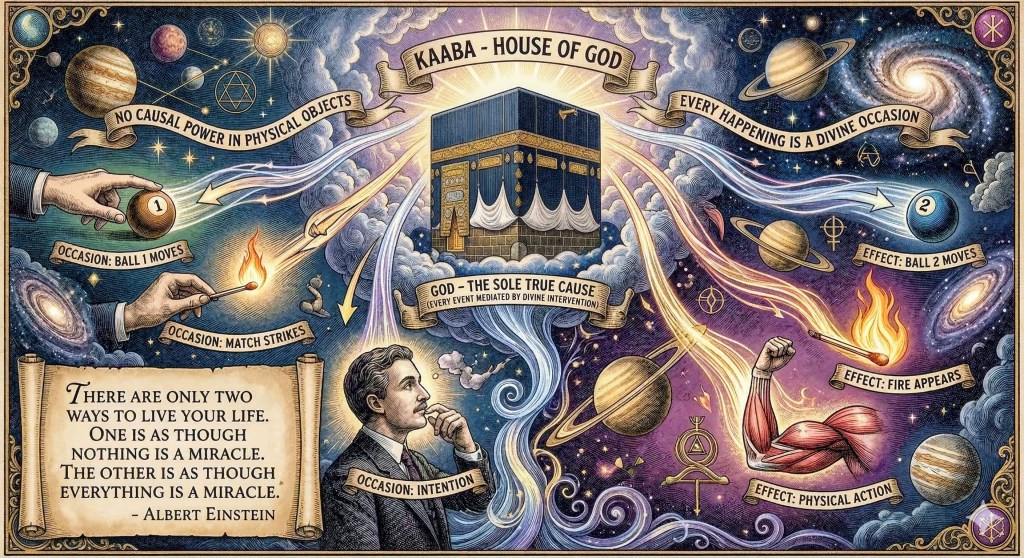
This point permits a fruitful dialogue between classical occasionalism and modern science without confusing the two. The research dossier summarizes Shah’s use of al-Ghazālī: natural regularities are the customary ordering of divine action, not metaphysically self-subsisting powers independent of God. One need not adopt full Ashʿarite occasionalism to appreciate the philosophical distinction between describing regular succession and explaining ultimate existence. Physics can describe gravitational interaction; geology can describe orogeny; meteorology can model precipitation; neuroscience can correlate brain states with conscious states. None of those descriptions, by itself, settles the metaphysical question of why there is an ordered reality capable of sustaining those processes.
The theological trajectory is therefore cumulative rather than competitive with science. The Qur’an repeatedly directs attention outward and inward and then asks the human being to infer. In 51:20–23 the sequence is almost phenomenological: earth → self → heaven → speech. The conclusion does not ask the listener to abandon empiricism. It takes one of the most immediate empirical facts available—“you speak”—and uses it as the standard of certainty for something beyond ordinary perception: the promised resurrection and judgment. That movement from seen to unseen is the passage’s deepest philosophical structure.
“In the Earth Are Signs”: Geology, Mountains, and Planetary Habitability
Verse 51:20 is extraordinarily open-ended: “And in the earth are signs for those possessed of certainty.” Al-Ṭabarī interpreted these as lessons perceived by travelers who observe the earth, while Ibn Kathīr specifically included valleys, mountains, deserts, rivers, oceans, plants, and animals among the earthly signs. The text therefore naturally accommodates geological reflection, although the Qur’an itself does not specify plate tectonics, mineralogy, stratigraphy, or mantle convection.
Modern geology dramatically expands what an observer can mean by “signs in the earth.” Earth’s outer shell is divided into moving tectonic plates; continental crust is much thicker than oceanic crust; earthquake and volcanic activity cluster around plate boundaries; and mountain belts often arise through collision, crustal shortening, subduction, magmatism, uplift, erosion, and long-term isostatic adjustment. The USGS notes that continental crust can become vastly thicker than oceanic crust and that elevated continents can possess deep compensating structures analogous, in a limited physical sense, to the submerged portion of an iceberg.
This makes the Qur’an’s separate mountain imagery particularly evocative. Sūrat al-Nabaʾ asks whether God made “the mountains as pegs” (awtādan, 78:7), while 16:15, 21:31, and 31:10 speak of mountains being set firmly in relation to the earth’s stability, and 88:19 invites reflection on how mountains are “set” or “anchored.” Shah has repeatedly emphasized these passages as geological clues. His mountain essays connect the “peg” metaphor with the modern concept of crustal roots and isostatic compensation, and the July 2026 commentary on Qur’an 79:27–33 explicitly recommends describing this as scientific resonance, not as a naïve proof that the Qur’an contains a modern geology textbook.
There is a genuine geological basis for speaking of “roots,” but accuracy requires qualification. Nineteenth-century investigations of gravitational anomalies near the Himalayas helped generate the Airy and Pratt models of isostasy. In Airy’s model, elevated terrain is supported by thickened low-density crust extending downward, analogous to an iceberg. Yet the actual Earth is more complicated: the USGS stresses that there is no single universally valid isostatic model; some mountain systems have clear crustal roots, while others receive support from density contrasts in the mantle or other mechanisms. The Sierra Nevada and European Alps exhibit pronounced crustal roots; parts of the Rocky Mountain system are more complex.
This qualification matters because apologetic literature sometimes overstates the case by claiming that mountains simply “prevent earthquakes.” That is not a good geological formulation. Major mountain belts are frequently tectonically active and earthquake-prone precisely because they are associated with plate convergence and crustal deformation. What can responsibly be said is subtler: mountains are not superficial heaps deposited on a passive crust; they are integral components of deep lithospheric structure, and their elevation is dynamically related to crustal thickening, density, buoyancy, erosion, and isostatic balance. The Qur’anic metaphors of “pegs,” “firmly set” mountains, and anchoring therefore possess a striking structural resonance with the discovery that what is visible above the surface may be supported by large, hidden geological structures below it.
The philosophical significance of 51:20 is broader than mountains. Plate tectonics recycles crust; erosion produces soils and sediments; volcanism brings materials from Earth’s interior to the surface; the atmosphere, hydrosphere, lithosphere, and biosphere interact continuously. Earth is not merely “ground.” It is a coupled planetary system. The Qur’anic invitation to see āyāt in the earth can therefore encompass the entire history written in rock: mountain uplift and erosion, sedimentation and fossilization, mineral cycles, continental drift, ocean basins, earthquakes, soils, groundwater, and the delicate conditions under which a geologically active planet became habitable. This is an inference from the verse’s broad category of “signs,” not a claim that the verse itself specifies each modern mechanism.
Theologically, geology also teaches humility. Mountains that appear permanent are temporary. Continents migrate; seas open and close; ranges rise and erode. What appears fixed at the human timescale is dynamic on the planetary timescale. A Qur’anic reader may see here an instructive contrast between created stability and divine permanence: creation is reliable enough to sustain life, yet contingent enough never to deserve ultimacy. The mountain is firm, but not eternal; the law is regular, but not self-existent; the earth is home, but not final destination.
“And in Yourselves”: Consciousness, Freedom, Personhood, and the Soul
Verse 51:21 turns the argument inward: “And in yourselves—will you not then see?” Classical exegetes already found astonishing breadth here. Al-Ṭabarī preserves a report from Ibn Zayd drawing attention to hearing, sight, the tongue, the heart, speech, and the mystery of intellect; he concludes that the human self contains signs pointing toward the unity of its Creator. Ibn Kathīr emphasizes the structure of the body, human cognitive differences, language, abilities, and the placement and function of organs.
Modern biology amplifies that invitation almost beyond measure. The self includes molecular machinery, cellular signaling, metabolism, immunity, embryological development, neural computation, sensory integration, memory, emotion, language, and social cognition. Yet among these phenomena consciousness remains philosophically distinctive: there is something it is like to see red, feel pain, remember childhood, intend an action, understand a sentence, or ask whether one is free. Contemporary neuroscience has identified many neural correlates and increasingly sophisticated experimental methods, but even a 2026 review of human intracranial research states that the quest to identify the neural correlates of perceptual consciousness remains unresolved and that methodological problems continue to complicate the distinction between consciousness itself and associated cognitive processes.
This is where Shah’s sustained interest in consciousness is especially relevant. His essays argue that conscious subjectivity cannot simply be dismissed as illusion, because an illusion is itself a conscious appearance to a subject. His broader project uses consciousness not as a laboratory “proof of the soul,” but as a challenge to reductive accounts that seem to explain objective neural processing while leaving the subjective first-person fact untouched. His 2024 essay on Qur’an 17:85 likewise stresses how little humanity still understands about the rūḥ and consciousness despite enormous scientific achievement.
The theological caution is important. Neuroscience has not scientifically demonstrated an immaterial soul, and the “hard problem” of consciousness is not itself a proof of dualism. There are physicalist, dualist, panpsychist, idealist, emergentist, and other philosophical interpretations of the same scientific data. What 51:21 does provide is a powerful epistemic invitation: the investigator must not exclude the first-person subject from the inventory of reality merely because it is difficult to quantify. Consciousness is not inferred in the same way as an electron or black hole; it is the precondition of every measurement, theory, observation, doubt, and scientific argument we ever entertain.
Free will intensifies the problem. Shah’s recent writings defend libertarian agency and argue that divine foreknowledge need not imply fatalistic causation. The scientific literature on volition remains contested, partly because experimental measures of preparatory neural activity do not straightforwardly settle the philosophical question of whether persons can be genuine sources of action. The Qur’an’s moral vocabulary—command, prohibition, repentance, intention, responsibility, judgment—presupposes meaningful agency, and 51:23’s destination in accountability reinforces that structure. Shah’s theological synthesis therefore treats human freedom as compatible with divine omniscience: knowing an action is not the same as coercively causing it.
The verse’s phrase fī anfusikum—“in yourselves”—is particularly fertile because the self is simultaneously biological and existential. One can map neural circuits, yet the map is not the experience. One can analyze vocal musculature, yet that does not exhaust meaning. One can identify Broca’s and temporal-language networks, yet a sentence is not merely a waveform or motor sequence: it carries reference, truth-value, intention, memory, and relationship. The Qur’an’s movement from “your selves” in verse 21 to “you speak” in verse 23 is therefore profoundly suggestive. The human subject is first presented as an object of contemplation and then, two verses later, as the most immediate witness to the certainty of divine promise.
The connection to soul and afterlife should nonetheless be framed theologically rather than pseudoscientifically. Islam affirms personal survival, resurrection, and accountability; science has not established the mechanism by which personal identity is preserved between death and resurrection. Shah’s proposal that the soul preserves identity belongs to metaphysics and revelation, not present neuroscience. That distinction strengthens rather than weakens the argument: 51:21 calls attention to the mystery of personhood; 51:23 grounds eschatological certainty in divine testimony. Science illuminates the complexity of the embodied person, while revelation makes the further claim that the person is not exhausted by mortal biological history.
“In Heaven Is Your Provision”: Rain, Cosmic Chemistry, and the Conditions of Life
Verse 51:22 declares: “And in heaven is your provision and what you are promised.” Classical exegesis understood “provision” first and foremost as rain. Al-Ṭabarī explains that rain and snow descend from the sky and thereby enable the earth to produce food and fruit. Ibn Kathīr likewise glosses heavenly provision as rain and takes “what you are promised” as Paradise, while al-Ṭabarī records broader interpretations embracing whatever good or evil God has promised.
The modern water cycle makes this classical interpretation far richer. Water continuously circulates among oceans, atmosphere, clouds, ice, soil, groundwater, rivers, organisms, and vegetation. Evaporation transfers liquid water into atmospheric vapor; condensation forms droplets and clouds; precipitation returns water to the surface; infiltration and percolation recharge soils and groundwater; plants return moisture through transpiration. NOAA emphasizes both water’s indispensability to life and the complexity of the cycle linking atmosphere, ocean, land, vegetation, snowpack, glaciers, rivers, and aquifers.
Rain itself requires a remarkable conjunction of conditions. Moisture must be supplied, air must be lifted and cooled, cloud droplets or ice crystals must nucleate and grow, and particles must become large enough to fall. Warm-cloud precipitation involves collision and coalescence; cold-cloud processes involve ice crystal growth and phase changes. Mountains can themselves influence precipitation by forcing moist air upward. Thus the “earth” of verse 20 and the “heaven” of verse 22 are not isolated domains but interacting systems: topography shapes atmospheric circulation; rainfall shapes erosion; erosion shapes soils; soils support vegetation; vegetation participates in atmospheric moisture cycling.
The word rizq may also invite a wider theological meditation on provision. Everything in human food ultimately depends on a chain of physical conditions extending far beyond the immediate meal: solar radiation, atmospheric chemistry, planetary temperature, liquid water, carbon chemistry, soil minerals, microbial ecosystems, photosynthesis, and stable ecological cycles. The Qur’anic language does not enumerate these mechanisms; modern science uncovers them. To call them rizq is to interpret the chain not merely as mechanism but as gift.
That meditation can be expanded cosmically. The essential chemical elements of terrestrial life—especially carbon, hydrogen, nitrogen, oxygen, phosphorus, and sulfur—have cosmic histories. NASA summarizes the familiar “CHNOPS” set as the principal elemental building blocks of known life. Hydrogen largely originated in the early universe; carbon, nitrogen, oxygen and many heavier elements were produced through stellar nucleosynthesis and later dispersed into space, eventually becoming incorporated into planets and living organisms.
Carbon is especially remarkable because of its capacity to form stable, diverse molecular architectures. Oxygen is central to water and, in complex aerobic organisms, energy metabolism. Iron is indispensable to human physiology—most conspicuously in hemoglobin—and also became foundational to civilization through tools, agriculture, construction, transportation, machinery, and industry. Astrophysically, carbon and oxygen are synthesized in stars, while iron represents a crucial endpoint in the fusion sequence of massive stars; supernovae and other stellar events redistribute heavy elements that later become part of new stars, planets, and biological bodies. NASA’s educational materials explicitly note that the carbon, oxygen, and much of the iron in our bodies have stellar origins.
This furnishes a powerful modern enlargement of “in heaven is your provision.” Classical readers saw rain descend from the sky. A modern reader can still affirm that first meaning while recognizing a much longer causal history: the hydrogen in water reaches back to the early universe; the oxygen in that water was forged through stellar processes; the carbon in our tissues was made in stars; the iron transporting oxygen in our blood arose from ancient nucleosynthetic events; the planetary materials from which soils and bodies are formed were assembled from cosmic matter before Earth existed. None of this should be retrojected into the lexical meaning of rizq as though seventh-century Arabic encoded stellar nucleosynthesis. But it is entirely legitimate as theological tadabbur: science has disclosed that what we call “provision” reaches from clouds to stars.
Fine-tuning enters at this point. The universe must possess conditions compatible with long-lived stars, chemical complexity, stable matter, planetary systems, and energy gradients before life can arise at all. Shah’s recent writing on fine-tuning argues that these life-permitting features invite philosophical explanation rather than being dismissed as metaphysically insignificant. Fine-tuning arguments remain philosophically debated—alternatives include brute fact, deeper physical law, selection effects, and multiverse proposals—but the empirical fact that life depends on a narrow and structured network of physical and chemical conditions is uncontroversial. The theological inference to design is a philosophical interpretation of that structure, not a result produced directly by the equations of physics.
In Qur’anic terms, the striking point is relational: heaven supplies earth, earth supports life, life gives rise to consciousness, and consciousness becomes capable of recognizing provision. The cosmos is therefore not merely background scenery for human theology. The atoms of the theologian, the water in the theologian’s cells, and the iron in the theologian’s blood carry a history older than the planet on which the theology is spoken.
“It Is the Truth Just as Surely as You Speak”: Speech, Al-Ḥaqq, Resurrection, and the Hidden God
Verse 51:23 is the climax: “So by the Lord of heaven and earth, it is surely the truth, just as surely as you speak.” Classical exegesis sharply anchors the pronoun innahu—“indeed it”—to what immediately precedes it. Al-Ṭabarī says that what God has stated concerning provision and what humanity is promised is true. Ibn Kathīr makes the eschatological referent explicit: resurrection, judgment, and recompense will certainly occur, and one should no more doubt them than one doubts one’s own act of speaking.
This classical reading is important because it prevents an overstatement. The verse does not grammatically say, in isolation, “God, the Qur’an, and the Afterlife are al-Ḥaqq.” Its immediate assertion concerns the promised reality. Yet within the surah’s larger theological structure, those realities are inseparable: the One who swears is the “Lord of heaven and earth”; the statement is delivered through revelation; and the content includes divine provision and eschatological fulfillment. The research dossier notes that classical exegetical discussions elsewhere allow interconnected senses of al-ḥaqq—the Qur’an, Islam, divine signs, and the truth of Muhammad’s message—while warning that antecedents must be interpreted contextually.
Why speech? Because speech sits at the intersection of the tangible and intangible. Acoustically, speech is vibration in air. Physiologically, it requires respiration, laryngeal control, tongue and lip movements, auditory feedback, and neural coordination. Cognitively, it requires conceptualization, syntax, memory, intention, and semantic representation. Subjectively, the speaker experiences meaning before, during, and after vocalization. Socially, speech makes promises, testimony, law, prayer, confession, knowledge, deception, poetry, science, and revelation possible.
The verse therefore chooses an extraordinarily intimate standard of certainty. A person may doubt philosophical arguments, misunderstand cosmology, or never see the deep structure beneath a mountain. But the person cannot seriously doubt, while speaking, that speech is occurring. The Qur’an takes that self-authenticating act and says: the divine promise is no less real.
This does not amount to a formal deductive proof recognizable as a syllogism in analytic philosophy. It is closer to an existential oath. The epistemic force arises from juxtaposition: you know this about yourself immediately; know the divine promise with corresponding seriousness. It resembles what philosophers call a Moorean certainty—something so basic in ordinary experience that denying it would undermine the act of denial itself. One cannot verbally argue that no speech is occurring without performing the very phenomenon one denies.
Here the passage’s earlier sequence converges. Verse 20 directs the eye to the external world. Verse 21 turns awareness inward. Verse 22 looks upward to provision and promise. Verse 23 then returns to the speaking subject. Earth, self, heaven, and speech form a conceptual circle. The universe supplies the material conditions for life; life supplies embodied consciousness; consciousness supplies language; language permits the human being to articulate questions of truth, God, responsibility, and destiny. The theological claim is that this ascent of intelligibility is not metaphysically orphaned.
From a philosophy-of-mind perspective, speech is especially appropriate because it exposes the inadequacy of purely third-person description as an exhaustive account of human existence. A spectrogram can describe frequencies but not what a sentence means. A neural scan can correlate with speech production but does not itself assert a proposition. Chemistry can describe neurotransmitters but not whether a promise is sincere. These are not arguments against neuroscience; they are reminders that explanation occurs at multiple levels. Meaning, intentionality, truth, normativity, and first-person awareness are real features of the human world even when physically embodied.
The theological inference to soul should remain carefully stated. Qur’anic anthropology includes nafs, qalb, ʿaql as function or activity, and rūḥ, but the precise metaphysics of their relationship to brain and body is not experimentally established. The Qur’an’s promise of resurrection requires divine preservation or reconstitution of personal identity; it does not require the believer to possess a neuroscientific model of how that occurs. Shah’s writings emphasize precisely this epistemic humility through Qur’an 17:85: human knowledge concerning the rūḥ remains limited.
Yet the eschatological force of 51:23 is stronger than a mere appeal to mystery. The argument is from first creation to re-creation. The God capable of producing a universe with stable law, stars, elements, planets, water, geology, chemistry, life, consciousness, memory, agency, and speech is not rendered incapable by death. Resurrection is not presented as a local anomaly intruding upon an otherwise godless nature; it is presented as the act of the same Lord whose creative power is already manifest in the entire order of nature.
This is why the names invoked in Qur’anic theology matter. The God toward whom the signs point is not a generic “higher power” added to a scientific picture. He is the God of Abraham, Ishmael, Isaac, Jacob, Moses, Jesus, and Muhammad; the Creator and Sustainer, the Merciful and Compassionate, the First and the Last, the Manifest and the Hidden. The cosmic argument terminates not in deism but in relationship, gratitude, moral accountability, and worship.
The sequence can therefore be read as a theology of gratitude. Geological stability is gift. Rain is gift. Carbon and oxygen are gift. Iron is gift. Life is gift. Consciousness is gift. Freedom is gift. Language is gift. Revelation is gift. And because gift implies responsibility, rizq naturally opens onto wa-mā tūʿadūn—“and what you are promised.” Provision without judgment would make gratitude optional in a metaphysically thin sense; provision joined to accountability transforms existence into vocation.
Thematic Epilogue: The Speaking Human in a Speaking Universe
Qur’an 51:20–23 may be imagined as four widening and narrowing circles. The first circle is the earth: rock, mountain, valley, river, soil, tectonic plate, mineral, organism, ecosystem. The second is the self: body, cell, genome, brain, memory, consciousness, intention, freedom. The third is heaven: atmosphere, cloud, rain, Sun, star, nucleosynthesis, cosmic history, the elemental inheritance out of which planets and bodies arise. The fourth is the human voice. The argument ends where experience is most immediate: you speak.
Modern science has not made these verses obsolete. It has made their field of contemplation vastly larger. The earth once encountered by the traveler is now known as a differentiated planet with a deep interior, mobile lithosphere, ancient geological record, and mountain systems whose visible elevations may be supported by profound structures beneath the surface. The rain once seen falling from clouds is now understood as one stage of a global hydrological engine. The “provision” used to sustain the body can be traced through planetary chemistry to stellar furnaces and, for hydrogen, to the earliest universe. The “self” can be investigated from proteins to neural ensembles, yet consciousness remains an unresolved frontier.
The scientific attitude and the Qur’anic attitude need not be adversaries. Science asks how mountains rise, how rain forms, how stars manufacture elements, how neurons communicate, and how speech is generated. The Qur’an asks what these realities mean within a total account of existence. One can answer the first set of questions magnificently and still have said nothing about why there is something rather than nothing, why the universe is intelligible, why rational agents can know it, why consciousness exists, why truth has normative authority, or why moral accountability should matter. Those are philosophical and theological questions, not defects in science.
Nor should theology retreat into whatever science has not yet explained. That would make faith hostage to ignorance. The more durable Qur’anic method is the one Shah repeatedly advocates in his strongest writing: lawful nature itself is a witness. A completely understood rain cycle would remain a sign. A complete geological theory would remain a sign. A complete map of neural activity would remain a sign. Explanation of mechanism does not abolish the metaphysical question of being; intelligibility itself becomes part of the evidence to be interpreted.
The mountain offers a particularly apt symbol. Human vision sees the summit; geology reveals the hidden support. The Qur’an’s epistemology repeatedly makes the same move: visible realities possess invisible depths. Rain has atmospheric causes we do not ordinarily see. Food has ecological and cosmic histories we do not ordinarily see. Speech has neural and conscious dimensions we cannot directly observe in another. The material world is not unreal; it is precisely because it is real that it can function as a sign.
Verse 23 then performs a final reversal. We began with what is external—the earth—and ended with what is internal and undeniable—speech. The hidden God is not made visible as an object among objects. Instead, the visible world and the conscious self are marshaled as witnesses. The Qur’an’s theology is therefore neither an escape from empiricism nor a reduction to empiricism. It is an argument through empirical reality toward metaphysical meaning.
Within the surah, the point is ultimately eschatological. Earth, self, and heaven do not merely prove that creation is wondrous. They establish a context in which resurrection ceases to be conceptually absurd. The One who brought the first world into being can bring another; the One who formed the first conscious person can restore the person; the One who supplied earthly life can fulfill the promise beyond earthly life. Classical tafsīr is unequivocal that this is the immediate burden of the oath: resurrection, judgment, recompense, Paradise, and the fulfillment of what God has promised are as certain as the hearer’s awareness of speaking.
Thus the final word of the passage is not geology, meteorology, cosmology, or neuroscience. It is ḥaqq—truth and reality. The sciences provide an ever-expanding inventory of the signs; philosophy asks what sort of reality can ground their intelligibility; theology identifies their ultimate Source and destination. The Qur’anic invitation is to allow each domain to do its proper work and then to see the whole.
The speaking human stands at the intersection. Our bodies contain hydrogen from the primordial cosmos, carbon and oxygen formed through stellar processes, iron inherited from ancient stellar evolution, water circulated through an astonishing planetary system, and minerals drawn from an active earth. Our brains organize those materials into the biological conditions for perception, memory, intention, and speech. And through speech we can say “I,” “you,” “truth,” “God,” “thank you,” “forgive me,” and “what happens when I die?”
That is why the comparison at the end of 51:23 is so powerful. The Qur’an does not end this sequence with a distant galaxy. It ends with the voice already emerging from the reader’s own mouth. The most intimate fact becomes the analogical measure of the greatest promise. From mountains to mind, from rain to resurrection, from stars to speech, the argument returns again and again to one theological horizon: creation is intelligible because it is not ultimate; provision is meaningful because it is gift; consciousness is morally weighty because the self is accountable; and the final truth belongs to the Lord of heaven and earth.
In that sense, 51:20–23 distills the Qur’anic movement from the tangible to the intangible with extraordinary economy. Look down: there are signs in the earth. Look within: there are signs in yourselves. Look up: there is your provision and your promised destiny. Then listen to your own voice. As surely as you know that you speak, the Qur’an asks you to take seriously the possibility that the visible universe is not the whole of reality—and that the God who is al-Awwal and al-Ākhir, the First and the Last, al-Ẓāhir and al-Bāṭin, the Manifest and the Hidden, has made the empirical world itself the road by which finite minds may reason toward Him.
For references, please go to Microsoft Word file:



Leave a Reply