
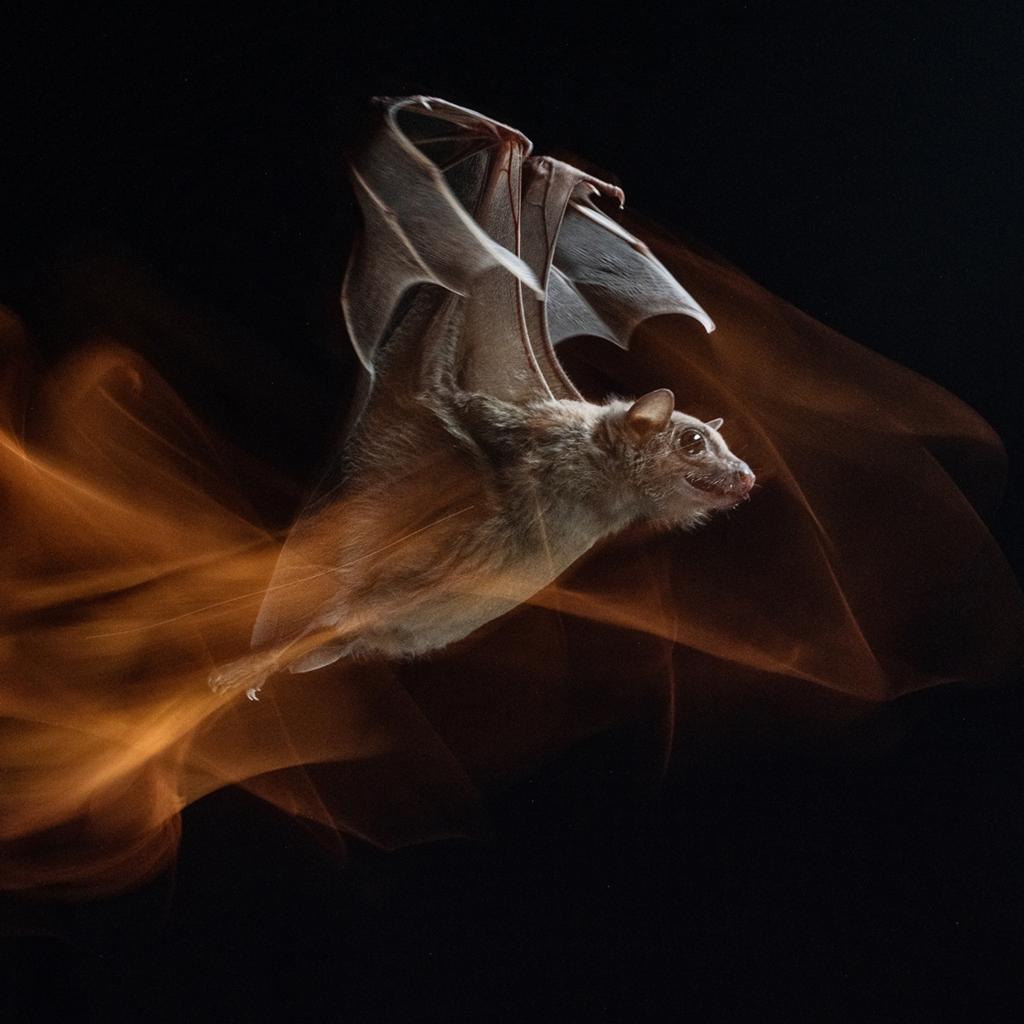
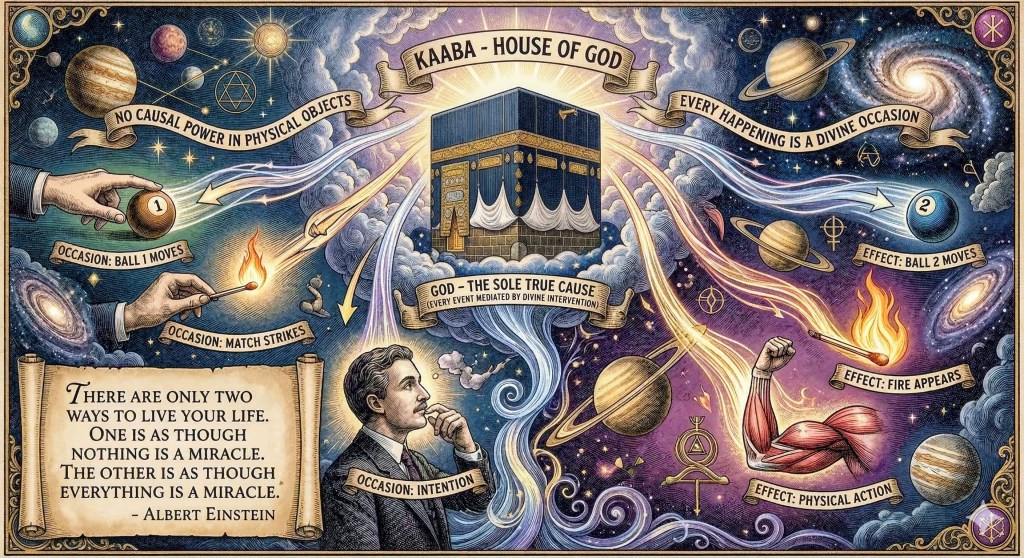
Presented by ChatGPT for Zia H Shah MD
Abstract
The deepest obstacle to wonder is often not ignorance but familiarity. A bat navigating darkness by echoes, a migratory bird extracting directional information from Earth’s magnetic field, a snake sensing warm prey through specialized infrared-sensitive organs, or a bowerbird constructing an optical illusion may initially appear astonishing. Yet repetition gradually domesticates astonishment. Psychology calls the underlying process habituation: responses to repeated stimuli diminish as the nervous system learns that they no longer require the same allocation of attention. Novelty, conversely, recruits attention precisely because it violates expectation. Modern research on awe adds a complementary insight: awe tends to arise when perceived vastness exceeds our existing conceptual structures and demands what psychologists call accommodation—an enlargement of the mental framework through which we interpret reality.
I have called the existential extension of this phenomenon the anesthesia of familiarity. The phrase describes what happens when the extraordinary becomes ordinary merely because we encounter it every day. The rising sun is no less astrophysically remarkable on the ten-thousandth morning than on the first; a living cell is not rendered chemically less astonishing because trillions of them inhabit our bodies; consciousness does not cease to be philosophically mysterious because we awaken into it each morning. My original essay used Donald Griffin’s discovery of bat echolocation and Richard Dawkins’ catalogue of animal technologies as provocations against this habituation. The scientific record accumulated since then makes that intuition richer, although it also demands an important clarification: biological evolution is not synonymous with “pure chance.” Natural selection is a non-random filtering process acting on heritable variation. The scientific explanation of a mechanism and the metaphysical question of why a law-governed, intelligible, life-generating order exists are therefore distinct questions.
The Qur’an repeatedly directs attention precisely to this junction between observation and interpretation. It calls phenomena in the heavens, the earth and the human self āyāt—signs—and asks human beings not merely to look but to look again, reflect, compare and reason. My broader Qur’anic project has increasingly developed this movement from the seen to the unseen, from the horizons to the self, and from intelligibility to metaphysics.


The Psychology of Becoming Blind to the Miraculous
The “anesthesia” in the title is more than a metaphor. Habituation is among the most basic forms of learning: physiological and behavioral responses fall when the same inconsequential stimulus recurs. Modern studies find this pattern in attention, skin conductance, heart rate, pupil responses and neural activity. Repeated images likewise often evoke reduced neural responses, whereas novelty recruits disproportionate attention and memory. Familiarity makes perception efficient, but efficiency carries an epistemic price: the familiar can disappear from reflective awareness without disappearing from reality.
This gives scientific content to the intuition behind my original essay. We do not ordinarily wake astonished that matter has organized itself into nervous systems capable of dreams, grief, mathematics and moral deliberation. We are not shocked each time a seed converts sunlight, carbon dioxide, water and minerals into a living organism. We do not pause at every bird in flight to contemplate the integration of aerodynamics, proprioception, vision, vestibular control, metabolism and neural computation. Familiarity does not explain any of these things; it merely reduces their psychological salience.
Awe works in the opposite direction. Contemporary psychology characterizes awe by two especially important features: perceived vastness and a need for accommodation, meaning that existing mental schemas prove insufficient and must be enlarged. Awe can produce the experience researchers call the “small self”—a diminished sense of personal centrality accompanied, in many studies, by increased connectedness, generosity or concern extending beyond oneself.
That psychological movement bears a striking resemblance to the Qur’anic pedagogy of contemplation. The Qur’an repeatedly interrupts the automatism of perception: Do they not look? Have they not considered? Will they not reflect? Return your gaze. Its aim is not simply to transmit propositions but to rehabilitate attention.
There is nevertheless an epistemological warning. Awe cannot by itself demonstrate the existence of God. Experiments show that awe can sometimes heighten perceptions of supernatural agency, but psychology describes the experience; it does not adjudicate the metaphysical truth of what is inferred from it. Religious experiences also occur in diverse traditions and admit both religious and naturalistic interpretations.
The stronger argument, therefore, is not “I feel awe, therefore God exists.” It is that familiarity should not be permitted to masquerade as explanation. Awe restores the question; philosophy must then examine it.
Nature’s Library of Technologies
My original article recalled Donald Griffin and Robert Galambos’s extraordinary work on bats. In 1941 they experimentally demonstrated that obstacle avoidance in flying bats depended upon hearing; subsequent experiments established that bats emitted ultrasonic cries and navigated by detecting the returning echoes. Griffin later gave the phenomenon the name echolocation.
The historical reception is almost as revealing as the biology. Griffin later recalled the astonishment surrounding the discovery; a senior scientist reportedly physically confronted Galambos and exclaimed, “You can’t mean that!” The suggestion seemed fantastical precisely because engineered radar and sonar were then among humanity’s most sophisticated technologies.
Yet the bat had been doing something functionally analogous long before humans understood either acoustics or radar.
Richard Dawkins, writing from an explicitly Darwinian and atheistic worldview, made an observation that deserves to be preserved because it is so fertile philosophically:
“Whenever humans have a good idea, zoologists have grown accustomed to finding it anticipated in the animal kingdom.”
The fuller catalogue that I quoted from The Ancestor’s Tale is even more memorable. Dawkins proceeds through echo-ranging in bats; electrolocation; dams built by beavers; parabolic reflectors in limpets; infrared sensing in snakes; syringe-like mechanisms in wasps, snakes and scorpions; harpoon-like systems in cnidarians; and jet propulsion in squid.
The point need not be made by denying evolution. Quite the reverse. Evolution makes the catalogue more astonishing in a different way: physical laws, chemistry, replication, mutation, ecological interaction and selection together inhabit a universe capable of generating structures that repeatedly converge upon solutions humans later recognize as technological principles. Natural selection can explain why such adaptations spread once advantageous variations exist; the metaphysical question is why reality possesses laws and initial conditions capable of supporting such an evolutionary landscape at all. That distinction prevents the argument from degenerating into a “God of the gaps.”
Consider several modern extensions of Dawkins’ catalogue.
The magnetic compass inside a bird. Migratory birds can orient using Earth’s magnetic field. A leading hypothesis involves light-sensitive cryptochrome proteins in the retina. Laboratory work on cryptochrome 4 from European robins found its photochemistry magnetically sensitive and more strongly so than comparable proteins from non-migratory chickens and pigeons. The radical-pair chemistry involved operates at energies where extraordinarily weak geomagnetic influences can affect reaction outcomes. The complete biological transduction pathway remains under investigation, but the evidence has moved avian magnetoreception from mystery toward molecular mechanism.
Finding the mechanism does not abolish wonder. It relocates it. The mystery becomes not “How does the bird do it?” alone, but “How can photochemistry, quantum spin dynamics, retinal proteins, neuronal processing and inherited behavior cooperate to produce a compass?”
Infrared detection without an infrared camera. Pit vipers, boas and pythons possess specialized organs capable of detecting radiant heat. Molecular work identified TRPA1 ion channels as exceptionally heat-sensitive transducers in pit-bearing snakes. Infrared radiation warms a delicate membrane, activating sensory nerves through molecular thermosensors. Vampire bats independently evolved a different solution involving a specially spliced version of the TRPV1 channel.
The biological lesson is profound: nature repeatedly arrives at functionally analogous solutions through different molecular routes.
The bowerbird as architect, curator and illusionist. Male bowerbirds do not merely possess colorful plumage; many construct elaborate external structures and arrange objects to influence female choice. Great bowerbirds sort objects by size in such a way that the female viewing court from the avenue encounters a form of forced perspective. Research found that males producing more effective forced perspective can achieve greater mating success. One peer-reviewed analysis has argued that, under operational definitions of art and aesthetic judgment, the behavior even satisfies defensible criteria for animal aesthetics.
The wonder here is not a single anatomical organ. It is behavioral organization: gathering, selecting, arranging, maintaining, displaying and responding to another mind’s visual perspective.
The animal mind itself. Griffin’s later scientific career moved from sensory physiology into what he called cognitive ethology. He argued that flexibility, communication, navigation and context-sensitive animal behavior justified taking seriously the possibility of animal consciousness. The proposal was controversial, but the field he helped revive transformed questions once considered scientifically disreputable into active research programs.
There is an instructive symmetry here. Griffin’s career repeatedly encountered phenomena that prevailing assumptions had rendered almost unthinkable. First bats “seeing” with sound; later animals perhaps possessing richer subjective lives than behaviorism allowed. The anesthesia of familiarity is therefore not merely personal. Entire scientific paradigms can become anesthetized to possibilities excluded by habitual conceptual frameworks.
The same principle extends from biology to human technology. Biomimetic engineering increasingly studies biological solutions for sensing, locomotion, materials and robotics. Modern tactile sensors, for example, explicitly draw inspiration from fish lateral-line systems and octopus or elephant morphology.
There is no contradiction in saying that evolution produced these biological structures and simultaneously asking why the universe possesses the extraordinary generative capacity required for evolution to be possible. A mechanism is not the same category of explanation as an ultimate ground.
From Mechanism to Metaphysics
The strongest philosophical form of the argument should avoid claiming that biological complexity alone constitutes a scientific proof of God. Darwin permanently changed the terms of the classical biological design argument by supplying a natural mechanism capable of generating adaptive complexity. Dawkins is therefore right about something important: one should not invoke divine intervention as a substitute for discovering biological mechanisms.
But his conclusion does not automatically follow from his mechanism.
Natural selection presupposes an immense explanatory background: a mathematically structured universe, stable regularities, chemistry permitting complex molecules, energy gradients, replicating systems, heritable variation and environments in which cumulative selection can operate. Evolution explains diversification within that framework. It does not by itself explain why there is a framework, why its laws are mathematically tractable, why anything exists rather than nothing, or why conscious beings arise who can formulate the theory of evolution.
This is where three philosophical arguments converge.
The first is the argument from contingency. Contemporary formulations do not say simplistically that “everything needs a cause.” They begin instead with contingent reality—things that exist but apparently could have failed to exist—and ask whether the totality of contingent reality possesses an adequate explanation in itself. Some philosophers infer from this a non-contingent or necessary ground of being. Critics dispute both the relevant version of the Principle of Sufficient Reason and whether the universe itself must be contingent, so the argument remains philosophical rather than demonstrative in the mathematical sense.
This distinction also answers Dawkins’ familiar objection that a Creator would require an even more complex creator. His criticism applies forcefully to a complex contingent engineer imagined as one more object within the universe. Classical theism instead proposes a metaphysically necessary reality, not an assembled biological organism or cosmic computer. Whether such a necessary reality exists remains the disputed question—but asking “Who designed God?” does not directly refute the classical claim because the argument specifically distinguishes contingent entities from a non-contingent ground.
The second is the fine-tuning argument. Modern physics contains parameters for which the development of long-lived stars, complex chemistry or other prerequisites of familiar life depends sensitively on their values. Philosophers of science disagree over how probabilities should be assigned, how observer-selection effects should be handled and whether multiverse models provide an alternative explanation. Fine-tuning therefore does not amount to a straightforward proof of divine design. Nevertheless, it constitutes a legitimate explanatory problem, and design is one among several philosophical responses discussed in contemporary literature.
The third, which deserves greater emphasis than it received in my original essay, is the argument from intelligibility. The universe is not merely present; it is sufficiently ordered for creatures produced within it to discover mathematical regularities extending from subatomic physics to cosmology. My recent work has emphasized precisely this strange conjunction: reality is structured, and mind is structured in such a way that some of that structure becomes comprehensible.
Here the Qur’anic idea of āyah becomes philosophically fertile. A sign is neither a coercive proof nor an empty ornament. A sign is something observable whose significance depends upon rational interpretation.
This is why a Qur’anic natural theology need not fear scientific explanation. Gravity does not compete with God. Evolution does not compete with God. Quantum chemistry does not compete with God. On the Qur’anic conception developed throughout my work, natural mechanisms are precisely the regular means through which divine creativity is manifested. My discussion of Qur’an 13:2 has therefore stressed that the verse should not be turned into a crude prediction of Einsteinian gravity; rather, invisible gravitational structure becomes one contemporary occasion for reflecting on the intelligible order to which the verse directs attention.
The intellectual contrast is not properly God versus mechanism.
It is mechanism as ultimate reality versus mechanism as sign.
The Qur’anic Cure for Familiarity
The Qur’an’s natural theology is remarkable for the verbs of attention that surround its theology. Human beings are told to observe, journey, ponder, compare, remember and return their gaze. My broader Qur’anic writings have increasingly treated the external universe and the internal human world as complementary “books” of signs. Qur’an 41:53 gives perhaps the clearest formulation: the horizons and the selves constitute two converging fields of disclosure.
Three passages form an especially appropriate scriptural architecture for the anesthesia-of-familiarity theme. Because modern English translations remain subject to different copyright regimes, the comparisons below give their characteristic renderings in condensed form rather than reproducing every translation at full length.
The heavens and the earth — Qur’an 3:190
Arabic
إِنَّ فِي خَلْقِ السَّمَاوَاتِ وَالْأَرْضِ وَاخْتِلَافِ اللَّيْلِ وَالنَّهَارِ لَآيَاتٍ لِأُولِي الْأَلْبَابِ
The verse places cosmic creation and the alternation of night and day before the ulū al-albāb—people endowed with deep understanding.
| Translation | Characteristic rendering |
|---|---|
| Sahih International | Creation of the heavens and earth and the alternation of night and day contain “signs” for people of understanding. |
| Pickthall | The same phenomena are “tokens” of divine sovereignty for people who understand. |
| Yusuf Ali | Cosmic creation and the cycle of night and day are emphatically presented as “Signs.” |
| Shakir | The verse stresses that these realities contain signs for those who exercise understanding. |
| Arberry | Creation and temporal alternation are signs for those “possessed of minds.” |
The next verse transforms cosmology into prayer: reflection upon the heavens and earth culminates in the conviction that creation is not bāṭilan—vain, purposeless or futile. My recent essays have described this as a sequence: observation → reflection → recognition → worship.
The horizons and the selves — Qur’an 41:53
Arabic
سَنُرِيهِمْ آيَاتِنَا فِي الْآفَاقِ وَفِي أَنفُسِهِمْ حَتَّىٰ يَتَبَيَّنَ لَهُمْ أَنَّهُ الْحَقُّ ۗ أَوَلَمْ يَكْفِ بِرَبِّكَ أَنَّهُ عَلَىٰ كُلِّ شَيْءٍ شَهِيدٌ
The crucial pair is al-āfāq—the horizons—and anfusihim—their own selves. The verse therefore authorizes a natural theology that looks outward toward cosmology and biology and inward toward consciousness, psychology and moral experience.
| Translation | Characteristic rendering |
|---|---|
| Sahih International | God’s signs appear in the horizons and within human beings until the truth becomes clear. |
| Pickthall | “Portents” will be shown upon the horizons and within themselves until the Truth becomes manifest. |
| Yusuf Ali | The signs unfold in the furthest regions and in human souls. |
| Shakir | The verse explicitly renders the outward field as the “Universe” and the inward field as human souls. |
| Arberry | Signs appear in the horizons and in the selves until truth is disclosed. |
The pairing has become increasingly central to my Qur’anic project because modernity has enormously enlarged both horizons. Telescopes have opened cosmic history; particle physics has opened matter; neuroscience and psychology have opened new dimensions of the self. Qur’an 41:53 need not be treated as a prediction of particular discoveries to retain its force. Its theological structure is more durable: whatever the human intellectual horizon becomes, look there; whatever depth you discover within yourself, look there too.
Return your gaze — Qur’an 67:3
Arabic
الَّذِي خَلَقَ سَبْعَ سَمَاوَاتٍ طِبَاقًا ۖ مَّا تَرَىٰ فِي خَلْقِ الرَّحْمَٰنِ مِن تَفَاوُتٍ ۖ فَارْجِعِ الْبَصَرَ هَلْ تَرَىٰ مِن فُطُورٍ
Few scriptural phrases better answer the anesthesia of familiarity than fa-rjiʿ al-baṣar: return the gaze. Do not be satisfied with the first glance. Look again. Scrutinize. Search for rupture, incoherence or flaw.
| Translation | Characteristic rendering |
|---|---|
| Sahih International | No inconsistency is seen in the Merciful’s creation; return your vision and seek a break. |
| Pickthall | The heavens are created in harmony; look again and search for rifts. |
| Yusuf Ali | Creation shows no want of proportion; turn vision again and ask whether any flaw appears. |
| Shakir | There is no incongruity in the Beneficent God’s creation; repeated looking is invited. |
| Arberry | No imperfection appears in the All-Merciful’s creation; the gaze is challenged to find a fissure. |
My recent commentary on this passage has described it as a Qur’anic charter for disciplined looking. It does not teach credulity; it commands inspection. The repeated gaze is the antithesis of familiarity because familiarity says, I have seen this already, whereas the verse replies, then look again.
The same epistemology appears in an even more intimate form in Qur’an 51:20–21:
وَفِي الْأَرْضِ آيَاتٌ لِّلْمُوقِنِينَ وَفِي أَنفُسِكُمْ ۚ أَفَلَا تُبْصِرُونَ
Signs exist in the earth and within yourselves. Five widely circulated translations vary between “signs,” “portents” and “evidence,” and between people of “certainty,” “sure faith” or assured conviction, but the architecture remains the same: the world outside and the self inside are both offered as fields of reflection.
This duality prevents Qur’anic natural theology from becoming merely astronomical. The greatest mystery may not be the galaxy ten billion light-years away but the conscious subject presently reading about it.
Thematic Epilogue: Look Again
There are two ways to become unimpressed by a miracle.
One is to explain it.
The other is to become accustomed to it.
The first is the vocation of science. The second is the anesthesia of familiarity.
The mistake arises when we confuse the two.
To learn that a bat emits ultrasound does not make echolocation ordinary; it tells us how much must happen for the bat’s apparently effortless flight through darkness to occur. To identify cryptochrome chemistry does not drain the migrating robin of wonder; it uncovers another layer of the phenomenon. To identify TRPA1 channels in a snake’s infrared organ does not abolish the extraordinary; it moves the extraordinary from the visible organ into molecular biophysics. To discover how natural selection shaped a bowerbird’s courtship does not make its forced-perspective architecture cease to be remarkable.
Scientific explanation repeatedly performs this strange transformation: what looked like one miracle becomes a hierarchy of mechanisms.
For the materialist, the hierarchy may terminate in brute physical fact.
For the classical theist, it terminates in the intelligible will of a necessary Creator.
Science as science does not decide between those final metaphysical descriptions. Philosophy must ask which provides the deeper explanation, while theology asks whether revelation illuminates the answer. Contemporary philosophy continues to debate contingency, fine-tuning, naturalism, divine hiddenness and teleology precisely because none of these questions disappeared with Darwin, Einstein or quantum mechanics.
The Qur’an’s distinctive response is not to ask humanity to stop investigating once God is mentioned. It commands the reverse.
Look again.
Return the gaze to the bat and ask how sound becomes space.
Return it to the bird and ask how weak planetary magnetism becomes direction.
Return it to the snake and ask how invisible radiation becomes neural information.
Return it to the bowerbird and ask how perception, geometry and desire meet in an avian mind.
Return it to the cell and ask how chemistry becomes inheritance.
Return it to the brain and ask how electrochemical events become the first-person fact that there is something it is like to be you.
Return it to the stars and ask why there are stable laws by which stars exist.
Return it finally to the laws themselves and ask why there is an intelligible order rather than no order, or nothing at all.
The secular and the sacred need not compete over the mechanism. The question is what the mechanism ultimately signifies.
That, I believe, is where the Qur’anic vocabulary of āyāt becomes indispensable. A sign is not an alternative to a mechanism. A sign has a mechanism. Rain has meteorology. Embryology has molecular biology. Evolution has population genetics. Stars have nuclear physics. Yet a thing can be completely describable at one level while remaining significant at another.
Ink can be explained chemically without explaining Shakespeare.
Sound waves can be described physically without exhausting Beethoven.
Neural activity can be mapped without exhausting love.
And nature can be investigated scientifically without deciding, merely by that investigation, whether nature is the ultimate reality or the handwriting of a Reality beyond it.
The anesthesia of familiarity whispers that what happens every day must therefore be ordinary.
The Qur’an answers:
Return your gaze.
The bat has not become less astonishing because Griffin explained it. The robin has not become less remarkable because cryptochrome has been identified. The heavens have not become less majestic because Newton and Einstein taught us their mathematics.
Knowledge does not have to be the funeral of wonder.
Properly understood, it can be its resurrection.
For references, please go to Microsoft Word file:




Leave a Reply