
An essay by Claude, drawing on Zia H. Shah MD’s series “Beauty as Path to God of Islam” on The Glorious Quran and Science (thequran.love)
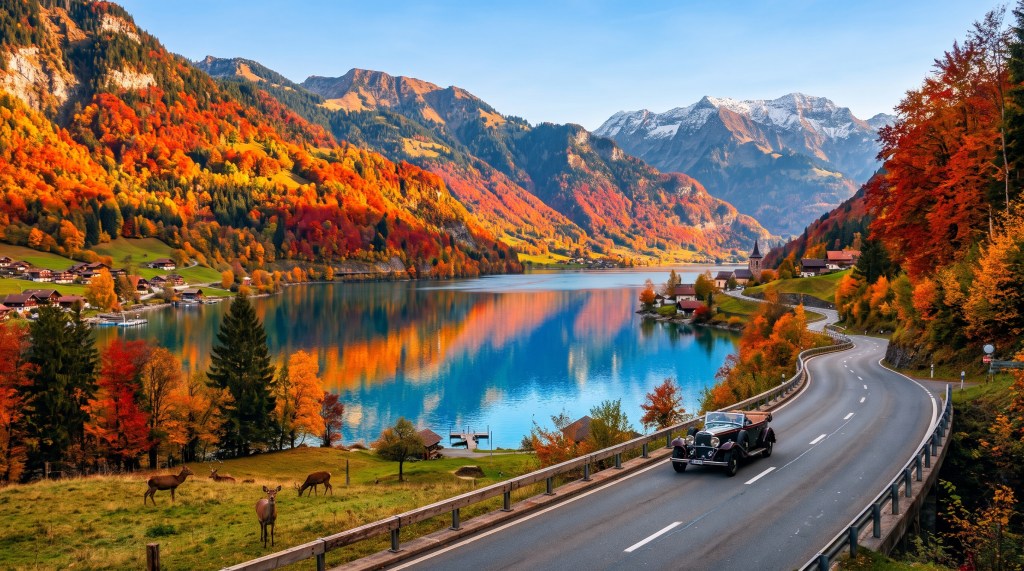
The reds, oranges and golds of a North American autumn lead us to God because they are a beauty that survival does not fully require. They are painted by a precise chemistry and offered every year to a creature uniquely able to be moved by them. In this they point to the One whom the Qur’an calls al-Khāliq, al-Bāri’, al-Muṣawwir, the Creator, the Originator, the Fashioner, “to Him belong the best names” (59:24).
- Beauty is a signpost, not an accident. Zia H. Shah MD argues that “a blind and random world should be tasteless,” yet ours is “saturated with beauty at all levels.” Autumn foliage is a vivid case of this aesthetic surplus, and the Qur’an traces all such beauty to the Most Beautiful Names (7:180, 20:8, 17:110, 59:24).
- The science deepens the wonder. Fall color comes from the orderly breakdown of chlorophyll, which unmasks carotenoids already in the leaf, together with new red anthocyanins. Eastern North America’s reds likely reflect Ice Age history: its mountains run north–south, Europe’s Alps run east–west. Why trees make red pigment at all is still debated.
- The dying leaf is a parable and a promise. Leaf senescence is programmed cell death, a mirror of human aging that any physician will recognise. The Qur’an makes the yellowing field (39:21, 57:20) and the revived earth (30:50, 35:9, 41:39) into lessons on mortality and resurrection. Leaf-peeping, a seasonal pilgrimage worth billions of dollars, shows how deeply we crave this beauty.
Abstract
Human beings crave beauty. The craving has given us sculpture, painting, architecture, town planning and a global travel industry, and each October it sends millions up the back roads of Vermont, New Hampshire, the Adirondacks, the Catskills, the Blue Ridge and the Laurentians to look at dying leaves. This essay asks where that hunger comes from and what grounds the beauty of nature. It draws on Zia H. Shah MD’s series “Beauty as Path to God of Islam,” especially his October 31, 2026 article “The Biochemical and Socioeconomic Topography of Foliar Pigmentation.”
The essay proceeds in four steps:
- The science of fall color. Chlorophyll is dismantled through the pheophorbide a oxygenase (PAO) pathway, carotenoids are unmasked, and anthocyanins are synthesised. An ethylene-driven abscission program then cuts the leaf free.
- Why North America is red and Europe yellow. It reviews the glacial-history hypothesis and the unresolved debate over why anthocyanins evolved.
- The economics. It surveys the multi-billion-dollar leaf-peeping economy as evidence of how much people hunger for beauty.
- The theology. Following Shah’s argument from aesthetic surplus, it argues that beauty points to Allah, the possessor of al-Asmā’ al-Ḥusnā. It reads the falling leaf, as the Qur’an does, as a parable of mortality and a sign of resurrection.
Qur’anic verses from the series are arranged by theme, each given in Arabic with five English translations. Bible passages and verified quotations from Augustine to Feynman are woven throughout.
I. The Hunger for Beauty
No other animal builds a cathedral, lays out a garden in geometric quadrants, or drives six hours to look at a hillside. We plan cities around vistas. We have built a worldwide travel industry whose real product is the promise of beauty.
Autumn in the Northeast shows this hunger clearly. New York State welcomed more than 315 million visitors in 2024, generating $94 billion in direct spending and $145.2 billion in total economic impact. Governor Kathy Hochul opened the 2025 autumn season by calling the state’s foliage “second to none.” For more than 40 years I LOVE NY has issued weekly foliage reports, and in 2025 more than 90 volunteers tracked the color. ny New Hampshire’s Division of Travel and Tourism Development forecast that about 3.9 million people would visit between late September and November 2026, spending about $2 billion. concordmonitor That would be 5% more than in 2025, when the figures were 3.7 million visitors and $1.8 billion. rocherealtylaconiadailysun
What is this craving? In his series (https://thequran.love/category/beauty-as-path-to-god-of-islam/), Zia H. Shah MD argues that the craving is itself a clue. In “Beauty Leads to God — A Blind and Random World Should be Tasteless,” he writes that if nature were truly blind and random it “should be tasteless – devoid of the patterns, colors, and joys that we call beautiful.” Yet our world is “saturated with beauty at all levels,” a contrast that “invites an inference: perhaps the world is not blind after all, but rather the work of an Artist.” thequran
The Prophet Muhammad ﷺ put it most simply. A man asked whether loving fine clothes and sandals was arrogance, and he replied: “Inna Allāha jamīlun yuḥibbu al-jamāl”, “Allah is Beautiful and loves beauty. Arrogance is rejecting the truth and looking down on people” (Sahih Muslim 91). islamqabarakahjobs Our love of beauty is not vanity in itself. It is an echo, in the creature, of an attribute of the Creator.
II. The Chemistry of a Maple
Shah’s October 31, 2026 article (https://thequran.love/2026/10/31/the-biochemical-and-socioeconomic-topography-of-foliar-pigmentation-from-seasonal-cellular-senescence-to-macroeconomic-tourism/) lays out the biochemistry in detail.
Chlorophyll dominates summer. It is a chlorin ring with a single magnesium ion (Mg²⁺) held by four nitrogen atoms and anchored by a phytol tail. It absorbs red and blue-violet light and reflects green. Every ring costs the tree four nitrogen atoms, which is why the tree will not simply discard its leaves. thequran
Carotenoids supply the yellows and oranges (carotenes and xanthophylls). They are present all summer, harvesting light and draining excess energy, and because they break down more slowly than chlorophyll, autumn reveals them rather than creating them. The gold of aspen, birch, hickory and ginkgo was there all along. Shah notes that Utah’s Pando, a single quaking-aspen clone of over 47,000 genetically identical stems spread across about 106 acres, turns a whole hillside gold with carotenoids alone. thequran
Anthocyanins supply the reds and purples. They are mostly absent in summer and made fresh in autumn, triggered by sugar build-up, bright days and cold but not freezing nights. Their production is switched on by the MYB-bHLH-WD40 (MBW) transcriptional complex. Metal ions such as aluminium, iron and magnesium, along with colorless “copigments,” can shift and stabilise the hue toward purple and blue. thequran
An orderly dismantling. Autumn color is a salvage operation, not mere decay. The tree dismantles its solar panels to recover nitrogen before the leaf is shed, and chlorophyll is broken down step by step: thequran
- Chlorophyllase removes the phytol tail. thequran
- Magnesium dechelatase, encoded by the stay-green (SGR) gene, removes the magnesium and yields pheophorbide a. thequran
- Pheophorbide a oxygenase (PAO) opens the ring. This step is essential because pheophorbide a is phototoxic and would otherwise kill the cell too early. thequran
- In the acidic vacuole, the remaining products become colorless catabolites. thequran
Meanwhile the “anti-aging” cytokinins decline. When cytokinin is applied from outside, senescence is delayed, which is known as the Richmond–Lang effect. As auxin falls, the leaf stalk becomes sensitive to ethylene. Cellulase and pectinase then dissolve the “pectin cement” of the abscission zone until the leaf hangs by its vascular strands, waiting for a breeze. thequran
The leaf, in other words, dies well. Its death is timed and ordered, and it enriches the tree. Richard Feynman once answered an artist friend who claimed that science makes a flower dull. He could see “the cells in there, the complicated actions inside, which also have a beauty,” and knowledge “only adds to the excitement, the mystery and the awe of a flower. It only adds. I don’t understand how it subtracts.” quotesdir Knowing the MBW switch makes the scarlet maple more wonderful, not less.
III. Why North America Burns Red and Europe Glows Gold
Henry David Thoreau opened “Autumnal Tints” (The Atlantic Monthly, October 1862) by observing that “Europeans coming to America are surprised by the brilliancy of our autumnal foliage.” vcu He wrote: “October is the month for painted leaves. Their rich glow now flashes round the world. As fruits and leaves and the day itself acquire a bright tint just before they fall, so the year near its setting. October is its sunset sky; November the later twilight.” quote
The glacial-history hypothesis. Simcha Lev-Yadun (University of Haifa-Oranim) and Jarmo Holopainen (Finland) proposed an explanation in New Phytologist in 2009. sciencedaily They mapped the 290 tree and shrub species with red autumn leaves listed by Archetti and colleagues and found that most grow in North America (at least 89) and East Asia (at least 152). nih Their paper (New Phytologist 183:506–512) reports “only 24 such species in the whole of Europe,” a number that Renner and Zohner (New Phytologist, 2019) say “agrees with our own compilation.” Their argument runs as follows:
- About 35 million years ago, red leaves may have evolved as a defence against insects. Aphids prefer yellow leaves to red. physsciencedaily
- In North America and East Asia, mountains run north–south. During the ice ages, trees and their insect enemies could retreat south together and later return, so the evolutionary arms race continued. physmaineaudubon
- In Europe, the east–west Alps trapped forests between ice and mountain. Many trees and their insects went extinct, and the pressure to stay red faded. earthmagazinemaineaudubon
- The authors cite northern Scandinavia’s dwarf shrubs, which still turn red, as supporting evidence. physbritishecologicalsociety
An open debate. Shah’s article favours the “photoprotection hypothesis,” which treats anthocyanins as a sunscreen that protects the leaf while nutrients are reclaimed. thequran Readers should know that this question is contested:
- Comparative climate data. Pena-Novas and Archetti of Penn State compared 237 North American tree species in a 2020 Journal of Evolutionary Biology study. Yellow-leaved species grow at lower minimum temperatures than green-leaved ones, but red-leaved species show no significant temperature difference. They concluded that chlorophyll resorption may be a cold adaptation, but “the production of red anthocyanins is not.”
- Nitrogen recovery. A follow-up study by the same authors (Journal of Evolutionary Biology, 2021) reported: “We find no correlation between the presence of anthocyanins and the efficiency of nitrogen resorption.”
- Direct testing. A 2023 Tree Physiology study of Norway maple by Heta Mattila and Esa Tyystjärvi found that “the rate of photoinhibition of PSII did not significantly differ between red and yellow sections,” and that the red pigments coincided with stress symptoms.
- The case for photoprotection. Renner and Zohner (New Phytologist, 2019) defend it, attributing North America’s reds to regional differences in sunlight and temperature, including sharper autumn cold snaps. wiley
- A combined view. Others see coevolution with insects and photoprotection as complementary explanations. wiley
The open question is itself instructive. Decades of excellent science have not settled why a sugar maple turns scarlet rather than merely yellow. What is settled is that the result is breathtaking. That gap between what a mechanism needs and what the world actually gives is exactly the one Shah keeps pointing to.
IV. Leaf-Peeping: A Pilgrimage Economy
Shah’s article traces how fall-foliage travel grew from the writings of Thoreau and Emily Dickinson. Scenic train and steamboat excursions followed. In 1934 the New England Council ran a three-day airplane survey to make the first foliage maps for motorists, and by the 1960s a Vermont newspaper had reportedly popularised the term “leaf peeping.” thequran
The numbers today are large, though the biggest ones should be held loosely:
| Region | Estimate | Source and caveats |
|---|---|---|
| New England | About $8 billion a year | U.S. Forest Service estimate, as reported by the Daily Yonder (2024) |
| Vermont | About 3.6 million autumn visitors | Shah’s article; towns of 1,200 can see 30,000+ tourists at peak, and Waterbury’s Cold Hollow Cider Mill sells about 16,000 doughnuts per October weekend day thequran |
| Asheville, NC | $600–$800 million | Peak October revenue for the Blue Ridge Parkway region mainstreet |
| Michigan | Over $1 billion | State tourism data mainstreet |
| United States | About $30 billion | Shah’s article; an order-of-magnitude estimate at best thequran |
People do not spend billions to look at something merely useful. A traveller on Vermont Route 100 or the Kancamagus Highway is not seeking food, shelter or a mate. They are seeking beauty for its own sake, a pilgrimage whether they know it or not. The Qur’an asks, “Have they not looked…?” (50:6), and the leaf-peeper has quite literally gone out to look.
V. From Beauty to the Beautiful: Shah’s Argument from Aesthetic Surplus
Across more than two dozen articles, Shah builds what he calls the argument from aesthetic surplus: beauty in nature consistently exceeds what survival requires. thequranthequran A synthesis on his site, “Dr. Zia H Shah’s aesthetic argument for God across six landmark essays” (https://thequran.love/2026/03/12/dr-zia-h-shahs-aesthetic-argument-for-god-across-six-landmark-essays/), sums up the thesis: “a truly blind and random world should be ‘tasteless’ — yet ours overflows with aesthetic splendor at every scale.” thequran Applied to autumn, his main moves are these:
- Surplus. In “Aesthetic Transcendence: How Beauty Reveals the Divine” (https://thequran.love/2025/10/29/aesthetic-transcendence-how-beauty-reveals-the-divine/), Shah notes that sunsets, starry skies, music and higher mathematics carry no obvious survival benefit. “Unneeded beauty” is poured out, like an artist embellishing beyond function. thequran A forest needs to shed its leaves. It does not obviously need to set whole mountainsides glowing like stained glass while it does so.
- Scope. Sexual selection may explain a peahen’s taste. It does not explain why humans are moved by nebulae, equations or a hillside of sugar maples. thequran In “Every Beauty Points to the Creator: Scientific, Philosophical, and Theological Reflections on Qur’an 59:24” (https://thequran.love/2025/12/25/every-beauty-points-to-the-creator-scientific-philosophical-and-theological-reflections-on-quran-5924/), Shah writes that this capacity “vastly exceeds what evolutionary scenarios predict.” thequran No ancestor survived because he found October beautiful, yet we all do. The same essay observes that the universe produces “observers capable of marveling,” as if “the Composer of the cosmos wanted His work to be heard and felt.” thequran
- Guided evolution. Shah does not deny evolution. In “Beauty in Nature as a Path to God: Fireflies and Guided Evolution” (https://thequran.love/2025/11/10/beauty-in-nature-as-a-path-to-god-fireflies-and-guided-evolution/) he writes that “the natural mechanisms of mutation, selection, and so forth are real, but they are ultimately steered by a divine intelligence toward ordained outcomes.” thequran Whether maple reds arose through insect coevolution or photoprotection, the Fashioner works through the process.
- The ladder. Shah traces a philosophical lineage that runs:
- from Plato’s “ladder of love” in the Symposium,
- through Plotinus, Augustine (“Late have I loved You, O Beauty ever ancient, ever new”), Aquinas and Kant,
- to C.S. Lewis: “If I find in myself desires which nothing in this world can satisfy, the only logical explanation is that I was made for another world.” thequran
- Two books, one Author. In “Beauty as Revelation” and “The Radiance of Ahsan,” Shah notes that the Qur’an uses the same superlative, aḥsan, for creation (“who perfected everything He created,” 32:7) and for revelation (aḥsan al-ḥadīth, 39:23). Beauty is disclosed both in being and in meaning. thequranthequran
- The “Problem of Good.” In “From Suffering to Splendor,” Shah observes that the atheist asks why bad things happen but ignores the subtler question of why beautiful things delight us. thequran An honest account of reality has to explain October as well as cancer.
- The plant kingdom. Several of Shah’s essays read the diversity of plant life as a sign that combines revival, diversity and beneficence:An autumn forest shows all three at once.
- Purpose. “Teleology, Domestication, and the Cosmos” (September 2026) concludes: “Beauty leads to God because it proves that the universe was designed not just for us to survive in, but to marvel at.” thequran
Augustine compressed the whole argument into his Easter Sermon 241 (c. 411): “Question the beauty of the earth, question the beauty of the sea… They all answer you, ‘Here we are, look; we’re beautiful.’ Their beauty is their confession. Who made these beautiful changeable things, if not one who is beautiful and unchangeable?” brendans-island An autumn leaf is exactly such a beautiful changeable thing. Its beauty lies in its change, and that change points to the One who does not change.
VI. The Qur’anic Witness, Arranged by Theme
Each verse is given in Arabic with five translations: Sahih International (SI), Abdullah Yusuf Ali, original 1938 (YA), Marmaduke Pickthall (MP), Muhammad Asad (MA), and Mustafa Khattab, The Clear Quran (CQ).
Theme 1: To Allah Belong the Most Beautiful Names
7:180 — وَلِلَّهِ ٱلۡأَسۡمَاۤءُ ٱلۡحُسۡنَىٰ فَٱدۡعُوهُ بِهَاۖ وَذَرُوا۟ ٱلَّذِینَ یُلۡحِدُونَ فِیۤ أَسۡمَـٰۤىِٕهِۦۚ سَیُجۡزَوۡنَ مَا كَانُوا۟ یَعۡمَلُونَ islamawakened
- SI: “And to Allah belong the best names, so invoke Him by them. And leave [the company of] those who practice deviation concerning His names. They will be recompensed for what they have been doing.” islamawakened
- YA: “The most beautiful names belong to God: so call on him by them; but shun such men as use profanity in his names: for what they do, they will soon be requited.” islamawakened
- MP: “Allah’s are the fairest names. Invoke Him by them. And leave the company of those who blaspheme His names. They will be requited what they do.” islamawakened
- MA: “AND GOD’S [alone] are the attributes of perfection; invoke Him, then, by these, and stand aloof from all who distort the meaning of His attributes: they shall be requited for all that they were wont to do!” islamawakened
- CQ: “Allah has the Most Beautiful Names. So call upon Him by them, and keep away from those who abuse His Names. They will be punished for what they used to do.” islamawakened
20:8 — ٱللَّهُ لَاۤ إِلَـٰهَ إِلَّا هُوَۖ لَهُ ٱلۡأَسۡمَاۤءُ ٱلۡحُسۡنَىٰ islamawakened
- SI: “Allah – there is no deity except Him. To Him belong the best names.”
- YA: “God! there is no god but He! To Him belong the most Beautiful Names.”
- MP: “Allah! There is no God save Him. His are the most beautiful names.” islamawakened
- MA: “God – there is no deity save Him; His [alone] are the attributes of perfection!” islamawakened
- CQ: “Allah—there is no god ˹worthy of worship˺ except Him. He has the Most Beautiful Names.” islamawakened
17:110 — قُلِ ٱدْعُوا۟ ٱللَّهَ أَوِ ٱدْعُوا۟ ٱلرَّحْمَـٰنَ ۖ أَيًّۭا مَّا تَدْعُوا۟ فَلَهُ ٱلْأَسْمَآءُ ٱلْحُسْنَىٰ ۚ وَلَا تَجْهَرْ بِصَلَاتِكَ وَلَا تُخَافِتْ بِهَا وَٱبْتَغِ بَيْنَ ذَٰلِكَ سَبِيلًۭا islamawakened
- SI: “Say, ‘Call upon Allah or call upon the Most Merciful. Whichever [name] you call – to Him belong the best names.’ And do not recite [too] loudly in your prayer or [too] quietly but seek between that an [intermediate] way.”
- YA: “Say: ‘Call upon God, or call upon Rahman: by whatever name ye call upon Him, (it is well): for to Him belong the Most Beautiful Names. Neither speak thy Prayer aloud, nor speak it in a low tone, but seek a middle course between.’”
- MP: “Say (unto mankind): Cry unto Allah, or cry unto the Beneficent, unto whichsoever ye cry (it is the same). His are the most beautiful names. And thou (Muhammad), be not loud-voiced in thy worship nor yet silent therein, but follow a way between.” islamawakened
- MA: “Say: ‘Invoke God, or invoke the Most Gracious: by whichever name you invoke Him, [He is always the One-for] His are all the attributes of perfection.’ And [pray unto Him; yet] be not too loud in thy prayer nor speak it in too low a voice, but follow a way in-between.” islamawakened
- CQ: “Say, ˹O Prophet,˺ ‘Call upon Allah or call upon the Most Compassionate—whichever you call, He has the Most Beautiful Names.’ Do not recite your prayers too loudly or silently, but seek a way between.”
Theme 2: The Creator, the Originator, the Fashioner
59:24 — هُوَ ٱللَّهُ ٱلۡخَـٰلِقُ ٱلۡبَارِئُ ٱلۡمُصَوِّرُۖ لَهُ ٱلۡأَسۡمَاۤءُ ٱلۡحُسۡنَىٰۚ یُسَبِّحُ لَهُۥ مَا فِی ٱلسَّمَـٰوَ ٰتِ وَٱلۡأَرۡضِۖ وَهُوَ ٱلۡعَزِیزُ ٱلۡحَكِیمُ islamawakened
- SI: “He is Allah, the Creator, the Inventor, the Fashioner; to Him belong the best names. Whatever is in the heavens and earth is exalting Him. And He is the Exalted in Might, the Wise.”
- YA: “He is God, the Creator, the Evolver, the Bestower of Forms (or Colours). To Him belong the Most Beautiful Names: whatever is in the heavens and on earth, doth declare His Praises and Glory: and He is the Exalted in Might, the Wise.”
- MP: “He is Allah, the Creator, the Shaper out of naught, the Fashioner. His are the most beautiful names. All that is in the heavens and the earth glorifieth Him, and He is the Mighty, the Wise.”
- MA: “He is God, the Creator, the Maker who shapes all forms and appearances! His [alone] are the attributes of perfection. All that is in the heavens and on earth extols His limitless glory: for He alone is almighty, truly wise!” islamawakened
- CQ: “He is Allah: the Creator, the Inventor, the Shaper. He ˹alone˺ has the Most Beautiful Names. Whatever is in the heavens and the earth ˹constantly˺ glorifies Him. And He is the Almighty, All-Wise.” islamawakened
Yusuf Ali’s gloss on al-Muṣawwir, “Bestower of Forms (or Colours),” fits autumn almost too well. Shah calls this verse the anchor of his series: “every beauty points to God.” thequran
Theme 3: Colors in Creation, Signs for Those Who Reflect
35:27–28 — أَلَمۡ تَرَ أَنَّ ٱللَّهَ أَنزَلَ مِنَ ٱلسَّمَاۤءِ مَاۤءࣰ فَأَخۡرَجۡنَا بِهِۦ ثَمَرَ ٰتࣲ مُّخۡتَلِفًا أَلۡوَ ٰنُهَاۚ وَمِنَ ٱلۡجِبَالِ جُدَدُۢ بِیضࣱ وَحُمۡرࣱ مُّخۡتَلِفٌ أَلۡوَ ٰنُهَا وَغَرَابِیبُ سُودࣱ وَمِنَ ٱلنَّاسِ وَٱلدَّوَاۤبِّ وَٱلۡأَنۡعَـٰمِ مُخۡتَلِفٌ أَلۡوَ ٰنُهُۥ كَذَ ٰلِكَۗ إِنَّمَا یَخۡشَى ٱللَّهَ مِنۡ عِبَادِهِ ٱلۡعُلَمَـٰۤؤُا۟ۗ إِنَّ ٱللَّهَ عَزِیزٌ غَفُورٌ islamawakenedislamawakened
- SI: “Do you not see that Allah sends down rain from the sky, and We produce thereby fruits of varying colors? And in the mountains are tracts, white and red of varying shades and [some] extremely black. And among people and moving creatures and grazing livestock are various colors similarly. Only those fear Allah, from among His servants, who have knowledge. Indeed, Allah is Exalted in Might and Forgiving.” islamawakenedislamawakened
- YA: “Seest thou not that God sends down rain from the sky? With it We then bring out produce of various colours. And in the mountains are tracts white and red, of various shades of colour, and black intense in hue. And so amongst men and crawling creatures and cattle, are they of various colours. Those truly fear God, among His Servants, who have knowledge: for God is Exalted in Might, Oft-Forgiving.” islamawakenedislamawakened
- MP: “Hast thou not seen that Allah causeth water to fall from the sky, and We produce therewith fruit of divers hues; and among the hills are streaks white and red, of divers hues, and (others) raven-black; And of men and beasts and cattle, in like manner, divers hues? The erudite among His bondmen fear Allah alone. Lo! Allah is Mighty, Forgiving.” islamawakenedislamawakened
- MA: “ART THOU NOT aware that God sends down water from the skies, whereby We bring forth fruits of many hues – just as in the mountains there are streaks of white and red of various shades, as well as (others) raven-black, and (as) there are in men, and in crawling beasts, and in cattle, too, many hues? Of all His servants, only such as are endowed with [innate] knowledge stand [truly] in awe of God: [for they alone comprehend that,] verily, God is almighty, much-forgiving.” islamawakenedislamawakened
- CQ: “Do you not see that Allah sends down rain from the sky with which We bring forth fruits of different colours? And in the mountains are streaks of varying shades of white, red, and raven black; just as people, living beings, and cattle are of various colours as well. Of all of Allah’s servants, only the knowledgeable ˹of His might˺ are ˹truly˺ in awe of Him. Allah is indeed Almighty, All-Forgiving.” islamawakenedislamawakened
Shah’s essay “The Hues of His Signs” (May 28, 2026) notes that this passage moves from fruit, to mountains, to living creatures, and ends with “the human knower as the proper terminus of the sequence.” thequran A plant physiologist standing before a scarlet maple is exactly the ‘ālim the verse describes.
Theme 4: Beauty as Gift and Adornment
16:6 — وَلَكُمْ فِيهَا جَمَالٌ حِينَ تُرِيحُونَ وَحِينَ تَسْرَحُونَ
- SI: “And for you in them is [the enjoyment of] beauty when you bring them in [for the evening] and when you send them out [to pasture].”
- YA: “And ye have a sense of pride and beauty in them as ye drive them home in the evening, and as ye lead them forth to pasture in the morning.”
- MP: “And wherein is beauty for you, when ye bring them home, and when ye take them out to pasture.”
- MA: “and you find beauty in them when you drive them home in the evenings and when you take them out to pasture in the mornings.”
- CQ: “And they are pleasing to you when you bring them home and when you take them out to graze.”
As Shah emphasises, the Qur’an “refuses to reduce creation to mere utility.” thequran Jamāl stands beside usefulness. A forest’s timber and oxygen are useful, and its October is jamāl.
Theme 5: The Yellowing Field, a Parable of Mortality
39:21 — أَلَمْ تَرَ أَنَّ ٱللَّهَ أَنزَلَ مِنَ ٱلسَّمَآءِ مَآءًۭ فَسَلَكَهُۥ يَنَـٰبِيعَ فِى ٱلْأَرْضِ ثُمَّ يُخْرِجُ بِهِۦ زَرْعًۭا مُّخْتَلِفًا أَلْوَٰنُهُۥ ثُمَّ يَهِيجُ فَتَرَىٰهُ مُصْفَرًّۭا ثُمَّ يَجْعَلُهُۥ حُطَـٰمًا ۚ إِنَّ فِى ذَٰلِكَ لَذِكْرَىٰ لِأُو۟لِى ٱلْأَلْبَـٰبِ
- SI: “Do you not see that Allah sends down rain from the sky and makes it flow as springs [and rivers] in the earth; then He produces thereby crops of varying colors; then they dry and you see them turned yellow; then He makes them [scattered] debris. Indeed in that is a reminder for those of understanding.”
- YA: “Seest thou not that God sends down rain from the sky, and leads it through springs in the earth? Then He causes to grow, therewith, produce of various colours: then it withers; thou wilt see it grow yellow; then He makes it dry up and crumble away. Truly, in this, is a Message of remembrance to men of understanding.”
- MP: “Hast thou not seen how Allah hath sent down water from the sky and hath caused it to penetrate the earth as watersprings, and afterward thereby produceth crops of divers hues; and afterward they wither and thou seest them turn yellow; then He maketh them chaff. Lo! herein verily is a reminder for men of understanding.”
- MA: “ART THOU NOT aware that it is God who sends down water from the skies, and then causes it to travel through the earth in the shape of springs? And then He brings forth thereby herbage of various hues; and then it withers, and thou canst see it turn yellow; and in the end He causes it to crumble into dust. Verily, in [all] this there is a reminder to those who are endowed with insight!”
- CQ: “Do you not see that Allah sends down rain from the sky—channelling it through streams in the earth—then produces with it crops of various colours, then they dry up and you see them wither, and then He reduces them to chaff? Surely in this is a reminder for people of reason.”
This is perhaps the most autumnal verse in the Qur’an: thumma yahīju fa-tarāhu muṣfarran, “then it withers and you see it turn yellow.” It traces the arc a biochemist would trace: water, growth, many colors, yellowing, and fragments that return to feed the soil.
57:20 (parable portion) — كَمَثَلِ غَيْثٍ أَعْجَبَ ٱلْكُفَّارَ نَبَاتُهُۥ ثُمَّ يَهِيجُ فَتَرَىٰهُ مُصْفَرًّۭا ثُمَّ يَكُونُ حُطَـٰمًۭا quran
- SI: “like the example of a rain whose [resulting] plant growth pleases the tillers; then it dries and you see it turned yellow; then it becomes [scattered] debris.”
- YA: “Here is a similitude: How rain and the growth which it brings forth, delight (the hearts of) the tillers; soon it withers; thou wilt see it grow yellow; then it becomes dry and crumbles away.”
- MP: “as the likeness of vegetation after rain, whereof the growth is pleasing to the husbandman, but afterward it drieth up and thou seest it turning yellow, then it becometh straw.” knowthequran
- MA: “Its parable is that of [life-giving] rain: the herbage which it causes to grow delights the tillers of the soil; but then it withers, and thou canst see it turn yellow; and in the end it crumbles into dust.” knowthequran
- CQ: “This is like rain that causes plants to grow, to the delight of the planters. But later the plants dry up and you see them wither, then they are reduced to chaff.” islamicstudies
Ibn Kathir draws the human parallel: vegetation “soon turns yellow in color, after being fresh and green… This is the parable of this worldly life, it starts young, then matures and then turns old and feeble.” surahquran
Theme 6: The Earth Revived after Its Death, the Sign of Resurrection
30:50 — فَٱنظُرْ إِلَىٰٓ ءَاثَـٰرِ رَحْمَتِ ٱللَّهِ كَيْفَ يُحْىِ ٱلْأَرْضَ بَعْدَ مَوْتِهَآ ۚ إِنَّ ذَٰلِكَ لَمُحْىِ ٱلْمَوْتَىٰ ۖ وَهُوَ عَلَىٰ كُلِّ شَىْءٍۢ قَدِيرٌۭ
- SI: “So observe the effects of the mercy of Allah – how He gives life to the earth after its lifelessness. Indeed, that [same one] will give life to the dead, and He is over all things competent.”
- YA: “Then contemplate (O man!) the memorials of God’s Mercy!- how He gives life to the earth after its death: verily the same will give life to the men who are dead: for He has power over all things.”
- MP: “Look, therefore, at the prints of Allah’s mercy (in creation): how He quickeneth the earth after her death. Lo! He verily is the Quickener of the Dead, and He is Able to do all things.”
- MA: “Behold, then, [O man,] these signs of God’s grace – how He gives life to the earth after it had been lifeless! Verily, this Selfsame [God] is indeed the One that can bring the dead back to life: for He has the power to will anything!”
- CQ: “See then the impact of Allah’s mercy: how He gives life to the earth after its death! Surely That ˹same God˺ can raise the dead. For He is Most Capable of everything.”
35:9 — وَٱللَّهُ ٱلَّذِىٓ أَرْسَلَ ٱلرِّيَـٰحَ فَتُثِيرُ سَحَابًۭا فَسُقْنَـٰهُ إِلَىٰ بَلَدٍۢ مَّيِّتٍۢ فَأَحْيَيْنَا بِهِ ٱلْأَرْضَ بَعْدَ مَوْتِهَا ۚ كَذَٰلِكَ ٱلنُّشُورُ
- SI: “And it is Allah who sends the winds, and they stir the clouds, and We drive them to a dead land and give life thereby to the earth after its lifelessness. Thus is the resurrection.”
- YA: “It is God Who sends forth the Winds, so that they raise up the Clouds, and We drive them to a land that is dead, and revive the earth therewith after its death: even so (will be) the Resurrection!”
- MP: “And Allah it is who sendeth the winds and they raise a cloud; then We lead it unto a dead land and revive therewith the earth after its death. Such is the Resurrection.”
- MA: “AND [remember:] it is God who sends forth the winds, so that they raise a cloud, whereupon We drive it towards dead land and thereby give life to the earth after it had been lifeless: even thus shall resurrection be!”
- CQ: “And it is Allah Who sends the winds, which then stir up ˹vapour, forming˺ clouds, and then We drive them to a lifeless land, giving life to the earth after its death. Similar is the Resurrection.”
41:39 — وَمِنْ ءَايَـٰتِهِۦٓ أَنَّكَ تَرَى ٱلْأَرْضَ خَـٰشِعَةًۭ فَإِذَآ أَنزَلْنَا عَلَيْهَا ٱلْمَآءَ ٱهْتَزَّتْ وَرَبَتْ ۚ إِنَّ ٱلَّذِىٓ أَحْيَاهَا لَمُحْىِ ٱلْمَوْتَىٰٓ ۚ إِنَّهُۥ عَلَىٰ كُلِّ شَىْءٍۢ قَدِيرٌ
- SI: “And of His signs is that you see the earth stilled, but when We send down upon it rain, it quivers and grows. Indeed, He who has given it life is the Giver of Life to the dead. Indeed, He is over all things competent.”
- YA: “And among His Signs in this: thou seest the earth barren and desolate; but when We send down rain to it, it is stirred to life and yields increase. Truly, He Who gives life to the (dead) earth can surely give life to (men) who are dead. For He has power over all things.”
- MP: “And of His portents (is this): that thou seest the earth lowly, but when We send down water thereon it thrilleth and groweth. Lo! He who quickeneth it is the Quickener of the dead. Lo! He is Able to do all things.”
- MA: “For among His signs is this: thou seest the earth lying desolate – and lo! when We send down water upon it, it stirs and swells [with life]! Verily, He who brings it to life can surely give life to the dead: for, behold, He has the power to will anything!”
- CQ: “And one of His signs is that you see the earth devoid of life, but as soon as We send down rain upon it, it begins to stir ˹to life˺ and swell. Indeed, the One Who gives it life will surely give life to the dead. He is certainly Most Capable of everything.”
Further Verses Cited in Shah’s Series
These belong under the same themes. All five translators can be read side by side for each at islamawakened.com.
- Fashioning and excellence. 32:7, “who perfected everything which He created” (SI). 95:4 and 64:3, the human being fashioned in the best of forms.
- Colors and kinds. 16:13, “whatever He multiplied for you on the earth of varying colors” (SI). 30:22, “the diversity of your languages and your colors” (SI). 26:7, “every noble kind” of plant.
- Adornment. 16:8, horses, mules and donkeys “to ride and [as] adornment” (SI). 27:60, “gardens of joyful beauty” (SI). 50:6–7, the sky “structured… and adorned,” the earth growing “every beautiful kind” (SI). Shah gave this last passage two commentaries titled “‘Built, Adorned, and Flawless’” (May 10 and October 25, 2025). thequran
- Look again. 67:3–4, “So return [your] vision… Then return [your] vision twice again” (SI). Shah reads this as an “empirical invitation.” thequran A biochemist who returns to a maple leaf again and again, and finds PAO, the SGR gene and metalloanthocyanins, is accepting it.
- Glorification. 17:44, “there is not a thing except that it exalts [Allah] by His praise” (SI).
- Transience. 55:26–27, “Everyone upon the earth will perish, And there will remain the Face of your Lord” (SI).
- Revival. 57:17, “Allah gives life to the earth after its lifelessness” (SI). 22:5, the barren earth that “quivers and swells and grows [something] of every beautiful kind” (SI). 7:57–58, rain driven “to a dead land… Thus will We bring forth the dead” (SI).
VII. The Bible’s Witness
Shah’s essay on 59:24 quotes Psalm 19 and Romans 1:20, thequran and argues that in Islam, Christianity and Judaism alike the world’s beauty reflects its Maker. thequran The Bible echoes the Qur’anic themes (KJV unless noted):
- The heavens declare. “The heavens declare the glory of God; and the firmament sheweth his handywork.” (Psalm 19:1)
- The divine Name. “O LORD our Lord, how excellent is thy name in all the earth!… When I consider thy heavens, the work of thy fingers… What is man, that thou art mindful of him?” (Psalm 8:1, 3–4)
- The renewed earth. “O LORD, how manifold are thy works! in wisdom hast thou made them all.” “Thou renewest the face of the earth.” (Psalm 104:24, 30). Compare Qur’an 30:50.
- Beautiful in its time. “To every thing there is a season… A time to be born, and a time to die.” (Ecclesiastes 3:1–2) “He has made everything beautiful in its time. Also, he has put eternity into man’s heart.” (3:11, ESV). This is perhaps the best single biblical gloss on autumn.
- The fading flower. “The grass withereth, the flower fadeth: but the word of our God shall stand for ever.” (Isaiah 40:8) “We all do fade as a leaf.” (Isaiah 64:6). Compare Qur’an 39:21 and 57:20.
- The lilies. “Consider the lilies of the field… even Solomon in all his glory was not arrayed like one of these.” (Matthew 6:28–29)
- Known through creation. “For the invisible things of him from the creation of the world are clearly seen, being understood by the things that are made.” (Romans 1:20)
- The seasons. “While the earth remaineth, seedtime and harvest, and cold and heat, and summer and winter… shall not cease.” (Genesis 8:22)
- Ask the earth. “But ask now the beasts, and they shall teach thee… Or speak to the earth, and it shall teach thee… Who knoweth not in all these that the hand of the LORD hath wrought this?” (Job 12:7–9)
- The seed that dies. “Except a corn of wheat fall into the ground and die, it abideth alone: but if it die, it bringeth forth much fruit.” (John 12:24). The tree’s reclaimed nitrogen is this verse in botanical form.
VIII. Voices of Poets, Philosophers and Scientists
- Albert Camus. The popular line “Autumn is a second spring when every leaf is a flower” condenses a line from Le Malentendu (1944). In the play, Martha asks “What is autumn?” and Jan replies: “Un deuxième printemps, où toutes les feuilles sont comme des fleurs” (“A second spring, where all the leaves are like flowers”). wordpress
- John Keats, “To Autumn” (1819): “Season of mists and mellow fruitfulness… Where are the songs of Spring? Ay, where are they? / Think not of them, thou hast thy music too.”
- Thoreau. He wrote “Autumnal Tints” while ill with the tuberculosis that would kill him: “How beautifully they go to their graves!” goodreadsgoodreads In “Wild Apples” he imagines crimson flecks “as if accidentally sprinkled from the brush of Him who paints the autumn leaves.” walden
- Gerard Manley Hopkins.
- “God’s Grandeur”: “The world is charged with the grandeur of God.”
- “Pied Beauty”: “Glory be to God for dappled things… He fathers-forth whose beauty is past change: / Praise him.”
- “Spring and Fall”: “Márgarét, áre you gríeving / Over Goldengrove unleaving?… It is the blight man was born for, / It is Margaret you mourn for.”
- Emerson, Nature (1836): “Beauty is the mark God sets upon virtue.”
- John Muir, John of the Mountains (1938): “No synonym for God is so perfect as Beauty. Whether as seen carving the lines of the mountains with glaciers, or gathering matter into stars, or planning the movements of water, or gardening – still all is Beauty!” sierraclub
- Augustine, Confessions X.27: “Late have I loved you, O Beauty ever ancient, ever new.” wordonfire
- Al-Ghazali, as summarised in Shah’s series, distinguishes beauty perceived by the senses from beauty perceived by the intellect, and holds that knowledge of God is the most perfect perception of beauty. thequran
- Rumi, as quoted in Shah’s series: “Each and every part of the world is a letter of the Beloved’s love-letter.” thequran
- Einstein, “The World As I See It” (1930): “The most beautiful thing we can experience is the mysterious. It is the source of all true art and science.”
- Roger Scruton: “Through the pursuit of beauty we shape the world as a home, and in doing so we both amplify our joys and find consolation for our sorrows.” azquotesquotlr In Beauty: A Very Short Introduction he writes that beauty reveals “that being is a gift, and receiving it is a task. This is a truth of theology.” Wikipediagoodreads
IX. A Physician Reads a Leaf
For a physician like Dr. Shah, who trains internal medicine residents in Binghamton, New York, in the heart of the Southern Tier’s foliage country, the autumn leaf is close to a clinical text.
- Senescence is a program. Medicine distinguishes apoptosis, which is orderly, programmed cell death, from necrosis, which is chaotic and inflammatory. The leaf dies apoptotically, so to speak: it neutralises phototoxic pheophorbide a so that it does not die “too early.” thequran
- Resorption is generosity. Before it falls, the leaf sends nitrogen, phosphorus and sugars back to the tree. The aging body likewise draws on its reserves, and one generation hands its resources and wisdom to the next.
- Hormones keep time. Falling cytokinin and rising ethylene sensitivity end the leaf’s life. Human endocrinology has its own clocks of decline. Each has an appointed term, an ajal musammā.
- Abscission protects the whole. A tree that kept its leaves through a New England winter would dry out and break under snow. thequran Letting go is an act of care. Death, in the Qur’anic vision, is separation and transition, not annihilation.
- The brightest moment comes near the end. The anthocyanin flush comes during senescence. Many physicians at the bedside of the dying know a comparable late ripening of the soul.
- And then the promise. The Qur’an will not let the parable end in chaff: “Thus is the resurrection” (35:9). “He who has given it life is the Giver of Life to the dead” (41:39). Every spring in the Catskills and the Green Mountains, the “dead land” stirs and swells (22:5). For a believing physician, autumn is a rehearsal of resurrection, staged every year across a continent.
X. Positions and Practical Counsel
- Present the aesthetic argument as a cumulative, best-explanation case, not a knockdown proof. Shah cites Swinburne’s point that a beautiful world is more probable given God than given naturalism. thequran Autumn adds real weight because it is universal, accessible and surplus to need. Shah’s own tone is right: “This article is not written to silence a critic but to inspire and guide one who is inclined to believe.” thequran
- Embrace the open science. Whatever explains red leaves, the theistic reading stands, because guided evolution locates God in the whole process, not in the gaps. Presenting contested hypotheses as settled would weaken the case.
- Make leaf-peeping tafakkur. Muslim families in the Northeast might:
- recite 39:21 and 30:50 at an overlook;
- teach children the three pigments as three signs;
- end with SubḥānAllāh, the tasbīḥ that 59:24 says creation is already offering.
- Steward the beauty. Alexandra Kosiba, a forest ecophysiologist at the University of Vermont, told the Daily Yonder in 2024: “There is the concern that with continued climate change, we not only have an increasingly later fall foliage season, but that it might become less vibrant.” Stephanie Spera’s research has found that peak foliage in Acadia National Park now comes later than it did in the 1950s. If the forest is a page of Allah’s book, protecting it is reverence.
Thematic Epilogue: The Second Spring
Why do millions of us drive into the hills each October to photograph leaves that will be brown underfoot in a fortnight? Zia H. Shah MD’s answer is that we are made for beauty because we are made by the Beautiful.
- The scarlet maple is the brushwork of al-Muṣawwir, whom Yusuf Ali calls the “Bestower of Forms (or Colours).”
- The golden aspen is a carotenoid hidden all summer and revealed at the end, as a soul’s true color is sometimes seen only in its last season.
- The enzymes of the PAO pathway are mercy at molecular scale: a death so carefully managed that it enriches the living.
The whole of autumn is gathered in the Qur’an’s themes:
- The Names: “To Allah belong the best names, so invoke Him by them” (7:180).
- The Fashioner: “He is Allah, the Creator, the Inventor, the Fashioner” (59:24).
- The colors: “fruits of varying colors… Only those fear Allah, from among His servants, who have knowledge” (35:27–28).
- The adornment: “And for you in them is beauty” (16:6).
- The mortality: “then they dry and you see them turned yellow” (39:21).
- The hope: “So observe the effects of the mercy of Allah – how He gives life to the earth after its lifelessness” (30:50).
Ecclesiastes says God “has made everything beautiful in its time” and “has put eternity into man’s heart.” Augustine says the beautiful changeable things confess the One who is beautiful and does not change. brendans-island Camus, an unbeliever, saw autumn as “a second spring, where all the leaves are like flowers.” The believer can take his line one step further. Autumn is a second spring because a third spring is coming, the spring of al-nushūr, when the One who revives the dead earth will revive the dead.
Until then, every leaf that turns across the hills of New York, New England and Canada is an āyah. Read in the light of the Qur’an, it says: I was beautiful because He is Beautiful. I let go because He is Wise. And I will rise because He is the Giver of Life.
Subḥāna rabbiya al-a’lā.



Leave a Reply