


Audio teaser: Why Your Brain Ignores Cosmic Miracles
Presented by Gemini for Zia H Shah MD
Abstract The human cognitive apparatus is profoundly susceptible to habituation, a psychological mechanism that ensures survival by filtering out constant environmental stimuli. While evolutionarily advantageous, this sensory gating simultaneously blinds the intellect to the profound mysteries and astronomical improbabilities of existence. This phenomenon, widely termed the “anesthesia of familiarity,” acts as an epistemic veil that obscures the mathematical precision of the cosmos, the biochemical elegance of life, and the deep ontological mystery of consciousness. This exhaustive report investigates the etiology and implications of this cognitive numbness through a rigorous multidisciplinary framework encompassing natural science, psychology, philosophy, and Islamic theology. By analyzing the fine-tuning of cosmological constants, the molecular orchestration of photosynthesis, and Donald Redfield Griffin’s revolutionary discovery of echolocation, this analysis demonstrates how scientific inquiry serves as a catalyst to rupture the veil of custom. Furthermore, the report critically contrasts materialist paradigms—which often succumb to the very anesthesia they seek to transcend—with the teleological and metaphysical frameworks proposed by thinkers such as Al-Ghazali, Said Nursi, and C.S. Lewis. Through a detailed exegesis of the Quranic epistemology of wonder, supported by multiple English translations of seminal scriptural verses, the report synthesizes a worldview where the lawful regularities of nature are not rivals to a Creator, but continuous, intentional manifestations of a Transcendent Architect. Ultimately, this treatise argues that true intellectual and spiritual awakening requires a deliberate, interdisciplinary effort to strip away the mundane, revealing the universe as a magnificent, guided architecture rather than a blind, mechanical accident.
The Cognitive Numbness: Defining the Anesthesia of Familiarity
The human mind operates with remarkable efficiency by relegating the repetitive, the constant, and the ubiquitous to the background of conscious awareness. In neurobiology and psychology, this is recognized as sensory habituation or neural adaptation. This evolutionary mechanism allows finite cognitive resources to focus exclusively on novel threats, immediate opportunities, and sudden environmental shifts. However, this same survival mechanism generates a profound epistemic blind spot. The deeply repetitive nature of cosmic and biological phenomena—the rising of the sun, the falling of rain, the beating of the heart—leads to a psychological condition where the extraordinary is perceived as mundane.
The renowned evolutionary biologist Richard Dawkins astutely diagnosed this condition in his work Unweaving the Rainbow, noting that humans frequently suffer from this cognitive dullness when observing the natural world. He observed that “Breaking the anesthesia of familiarity is what poets do best”. Dawkins champions the poetic and scientific unweaving of the universe to stimulate wonder, arguing that a deeper understanding of reality should evoke a sense of awe rather than diminish it. However, he frequently marshals this wonder toward a strict metaphysical naturalism, attempting to demonstrate that a blind, unguided universe is sufficient to explain all complexity.
Yet, the very concept of the “anesthesia of familiarity” has been adopted and expanded by theologians, philosophers, and advocates of Guided Evolution as the primary obstacle to recognizing the Divine. When the anesthesia of familiarity is successfully lifted, the human intellect is confronted not with a self-explanatory void, but with the stark improbability of an ordered, comprehensible, and life-permitting universe. The transition from an inert, lifeless cosmos to a realm inhabited by conscious, subjective observers requires an explanation that transcends mere brute fact. To accept the universe as a “given” without interrogating its origins and precise parameters is to succumb completely to the anesthesia of familiarity.
The Psychological and Philosophical Paradigms: Piercing the Veil of Custom
In psychological, philosophical, and theological literature, the state of cognitive dullness that obscures the wonders of the natural world is frequently referred to as the “veil of custom,” the “curtain of uniformities,” or the “anesthesia of familiarity”. Thinkers across divergent intellectual traditions have independently identified this cognitive barrier and proposed metaphysical and literary remedies to awaken the human mind.
Mythic Framing and the Defamiliarization of Reality
The British scholar and apologist C.S. Lewis recognized that the daily routine of existence reduces life to a mundane mechanism. He argued that the “veil of familiarity” hides the rich, vibrant significance of reality, causing humanity to sleepwalk through a miraculous universe. For Lewis, the primary remedy was literary and mythic framing. By placing the ordinary components of life—light, water, trees, and morality—into an unfamiliar, mythical context, narrative art tears away the veil, allowing individuals to rediscover the “savor” of existence and the gospel of reality. This defamiliarization forces the reader to confront the sheer strangeness of existence, breaking the cognitive habituation that assumes the world must necessarily be the way it is.
Said Nursi and the Critique of Philosophical Astonishment
In the Islamic tradition, the twentieth-century theologian Said Nursi provided a trenchant critique of secular philosophy’s approach to the natural world. Nursi argued that materialist philosophy effectively throws a “veil of familiarity” over the universe by reducing continuous, staggering cosmic miracles to mere “laws of nature” or “customary uniformities”. By treating physical regularities as automatic, autonomous, and self-sustaining, materialism dismisses the continuous manifestation of Divine power and mercy.
Nursi observed a profound irony: secular philosophy only experiences astonishment when confronted with unusual anomalies, extreme deviations, or “monsters” of nature, entirely ignoring the immense, daily miracle of standard physical existence. This represents a profound intellectual failure. A system of thought that requires a disruption of order in order to feel awe is deeply anesthetized to the baseline miracle of order itself. The fact that the sun rises predictably, that gravity holds galaxies together, and that thermodynamics operates consistently is infinitely more miraculous than any chaotic anomaly.
Al-Ghazali, Occasionalism, and the Metaphysics of Divine Habit
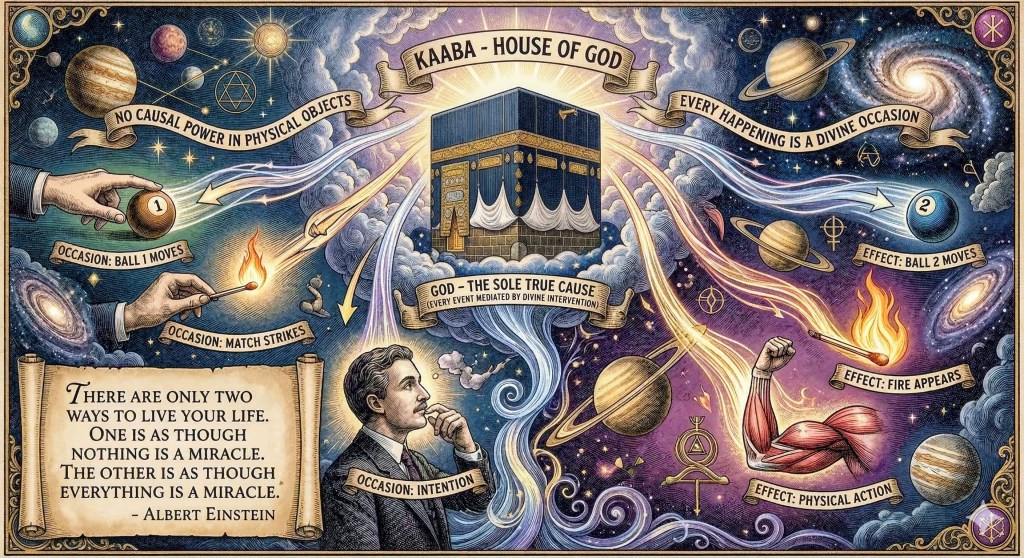
The epistemological foundation for lifting this veil was rigorously formulated in the eleventh century by the Islamic polymath Abu Hamid al-Ghazali. In the 17th Discussion of his seminal work Tahafut al-Falasifa (The Incoherence of the Philosophers), al-Ghazali deconstructed the Aristotelian notion of necessary, independent physical causality. He asserted that what human beings perceive as immutable, intrinsic natural laws are, in fact, the consistent “habit” or “custom” of God (Sunnat Allah).
To maintain a stable, predictable world in which human beings can exercise moral agency, plan for the future, and develop scientific rationality, the Creator establishes events in a reliable, continuous sequence. However, because this regularity is a voluntary habit of a Sovereign Will rather than an intrinsic, logical necessity of dead matter, the universe is not a clockwork mechanism running on its own inertia. Rather, it is being constantly recreated and sustained at every discrete quantum instant.
Al-Ghazali’s framework of occasionalism completely shatters the anesthesia of familiarity. It demands that the observer recognize every standard chemical reaction, every sunrise, and every biological process not as an independent law, but as a deliberate, real-time act of Divine initiation. Under this paradigm, the predictability of nature is viewed as an expression of Divine mercy and faithfulness, preventing the universe from devolving into chaotic unpredictability.
The Physical Sciences: The Illusion of Simplicity and the Fine-Tuned Cosmos
When the veil of custom is lifted from the physical sciences, the fundamental parameters of the universe present a staggering degree of mathematical precision. The universe is not merely large, ancient, and structured; it is exquisitely calibrated for the existence of complex matter, chemistry, and life.
The Anthropic Principle and Cosmic Resonance
Every fundamental constant, interaction strength, and cosmological parameter appears to be set within a vanishingly narrow range that permits the emergence of atoms, stars, planets, and conscious observers. This phenomenon, known in astrophysics as the Fine-Tuned Universe or the Anthropic Principle, represents one of the deepest intersections between physics, philosophy, and theology. The Quranic term Qadar (from the root qadara) denotes exact proportion, precise mathematical determination, and a specified, fixed measure, perfectly encapsulating the modern physical discovery that forces are precisely measured to permit a structured, life-supporting reality.
Consider the synthesis of carbon, the elemental basis for all known biochemistry. The astrophysicist Fred Hoyle realized that if it were not for the precise coincidence that a nuclear resonance exists at exactly the right energy level, there would be virtually no carbon in the universe, rendering life entirely impossible. The energy at which this carbon resonance occurs is strictly determined by the delicate interplay between the strong nuclear force and the electromagnetic force.
If the strong nuclear force were slightly stronger or slightly weaker—by a margin as microscopic as one percent—the binding energies of the atomic nuclei would alter completely. The arithmetic of the resonance would fail, and the universe would be devoid of carbon, chemistry, and biology, remaining forever sterile and unobserved. Furthermore, if the strong force constant had always had a value less than a hundredth of its actual value, or more than twice its actual value, intelligent life could not exist. The strong force of attraction between protons is roughly 100 times greater than electromagnetism, and this precise ratio is non-negotiable for a life-permitting reality.
| Physical Parameter | Condition for Life | Implication of Alteration |
|---|---|---|
| Strong Nuclear Force | Must be strictly balanced with electromagnetism (~100x stronger). | A 1% change alters nuclear binding energies; carbon resonance fails; universe remains biologically sterile. |
| Electromagnetic Force | Must overcome the repulsion of protons just enough to form stable atoms. | If too strong or weak, chemical bonding fails, rendering complex molecules and DNA impossible. |
| Gravitational Constant (G) | Must be precisely calibrated to balance cosmic expansion and stellar formation. | If too weak, stars do not ignite. If too strong, the universe collapses before life can evolve. |
| Cosmological Constant | Must fall within a vanishingly small range near zero. | A slight deviation results in either rapid cosmic tearing or immediate catastrophic collapse. |
The Contradiction of Materialist Reductionism
Despite these profound physical realities, Richard Dawkins claims that “physics is the study of simple things that do not tempt us to invoke design”. A rigorous philosophical analysis reveals this assertion to be a profound manifestation of the very anesthesia of familiarity Dawkins himself diagnosed. The assertion that fundamental particles and the forces governing them are “simple” and require no explanation is a delusion born of a passionate, a priori commitment to metaphysical naturalism.
Dawkins further argues in The Blind Watchmaker: “A complicated thing is one whose existence we do not feel inclined to take for granted, because it is too ‘improbable’. It could not have come into existence in a single act of chance”. Yet, the fundamental laws and constants of the universe are the epitome of such astronomical improbability. A universe hospitable to life—a biophilic universe—must be incredibly special in its initial conditions in a multitude of independent ways. The prerequisites for life, including long-lived stable stars and a periodic table of atoms capable of complex chemistry, are exquisitely sensitive to physical laws and could not have emerged from a random, undirected parameter space.
The physical parameters do not “just exist” as brute facts. The fundamental mystery of this distinctive and special-seeming recipe cannot be brushed aside. It strongly indicates an Intelligent Architect who calculated and set the cosmic framework. The physicist Albert Einstein once remarked, “Science without religion is lame, religion without science is blind,” capturing the necessity of viewing the incomprehensible universe as the manifestation of a superior reasoning power. Immanuel Kant echoed this sentiment, noting that the starry heavens above and the moral law within fill the mind with ever-increasing wonder and awe the more intensely they are contemplated.
Biological Marvels I: Photosynthesis, Aesthetic Surplus, and the Rebuttal of Blind Evolution
The transition from cosmic fine-tuning to biological complexity offers further evidence that forcibly shakes off the anesthesia of familiarity. The botanical world provides a continuous, daily miracle that sustains virtually all aerobic life on Earth: photosynthesis.
Leaves function as microscopic, highly advanced food factories. The raw materials they utilize are of the absolute simplest variety: carbon dioxide, water, and a few mineral ingredients. The carbon dioxide is a ubiquitous atmospheric gas absorbed through microscopic pores known as stomata, while water and dissolved minerals are collected by the roots and transported through complex vascular tissues. Powered by the energy of the sun—captured across 93 million miles of empty space—the plant’s chloroplasts orchestrate a quantum-mechanical and biochemical ballet to combine these elements, producing complex starches and sugars from which the plant builds its tissues. The byproduct of this extraordinary molecular synthesis is oxygen, which drifts out of the leaf pores into the atmosphere, providing the very breath of life for the entire animal kingdom.
The sheer improbability of the blind, unguided evolution of the chlorophyll molecule, alongside the intricate electron transport chains required for photosynthesis, points directly toward the concept of Guided Evolution. This paradigm posits that the Creator directs the unfolding of biological complexity, utilizing evolutionary mechanisms as a mode of deliberate creation.
Dawkins and the Argument from “Waste”
However, Dawkins attempts to preempt arguments for teleological design by focusing on alleged biological flaws and inefficiencies. In presenting his thesis against a Creator, Dawkins writes: “Nature might be expected to be a planned economy, carefully designed to eliminate extravagance and waste. It isn’t, and this chapter will show it”. Dawkins operates on the premise that any perceived imperfection, redundancy, or “extravagance” suggests the absolute absence of a Creator.
Yet, as numerous philosophers and theologians have pointed out, this is a profound philosophical misstep that effectively shoots his own argument in the foot. If Dawkins believes that perceived extravagance or excess argues against design, one must allow the converse: the overwhelming, pervasive presence of beauty, elegance, and systemic interdependence must argue powerfully for a Creator.
Nature exhibits what philosophers of religion term an “aesthetic surplus”—a level of beauty and comprehensibility that far exceeds the strict, utilitarian requirements of survival, reproduction, and natural selection. This aesthetic anomaly is evident in phenomena ranging from the splendid interior decorations arranged by the bowerbirds to the mathematical precision of a nautilus shell. This surplus directs the human intellect to observe the biological and mathematical order of creation not merely as survival mechanisms, but as intentional art designed for conscious appreciation by rational observers.
Biological Marvels II: Donald Griffin, Echolocation, and the Defeat of Mentophobia
To fully appreciate how the anesthesia of familiarity blinds even the highest, most rigorously educated echelons of the scientific community, one must examine the history of cognitive ethology and the discovery of echolocation. For centuries, humanity was anesthetized to the sensory realities and internal lives of the animal kingdom, viewing creatures largely as Cartesian automatons driven by blind, mechanistic instinct.
The Discovery of Biosonar
This reductionist paradigm was forcefully challenged by the American biophysicist and animal behaviorist Donald Redfield Griffin (1915–2003). While an undergraduate at Harvard University in 1938, Griffin utilized ultrasonic detection equipment—originally developed by the physicist G.W. Pierce to study high-frequency insect sounds—to investigate how bats navigate in complete darkness. Prior to this research, it was a profound scientific mystery how bats could accurately avoid fine obstacles and capture tiny, erratic prey in pitch-black environments.
Collaborating with a fellow student and auditory physiology expert, Robert Galambos, Griffin conducted meticulous experiments demonstrating that bats produce high-frequency ultrasonic sounds to orient themselves. The bats emit echolocation sounds in pulses—often frequency modulated (FM), constant frequency (CF), or highly complex combinations of both. The auditory processing is astonishingly rapid. As a bat approaches its target, it constantly updates its rate of emission to avoid pulse-echo overlap. This culminates in a “feeding buzz” during the terminal phase of the hunt, where pulses may be only a fraction of a millisecond long, allowing the animal to execute rapid, complex, three-dimensional maneuvers during insect pursuit.
Griffin and Galambos proved that bats essentially “see in the dark” by analyzing the returning echoes from their environment, a phenomenon Griffin officially coined as “echolocation” in 1944. Echolocating animals can determine not only the exact location and distance of a target but also its size, form, and even subtle surface textures. In later experiments, Griffin and Frederic Webster demonstrated that bats could effortlessly catch fruit flies brushed into the air in complete darkness, utilizing a “Drosophila fountain” that provided continuous hunting opportunities.
The Hostility of the Scientific Establishment
The revelation that a small, seemingly simple mammal possessed a biological sonar system far more sophisticated, miniature, and energy-efficient than the most advanced radar technology developed by human military forces should have immediately inspired universal scientific awe. Instead, Griffin and Galambos faced fierce, hostile, and irrational opposition from the established scientific community, serving as a pristine historical example of the blinding power of familiar paradigms.
At a prominent scientific meeting hosted by the American Association for the Advancement of Science (AAAS) in 1941, an eminent leading scientist physically shook Galambos by the shoulders, openly ridiculing the very idea that bats could use echolocation. The scientific community was so deeply entrenched in the anesthesia of familiarity—the belief that animals were mindless biological machines—that they found the idea of complex, high-speed acoustic information processing in a bat’s brain to be inherently absurd.
The Founding of Cognitive Ethology and the End of Mentophobia
Griffin refused to yield to this academic hostility. He authored several foundational texts that shattered the prevailing dogmas, including Listening in the Dark: The Acoustic Orientation of Bats and Men (1958) and Bird Migration: The Biology and Physics of Orientation Behavior (1964). As he continued his pioneering research into animal navigation, Griffin proposed in the late 1970s that animals possess the ability to think, reason, and experience sentient emotions.
This bold proposition led Griffin to establish the entirely new field of cognitive ethology, which formally examines animal consciousness and mental experiences. In his seminal 1976 book, The Question of Animal Awareness: Evolutionary Continuity of Mental Experience, Griffin introduced the concept of “mentophobia”—the irrational, systematic denial of the consciousness of other animals by scientists. Griffin’s zoomorphic approach shifted established paradigms, providing a realistic framework for understanding that consciousness is not an exclusive human anomaly but a widespread biological reality that demands a profound ontological explanation.
The irreducibility of consciousness—from the real-time sonar computations of the bat to the abstract, self-reflective reasoning of the human being—provides a powerful foundation for the philosophical argument from intentionality. As articulated by the philosopher William Lane Craig, the argument can be formulated as a concise deductive syllogism: If God did not exist, intentional states of consciousness would not exist. Intentional states of consciousness do exist. Therefore, God exists. The emergence of subjective, experiential observers (hayat) from a lifeless, inert universe (mawt) fundamentally refutes the central tenets of metaphysical materialism.
The Theological Synthesis: The Quranic Epistemology of Wonder
The insights gleaned from cosmology, botany, and cognitive ethology all converge on a central, unifying theological thesis: the universe is a vast theater of signs (Ayat) explicitly designed to point the conscious observer toward the Creator. The Quran systematically seeks to break the anesthesia of familiarity by commanding human beings to observe, reflect (tadabbur), and reason (ta’aqqul).
Intellect (Aql) in the Islamic tradition is not merely a pragmatic tool for physical survival; it is a sacred, divinely endowed faculty designed to bridge the gap between physical observation and spiritual realization. True intelligence culminates in wisdom (Hikmah), producing a deep humility born from the recognition of Divine majesty. Knowledge without worship is viewed as an unfulfilled premise, while worship without knowledge is akin to a body without a soul.
To illustrate this robust theological framework, this report examines four core Quranic passages that command the defamiliarization of the universe, accompanied by their original Arabic text and five distinct, highly regarded English translations.
1. The Call to Examine the Horizons and the Self (Surah Fussilat 41:53)
The Quran explicitly predicts that the continuous, historical unfolding of scientific knowledge in the external universe (the horizons) and within biology and consciousness (themselves) will serve as the ultimate, unfolding proof of the Divine truth.
Arabic Text: سَنُرِيهِمْ آيَاتِنَا فِي الْآفَاقِ وَفِي أَنفُسِهِمْ حَتَّىٰ يَتَبَيَّنَ لَهُمْ أَنَّهُ الْحَقُّ ۗ أَوَلَمْ يَكْفِ بِرَبِّكَ أَنَّهُ عَلَىٰ كُلِّ شَيْءٍ شَهِيدٌ
| Translator | Translation of Surah Fussilat 41:53 |
|---|---|
| Sahih International | “We will show them Our signs in the horizons and within themselves until it becomes clear to them that it is the truth. But is it not sufficient concerning your Lord that He is, over all things, a Witness.” |
| Yusuf Ali | “Soon will We show them our Signs in the (furthest) regions (of the earth), and in their own souls, until it becomes manifest to them that this is the Truth. Is it not enough that thy Lord doth witness all things?” |
| Pickthall | “We shall show them Our portents on the horizons and within themselves until it will be manifest unto them that it is the Truth. Doth not thy Lord suffice, since He is Witness over all things?” |
| Shakir | “We will soon show them Our signs in the Universe and in their own souls, until it will become quite clear to them that it is the truth. Is it not sufficient as regards your Lord that He is a witness over all things?” |
| Abdul Haleem | “We shall show them Our signs in every region of the earth and in themselves, until it becomes clear to them that this is the Truth. Is it not enough that your Lord witnesses everything?” |
This verse acts as a foundational mandate for scientific pursuit in classical and modern Islamic thought. The 9th-century Arab polymath Al-Kindi viewed this exact verse as a divine imperative to study optics, astronomy, medicine, and psychology. The pursuit of secular knowledge (such as Griffin’s study of echolocating bats or Hoyle’s study of carbon resonance) is elevated to an act of worship when done with the intention of recognizing the Creator. The signs in the “horizons” map perfectly onto the fine-tuned physical constants of astrophysics, while the signs in “themselves” map onto the irreducibility of consciousness, human biology, and cognitive ethology.
2. The Command for Cosmic Contemplation (Surah Ali ‘Imran 3:190-191)
The Quran explicitly contrasts the mind that is anesthetized by familiarity with the vibrant minds of “those of understanding” (Ulul Albab), who actively and continuously reflect on the architecture of the heavens and the earth.
Arabic Text: إِنَّ فِي خَلْقِ السَّمَاوَاتِ وَالْأَرْضِ وَاخْتِلَافِ اللَّيْلِ وَالنَّهَارِ لَآيَاتٍ لِّأُولِي الْأَلْبَابِ الَّذِينَ يَذْكُرُونَ اللَّهَ قِيَامًا وَقُعُودًا وَعَلَىٰ جُنُوبِهِمْ وَيَتَفَكَّرُونَ فِي خَلْقِ السَّمَاوَاتِ وَالْأَرْضِ رَبَّنَا مَا خَلَقْتَ هَٰذَا بَاطِلًا سُبْحَانَكَ فَقِنَا عَذَابَ النَّارِ
| Translator | Translation of Surah Ali ‘Imran 3:190-191 |
|---|---|
| Sahih International | “Indeed, in the creation of the heavens and the earth and the alternation of the night and the day are signs for those of understanding. Who remember Allah while standing or sitting or [lying] on their sides and give thought to the creation of the heavens and the earth, [saying], ‘Our Lord, You did not create this aimlessly; exalted are You [above such a thing]; then protect us from the punishment of the Fire.’” |
| Yusuf Ali | “Behold! in the creation of the heavens and the earth, and the alternation of night and day, there are indeed Signs for men of understanding. Men who celebrate the praises of Allah, standing, sitting, and lying down on their sides, and contemplate the (wonders of) creation in the heavens and the earth, (With the thought): ‘Our Lord! not for naught Hast Thou created (all) this! Glory to Thee! Give us salvation from the penalty of the Fire.’” |
| Pickthall | “Lo! In the creation of the heavens and the earth and (in) the difference of night and day are tokens (of His Sovereignty) for men of understanding, Such as remember Allah, standing, sitting, and reclining, and consider the creation of the heavens and the earth, (and say): Our Lord! Thou createdst not this in vain. Glory be to Thee! Preserve us from the doom of Fire.” |
| Shakir | “Most surely in the creation of the heavens and the earth and the alternation of the night and the day there are signs for men who understand. Those who remember Allah standing and sitting and lying on their sides and reflect on the creation of the heavens and the earth: Our Lord! Thou hast not created this in vain! Glory be to Thee; save us then from the chastisement of the fire.” |
| Abdul Haleem | “There are signs in the creation of the heavens and the earth, and in the alternation of night and day for people of understanding; who remember God standing, sitting, and lying down, who reflect on the creation of the heavens and earth: ‘Our Lord! You have not created all this without purpose—You are far above that!—protect us from the torment of the Fire.’” |
This passage links rigorous intellectual reflection directly with theological consequence. By recognizing that the universe was not created “aimlessly” (batilan) or in vain, the observer realizes that cosmic architecture carries an immense ethical weight. The fine-tuning of the universe is not an accident of an infinite, unobservable multiverse; it is a deliberate, meticulously constructed stage set for moral accountability and the exercise of libertarian free will.
3. The Perfection of the Cosmic Blueprint (Surah Al-Mulk 67:1-4)
The most direct Quranic challenge to the anesthesia of familiarity is found in Surah Al-Mulk. It invites the skeptic to search the universe for structural flaws, asserting that the human intellect will ultimately return fatigued, dazzled, and humbled by the perfection of the cosmic order.
Arabic Text: تَبَارَكَ الَّذِي بِيَدِهِ الْمُلْكُ وَهُوَ عَلَىٰ كُلِّ شَيْءٍ قَدِيرٌ الَّذِي خَلَقَ الْمَوْتَ وَالْحَيَاةَ لِيَبْلُوَكُمْ أَيُّكُمْ أَحْسَنُ عَمَلًا ۚ وَهُوَ الْعَزِيزُ الْغَفُورُ الَّذِي خَلَقَ سَبْعَ سَمَاوَاتٍ طِبَاقًا ۖ مَّا تَرَىٰ فِي خَلْقِ الرَّحْمَٰنِ مِن تَفَاوُتٍ ۖ فَارْجِعِ الْبَصَرَ هَلْ تَرَىٰ مِن فُطُورٍ ثُمَّ ارْجِعِ الْبَصَرَ كَرَّتَيْنِ يَنقَلِبْ إِلَيْكَ الْبَصَرُ خَاسِئًا وَهُوَ حَسِيرٌ
| Translator | Translation of Surah Al-Mulk 67:1-4 |
|---|---|
| Sahih International | “Blessed is He in whose hand is dominion, and He is over all things competent – [He] who created death and life to test you [as to] which of you is best in deed – and He is the Exalted in Might, the Forgiving – [And] who created seven heavens in layers. You do not see in the creation of the Most Merciful any inconsistency. So return [your] vision [to the sky]; do you see any breaks? Then return [your] vision twice again. [Your] vision will return to you humbled while it is fatigued.” |
| Yusuf Ali | “Blessed be He in Whose hands is Dominion; and He over all things hath Power. He Who created Death and Life, that He may try which of you is best in deed: and He is the Exalted in Might, Oft-Forgiving. He Who created the seven heavens one above another: No want of proportion wilt thou see in the Creation of (Allah) Most Gracious. So turn thy vision again: seest thou any flaw? Again turn thy vision a second time: (thy) vision will come back to thee dull and discomfited, in a state of weariness.” |
| Pickthall | “Blessed is He in Whose hand is the Sovereignty, and, He is Able to do all things. Who hath created life and death that He may try you which of you is best in conduct; and He is the Mighty, the Forgiving. Who hath created seven heavens in harmony. Thou (O Muhammad) canst see no fault in the Beneficent One’s creation; then look again: Canst thou see any rifts? Then look again and yet again, thy sight will return unto thee weakened and made dim.” |
| Shakir | “Blessed is He in Whose hand is the kingdom, and He has power over all things, Who created death and life that He may try you– which of you is best in deeds; and He is the Mighty, the Forgiving, Who created the seven heavens one above another; you see no incongruity in the creation of the Beneficent Allah; then look again, can you see any disorder? Then turn back the eye again and again; your look shall come back to you confused while it is fatigued.” |
| Abdul Haleem | “Exalted is He who holds all control in His hands; who has power over all things; who created death and life to test you [people] and reveal which of you does best––He is the Mighty, the Forgiving; who created the seven heavens, one above the other. You will not see any flaw in what the Lord of Mercy creates. Look again! Can you see any flaw? Look again! And again! Your sight will turn back to you, weak and defeated.” |
By demanding that humanity “return the gaze” (farji’i al-basara) repeatedly to the fundamental structure of the cosmos, the Quran actively and deliberately dissolves cognitive habituation. The transition highlighted in the second verse—from death and lifelessness (mawt) to conscious life (hayat)—mirrors the philosophical argument from intentionality, demanding a reckoning of how inert matter spawned conscious, moral agents. Furthermore, when human beings probe the subatomic quantum realms or the farthest edges of the observable universe, actively searching for a breakdown in the “proportion” or a “fissure” in the laws of physics, the intellect is ultimately forced to admit its profound limitations. The underlying theological and scientific message is that the comprehensibility and lawfulness of nature are not rivals to God, but rather the most powerful, irrefutable witnesses to His existence.
4. The Defamiliarization of Basic Sustenance (Surah Al-Waqi’ah 56:68-73)
To further break the anesthesia of familiarity regarding the most mundane aspects of daily survival—water and fire—the Quran forces the reader to confront their origin and the impossibility of human independence.
Arabic Text: أَفَرَأَيْتُمُ الْمَاءَ الَّذِي تَشْرَبُونَ أَأَنتُمْ أَنزَلْتُمُوهُ مِنَ الْمُزْنِ أَمْ نَحْنُ الْمُنزِلُونَ لَوْ نَشَاءُ جَعَلْنَاهُ أُجَاجًا فَلَوْلَا تَشْكُرُونَ أَفَرَأَيْتُمُ النَّارَ الَّتِي تُورُونَ أَأَنتُمْ أَنشَأْتُمْ شَجَرَتَهَا أَمْ نَحْنُ الْمُنشِئُونَ نَحْنُ جَعَلْنَاهَا تَذْكِرَةً وَمَتَاعًا لِّلْمُقْوِينَ
| Translator | Translation of Surah Al-Waqi’ah 56:68-73 |
|---|---|
| Sahih International | “And have you seen the water that you drink? Is it you who brought it down from the clouds, or is it We who bring it down? If We willed, We could make it bitter, so why are you not grateful? And have you seen the fire that you ignite? Is it you who produced its tree, or are We the producer? We have made it a reminder and provision for the travelers.” |
| Yusuf Ali | “See ye the water which ye drink? Do ye bring it down (in rain) from the cloud or do We? Were it Our Will, We could make it salt (and unpalatable): then why do ye not give thanks? See ye the Fire which ye kindle? Is it ye who grow the tree which feeds the fire, or do We grow it? We have made it a memorial (of Our handiwork), and an article of comfort and convenience for the denizens of deserts.” |
| Pickthall | “Have ye observed the water which ye drink? Is it ye who shed it from the raincloud, or are We the Shedder? If We willed We verily could make it bitter. Why then, give ye not thanks? Have ye observed the fire which ye strike out; Was it ye who made the tree thereof to grow, or were We the grower? We, even We, appointed it a memorial and a comfort for the dwellers in the wilderness.” |
| Shakir | “Have you considered the water which you drink? Is it you that send it down from the clouds, or are We the senders? If We pleased, We would have made it salty; why do you not then give thanks? Have you considered the fire which you strike? Is it you that produce the trees for it, or are We the producers? We have made it a reminder and an advantage for the wayfarers of the desert.” |
| Abdul Haleem | “Consider the water you drink- was it you who brought it down from the rain-cloud or We? If We wanted, We could make it bitter: will you not be thankful? Consider the fire you kindle- is it you who make the wood for it grow or We? We made it a reminder, and useful to those who kindle it.” |
The physical world, down to the weight of an atom (Mithqala Tharratin) and the complex interplay of the water cycle and thermodynamics, operates on a principle of cosmic equilibrium established by a deliberative Creator. Whether analyzing the delicate, miraculous splitting of a seed (Quran 6:95) or the complex internal lives of animals that form distinct communities and continuously glorify Allah (Quran 59:24, 17:44), the aesthetic and functional perfection of the universe leaves the un-anesthetized mind in a state of profound awe and gratitude.
Thematic Epilogue: Waking to the Architecture of Reality
The human journey through the physical world is fraught with the profound peril of existential slumber. The anesthesia of familiarity acts as a potent neurological and psychological dampener, reducing the blazing, continuous miracle of existence into a flat, unexamined, and strictly utilitarian routine. Materialist philosophies, while priding themselves on rigorous logic and empirical objectivity, frequently capitulate to this very numbness. By waving away the absolute fine-tuning of the cosmos, the staggering biochemical orchestration of photosynthesis, and the irreducible, undeniable complexity of animal and human consciousness as mere accidents of blind chance, such worldviews fundamentally fail to answer the deeper ontological questions of existence. As demonstrated by the historical hostility faced by Donald Griffin regarding the discovery of echolocation, scientific paradigms built solely on reductionism actively resist the profound, consciousness-driven realities of biology.
Science, when properly understood and unencumbered by a priori commitments to naturalism, is not the antagonist of theology; it is, in fact, the most potent antidote to the anesthesia of familiarity. The telescope, the microscope, the sonar detector, and the particle accelerator are instruments that tear the veil of custom, revealing a universe of mathematical exactitude, biological elegance, and an aesthetic surplus that points undeniably to a Grand Designer.
However, empirical observation must be married to philosophical rigor and theological insight. The lawful nature of the universe is not an independent machine running in the complete absence of a Creator; it is the Sunnat Allah, the continuous, reliable habit of a Gracious God who sustains every atom in real-time. By reading the signs (Ayat) scattered across the cosmic horizons and embedded within the profound depths of human and animal consciousness, the human intellect is drawn inexorably toward a grand synthesis of awe.
To definitively overcome the anesthesia of familiarity is to realize that there is no such thing as an “ordinary” moment or a “simple” physical law. The vast darkness of the night sky that allows us to peer into cosmic history, the precise nuclear resonance of carbon that permits biochemistry, the incredibly rapid echolocating flight of a bat in pitch darkness, and the silent, solar-powered factories of leaves are all deliberate, majestic drafts in a cosmic manuscript. Ultimately, humanity is invited to stand before this staggering architecture not with the arrogance of those who take existence for granted, but with the profound humility of those whose gaze has returned to them dazzled, fatigued, and overflowing with gratitude for the Creator, the Maker, and the Fashioner of all things.




Leave a Reply