
Presented by Claude for Zia H Shah MD
Billions of extinct species are not evidence against a Creator: they show that God creates through deep time and lawful process, and they tell against a stage-managed, instant creation only. The question they raise is not whether God exists but what kind of God, and the guided-evolution account defended by Zia H. Shah, MD answers it more coherently than either young-earth creationism or atheistic Darwinism.
- Extinction, including the more than 99% of species now gone (David Raup’s “almost all species are extinct”) and the “Big Five” mass extinctions, is the expected signature of creation through secondary causes over deep time. It is not evidence of an absent or incompetent Creator. Fine-tuning, the fitness of the environment and convergent evolution suggest that the process is constrained toward life and mind.
- The strongest atheist case, Darwin’s ichneumon wasp and Dawkins’s “blind, pitiless indifference,” targets a designer who micromanages each species. It does not touch the God of classical theism (Aquinas, al-Ghazālī), who sustains natural law as its ground rather than filling gaps in it.
- No answer to evolutionary suffering is complete. A layered answer is credible: the “only way” and free-process arguments, life as trial (ibtilāʾ) and soul-making, cooperation as an equal partner to competition, honest uncertainty about animal consciousness, and eschatological recompense (Sahih Muslim 2582; Romans 8). Together these make guided evolution consistent with a merciful (Raḥmān) and wise (Ḥakīm) God.
Abstract
Most of the species that have ever lived on Earth are extinct. Paleontologists estimate that more than 99% have disappeared, many of them in five catastrophic mass extinctions. To critics from Darwin to Richard Dawkins, this record of waste, predation, parasitism and pain counts against a wise and benevolent Creator. This essay argues the opposite: evolution is God’s mechanism of creation, and the extinct species are the drafts and scaffolding of a creation unfolding through time. The scientific section surveys the fossil record, deep time, common descent, genomic evidence, convergent evolution (Simon Conway Morris), cosmic fine-tuning, Lawrence Henderson’s “fitness of the environment,” and evolvability, and suggests that the process is lawful, constrained and pregnant with life and mind. The philosophical section separates methodological from metaphysical naturalism. It answers the “wastefulness” objection with analogies from art and craft, and draws on Aquinas’s primary and secondary causation, al-Ghazālī’s occasionalism and the argument from contingency to replace the “God of the gaps” with God as the sustaining ground of natural law. The theological section shows that the Qur’an (71:14, 71:17–18, 24:45, 21:30, 76:1–2, 35:1), classical Muslim thinkers (al-Jāḥiẓ, Ibn Miskawayh, Ibn Khaldūn, Rūmī), Ahmadiyya thought and Christian tradition (Augustine, John Paul II, BioLogos) can all accommodate evolutionary creation. The final section takes up suffering. Drawing on Southgate, Rolston, Murray, Polkinghorne, Hick and the Qur’anic theology of trial and mercy, it offers a layered theodicy: evolution as the “only way,” life as test, cooperation alongside competition, and eschatological recompense for animals. Throughout, the essay draws on the guided-evolution writings of Zia H. Shah, MD.
I. The Question Posed at Full Strength
Any honest essay on this subject must start by letting the skeptic speak. In a letter to the Harvard botanist Asa Gray dated 22 May 1860, Charles Darwin wrote: “There seems to me too much misery in the world. I cannot persuade myself that a beneficent & omnipotent God would have designedly created the Ichneumonidæ with the express intention of their feeding within the living bodies of caterpillars, or that a cat should play with mice.” inters The ichneumon wasps he had in mind lay their eggs inside living hosts, which their larvae then eat from within. priweb They are not a marginal curiosity: Encyclopaedia Britannica counts “around 25,000 ichneumon wasp species known to science and as many as 75,000 more that are yet to be discovered and named.”
A century later Richard Dawkins turned Darwin’s unease into a creed. In River Out of Eden (1995) he wrote that the universe “has precisely the properties we should expect if there is, at bottom, no design, no purpose, no evil and no good, nothing but blind, pitiless indifference.” wikiquote Stephen Jay Gould added a second argument, from imperfection and contingency. The panda’s “thumb” is a jury-rigged wrist bone, which betrays tinkering rather than foresight. In Wonderful Life Gould argued that if the “tape of life” were replayed, humans would almost certainly not reappear. Jerry Coyne has pressed the point that evolution’s cruelty and clumsiness are exactly what an unguided process predicts. Put together, these give the atheist argument its strongest form. A wise God would not use a method that discards 99% of its products. A good God would not use a method driven by suffering. A purposeful God would not use a method whose outcomes are accidents.
This essay accepts every scientific premise of that argument and rejects its theological conclusion. The rejection does not come from denying the data, the path of young-earth creationism, which Zia H. Shah, MD has criticized in figures such as Zakir Naik and Harun Yahya. thequran It comes from asking what kind of God the data actually rule out.
II. The Scientific Picture: A Lawful, Constrained, Life-Bearing Process
Deep time and the fossil record
The Earth is about 4.5 billion years old, and complex animal life has flourished for more than half a billion of those years. Over that span, species have arisen and vanished in a steady turnover. The American Museum of Natural History estimates that “at least 99.9 percent of all species of plants and animals that ever lived are now extinct.” amnh The paleontologist David M. Raup, in Extinction: Bad Genes or Bad Luck? (1991), opened with a chapter titled “Almost all species are extinct,” and the widely repeated figure of “more than 99 percent” has been translated into as many as five billion species. Fewer than 2 million living species have been formally described, and only about 250,000 fossil species, so these figures are extrapolations, not counts. epfl The direction, however, is not in doubt. While roughly 2 million species are known and described, scientists estimate that the total number of living species on Earth is much higher—commonly estimated around 8.7 million eukaryotes, though broader estimates including microorganisms and bacteria range from millions to trillions. [1, 2, 3, 4]
Most of this loss came from steady “background” extinction, not catastrophe. Against that background stand the “Big Five” mass extinctions: the end-Ordovician (about 444 million years ago, roughly 86% of species lost), the Late Devonian (about 360 million years ago, roughly 75%), the end-Permian “Great Dying” (about 252 million years ago, roughly 96%), the end-Triassic (about 200 million years ago, roughly 80%), and the end-Cretaceous (66 million years ago, roughly 76%, including all non-avian dinosaurs). arxiv The last was triggered by the Chicxulub asteroid impact in the Yucatán. ourworldindata Its aftermath opened the ecological space in which mammals radiated, and from which primates and eventually humans emerged. arxivthequran
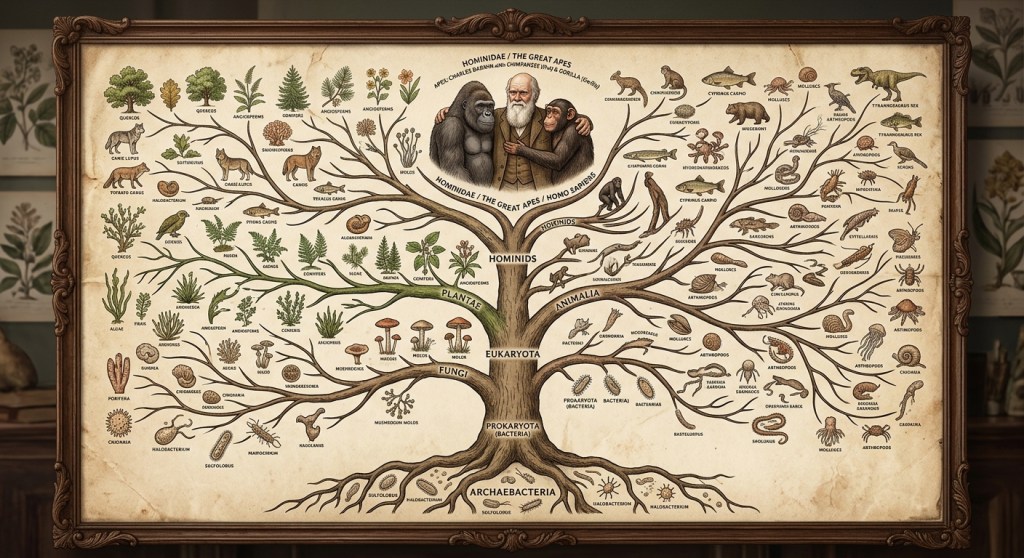
Common descent and the genomic record
Comparative anatomy first suggested common ancestry: the same bones in the human arm, the whale’s flipper and the bat’s wing. Genomics has confirmed it. Douglas Theobald’s 2010 formal test in Nature found, as Science News summarized it, that “a universal common ancestor is at least 10^2,860 times more probable than having multiple ancestors,” although Koonin, Wolf and others have challenged the method. Shared “molecular fossils” such as endogenous retroviruses, which make up about 8% of the human genome according to the International Human Genome Sequencing Consortium (2001), sit at the same chromosomal positions in humans and other primates. That pattern is very hard to explain without shared descent. Some of these viral remnants have been co-opted for vital functions. thequran The syncytin genes that build the fused cell layer of the placenta came from ancient retroviral envelope proteins. thequran +2
Convergence, fitness and evolvability
If evolution were pure chance, its outcomes would be unrepeatable. In Life’s Solution: Inevitable Humans in a Lonely Universe (2003), Cambridge paleobiologist Simon Conway Morris documents the opposite. Camera eyes evolved separately in octopuses and vertebrates. Echolocation evolved in bats and in whales, agriculture in ants and in humans, and complex intelligence in primates, cetaceans and corvids. archive +2 As his argument is often summarized, “the evolutionary routes are many, but the destinations are limited.” drwile This directly challenges Gould’s contingency thesis. Conway Morris argues that something like human-level sentience was close to inevitable once life began on a suitable planet. googlenature
The deeper constraint lies in physics and chemistry. In The Fitness of the Environment (1913), Harvard biochemist Lawrence J. Henderson showed that the properties of water, carbon dioxide and carbon compounds are strikingly suited to complex life. He concluded that “the fitness of environment is quite as essential a component as the fitness which arises in the process of organic evolution.” encyclopediawhiteheadresearch Henderson was an agnostic, which makes his testimony more valuable, not less. encyclopediaWikipedia Modern cosmology extends his point to the fine-tuning of physical constants: small changes in gravity, electromagnetism or the cosmological constant would yield a universe without stars, chemistry or observers. To these we can add evolvability. Life’s modular genetic toolkits, gene duplication and developmental systems make it capable of producing heritable novelty. The process does not just sift variation. It is built to generate it.
The scientific picture, then, is not one of chaos. Life unfolds within deep constraints, physical, chemical and developmental, that funnel it toward complexity, sentience and mind. Extinction is part of that unfolding: it clears the stage for new forms, as Chicxulub cleared it for mammals. thequran
III. The Philosophical Argument: Why Extinction Is Not Evidence Against a Creator
Methodological versus metaphysical naturalism
Science proceeds by methodological naturalism. It explains natural events by natural causes and brackets the question of ultimate origins. Metaphysical naturalism is a different claim: that nature is all there is. The step from the first to the second is a philosophical choice, not a scientific finding. Zia H. Shah states the distinction plainly. He is “all for methodological naturalism, as God of Islam is Al-Baatin or hidden,” but does “not believe in metaphysical naturalism.” In his 2014 essay “Evolution: Natural Selection or Divine Choice?” he divides the field into three camps, guided evolution, blind evolution and creationism, and declares: “This is the camp of Guided Evolution, where I belong.” themuslimtimes He adds a sentence that sums up the hermeneutic of this essay: “What appears to be natural selection to the naturalist can be considered, with equal validity, to be Divine Providence.” thequranthemuslimtimes
Francisco Ayala, a former Dominican and later a leading evolutionary geneticist, described Darwin’s achievement as “design without designer.” In Ayala’s own theological reading, this freed God from authorship of every parasitic adaptation. The philosopher of science Michael Ruse, himself no theist, asked in Can a Darwinian Be a Christian? and answered that the two are logically compatible. Kenneth Miller, in Finding Darwin’s God, and Francis Collins, in The Language of God, both argue that evolution describes God’s method rather than refuting God’s existence. equipWikipedia Shah calls Collins’s book “one of the best books to present guided evolution, rather than a godless metaphysics.” thequran
Hume, Paley, Darwin, and the wrong God
The modern debate is shaped by an argument most participants have forgotten. William Paley’s Natural Theology (1802) argued from intricate adaptations, the watch found on the heath, to a designer who crafted each species directly. David Hume had already objected that the world’s imperfections and miseries hardly point to a perfect artisan. Darwin’s theory then dissolved Paley’s specific argument by showing how adaptation arises naturally. But Paley’s God was a craftsman inside the world, competing with natural causes for explanatory space. Darwin did refute that God. He did not refute the God of Augustine, Aquinas or al-Ghazālī, who is not one cause among others but the reason there are causes at all.
Thomas Aquinas distinguished the primary causation of God, who gives being to all things at every moment, from the secondary causation of creatures, which act according to their natures. The two are not rivals. They work at different levels, as an author’s agency differs from a character’s within the story. On this view, natural selection is a secondary cause through which the primary cause works. Al-Ghazālī went further. In the seventeenth discussion of The Incoherence of the Philosophers, he argued that observation shows only that fire and the burning of cotton occur together, never that fire necessitates the burning. The regularity we call natural law is God’s custom (ʿāda, sunnat Allāh). thequranthequran Shah has revived this occasionalism at length. thequran He presents the shahāda as a metaphysical claim, “there is no cause but God,” and argues that determinism and occasionalism describe the same empirical universe: “the only difference between them is God.” He also draws on Kenneth Miller’s use of quantum indeterminacy. When a photon meets glass, physics predicts only a probability of reflection, and that leaves room, without any violation of law, for divine determination of individual events. thequran
Contingency and the end of the “God of the gaps”
The argument from contingency carries the point further. Every object in the universe, and the universe as a whole with its laws, is contingent: it might not have existed. A chain of contingent causes, however long, does not explain why there is any chain at all. Only a necessary being, whose existence is self-explanatory, ends the regress. Shah cites Hawking’s question about what “breathes fire into the equations.” thequran Natural selection, however powerful, is one of those equations. It presupposes a universe with stable laws, replicating chemistry and a fit environment, and none of these does natural selection itself explain.
This is why the “God of the gaps” is both bad science and bad theology. A God placed in the gaps of scientific knowledge shrinks as science advances. God as the sustaining ground of all natural law grows more impressive the more lawful nature proves to be. Shah quotes the nineteenth-century evangelist Henry Drummond: “an immanent God, which is the God of Evolution, is infinitely grander than the occasional wonder-worker, who is the God of an old theology.” He also quotes Mirza Ghulam Ahmad, founder of the Ahmadiyya community: “If God has created the universe, then one can be certain that in keeping with His infinite entity, He would have left innumerable ways to influence the universe so that His divinity is not suspended in any way at any time.” themuslimtimes Shah draws the conclusion: “God influences our world through natural means only.” themuslimtimes
The “wastefulness” objection
What, then, of the 99%? The waste objection assumes that God, like a human manufacturer, has limited resources and judges success by the ratio of final products to inputs. Neither assumption holds for an infinite Creator, for whom time and matter are not scarce. Human art offers better analogies. A composer’s sketchbooks are full of discarded themes. Michelangelo’s quarries were full of rejected marble. A novelist’s first drafts are rewritten many times over. Nobody calls Beethoven wasteful because the Fifth Symphony grew from pages of crossed-out phrases. Extinct species, moreover, were not failures. Each was a living form adapted to its age, often for millions of years: trilobites thrived for some 300 million years, dinosaurs for 165 million. discoverwildlife Each also contributed to what followed, through descendants, through the ecosystems they built and through the niches they left open. Extinction is how a finite planet makes room for continued novelty. A world in which nothing ever died out would be a world in which nothing new could arise.
Gould’s panda’s thumb belongs to the same argument. It tells against a God who designs each organism from a blank slate. It tells nothing against a God who works through history, as a craftsman reworks the materials at hand. The Qur’an presents God as al-Muṣawwir, the Fashioner of forms (59:24), not as an engineer bound by blank-slate optimization. thequran
Teilhard, Polkinghorne, McGrath
Pierre Teilhard de Chardin, Jesuit and paleontologist, saw evolution as a cosmic ascent toward greater complexity and consciousness, drawn forward toward an “Omega Point.” His mysticism can be extravagant, but his core intuition is that creation is a process rather than a single event, and evolution shows exactly that. John Polkinghorne, a physicist turned Anglican priest, described a God who gives creation the gift of “making itself.” Alister McGrath, trained in molecular biophysics and in theology, argues that natural theology should not try to prove God from gaps. It should show how belief in God makes sense of a universe that is intelligible, fine-tuned and morally serious. The best explanation of what we observe is a Creator who works through evolution, not one who works despite it.
IV. The Theological Argument: Scripture and Tradition Open to Evolution
The Qur’an’s grammar of stages
Zia H. Shah has assembled a whole hermeneutic from verses that earlier commentators read only as embryology or general providence. In Sūrat Nūḥ the Prophet Noah asks: “What is the matter with you that you do not attribute majesty to God, when He has created you in stages (aṭwāran)?” (71:13–14). thequran His platform notes that aṭwār shares a root with taṭawwur, the modern Arabic word for evolution. thequran Three verses later comes an agricultural image: “And God has caused you to grow out of the earth like a plant (nabātan); then He will return you into it, and bring you forth anew” (71:17–18). thequran For Shah, this organic picture of humanity sprouting from the earth’s elements is the Qur’an’s own image of life arising from matter through a guided process. thequran
Other verses deepen the theme. “We made from water every living thing” (21:30) places the origin of life in water. “God has created every animal from water: of them some creep on their bellies, some walk on two legs, and some on four. God creates what He wills” (24:45) presents the diversity of body plans as one creative act working through a common medium. “Has there come upon man a period of time when he was not a thing worth mentioning?” (76:1) suggests a long prehistory before humanity became significant. The next verse adds that the human was created “from a drop of mingled fluid” in order to be tested (76:2). “He adds to creation whatever He wills” (35:1) makes creation ongoing rather than finished. Qur’an 7:69 reminds the people of ʿĀd that God “made you successors after the people of Noah and increased you in stature.” The verse is about peoples rather than species, but it shows the Qur’an’s comfort with succession and change in the created order. Shah also stresses 20:50 (“Our Lord is He who gave everything its form and then guided it”), 87:1–3 (“who creates and proportions, who measures and guides”), and 32:7–9. thequranthequran Of the last he writes that the sequence from clay to “humble fluid” to the breathing-in of the Spirit “encapsulates the entire evolutionary process.” He reads the divine name Rabb as the Nurturer who brings a thing “from one stage to the next until it reaches its goal of perfection.” thequran
Shah’s handling of these verses is restrained. He distinguishes Qur’anic “signs” (āyāt) that invite reflection from overstated “scientific miracles,” and he warns that tying a verse too tightly to a passing theory harms the scripture when the theory changes. thequran He describes the Qur’an as “not a book of science but of clues for science.” thequran That distinction matters for intellectual honesty. Guided evolution is a faith interpretation of scientific findings, not a rival scientific theory. thequran
Al-Ghazālī, secondary causes, and the “two books”
Al-Ghazālī’s occasionalism might seem to rule out natural causes. In fact it removes the supposed competition between God and nature. If every natural regularity is God’s habit, then evolution by natural selection is simply the pattern of God’s creative custom across geological time. thequran Nothing in the doctrine requires God to act outside that pattern in order to be the Creator. Shah builds this into his “two books” framework. thequran The Qur’an calls both its verses and the phenomena of nature āyāt, signs. Since God authors both the Word and the Work, the two cannot truly conflict, and an apparent conflict exposes a misreading of one or the other. Shah often cites 41:53: “We will show them Our signs in the horizons and in themselves until it becomes clear to them that it is the truth.” He notes that roughly 750 verses, about an eighth of the Qur’an, call on believers to reflect on nature. thequran Christian writers, from Francis Bacon on, have used the same image of the Book of Nature and the Book of Scripture.
Classical Muslim anticipations
Classical Muslim thought was more open to gradualism than modern polemics suggest. In his ninth-century Kitāb al-Ḥayawān (Book of Animals), al-Jāḥiẓ described animals competing for food, avoiding predators and being shaped by their environments. Wikipedia Some modern readers see in this a rudimentary notion of the struggle for existence, though historians rightly warn against reading Darwin back into him. In al-Fawz al-Aṣghar, Ibn Miskawayh (d. 1030) set out a graded ascent from minerals through plants and animals to humans, with apes standing nearest the human threshold. researchgateWikipedia
Ibn Khaldūn’s Muqaddimah (1377) is the most striking case. In Franz Rosenthal’s translation, he writes that the world of creation “started out from the minerals and progressed, in an ingenious, gradual manner, to plants and animals,” and that “the higher stage of man is reached from the world of the monkeys, in which both sagacity and perception are found, but which has not reached the stage of actual reflection and thinking.” puwordpress Scholars debate whether Ibn Khaldūn meant a temporal transformation or a static “great chain of being.” Wikipedia Either way, a towering Muslim intellect found nothing irreligious in placing humanity on a graded continuum with the rest of life.
Jalāl al-Dīn Rūmī expressed the same vision as spiritual autobiography. Wikipedia In the Masnavī (Book III), in the familiar Arberry/Nicholson rendering, he writes: “I died as a mineral and became a plant, / I died as plant and rose to animal, / I died as animal and I was Man. / Why should I fear? When was I less by dying?” wikiquotelibquotes Rūmī’s subject is the soul’s ascent, not Darwinian biology. Still, his lines suggest a theological reading of extinction: each “death” in the history of life can be a passage to something higher, not a loss.
Ahmadiyya perspectives
Among modern Muslim communities, the Ahmadiyya Muslim Community has been distinctive in affirming evolution as divinely guided. Wikipedia In Revelation, Rationality, Knowledge and Truth (1998), Mirza Tahir Ahmad, the community’s fourth caliph, argued that life’s history resembles a strategic game of chess more than a game of chance. pressenzathemuslimtimes He also read the Qur’an’s “stages” (71:14) as evolutionary stages and not only embryonic ones. Wikipedia He addressed suffering directly as well (see Section V). voiceofbritishmuslimwomen Shah’s work extends Tahir Ahmad’s synthesis with current genomics, embryology and placental biology. He cites, for example, the teeth that baleen-whale fetuses grow and then reabsorb as evidence that God’s “grand plan of creation” works through “common ancestry by means of guided evolution.” He describes the whole history of life as “the grand show on Earth.” thequran
Christian voices
Christian tradition offers parallel resources. In De Genesi ad litteram (c. 401–415), Augustine of Hippo proposed that God created all things at once in their rationes seminales, or “seminal reasons.” These were latent potentialities implanted in matter, which would unfold into visible forms over time under divine providence. philosophygrokipedia Augustine was not an evolutionist in the modern sense, but his model of creation as potential unfolding through secondary causes is remarkably congenial to evolutionary theology. philosophy In a message to the Pontifical Academy of Sciences on 22 October 1996, Pope John Paul II stated that “new knowledge leads us to recognise the theory of evolution as more than a hypothesis.” He rejected only those philosophies that treat the human mind as a mere product of matter. pas The Catechism of the Catholic Church welcomes scientific study of origins as enriching our sense of the Creator’s greatness. In September 2008, Malcolm Brown, the Church of England’s Director of Mission and Public Affairs, wrote on the Church’s website that “the Church of England owes you an apology for misunderstanding you,” though the Church said this was not an official apology. In the United States, BioLogos, the foundation Francis Collins established, promotes “evolutionary creation” among evangelical Christians. Wikipedia
V. Suffering and “Survival of the Fittest”: A Layered Theodicy
The hardest part of the question remains. Even if extinction is not waste, evolution still involves predation, parasitism and pain. Darwin’s ichneumon still feeds inside its caterpillar. Christopher Southgate, whose The Groaning of Creation (2008) is a landmark of evolutionary theodicy, insists that any answer must face the suffering of individual creatures, not only the beauty of the system. Wikipedia No single argument settles the matter, but several together carry real weight.
First layer: the “only way” argument and the free-process defense
Southgate’s core claim is the “only way” argument. Creation is under constraint, so that “a process of evolution by natural selection is the only way (or at any rate the least costly way) in which complex life could come into being.” Holmes Rolston III supplies the image: “the cougar’s fang has carved the limbs of the fleet-footed deer, and vice versa.” mdpi The deer’s grace, speed and alertness exist because of the cougar. Remove predation and you do not get a gentler deer. You get no deer at all. Rolston calls nature “cruciform”: life persists through perpetual perishing and is perpetually renewed. wiley Polkinghorne’s free-process defense complements this. A creation allowed to “make itself” must be given real freedom, and the same processes of mutation and contingency that produce novelty also produce disease and death. Michael Murray, in Nature Red in Tooth and Claw (2008), argues that a lawful, regular world (what he calls “nomic regularity”) is a precondition for embodied, morally significant creatures, and that such a world inevitably contains pain. In the Islamic framework, these arguments fit God’s name al-Ḥakīm, the All-Wise, whose wisdom chooses means suited to ends. Critics such as Mats Wahlberg question whether an omnipotent God was really limited to one method. philpapersspringer The honest reply is that we know of no other way by which embodied, autonomous, intelligent creatures could arise in a lawful universe.
Second layer: life as trial and soul-making
The Qur’an frames earthly existence as a test (ibtilāʾ). God “created death and life to test you, which of you is best in deed” (67:2). themuslimtimes “Do people think they will be left alone on saying ‘We believe,’ and will not be tested? We certainly tested those before them” (29:2–3). “We will surely test you with something of fear and hunger and loss of wealth and lives and fruits; but give glad tidings to the patient, who, when calamity strikes them, say: ‘Surely we belong to God and to Him we shall return’” (2:155–156). John Hick, drawing on Irenaeus, called this “soul-making”: a world without danger, loss or struggle could not produce courage, compassion, patience or moral maturity. Mirza Tahir Ahmad applied the idea to evolution itself. Pain and pleasure, he argued, “participate equally in propelling the wheel of evolution.” The struggle between life and death “is the primary motivating force which fuels the carriage of evolution to move forward eternally.” Without suffering there would be “no struggle for existence, no natural selection, no survival of the fittest.” themuslimtimes He concluded that suffering, “to play its subtle creative role in the scheme of things, is indeed a blessing in disguise.” goodreadsthemuslimtimes Soul-making works best for human suffering. For animals, who are not moral agents, it must be supplemented, which the remaining layers try to do.
Third layer: “survival of the fittest” is a misnomer
The phrase that drives so much theological anxiety is not Darwin’s. Herbert Spencer coined “survival of the fittest” in 1864, and Darwin adopted it only in the fifth edition of the Origin (1869). “Fittest” in biology means reproductive success, not brutality. Much of that success comes through cooperation. In Mutual Aid (1902), Peter Kropotkin documented cooperation among animals as a major factor in evolution. Lynn Margulis showed that the mitochondria and chloroplasts in our cells began as free-living bacteria that entered into symbiosis, so complex life itself rests on partnership. W. D. Hamilton’s theory of kin selection explains self-sacrifice among relatives, and mutualism between species, from pollinators and flowers to gut microbes and their hosts, is everywhere. Southgate rightly notes that cooperation can also intensify suffering, as when a pod of orcas hunts a whale together. researchgate Even so, the picture of nature as nothing but a gladiatorial arena is a Victorian caricature. Shah’s platform makes this point through maternal biology: milk, the placenta and parental care are evolutionary products of nurture, signs that God’s names al-Raḥmān and al-Raḥīm, both rooted in raḥim, the womb, are written into the evolutionary record itself. thequranthequran
Fourth layer: the extent of animal pain is debated
We should also be honest about what we do not know. Nociception, the detection of harmful stimuli, is widespread, but conscious suffering of the kind humans feel needs neural structures that many organisms lack. Murray and Trent Dougherty, in The Problem of Animal Pain (2014), both explore this, along with the possibility that the subjective intensity of pain varies greatly across taxa. Whether a caterpillar parasitized by an ichneumon suffers in any morally weighty sense is a serious open question. Raising it should not become an excuse for callousness. Higher mammals clearly feel pain, and Darwin himself noted that animals “feel pleasure and pain, happiness, and misery.” columbia But the debate weakens the assumption that the whole history of life is one unbroken scream.
Fifth layer: eschatological recompense
The deepest answer is eschatological. The Qur’an affirms that animals form “communities like you” who “will be gathered to their Lord” (6:38), and that “the wild beasts shall be gathered” (81:5). The Prophet Muhammad said: “Rights will certainly be restored to those entitled to them on the Day of Resurrection, even the hornless sheep will lay claim upon the horned one” (Sahih Muslim 2582). sunnahlovebaxter Classical commentators such as al-Nawawī understood this as a settling of scores rather than moral accountability, since animals are not morally responsible. lovebaxterislamqa Still, the hadith affirms that no creature’s injury is forgotten by God. Christian scripture speaks of a creation that “groans” and “waits with eager longing” to be “set free from its bondage to decay” (Romans 8:19–22), and of a peaceable kingdom where “the wolf shall dwell with the lamb” (Isaiah 11:6). Southgate argues that a good God must offer redemption to individual animals as well as to the system. Islamic tradition, with its insistence that even the hornless sheep receives justice, has long held exactly that.
The theodicy assembled
Assembled, these layers form a coherent position. God, al-Ḥakīm, chose evolution because it is the only known way, or the least costly way, to bring forth autonomous, embodied, intelligent and moral creatures in a lawful universe. God, al-Raḥmān, built cooperation, nurture and beauty into that process alongside struggle. Suffering is real and is not dismissed, but its extent among simpler organisms is uncertain. For humans it serves as trial and as the soil of virtue. For all creatures, God promises a final restoration in which no injury goes unanswered. Shah’s own platform states the needed humility in its commentary on Chicxulub: “Science can establish this causal history, but it cannot establish divine intention.” A providential reading is coherent, it adds, provided that “even a rare catastrophe may be interpreted—without minimizing its victims—as an event incorporated into a longer history of life’s renewal.” thequran
VI. Conclusion: Guided Evolution as the More Coherent Vision
Shah sets out three options. Young-earth creationism denies the evidence and makes God the author of a deceptive world full of false fossils and misleading genomes. Atheistic Darwinism accepts the evidence but cannot explain why there is a lawful, fine-tuned, life-fitted universe for natural selection to operate in, or why that process keeps converging on eyes, minds and moral consciousness. Guided evolution accepts all the evidence and gives it an ultimate ground and purpose. The extinct species do not argue against the Creator. They show the patience, scale and generosity with which the Creator works. As Shah puts it about the placenta’s viral origins, he does “not have as much faith as the atheists” to believe that such exquisite engineering is mere accident. thequranthequran
Thematic Epilogue: The Rahman Who Creates Through Time
Picture the fossil record as a manuscript, written in sediment and kept in stone. Most of its pages hold drafts: trilobites with crystalline eyes, crinoids that waved in Paleozoic seas, the great saurians of the Mesozoic, and the mammals of the Paleocene with their newly evolved milk and placenta. None of these drafts was a mistake. Each was complete in its own age and also preparation for what came next. A reader who saw only the crossed-out lines might call the author careless. A reader who followed the whole would see patience.
The Qur’an names God al-Raḥmān and al-Raḥīm, words rooted in raḥim, the womb. A womb does not create instantly. It nourishes through stages, aṭwāran, and labor and pain are part of the birth it makes possible. Perhaps the Earth has been such a womb for four billion years. The five great extinctions would then be its contractions, harsh and grievous, but never purposeless. Each brought forth a new world: forests after the Devonian, dinosaurs after the Permian, mammals after the Cretaceous.
Rūmī asked, “When was I less by dying?” The billions of extinct species could ask the same. Their lines continue in us, in our genes, in our ancestry and in the ecosystems they shaped. The Qur’an promises that they too are not forgotten: even the hornless sheep will have its due. The God who adds to creation whatever He wills (35:1) has been writing for a very long time and has not finished. To read the fossil record as a record of divine patience is not to deny its sorrow. It is to trust that the Author of the book of nature is the same Author who revealed, in the other book, that His mercy encompasses all things (7:156), including the creatures that came before us and made room for us.



Leave a Reply