
Presented by Zia H Shah MD with the help of ChatGPY
A Scientific, Philosophical, and Theological Commentary on Qur’an 69:38–43
Editorial note: the intended passage is Sūrat al-Ḥāqqah 69:38–43. Sūrah 59 ends at verse 24, while the reference to 69:51–52 confirms that Sūrah 69 is intended.
Abstract
Qur’an 69:38–43 contains perhaps the most comprehensive oath in scripture: God calls to witness everything human beings see and everything they do not see, and then declares that the Qur’an is neither poetry nor soothsaying but a revelation from the Lord of all worlds. Other Qur’anic oaths direct attention to particular signs—the sun, moon, stars, dawn, night, winds, rain, or the human soul. This oath gathers all those signs, together with every hidden level of reality, into a single universal testimony.
Its intellectual force has expanded dramatically since the seventh century. The unaided eye sees neither microorganisms nor cells, neither atoms nor quantum fields, neither infrared radiation nor gravitational waves. Modern cosmology infers that ordinary matter accounts for only about five percent of the universe’s total mass-energy budget; dark matter and dark energy account for the remainder. Physics entertains additional spatial dimensions, while quantum theory reveals an experimentally confirmed but profoundly nonclassical foundation beneath ordinary experience. Microscopes, telescopes, particle detectors, interferometers, and mathematical inference have therefore transformed the scientifically “unseen” from an empty region of ignorance into an immense plenitude of reality.
Yet scientific invisibility must not simply be equated with the theological ghayb. Dark matter is not an angel, quantum indeterminacy is not divine action demonstrated in a laboratory, and extra dimensions remain hypothetical. Rather, modern science establishes the crucial philosophical premise of the oath: reality is not exhausted by unaided perception. Once naive empiricism is abandoned, reason becomes open to multiple modes of knowledge—observation, instrumental detection, inference, rational demonstration, trustworthy testimony, and revelation.
The surah culminates in 69:51–52: the Qur’an is ḥaqq al-yaqīn, the truth of absolute certainty, and the fitting response is glorification of the Most Great. The One who reveals is al-ʿAlīm, the All-Knowing, and al-Ḥaqq, the Truth and Ultimate Reality. Thus the passage unites cosmology, epistemology, prophecy, and worship: the visible and invisible books of creation bear witness to the revealed Book, leading the reflective reader from empirical signs to philosophical humility, from humility to revelation, and from revelation to the recognition of God.
The text
فَلَا أُقْسِمُ بِمَا تُبْصِرُونَ وَمَا لَا تُبْصِرُونَ إِنَّهُ لَقَوْلُ رَسُولٍ كَرِيمٍ وَمَا هُوَ بِقَوْلِ شَاعِرٍ قَلِيلًا مَّا تُؤْمِنُونَ وَلَا بِقَوْلِ كَاهِنٍ قَلِيلًا مَّا تَذَكَّرُونَ تَنزِيلٌ مِّن رَّبِّ الْعَالَمِينَ
“No indeed! I swear by all that you see, and by all that you do not see: this is truly the word conveyed by a noble messenger. It is not the word of a poet—how little you believe—nor the word of a soothsayer—how little you reflect. It is a revelation sent down from the Lord of all worlds.”
—Qur’an 69:38–43
The Arabic text and several established translations can be compared at Quran.com.
The place of the oath in Sūrat al-Ḥāqqah
The surah is named al-Ḥāqqah—the Inevitable Reality, the event whose truth must become manifest. Its first movement recalls peoples who denied divine judgment: Thamūd, ʿĀd, Pharaoh, the overturned cities, and the people of Noah. Its second movement portrays the cosmic upheaval of the Last Day, the presentation of human records, and the radically different destinies of those receiving their books in the right or left hand.
Verses 38–43 then turn from the truth of the Resurrection to the truth of the revelation announcing it. The argument is carefully structured:
- The totality of the visible and invisible is summoned as witness.
- The Qur’an is delivered by a trustworthy messenger.
- The poetic hypothesis is rejected.
- The soothsaying hypothesis is rejected.
- The positive explanation is given: it is tanzīl, revelation from the Lord of all worlds.
- Verses 44–47 exclude deliberate prophetic fabrication.
- Verses 48–52 identify the revelation as a reminder and finally as ḥaqq al-yaqīn.
Thus the oath is not an isolated flourish. It is the hinge between cosmology and revelation. The same Lord who created the visible and invisible order possesses the knowledge required to reveal the meaning, destiny, and moral purpose of that order.
“No indeed! I swear”: the force of falā uqsimu
Verse 38 begins:
فَلَا أُقْسِمُ — Falā uqsimu
The lā has generated extensive grammatical discussion. The most natural contextual reading is repudiative: “No indeed—the matter is not as the deniers allege—I swear…” It first rejects the false explanation and then introduces the true one. Other grammarians understand the construction as an emphatic oath formula.
The oath has two essential components:
- The muqsam bihi: that by which the oath is made—everything seen and unseen.
- The jawāb al-qasam: the truth affirmed by the oath—the divine origin of the Qur’an.
In Dr. Zia H. Shah’s treatment, Qur’anic oaths are not ornamental exclamations. They operate as signs, testimony, and arguments. Drawing upon the approach associated with Ḥamīd al-Dīn Farāhī, he treats the object of an oath as evidence for what follows it: nature is called to the witness stand. His writings organize the oaths around three recurring conclusions—divine unity, resurrection, and revelation—and invite contemplation at empirical, reflective, and theological levels. His dedicated collection currently includes studies of the sun, night and day, natural phenomena, Qur’anic oath particles, al-Ghazālian occasionalism, and Sūrat al-Ḥāqqah itself. The full collection is indexed here.
Verses 38–39: the totality of reality as witness
فَلَا أُقْسِمُ بِمَا تُبْصِرُونَ وَمَا لَا تُبْصِرُونَ
“I swear by what you see and what you do not see.”
The verb tubṣirūn comes from the semantic field of seeing and perceiving. The wording does not merely name al-ghayb; it creates a universal division determined by the human observer: whatever falls within your perception and whatever lies outside it.
Classical commentators naturally understood the unseen according to the horizons available to them. Reported interpretations include:
- heaven and earth as visible, Paradise and Hell as invisible;
- sun and moon as visible, the Throne and Footstool as invisible;
- Muhammad as visible, Gabriel as invisible;
- the outward creation and the hidden spiritual order;
- all creatures without exception.
Al-Jalālayn’s concise understanding—“all creatures”—captures the totalizing scope. Ibn Kathīr connects the oath directly to the reliability of the messenger and compares it with 81:19–25, where the same expression, “the word of a noble messenger,” refers in context to Gabriel’s transmission. Ibn Kathīr’s discussion is available here.
These classical interpretations are not displaced by science. They disclose the theological horizon of the verse. Modern knowledge adds further empirical content to a deliberately unrestricted expression.
The expanding scientific universe of “what you do not see”
From unaided sight to instrument-mediated knowledge
The original hearers possessed extraordinarily rich observational knowledge of their environment and night sky, but they had no modern optical instruments. The later development of microscopes disclosed cells, bacteria, protozoa, tissues, chromosomes, and subcellular structures. Microorganisms are all around and within us, although they are too small to be seen by the unaided eye, as summarized by the U.S. National Library of Medicine.
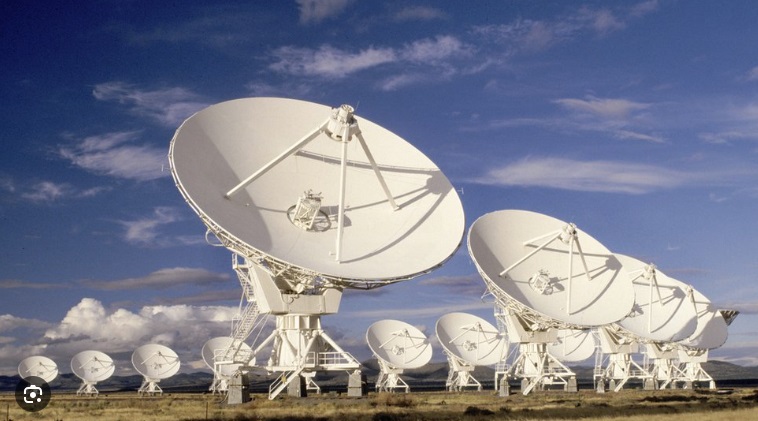
Telescopes expanded sight in the opposite direction. Modern observatories do more than magnify visible light: they translate radio, infrared, ultraviolet, X-ray, and gamma-ray signals into forms human beings can analyze. NASA emphasizes that the eye detects only a small portion of the electromagnetic spectrum, whereas scientific instruments examine the full range of radiation. NASA’s overview of the electromagnetic spectrum makes this limitation especially clear.
Scientific “seeing,” therefore, is rarely simple ocular vision. It is an epistemic chain:
We do not literally see a neutrino, magnetic field, electron wavefunction, or gravitational wave. We observe tracks, flashes, deflections, interference patterns, energy deficits, or synchronized detector signals and infer the best explanation. Science itself depends upon disciplined reasoning from visible effects to invisible causes.
The electromagnetic unseen
Visible light is only a narrow band within the electromagnetic spectrum. Infrared can reveal heat and penetrate dust; radio astronomy maps structures invisible to ordinary telescopes; X-ray observatories disclose extremely energetic environments; microwave detectors study the cosmic background radiation.
The James Webb Space Telescope observes near- and mid-infrared wavelengths, exposing regions and epochs that visible-light observation cannot reach. NASA describes this as engineering telescopes to reveal otherwise hidden regions of space. NASA: Infrared Astronomy.
The Qur’anic distinction is thus not between an illuminated universe and an empty darkness. What appears dark to one sensory system may be saturated with information at wavelengths that system cannot receive.
Dark matter and dark energy
Modern cosmology provides the most dramatic quantitative illustration. Current cosmological models assign approximately:
| Cosmic component | Approximate share | How it is known |
|---|---|---|
| Ordinary matter | 5% | Electromagnetic and gravitational observation |
| Dark matter | 27% | Primarily inferred from gravitational effects |
| Dark energy | 68% | Inferred from the accelerating cosmic expansion |
These percentages describe the universe’s modeled mass-energy budget; they do not mean that everything within the five percent of ordinary matter is directly visible. NASA presents the same approximate division in its official dark matter overview.
Dark matter does not emit, absorb, or reflect light in the usual way. Its distribution is inferred through galaxy rotation, gravitational lensing, cosmic structure, and other effects. Dark energy is a name for the still poorly understood phenomenon associated with accelerated expansion. The scientific evidence for the effects is strong, while the underlying ontologies remain unsettled.
Consequently, “what you do not see” is not a peripheral remainder. Most of the modeled cosmic budget lies outside direct visual perception. Shah’s commentary makes this one of the central modern resonances of 69:39: the hidden is not an impoverished void but an immense and causally significant domain. His focused multidisciplinary treatment develops this argument at length in “The Oath on the Unseen”.
Gravitational waves and neutrinos
Gravitational waves are distortions of spacetime rather than visible objects. LIGO’s first detection occurred in September 2015 and was reported in 2016, opening an entirely new mode of astronomy. We now “listen” to otherwise invisible mergers of black holes and neutron stars through exquisitely small changes in interferometer lengths. LIGO’s scientific overview describes this new observational window.
Neutrinos provide another example. They possess no electric charge and interact so weakly that enormous numbers pass through matter without leaving ordinary sensory evidence. Their reality is nevertheless established by carefully designed detectors. They embody a recurring scientific lesson: imperceptibility is not nonexistence.
Quantum physics: the invisible architecture of the visible
All ordinary matter is quantum mechanical. Atoms, chemical bonds, semiconductors, lasers, stars, and biological molecules depend upon quantum principles. Yet quantum states are not little colored objects waiting to be viewed under a stronger microscope. What becomes observable is the outcome of an interaction prepared and interpreted through theory.
Quantum physics challenges the assumptions of common-sense realism:
- systems may exist in superpositions relative to a chosen measurement basis;
- outcomes are described probabilistically;
- incompatible observables cannot simultaneously possess arbitrarily precise measured values;
- entangled systems display correlations irreducible to local hidden-variable models of the tested Bell type;
- measurement converts a range of possible outcomes into a recorded event, while interpretations disagree over the metaphysical description of that transition.
The 2022 Nobel Prize in Physics recognized experiments with entangled photons that established violations of Bell inequalities and advanced quantum information science. These experiments confirm quantum predictions; they do not, by themselves, prove any theology or single metaphysical interpretation. The Nobel Prize’s official explanation is a useful guard against exaggerated claims.
Quantum mechanics belongs to “what you do not see” in at least three senses. Its objects are below unaided sensory access; its mathematical state space is not itself a visible location; and its conceptual structure lies far outside everyday intuition. Nevertheless, quantum theory is among the most precisely tested frameworks in science. It shows that the real need not resemble the immediately perceptible.
Extra dimensions: a genuine possibility, not an established discovery
Additional spatial dimensions appear in string theory and other attempts to unify gravity with quantum physics. Such dimensions may be compactified at extremely small scales or otherwise hidden from ordinary experience. CERN explains how a dimension contracted below atomic scales could escape everyday detection and how collider experiments seek possible signatures. CERN: Extra Dimensions, Gravitons and Tiny Black Holes.
But extra dimensions have not been experimentally established. They should therefore be included within the realm of scientifically serious possibilities, not asserted as confirmed components of the Qur’anic unseen. Their theological value lies in what they demonstrate conceptually: even rigorous physics recognizes that familiar three-dimensional perception may not exhaust the architecture of reality.
Three levels of the unseen
A sound commentary should distinguish rather than conflate different kinds of invisibility.
| Level | Examples | Mode of knowledge |
|---|---|---|
| Sensory unseen | Microbes, infrared light, distant galaxies | Instruments extend perception |
| Theoretical or inferential unseen | Dark matter, quantum states, fields; possible extra dimensions | Effects, mathematics, prediction and inference |
| Metaphysical ghayb | God, angels, revelation, resurrection and the Hereafter | Revelation, reason and trustworthy prophetic testimony |
The first two categories show that the inference “I cannot see it, therefore it is unreal” is philosophically indefensible. They do not mechanically prove every claim in the third category. Rather, they dismantle the prejudice that only naked-eye objects can be real and prepare the mind for a more adequate epistemology.
Dark matter should not be called an angel. A compactified dimension should not be identified with Paradise. Quantum indeterminacy should not be presented as laboratory detection of divine will. Such identifications diminish both science and revelation. The stronger claim is also the more disciplined one: empirical history has repeatedly shown human perception to be a narrow aperture onto a much larger reality. Therefore, testimony about the metaphysical unseen must be judged by the credibility of the messenger, the coherence of the message, and the cumulative evidence—not dismissed merely because its object is invisible.
Why this oath is more comprehensive than the sun, moon, day, or night
The Qur’an’s particular oaths remain magnificent. Their specificity makes them pedagogically powerful:
- The sun represents radiance, energy, order, and life.
- The moon displays reflected light, phases, measurement, and dependence.
- Day and night symbolize disclosure and concealment, labor and rest.
- Rain and vegetation provide visible analogies of resurrection.
- Winds reveal movement, distribution, fertility, and divine command.
- The human soul makes moral purification the field of ultimate success.
Sūrat al-Shams gathers the sun, moon, day, night, sky, earth, and soul before declaring that the person who purifies the soul succeeds. Sūrat al-Wāqiʿah calls the positions of the stars a tremendous oath “if you only knew” before affirming the nobility of the Qur’an.
But 69:38–39 exceeds every particular oath in scope, because it contains them all:
| Oath | Range | Truth emphasized |
|---|---|---|
| Sun and moon | Specific celestial signs | Order, illumination and moral purification |
| Day and night | Temporal and biological cycles | Providence, rest, disclosure and concealment |
| Stars and their positions | Cosmic magnitude and order | The nobility of revelation |
| Seen and unseen | Every actual or possible created reality | The Qur’an’s revelatory origin |
Every sun and moon is included in “what you see.” Their interiors, fields, histories, unseen wavelengths, gravitational relations, and ultimate destinies belong largely to “what you do not see.” The oath of al-Ḥāqqah therefore does not compete with the other oaths; it gathers and universalizes them.
This fulfills Shah’s central insight that the Qur’anic oaths harmonize the Book of Scripture with the book of nature. Here, the whole cosmic book—every readable line and every line still hidden—is called as a witness for the revealed Book.
The philosophical demolition of naive empiricism
The oath challenges the assumption that reality equals present perception. Human beings occupy a narrow biological window. We perceive only certain wavelengths, frequencies, sizes, distances, durations, and intensities. Evolution equipped us for survival at a middle scale, not for direct comprehension of quarks, galactic filaments, curved spacetime, or eternity.
Philosophically, several conclusions follow.
First, being is greater than appearing. An entity’s failure to appear to human eyes tells us more about the limitations of the eyes than about the entity’s existence.
Second, knowledge is mediated. Even ordinary sight involves light, neural processing, memory, and interpretation. Scientific knowledge adds instruments, calibration, statistics, models, and communal verification.
Third, reason legitimately moves from effects to causes. No scientist rejects dark matter merely because it cannot be photographed as an ordinary luminous object. Its explanatory power is judged through the phenomena attributed to it. Theology similarly reasons from contingency, order, intelligibility, consciousness, morality, and revelation toward their sufficient ground—although theological arguments operate at a different explanatory level.
Fourth, epistemic humility is rational. Every great expansion of knowledge has exposed a former horizon as provincial. The microscope humbled the eye; the telescope humbled the earth; relativity humbled absolute space and time; quantum mechanics humbled classical intuition; cosmology humbled the visible universe.
The oath is therefore an antidote to both credulity and reductionism. It does not command belief in every unseen speculation. It commands rejection of the dogma that the currently visible is all that exists.
A Ghazalian reading: visible causes and invisible agency
Dr. Shah’s writings connect Qur’anic oaths with al-Ghazālī’s occasionalism. On this reading, created things are not independent efficient causes possessing powers autonomous from God. What we call laws of nature describe the stable regularities of the divine custom—sunnat Allāh. God continuously sustains the order we study.
When the Qur’an swears by the sun, the wind, or the dawn, God is not appealing to independent witnesses beside Himself. He is directing attention to His own continuous creative activity displayed through those phenomena. Shah summarizes this metaphysical vision as an “Inshallah universe”: every event occurs within the sovereignty and sustaining will of God. His synthesis is developed most explicitly in “Ninety Oaths and the Last Laugh of al-Ghazālī” and “The Architecture of Divine Volition”.
Quantum mechanics does not prove occasionalism. Physical theories describe patterns among observable events; they cannot experimentally identify God as one more physical cause within the universe. Nevertheless, quantum theory undermines the older confidence that nature is necessarily a completely local, deterministic machine whose future is fixed by intrinsic material causes. It therefore makes room for renewed philosophical consideration of Ghazalian causal humility.
Verse 40: “the word of a noble messenger”
إِنَّهُ لَقَوْلُ رَسُولٍ كَرِيمٍ
“It is truly the word conveyed by a noble messenger.”
Calling the Qur’an the messenger’s qawl does not mean that the messenger authored it. Speech may be attributed to the person faithfully transmitting it. The same description appears in 81:19, where the contextual messenger is Gabriel. Here, the accusations of poetry and soothsaying were directed primarily against Muhammad, so many commentators identify the noble messenger as the Prophet.
The chain is therefore:
Invalid or unsupported diagram.
The messenger is karīm: noble, honored, trustworthy, and incapable of betraying the message entrusted to him. Verse 43 makes the ultimate origin explicit: it is tanzīl min rabbi al-ʿālamīn, not a human composition.
Verse 41: not the word of a poet
وَمَا هُوَ بِقَوْلِ شَاعِرٍ قَلِيلًا مَّا تُؤْمِنُونَ
“It is not the word of a poet—how little you believe.”
Pre-Islamic Arabia rightly treasured poetry. A poet could preserve tribal memory, defend honor, praise heroes, and satirize enemies. Because the Qur’an possessed extraordinary cadence, imagery, sonic power, and rhetorical beauty, opponents attempted to place it within their highest familiar literary category.
The Qur’an refuses the classification. Its discourse does not conform to the meters of Arabic poetry. It moves among proclamation, narrative, law, prayer, warning, argument, parable, eschatological vision, and moral instruction. Its purpose is not imaginative performance but guidance and transformation.
“Little do you believe” diagnoses the deeper problem. The obstacle is not inability to hear the Qur’an’s beauty but unwillingness to follow its moral implications. A person may admire revelation aesthetically while resisting it existentially.
Verse 42: not the word of a soothsayer
وَلَا بِقَوْلِ كَاهِنٍ قَلِيلًا مَّا تَذَكَّرُونَ
“Nor is it the word of a soothsayer—how little you reflect.”
The kāhin claimed access to hidden information and often spoke in cryptic rhymed prose. Since the Qur’an announced resurrection, judgment, angels, and realities beyond ordinary perception, its opponents tried to assimilate prophecy to divination.
But the differences are fundamental. Soothsaying is opaque, fragmented, self-serving, and inseparable from manipulation. The Qur’an offers a sustained moral and theological worldview, condemns exploitation, subjects its messenger to the same commandments as everyone else, and repeatedly invites reflection, comparison, and scrutiny.
The response is no longer merely “little do you believe,” but “little do you remember or reflect”—qalīlan mā tadhakkarūn. Proper remembrance would have enabled the hearers to compare Muhammad’s known character, the content of the revelation, and the methods of soothsayers. The accusation collapses under thoughtful examination.
Verse 43: revelation from the Lord of all worlds
تَنزِيلٌ مِّن رَّبِّ الْعَالَمِينَ
“A revelation sent down from the Lord of all worlds.”
The terse nominal construction delivers the positive verdict after the false alternatives have been eliminated. It is tanzīl: something progressively bestowed from a higher source, not manufactured from below.
Its source is not merely “God” in the abstract but Rabb al-ʿālamīn—the Creator, Sustainer, Educator, and Lord of every world and order of existence. The plural ʿālamīn should not be converted into a technical prediction of the modern multiverse. Its theological meaning is broader: every class of beings, every domain of existence, and every horizon of knowledge belongs to one Lord.
This title perfectly answers the oath. Only the Lord of every visible and invisible world could summon them all as witnesses. Only the Knower of every realm could reveal a discourse adequate to the destiny of humanity.
From the All-Knowing to al-Ḥaqq
The Qur’an elsewhere describes revelation as coming from the One “who knows the secrets of the heavens and the earth” (25:6). Divine omniscience supplies the epistemic foundation of revelation: God does not infer, approximate, conjecture, or revise. He knows creation outwardly and inwardly, actually and possibly, temporally and eternally.
God is also al-Ḥaqq—the Truth and the Ultimately Real:
“That is because Allah is al-Ḥaqq, the Truth, and what they invoke besides Him is falsehood.”
—Qur’an 22:62
Dr. Shah’s writings connect six dimensions of ḥaqq: God as Ultimate Reality, creation made bi’l-ḥaqq with truth and purpose, revelation as truth, prophetic history, final accountability, and human rights. His focused discussion of the divine name can be read in “Al-Ḥaqq in the Glorious Qur’an”.
The relationship may be stated simply:
- Because God is al-ʿAlīm, nothing real is absent from His knowledge.
- Because God is al-Ḥaqq, falsehood cannot originate in Him.
- Because He is Rabb al-ʿālamīn, every visible and invisible realm belongs to His governance.
- Therefore, revelation truly originating from Him is not conjecture but truth.
This does not make every human commentary infallible. The Qur’an may be absolute truth while exegetes—including scientific commentators—remain fallible. Dark matter models may change; theories of quantum gravity may be replaced; proposed extra dimensions may never be detected. The divine text is not revised when a human concordist interpretation fails. Intellectual humility is required precisely because God is All-Knowing and we are not.
The culmination: 69:51–52
وَإِنَّهُ لَحَقُّ الْيَقِينِ فَسَبِّحْ بِاسْمِ رَبِّكَ الْعَظِيمِ
“And indeed, it is the truth of absolute certainty. So glorify the name of your Lord, the Most Great.”
Qur’an 69:51 employs the extraordinary expression ḥaqq al-yaqīn. Qur’anic epistemology uses three closely related formulations:
- ʿIlm al-yaqīn: certainty reached through sound knowledge.
- ʿAyn al-yaqīn: certainty as though brought before the eye.
- Ḥaqq al-yaqīn: truth fully realized—the reality corresponding perfectly to what was known and seen.
The surah named al-Ḥāqqah, the inevitable Reality, concludes by calling the Qur’an ḥaqq al-yaqīn. The revelation and the reality it announces correspond. What the Qur’an now describes through words will become existentially manifest in the Hereafter.
The passage offers a cumulative movement toward that certainty:
- The seen world exhibits order, contingency, intelligibility, beauty, and law.
- The scientifically unseen reveals that sensory perception accesses only a fragment of reality.
- Philosophy demonstrates that invisibility cannot equal nonexistence.
- The Prophet’s character and faithful transmission establish the credibility of the messenger.
- The hypotheses of poetry, soothsaying, and fabrication fail to explain the Qur’an adequately.
- The unity, coherence, moral depth, and revelatory power of the Qur’an point beyond a merely human source.
- The best theological explanation is tanzīl min rabbi al-ʿālamīn—revelation from the Lord of all worlds.
- Because that Lord is the All-Knowing and al-Ḥaqq, His revelation is ḥaqq al-yaqīn.
The final command is therefore not “speculate endlessly,” but glorify. Scientific discovery should generate wonder; philosophical reflection should generate humility; theological recognition should generate worship. Knowledge fulfills its purpose when it leads the knower from creation to the Creator.
Thematic epilogue: when the invisible becomes testimony
A seventh-century hearer could look at the desert horizon, the sun, moon, stars, mountains, animals, and human faces and understand the first half of the oath. The unseen could be understood through revelation as God, angels, judgment, Paradise, Hell, divine decree, and the hidden intentions of the heart.
The modern reader stands beneath the same sky but inhabits a vastly enlarged universe. The telescope reveals ancient galaxies and invisible wavelengths. The microscope discloses living worlds in a drop of water. Particle accelerators reconstruct events at scales beyond imagination. Interferometers register ripples in spacetime. Quantum experiments demonstrate a nonclassical order beneath apparently solid matter. Cosmology concludes that luminous matter is only a small share of the cosmic budget. Theories of extra dimensions remind us that even the dimensional structure of reality may exceed ordinary experience.
Every scientific advance moves some reality from “what you do not see” into the domain of instrumentally mediated knowledge, but the horizon continually recedes. The more humanity sees, the more it discovers how much remains unseen.
This is why the oath of 69:38–39 possesses a unique and ever-expanding power. The oaths by the sun, moon, day, and night direct us to majestic particular signs. The oath by the seen and unseen encompasses every particular sign already known, every reality later discovered, every physical process forever beyond direct perception, and every metaphysical truth disclosed by revelation. It is an oath capacious enough for the desert observer, the microbiologist, the astronomer, the quantum physicist, the philosopher, and the mystic.
Yet its purpose is not to turn the Qur’an into a physics textbook. It is to cure the soul of epistemic arrogance. Human sight is narrow, instruments are finite, theories remain revisable, and commentators are fallible. The All-Knowing alone sees reality without horizon. The Lord who is al-Ḥaqq knows equally the photon and the galaxy, the visible body and the secret intention, the present cosmos and the coming Resurrection.
When the Qur’an summons all that is seen and unseen, creation becomes a universal courtroom and every layer of reality becomes a witness. The testimony converges upon the same verdict:
This is not the performance of a poet, the obscurity of a soothsayer, or the fabrication of an ambitious man. It is a revelation from the Lord of all worlds. It is ḥaqq al-yaqīn—the truth of absolute certainty.
And once reason reaches that threshold, the appropriate culmination is neither intellectual pride nor sterile astonishment, but the final command of Sūrat al-Ḥāqqah:
فَسَبِّحْ بِاسْمِ رَبِّكَ الْعَظِيمِ
“So glorify the name of your Lord, the Most Great.”
For references please go to Microsoft Word file:




 The Glorious Quran and Science
Leave a comment