
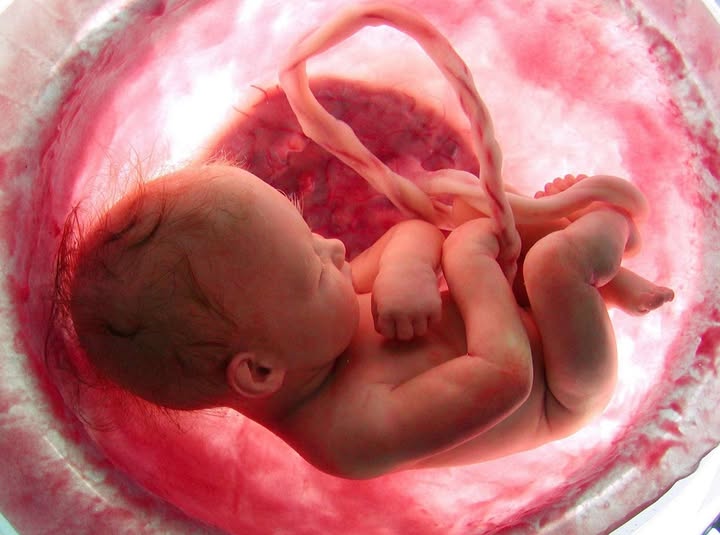
“He Shapes You in the Wombs as He Wills”: A Scientific, Philosophical, and Theological Commentary on Qur’an 3:5–6
On genetic disease, evolution, and the case for guided evolution
Presented by Claude for Zia H Shah MD
Abstract
Two verses near the opening of Sūrat Āl ʿImrān bind together divine omniscience and divine artistry: nothing in earth or heaven is hidden from God, and it is He who shapes every human being in the womb “as He wills.” Read in the light of modern genetics, these verses acquire an unexpected depth. Medical literature now catalogues between 6,000 and 10,000 distinct genetic disorders, with new ones described every year, and roughly three-quarters of all rare diseases are genetic in origin. This commentary argues that the very phenomena we call “genetic disease” are the visible edge of the mutational process by which all evolution proceeds, and that the Qur’anic framing of that process — nothing hidden, everything shaped, every measure known — transforms the scientific picture of evolution into one of guided evolution. The disease-causing allele and the adaptive allele are the same kind of event; what distinguishes them is context, and context is precisely what an omniscient Creator sees and a blind process cannot. Drawing on the writings of Zia H. Shah, MD, on the placenta, on beauty as a path to God, and on the wider architecture of guided evolution, the commentary concludes with a thematic epilogue on suffering, mercy, and the closing divine names of the passage: al-ʿAzīz al-Ḥakīm, the Mighty, the Wise.
1. The Verses
إِنَّ اللَّهَ لَا يَخْفَىٰ عَلَيْهِ شَيْءٌ فِي الْأَرْضِ وَلَا فِي السَّمَاءِ
Truly, nothing in the earth or in the heaven is hidden from Allah. (3:5)
هُوَ الَّذِي يُصَوِّرُكُمْ فِي الْأَرْحَامِ كَيْفَ يَشَاءُ ۚ لَا إِلَٰهَ إِلَّا هُوَ الْعَزِيزُ الْحَكِيمُ
He it is who shapes you in the wombs as He wills. There is no god but He, the Mighty, the Wise. (3:6)
(In editions that count the Basmalah as the first verse of the sūrah, these are numbered 3:6–7.)
The two verses form a single thought. The first asserts a knowledge without remainder; the second asserts an activity without external constraint. Together they place the formation of every human being — and, by extension, every living being formed in a womb — inside a field of perfect knowledge and sovereign intention. Classical commentators (al-Ṭabarī, al-Rāzī, Ibn Kathīr) read verse 6 as a refutation of those who deified Jesus: whoever is shaped in a womb is a creature, not the Creator. That polemical setting is real, but the verse’s vocabulary reaches further. The verb يُصَوِّرُ (yuṣawwiru) is the verb of the divine name الْمُصَوِّر (al-Muṣawwir), the Fashioner, the giver of form, and the phrase كَيْفَ يَشَاءُ (“however He wills”) is the Qur’an’s standing formula for divine freedom in the particulars of creation, not merely in its existence.
2. Verse 5: Nothing Hidden — The Genome as an Open Book
2.1 The theological claim
Divine omniscience in the Qur’an is not abstract. It is repeatedly illustrated at the smallest scales of the biological world:
وَعِندَهُ مَفَاتِحُ الْغَيْبِ لَا يَعْلَمُهَا إِلَّا هُوَ ۚ وَيَعْلَمُ مَا فِي الْبَرِّ وَالْبَحْرِ ۚ وَمَا تَسْقُطُ مِن وَرَقَةٍ إِلَّا يَعْلَمُهَا وَلَا حَبَّةٍ فِي ظُلُمَاتِ الْأَرْضِ وَلَا رَطْبٍ وَلَا يَابِسٍ إِلَّا فِي كِتَابٍ مُّبِينٍ
With Him are the keys of the unseen; none knows them but He. He knows what is on land and in the sea. Not a leaf falls but He knows it, nor a grain in the darknesses of the earth, nor anything moist or dry, but it is in a clear Book. (6:59)
And, strikingly, the Qur’an applies this omniscience to the womb itself and to what the womb loses:
اللَّهُ يَعْلَمُ مَا تَحْمِلُ كُلُّ أُنثَىٰ وَمَا تَغِيضُ الْأَرْحَامُ وَمَا تَزْدَادُ ۖ وَكُلُّ شَيْءٍ عِندَهُ بِمِقْدَارٍ
Allah knows what every female bears, and what the wombs diminish and what they increase; and everything with Him has a measure. (13:8)
“What the wombs diminish” — mā taghīḍu al-arḥām — is an arresting phrase to read as a physician. It names, fourteen centuries before karyotyping, the hidden attrition of pregnancy.
2.2 The scientific picture
The human genome is roughly 3.1 billion base pairs, distributed across 23 chromosome pairs, encoding about 20,000 protein-coding genes and a far larger regulatory landscape. Each of us is born with roughly 60 to 70 new mutations that neither parent carried, the number rising with paternal age. Most are neutral. A few are not.
What the womb “diminishes” is now measurable. Perhaps half or more of all human conceptions never reach a recognized pregnancy; of clinically recognized pregnancies, 10–20% end in miscarriage; and of first-trimester losses, roughly half carry a chromosomal abnormality — trisomies, monosomies, triploidy. Turner syndrome (45,X) is a vivid example: it is found in about 1 in 2,000 live female births, yet the great majority of 45,X conceptions are lost before birth. Shah’s own survey notes that Turner syndrome is thought to be far more common at conception than at birth, since many 45,X embryos do not survive to term. thequran
The catalogue of what survives is vast. Depending on how conditions are counted, medical databases recognize between 6,000 and 10,000 genetic disorders; the Online Mendelian Inheritance in Man database alone lists more than 7,000 phenotypes with a known molecular basis, and the number grows monthly as exome and genome sequencing name conditions that were once merely “syndromes of unknown cause.” These fall into three great families:
- Monogenic (Mendelian) disorders — cystic fibrosis, sickle-cell disease, Huntington’s disease, Duchenne muscular dystrophy, the thalassemias — each traceable to a single gene, collectively numbering in the thousands.
- Chromosomal disorders — trisomy 21 (Down syndrome), trisomy 18, trisomy 13, Turner, Klinefelter, and countless microdeletions and duplications — arising from errors in the segregation or structure of whole chromosomes.
- Multifactorial disorders — coronary disease, type 2 diabetes, most cancers, most psychiatric illness — in which many variants of small effect interact with environment.
Individually rare, they are collectively common. An estimated 300 million people worldwide live with a rare disease, and about 72% of rare diseases are genetic in origin. Shah summarizes the burden this way: roughly 1 in 50 people is affected by a known single-gene disorder, about 1 in 263 has a chromosomal disorder, and if minor congenital variants with health consequences are included, something like 65% of people carry a health problem traceable to their genes. thequran
2.3 The philosophical hinge
Here is the point on which the whole commentary turns. To the geneticist, a mutation is “random.” But random in evolutionary biology has a precise and limited meaning: mutations arise without regard to whether they will be useful to the organism. It does not mean uncaused, and it does not mean unknown. A cosmic ray strikes a base; a polymerase slips on a repeat; a chromosome fails to disjoin at maternal meiosis I. Each has a physical cause. Each is, in the language of 13:8, bi-miqdār, according to a measure.
Verse 5 therefore does not deny stochasticity as science describes it. It denies hiddenness. The genome, with all its transcription errors, is a book already read. Whether one takes this in the strong occasionalist sense that Shah has explored — that God is the direct cause of every event, with natural laws as the habitual pattern of His action — or in the more modest sense that God’s knowledge encompasses all the outcomes of a lawful world, the consequence is the same: no mutation is a surprise to God. And a process of which every step is foreknown by the One who set its laws is not, in any ultimate sense, blind. That is the seed of guided evolution.
3. Verse 6: Shaped in the Wombs — Formation, Variation, and Imperfection
3.1 The vocabulary of form
The Qur’an’s descriptions of embryogenesis are among its most sustained scientific-sounding passages, and they consistently emphasize stages and shaping:
وَلَقَدْ خَلَقْنَا الْإِنسَانَ مِن سُلَالَةٍ مِّن طِينٍ ﴿١٢﴾ ثُمَّ جَعَلْنَاهُ نُطْفَةً فِي قَرَارٍ مَّكِينٍ ﴿١٣﴾ ثُمَّ خَلَقْنَا النُّطْفَةَ عَلَقَةً فَخَلَقْنَا الْعَلَقَةَ مُضْغَةً فَخَلَقْنَا الْمُضْغَةَ عِظَامًا فَكَسَوْنَا الْعِظَامَ لَحْمًا ثُمَّ أَنشَأْنَاهُ خَلْقًا آخَرَ ۚ فَتَبَارَكَ اللَّهُ أَحْسَنُ الْخَالِقِينَ ﴿١٤﴾
We created man from an extract of clay; then We placed him as a drop in a secure resting-place; then We made the drop a clinging thing, and the clinging thing a lump, and the lump bones, and clothed the bones with flesh; then We brought him forth as another creation. So blessed be Allah, the best of creators. (23:12–14)
يَخْلُقُكُمْ فِي بُطُونِ أُمَّهَاتِكُمْ خَلْقًا مِّن بَعْدِ خَلْقٍ فِي ظُلُمَاتٍ ثَلَاثٍ
He creates you in the wombs of your mothers, creation after creation, in three darknesses. (39:6)
الَّذِي خَلَقَكَ فَسَوَّاكَ فَعَدَلَكَ ﴿٧﴾ فِي أَيِّ صُورَةٍ مَّا شَاءَ رَكَّبَكَ ﴿٨﴾
Who created you, then proportioned you, then balanced you; in whatever form He willed, He assembled you. (82:7–8)
The last of these is the key to 3:6. فِي أَيِّ صُورَةٍ مَّا شَاءَ رَكَّبَكَ — “in whatever form He willed, He assembled you” — is a statement about variation. Human beings are not stamped from one mould. Height, pigmentation, facial geometry, metabolic set-points, immune repertoires, and — inseparably — susceptibilities and vulnerabilities are all “forms” in which we are assembled. The verse does not promise uniformity; it asserts authorship over diversity.
3.2 “Formed and unformed”: the Qur’an names imperfection
Most remarkable of all, the Qur’an explicitly includes incomplete formation within the divine act:
يَا أَيُّهَا النَّاسُ إِن كُنتُمْ فِي رَيْبٍ مِّنَ الْبَعْثِ فَإِنَّا خَلَقْنَاكُم مِّن تُرَابٍ ثُمَّ مِن نُّطْفَةٍ ثُمَّ مِنْ عَلَقَةٍ ثُمَّ مِن مُّضْغَةٍ مُّخَلَّقَةٍ وَغَيْرِ مُخَلَّقَةٍ لِّنُبَيِّنَ لَكُمْ ۚ وَنُقِرُّ فِي الْأَرْحَامِ مَا نَشَاءُ إِلَىٰ أَجَلٍ مُّسَمًّى
O mankind, if you are in doubt about the resurrection, then [know that] We created you from dust, then from a drop, then from a clinging thing, then from a lump, formed and unformed, that We may make clear to you. And We settle in the wombs whom We will for an appointed term. (22:5)
مُّخَلَّقَةٍ وَغَيْرِ مُخَلَّقَةٍ — mukhallaqah wa ghayr mukhallaqah, “formed and unformed.” Classical exegetes debated whether this refers to the completed versus the miscarried embryo, or to the well-proportioned versus the malformed. Both readings are now medically literal. Some embryos are “settled in the wombs” to term; others are not. Some are formed completely; others carry a neural tube that fails to close, a heart that fails to septate, a chromosome that failed to disjoin. The Qur’an does not hide this from view. It places it inside the sentence that begins “We created you,” and it gives a reason: لِّنُبَيِّنَ لَكُمْ — “that We may make clear to you.” The malformed embryo is, in the Qur’an’s own framing, a sign, an instrument of clarification.
What does it clarify? Verse 22:5 says: the resurrection. But the logic runs deeper. The existence of ghayr mukhallaqah clarifies that formation is a process — that it can be arrested, deflected, or completed — and a process that admits of degrees is precisely what evolution requires. A creation by instantaneous fiat would have no “unformed.” Guided formation does.
3.3 The present tense
A grammatical detail matters. يُصَوِّرُكُمْ is imperfect — present-continuous. God is not described as having shaped humanity once; He shapes, now, in every womb, in every generation. Creation in the Qur’an is not a completed event but an ongoing activity, and the Qur’an elsewhere describes that activity as staged and grown:
وَقَدْ خَلَقَكُمْ أَطْوَارًا
And He has created you in stages. (71:14)
وَاللَّهُ أَنبَتَكُم مِّنَ الْأَرْضِ نَبَاتًا
And Allah has caused you to grow from the earth as a growth. (71:17)
A God who shapes continuously, in stages, growing His creatures like plants from the earth, is a God whose creative act looks like evolution from the inside.
4. The Scientific Heart of the Matter: Disease and Evolution Are One Process
4.1 Mutation is the only source of novelty
Every heritable difference between a human and a chimpanzee, between a wolf and a Pekingese, between a wild grass and bread wheat, began as a mutation. Natural selection, drift, and recombination sort variation; they do not create it. Only mutation does. And the mutational process is indifferent to outcome. The same slip of a polymerase that produces a lethal frameshift in one gene produces, in another, a duplicated gene free to acquire a new function. The same non-disjunction that yields trisomy 21 in one lineage yielded, in another, the whole-genome duplications that gave vertebrates their expanded gene families.
This is why the enormous catalogue of genetic disease is not evidence against a creative process but the fingerprint of one. A species with no genetic disease would be a species with no mutation, and therefore no evolution, no adaptation, no future. The 6,000-to-10,000 disorders are the cost of having a genome that can change at all.
4.2 The same allele, two faces
Consider how frequently the boundary between “disease” and “adaptation” dissolves under scrutiny:
- Sickle-cell disease. Homozygotes suffer a devastating hemoglobinopathy; heterozygotes are substantially protected against falciparum malaria. The geography of the sickle allele traces the geography of malaria almost exactly. As Shah observes, evolutionary theory predicted this heterozygote advantage, and it remains a classic case of natural selection’s trade-off. The “disease gene” is an adaptation seen from the wrong angle. thequran
- Cystic fibrosis. CFTR mutations are lethal in homozygotes yet persist at carrier frequencies of 1 in 25–30 among Europeans; the leading hypotheses invoke heterozygote resistance to cholera or typhoid toxins.
- CCR5-Δ32. A 32-base-pair deletion that confers near-complete resistance to HIV in homozygotes — a “broken” gene that became, in the late twentieth century, a shield.
- Lactase persistence. A regulatory mutation upstream of LCT that keeps the enzyme active into adulthood arose independently in Europe and in East Africa within the last 10,000 years; without it, most adult humans are, technically, lactose “intolerant.” Which is the disease and which is the norm depends entirely on the herd outside the tent.
- EPAS1 in Tibetans. A haplotype for high-altitude adaptation acquired through interbreeding with Denisovans — an entire adaptive module borrowed from an extinct human lineage.
- The GULO pseudogene. All humans carry the wreckage of the gene for vitamin C synthesis, shared in the same disabled state with every monkey and ape, lost in a common ancestor some 61–63 million years ago. Shah calls attention to the phrase geneticists have used for it: a “public inborn error of metabolism” carried by our entire species. Scurvy is a genetic disease that every human being inherits. thequran
- Human chromosome 2. We have 46 chromosomes; the other great apes have 48. Our chromosome 2 is a head-to-head fusion of two ancestral chromosomes, with a vestigial second centromere and telomere sequences buried mid-chromosome. A chromosomal “abnormality,” fixed in an entire species.
- Endogenous retroviruses. Roughly 8% of the human genome consists of the remains of ancient viral infections, and, as we will see, one of these infections built the placenta.
The pattern is unmistakable. Genetic disease and evolutionary novelty are not two phenomena but one, distinguished only by context and consequence.
4.3 The fine-tuned mutation rate
There is a subtler point, and it is the one that most directly supports guidance. The mutation rate is not arbitrary. DNA polymerase with its proofreading domain achieves an error rate of roughly one in ten million; mismatch repair improves this to about one in a billion per base per replication. Too much fidelity, and populations cannot adapt to changing environments. Too little, and lineages collapse under a load of deleterious mutations — the “error catastrophe” that sets a ceiling on viral genome size. Life sits in a narrow window between rigidity and dissolution. The very parameter that produces genetic disease is tuned so that it produces just enough disease to permit evolution and not so much as to abort it. Whoever set that dial set the tempo of the whole drama of life.
4.4 Convergence and the shape of the possible
Evolution is not infinitely open-ended. The camera eye evolved independently in vertebrates and cephalopods. Echolocation arose in bats and in toothed whales, with convergent changes in the same hearing gene, prestin. Placental-like structures evolved in lizards and sharks. Flight evolved four times. Simon Conway Morris has argued that these convergences show evolution to be channeled — that the space of viable forms is pre-structured, so that similar solutions are found again and again. If the landscape is shaped, the walker is guided even when every step is locally free. The Qur’an’s own formula for this is:
سَبِّحِ اسْمَ رَبِّكَ الْأَعْلَى ﴿١﴾ الَّذِي خَلَقَ فَسَوَّىٰ ﴿٢﴾ وَالَّذِي قَدَّرَ فَهَدَىٰ ﴿٣﴾
Glorify the name of your Lord, the Most High, who created and proportioned, and who determined and guided. (87:1–3)
قَالَ رَبُّنَا الَّذِي أَعْطَىٰ كُلَّ شَيْءٍ خَلْقَهُ ثُمَّ هَدَىٰ
[Moses] said: Our Lord is He who gave everything its form, then guided it. (20:50)
Qaddara fa-hadā — He measured, and He guided. The measure is the law; the guidance is the outcome. That is the Qur’anic definition of guided evolution, and it was pronounced long before Darwin.
5. From Evolution to Guided Evolution: The Philosophical Argument
The materialist reading of the same data is familiar: mutation is blind, selection is a filter, the appearance of design is an illusion, and genetic disease is simply what a purposeless process leaves behind. The theistic reading advanced here does not contest any of the data. It contests the inference from “random with respect to fitness” to “random with respect to everything.”
Three considerations tip the balance.
First, the laws are prior to the process. Evolution does not explain why there is a universe in which chemistry is possible, in which carbon forms four bonds, in which water is a solvent, in which a molecule can both store information and copy itself. Evolution runs on these facts; it does not generate them. Whoever authored the laws authored everything the laws make possible, including every mutation. Verse 5 asserts that this Author knows the whole.
Second, foreknowledge dissolves the opposition between chance and purpose. A gardener who knows exactly how seeds, soil, and weather will interact does not need to reach into the ground to move each root. The Qur’an’s picture — كُلُّ شَيْءٍ عِندَهُ بِمِقْدَارٍ, “everything with Him has a measure” — is of a God for whom the entire tree of life, root to crown, is present in a single act of knowing. What is stochastic to us is settled to Him. Guided evolution therefore requires no “god of the gaps,” no interventions detectable in the laboratory, and no conflict with any experiment. It requires only that the process be known and willed by the One who sustains it.
Third, the outputs are of the wrong kind for a blind process. This is the argument Shah has pressed most forcefully. A blind process should produce competent survivors. It should not, on its own terms, produce a cosmos that is mathematically comprehensible, a biosphere saturated with beauty far in excess of any reproductive need, and a creature capable of recognizing both. These are the “aesthetic surplus” and “cosmic comprehensibility” of which he writes — signatures that the process was aimed.
الَّذِي أَحْسَنَ كُلَّ شَيْءٍ خَلَقَهُ ۖ وَبَدَأَ خَلْقَ الْإِنسَانِ مِن طِينٍ
Who made beautiful everything He created, and began the creation of man from clay. (32:7)
Note the sequence: beautified everything, and began humanity from clay — beauty and gradual origins in a single verse.
The objection from suffering. The strongest objection to guided evolution is moral, not scientific: why would a wise Creator guide a process that produces Tay-Sachs and Huntington’s and anencephaly? Three Qur’anic responses converge. (i) The world is explicitly framed as a trial: الَّذِي خَلَقَ الْمَوْتَ وَالْحَيَاةَ لِيَبْلُوَكُمْ أَيُّكُمْ أَحْسَنُ عَمَلًا — “who created death and life to test which of you is best in deed” (67:2); a world of lawful regularity, in which actions have consequences and courage and compassion are possible, cannot be a world without loss. (ii) Suffering is met by mercy on the human side — the disease that evolution’s mechanism produces is precisely what summons the physician, the geneticist, the gene therapist; the healing arts are humanity’s participation in the divine name al-Shāfī. (iii) The Qur’an locates final justice beyond the womb of this world: إِنَّا لِلَّهِ وَإِنَّا إِلَيْهِ رَاجِعُونَ — “to Allah we belong and to Him we return” (2:156). The genetically afflicted child is not the discarded by-product of a process; he is, in the terms of 22:5, mukhallaqah or ghayr mukhallaqah, formed or unformed, but in either case known, and in either case returning.
6. Zia H. Shah on Guided Evolution: A Synthesis
Over several years of writing at The Glorious Quran and Science, Shah has built a cumulative case for guided evolution from many independent lines of evidence. Because the present verses concern knowledge and formation in the womb, his central themes are gathered here.
6.1 Evolution as God’s method of creation
The foundation of Shah’s position is that evolution and the Qur’an are not rivals. He describes biological evolution as a divinely guided process consistent with Islamic thought — evolution as Allah’s chosen method of creation, unfolding according to laws imbued in the universe — and argues that this view neither dismisses the scientific evidence nor sidelines God, but envisions God as the author of the evolutionary algorithm who set the laws and initial conditions and guided life toward intended outcomes. He grounds this in the “stages” of 71:14, the “growth from the earth” of 71:17, the “beautification of everything” of 32:7, and, in his commentary on Sūrat Nūḥ, in the whole architecture of guided evolution that these verses imply. His treatments of Qur’an 71:11–20, of the botanical metaphor of human creation in 71:17 and 67:24, and of the rain-revival parable as an anticipation of the unity and common origin of all life all serve this thesis. thequranthequran
6.2 Genetic disease as evidence for evolution — and for guidance
In the two articles most directly relevant to our verses, Shah confronts genetic and congenital disease head-on. He argues that genetic disorders and birth defects, rather than embarrassing faith, strongly support evolution over the notion of each species being spontaneously and perfectly created in isolation — because thousands of accumulated mutations, shared broken genes like GULO across primates, adaptive trade-offs like sickle cell, error-prone meiosis, atavisms, and endogenous retroviruses are all exactly what an evolutionary history predicts. He then turns the argument: under guided evolution, the features that seem imperfect or cruel can be reinterpreted as part of a larger plan, and the long history of trial and error in nature becomes not a series of mistakes but the intended method of achieving complexity and diversity. He also uses population genetics and comparative genomics to argue that a sudden origin of humanity from a single created pair is implausible — which, far from threatening the Qur’an, harmonizes with its language of growth, stages, and formation. Genetic and Congenital Diseases: Evidence for Evolution and the Case for Guided Evolution +2
6.3 The placenta: a retrovirus that built a womb
No single organ figures more prominently in Shah’s argument than the placenta. The biology is astonishing and bears directly on يُصَوِّرُكُمْ فِي الْأَرْحَامِ. The outer layer of the placenta, the syncytiotrophoblast, is formed by the fusion of individual cells into a continuous sheet that mediates exchange between mother and child while shielding the fetus from maternal immune attack. The proteins that drive this fusion — the syncytins — are envelope genes of ancient retroviruses that infected the germline of mammalian ancestors and were domesticated. Primates use syncytin-1 (from HERV-W) and syncytin-2 (from HERV-FRD); mice use syncytin-A and -B; ruminants, carnivores, and marsupials each use their own, captured independently from different viruses at different times. The same solution was found repeatedly, from viral raw material, across the mammalian tree.
Shah draws three conclusions. First, the placenta is a textbook case of evolution’s exaptation — a chance infection repurposed — and therefore a refutation of separate special creation. Second, the repeated, independent co-option of viral genes for the same essential function in lineage after lineage looks less like luck than like a landscape shaped toward that outcome — hence his framing question: accident, or guided evolution? His series runs from “Placenta: What a Retrovirus Did, Humanity Cannot,” through “Placenta From A Retrovirus: Accident Or Guided Evolution?,” to “Viral Architects of the Placenta” and “The Marvel of Placenta: A Clue to Guided Evolution and Afterlife.” The title of the first is the point: with all our biotechnology we cannot construct a placenta, yet a virus, guided, did. thequran
Third — and this is where Shah’s thought is most original — the placenta becomes an argument for the afterlife. The fetus, floating in the “three darknesses” of 39:6, receives everything through an organ it will discard at birth, and has no conception of the world of light, air, and faces into which it will emerge. Its entire universe is a preparation for a life it cannot imagine. Shah reads 22:5 and 75:36–40 through exactly this lens: the transition from womb to world is the Qur’an’s own analogy for the transition from this world to the next. His essays “Arguing the Afterlife from the Miracle of Mammalian Pregnancy,” “The Glorious Quran: From Mother’s Placenta to Afterlife,” “From ʿAlaqah to Accountability,” and “Ancient Viruses and the Logic of Resurrection” develop this line. thequran
أَلَمْ يَكُ نُطْفَةً مِّن مَّنِيٍّ يُمْنَىٰ ﴿٣٧﴾ ثُمَّ كَانَ عَلَقَةً فَخَلَقَ فَسَوَّىٰ ﴿٣٨﴾ فَجَعَلَ مِنْهُ الزَّوْجَيْنِ الذَّكَرَ وَالْأُنثَىٰ ﴿٣٩﴾ أَلَيْسَ ذَٰلِكَ بِقَادِرٍ عَلَىٰ أَن يُحْيِيَ الْمَوْتَىٰ ﴿٤٠﴾
Was he not a drop of emitted fluid? Then he was a clinging thing, and He created and proportioned, and made of him the two sexes, male and female. Is not He, then, able to give life to the dead? (75:37–40)
6.4 Beauty as a path to God
Shah’s second great theme is aesthetic. In a sequence of essays — “Beauty Leads to God — A Blind and Random World Should be Tasteless,” “Beauty in Nature as a Path to God: An Islamic Perspective,” “Beauty as the Signature of God: An Argument from Aesthetic Splendor for Guided Evolution Across Nine Million Species,” “The Aesthetic Anomaly,” and “Every Beauty Points to the Creator” on Qur’an 59:24 — he builds what he calls the argument from aesthetic surplus. The case runs roughly as follows: thequran
- Natural selection explains functional adequacy. It does not, on its own, explain why the world is saturated with beauty — 19,000 species of butterfly, the peacock’s tail, the firefly’s cold light, the sunflower’s Fibonacci spirals, the nebula, the fjord — far beyond anything reproductive fitness requires.
- Nor does it explain why we possess the capacity to perceive this beauty and to be moved by it, a capacity that has no obvious survival value in most of its exercise.
- The same anomaly appears in physics and mathematics: the universe is comprehensible, and its deepest laws are the ones physicists find most beautiful. Dirac, Weyl, and Wigner all remarked on this “unreasonable” fit between aesthetic intuition and physical truth.
- Beauty, in other words, is a signature — the mark of an Artist who, as 32:7 says, “made beautiful everything He created,” and whose names are themselves الْأَسْمَاءُ الْحُسْنَىٰ, the most beautiful names.
هُوَ اللَّهُ الْخَالِقُ الْبَارِئُ الْمُصَوِّرُ ۖ لَهُ الْأَسْمَاءُ الْحُسْنَىٰ ۚ يُسَبِّحُ لَهُ مَا فِي السَّمَاوَاتِ وَالْأَرْضِ ۖ وَهُوَ الْعَزِيزُ الْحَكِيمُ
He is Allah, the Creator, the Originator, the Fashioner; His are the most beautiful names. Whatever is in the heavens and the earth glorifies Him, and He is the Mighty, the Wise. (59:24)
This verse and 3:6 share the same verb-root of fashioning and the same closing pair of names, al-ʿAzīz al-Ḥakīm. The One who shapes in the womb is the One whose fashioning is beautiful. Shah’s essay “From Suffering to Splendor” makes the pastoral application: the atheist who fixes his gaze only on genetic disease and predation is looking at one half of the ledger; the same process that produced Huntington’s produced the Monarch’s wing, and it is the whole that must be weighed.
6.5 The wider architecture
Around these two pillars Shah has arranged further supports, each treated in its own essay:
- Domestication and taskhīr. The neural-crest biology underlying domesticability — why some animals can be tamed and others cannot — as a fulfilment of the Qur’an’s claim that livestock were subjected (sakhkhara) for human use, and hence as evidence of purpose in mammalian evolution.
- The mammary gland and the providential meteorite. The evolution of milk from modified sweat glands, and the K–Pg impact that cleared the way for mammals, read as providence rather than accident.
- Jinn and Archaea. A reading of 15:26–27 — creatures “created before you from scorching fire” — as an intimation of the extremophile microbial world that preceded and underlies all higher life.
- “Heaven Held Back” (22:65). The stability of the cosmos over the deep time evolution requires, as itself a divine sustaining.
- Occasionalism and kun fa-yakūn. The metaphysical frame in which natural law is the habitual pattern of God’s continuous act, so that evolution’s every step is a divine “Be.”
- Language as the fingerprint of a divine teacher (2:30–33; 55:3–4). The emergence of human language, and the Qur’an’s own linguistic genome of Arabic roots, as parallel witnesses to design.
- Zoology and botany as exhibits (29:60; 26:7). Every species as an item in a gallery meant to be seen.
- Denis Noble and the agency of life. The critique of gene-centric neo-Darwinism from within biology — the organism as an active agent, not a passive vehicle — as space for teleology.
- The simulation hypothesis. If a simulated universe would be obviously guided, the burden shifts onto the naturalist to explain why a real one should not be.
- The Four Books thesis. The Qur’an, the book of nature, and the other “books” of God read as one Author’s coherent corpus, so that a discovery in genetics is a verse read in a second scripture.
The cumulative shape of the case is what matters. No single item is a proof; together they form what philosophers call a cumulative inference to the best explanation, and it is this to which the closing words of our verse point.
7. Al-ʿAzīz al-Ḥakīm: The Theological Center
Verse 6 ends with لَا إِلَٰهَ إِلَّا هُوَ الْعَزِيزُ الْحَكِيمُ — no god but He, the Mighty, the Wise. Why these two names, at the end of a verse about wombs?
Al-ʿAzīz is the One whose will cannot be overridden. Al-Ḥakīm is the One whose will is never arbitrary. The pair holds the two poles that a doctrine of guided evolution must hold. Without ʿizzah, the process might escape its Author — and then genetic disease would be a defeat. Without ḥikmah, the process might be Authored but pointless — and then genetic disease would be cruelty. The verse insists on both: the shaping in the womb, including the shaping that goes awry, is neither out of God’s hands nor devoid of wisdom. It is the work of the One who, in 59:24, is called by the same two names immediately after being called al-Muṣawwir, the Fashioner.
The Qur’an anticipates the human response to this. It challenges the observer to look for a flaw and predicts the outcome:
مَّا تَرَىٰ فِي خَلْقِ الرَّحْمَٰنِ مِن تَفَاوُتٍ ۖ فَارْجِعِ الْبَصَرَ هَلْ تَرَىٰ مِن فُطُورٍ ﴿٣﴾ ثُمَّ ارْجِعِ الْبَصَرَ كَرَّتَيْنِ يَنقَلِبْ إِلَيْكَ الْبَصَرُ خَاسِئًا وَهُوَ حَسِيرٌ ﴿٤﴾
You see no incoherence in the creation of the Most Merciful. Return your gaze: do you see any rift? Then return your gaze again and again; your sight will return to you humbled and weary. (67:3–4)
The word is tafāwut — incoherence, disproportion, inconsistency — not the absence of individual imperfection. What the Qur’an denies is not that a chromosome can fail to disjoin, but that the system is incoherent. And that is exactly what the study of genetic disease has revealed: not chaos but law, not incoherence but a single mutational process whose logic we can now read, whose costs are the price of its creativity, and whose products — including ourselves — were foreseen.
سَنُرِيهِمْ آيَاتِنَا فِي الْآفَاقِ وَفِي أَنفُسِهِمْ حَتَّىٰ يَتَبَيَّنَ لَهُمْ أَنَّهُ الْحَقُّ
We shall show them Our signs on the horizons and within themselves, until it becomes clear to them that it is the truth. (41:53)
“Within themselves” — fī anfusihim — now includes the genome.
Epilogue: The Wound and the Wing
A physician sees genetic disease first as a face: the child with trisomy 21 whose heart must be repaired, the young man with cystic fibrosis whose lungs are failing, the family carrying Huntington’s from one generation to the next. It would be obscene to write about these as “plot devices” if that were all one could say. It is not.
The deepest lesson of these two verses is that the wound and the wing are cut from the same cloth. The mutational process that produces the 10,000 catalogued disorders is the only process by which life has ever produced anything new — a hemoglobin that resists malaria, a gut that digests milk, a placenta assembled from a domesticated virus, a brain that can read its own genome and write commentaries on scripture. There is no version of the biological world that keeps the wing and discards the wound. To ask for one is to ask for a world without change, which is to say without life.
What the Qur’an adds to this — and what neither the geneticist’s data nor the philosopher’s logic can add on its own — is that the process is watched and willed. Nothing in it is hidden (3:5). Every form it produces is a form God assembled (82:8). What the wombs diminish is counted (13:8). The unformed embryo is named alongside the formed one, in the same divine sentence, “that We may make clear to you” (22:5). And the whole is signed with two names that refuse both despair and indifference: al-ʿAzīz, so that nothing escapes; al-Ḥakīm, so that nothing is pointless.
Zia H. Shah’s contribution to this discussion has been to insist on looking at the whole ledger. The atheist gaze that fixes on the wound must be redirected to the wing: to the retrovirus that became a womb, to the 19,000 species of butterfly, to the sunflower’s spiral and the peacock’s eye, to a cosmos that is not only survivable but beautiful, and to a creature that can see that it is. A blind process, he argues, should have been tasteless. Ours is not. That surplus of beauty, and the surplus of intelligibility that lets us map our own chromosomes, are the signatures of guidance written into the very process that also produces our suffering.
And the fetus — floating in three darknesses, nourished by an organ it will leave behind, unable to imagine the world of light toward which every day of its formation is aimed — remains the Qur’an’s own image of where all this is going. We too are being shaped, in a womb we call the world, for a birth we cannot picture. Genetic disease is not the refutation of that hope. In the strange economy of guided evolution, it is one of the labor pains.
فَتَبَارَكَ اللَّهُ أَحْسَنُ الْخَالِقِينَ
So blessed be Allah, the best of creators. (23:14




Leave a Reply