

Presented by Gemini for Zia H Shah MD
Audio teaser: The mathematical evidence for a creator
Abstract
This comprehensive research report presents an exhaustive cosmological, theological, and philosophical commentary on Quran 44:38-39 and 21:16-17. The analysis centers on the profound ontological dichotomy between creation bil-Haqq (with absolute truth, justice, and purpose) and creation as lahw or la’ib (play, sport, and vain diversion). By systematically synthesizing classical Islamic exegesis—including the corpus of Al-Tabari, Al-Qurtubi, Ibn Kathir, and Ibn ‘Ashur—with the contemporary scientific and metaphysical paradigms articulated by Dr. Zia H. Shah MD, this report constructs a multidisciplinary framework of cosmic origins. The investigation explores the semantic depth of Al-Haqq as the Absolute Reality, arguing that the modern translation of creation bil-Haqq is intrinsically bound to the mathematical intelligibility of the universe, famously described by Eugene Wigner as the “unreasonable effectiveness of mathematics.” The report extensively examines cosmic fine-tuning through the cosmological constant ($\Lambda$) and the staggering precision of the Penrose number ($10^{10^{123}}$), demonstrating how empirical data refutes existential nihilism and the multiverse hypothesis. Furthermore, the analysis revitalizes Al-Ghazali’s Ash’arite occasionalism, integrating it with quantum indeterminacy, the von Neumann-Wigner interpretation, and the Quantum Zeno effect to elucidate the mechanics of continuous divine sustenance. Ultimately, through the epistemological synthesis of the “Two Books” and “Four Books” paradigms, the cosmos is revealed not as a product of cosmic dice, but as a deliberate, mathematically precise manifestation of the Divine Attributes: Al-Khaliq, Al-Bari, and Al-Musawwir.
I. Introduction: The Ontological Divide Between Purpose and Futility
The foundational premise of the Quranic cosmology is that the universe is characterized by absolute intentionality, structural perfection, and profound moral purpose. This teleological paradigm is most explicitly captured in Surat Al-Dukhan (44:38-39), which declares: “We did not create the heavens and the earth and all that is between them in play. We did not create them except in truth (bil-Haqq), but most of them do not know”. This assertion serves as an unequivocal negation of any cosmological worldview that posits existence as an arbitrary accident, a purposeless manifestation of brute matter, or an act of idle amusement.
This thematic rejection of cosmic futility is further amplified in Surat Al-Anbiya (21:16-17): “And We did not create the heaven and earth and that between them in play. Had We intended to take a diversion (lahw), We could have taken it from [what is] with Us—if [indeed] We were to do so”. Together, these verses establish a rigorous binary framework for understanding the nature of existence: the universe is either a product of profound truth and justice (Haqq) or it is a meaningless, absurd diversion (lahw and la’ib).
Comprehending the sheer magnitude of this Quranic assertion requires a highly interdisciplinary hermeneutic. Historically, classical Muslim exegetes approached these verses through the lenses of philology, classical theology (kalam), and the metaphysical paradigms of their respective eras. In the contemporary intellectual landscape, scholars such as Dr. Zia H. Shah MD have exponentially expanded this exegetical tradition. By utilizing a methodology that harmonizes the Book of Revelation (Scripture) with the Book of Nature (Science), the modern analysis demonstrates that the theological rejection of cosmic “play” perfectly mirrors the contemporary scientific discovery of a mathematically intelligible, exquisitely fine-tuned cosmos.
II. Philological and Classical Exegetical Foundations
A rigorous analysis of Quran 44:38-39 and 21:16-17 must begin with a deconstruction of the classical Arabic lexicon and an examination of the extensive tradition of Quranic exegesis (Tafsir). The theological weight of these verses hinges on the precise semantic fields of three pivotal terms: Haqq, La’ib, and Lahw.
The Semantics and Morphology of Al-Haqq
The term Al-Haqq (الْحَقُّ) is derived from the Arabic triliteral root ḥā-qāf-qāf (ح-ق-ق), a root that appears in over 280 distinct places across the Quranic text, with the specific noun Al-Haqq occurring more than 220 times. Its primary semantic field encompasses truth, reality, that which is ontologically established and firm, justice, correct purpose, and inescapable obligation. The root generates key lexical derivatives that are central to Islamic epistemology, including haqiqah (reality or essence), tahqiq (empirical verification or establishing the truth of a matter), and istihqaq (deservingness or inherent entitlement). Furthermore, the Day of Judgment is titled Al-Haqqah (The Inevitable Reality) because it represents the ultimate manifestation of this inescapable truth.
When prefixed with the preposition bi- (بِالْحَقِّ, bil-Haqq), the noun transitions into an adverbial phrase denoting “with truth,” “through truth,” or “in strict accordance with a just and established order”. In his monumental exegesis, Jami’ al-Bayan, Al-Tabari explains that creation bil-Haqq denotes creation executed through divine wisdom and justice, structurally devoid of falsehood, contradiction, or chaos. Similarly, Al-Qurtubi interprets bil-Haqq as a manifestation of divine equity and exact measure, asserting that the heavens and the earth were established by God’s exact speech and unyielding power. The later scholar Ibn ‘Ashur adds that creation in truth means existence is inherently free from futility or structural disorder, serving as the ultimate, irrefutable proof of the Creator’s absolute perfection.
The Semantics of La’ib and Lahw
Standing in diametric ontological opposition to Haqq are the concepts of la’ib (play or sport) and lahw (diversion or amusement). La’ib implies an activity undertaken purely for immediate gratification, frivolous sport, or entertainment, inherently lacking any long-term utility, moral weight, or serious objective. Lahw carries a related but distinct nuance; it refers specifically to a distraction or an encompassing diversion that turns an individual’s attention away from that which is momentous, essential, or spiritually obligatory.
In analyzing Quran 21:16-17, classical exegetes provided profound, albeit culturally contextualized, interpretations of lahw. Authorities such as Ibn Kathir, Al-Tabari, and Al-Qurtubi transmit historical reports from early scholars—including Ibn Abbas, Al-Hasan, and Qatadah—noting that in the dialect of the people of Yemen, the term lahw could metaphorically refer to a wife, a consort, or a child.
Within this specific theological context, the Quran is decisively refuting the anthropomorphic mythologies of surrounding civilizations, such as the pagan Arabian, Hellenistic, or Near Eastern pantheons. These mythological frameworks frequently depicted deities engaging in cosmic dramas, taking consorts, producing divine offspring, or creating worlds out of divine boredom, vanity, or amusement. The Quran categorically states that if God desired a mere diversion, He would not have constructed this magnificent, law-bound physical universe to achieve it; such frivolity directly contradicts the very essence of the Transcendent Creator.
| Lexical Concept | Arabic Root | Quranic Context | Theological Implication | Scientific/Modern Correlate |
| Bil-Haqq | ḥ-q-q (Truth, Absolute Reality) | Quran 44:39, 6:73 | Purposeful, law-bound, just, structured, intentional creation with moral teleology. | Mathematical intelligibility, cosmic fine-tuning, immutable laws of physics. |
| La’ib / Lahw | l-‘a-b / l-h-w (Play, Diversion) | Quran 44:38, 21:16 | Frivolous, random, accidental, lacking moral or physical order, mythological vanity. | Pure chance, unguided materialism, cosmic nihilism, thermodynamic chaos. |
| Al-Batil | b-t-l (Falsehood, Futility) | Quran 15:85, 21:18 | The absurd, the unreal, that which lacks enduring foundation or ultimate purpose. | The breakdown of intelligibility, existential meaninglessness. |
III. The Teleological Imperative and Moral Accountability
The assertion that the universe was created bil-Haqq extends far beyond cosmology; it forms the bedrock of Islamic moral philosophy and eschatology. The Quran explicitly links the physical design of the cosmos to the inevitability of moral accountability and the Hereafter. In this worldview, an intrinsically purposeful universe demands an intrinsically purposeful human existence.
This teleological imperative is detailed across multiple Quranic passages. For instance, Quran 45:22 states, “And Allah created the heavens and earth in truth (bil-Haqq) and so that every soul may be recompensed for what it has earned, and they will not be wronged”. Furthermore, Quran 46:3 bounds this creation within a specific temporal framework: “We did not create the heavens and the earth and what is between them except in truth and for a specified term (ajal musamma)”.
The integration of bil-Haqq with an “appointed term” indicates that the cosmos has a highly specific lifespan and timeline designed to fulfill its purpose, fundamentally countering the Aristotelian notion of an eternal, static universe, as well as the modern concept of a meaningless, infinitely expanding void. Denying purpose in creation goes hand-in-hand with denying accountability to God. If the universe is merely la’ib (a game), then human actions carry no transcendent consequence, and the pursuit of justice is an arbitrary human invention rather than a cosmic imperative.
Historically, this perspective places the Quran in direct opposition to various philosophical systems that strip the universe of inherent meaning. For example, the 17th-century philosopher Baruch Spinoza aggressively departed from Abrahamic orthodoxy by totally rejecting teleology—the doctrine of design and purpose—positing instead a form of pantheistic determinism where nature simply exists without intention. Similarly, modern unguided materialism and existential nihilism posit that the universe is a brute, unthinking fact, a cosmic accident devoid of inherent meaning. In the Quranic paradigm, viewing the universe as a product of blind chance or a purposeless expanse is intellectually synonymous with accusing God of creating “in play.” The Quran functions as an anti-nihilistic text that demands the intellect (‘aql) recognize the teleology of the cosmos; every physical phenomenon serves as a sign (ayah) pointing toward a moral and eschatological conclusion.
IV. The Architecture of Absolute Reality: God as Al-Haqq
To state that the universe was created bil-Haqq is not merely to describe the mechanics of the universe; it is a profound ontological claim about the Source of the universe. In Islamic theology, God is not merely the possessor of truth, nor is He subordinate to an independent standard of truth; He is the Truth—Al-Haqq. As one of the Beautiful Names of God (Al-Asma Al-Husna), Al-Haqq signifies the Ultimate, Necessary, and Self-Subsisting Reality from which all contingent reality flows.
Because God is Al-Haqq, every secondary truth in existence—whether a mathematical theorem, a law of physics, a moral imperative, or a verse of divine revelation—derives its validity entirely from Him. The physical universe, therefore, is an expression of divine reality. The recurring Quranic assertion that creation is opposed to batil (falsehood, vanity, absurdity) signifies that the cosmos is a theater of profound significance.
The Dialectic of Transcendence and Immanence
Islamic theology rigorously maintains God’s absolute transcendence (Tanzih), asserting that there is “nothing like unto Him” (Quran 42:11). Names of Essence (Dhat), such as Allah, Al-Ahad (The One, indicating absolute singularity beyond numerical concept), and Al-Samad (The Eternal Refuge), refer directly to God’s necessary, uncaused being without direct reference to creation.
However, this transcendent God is intimately knowable through His active engagement with the universe, delineated through the Names of Majesty (Jalal) and the Names of Beauty (Jamal). The Attributes of Majesty—such as Al-Jabbar (The Compeller), Al-Aziz (The Mighty), and Al-Qahhar (The Subduer)—convey God’s absolute authority and irresistible physical power over the cosmos. Conversely, the Attributes of Beauty—such as Al-Rahman (The Most Merciful), Al-Wadud (The Loving), and Al-Latif (The Subtle/Gentle)—represent His grace, benevolence, and the aesthetic perfection woven into the fabric of nature. This profound equilibrium ensures that divine power is continually tempered by infinite goodness, inspiring both awe (khushu’) and love (hubb) in the observer.
The Triad of Physical Manifestation
In the context of the physical manifestation and ongoing evolution of the universe, Dr. Shah’s research emphasizes a highly specific triad of Divine Names found in Quran 59:24: Al-Khaliq (The Creator), Al-Bari (The Originator/Evolver), and Al-Musawwir (The Fashioner). This triad represents the phased ontological architecture of existence, moving from conceptual potentiality to exact physical form.
| Divine Attribute | Meaning in Classical Theology | Function in Cosmic & Biological Evolution |
| Al-Khaliq (الْخَالِقُ) | The Creator, the Conceiver of measure and proportion. | The establishment of the cosmic blueprint, the physical laws, the initial quantum boundary conditions, and the foundational mathematical architecture. Originating potentiality from nothingness. |
| Al-Bari (الْبَارِئُ) | The Originator, the Maker who brings entities into physical existence. | The execution of the blueprint into physical reality; separating distinct entities, initiating biological and stellar evolution, and bringing mass, energy, and thermodynamics into active being. |
| Al-Musawwir (الْمُصَوِّرُ) | The Fashioner, the Bestower of specific forms and aesthetics. | The culmination of form and aesthetic perfection; the fine-tuning of galaxies, the exquisite biological morphology of the human body, and the balance of beauty and functionality in nature. |
The ongoing operation of this triad is what precludes the universe from ever being considered lahw or la’ib. The meticulous conceiving (Al-Khaliq), the precise evolutionary execution (Al-Bari), and the aesthetic culmination (Al-Musawwir) collectively prove that existence is an intentional, sustained masterpiece.
V. The Laws of Nature and the Cosmic Balance (Mizan)
The theological concept of bil-Haqq translates directly into the observable physical order of the universe, a concept the Quran refers to as Mizan (balance). The belief in immutable laws of nature is deeply rooted in Islamic thought, presenting a natural world that emphasizes both inherent regularity and its role as a testament to divine wisdom.
Dr. Shah notes that the Quran repeatedly underscores this regularity. In Surat Ar-Rahman (55:5-7), the text states: “The sun and the moon [move] by precise calculation, and the stars and trees prostrate. And the heaven He raised and imposed the balance (mizan).” This passage introduces an intrinsic order in the universe, governing complex ecosystems and the physical laws of the cosmos.
The Quran goes so far as to “guarantee” the reliability of these physical laws across the cosmos. For instance, in Surat Al-Jathiya (45:12), God highlights hydrodynamics and navigation, stating that He subjected the sea so that ships may sail by His command, effectively underwriting Archimedes’ principle of buoyancy and the predictability of fluid dynamics. The subsequent verse (45:13) expands this subjection to “all that is in the heavens and the earth,” demonstrating that these natural laws operate universally, not just terrestrially.
Furthermore, celestial motions are explicitly linked to mathematics and timekeeping. Quran 10:5 expresses that God ordained stages for the moon so humans “might know the number of years, reckoning of time and mathematics (al-hisab).”. Sir Isaac Newton famously discovered the mathematics of how gravity dictates planetary motion, but acknowledged that his equations could not explain who initially set the planets in motion with such precision. The Quran addresses this metaphysical gap by establishing God as the continuous Sustainer who lays down these determined courses. Empirical science, therefore, operates by investigating the very laws of nature that God has permanently ordained, transforming scientific inquiry into an act of worship and a recognition of the Creator’s majesty.
VI. The Mathematics of Creation: Translating Bil-Haqq in the Modern Era
In bridging classical theology with modern cosmological physics, Dr. Shah posits a transformative hermeneutic: in the era of high-energy physics, the ancient phrase bil-Haqq can be understood both metaphorically and literally as creation through mathematics and immutable algorithmic law.
Eugene Wigner and the Intelligibility of the Cosmos
In 1960, the Nobel Prize-winning theoretical physicist Eugene Wigner published a seminal, highly influential essay titled “The Unreasonable Effectiveness of Mathematics in the Natural Sciences”. Wigner marveled at the inexplicable miracle that abstract mathematics—a pure product of the human mind, often developed decades or centuries before any known physical application—so flawlessly describes the fundamental mechanics of the physical universe.
From an atheistic or purely materialistic standpoint, this effectiveness is indeed “unreasonable” and borders on the magical. There is absolutely no logical necessity for a universe born of random thermodynamic chaos to be intelligible, let alone elegantly described by symmetrical mathematical equations. The philosopher Alvin Plantinga’s “Evolutionary Argument Against Naturalism” further compounds this issue, arguing that if human cognition evolved purely for survival in a blind universe, there is no reason to trust that our abstract mathematical reasoning accurately grasps the deep, hidden truths of quantum mechanics or astrophysics.
However, within the Quranic paradigm of creation bil-Haqq, this effectiveness is profoundly reasonable. If the Creator is Al-Haqq (Absolute Truth) and Al-Alim (The All-Knowing), and He fashions the universe intentionally, then mathematics is the foundational language of that divine intention. The universe obeys mathematical laws because it is subjected to the continuous will of a rational, order-imparting Creator. The uncanny alignment between human mathematics and cosmic mechanics is not a statistical coincidence; it is a profound divine Sign (Ayah). Historically, this mathematical order directly inspired early Muslim polymaths like al-Khwarizmi (from whose name and work the terms algorithm and algebra are derived) to chart celestial cycles, viewing their mathematics as an uncovering of divine syntax.
Mathematical Platonism vs. The Divine Mind
This synthesis requires addressing a deep philosophical and theological challenge: Are mathematical truths independent of God? Mathematical Platonism posits that abstract objects (numbers, sets, geometric forms, and logical truths) exist in an eternal, immaterial, uncreated realm independent of the physical universe. If these abstract truths are eternal and uncreated, do they constrain God? If $2+2=4$ is a necessity outside of God, does that make God merely a “pawn” of independent mathematical laws?.
Prominent philosophers of religion, such as Brian Leftow and Alvin Plantinga, have rigorously addressed this dilemma within the framework of Abrahamic monotheism. Leftow, tackling the “sovereignty problem” head-on, argues forcefully against the notion that abstract objects are properties existing entirely apart from the Divine. Instead, he posits that mathematical and logical truths are uncreated precisely because they are inherent to the very nature, intellect, and essence of God. Plantinga’s Reformed Epistemology similarly aligns abstract objects with the divine mind, resolving the tension by anchoring the abstract realm within the ontological necessity of God.
Dr. Shah synthesizes this philosophical discourse with Islamic metaphysics: Allah did not “discover” mathematics to build the universe, nor is He subordinate to it; rather, the mathematical perfection of the cosmos is a direct emanation of His attribute of Al-Haqq. Mathematics thus transitions from being an independent Platonic deity to serving as the grammatical structure of God’s creative command (Kun, “Be”).
VII. Cosmic Fine-Tuning and the Refutation of the “Cosmic Dice”
The assertion in Quran 44:38 that the heavens and the earth were not created “in play” (la’ib) finds its most spectacular and mathematically rigorous modern scientific vindication in the discovery of cosmic fine-tuning. Over the past century, astrophysics has revealed that the universe is balanced on a razor’s edge of physical constants and initial boundary conditions. If any of these foundational numbers were altered by even a microscopic fraction, the emergence of complex chemistry, stars, galaxies, and life would be entirely impossible.
The Cosmological Constant ($\Lambda$)
One of the most striking and perplexing examples of this precision involves the cosmological constant, often denoted by the Greek letter $\Lambda$ (Lambda). This constant represents the energy density of empty space, which drives the accelerating expansion of the universe against the inward pull of gravity. According to quantum field theory calculations, the expected theoretical value of this constant is astronomically higher than what is observed in reality.
The actual measured value of the cosmological constant is fine-tuned to an incomprehensible degree—often cited in the literature as precisely tuned to one part in $10^{120}$. The implications of this are staggering. If this value were slightly larger, the universe would have expanded so rapidly and violently that stars, planets, and galaxies could never have coalesced out of the primordial plasma. Conversely, if it were slightly smaller, the universe would have immediately collapsed back in on itself in a Big Crunch shortly after the Big Bang.
The Penrose Number and Low Initial Entropy
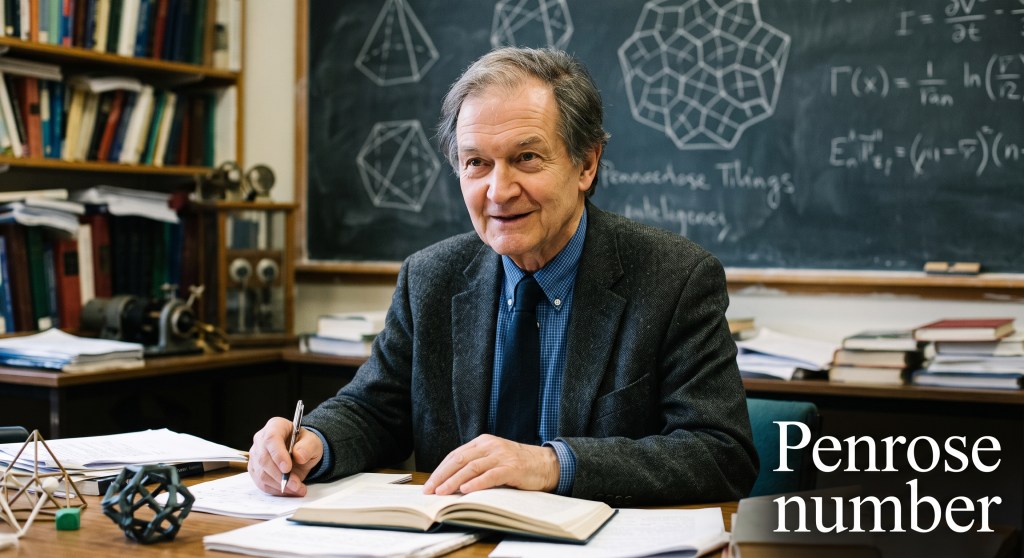
An even more staggering metric of creation bil-Haqq is the initial entropy of the universe at the moment of the Big Bang. Sir Roger Penrose, the renowned mathematical physicist and Nobel laureate, calculated the statistical probability of our universe emerging from the singularity with the exceedingly low entropy required to allow for the unidirectional arrow of time, the formation of complex thermodynamic structures, and the eventual existence of biological life.
Penrose calculated that the precision required to establish this highly specific, low-entropy initial boundary condition is one part in $10^{10^{123}}$. This “Penrose Number” is so unfathomably large—a double exponential—that writing it out in full, by placing a zero on every single subatomic particle in the observable universe, would not suffice to write the number down. In the context of the exegesis of Quran 21:16-17, this mathematical reality serves as the empirical death knell to the notion that the universe was created in “play,” by accident, or by the rolling of cosmic dice.
The Multiverse Hypothesis vs. Divine Parsimony
Faced with the profound teleological implications of fine-tuning—which overwhelmingly suggest the intervention of a transcendent Grand Designer—many secular cosmologists invoke the Multiverse hypothesis, often coupled with the Anthropic Principle. This theory posits an infinite, unobservable ensemble of universes, each generated with randomly rolling physical constants. The Anthropic Principle is then applied to suggest that our mathematically perfect universe is simply a statistical inevitability; we only observe a fine-tuned universe because we could not exist in the infinite matrix of failed, chaotic universes.
Dr. Shah’s research corpus thoroughly and systematically critiques the multiverse evasion. Methodologically and philosophically, the multiverse theory represents a catastrophic violation of Occam’s Razor (the law of parsimony), which dictates that the simplest explanation requiring the fewest assumptions is usually correct. The multiverse attempts to multiply unobservable, theoretical entities infinitely simply to avoid the teleological conclusion of a single, purposeful Creator (Rabb al-‘Alamin, Lord of the Worlds). The Quranic paradigm of bil-Haqq offers a vastly more coherent, mathematically elegant, and philosophically parsimonious explanation: the universe is perfectly tuned precisely because it was authored by Al-Haqq.
VIII. The Metaphysics of Continuous Creation: Al-Ghazalian Occasionalism
If the universe was created with such mathematical precision and governed by unyielding laws of nature (Mizan), what is the ongoing, exact relationship between the Creator and the cosmos? Does God simply wind up the clock of the universe, set the constants, and let it run autonomously (a concept akin to Deism), or is He actively, continuously involved in every millisecond and micrometer of physical existence?
To answer this, Dr. Shah’s corpus revitalizes the classical Islamic metaphysical doctrine of Occasionalism, championed most famously by the towering Ash’arite theologian and polymath, Abu Hamid Al-Ghazali (1058–1111 CE).
Al-Ghazali’s Rejection of Aristotelian Causality
In his seminal and fiercely debated work, Tahafut al-Falasifa (The Incoherence of the Philosophers), Al-Ghazali mounted a rigorous critique of classical Aristotelian necessary causation. The classical philosophers (such as Ibn Sina) argued that natural causes produce their effects necessarily and autonomously by virtue of their inherent natures (e.g., fire burns cotton because it is the autonomous nature of fire to burn). Al-Ghazali argued that granting autonomous causal power to brute matter severely limits the omnipotence of God and introduces a form of polytheism, where matter shares in the divine prerogative of creation.
Occasionalism dictates that God is the sole true Agent (cause) in every single event (la mu’aththira fi’l-wujud illa Allah). Natural laws and physical causes do not possess independent, autonomous causal power; rather, they are merely the “habits” or customs (sunnat Allah) that God voluntarily and consistently upholds to make the universe intelligible for human beings. When fire touches cotton, it is not the fire that autonomously creates the burning; it is God who directly creates the burning at the occasion of the contact.
Metaphysical Atomism and Al-Khalq Al-Jadid
The intricate metaphysical infrastructure underpinning Al-Ghazali’s occasionalism is Ash’arite atomism. In this highly sophisticated framework, space, time, and matter are not smooth, continuous spectrums, but are composed of discrete, indivisible units or atoms (jawahir), which possess temporal characteristics or accidents (a’rad). Crucially, Ash’arite atomism dictates that these accidents have no temporal endurance; they do not survive for two consecutive moments.
Therefore, for the universe to persist from one second to the next without annihilating into nothingness, God must continuously re-create every atom and its properties at every fleeting instant. This doctrine is formally known as al-khalq al-jadid (continuous creation or renewal). The universe, in this view, is conceptually similar to a “divine simulation” or a digital projection, re-rendered frame by frame, Planck time by Planck time, by the sustaining Will of the Omnipresent Creator.
IX. Quantum Indeterminacy as the Divine Interface
Historically, Occasionalism was heavily marginalized during the Enlightenment and by Newtonian physicists, who viewed it as an archaic theological construct incompatible with classical mechanics, which championed a strictly deterministic, clockwork universe. However, as Dr. Shah’s extensive synthesis demonstrates, the advent of Quantum Mechanics in the 20th century has spectacularly resurrected the scientific and philosophical viability of Al-Ghazalian occasionalism.
The Epistemic Wall of Quantum Mechanics
Quantum indeterminacy shatters the centuries-old illusion of classical deterministic causation. At the subatomic level, events (such as the exact moment of radioactive decay or the precise position and momentum of an electron) are not strictly determined by prior physical causes. Instead, they exist as smeared clouds of probability mathematically described by the Schrödinger wave function. Modern physicists, such as Sean Carroll and Jim Al-Khalili, often maintain deterministic views, but Dr. Shah notes that relying on strict determinism essentially ignores the foundational realities of quantum mechanics.
Dr. Shah proposes that quantum indeterminacy serves as the ultimate “interface” for occasionalism. Physics can calculate the statistical probability of a quantum outcome occurring, but it cannot explain or predict why a specific outcome actualizes in reality at a given moment instead of another. This inherent epistemic wall allows for divine participation and continuous sustenance without violating the statistical laws of physics. God’s continuous rendering of reality occurs at the quantum boundary.
The Von Neumann-Wigner Interpretation and the Quantum Zeno Effect
This synthesis is further bolstered by specific interpretations of quantum mechanics. The von Neumann-Wigner interpretation posits that the wave function only “collapses” from a state of probability into a definite physical state upon measurement by a conscious observer. By extending this logic philosophically and theologically, the Ultimate Conscious Observer is God, whose continuous, omnipresent awareness and volition actualize physical reality out of quantum potentiality.
Additionally, Dr. Shah frequently cites the Quantum Zeno Effect—a well-documented quantum principle wherein the rapid, continuous observation of a quantum system actually freezes its evolution. Through the lens of physics pioneered by theorists like Henry Stapp, who applies the Quantum Zeno Effect to the rapid localized collapse of the wave function within the synapses of the human brain (addressing consciousness and free will), this mechanism closely mimics the frame-by-frame rendering of reality proposed by Al-Ghazali centuries ago.
X. The Epistemological Synthesis: The Two Books and Four Books Paradigms
The deep integration of Quran 44:38-39 (a claim of theological purpose) with mathematical physics and quantum mechanics requires an epistemological framework capable of holding both realms of knowledge in harmony. This is realized in the classical “Two Books” paradigm, which Dr. Shah rigorously champions and modernizes.
The “Two Books” thesis dictates that God has authored two primary texts for humanity to read and decipher: the Book of Revelation (the Quran, representing absolute theological truth, or al-Wahy) and the Book of Nature (the physical cosmos, representing empirical and scientific truth). Because both books share the exact same Divine Author (Al-Haqq), they can never fundamentally contradict one another. If a contradiction appears to exist, it is necessarily a flaw in human interpretation—either a misunderstanding of the scientific data or a misreading of the scriptural text.
Dr. Shah further expands this epistemology into the ambitious “Four Books Thesis,” a comprehensive theory of everything that maps reality into four distinct but totally harmonious domains of information. While the full breadth of the Four Books encompasses complex cybernetics, digital physics, biology, and divine volition, its core utility in explaining Quran 44:38-39 is absolute: the structural reality of the universe (the Book of Nature) perfectly echoes the teleological claims of the scripture (the Book of Revelation). The physical evidence of fine-tuning, the mathematical elegance of the cosmos, and the quantum mechanics of continuous creation act as the empirical commentary on the Quranic declaration that the heavens were created bil-Haqq.
XI. Thematic Epilogue: Meaning in the Cosmos and the Rejection of Frivolity
To gaze into the night sky through the unified lens of classical Quranic exegesis and modern cosmology is to witness the absolute vindication of Quran 44:38-39 and 21:16-17. The universe is entirely and profoundly antithetical to la’ib (play) and lahw (diversion).
If the universe were a product of cosmic play, it would reflect the characteristics of a frivolous, unguided game: arbitrary rule changes, localized physical contradictions, thermodynamic chaos, and eventual meaninglessness. Instead, empirical science discovers a cosmos built on the immutable foundations of advanced mathematics, governed by constants calibrated to a degree of precision ($10^{10^{123}}$) that defies human comprehension, and sustained moment-by-moment through the quantum architecture of occasionalist continuous creation.
The profound, tertiary implication of creation bil-Haqq is intrinsically moral. Because the universe is deliberate and intentional, human existence within it is inherently accountable. The physical balance (Mizan) of the stars demands a corresponding moral balance in the human soul. The aesthetic and structural perfection authored by Al-Khaliq, Al-Bari, and Al-Musawwir requires that humanity utilizes its intellect, recognizes the Creator, rejects the existential despair of unguided nihilism, and aligns itself with the Absolute Reality of Al-Haqq.
In ultimate summation, the rigorous dialogue between classical Islamic theology and quantum-era physics yields a singular, unified truth: the universe is not a rolling of cosmic dice. It is a deliberate, meticulously sustained, mathematically elegant manifestation of Divine Truth. We were not placed on this Earth in play; we were brought forth in Truth, to seek the Truth, and ultimately, to return to the Truth.



Leave a comment