
Presented by Claude for Zia H Shah MD
Abstract
This essay examines the pantheism of Baruch Spinoza (1632–1677) and the “cosmic religious feeling” of Albert Einstein (1879–1955), arguing that both men achieved a genuine and profound apprehension of the order, beauty, and intelligibility of the universe, yet declined the final and decisive step that the Qur’an ascribes to the Ulū al-Albāb, the “people of understanding” (Q 3:190–194). For Spinoza, God is identical with the one infinite Substance, Deus sive Natura, acting by blind necessity without will, purpose, providence, or personal concern. Einstein, invoking “Spinoza’s God” in his celebrated 1929 telegram, restricted the meaning of his awe to “the orderly harmony of what exists,” explicitly rejecting a God “who concerns himself with the fates and actions of human beings.” I contend, from within the Abrahamic and specifically Islamic monotheistic tradition, that this contemplative wonder is authentic but truncated: it reaches the signs (āyāt) and halts before the One who authored them. Drawing on the Qur’anic passage on the Ulū al-Albāb, classical tafsīr (Ibn Kathīr, al-Rāzī, al-Qurṭubī) and the hadith of the Prophet weeping at its revelation, I show that the “final leap” is the recognition of a transcendent, living, knowing, willing Creator who creates with purpose, calls to accountability, and may be addressed in prayer. I then mount the classical Abrahamic critique of pantheism—tawḥīd and tanzīh, the distinction between pantheism and waḥdat al-wujūd, and the philosophical problems of evil, moral responsibility, and worship. Finally, I trace the historical trajectory by which pantheism, like deism, has functioned as a way-station toward agnosticism and atheism—Schopenhauer’s “polite form of atheism,” Dawkins’s “sexed-up atheism,” and the appropriation of Einstein’s authority by contemporary religious naturalism—while noting the counter-current represented by Antony Flew. A thematic epilogue draws the threads together in the prayer of the Ulū al-Albāb.
I. Spinoza’s Pantheism: Deus sive Natura
Baruch (Benedict) de Spinoza stands as the most rigorous architect of modern pantheism. Born into Amsterdam’s community of Sephardic Jews who had fled the Iberian inquisitions, he was, by the testimony of his rabbis, a stellar pupil—until his questioning of the biblical God led, on 27 July 1656 (6 Av 5416), to the harshest ḥerem (writ of excommunication) ever pronounced by that congregation, issued from the ark of the Talmud Torah synagogue The Times of Israel when Spinoza was twenty-three, condemning his “evil opinions and acts” and “abominable heresies” and never rescinded. lehigh Refusing to convert to Christianity, Spinoza lived thereafter without any organized religion, grinding lenses for his living and composing the works that would reshape Western metaphysics.
His masterpiece, the Ethics (Ethica, ordine geometrico demonstrata), published posthumously in 1677, is written in the deductive form of Euclid’s Elements, proceeding from definitions and axioms through propositions, demonstrations, corollaries, and scholia. Its metaphysical core is substance monism. A substance, for Spinoza, is “that which is in itself and is conceived through itself”; because no two substances can share an attribute, and because God is defined as a being of infinite attributes, it follows in Spinoza’s geometry that only one substance can exist. Everything else—stars, trees, human bodies, human minds—exists not independently but as a “mode,” a modification of that single Substance. thequran God possesses infinite attributes, of which the human intellect perceives only two: thought and extension. thequran
From this monism flows Spinoza’s identification of God with Nature. In the Preface to Part IV of the Ethics he writes: “the eternal and infinite Being, which we call God or Nature, acts by the same necessity as that whereby it exists.” Wikisource This formula—Deus sive Natura, “God or Nature”—is the emblem of his system. God is “the immanent, not the transitive, cause of all things” (Ethics I, P18): PhilosopherHackett Publishing God does not stand outside the world and act upon it, but is the inner ground of a world that flows from him necessarily.
Necessity is absolute. “In nature there is nothing contingent,” Spinoza declares, “but all things have been determined from the necessity of the divine nature to exist and produce an effect in a certain way” (Ethics I, P29). “Things could have been produced by God in no other way, and in no other order than they have been produced” (Ethics I, P33). Stanford Encyclopedia of Philosophy God “acts from the laws of his nature alone, and is compelled by no one” (Ethics I, P17), Philosopher and is therefore free only in the sense of being self-determined—never in the sense of choosing among genuine alternatives.
Precisely here Spinoza severs the nerve of Abrahamic theism. His God has neither intellect nor will as we understand those words. In the Scholium to Ethics I, P17 he warns that if intellect and will are attributed to God, they “would have nothing in common” with the human faculties of the same name, agreeing with them no more “than there is between the Dog, the heavenly constellation, and a dog, an animal that barks.” In his Letter 56 to Hugo Boxel (1674), he ridicules anthropomorphism with an image that has become famous: “if a triangle could speak, it would say, in like manner, that God is eminently triangular, while a circle would say that the divine nature is eminently circular.” Sacred Texts Archive A God with purposes is a projection of human need. In the Appendix to Part I, Spinoza dismisses teleology altogether: “nature has no particular goal in view, and final causes are mere human figments.” Wikiquote Nature does nothing “for the sake of” anything; to think otherwise “turns nature completely upside down.”
The consequences for religion are drawn out in the Theological-Political Treatise (1670). Miracles, understood as violations of natural law, are impossible and indeed incoherent: nature “preserves a fixed and immutable order,” and “nothing comes to pass in nature in contravention to her universal laws” (TTP, ch. 6). sacred-texts Since “the universal laws of nature are decrees of God following from the necessity and perfection of the Divine nature,” a miracle would require God to act against his own nature—”an evident absurdity.” sacred-texts Whether “we say that all things happen according to the laws of nature, or are ordered by the decree and direction of God, we say the same thing” (TTP, ch. 3). Wikipedia Providence, a God who hears prayer, a personal immortality of reward and punishment—all are, for Spinoza, pious fictions.
And yet Spinoza is no cold materialist. His system culminates, in Part V of the Ethics, in the amor Dei intellectualis, the intellectual love of God. From the “third kind of knowledge”—intuitive knowledge of things in their eternal necessity—”there necessarily arises an intellectual love of God” (Ethics V, P32C). This love is not petition or worship but joyful understanding: to grasp the necessary order of Nature is to participate in the very love by which the divine contemplates itself. “God loves himself with an infinite intellectual love” (Ethics V, P35), Wikisource and “the love of God towards men, and the intellectual love of the mind towards God are one and the same” (Ethics V, P36C). Wikisource In this rational serenity—acquiescentia, contentment of mind—Spinoza located human blessedness and freedom. His awe before the rational unity of all things is unmistakable; it is a genuine reverence. But it is reverence for an order, not adoration of a Person; contemplation, not covenant.
II. Einstein’s Cosmic Religious Feeling
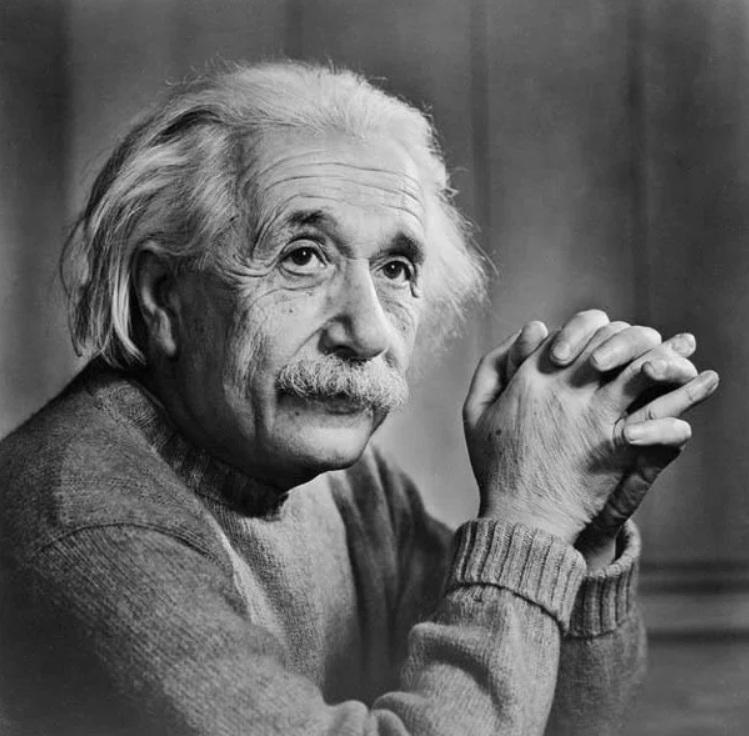
More than any modern figure, Albert Einstein carried the Spinozan sensibility into the twentieth-century imagination. He had read the Ethics as a young man in Bern in the “Olympia Academy” reading circle, and he named Spinoza his favorite philosopher. arxiv In 1920 he composed a poem, “Zu Spinozas Ethik,” whose first stanza (translated in Max Jammer’s Einstein and Religion, 1999, p. 43) reads: “How much do I love that noble man / More than I could tell with words / I fear though he’ll remain alone / With a holy halo of his own.”
The decisive public statement came in April 1929. Alarmed by Boston’s Cardinal O’Connell, who had charged that relativity conjured “the ghastly apparition of atheism,” Rabbi Herbert S. Goldstein of New York cabled Einstein: “Do you believe in God? Stop. Answer paid 50 words.” Einstein replied (in twenty-five German words): “I believe in Spinoza’s God, who reveals himself in the orderly harmony of what exists, not in a God who concerns himself with the fates and actions of human beings.” This sentence—precise, public, and much-quoted (Einstein Papers, CP 16, Doc. 508)—is the hinge of his religious reputation.
Einstein elaborated the positive content of his stance in “Religion and Science” (New York Times Magazine, 9 November 1930). There he distinguished three stages of religion—the religion of fear, the religion of morality, and a third, “cosmic religious feeling,” which “knows no dogma and no God conceived in man’s image.” Its content is “the sublimity and marvelous order which reveal themselves both in nature and in the world of thought”; the individual “feels the futility of human desires and aims” and “wants to experience the universe as a single significant whole.” Einstein found intimations of it “in many of the Psalms of David and in some of the Prophets,” and, following Schopenhauer, in Buddhism. “How can cosmic religious feeling be communicated,” he asked, “if it can give rise to no definite notion of a God and no theology? In my view, it is the most important function of art and science to awaken this feeling and keep it alive in those who are receptive to it.” And: “the cosmic religious feeling is the strongest and noblest motive for scientific research.”
Two further authentic sayings capture the texture of his wonder. In his 1936 essay “Physics and Reality” he wrote the aphorism usually rendered “The eternal mystery of the world is its comprehensibility” and often quoted as “The most incomprehensible thing about the world is that it is comprehensible.” And from his 1941 contribution to the symposium Science, Philosophy and Religion comes the celebrated image: “science without religion is lame, religion without science is blind”—though the surrounding text makes clear that by “religion” he meant faith in the rational intelligibility of the world, not any creed.
Was Einstein, then, a pantheist? He resisted every label. In the interview published in George Sylvester Viereck’s Glimpses of the Great (1930), asked directly whether he was a pantheist, he answered: “Your question is the most difficult in the world. It is not a question I can answer simply with yes or no. I am not an Atheist. I do not know if I can define myself as a Pantheist. The problem involved is too vast for our limited minds.” He then offered his famous parable of the child in the library: “The human mind, no matter how highly trained, cannot grasp the universe. We are in the position of a little child, entering a huge library whose walls are covered to the ceiling with books in many different tongues. The child knows that someone must have written those books. It does not know who or how… That, it seems to me, is the attitude of the human mind… toward God.” Elsewhere he preferred “agnostic” to “atheist,” disavowing “the crusading spirit of the professional atheist,” and spoke of “a superior mind that reveals itself in the world of experience” as his conception of God—”in common parlance,” he conceded, this “may be described as ‘pantheistic’ (Spinoza).”
Yet the boundaries he drew were unwavering. He rejected the personal God repeatedly and firmly, calling the idea “childlike.” He did not believe in personal immortality: “one life is enough for me.” And in the 1954 letter to the philosopher Erik Gutkind (the so-called “God Letter,” dated 3 January 1954), he wrote with startling bluntness: “The word God is for me nothing more than the expression and product of human weakness, the Bible a collection of honorable but still primitive legends which are nevertheless pretty childish… For me the Jewish religion like all other religions is an incarnation of the most childish superstitions.” (The 1½-page letter fetched $404,000 at Bloomsbury Auctions, London, in 2008, and then sold at Christie’s New York on 4 December 2018 for $2,892,500—against a $1–1.5 million estimate—a world auction record for an Einstein letter.)
Scholarship has therefore divided over Einstein’s precise position. A recent analysis of the Einstein Papers argues that his “cosmic religious feeling” was “not spiritual pantheism but a form of epistemic reverence—a deeply felt response to the coherence and intelligibility of the universe, unaccompanied by metaphysical or devotional content,” and that “Spinoza’s God” functioned as “rhetorical shorthand for Einstein’s commitment to natural law.” Whether we call him a strict pantheist, a Spinozist, an agnostic, or a “deeply religious nonbeliever” (his own phrase), the substantive core is stable and is what matters for this essay: Einstein revered the order of the cosmos and refused a personal, providential, prayer-answering, judging Creator. On that refusal, he and Spinoza stand together.
III. Wonder Held in Common: The Beauty and Intelligibility of the Cosmos
It would be a grave error—and a failure of intellectual charity—to treat the Spinozan-Einsteinian wonder as merely a mistake to be refuted. It is, on the contrary, a point of profound contact with the Qur’anic vision, and the honest monotheist should say so plainly. The intelligibility of the universe, its “orderly harmony,” its susceptibility to elegant mathematical description, its “marvelous order”—these are exactly the data the Qur’an calls āyāt, “signs.” “We shall show them Our signs in the horizons and within themselves until it becomes clear to them that it is the truth” (Q 41:53). Where Einstein marveled that the world is comprehensible, the Qur’an had already framed comprehensibility as invitation: the cosmos is legible because it is authored.
Both Spinoza and Einstein grasped that reality is a single, law-bound, rationally penetrable whole; both felt the “futility of human desires” against the sublimity of that whole; both experienced what Einstein called the mysterious as “the source of all true art and science.” The Islamic tradition does not deny this experience—it names it tafakkur, reflection upon creation, and makes it a form of worship. The difference lies entirely in the terminus. For the Qur’an, the sign points beyond itself to the One who placed it; to rest in the sign, mistaking the signifier for the signified, is precisely the error the tradition calls a failure of the intellect (‘aql, lubb). Spinoza and Einstein reached the threshold of the sanctuary and admired its architecture; they did not cross into the presence of its Lord.
IV. The Ulū al-Albāb and the Final Leap (Qur’an 3:190–194)
The Qur’an describes the completed arc of contemplation in the closing verses of Sūrat Āl ‘Imrān. In the numbering standard to the 1924 Cairo edition, verses 3:190–191 form the core:
“Indeed, in the creation of the heavens and the earth and the alternation of the night and the day are signs for those of understanding [Ulū al-Albāb] — Who remember Allah while standing or sitting or [lying] on their sides and give thought to the creation of the heavens and the earth, [saying], ‘Our Lord, You did not create this aimlessly; exalted are You [above such a thing]; then protect us from the punishment of the Fire.’” (Q 3:190–191, Sahih International)
Muhammad Abdel Haleem renders the opening: “There truly are signs in the creation of the heavens and earth, and in the alternation of night and day, for those with understanding.” Muhammad Asad translates Ulū al-Albāb as “those who are endowed with insight.” The passage continues through verse 194 in a rising sequence of supplication: “Our Lord, indeed whoever You admit to the Fire — You have disgraced him… Our Lord, indeed we have heard a caller calling to faith… so forgive us our sins… Our Lord, and grant us what You promised us through Your messengers and do not disgrace us on the Day of Resurrection” (Q 3:192–194).
The structure is a precise map of the ascent the Ulū al-Albāb complete and that Spinoza and Einstein did not. It begins exactly where they began—fī khalq al-samāwāt wa’l-arḍ, in the creation of the heavens and the earth, in the alternation of night and day, the very “orderly harmony” of Einstein’s telegram. It proceeds through dhikr (remembrance of God in every posture) and tafakkur (deep thought upon creation). But it does not stop at contemplation. It culminates in three things the pantheist worldview forecloses: the recognition of purpose (“You did not create this aimlessly,” mā khalaqta hādhā bāṭilan); the glorification of a transcendent Person (subḥānaka, “exalted are You”); and prayer, direct address to a God who hears (“protect us… forgive us… grant us”). It ends in accountability before the Day of Resurrection.
The classical exegetes underscore that the passage is about the transformation of observation into relationship. Ibn Kathīr, citing the practice reported by Ibn ‘Abbās, notes that the Prophet would rise in the depth of the night, look to the sky, and recite these verses before praying. Al-Rāzī, in Mafātīḥ al-Ghayb, treats the verses as a demonstration that reasoned reflection on the cosmos (al-istidlāl bi’l-āfāq) is a duty of the intellect and that its proper conclusion is the affirmation of the Maker’s wisdom and the negation of purposelessness. Al-Qurṭubī emphasizes mā khalaqta hādhā bāṭilan—that nothing in creation is bāṭil, vain or in vain—as a direct refutation of any doctrine of a purposeless universe.
The gravity of the passage is captured in the hadith transmitted through ‘Ā’isha and recorded by Ibn Ḥibbān, Ibn Kathīr, and others. When Q 3:190 was revealed, the Prophet wept through the night in prayer—until his lap, then his beard, then the ground beneath him were wet with tears. When Bilāl came at dawn and asked why he wept though his sins were forgiven, he answered: “Shall I not be a grateful servant? Tonight a verse was revealed to me; woe to whoever recites it and does not reflect upon it,” and he recited, “Indeed, in the creation of the heavens and the earth…” The lesson is exact and cuts to the heart of the matter: the verse indicts not the failure to observe the cosmos but the failure to reflect upon it to its proper end. “Woe to whoever recites it and does not reflect upon it” is, read across the centuries, a description of contemplation that stops short—of wonder that admires the library and declines to seek its Author.
This is the “final leap” of the Ulū al-Albāb: the movement from a lawful, beautiful order to a transcendent, living, knowing, willing Creator who creates purposefully, who calls his creatures to accountability, and who may be addressed in prayer and dialogue. It is precisely this leap—purpose, personhood, providence, prayer, judgment, and life after death—that Spinoza declined on principle and Einstein declined by careful qualification. Their wonder was real; their ascent was arrested at the penultimate step.
V. The Abrahamic Critique of Pantheism
Tawḥīd and Tanzīh: The Creator is Not the Creation
The foundation of the Islamic response is tawḥīd—the absolute oneness of God—understood together with tanzīh, God’s transcendence above any likeness to creation. The Qur’an’s decisive formula is laysa ka-mithlihi shay’un, “There is nothing like unto Him” (Q 42:11), and the terse creed of Sūrat al-Ikhlāṣ: “Say, He is Allah, [who is] One… He neither begets nor is born, nor is there to Him any equivalent” (Q 112:1–4). God is al-Ḥayy al-Qayyūm, “the Ever-Living, the Sustainer of existence” (Q 2:255)—living and self-subsisting, sustaining a world that is other than, and utterly dependent upon, Himself.
Against pantheism’s collapse of Creator into cosmos, the Qur’an insists on purposeful creation by a willing agent. “Did you think that We created you uselessly [‘abathan] and that to Us you would not be returned?” (Q 23:115). “And We did not create the heaven and the earth and that between them aimlessly [bāṭilan]” (Q 38:27). “We did not create the heavens and earth and that between them in play; We did not create them except in truth [bi’l-ḥaqq]” (Q 44:38–39). Purpose (ḥaqq, not bāṭil) is the very word the Ulū al-Albāb utter—and it presupposes a purposer with intellect and will, exactly what Spinoza denied to God.
The linked source essay by Zia H. Shah, MD (“The One Substance and the Living God”), frames the contrast sharply: pantheism “strips the divine of agency, moral authority, and intentionality,” thequran so that a “God [who] is the laws of physics” cannot “intervene, perform miracles, answer prayers, or transcend the laws of physics.” thequran As that essay observes, the Qur’an makes the cosmos a collection of signs pointing beyond themselves—”worshiping the signs (the universe) instead of the One who manifested the signs is the essence of idolatry.” thequran
The Common Front: Maimonides and Aquinas
The critique is genuinely Abrahamic. In Jewish theology, Maimonides’ doctrine of divine simplicity (in the Guide for the Perplexed) holds that God’s essence is identical with His existence and utterly devoid of composition or corporeality; the “via negativa” forbids equating the composite, divisible, changing physical universe with the simple, immutable God, and creation is ex nihilo by sovereign will, not an emanation of the divine substance. thequran In Christian scholasticism, Aquinas’ Summa Theologiae establishes God as actus purus, pure actuality without potentiality; since an effect is distinct from its cause, the created universe cannot be identical with the Creator, and to make God the material cause of the world would subject Him to change and division—a contradiction of divine perfection. thequran On this one point the three traditions speak as one against Spinoza.
Al-Ghazālī and the Continuous Creation of the World
Islamic theology sharpens the point through the Ash’arī doctrine of occasionalism, articulated by al-Ghazālī (d. 1111). On this view the world does not run on self-sufficient natural powers; rather God continuously re-creates the cosmos and its regularities at every instant, so that what we call causation (fire burning cotton) is the “custom of God” (sunnat Allāh). thequran If God actively holds the world in being moment by moment, the world cannot be God: the painting, however magnificent, cannot be identical with the living will of the painter. This is the metaphysical inverse of Spinoza’s necessitarian immanence—dependence rather than identity.
Pantheism versus Waḥdat al-Wujūd
It is essential, and a mark of scholarly precision, to distinguish Spinoza’s pantheism from the Sufi doctrine of waḥdat al-wujūd (“the oneness of being”) associated with Ibn ‘Arabī (d. 1240). The two are superficially similar and fundamentally opposed. Pantheism asserts that God is the physical universe—nature and cosmos collectively constitute the divine. Waḥdat al-wujūd asserts the reverse ontology: true, necessary existence (wujūd) belongs to God alone, and the cosmos possesses only a borrowed, contingent, shadow-like existence—a reflection of the Divine Names upon the “fixed archetypes” (al-a’yān al-thābita), as a reflection depends on but is not identical with the object mirrored. Pantheism says “everything is God”; waḥdat al-wujūd says “everything is from God, and beside His reality is as nothing.” One denies transcendence; the other affirms it absolutely, adding only a doctrine of manifestation (tajallī).
The distinction was itself the subject of one of Islam’s great controversies. It is a matter of scholarly consensus that Ibn ‘Arabī did not use the term waḥdat al-wujūd; it was coined, decades after his death, by his fierce critic Ibn Taymiyya (d. 1328), who used it as a term of condemnation, Muhyiddin Ibn Arabi Society reading the doctrine as the equation of God with nature—pantheism in modern terms—and DOAJ even charging Ibn ‘Arabī with unbelief (takfīr). Thebrpi Defenders of the Akbarian school, such as ‘Abd al-Ghanī al-Nābulusī, rejected any materialistic reading. Muhyiddin Ibn Arabi Society The controversy is instructive for our purposes: the tradition possessed the conceptual tools to detect, name, and reject the pantheistic equation of God and world long before Spinoza, and it treated that equation as the antithesis of tawḥīd.
Jewish and Christian Responses to Spinoza
Spinoza’s own reception dramatizes the stakes. His ḥerem of 1656 was the Jewish community’s judgment on a man who denied a personal God, the divine origin of the Torah, the chosenness of Israel, and the immortality of the soul. A century later, in Germany, the “Pantheism Controversy” (Pantheismusstreit) erupted when Friedrich Heinrich Jacobi revealed in 1785 that the revered Lessing had confessed, before his death, to being a Spinozist—embracing the credo hen kai pan (“One and All”) Cambridge Core and denying final causes, free will, providence, and a personal God. Jacobi’s thesis was blunt: “Spinozism is atheism”; Encyclopedia.com the denial of a transcendent deity and the teaching of Deus sive Natura were, he argued, “the philosophical expression of a thoroughgoing atheism,” Jewish Review of Books and rational Enlightenment religion, thought through, “collapses into nihilism” (a word Jacobi coined). Jewish Review of Books Moses Mendelssohn defended a “purified pantheism,” PhilArchive but the charge that Spinoza’s God is functionally no God at all had entered the bloodstream of modern thought. Leibniz’s earlier Theodicy (1710) had likewise recoiled Encyclopedia.com from Spinozan necessity as destructive of divine freedom and moral order.
The Philosophical Problems
The critique is not merely theological but philosophical, and it bears directly on the concerns of anyone who, like the present reader, defends libertarian free will. First, the problem of moral responsibility under necessitarianism: if, as Spinoza holds, “in nature there is nothing contingent” and “things could have been produced in no other way,” Stanford Encyclopedia of Philosophy then human freedom is, in his own words, an illusion born of ignorance of the causes that compel us. But if no one could ever have done otherwise, the entire apparatus of moral desert, praise, blame, and accountability—central to the Qur’anic vision of the Ulū al-Albāb who pray to be spared the Fire—loses its ground. Schopenhauer pressed the second problem, that of evil: “All pantheism must ultimately be shipwrecked on the inescapable demands of ethics, and then on the evil and suffering of the world. If the world is a theophany, then everything done by man, and even by animal, is equally divine and excellent; nothing can be more censurable and nothing more praiseworthy than anything else.” A God identical with everything sanctifies the torturer with the healer. Third is the problem of worship: as Carl Sagan observed, “it does not make much sense to pray to the law of gravity.” A God who is merely the sum of physical law can be admired but not thanked, contemplated but not loved in return, since—as the atheist John Gray put it, summarizing Spinoza—”no one can ask God to love them in return, since they and God are not different things.” The intellectual love of God, on Spinoza’s own account, is a love that cannot be reciprocated as persons reciprocate. Fourth is the problem of personhood and consciousness: pantheism must either deny the reality of the personal and the mental or, via panpsychism, distribute mind through all matter—yet, as the source essay argues, it cannot explain how scattered micro-experiences would combine into the unified, sovereign, purposive consciousness that alone could “decree laws, create life, or offer salvation.” thequran
VI. A Station on the Road to Unbelief: Pantheism After Einstein
The thesis that pantheism, like deism, has functioned as a way-station on the journey toward agnosticism and atheism is well supported by the historical record, and I judge it substantially correct, with one important qualification.
The deist trajectory is the template. Enlightenment deism retained a “cosmic intelligence” who wound the watch and departed; but a God who neither speaks, acts, judges, nor answers becomes, within a few generations, a God difficult to distinguish from no God at all, and the deist current largely drained into nineteenth-century skepticism. Pantheism follows a parallel path from the other direction. Schopenhauer stated the logic with an epigram: “Pantheism is only a polite form of atheism.” To call the universe “God,” he argued, is not to explain it but merely to furnish a superfluous synonym for “the world.” The name adds reverence but subtracts nothing from, and adds nothing to, the naturalist’s inventory of what exists.
Richard Dawkins made the same point the centerpiece of The God Delusion (2006), and did so by appropriating Einstein directly. “Pantheists don’t believe in a supernatural God at all,” he wrote, “but use the word God as a nonsupernatural synonym for Nature, or for the Universe, or for the lawfulness that governs its workings… Pantheism is sexed-up atheism. Deism is watered-down theism.” Einstein’s God, Dawkins insisted, was “pantheistic, not deistic, and certainly not theistic”; the physicist’s sayings were, for Dawkins, poetic naturalism and nothing more. The rhetorical move is telling: the world’s most prominent atheist claimed Einstein as, in effect, one of his own—an atheist who happened to speak reverently. Whether or not the claim is fair to Einstein, its success illustrates the thesis: the pantheistic idiom is so thin metaphysically that it can be annexed by atheism with minimal adjustment.
Einstein’s own authority accelerated this drift. Because the most famous scientist of the age had spoken of “Spinoza’s God” and “cosmic religious feeling,” a whole vocabulary of scientific reverence-without-transcendence became culturally respectable. It flows through Carl Sagan’s cosmos (“The Cosmos is all that is or ever was or ever will be”), through Neil deGrasse Tyson’s public awe, through the “religious naturalism” movement, and through the World Pantheist Movement, which—as its own literature cheerfully affirms—regards Dawkins’s “sexed-up atheism” as an accurate description and offers “a form of spirituality that is totally compatible with science” while denying any supernatural or transcendent reality. It is also a component of the sociological rise of the “spiritual but not religious” and of the “nones,” for whom a diffuse reverence for nature substitutes for creed, community, and worship.
The survey data reinforce the picture without oversimplifying it. The Pew Research Center’s “Scientists and Belief” report (5 November 2009), based on a May–June 2009 poll of AAAS members, found that “just over half of scientists (51%) believe in some form of deity or higher power; specifically, 33% of scientists say they believe in God, while 18% believe in a universal spirit or higher power,” with 41% believing in neither; the same survey found that scientists are “far more likely to identify… as atheist (17% vs. 2%)” than the general public. Elaine Howard Ecklund’s research (Science vs. Religion: What Scientists Really Think, 2010), drawn from a survey of nearly 1,700 scientists and 275 in-depth interviews at elite research universities, found that “nearly half of the scientists identified with a religious label”—and, crucially for our theme, that “even 22% of the atheist scientists in her survey expressed feelings of spirituality about nature and the mysteries of the world” (with still higher rates among agnostics and the unaffiliated). That residual, creedless spirituality is the Einsteinian-Spinozan sensibility in its contemporary, secularized form: awe without a personal God, reverence without prayer, a “cosmic religious feeling” that has, for many, become the acceptable face of practical atheism.
The qualification is important, and honesty requires it. The road does not run only one way. The most striking counter-example is Antony Flew, for half a century the English-speaking world’s most prominent philosophical atheist, who in 2004 announced that he had come to believe in God—following, he said, “the argument wherever it leads,” Goodreads persuaded by the fine-tuning of nature’s laws and the origin of life. Flew’s destination was not full theism but an Aristotelian deism: a God with intellect and purpose, “the unmoved mover,” yet without revelation, miracle, or afterlife. Encyclopedia Britannica His trajectory shows that the same wonder that can drain toward atheism can also, followed honestly, flow back toward a purposive Mind. Flew reached the deist’s God—an intelligence behind the laws—which is already a step beyond both Spinoza’s impersonal Substance and Einstein’s careful agnosticism, and precisely the step toward which the source essay urges the pantheist. He did not, however, complete the ascent of the Ulū al-Albāb to the living, personal Lord who is addressed in prayer. His case suggests that pantheism and deism are indeed stations—but stations on a line that runs in both directions, and the direction traveled depends on whether one, like the Ulū al-Albāb, is willing to reflect to the end.
VII. Thematic Epilogue
There is a night in the life of the Prophet, peace be upon him, that gathers this whole argument into a single image. A verse is revealed—”Indeed, in the creation of the heavens and the earth and the alternation of the night and the day are signs for those of understanding”—and he does not merely assent to it; he weeps until his beard is wet, until the ground beneath him is wet, and says, “Woe to whoever recites it and does not reflect upon it.” The same heavens that would, centuries later, resolve into Einstein’s field equations and Spinoza’s necessitarian order here dissolve a man into tears—not because the order is less real, but because it is read to its conclusion. The alternation of night and day is, for the physicist, a rotation; for the Ulū al-Albāb, it is a summons.
Spinoza and Einstein stood, one might say, at the door of that same night. Spinoza, exiled from his people yet incapable of ceasing to love the order he beheld, gave that love a name—amor Dei intellectualis—and offered it to a God who could not love him back, could not hear him, had no face to turn toward him. Einstein, gazing into the library whose books he could not read, knew “that someone must have written those books”—and stopped there, at the threshold of authorship, unwilling to knock. Theirs was no small achievement. To feel the sublimity of the whole, to be humbled before the marvelous order, to make of science itself a kind of devotion—this is more than most attain, and the tradition of the Ulū al-Albāb honors it as the beginning of wisdom. But it is the beginning, not the end.
The final leap is not a leap into the dark. It is the recognition that comprehensibility implies a Comprehender, that purpose implies a Purposer, that a signature implies a hand, that a summons implies One who calls—and that the fitting response to a Person is not analysis but address: Rabbanā mā khalaqta hādhā bāṭilan, “Our Lord, You did not create this in vain.” The pantheist falls in love with the painting and denies the painter; the Ulū al-Albāb trace the beauty of the painting back to the living hand, and then, having found Him, speak to Him. Between the intellectual love of an order and the answered prayer of a servant lies the whole distance the Ulū al-Albāb travel in a single night—the distance from the sign to its Author, from the harmony of what exists to the One who said, and says still, kun fa-yakūn, “Be, and it is.”
Subḥānaka—fa-qinā ‘adhāb al-nār.






Leave a Reply