
Presented by Gemini for Zia H Shah MD
Audio teaser: Why the universe is not God
Abstract
Pantheism, defined fundamentally as the metaphysical equation of the universe and God, posits an immanent divinity entirely inseparable from the natural cosmos. In this framework, nature, matter, and the cosmos collectively constitute the divine, leaving no room for a transcendent Creator standing outside of creation; the physical universe is all there is, and it is intrinsically divine. This exhaustive report critically examines pantheism from the theological perspectives of the Abrahamic faiths—Judaism, Christianity, and Islam—demonstrating that orthodox monotheism proclaims a profoundly transcendent, personal God who exists beyond the physical cosmos yet sustains it at every moment. By exploring the historical and philosophical genealogies of pantheism, particularly the substance monism of Baruch Spinoza, this analysis highlights the scientific and theological incoherence of equating physical laws with divine agency. Furthermore, the report systematically refutes panpsychism—the theory that consciousness is an inherent property of all matter—and extends this critique to dismantle the broader pantheistic worldview. A critical distinction is then drawn between pantheism and the Islamic Sufi doctrine of Wahdat al-Wujud (Unity of Existence). While superficially similar, the analysis reveals them to be diametrically opposed: pantheism equates God with the physical universe, whereas Wahdat al-Wujud asserts that true existence belongs exclusively to God, with the cosmos functioning merely as a shadow or reflection of the Divine Names and Attributes. By analyzing insights from classical theologians such as Maimonides, Thomas Aquinas, Al-Ghazali, and Ibn Arabi, alongside contemporary scientific reflections on cosmic awe observed in figures like Albert Einstein and Stephen Hawking, this report seeks to guide the philosophical trajectory from a state of naturalistic wonder toward the recognition of a Transcendent, Personal Creator.
The Architecture of Pantheism: Origins and Metaphysical Foundations
Pantheism is a philosophical and theological perspective that identifies God with the universe, asserting that everything collectively composes an all-encompassing, immanent deity. The core idea of pantheism is that the physical universe is all there is, and it is intrinsically divine; there is no separate, transcendent Creator standing outside of creation. The term derives from the Greek roots pan (all) and theos (God), distilling its foundational maxim: “God is the universe” and “all is God and God is all”. In this worldview, the divine is not a supernatural being possessing will, intentionality, or personality, but is synonymous with Nature itself in all its grandeur, laws, and phenomena.
Spinoza and the Doctrine of Substance Monism
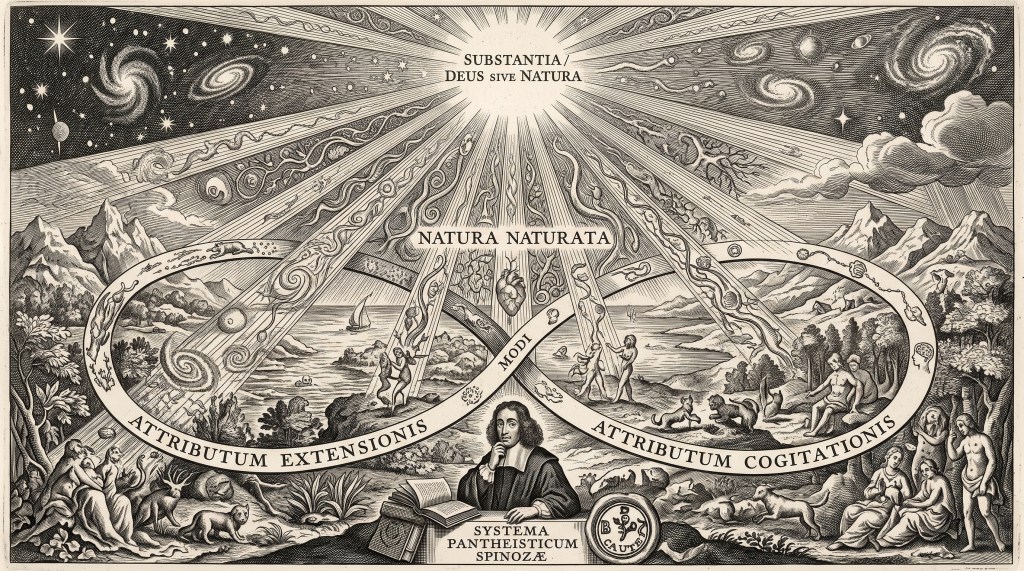
The most systematic formulation of modern pantheism is found in the philosophy of the seventeenth-century Dutch rationalist Baruch Spinoza. In his magnum opus, Ethics, Spinoza presented a rigorous framework of substance monism, famously coining the phrase Deus sive Natura (“God, or Nature”). For Spinoza, God is not a separate personal being standing outside the universe and directing it from beyond; rather, God is the infinite, necessarily existing, unique substance of the universe.
Spinoza’s metaphysical system begins with definitions that preclude the existence of anything outside of God. He argued that a substance is that which is in itself and is conceived through itself. Because no two substances can share an attribute, and because God is a being with infinite attributes, it logically follows in Spinoza’s geometry of thought that no other substance can exist. Therefore, there is only one substance, and everything else exists merely as a “mode” or modification of that singular substance. The trees, the stars, human bodies, and human minds are not independent entities; they are transient modes of God.
To navigate the complexities of this singular reality, Spinoza distinguished between two aspects of this unified reality: Natura naturans and Natura naturata. Natura naturans, translating roughly to “naturing Nature,” refers to the self-causing, active essence of God conceived through itself, independent of its modes. It is Nature considered in its infinite, productive capacity. Conversely, Natura naturata, or “natured Nature,” denotes the passive universe of modes and particular things that necessarily follow from God’s attributes. It is the universe considered as a passive product of an infinite causal chain. Spinoza argued that God possesses infinite attributes, though human beings, due to their finite nature, can only perceive two: thought and extension (matter). Consequently, mind and body are not two different interacting substances, as in Cartesian dualism, but parallel attributes of the exact same underlying reality.
Modern Naturalistic Pantheism and Scientific Reverence
In the modern era, pantheistic thought has deeply influenced scientific naturalism, often presenting itself as a reverence for the cosmos devoid of supernatural elements. Thinkers such as Albert Einstein explicitly associated themselves with “Spinoza’s God,” finding divinity not in a personal deity who intervenes in human affairs, but in the orderly harmony of natural laws. Modern pantheistic movements, such as the World Pantheist Movement, promote reverence, awe, and a feeling of belonging to nature, viewing the universe as a unified, self-organizing, and sacred system while explicitly rejecting the necessity of a transcendent creator. While this worldview fully acknowledges the breathtaking complexity of the cosmos, it categorically denies a Creator distinct from the world, thereby stripping the divine of agency, moral authority, and intentionality.
The Theological Refutation from the Abrahamic Traditions
The Abrahamic traditions—Judaism, Christianity, and Islam—stand in stark, uncompromising opposition to the pantheistic equation of God and the cosmos. Orthodox monotheism proclaims a God who is unequivocally transcendent, existing infinitely beyond all physical dimensions, time, and space, yet simultaneously personal and deeply immanent through knowledge and sustaining power. By examining the classical philosophical theology of these three faiths, the fundamental incompatibility between monotheism and pantheism becomes intellectually undeniable.
Judaism: Maimonides, Divine Simplicity, and the Via Negativa
In Jewish theology, the absolute oneness and transcendence of God is the paramount metaphysical truth. The great twelfth-century philosopher Moses Maimonides (the Rambam) articulated this with unparalleled rigor in his seminal work, The Guide for the Perplexed. Maimonides championed the doctrine of Divine Simplicity, arguing that God is a simple substance entirely devoid of composition, plurality, or corporeality. For Maimonides, God’s essence is identical to His existence, making Him fundamentally distinct from all created entities whose existence is merely contingent.
Maimonides asserted that God has no essential attributes distinct from His essence; to claim otherwise is to introduce plurality into the Divine, which borders on polytheism. He wrote, “You must understand that God has no essential attribute in any form or in any sense whatever, and that the rejection of corporeality implies the rejection of essential attributes”. He critiqued those who declare God’s unity with their lips but assume plurality in their thoughts by assigning Him distinct faculties or physical dimensions.
This uncompromising approach naturally leads to “negative theology” or via negativa. Maimonides argued that human beings cannot positively describe what God is, only what God is not. If God is described as powerful, it merely means He is not weak; if described as living, He is not inanimate. Because God is completely devoid of matter, form, and structural composition, it is metaphysically impossible for the physical, highly composite, divisible, and constantly fluctuating universe to be God. Creation is not an emanation that extends the Divine Essence, nor is it a piece of God; it is a distinct reality brought into existence ex nihilo (out of nothing) by the sovereign will of the Creator. Thus, Maimonidean theology fundamentally shatters the pantheistic premise by establishing an infinite ontological chasm between the necessary, simple, non-corporeal existence of God and the contingent, composite, material existence of the universe.
Christianity: Thomas Aquinas and the Pure Actuality of God
Christian scholasticism, particularly through the vast philosophical synthesis of Thomas Aquinas, echoes this absolute distinction between Creator and creation. In his Summa Theologiae, Aquinas systematically addresses the question of whether God enters into the composition of other things. He begins by establishing that God is actus purus (pure actuality), possessing absolutely no potentiality. Since everything composed of matter and form possesses potentiality—because matter is inherently the principle of potentiality awaiting the determination of form—it is impossible for matter to exist in God.
Aquinas deduces that God is the primary efficient cause of the universe. Because an effect is distinct from its cause, the created universe cannot be identical to the Creator. If pantheism were true, God would essentially serve as the material cause of the universe, rendering Him subject to change, decay, division, and the limitations of space and time. This would be a blatant contradiction of divine perfection, immutability, and infinity.
Furthermore, Aquinas addresses the relationship between the suppositum (the individual entity) and its nature. In created things, a man is not identical to his humanity, because the man includes individuating material characteristics (like specific flesh and bones) that are not part of the abstract definition of humanity. However, because God has no matter to individuate Him, God is identical with His own essence and His own existence. Therefore, Christian theology maintains that the universe reflects the goodness of God as an effect reflects the signature of its cause, but the universe itself is entirely devoid of the divine essence. Creation is an act of free will by a transcendent Lord, not an involuntary, deterministic emanation of a cosmic substance.
Islam: Tawhid, Tanzih, and the Metaphysics of Occasionalism
In Islam, the absolute distinction between the Creator (Al-Khaliq) and the created (al-makhluq) is the bedrock of Tawhid (the absolute oneness of God). Islamic theology emphasizes Tanzih—the absolute transcendence of God beyond any physical limitations, forms, boundaries, or likeness to His creation. The Quran continuously asserts this transcendence alongside God’s omniscient immanence, demanding a rigorous intellectual separation between the Maker and the made.
Consider the profound declaration in Surah Al-Hadid, emphasizing absolute divine sovereignty and challenging any notion that nature operates independently of the Divine Will:
هُوَ الْأَوَّلُ وَالْآخِرُ وَالظَّاهِرُ وَالْبَاطِنُ ۖ وَهُوَ بِكُلِّ شَيْءٍ عَلِيمٌ “He is the First and the Last, the Ascendant and the Intimate, and He is, of all things, Knowing.” (Al-Quran 57:3)
Classical scholars such as Al-Tabari, Al-Qurtubi, and Ibn Kathir interpret these verses as dismantling any illusion of an autonomous natural order. God is the First (without beginning or precedent) and the Last (without end or successor), the Ascendant (transcendent above creation in majesty and essence) and the Intimate (immanent through His infinite knowledge and sustaining power, though strictly not through physical identity or spatial indwelling).
This continuous, radical dependence of the universe upon God is brilliantly formulated in the Islamic theological concept of Occasionalism, championed by the Ash’ari school and articulated extensively by the great theologian Al-Ghazali. Occasionalism posits that the universe does not operate independently on self-sustaining natural laws. Instead, God continuously creates and re-creates the universe, and all its interactions, at every successive moment. Through this lens, physical causality as an independent force is an illusion; the regularities we observe in nature (such as fire burning cotton) are merely the customary habits (sunnat Allah) of God’s continuous, deliberate creation. Contemporary medical and scientific thinkers, such as Zia H Shah MD, have synthesized Al-Ghazali’s occasionalism with modern quantum mechanics, demonstrating that the cosmos is held in being moment by moment. If God is actively creating the cosmos at every infinitesimal fraction of a second, the cosmos cannot be God. The artwork, no matter how magnificent, cannot be ontologically identical to the active, living will of the Artist.
Furthermore, the Quran insists that the cosmos is a collection of signs (ayat) pointing to the Creator, not the ultimate reality itself:
سَنُرِيهِمْ آيَاتِنَا فِي الْآفَاقِ وَفِي أَنفُسِهِمْ حَتَّىٰ يَتَبَيَّنَ لَهُمْ أَنَّهُ الْحَقُّ ۗ أَوَلَمْ يَكْفِ بِرَبِّكَ أَنَّهُ عَلَىٰ كُلِّ شَيْءٍ شَهِيدٌ “We shall show them Our signs in every region of the earth and in themselves, until it becomes clear to them that this is the Truth. Is it not enough that your Lord witnesses everything?” (Al-Quran 41:53)
In the Islamic paradigm, worshiping the signs (the universe) instead of the One who manifested the signs is the essence of idolatry. Pantheism, by collapsing the signifier into the signified, commits a fundamental metaphysical error.
The Scientific and Philosophical Incoherence of Pantheism
While pantheism attempts to bridge the emotional resonance of spirituality with the empirical rigor of naturalism, subjecting it to scientific and philosophical scrutiny reveals deep structural incoherences.
The Scientific Redundancy of “Sexed-Up Atheism”
From a scientific standpoint, pantheism borders on explanatory redundancy. By identifying God exclusively with the immanent physical laws of the universe, pantheism ensures that divine activity and natural causality are one and the same. A pantheistic God cannot intervene, perform miracles, answer prayers, or transcend the laws of physics, because this God is the laws of physics. Einstein explicitly stated, “I believe in Spinoza’s God who reveals himself in the orderly harmony of what exists, not in a God who concerns himself with fates and actions of human beings”.
While this alignment with physical law makes pantheism superficially science-friendly, it strips the concept of God of any independent causal role. All events follow natural causality, meaning there are no external interventions in nature. If God never does anything beyond the strict parameters of nature, then calling nature “God” adds no predictive value, testable hypotheses, or explanatory power. Scientists can fully describe phenomena via impersonal equations without invoking a deity. Biologist Richard Dawkins famously argued that pantheism is merely “sexed-up atheism”—essentially identical to atheistic naturalism, save for an added layer of emotional appeal and poetic metaphor. Relabeling gravitational or thermodynamic equations as “divine” is an aesthetic choice, not a metaphysical discovery.
Determinism and the Collapse of Moral Teleology
Philosophically, Spinozan pantheism relies on a strict, unyielding determinism. Because everything follows necessarily from the infinite nature of God (or Nature), nothing happens without a sufficient cause, and an appeal to a final, teleological cause is impossible. In a purely deterministic, pantheistic universe, human free will is an illusion born merely of our ignorance of the complex chain of antecedent causes that compel our actions.
This deterministic worldview causes the total collapse of objective morality and teleology. The Abrahamic God provides objective purpose, moral justice, and spiritual consolation through ultimate accountability and the promise of an afterlife. Pantheism, in stark contrast, offers no afterlife, no objective moral anchor, and no personal God to whom one is ultimately responsible. It sacrifices the individual to a cold, impersonal, geometric mechanism. For the monotheist, a universe devoid of love, intention, and justice cannot satisfy the profound religious cravings of the human soul, nor can it provide a rational foundation for objective moral duties.
Refuting Panpsychism and Extending the Critique to Pantheism
To bridge the glaring gap between inert, unthinking matter and the reality of human consciousness, some naturalistic philosophies and pantheistic frameworks lean heavily on panpsychism. Panpsychism is the philosophical thesis that consciousness, or a mind-like quality, is a fundamental and ubiquitous feature of the physical universe; in essence, it posits that all matter possesses some form of subjective awareness. Spinoza’s assertion that thought and extension are parallel attributes of one single substance establishes a panpsychist reality where every material entity, down to the smallest particle, has a corresponding mental reality.
The Explanatory Failure of Panpsychism
Despite centuries of intense philosophical and neurobiological investigation, secular science cannot explain how inorganic atoms, molecules, and biological compounds aggregate to yield the rich, fantastic subjective inner experience of human consciousness—the “hard problem of consciousness”. Panpsychism attempts to solve this problem by fiat, simply declaring that consciousness was there all along, embedded in the fundamental particles of matter.
However, panpsychism suffers from severe empirical and philosophical flaws. Chief among them is a total lack of empirical testability. Consciousness is inherently subjective; it is scientifically impossible to observe, measure, or verify the “inner life” of an electron, a thermostat, or a rock. Furthermore, panpsychism falls victim to the “combination problem”: even if one grants the bizarre premise that subatomic particles possess micro-consciousness, there is no coherent mechanism explaining how billions of disjointed, independent micro-consciousnesses bind together to form the unified, continuous, and highly complex macro-consciousness experienced by a human being.
Extending the Critique to Pantheism
When panpsychism is utilized to justify a pantheistic worldview—suggesting that the universe itself possesses a “cosmic consciousness” or is a universal mind—it strips both the universe and God of coherence. If the universe is God, and the universe is conscious merely by virtue of panpsychism, this “divine consciousness” is trapped within the deterministic mechanics of matter. It becomes a passive, localized awareness tethered to physical forms, rather than an active, sovereign, and transcendent will. A God composed of the aggregate micro-consciousness of quarks and electrons is not a God who can decree laws, create life, or offer salvation.
Islamic theology approaches consciousness not as an emergent property of physical matter, but as a direct, immaterial interface with the Transcendent. The Quran explicitly addresses the transcendent origin and reach of divine awareness into human cognition, locating consciousness beyond the reach of physical instrumentation:
لَا تُدْرِكُهُ الْأَبْصَارُ وَهُوَ يُدْرِكُ الْأَبْصَارَ ۖ وَهُوَ اللَّطِيفُ الْخَبِيرُ “Eyes cannot reach Him but He reaches the human consciousness. And He is the Incomprehensible, the All-Aware.” (Al-Quran 6:103)
In the Abrahamic framework, human consciousness is a profound mystery to secular science precisely because it is an immaterial reality, breathed into humanity by a transcendent God, not a byproduct of cosmic dust. By refuting panpsychism’s claim that matter inherently possesses mind, we dismantle the pantheistic notion of a self-aware, divine physical cosmos. Matter remains contingent and inert; consciousness remains a deliberate, purposeful gift from the Incomprehensible, All-Aware Creator.
Pantheism vs. Wahdat al-Wujud: Distinguishing the Divine from the Cosmos
A common and profound error in comparative theology and Orientalist studies is the conflation of Western pantheism with the Islamic Sufi metaphysical doctrine of Wahdat al-Wujud (Unity of Existence or Oneness of Being). While Pantheism and Wahdat al-Wujud look similar on the surface, they are fundamentally different frameworks rooted in distinct theological and metaphysical traditions. Direct Answer: They are not the same set of ideas; Wahdat al-Wujud is a deeply theistic, mystical Islamic concept of divine unity, whereas pantheism is a philosophical worldview equating God directly with the physical universe.
Understanding Wahdat al-Wujud
The doctrine of Wahdat al-Wujud is primarily associated with the great Andalusian mystic, philosopher, and scholar Muhyiddin Ibn Arabi (known as al-Shaykh al-Akbar, the Greatest Master). The core idea of Wahdat al-Wujud is that true, independent, and necessary existence (wujud) belongs exclusively to God. In this paradigm, God is the only Reality. The physical universe, humans, and all created entities possess no inherent existence of their own. Their existence is contingent, borrowed, and utterly dependent on God at every conceivable moment.
Ibn Arabi fiercely preserved the absolute transcendence (Tanzih) of the divine while simultaneously explaining God’s immanence (Tashbih) through the concept of manifestation or unveiling (Tajalli). According to Ibn Arabi’s ontology, before the physical universe was created, the archetypes or essences of all things existed in the divine knowledge as a’yan al-thabita (fixed entities or immutable archetypes). These archetypes act as the quantum code of Fitrah (primordial nature), existing within the divine knowledge without yet possessing external physical existence. Creation is simply the process by which God bestows the light of His wujud upon these latent archetypes, causing them to manifest in the external world. Therefore, the universe is a theater displaying the Divine Names, but the theater is not the Director.
The Analogy of the Mirror and the Sun
To elucidate the profound nuances of Wahdat al-Wujud and protect it from accusations of pantheism, Sufi scholars employ powerful analogies. Creation borrows its reality from God the way the earth borrows light from the sun, or how an object reflects in a mirror—the reflection is not the mirror, nor is it independent of it.
Consider the earth bathed in sunlight. The light on the earth is entirely dependent on the sun; without the sun, the earth would plunge into absolute darkness. However, it would be absurd to say that the earth is the sun, or that the sun is contained within the earth. Similarly, the universe borrows its existence from God’s Being, but the universe is not God.
Alternatively, consider the analogy of a vast array of mirrors. The universe is like a collection of mirrors reflecting the Divine Names and Attributes (Mercy, Power, Knowledge, Artistry). When one looks into a mirror, one sees a reflection of an object. The reflection intimately depends on the presence of the object and the capacity of the mirror, but the reflection is not the object itself, nor is it the mirror. The physical universe is a shadow-manifestation of God’s attributes. While all beings manifest the divine reality, they do not encompass the totality of God, nor are they identical to God’s essence.
A Fundamental Ontological Divergence
The distinctions between Spinozan Pantheism and Akbarian Wahdat al-Wujud are absolute, defining the boundary between materialism and transcendent mysticism. The following table systematically outlines these divergences:
| Feature | Pantheism (e.g., Spinoza) | Wahdat al-Wujud (Ibn Arabi) |
| Identity of God | The belief that the universe and God are the exact same entity. | True existence belongs exclusively to God. The universe is a shadow or reflection. |
| Nature of Existence | Nature, matter, and the cosmos collectively constitute God. | Only God truly exists (Wujud); the universe has a contingent, “borrowed” existence. |
| Transcendence (Tanzih) | Denied. There is no separate, transcendent Creator standing outside of creation. | Affirmed absolutely. God transcends all creation, physical dimensions, and comprehension. |
| Immanence (Tashbih) | God is physically present as the extension (matter) of the cosmos. | God is present through His Tajalli (manifestation) of Divine Names upon the a’yan al-thabita. |
| Agency and Will | God operates through blind, impersonal, deterministic necessity without a final cause. | God possesses supreme Will, Intentionality, and Personal Lordship over creation. |
Where pantheism effectively reduces God to the sum total of physical parts, denying a transcendent Creator, Wahdat al-Wujud elevates God to the absolute pinnacle of reality, reducing the universe to a mere sign (ayah) or reflection. Pantheism proclaims, “Everything is God.” Wahdat al-Wujud declares, “Everything is from God, and compared to God’s ultimate reality, everything else is essentially nothing.”
Wonder Without the Final Step: Einstein, Hawking, and the Quranic Paradigm
The modern allure of pantheism often begins with a genuine, authentic emotional reaction to the staggering grandeur of the cosmos. Theoretical physicists like Albert Einstein and Stephen Hawking frequently employed the vocabulary of awe, describing the universe’s order, beauty, fine-tuning, and intelligibility as miraculous, romantic, and breathtaking. Einstein described this as a “cosmic religious feeling,” identifying the capacity to wonder and marvel as essential to both intellectual and spiritual vitality. He famously stated that the harmony of natural law reveals an “intelligence of such superiority” that all human thinking is but an absolutely insignificant reflection.
However, both thinkers experienced this wonder without taking the logical final step. Einstein explicitly restricted what this awe was permitted to mean. He aligned himself with Spinoza’s God, rejecting the Abrahamic conception of a personal God who exercises providence, responds to prayers, judges human conduct, and establishes an afterlife. Hawking went further, culminating in explicit atheism. In his later works, Hawking argued that because physical laws such as gravity exist, the spontaneous creation of the universe becomes possible, rendering a Creator entirely unnecessary.
From the perspective of Islamic theology, this represents a profound cognitive dissonance—an experience of genuine wonder that arbitrarily halts before reaching its existential conclusion. The Quran outlines a specific epistemic trajectory for the Ulu al-Albab (people of understanding), moving from cosmic awe to personal accountability.
إِنَّ فِي خَلْقِ السَّمَاوَاتِ وَالْأَرْضِ وَاخْتِلَافِ اللَّيْلِ وَالنَّهَارِ لَآيَاتٍ لِّأُولِي الْأَلْبَابِ الَّذِينَ يَذْكُرُونَ اللَّهَ قِيَامًا وَقُعُودًا وَعَلَىٰ جُنُوبِهِمْ وَيَتَفَكَّرُونَ فِي خَلْقِ السَّمَاوَاتِ وَالْأَرْضِ رَبَّنَا مَا خَلَقْتَ هَٰذَا بَاطِلًا سُبْحَانَكَ فَقِنَا عَذَابَ النَّارِ “Indeed, in the creation of the heavens and the earth and the alternation of the night and the day are signs for those of understanding. Who remember Allah while standing or sitting or [lying] on their sides and give thought to the creation of the heavens and the earth, [saying], ‘Our Lord, You did not create this aimlessly; exalted are You [above such a thing]; then protect us from the punishment of the Fire.’” (Al-Quran 3:190-191)
The Quranic paradigm describes a trajectory that begins with observation and cosmic awe but demands a “final step” beyond them. It moves from acknowledging the intricate order of nature, through disciplined contemplation, to divine remembrance, recognition of objective purpose, prayer, and moral accountability. Einstein and Hawking achieved the initial stages of observation and awe but refused the final step. Hawking confused the mechanism (the laws of physics) with the agency (the Lawgiver). Physics explains how physical states develop from one another, but it cannot explain why a lawful reality exists at all, why the laws take the specific form they do, or why conscious observers exist to comprehend them. To stop at the laws themselves, deifying them as pantheism does, is akin to marveling at the architecture and cataloging system of a grand library while stubbornly denying the existence of an architect or an author.
Bridging the Gap: Nudging the Pantheist to Monotheism
Despite its theological shortcomings, pantheism should not be entirely dismissed as mere heresy; rather, from a psychological, intellectual, and epistemic standpoint, it can be understood as a vital intermediary stage in the journey from agnosticism and atheistic materialism toward true theism. Theists can utilize the common ground of cosmic awe to guide thinkers toward a more robust metaphysics.
The Nudge to Deism
Pantheists like Einstein recognized a “superior reasoning power” behind the cosmos. Theist apologists can nudge pantheists toward Deism by demonstrating that the breathtaking order of natural laws points inherently to an underlying Mind or Intelligence. Returning to Einstein’s own library analogy: he described humanity’s position relative to God as a small child entering a vast library filled with books in many languages; the child knows someone must have written those books, even if they do not understand how or in what language. Acknowledging that the universe obeys laws and is marvelously arranged points toward an ordering intelligence rather than random chance or self-contained matter.
The Nudge to Theism
Moving from Deism to Theism requires demonstrating that this Transcendent Intelligence is Personal, Purposeful, and Active. This can be achieved through a unified academic effort among monotheists (Jewish, Christian, and Muslim scholars) setting aside sectarian quibbles to present a coherent case for monotheism. By exploring the dimensional architecture of divine transcendence, theologians can demonstrate that a God existing beyond physical dimensions can simultaneously be omniscient and immanent—”closer to man than his jugular vein”.
Furthermore, nudging pantheists toward theism involves showing that an All-Powerful, Most-Merciful, and Loving God provides what an impersonal universe cannot: objective purpose, moral justice, and spiritual consolation regarding the afterlife. Theism connects cosmic awe to the intentional Creator. By looking at natural phenomena—the fine-tuning of the universe, mathematics, the genesis of life—one can recognize them as deliberate signs (ayat) created with absolute wisdom and purpose by a Personal God. Pantheists are thus invited to “fine-tune” their worldview: to retain their reverence for the unity of nature, but to recognize that this lawful harmony is the signature of a Transcendent God who actively holds the cosmos in being.
Thematic Epilogue
The intellectual journey from observing the physical cosmos to recognizing the transcendent Creator represents the ultimate climax of human consciousness. Pantheism correctly identifies the undeniable splendor, unity, and awe-inspiring complexity of the universe. The Spinozan reverence for nature and the Einsteinian rapturous amazement at the harmony of natural laws are authentic, beautiful human responses to reality. However, stopping at the worship of the universe is a profound metaphysical tragedy; it is akin to falling in love with a magnificent painting while vehemently denying the existence of the breathing, living artist who painted it.
The theology of the Abrahamic faiths—with its fierce defense of Divine Simplicity in Judaism, the pure actuality of God in Christianity, and the profound dialectic of Tanzih (transcendence) and Tajalli (manifestation) in Islam—offers a metaphysically robust and spiritually satisfying paradigm. The cosmos is not an autonomous machine operating on blind necessity, nor is it the literal, material body of God. It is a continuous, moment-by-moment creation, an ocean of mirrors reflecting the infinite Attributes of a Living, Loving, and Transcendent Lord.
By passing through the intermediary stage of pantheistic wonder and taking the “final step” recognized by the Ulu al-Albab, the seeker discovers that the universe is not the ultimate end, but a magnificent signpost. The physical universe is not all there is. Beyond the boundaries of space, time, and physical law resides the One True Substance, the Incomparable Originator, who is infinitely transcendent above creation, yet intimately aware of the secrets of the human heart and the grand architecture of the stars.






Leave a Reply