

Presented by ChatGPT for Zia H Shah MD
Abstract
The Qur’an repeatedly invites humanity to recognize divine generosity in animals that provide food, milk, clothing, transport, and labor. It also calls attention to their beauty and connects gratitude for a mount with the certainty of returning to God. This commentary argues that these passages support a coherent theology of providence in which the biological history of domestication belongs within God’s creative activity. Modern genetics explains how domesticated populations changed; it also reveals the inherited capacities upon which human selection depended. Neither explanation makes the existence of those capacities philosophically self-explanatory.
Domestication, beauty, and cosmic fine-tuning contribute differently to a cumulative argument for God. Domestication illustrates a particular relationship made possible within the biosphere; beauty concerns both the world’s forms and our capacity to appreciate them; fine-tuning addresses the physical conditions that make complex life possible at all. Together they can support a serious inference to purposeful creation. They do not constitute an uncontested scientific deduction of God or the Afterlife. The Qur’anic case for accountability adds claims about divine wisdom, justice, and revelation. Its practical conclusion is demanding: receiving benefits from animals obliges people to gratitude, generosity, and humane treatment.
Purpose and the limits of a scientific explanation
The central claim defended here is that a scientifically intelligible universe can also be a purposeful creation. Discovering the mechanisms through which a blessing arises does not establish that the blessing has no ultimate giver. A complete description of breeding, digestion, or stellar nucleosynthesis would still leave philosophical questions about why reality contains such productive possibilities and whether their existence expresses intention.
Atheists hold diverse positions. Many affirm meaningful lives, moral obligations, compassion, and responsibility to future generations while rejecting divine judgment. The disagreement considered here concerns ultimate cosmic purpose and accountability beyond death; it should not be confused with an accusation that unbelievers lack ethics. Equally, the claim that science has demonstrated the absence of divine purpose goes beyond what the scientific methods used in biology and cosmology establish.
A strong theistic argument must distinguish three judgments. The first is empirical: particular biological and physical arrangements exist and have consequential effects. The second is philosophical: those arrangements may be better understood within an account of purposeful creation. The third is theological: the Creator is wise and just, has addressed humanity through revelation, and will hold human beings accountable. These judgments can support one another without becoming interchangeable.
The Qur’an presents animals as signs within an already articulated relationship between God and humanity. Reading those signs today permits a richer appreciation of their biological depth. It does not require attributing genetics to seventh-century commentators or treating a modern interpretation as the only possible meaning of the text.
The Quranic language of livestock and subjection
Anʿām usually denotes the familiar livestock categories of camels, cattle, sheep, and goats. Rendering it simply as “cattle” can suggest bovines alone to a modern English reader. Horses, mules, and donkeys receive separate mention in 16:8. The Qur’anic categories should therefore be understood in their linguistic setting rather than forced into a modern zoological classification.1
Two expressions are central. Dhallalnāhā in 36:72 conveys making the animals tractable or manageable. Sakhkhara, used in 43:13 and 22:36–37, conveys making something available for service or bringing it under usable control. The latter expression also applies to ships. Consequently, its theological meaning is broader than a claim about docility: it concerns the conditions that make human use possible.
The English renderings below are fresh explanatory translations from the Arabic, prepared for this commentary. They are not quotations attributed to a published English translator. Arabic is presented in conventional spelling with vowel marks; differences from the typography of an Uthmani-script muṣḥaf do not represent changes to the wording.
Livestock as a gift that calls for gratitude
Surah Ya Sin verses 71 to 73
أَوَلَمْ يَرَوْا أَنَّا خَلَقْنَا لَهُمْ مِمَّا عَمِلَتْ أَيْدِينَا أَنْعَامًا فَهُمْ لَهَا مَالِكُونَ
36:71 — Have they not considered that We created livestock for them, among the things Our own hands have made, and that they have possession of them?
وَذَلَّلْنَاهَا لَهُمْ فَمِنْهَا رَكُوبُهُمْ وَمِنْهَا يَأْكُلُونَ
36:72 — We made these animals manageable for them: some serve as their mounts, and from some they take their food.
وَلَهُمْ فِيهَا مَنَافِعُ وَمَشَارِبُ أَفَلَا يَشْكُرُونَ
36:73 — They obtain other benefits and drinks from them as well. Will they therefore give no thanks?2
The sequence identifies creation, human possession, practical manageability, and the moral response that should follow. Owning an animal is not the same achievement as originating its life. A herder can nurture a calf and influence which animals reproduce, but does not invent the hereditary system that makes breeding effective. The passage challenges the assumption that possession amounts to complete independence from the source of what is possessed.
Ibn Kathīr illustrates manageability by describing a child leading camels, despite the animals’ superior strength. His example conveys a familiar pastoral asymmetry: muscle alone does not determine who can guide whom. It should be read as an illustration of trained animals’ tractability, not a guarantee that every camel is safe or that livestock never resist.3
The reference to God’s “hands” also requires interpretive care. Abul Aʿlā Mawdūdī understands the expression as emphasizing God’s own creative work without implying a bodily resemblance to human makers. Other theological traditions affirm the divine attribute while declining to specify its manner. This commentary follows the non-anthropomorphic emphasis on divine agency; it does not require imagining physical hands or an instantaneous creation of modern breeds.4
Mufti Muhammad Shafīʿ develops the passage’s implications for ownership: humanity’s title to things ultimately depends on God’s gift rather than on capital or labor considered in isolation. Applied to domestication, the point is that breeding and husbandry work upon a living world that precedes them. Human contributions remain real, but they operate within conditions that humans did not establish.5
Verse 73 gives the passage its direction. The response to livestock is gratitude, not merely astonishment at human control. Gratitude includes acknowledging dependence and using benefits responsibly. If a person praises the Creator while neglecting the creatures entrusted to that person, the acknowledgment remains morally incomplete.
Surah Ghafir verses 79 to 81
اللَّهُ الَّذِي جَعَلَ لَكُمُ الْأَنْعَامَ لِتَرْكَبُوا مِنْهَا وَمِنْهَا تَأْكُلُونَ
40:79 — God is the One who provided livestock for you, so that some you ride and from some you eat.
وَلَكُمْ فِيهَا مَنَافِعُ وَلِتَبْلُغُوا عَلَيْهَا حَاجَةً فِي صُدُورِكُمْ وَعَلَيْهَا وَعَلَى الْفُلْكِ تُحْمَلُونَ
40:80 — You have further benefits in them, and through them you can accomplish a purpose you hold in your hearts; upon them and upon ships you are carried.
وَيُرِيكُمْ آيَاتِهِ فَأَيَّ آيَاتِ اللَّهِ تُنْكِرُونَ
40:81 — He shows you His signs. Which of God’s signs, then, do you deny?6
The expression about a purpose within the heart connects material provision with human intention. Animals make it possible to translate a plan into action: travel, carry goods, visit another community, or transport essential supplies. Providence here encompasses both the creature that can carry and the human being who can envisage a destination.
The parallel between animals and ships is philosophically significant. Ships involve human design, materials, skilled work, and the behavior of water. The verse nevertheless includes them among divine provisions. This supports an interpretation of providence that includes human technology and effort. By the same reasoning, acknowledging selective breeding does not displace the Qur’anic claim that livestock are God’s gift.
The closing question concerns signs, not objects without context. The animal’s existence, the human capacity to use its strength, and the resulting possibilities of life together become material for reflection. Scientific investigation can increase the detail of that reflection without determining its entire metaphysical conclusion.
Travel as a reminder of the return to God
Surah Az Zukhruf verses 12 to 14
وَالَّذِي خَلَقَ الْأَزْوَاجَ كُلَّهَا وَجَعَلَ لَكُمْ مِنَ الْفُلْكِ وَالْأَنْعَامِ مَا تَرْكَبُونَ
43:12 — He created all the pairs and provided, among ships and livestock, that on which you ride.
لِتَسْتَوُوا عَلَىٰ ظُهُورِهِ ثُمَّ تَذْكُرُوا نِعْمَةَ رَبِّكُمْ إِذَا اسْتَوَيْتُمْ عَلَيْهِ وَتَقُولُوا سُبْحَانَ الَّذِي سَخَّرَ لَنَا هَٰذَا وَمَا كُنَّا لَهُ مُقْرِنِينَ
43:13 — Thus you may settle upon their backs and, once settled there, remember your Lord’s favor, saying: Glory belongs to the One who made this available to us; by ourselves we could not have mastered it.
وَإِنَّا إِلَىٰ رَبِّنَا لَمُنْقَلِبُونَ
43:14 — And to our Lord we shall surely return.7
This is the most direct connection between domestication and the Afterlife in the passages under consideration. The rider first recognizes a present benefit, then remembers the final destination of human existence. Ibn Kathīr explicitly reads the earthly journey as a reminder of the journey after death. The transition to accountability belongs to the passage itself, rather than being an association imposed upon it by modern apologetics.8
The prayer does not deny training, skill, or manufacture. Its claim is that human mastery depends on enabling conditions outside human authorship. The rider did not establish the animal’s nervous system or the physical reliability on which travel depends. Even an expert remains a dependent creature.
The opening reference to pairs should not be converted into a claim that every organism reproduces through male–female mating. Asexual reproduction and other reproductive arrangements are well known. Within this passage, the emphasis is God’s comprehensive creative activity and the provision of usable forms of transport; a universal technical formula for reproductive biology is not being supplied.
The moral force of the final verse is particularly sharp. Human beings guide animals, yet do not control their own ultimate destiny. A temporary capacity to command should teach humility. For the believer, every departure can become a rehearsal in remembering the return to God.
Food warmth beauty and relief from hardship
Surah An Nahl verses 5 to 8
وَالْأَنْعَامَ خَلَقَهَا لَكُمْ فِيهَا دِفْءٌ وَمَنَافِعُ وَمِنْهَا تَأْكُلُونَ
16:5 — He created livestock: in them you find warmth and other benefits, and from them you eat.
وَلَكُمْ فِيهَا جَمَالٌ حِينَ تُرِيحُونَ وَحِينَ تَسْرَحُونَ
16:6 — In them you also find beauty, when you bring them home to rest and when you send them out to pasture.
وَتَحْمِلُ أَثْقَالَكُمْ إِلَىٰ بَلَدٍ لَمْ تَكُونُوا بَالِغِيهِ إِلَّا بِشِقِّ الْأَنْفُسِ إِنَّ رَبَّكُمْ لَرَءُوفٌ رَحِيمٌ
16:7 — They carry your heavy loads to a land you could reach only with great exertion. Your Lord is indeed tender in care and merciful.
وَالْخَيْلَ وَالْبِغَالَ وَالْحَمِيرَ لِتَرْكَبُوهَا وَزِينَةً وَيَخْلُقُ مَا لَا تَعْلَمُونَ
16:8 — And horses, mules, and donkeys are for you to ride and to enjoy as adornment. He creates things of which you have no knowledge.9
The passage’s ordering deserves attention. Beauty appears between food and burden-bearing. Human beings are addressed as creatures who can enjoy the appearance and movement of animals, not merely calculate their output. Ibn Kathīr’s commentary likewise attends to the sight of livestock returning from pasture, well fed and with milk, alongside the benefits of their hair, wool, and labor.
Verse 7 locates divine mercy in relief from ordinary hardship. Carrying a load over a long distance can be exhausting; an animal’s strength extends human practical capacity. The theological lesson is accessible without a telescope. It concerns the bodily vulnerability of the traveler and a provision that lessens that vulnerability.
Verse 8 broadens the setting to other working animals. The mule is an illuminating example: a usually sterile horse–donkey hybrid has nevertheless played a substantial role in human transport. Its inclusion reminds us that the usefulness named in these verses is not confined to populations that reproduce as independent, self-sustaining breeds. Husbandry, hybridization, and training can belong within the sphere of providence.
The closing phrase leaves room for human ignorance of creation’s extent. It is appropriate to reflect on new discoveries and new forms of transport in its light. It would be much stronger than the wording warrants, however, to claim that this phrase specifically predicts cars, aircraft, or a particular future invention.
Milk in Surah An Nahl verse 66
وَإِنَّ لَكُمْ فِي الْأَنْعَامِ لَعِبْرَةً نُسْقِيكُمْ مِمَّا فِي بُطُونِهِ مِنْ بَيْنِ فَرْثٍ وَدَمٍ لَبَنًا خَالِصًا سَائِغًا لِلشَّارِبِينَ
16:66 — There is a lesson for you in livestock. We give you drink from what is within their bodies: amid digested contents and blood comes pure milk, agreeable to those who drink it.10
Milk is synthesized and secreted by specialized mammary epithelial cells. Nutrients arising from digestion and metabolism reach the mammary gland through the circulation; the resulting secretion is distinct from intestinal contents and blood. The verse can be read as directing attention to that striking transformation and distinction. It should not be diagrammed as three adjacent layers of dung, milk, and blood in the abdomen, or described as a complete anticipation of modern lactation physiology.11
The word ʿibrah invites an inference beyond the immediate sight. The familiar cup has a history involving feed, digestion, bodily transport, cellular activity, and animal reproduction. Each can be studied in its own right. Within a theistic account, understanding more of that history gives gratitude a fuller object.
Biologically, mammalian milk nourishes offspring. Its later availability to human communities does not cancel that function. It creates a responsibility to consider the dependent young and the lactating animal as well as the human consumer. Nor does the verse’s language of purity amount to a modern microbiological claim that every sample is free of pathogens.
Materials and shelter in Surah An Nahl verse 80
وَاللَّهُ جَعَلَ لَكُمْ مِنْ بُيُوتِكُمْ سَكَنًا وَجَعَلَ لَكُمْ مِنْ جُلُودِ الْأَنْعَامِ بُيُوتًا تَسْتَخِفُّونَهَا يَوْمَ ظَعْنِكُمْ وَيَوْمَ إِقَامَتِكُمْ وَمِنْ أَصْوَافِهَا وَأَوْبَارِهَا وَأَشْعَارِهَا أَثَاثًا وَمَتَاعًا إِلَىٰ حِينٍ
16:80 — God has made your houses places of rest, and from livestock hides He has provided dwellings light enough to handle when you travel and when you settle. From their wool, fur, and hair come furnishings and useful goods for a time.12
This verse joins biological materials to human craftsmanship. Wool must be collected and worked; hides must be prepared; shelters must be assembled. Divine provision and human making are therefore already connected in the text. A theological reading that acknowledges breeding and technological skill fits this pattern naturally.
The phrase “for a time” places material comfort within mortality. A tent shelters but does not confer permanence. Animals supply resources for life’s journey, while the resources themselves wear out. The passage therefore permits both appreciation of comfort and freedom from the illusion that possessions can secure us against every loss.
| Qur’anic benefit | Principal passages | Biological or practical relationship |
| Transport and labor | 36:72; 40:79–80; 43:12–13; 16:7–8 | Strength and trainable behavior used through husbandry |
| Food and drink | 36:72–73; 40:79; 16:5, 66 | Animal tissues and mammary production support nourishment |
| Clothing and shelter | 16:5, 80 | Hair, wool, and hides become useful through human work |
| Beauty | 16:6, 8 | Living forms and movement elicit aesthetic appreciation |
| Charity and remembrance | 22:36–37; 43:13–14 | Receiving a benefit creates an occasion for moral response |
Sacrifice generosity and the dignity of animals
Surah Al Hajj verses 36 and 37
وَالْبُدْنَ جَعَلْنَاهَا لَكُمْ مِنْ شَعَائِرِ اللَّهِ لَكُمْ فِيهَا خَيْرٌ فَاذْكُرُوا اسْمَ اللَّهِ عَلَيْهَا صَوَافَّ فَإِذَا وَجَبَتْ جُنُوبُهَا فَكُلُوا مِنْهَا وَأَطْعِمُوا الْقَانِعَ وَالْمُعْتَرَّ كَذَٰلِكَ سَخَّرْنَاهَا لَكُمْ لَعَلَّكُمْ تَشْكُرُونَ
22:36 — We have appointed the sacrificial animals among God’s sacred signs for you; there is good for you in them. Mention God’s name over them as they stand in line. When their sides have fallen, eat from them and feed those who refrain from asking and those who seek assistance. In this way We have made them available to you, so that you may give thanks.
لَنْ يَنَالَ اللَّهَ لُحُومُهَا وَلَا دِمَاؤُهَا وَلَٰكِنْ يَنَالُهُ التَّقْوَىٰ مِنْكُمْ كَذَٰلِكَ سَخَّرَهَا لَكُمْ لِتُكَبِّرُوا اللَّهَ عَلَىٰ مَا هَدَاكُمْ وَبَشِّرِ الْمُحْسِنِينَ
22:37 — Their flesh and blood do not reach God; what reaches Him is your God-consciousness. Thus He has made them available to you, so that you may magnify God for guiding you. Give glad tidings to those who do good.13
Al-budn designates the large sacrificial animals, prominently camels; cattle are also included in the sacrificial practice. Classical and modern discussions differ over the precise lexical reach of the term, and the editorial notes to Mawdūdī’s commentary acknowledge that disagreement. The ethical direction of the passage is much clearer than that lexical dispute: the sacrifice should express devotion and distribute food to people in need.14
Verse 37 prevents a crude transaction in which the deity is imagined to need animal flesh or blood. The act matters because of the human disposition and conduct it expresses. God’s provision becomes the occasion for relinquishing exclusive possession and recognizing others’ needs.
Subjection is not consent in the human moral sense. A tractable animal can feel fear or pain. Its manageability does not establish that every human use is justified. Indeed, dependence can increase the owner’s responsibility because the creature has fewer opportunities to escape neglect or mistreatment.
Animal communities in Surah Al Anam verse 38
وَمَا مِنْ دَابَّةٍ فِي الْأَرْضِ وَلَا طَائِرٍ يَطِيرُ بِجَنَاحَيْهِ إِلَّا أُمَمٌ أَمْثَالُكُمْ مَا فَرَّطْنَا فِي الْكِتَابِ مِنْ شَيْءٍ ثُمَّ إِلَىٰ رَبِّهِمْ يُحْشَرُونَ
6:38 — Every creature moving upon the earth and every bird flying on its two wings belongs to communities like yours. We have left nothing out of the Book. Then to their Lord they will be gathered.15
This verse prevents human benefit from becoming the entire account of animal value. Animals possess their own communal existence and stand within God’s concern. Their being useful “for you” does not mean that their only possible purpose is to satisfy you.
The Prophetic teaching reinforces this responsibility. Ṣaḥīḥ Muslim 1955a requires excellence in the treatment of animals even at slaughter. Muslim 2582 depicts justice reaching even a hornless sheep wronged by a horned one. Whatever broader theological questions arise concerning animal resurrection, these reports make it difficult to treat animal suffering as morally invisible.16,17
For contemporary husbandry, the resulting obligations include adequate nourishment, appropriate shelter and handling, attention to illness, and avoidance of needless suffering. These are applications of gratitude and mercy. They should be central to an argument about divine provision, since praising the giver while abusing the gift’s living bearer contradicts the argument’s practical meaning.
The biology of becoming domestic
Taming breeding and domestication
Taming changes the behavior of an individual through experience. Domestication concerns a relationship extending across generations, usually accompanied by inherited changes in a population. Captive breeding alone is insufficient: a zoo can breed tigers without turning them into domestic animals. Conversely, an animal can belong to a domesticated population while being dangerous or poorly socialized.18
Melinda Zeder describes domestication as a sustained relationship that changes the interacting organisms, their reproduction, and their circumstances. Her account also emphasizes that no single genetic or skeletal marker captures every domestication history. Biology, archaeology, and human practices must be examined together.19
Commonly distinguished pathways include animals drawn into human environments, prey populations increasingly managed by people, and later projects directed toward a particular human use. These are explanatory models rather than rigid historical boxes. Different species, and sometimes different populations of the same species, entered human relationships through different combinations of selection and management.
Consequently, the Qur’anic statement that animals were made manageable need not imply that fully modern domestic breeds were present at the beginning of human history. It can describe the actual relationship that emerged through inherited capacities, environmental circumstances, human decisions, and many generations of change.
The useful traits and the limits of a checklist
Jared Diamond’s influential account emphasizes that domesticating a large mammal depends on several favorable conditions occurring together. A failure in one can make management costly or impractical. This is a useful historical heuristic, especially for large food and work animals; it is not a universal biological law governing every domesticated species.20
| Trait | Why it can help | Necessary qualification |
| Tolerance of social proximity | Allows animals to remain together under management | Human control is not always substitution for a herd leader |
| Manageable aggression | Reduces injury during handling and breeding | Domesticated bulls and other animals can remain dangerous |
| Affordable feeding | Makes sustained husbandry feasible | Domestic cats show that carnivory is not an absolute barrier |
| Suitable growth and reproduction | Makes population maintenance practical | Feasibility depends on purpose and available resources |
| Reproduction under management | Allows relationships to continue across generations | Successful captive reproduction is not itself domestication |
| Tolerable response to confinement and fear | Reduces escape, injury, and handling difficulty | Responses vary by species, individual, experience, and setting |
Cats expose the limits of a universal “pack leader” explanation. They descend from carnivorous, substantially solitary ancestors, yet entered lasting relationships with humans. Their history differs from that of herd livestock. The broader lesson is that multiple routes to domestication exist; human beings did not simply find one behavioral blueprint repeated across all domestic animals.
The distinction between an inherited disposition and its later modification also matters. Domestication can favor less fearful individuals, but it must begin with organisms capable of surviving and reproducing in the relevant circumstances. A population’s starting possibilities and the changes produced by selection jointly shape the outcome.
Zebras deer and large carnivores
Zebras provide a legitimate contrast with horses in the history of domestication, but several popular explanations are too simple. Zebras have not produced a widespread domestic lineage comparable to horses, and individual training does not amount to population domestication. Nevertheless, it is false that all zebras lack social organization. Mountain zebras form small breeding groups; Grevy’s zebras have a different, more fluid pattern. “Zebra” therefore does not name one uniform social system.21,22
Predator exposure alone cannot explain the difference: the ancestors of horses also encountered predators. Temperament, stress responses, reproductive ecology, historical opportunity, and the costs of sustained management all deserve consideration. A claim that zebras could never be domesticated under any conceivable circumstances exceeds the historical evidence.
The assertion that deer are impossible to farm is demonstrably mistaken. Reindeer have established histories of domestication, while red deer and other deer are farmed, although farming and domestication are not synonymous. The FAO’s discussion also notes the danger that otherwise manageable males can pose during the rut. These cases reveal variation and practical limits rather than an absolute boundary between “deer” and domestic animals.23,24
The reindeer evidence is especially relevant to the argument from biological possibility. Wu and colleagues sequenced 32 wild and domestic reindeer genomes and reported relatively weak signals of artificial selection. Their 2024 study proposes that inherited, species-specific differences affecting nervous-system development may have contributed to reindeer’s relative docility before intensive human selection. These genomic associations are suggestive, not a complete experimental explanation of temperament. Even so, they provide a concrete example of useful predispositions that humans did not first manufacture.25
Bears, tigers, and lions have not become ordinary domestic livestock. Their size, hazards, feeding requirements, and reproductive circumstances can make such relationships impractical. Yet carnivory cannot be the decisive exclusion, given dogs and cats. Nor should the carnivores’ limited usefulness as livestock be treated as a failure of creation. The theological account must allow creatures to have ecological and other goods beyond human service.
Selection can alter behavior
The fox-breeding experiment associated with Dmitry Belyaev and Lyudmila Trut demonstrates that selection for responses to humans can alter animal populations over generations. Trut and colleagues reported behavioral, physiological, and morphological changes in foxes selected for tameness. This makes it unnecessary to imagine that domestic docility appeared without a biological history.26
The interpretation of all associated changes remains debated. Wilkins, Wrangham, and Fitch proposed that changes involving embryonic neural crest cells might connect several traits often associated with domestication. This is a hypothesis with testable consequences, not an established universal mechanism. Lord and colleagues subsequently argued that the foxes’ earlier history in fur farming complicates claims about the experiment and the universality of a domestication syndrome.27,28
The secure conclusion is sufficient for this commentary: selection can change human-directed behavior, while the precise pathways and associated traits vary. A theology of providence can acknowledge that result without tying itself to a disputed single-gene or single-developmental-mechanism account.
Domestication as an argument for providence
The observation “these animals need not have been amenable to us” expresses a useful counterfactual. The actual relationship depends on a conjunction of animal capacities and human abilities. A creature must tolerate some form of management; people must be able to learn its needs and influence its behavior or reproduction. None of these capacities is generated simply by wanting the animal to be useful.
Nevertheless, contingency alone does not establish design. A defender of naturalism can point to evolutionary diversity, human selection of suitable species, and the enormous number of organisms never domesticated. The domestic animals around us are a selected sample. It would be misleading to calculate the improbability of their docility as though species had been chosen randomly from the entire animal kingdom.
Nor does the absence of livestock imply the impossibility of meaningful human life. Hunting, gathering, fishing, and plant cultivation can support complex human relationships without dependence on large domestic mammals. Domestication has profoundly shaped many societies, but it is not the sole imaginable route to human flourishing.
The stronger theological question concerns why the world contains a productive field of possibilities at all. Biological inheritance can preserve useful traits; learning can extend cooperation; diverse species can enter durable relationships. On theism, these capacities belong to a creation that can sustain embodied agency and mutual dependence. On naturalism, they arise through physical and evolutionary processes without ultimate intention. The biological evidence is compatible with discussion between these accounts; it does not settle that discussion by definition.
Domestication therefore works most persuasively as an illustration within a wider theology of providence. Its force is existential as well as explanatory: the grateful person recognizes benefits that cannot honestly be credited to individual achievement alone. Acknowledging dependence need not erase the ingenuity of generations of herders. Their knowledge becomes part of the history through which the benefit arrives.
This also clarifies the relationship to guided evolution. Zia H. Shah’s writings place evolutionary processes within divine creative purpose. In that understanding, mutations, selection, development, and environmental histories can be the means through which God brings about living diversity. Biological randomness, understood in a scientific model, does not by itself establish metaphysical purposelessness. Conversely, theology alone does not identify which particular mutations were divinely selected or provide a scientific test of that claim.29
An occasionalist can understand the same regularities as the ordered continuity of God’s action; a theologian who affirms secondary causes can understand created powers as dependent on God. The cattle passages do not resolve that intratheological debate. Both positions can recognize human husbandry as effective and creation as ultimately dependent.
How beauty can lead to God
Beauty belongs to the scriptural argument before a modern philosopher introduces it. The word jamāl appears in 16:6, and adornment appears again in 16:8. The observer is invited to attend to an animal’s presence, movement, and place in daily life. A purely economic inventory would omit something the verses deliberately include.
Divine fashioning and the appreciation of form
هُوَ اللَّهُ الْخَالِقُ الْبَارِئُ الْمُصَوِّرُ لَهُ الْأَسْمَاءُ الْحُسْنَىٰ يُسَبِّحُ لَهُ مَا فِي السَّمَاوَاتِ وَالْأَرْضِ وَهُوَ الْعَزِيزُ الْحَكِيمُ
59:24 — He is God, the Creator, the Originator, the Fashioner. The most beautiful names belong to Him. Everything in the heavens and the earth glorifies Him; He is mighty and wise.30
الَّذِي أَحْسَنَ كُلَّ شَيْءٍ خَلَقَهُ وَبَدَأَ خَلْقَ الْإِنْسَانِ مِنْ طِينٍ
32:7 — He made well everything He created, and began the creation of the human being from clay.31
The expression aḥsana admits the sense of making well or excellently, which can include beauty. It should not be reduced to the assertion that every organism looks attractive to every observer. The verse concerns excellence in divine creation, while judgments of visual attractiveness differ among creatures and people.
In “Every Beauty Points to the Creator,” Shah relates natural beauty and human artistic creativity to the divine names al-Khāliq, al-Bāriʾ, and al-Muṣawwir. A fruitful extension of that argument is that human artistry itself belongs within the created order: the capacity to perceive proportion, imagine a form, and make something beautiful can also occasion gratitude. The connection is theological and philosophical, not a laboratory identification of God within a visual pattern.32
Aesthetic abundance and evolutionary explanation
Shah’s butterfly essay develops the idea of aesthetic surplus: nature offers forms whose significance to human observers seems to exceed immediate practical need. This insight encourages sustained attention to the experience of beauty rather than dismissing it as irrelevant to understanding reality. It also fits the cattle passage, where usefulness and aesthetic delight coexist.33
The empirical argument requires discipline. Color patterns can serve camouflage, mating, warning, and other functions; developmental constraints and evolutionary by-products can also generate attractive forms. A feature’s beauty to humans does not demonstrate that it has no biological function. Failure to establish one proposed function would not establish that no function or evolutionary explanation exists.
The philosophical argument can remain strong without that claim. Even when the production of a pattern is understood, its apprehension as beautiful raises questions about the relation between mind and world. Why should a universe contain beings able to experience its order as delightful, moving, or worthy of contemplation? The theist sees a natural affinity between a wise Creator, an intelligible creation, and creatures capable of appreciation.
The naturalist can offer an alternative account involving perception, learning, evolutionary history, and culture. Such explanations deserve consideration. The theistic claim is that the whole relationship between the existence of forms and the experience of their value finds a satisfying ultimate interpretation in God. This is an inference from an integrated account of reality, rather than a claim that evolutionary biology has exhausted its resources and failed.
Beauty also has moral implications. The report in Ṣaḥīḥ Muslim 91a connects God’s love of beauty with rejection of arrogance, defined through resistance to truth and contempt for people. Appreciation of beauty should therefore soften possessiveness and encourage care. Admiring an animal’s appearance while allowing it to suffer would separate aesthetic pleasure from the responsibilities accompanying it.34
How cosmic fine tuning can lead to God
Cosmic fine-tuning addresses a more fundamental level than domestication. Before an animal can evolve, there must be matter with suitable properties, sources of usable energy, and environments in which complex structures can persist. Evolution describes changes within a physical world; its ordinary biological mechanisms do not independently explain why that world has the underlying laws and parameters that make evolution possible.
Creation in measure
إِنَّا كُلَّ شَيْءٍ خَلَقْنَاهُ بِقَدَرٍ
54:49 — We have created everything according to a measure and determination.35
This verse expresses divine measure or determination; it is not a numerical specification of physical constants. Modern fine-tuning can inform reflection upon it without becoming the lexical definition of qadar. The distinction allows the theological insight to remain meaningful even as physical theories change.
Shah’s “The Fine-Tuned Universe” presents the coordination of physical possibilities as a cumulative case for an intelligent Creator. His “Teleological Dimensions of Modern Cosmology” further emphasizes laws, constants, and initial conditions, drawing on the philosophical arguments of Robin Collins and Ernan McMullin. These essays are most compelling when their central insight is separated from overly precise popular claims about the probability of an accidental universe.36,37
The physical questions
Luke Barnes’s scientific review surveys constraints involving particles, chemistry, stars, cosmic structure, and initial conditions. Its central concern is whether the conditions supporting intelligent life occupy a restricted region among physical possibilities. The review critiques dismissals of fine-tuning, but explicitly distinguishes the scientific investigation from conclusions drawn from it.38
| Physical feature | Relevance to life | Limit of the inference |
| Particle masses and interaction strengths | Affect nuclei, atoms, and the range of chemistry | Constraints depend on which parameters vary together |
| Stellar processes and energy production | Provide sustained energy and produce heavier elements | Stars can adjust, and some alternative parameters permit viable stars |
| The carbon-producing triple-alpha process | Helps determine stellar carbon and oxygen production | Nuclear and stellar models establish ranges rather than an exact lottery probability |
| Vacuum energy and structure formation | Excessive positive vacuum energy can obstruct gravitational assembly in relevant models | The observed scale is not itself a probability of God or chance |
| Cosmic initial conditions | Influence the development of structure and available energy gradients | A probability claim requires a specified space of possibilities and measure |
The carbon case is concrete. Epelbaum and colleagues investigated how changes in light-quark masses and electromagnetic interaction strength affect the nuclear energies involved in carbon production. The Hoyle state, an excited state of carbon-12 important in helium-burning stars, is part of the explanation. Their work studies sensitivity and correlations among nuclear quantities; it does not establish that the slightest conceivable change would eliminate every possible form of life.39
Fred Adams’s extensive review supplies an essential qualification. It finds constraints on habitability but also substantial viable ranges in several models and possibilities for alternative astrophysical arrangements. The severity of fine-tuning differs among parameters. Adams also stresses that the underlying distributions needed to assign probabilities across possible universes are not currently known.40
Thus, familiar expressions such as “one chance in 10 to the 120” should not be offered as measured odds that the universe arose without God. Comparisons between vacuum-energy scales and observed values are not equivalent to sampling probabilities. An unknown joint distribution cannot be replaced by multiplying several dramatic numbers whose meanings, correlations, and assumptions differ.
The philosophical inference
The design argument asks whether a world capable of embodied conscious life is more expected given a Creator who values such life than given an account with no preference for life. If that comparison is justified, the evidence can increase the rational credibility of theism. It need not establish certainty to have evidential significance. Contemporary discussions of fine-tuning examine this type of comparative reasoning alongside disputes about probabilities and observer selection.41
The claim that physical laws operate consistently does not answer the question by itself. Consistency explains why similar circumstances yield reliable outcomes; it does not automatically explain why the laws admit chemistry, stars, and organisms. A theist can regard this productive order as an expression of divine wisdom.
The inference also has a limitation on the theistic side. An unspecified “designer” can be imagined to prefer almost anything. The argument gains content only when it states a substantive hypothesis about divine purposes, such as the value of conscious life and moral relationship. Those purposes are informed by philosophical theology and, for Muslims, revelation. They are not read directly from a cosmological data table.
Observer selection necessity and the multiverse
Observer selection reminds us that observers can only find themselves where observation is possible. This blocks the naive idea that we could equally well have observed a lifeless universe. It does not by itself identify what produced the conditions permitting observers. Its importance lies in how rival hypotheses should be compared, especially when a theory proposes many domains with different properties.
A multiverse could provide a naturalistic account if an adequately specified mechanism generates varied domains and the resulting distribution makes observations like ours reasonably expected. It therefore deserves serious consideration. Difficult questions remain about the mechanism, the distribution of parameters, and which observers should count as representative. The existence of a multiverse also would not logically exclude God: a Creator could create a plurality of worlds. That compatibility, however, does not exempt the theist from evaluating a particular multiverse explanation on its merits.
A deeper theory might instead show that some parameters are necessary or tightly linked. Such a discovery would change particular fine-tuning arguments and should be incorporated without resistance. The philosophical question could then concern the existence and character of that deeper order. It would be inappropriate to claim in advance that every new theory must strengthen the same probability argument.
The universe’s immense uninhabitable regions are another serious consideration. Theism need not predict that every region serves human comfort, or that humans exhaust the purposes of creation. Nevertheless, cosmic hostility prevents an easy claim that the entire universe is optimized for us. The defensible contention concerns its capacity to sustain life and value in some settings, not universal biological hospitality.
Taken together, these considerations permit a confident but bounded conclusion. Fine-tuning presents substantial scientific and philosophical questions and can form a powerful part of a cumulative case for God. Calling it a scientific demonstration accepted by all informed investigators would weaken the argument by asserting more agreement and certainty than the evidence warrants.
From purposeful creation to accountability
The connection between a life-permitting universe and the Afterlife requires an additional argument. Physics does not directly establish moral judgment after death. A theological account asks whether conscious persons, capable of understanding moral claims and causing serious harm, belong to a creation in which justice finally matters. The Qur’an answers affirmatively and makes that answer explicit.
Creation is not a futile undertaking
أَفَحَسِبْتُمْ أَنَّمَا خَلَقْنَاكُمْ عَبَثًا وَأَنَّكُمْ إِلَيْنَا لَا تُرْجَعُونَ
23:115 — Did you imagine that We created you to no purpose, and that you would not be returned to Us?42
وَمَا خَلَقْنَا السَّمَاءَ وَالْأَرْضَ وَمَا بَيْنَهُمَا بَاطِلًا ذَٰلِكَ ظَنُّ الَّذِينَ كَفَرُوا فَوَيْلٌ لِلَّذِينَ كَفَرُوا مِنَ النَّارِ
38:27 — We did not create heaven, earth, and what lies between them in futility. That is the supposition of those who disbelieve; woe, then, to those who disbelieve because of the Fire.
أَمْ نَجْعَلُ الَّذِينَ آمَنُوا وَعَمِلُوا الصَّالِحَاتِ كَالْمُفْسِدِينَ فِي الْأَرْضِ أَمْ نَجْعَلُ الْمُتَّقِينَ كَالْفُجَّارِ
38:28 — Shall We treat those who believe and do good as those who spread corruption on earth, or treat the God-conscious as the wicked?43
The argument in these verses moves from the character of creation to the moral distinction between lives. It challenges the thought that righteousness and corruption can be ultimately equivalent. In worldly history, power often allows wrongdoers to escape restitution, while suffering can deprive victims of any adequate remedy. A just Creator provides a theological ground for expecting a reckoning beyond what earthly institutions accomplish.
That expectation is not a proof produced by our desire for justice. Wanting redress does not establish that it exists. The argument depends on the claim that reality’s ultimate source is just and that revelation truthfully discloses human destiny. Fine-tuning can support belief in a purposive source; moral and revelatory arguments supply further steps. Within Islamic theology, these steps form a connected account.
Life as a test of conduct
الَّذِي خَلَقَ الْمَوْتَ وَالْحَيَاةَ لِيَبْلُوَكُمْ أَيُّكُمْ أَحْسَنُ عَمَلًا وَهُوَ الْعَزِيزُ الْغَفُورُ
67:2 — He created death and life to test which of you is best in action; He is mighty and forgiving.44
This verse identifies the morally relevant outcome as the quality of action. In the context of livestock, that includes how strength, wealth, and control are used. An animal’s tractability can facilitate kindness or exploitation. Human power therefore creates an occasion for responsibility rather than a presumption of virtue.
The account also leaves room for meaningful human choice. Divine provision supplies conditions and opportunities; it does not make every response equally good or erase the person who responds. A theology of guided creation can affirm that people are accountable agents, while recognizing that the precise relation between divine action and freedom remains a further philosophical question.
The riding prayer returns here with renewed force. A person who remembers 43:14 while benefiting from an animal confesses that possession and command are temporary. The one being carried remains answerable for how the journey is made and how the creature carrying the burden is treated.
Suffering and the integrity of the argument
A serious theology of animals must face disease, predation, fear, and the suffering imposed by human husbandry. These realities cannot be removed by listing benefits. Evolutionary success does not guarantee the welfare of each individual animal, and a population’s numerical increase under domestication does not by itself vindicate the conditions of its life.
The Qur’anic account provides reasons for mercy and a horizon of divine justice; it does not supply a detailed explanation of every instance of suffering. A believer may understand stable natural processes, creaturely vulnerability, and moral freedom as features of an unfinished earthly order. That interpretation should be stated with humility, particularly when the suffering under discussion is another creature’s.
One conclusion is available without solving every problem of theodicy. Humanly avoidable suffering is a call to action. Gratitude for livestock should lead to better care, more thoughtful consumption, and generosity toward people in need. Fine-tuning does not substitute for these duties, and the beauty of a creature does not excuse its exploitation.
The three arguments can now be placed in their proper relationship. Fine-tuning concerns the physical possibility of life. Domestication concerns contingent relationships within living history. Beauty concerns forms and their apprehension as valuable. Their evidential contributions should be considered together, with allowance for overlap, rather than multiplied as though they were independent statistical experiments.
Thematic epilogue
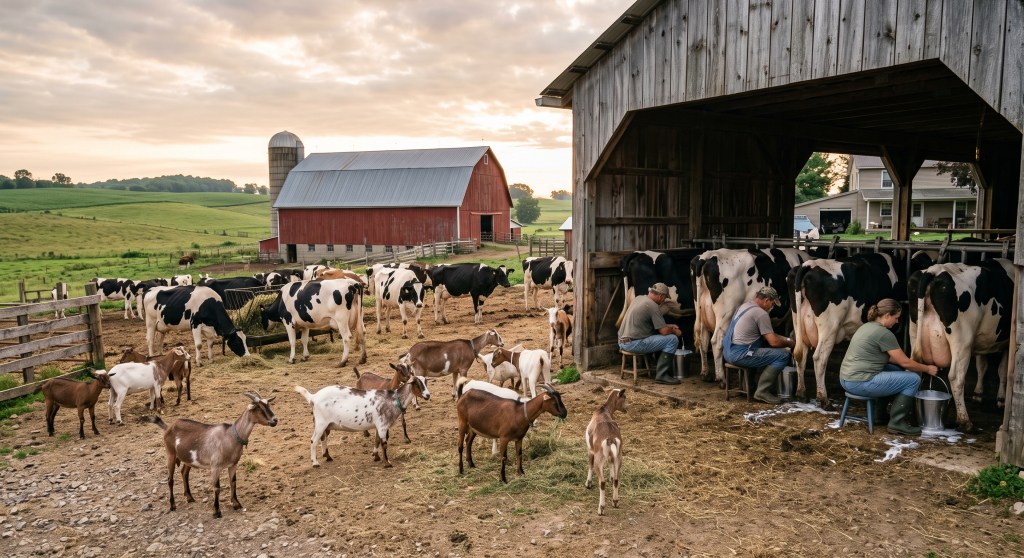
The herd returning at evening is familiar enough to be overlooked. The Qur’an asks the observer to see it again: as living strength that eases a journey, as a source of nourishment and shelter, and as a sight in which beauty has a place. Familiarity does not make these benefits self-originating.
Modern biology lets us see more of what the herder sees. The manageable animal carries a history of inheritance, selection, learning, and care. Modern physics extends that history into the conditions that make matter, energy, and life possible. For the believer, these discoveries can deepen the recognition of providence by revealing how much lies within an apparently ordinary gift.
Recognition should change conduct. The milk ought to recall the living creature that produces it; the hide ought to recall the life from which it came; possession ought to recall the person in need who has no share. The God whom the Qur’an names as merciful is not honored by indifference to suffering.
The final movement is the return named in 43:14. We travel through a world whose powers we can use but whose existence we did not establish. We can respond with gratitude or entitlement, with care or cruelty. The Qur’anic invitation is to recognize the Creator through His provisions and to live as people who will answer for what they have done with them.
- Ibn Kathīr. Tafsīr al-Qurʾān al-ʿAẓīm, abridged English edition, commentary on 16:5–7. Quran.com. Source
- Qur’an 36:71–73. Arabic text and comparison translation, Towards Understanding the Quran. English renderings in this article are independently prepared. Source
- Ibn Kathīr. Tafsīr al-Qurʾān al-ʿAẓīm, abridged English edition, commentary on 36:71–73. Quran.com. Source
- Mawdūdī, Abul Aʿlā. Tafhīm al-Qurʾān, commentary on 36:71–73, notes 60–61. Towards Understanding the Quran. Source
- Shafīʿ, Mufti Muhammad. Maʿāriful-Qurʾān, commentary on 36:71 and divine gift as the basis of ownership. Quran.com. Source
- Qur’an 40:79–81, with Ibn Kathīr’s abridged commentary. Quran.com. See also the Arabic and context for 40:80. Source
- Qur’an 43:12–14. Arabic text and passage context. Quran.com; 43:13–14 also reproduced in the accompanying Ibn Kathīr commentary. Source
- Ibn Kathīr. Tafsīr al-Qurʾān al-ʿAẓīm, abridged English edition, commentary on 43:9–14, particularly the connection between earthly travel and return after death. Quran.com. Source
- Qur’an 16:5–8. Arabic text and passage context. Quran.com. The wording of 16:7–8 was also checked on their individual verse pages. Source
- Qur’an 16:66. Arabic text and comparison translation. Quran.com. Source
- Boutinaud, Marion, et al. Mammary epithelial cells isolated from milk are a valuable, non-invasive source of mammary transcripts. Frontiers in Genetics (2015). Source
- Qur’an 16:80. Arabic text and comparison translation. Quran.com. Source
- Qur’an 22:36–37. Arabic text and comparison translation. Quran.com. Source
- Mawdūdī, Abul Aʿlā. Tafhīm al-Qurʾān, commentary on 22:34–38, especially notes 67–72 and the editorial discussion of al-budn. Towards Understanding the Quran. Source
- Qur’an 6:38. Arabic text and comparison translation. Quran.com. Source
- Muslim ibn al-Ḥajjāj. Ṣaḥīḥ Muslim 1955a, on excellence in treatment and slaughter. Sunnah.com. Source
- Muslim ibn al-Ḥajjāj. Ṣaḥīḥ Muslim 2582, on restitution and the hornless sheep. Sunnah.com. Source
- Driscoll, Carlos A., David W. Macdonald, and Stephen J. O’Brien. From wild animals to domestic pets, an evolutionary view of domestication. Proceedings of the National Academy of Sciences 106, suppl. 1 (2009): 9971–9978. doi:10.1073/pnas.0901586106. Source
- Zeder, Melinda A. Core questions in domestication research. Proceedings of the National Academy of Sciences 112 (2015): 3191–3198. doi:10.1073/pnas.1501711112. Source
- Diamond, Jared. Evolution, consequences and future of plant and animal domestication. Nature 418 (2002): 700–707. doi:10.1038/nature01019. The trait comparison also draws on Driscoll and colleagues, Table 2. Source
- Smithsonian’s National Zoo and Conservation Biology Institute. Hartmann’s mountain zebra, especially Social Structure. Species account, accessed September 12, 2026. Source
- Smithsonian’s National Zoo and Conservation Biology Institute. Grevy’s zebra, especially Social Structure. Species account, accessed September 12, 2026. Source
- Food and Agriculture Organization of the United Nations. Deer Farming, chapter 3, Domestication. Undated online chapter; used for established examples and distinctions, not current husbandry statistics. Source
- Røed, Knut H., et al. Genetic analyses reveal independent domestication origins of Eurasian reindeer. Proceedings of the Royal Society B 275 (2008): 1849–1855. doi:10.1098/rspb.2008.0332. Source
- Wu, Baosheng, et al. Resequencing of reindeer genomes provides clues to their docile habits. Evolution Letters 8 (2024): 494–504. Published March 5, 2024. doi:10.1093/evlett/qrae006. Source
- Trut, Lyudmila, Irina Oskina, and Anastasiya Kharlamova. Animal evolution during domestication: the domesticated fox as a model. BioEssays 31 (2009): 349–360. doi:10.1002/bies.200800070. Source
- Wilkins, Adam S., Richard W. Wrangham, and W. Tecumseh Fitch. The ‘Domestication Syndrome’ in Mammals: A Unified Explanation Based on Neural Crest Cell Behavior and Genetics. Genetics 197 (2014): 795–808. doi:10.1534/genetics.114.165423. Source
- Lord, Kathryn A., Greger Larson, Raymond P. Coppinger, and Elinor K. Karlsson. The History of Farm Foxes Undermines the Animal Domestication Syndrome. Trends in Ecology & Evolution 35 (2020): 125–136. doi:10.1016/j.tree.2019.10.011. Source
- Shah, Zia H., presented by. The Aesthetic Anomaly: Cosmic Comprehensibility, Guided Evolution, and the Theological Synthesis of Aesthetic Surplus. The Glorious Quran and Science, June 26, 2026. Used for the theological framework of guided evolution. Source
- Qur’an 59:24. Arabic text and comparison translation. Quran.com. Source
- Qur’an 32:7. Arabic text and comparison translation. Quran.com. Source
- Shah, Zia H., presented by. Every Beauty Points to the Creator: Scientific, Philosophical, and Theological Reflections on Qur’an 59:24. The Glorious Quran and Science, December 25, 2025. Source
- Shah, Zia H., presented by. Butterflies, Beauty, and the Path to God: Aesthetic Surplus and the Case for Guided Evolution. The Glorious Quran and Science, June 21, 2026. Source
- Muslim ibn al-Ḥajjāj. Ṣaḥīḥ Muslim 91a, on divine beauty and the rejection of arrogance. Sunnah.com. Source
- Qur’an 54:49. Arabic text and comparison translation. Quran.com. Source
- Shah, Zia H., presented by. The Fine-Tuned Universe: A Quranic, Scientific, Philosophical, and Theological Argument for the Existence of God. The Glorious Quran and Science, March 5, 2026. Source
- Shah, Zia H., presented by. The Teleological Dimensions of Modern Cosmology: A Critical Analysis of the Fine-Tuning Debate. The Glorious Quran and Science, February 22, 2026. Source
- Barnes, Luke A. The Fine-Tuning of the Universe for Intelligent Life. Publications of the Astronomical Society of Australia 29 (2012): 529–564. doi:10.1071/AS12015. Author manuscript revised June 7, 2012. Source
- Epelbaum, Evgeny, Hermann Krebs, Timo A. Lähde, Dean Lee, and Ulf-G. Meißner. Viability of Carbon-Based Life as a Function of the Light Quark Mass. Physical Review Letters 110 (2013): 112502. doi:10.1103/PhysRevLett.110.112502. Source
- Adams, Fred C. The Degree of Fine-Tuning in our Universe—and Others. Physics Reports 807 (2019): 1–111. doi:10.1016/j.physrep.2019.02.001. See especially sections 1.3 and 10 and Appendix E. Source
- Friederich, Simon. Fine-Tuning. Stanford Encyclopedia of Philosophy. Online scholarly survey, accessed September 12, 2026. Used for the philosophical debate, including comparative reasoning, observer selection, and multiverse measures. Source
- Qur’an 23:115. Arabic text and comparison translation. Quran.com. Source
- Qur’an 38:27–28. Arabic text and comparison translations. Quran.com; see the adjacent verse for 38:28. Source
- Qur’an 67:2. Arabic text and comparison translation. Quran.com. Source
Sources
Source numbers correspond to the numbered footnotes. Qur’anic English renderings are explanatory translations prepared for this article. Scientific sources support empirical claims; the arguments connecting them to divine purpose are philosophical and theological interpretations.
1. Ibn Kathīr. Tafsīr al-Qurʾān al-ʿAẓīm, abridged English edition, commentary on 16:5–7. Quran.com. Source
2. Qur’an 36:71–73. Arabic text and comparison translation, Towards Understanding the Quran. English renderings in this article are independently prepared. Source
3. Ibn Kathīr. Tafsīr al-Qurʾān al-ʿAẓīm, abridged English edition, commentary on 36:71–73. Quran.com. Source
4. Mawdūdī, Abul Aʿlā. Tafhīm al-Qurʾān, commentary on 36:71–73, notes 60–61. Towards Understanding the Quran. Source
5. Shafīʿ, Mufti Muhammad. Maʿāriful-Qurʾān, commentary on 36:71 and divine gift as the basis of ownership. Quran.com. Source
6. Qur’an 40:79–81, with Ibn Kathīr’s abridged commentary. Quran.com. See also the Arabic and context for 40:80. Source
7. Qur’an 43:12–14. Arabic text and passage context. Quran.com; 43:13–14 also reproduced in the accompanying Ibn Kathīr commentary. Source
8. Ibn Kathīr. Tafsīr al-Qurʾān al-ʿAẓīm, abridged English edition, commentary on 43:9–14, particularly the connection between earthly travel and return after death. Quran.com. Source
9. Qur’an 16:5–8. Arabic text and passage context. Quran.com. The wording of 16:7–8 was also checked on their individual verse pages. Source
10. Qur’an 16:66. Arabic text and comparison translation. Quran.com. Source
11. Boutinaud, Marion, et al. Mammary epithelial cells isolated from milk are a valuable, non-invasive source of mammary transcripts. Frontiers in Genetics (2015). Source
12. Qur’an 16:80. Arabic text and comparison translation. Quran.com. Source
13. Qur’an 22:36–37. Arabic text and comparison translation. Quran.com. Source
14. Mawdūdī, Abul Aʿlā. Tafhīm al-Qurʾān, commentary on 22:34–38, especially notes 67–72 and the editorial discussion of al-budn. Towards Understanding the Quran. Source
15. Qur’an 6:38. Arabic text and comparison translation. Quran.com. Source
16. Muslim ibn al-Ḥajjāj. Ṣaḥīḥ Muslim 1955a, on excellence in treatment and slaughter. Sunnah.com. Source
17. Muslim ibn al-Ḥajjāj. Ṣaḥīḥ Muslim 2582, on restitution and the hornless sheep. Sunnah.com. Source
18. Driscoll, Carlos A., David W. Macdonald, and Stephen J. O’Brien. From wild animals to domestic pets, an evolutionary view of domestication. Proceedings of the National Academy of Sciences 106, suppl. 1 (2009): 9971–9978. doi:10.1073/pnas.0901586106. Source
19. Zeder, Melinda A. Core questions in domestication research. Proceedings of the National Academy of Sciences 112 (2015): 3191–3198. doi:10.1073/pnas.1501711112. Source
20. Diamond, Jared. Evolution, consequences and future of plant and animal domestication. Nature 418 (2002): 700–707. doi:10.1038/nature01019. The trait comparison also draws on Driscoll and colleagues, Table 2. Source
21. Smithsonian’s National Zoo and Conservation Biology Institute. Hartmann’s mountain zebra, especially Social Structure. Species account, accessed September 12, 2026. Source
22. Smithsonian’s National Zoo and Conservation Biology Institute. Grevy’s zebra, especially Social Structure. Species account, accessed September 12, 2026. Source
23. Food and Agriculture Organization of the United Nations. Deer Farming, chapter 3, Domestication. Undated online chapter; used for established examples and distinctions, not current husbandry statistics. Source
24. Røed, Knut H., et al. Genetic analyses reveal independent domestication origins of Eurasian reindeer. Proceedings of the Royal Society B 275 (2008): 1849–1855. doi:10.1098/rspb.2008.0332. Source
25. Wu, Baosheng, et al. Resequencing of reindeer genomes provides clues to their docile habits. Evolution Letters 8 (2024): 494–504. Published March 5, 2024. doi:10.1093/evlett/qrae006. Source
26. Trut, Lyudmila, Irina Oskina, and Anastasiya Kharlamova. Animal evolution during domestication: the domesticated fox as a model. BioEssays 31 (2009): 349–360. doi:10.1002/bies.200800070. Source
27. Wilkins, Adam S., Richard W. Wrangham, and W. Tecumseh Fitch. The ‘Domestication Syndrome’ in Mammals: A Unified Explanation Based on Neural Crest Cell Behavior and Genetics. Genetics 197 (2014): 795–808. doi:10.1534/genetics.114.165423. Source
28. Lord, Kathryn A., Greger Larson, Raymond P. Coppinger, and Elinor K. Karlsson. The History of Farm Foxes Undermines the Animal Domestication Syndrome. Trends in Ecology & Evolution 35 (2020): 125–136. doi:10.1016/j.tree.2019.10.011. Source
29. Shah, Zia H., presented by. The Aesthetic Anomaly: Cosmic Comprehensibility, Guided Evolution, and the Theological Synthesis of Aesthetic Surplus. The Glorious Quran and Science, June 26, 2026. Used for the theological framework of guided evolution. Source
30. Qur’an 59:24. Arabic text and comparison translation. Quran.com. Source
31. Qur’an 32:7. Arabic text and comparison translation. Quran.com. Source
32. Shah, Zia H., presented by. Every Beauty Points to the Creator: Scientific, Philosophical, and Theological Reflections on Qur’an 59:24. The Glorious Quran and Science, December 25, 2025. Source
33. Shah, Zia H., presented by. Butterflies, Beauty, and the Path to God: Aesthetic Surplus and the Case for Guided Evolution. The Glorious Quran and Science, June 21, 2026. Source
34. Muslim ibn al-Ḥajjāj. Ṣaḥīḥ Muslim 91a, on divine beauty and the rejection of arrogance. Sunnah.com. Source
35. Qur’an 54:49. Arabic text and comparison translation. Quran.com. Source
36. Shah, Zia H., presented by. The Fine-Tuned Universe: A Quranic, Scientific, Philosophical, and Theological Argument for the Existence of God. The Glorious Quran and Science, March 5, 2026. Source
37. Shah, Zia H., presented by. The Teleological Dimensions of Modern Cosmology: A Critical Analysis of the Fine-Tuning Debate. The Glorious Quran and Science, February 22, 2026. Source
38. Barnes, Luke A. The Fine-Tuning of the Universe for Intelligent Life. Publications of the Astronomical Society of Australia 29 (2012): 529–564. doi:10.1071/AS12015. Author manuscript revised June 7, 2012. Source
39. Epelbaum, Evgeny, Hermann Krebs, Timo A. Lähde, Dean Lee, and Ulf-G. Meißner. Viability of Carbon-Based Life as a Function of the Light Quark Mass. Physical Review Letters 110 (2013): 112502. doi:10.1103/PhysRevLett.110.112502. Source
40. Adams, Fred C. The Degree of Fine-Tuning in our Universe—and Others. Physics Reports 807 (2019): 1–111. doi:10.1016/j.physrep.2019.02.001. See especially sections 1.3 and 10 and Appendix E. Source
41. Friederich, Simon. Fine-Tuning. Stanford Encyclopedia of Philosophy. Online scholarly survey, accessed September 12, 2026. Used for the philosophical debate, including comparative reasoning, observer selection, and multiverse measures. Source
42. Qur’an 23:115. Arabic text and comparison translation. Quran.com. Source
43. Qur’an 38:27–28. Arabic text and comparison translations. Quran.com; see the adjacent verse for 38:28. Source
44. Qur’an 67:2. Arabic text and comparison translation. Quran.com. Source
To read in Microsoft Word file go to:




Leave a comment