
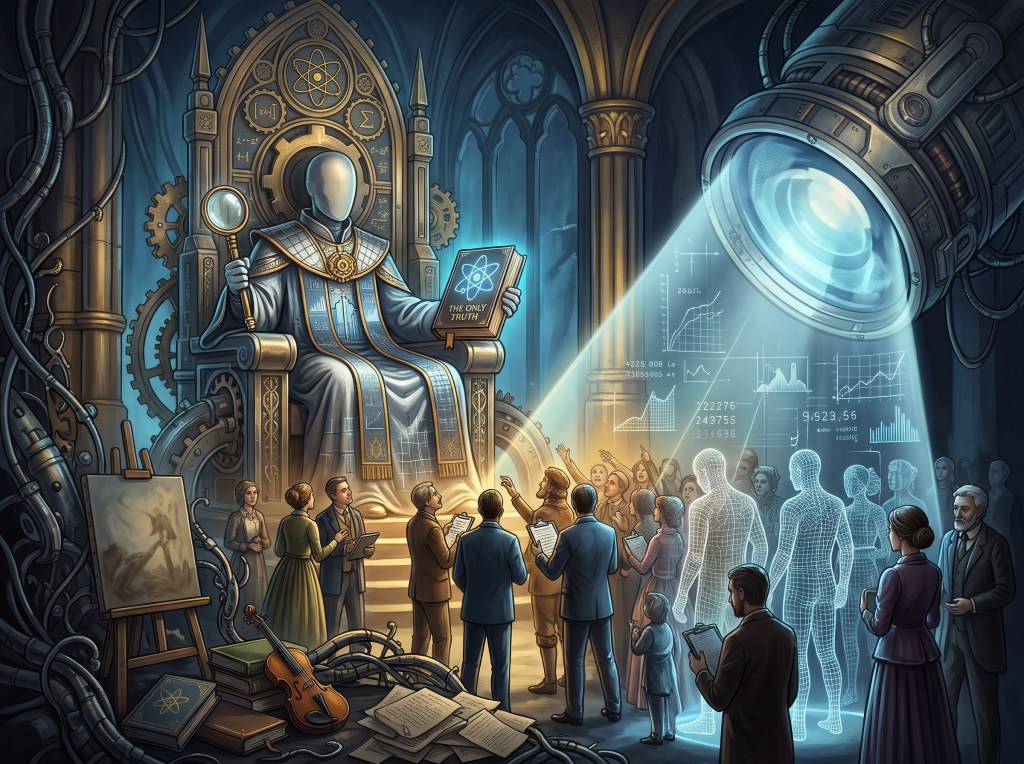
Presented by Gemini for Zia H Shah MD
Audio teaser: Why Natural Laws Point to God
Abstract
The contemporary discourse surrounding the intersection of science, philosophy, and religion is frequently dominated by the “God of the gaps” accusation, an epistemological critique primarily leveled by proponents of atheism and scientism. This charge asserts that theists arbitrarily insert divine agency into the lacunae of scientific understanding, only for this deity to be continually evicted as naturalistic explanations advance. However, a rigorous philosophical and theological analysis reveals this accusation to be structurally flawed, rooted in a categorical error that conflates natural mechanism with divine agency. Furthermore, an exhaustive examination of the modern atheistic paradigm exposes an inherent epistemological weakness: the pervasive reliance on a “naturalism of the gaps,” wherein an unguided material explanation is assumed as a protected prior for all phenomena, regardless of causal adequacy. This report provides a comprehensive scientific, philosophical, and theological deconstruction of these competing paradigms. By synthesizing the insights of thinkers such as C.S. Lewis, John Lennox, Edward Feser, Alvin Plantinga, and Eugene Wigner, the analysis demonstrates that the scientific method’s reliance on the rational intelligibility of the cosmos and the unreasonable effectiveness of mathematics does not obviate the need for a Creator, but rather stands as the most profound witness to one. Ultimately, the atheistic demand that divine action be localized solely in the chaotic or the inexplicable fundamentally misconstrues classical theism, inadvertently demanding a capricious deity while ignoring the reality that a lawful nature serves as a testament to, rather than a rival of, a rational Creator.
1. Introduction: The Epistemological Battlefield
In the enduring debate over the origins, nature, and ultimate meaning of the cosmos, few rhetorical weapons have been wielded with as much frequency and success as the “God of the gaps” argument. The premise is superficially persuasive: throughout human history, prescientific cultures attributed phenomena they did not understand—thunder, disease, celestial movements, and the diversity of life—to the direct, miraculous intervention of a deity. As the natural sciences matured, uncovering the physical mechanisms governing these phenomena, the necessity of supernatural explanations evaporated. Consequently, the argument claims, God is progressively pushed to the ever-shrinking margins of human ignorance. In this framework, theology is reduced to a placeholder for future scientific discovery, and the entire edifice of religious belief is framed as an argument from ignorance.
However, when this epistemological battlefield is analyzed with philosophical rigor, the “God of the gaps” charge reveals less about the vulnerabilities of classical theism and more about the inherent assumptions and structural weaknesses of modern atheism and scientism. The atheistic framework, upon deeper examination, issues a paradoxical and logically incoherent demand: it claims that a Creator or God can only be acknowledged if human beings cannot discover the natural means through which that God creates and maintains the universe. As soon as the scientific method illuminates a natural mechanism—the how of a phenomenon—atheist critics subsequently deny the divine attributes or existence entirely, concluding that the how has successfully eliminated the why.
This dynamic suggests that atheistic materialists are demanding that God, in all His attributes, should be either entirely hidden, fundamentally incomprehensible, or overtly chaotic, such that humanity can have absolutely no rational understanding of His workings. Only under the condition of total cosmic unintelligibility would they theoretically concede to believing in God. Because the universe is instead governed by elegant, comprehensible laws, they reject the divine and place their faith exclusively in scientism.
This comprehensive report will systematically dismantle this false dichotomy. It will demonstrate that the assertion that a lawful, mathematically intelligible universe somehow precludes a divine Lawgiver rests upon fundamental category errors regarding causality and agency. Furthermore, it will explore how the outright rejection of any non-material explanation has given rise to the “naturalism of the gaps”—a mirror image of the very fallacy atheists decry, where an absolute, unfalsifiable faith is placed in the future explanatory power of unguided natural processes. Finally, the report will establish that the historical, philosophical, and mathematical foundations of the scientific enterprise rely upon an intelligible world that points inexorably toward a rational Creator.
2. The Historical and Theological Repudiation of the “God of the Gaps”
It is a profound historical irony that the “God of the gaps” fallacy was not originally articulated by atheists seeking to dismantle religion, but by Christian scientists and theologians seeking to correct a degraded, intellectually lazy form of apologetics. The classical theistic tradition has never viewed God as a secondary, temporal cause to be slotted into the unexplained mysteries of nature, but rather as the sustaining ground of all existence.
2.1. The Nineteenth-Century Critique: Henry Drummond
The specific concept finds its intellectual roots in the late 19th century with the Scottish evangelical writer and lecturer Henry Drummond. During a period when Darwinian evolution was aggressively challenging traditional readings of biological history, Drummond criticized those religious apologists who retreated into the shadows of scientific ignorance to defend the divine. He lamented that such thinkers “ceaselessly scan the fields of Nature and the books of Science in search of gaps—gaps which they will fill up with God”.
Drummond recognized the theological peril of this approach. If God is defined by what science cannot explain, then every scientific advancement becomes a theological defeat. He argued that an immanent God who authors the magnificent, overarching evolutionary and physical processes of the universe is far grander than an occasional interloper who only appears when natural laws fail. For Drummond, the interest of the true believer should not be in what science cannot explain, but in the majestic order of what it can explain.
2.2. Charles Coulson and the Order of Nature
This theological critique was formalized in the mid-20th century by the British theoretical chemist and mathematician Charles A. Coulson, who is widely credited with popularizing the exact phrase “God of the gaps” in his influential 1955 work Science and Christian Belief. Coulson, holding the prestigious Rouse Ball Chair of Mathematics at Oxford, vehemently opposed the idea that God should be used to plug holes in scientific knowledge.
He wrote, “There is no ‘God of the gaps’ to take over at those strategic places where science fails; and the reason is that gaps of this sort have the unpreventable habit of shrinking”. By confronting God-of-the-gaps assumptions and introducing the concept of complementarity, Coulson argued that science and religion provide different, complementary descriptions of the same reality. For Coulson, God was to be discerned through the breathtaking ordering and beauty of the world, not found hiding in its recesses. “We can trace in what we call the Order of Nature the working out of an almost unbelievably grand purpose,” Coulson argued, insisting that the regularities of chemistry and physics were themselves the primary evidence of divine mind.
2.3. Dietrich Bonhoeffer and “Religionless Christianity”
Perhaps the most poignant and philosophically devastating dismantling of the concept came from the German theologian Dietrich Bonhoeffer, writing from a Nazi prison cell in Tegel in 1944. In his Letters and Papers from Prison, Bonhoeffer recognized the inevitability of scientific advancement and the fatal danger of tethering Christian theology to the receding frontiers of human ignorance.
“How wrong it is to use God as a stop-gap for the incompleteness of our knowledge. If in fact the frontiers of knowledge are being pushed further and further back (and that is bound to be the case), then God is being pushed back with them, and is therefore continually in retreat. We are to find God in what we know, not in what we don’t know; God wants us to realize his presence, not in unsolved problems but in those that are solved.”
Bonhoeffer’s profound insight was that a God who only exists where science has not yet reached is not the God of classical theism, but a pagan deus ex machina. Bonhoeffer advocated for a “secular interpretation” of Christianity, arguing that humanity had “come of age” and must learn to live in the world etsi deus non daretur (as if God were not given as a working hypothesis). This did not mean abandoning God, but recognizing that the true God is not a scientific hypothesis used to explain away the unknown. Instead, God is the transcendent reality who is “beyond in the midst of our life,” reigning not at the boundaries of human power, but at the very center of existence.
The genuine Christian intellectual tradition, spanning from Thomas Aquinas to Coulson and Bonhoeffer, posits that God is the sustaining ground of all reality, making the very enterprise of science possible. Therefore, when contemporary atheists deploy the “God of the gaps” argument against sophisticated classical theism, they are attacking a straw man. As Oxford mathematician John Lennox points out, influential atheists like Richard Dawkins are “tilting at a windmill – dismissing a concept of God that no serious thinker believes in anyway”.
3. The Atheistic Epistemological Trap: Demanding a Chaotic Deity
By weaponizing a concept that sophisticated theology itself rejects, proponents of scientism construct a subtle but inescapable epistemological trap. The unspoken premise of their argument is this: If an event can be explained by natural laws and regular mechanisms, it is entirely devoid of divine action or purpose.
3.1. The Misunderstanding of Divine Action
This framework is ubiquitous in contemporary atheist apologetics. For instance, in the discourse surrounding evolutionary biology and cosmology, critics frequently assert that if a naturalistic pathway can even be hypothesized, God is immediately rendered redundant. Prominent atheists argue that if God has any meaning at all, He must exist completely outside the natural world, and any attempt to detect His design within the lawful structures of the universe is a “misuse of the tools of science”.
Critics of theism often mock the idea of divine fine-tuning or purposeful design by suggesting that the “gaps left by our current science for god to fill (supposedly) are trivial”. The philosopher Daniel Dennett famously described Darwinian evolution as a “universal acid” that eats through every traditional concept of meaning and design, leaving only blind, algorithmic, naturalistic processes. For the strict materialist, the presence of a mechanism is absolute proof of the absence of a Maker.
3.2. The Incoherence of the Atheistic Demand
When this logic is carried to its ultimate conclusion, it reveals an inherent, fatal weakness in atheism. The atheist demands that believers produce a phenomenon that is utterly chaotic, unrepeatable, and scientifically opaque in order to prove God’s existence. The subtext is clear: God can only be recognized if He acts irrationally or magically, bypassing all secondary causes and physical laws.
However, if believers were to accept this premise, they would be endorsing a universe that is fundamentally unintelligible—a cosmos where the scientific method could not function. Theists assert that the universe is orderly precisely because its Maker is a God of absolute rationality and order. To demand that God manifest Himself exclusively through chaos and inexplicability is to demand that God cease to be God in order to be recognized as God.
As Lennox and others have noted, if the universe were chaotic, science would be impossible, and humanity would perish in ignorance. Because the universe is orderly, science flourishes; yet the atheist perversely uses that very order to deny the Orderer. They claim that they will only believe in God if nature is unlawful, but because nature is lawful, they choose to believe in scientism. This is a rigged epistemological game that insulates materialist philosophy from any possible empirical or metaphysical challenge.
4. The Mirror Image: Scientism and the “Naturalism of the Gaps”
While the “God of the gaps” is widely recognized and ruthlessly critiqued in modern discourse, a corresponding and arguably more pervasive fallacy has emerged on the other side of the ideological divide: the “Naturalism of the gaps.”
4.1. Defining the Fallacy of Protected Priors
The philosopher Alvin Plantinga, particularly in his seminal work Where the Conflict Really Lies: Science, Religion, and Naturalism, highlighted how naturalists often commit the exact same structural error they accuse theists of making. If the “God of the gaps” fallaciously assumes that an unexplained phenomenon is positive proof of supernatural intervention, the “Naturalism of the gaps” fallaciously assumes that an unexplained phenomenon is absolute proof of an undiscovered, unguided, naturalistic mechanism.
Scholar Charles Mason meticulously mapped this cognitive bias, defining the “Naturalism of the gaps” as “the assumption that unguided natural processes will eventually provide a complete, causally sufficient explanation for any currently unexplained phenomenon, even when the evidence shows that those processes have not yet been demonstrated capable of producing the effect under realistic conditions”.
Under this framework, glaring gaps in the causal adequacy of materialistic theories—such as the origin of the first self-replicating protocell, the sudden infusion of specified digital information in the Cambrian explosion, or the emergence of subjective consciousness from non-conscious matter—are not treated as genuine open questions. Instead, they are treated as temporary placeholders that unguided naturalism is absolutely guaranteed to fill given the invocation of “deep time, trillions of trials, and future research”. As Mason points out, naturalism functions as a “protected prior that exempts naturalistic hypotheses from the same evidentiary audit applied to competing cause classes”.
| Feature | God of the Gaps | Naturalism of the Gaps |
| Response to Unknowns | “We do not know how this works; therefore, God did it.” | “We do not know how this works; therefore, unguided natural processes will eventually explain it.” |
| Epistemological Status | Appeal to current ignorance. | Appeal to future ignorance and promised discoveries. |
| Handling of Evidence | Treats gaps as proof of divine intervention. | Treats gaps as a protected prior for materialism; exempts naturalistic hypotheses from evidentiary audits. |
| Sociological Reception | Widely recognized, discredited by both theologians and scientists. | Operates as an unquestioned default in modern academia; rarely scrutinized. |
Table 1: A comparative analysis of the parallel logical fallacies in origin science and philosophy, adapted from Mason’s structural definitions.
4.2. Alvin Plantinga and the Evolutionary Challenge to Naturalism
Plantinga’s critique goes deeper than merely identifying a double standard; he argues that naturalism, when combined with unguided evolution, is a self-defeating worldview. In his Evolutionary Argument Against Naturalism (EAAN), Plantinga asserts that if human cognitive faculties are solely the product of blind evolutionary forces geared entirely toward survival and reproduction, we have no robust reason to trust that our minds are capable of producing true beliefs about the universe—including the belief in naturalism itself.
Plantinga illustrates this with the analogy of early hominids encountering a tiger. If a hominid forms the false belief that the tiger is a giant, friendly kitten, but forms the equally false belief that the best way to play with the kitten is to run away as fast as possible, the hominid survives. Evolution selects for adaptive behavior, not for objective truth. Therefore, if naturalism is true, the probability that our cognitive faculties are reliable is low or inscrutable. Thus, the naturalist has a defeater for all their beliefs. The theist, conversely, believes that human beings are made in the image of a rational God, providing a firm metaphysical grounding for trusting human reason and the scientific method.
4.3. The Dogma of Scientism
The “Naturalism of the gaps” is the inevitable byproduct of scientism—the rigid philosophical belief that the hard empirical sciences (physics, chemistry, biology) provide the only genuine knowledge of reality, and that all other forms of inquiry (metaphysics, theology, ethics) are merely subjective or meaningless.
Philosopher Edward Feser has written extensively on the self-defeating nature of scientism. The core tenet of scientism—the claim that “only propositions verifiable by the scientific method are true”—is not itself a proposition that can be verified by the scientific method. It is a philosophical assertion, smuggled in as a scientific one. During debates with theoretical physicists like Sean Carroll, Feser has pointed out that science presupposes various metaphysical principles, such as the Principle of Sufficient Reason (PSR), the reality of change, and the reliability of our cognitive faculties. Science cannot prove these principles because it must assume them in order to get off the ground.
When atheists encounter profound evidence of design—such as the digital information encoded in DNA or the fine-tuning of cosmological constants—scientism dictates that they must reject the design inference, not because the evidence lacks strength, but because their a priori commitment to naturalism demands a material answer. If one approaches the universe with the unshakeable premise that only matter and natural laws exist, one will naturally view every unresolved mystery as a “gap” waiting for a material plug, effectively rendering naturalism an unfalsifiable dogma.
5. The Categorical Error: Confusing Mechanism with Agency
To unravel the core of the debate, one must understand the philosophical distinction between mechanism and agency. The atheistic insistence that the discovery of a natural law renders God obsolete represents a profound categorical error. It conflates the rules by which a system operates with the agent who designed the system.
5.1. The Henry Ford and Jet Engine Analogies
Oxford mathematician and philosopher of science John Lennox illustrates this confusion masterfully through two overlapping analogies. First, consider a person who has never seen an automobile. Upon observing a Ford Model T, they might postulate that there is a literal “Mr. Ford” hidden inside the engine block, manually turning the gears and firing the spark plugs. If this observer were to study mechanical engineering, take the engine apart, and map the principles of internal combustion, they would correctly conclude that there is no “Mr. Ford” physically operating inside the engine.
However, if the observer were to then proclaim, “I have discovered the laws of internal combustion and the mechanisms of the engine; therefore, Henry Ford does not exist,” they would be universally recognized as a fool. Henry Ford is not a mechanism competing with internal combustion; he is the agent who designed the mechanism itself.
Lennox extends this with the analogy of the jet engine and its inventor, Sir Frank Whittle. Science is exquisitely equipped to answer the “how” questions (how does the jet engine work based on material causation, thermodynamics, and aerodynamics?) and the “why” of function (why is this specific pipe located here?). The scientific account of the jet engine is complete without ever needing to reference Sir Frank Whittle. To quote Laplace, the scientific account has “no need of that hypothesis.”
But science is structurally incapable of answering the “why” of ultimate purpose: Why does the jet engine exist in the first place? The existence of the mechanism is not an argument for the absence of the agent who set those laws and mechanisms into place. Whittle does not appear in the scientific description of the engine, but he is the sole reason the engine exists to be described.
5.2. Stephen Hawking and the Illusion of Self-Creation
This conflation of mechanism and agency is not limited to laymen; it frequently ensnares the world’s most brilliant scientific minds. In his highly publicized 2010 book The Grand Design, the late theoretical physicist Stephen Hawking famously declared: “Because there is a law such as gravity, the universe can and will create itself from nothing”. Hawking posited that the spontaneous invocation of natural laws removed the necessity of a Creator.
Lennox, alongside numerous philosophers of science, dismantled this claim by exposing its deep logical incoherence. First, Hawking asserts that the universe creates itself from “nothing,” but immediately attributes this creation to the “law of gravity”. Gravity, and the mathematical laws that describe it, are decidedly not “nothing”; they are something highly specific and structured. As Frank Turek quipped regarding Hawking’s logic: “Because there was something, the universe created itself from nothing… which was in fact not nothing, but something”.
More profoundly, Lennox points out that physical laws themselves do not possess creative or causal power. “Laws themselves do not create anything, they are merely a description of what happens under certain conditions,” Lennox argues. Newton’s Laws of Motion describe the trajectory of billiard balls on a table, but the laws do not strike the balls—an agent with a cue stick does.
Hawking’s error was a structural one, categorized by philosophers of science as the Failure of Local Closure. He treated a physical law (the admissibility condition) as if it were an operational product capable of bringing itself into existence. To say “the universe created itself because of gravity” is analogous to saying “a cake baked itself because of the recipe.” The recipe describes how ingredients interact; it does not instantiate the flour, eggs, and sugar, nor does it generate the heat. As Lennox concludes, explaining the universe by saying “the universe creates itself” is nothing more than Alice-in-Wonderland thinking.
6. The Metaphysics of Causality: Primary and Secondary Causes
If laws do not possess creative power, how then are we to understand the relationship between God and the natural world? The resolution to the false dichotomy of “Science vs. God” lies in the recovery of classical metaphysics, specifically the distinction between primary and secondary causality.
6.1. Aristotelian-Thomistic Metaphysics
In the Aristotelian-Thomistic tradition, powerfully articulated in the modern era by philosopher Edward Feser, God is not viewed as one item within the universe, nor as a temporal cause existing alongside natural causes. God is not a “gap-filler” because God is not a physical mechanism. Rather, God is the Primary Cause—the sheer act of Being itself (Actus Purus)—who holds all things in existence at every moment.
Feser’s exposition of Thomas Aquinas’s proofs for God highlights that there is a real distinction between a thing’s essence (what it is) and its existence (that it is). Nothing in the physical universe contains the reason for its own existence. Therefore, the universe must be continuously sustained by something whose very essence is existence—an uncaused cause.
When natural entities interact, they do so as secondary causes. The properties of hydrogen and oxygen interacting to form water is a genuine, natural, secondary cause. But these secondary causes have no ontological power to exist or act on their own; they derive their causal efficacy entirely from the Primary Cause. Feser points out that atheistic scientism fundamentally misunderstands this dynamic. When science maps a chemical reaction or the trajectory of a planet, it is simply describing the regularities of secondary causality. The Thomist does not look at the chemical reaction and say, “God is the chemical reaction.” Rather, the Thomist says, “Because God is the primary cause, all else must be secondary causes—and he never confuses the two”.
6.2. Islamic Philosophy and Natural Law
This nuanced understanding of causality is not exclusive to Western Christianity. The great Andalusian Islamic polymath Ibn Rushd (Averroes) heavily engaged with Aristotelian thought to synthesize divine law and natural philosophy. Ibn Rushd distinguished between the agent, form, matter, and purpose of all natural beings. For him, prophetic miracles and divine wisdom were not in conflict with philosophy; rather, they established the very laws that regulate both belief and physical conduct.
The regularities observed in nature (secondary causes) were viewed by Ibn Rushd not as rivals to God’s power, but as the manifestation of divine wisdom, enriching the human understanding of God’s rationality. In both the Christian and Islamic classical traditions, to assert that a natural mechanism displaces God is as absurd as claiming that discovering the chemical composition of paint on a canvas disproves the existence of the painter.
| Causality Type | Definition | Ontological Status | Example |
| Primary Causality | The foundational cause of all existence; the Sustainer of Being. | Actus Purus (Pure Actuality); uncaused, eternal, simple. | God holding the universe in existence at every moment. |
| Secondary Causality | The natural mechanisms, laws, and physical interactions within the universe. | Contingent; derived entirely from the sustaining power of the Primary Cause. | Gravity; chemical bonding; biological reproduction; natural selection. |
Table 2: The classical metaphysical distinction between Primary and Secondary Causality, resolving the conflict between natural mechanisms and divine agency.
7. The Laws of Nature: Descriptive, Not Prescriptive
Building upon the metaphysical framework of causality, we must refine our understanding of what a “Law of Nature” actually is. The atheistic overreliance on natural law as a substitute for a Creator often stems from a fundamental misunderstanding of the epistemological limits of scientific laws.
7.1. C.S. Lewis and the Laws of Arithmetic
The British scholar and apologist C.S. Lewis provided one of the most lucid explanations of this limitation in his work Miracles. Lewis argued that science has, erroneously in the minds of materialists, mistaken a partial system within reality—namely, Nature—for the entirety of all that exists.
Lewis likened the laws of nature to the laws of arithmetic. He wrote:
“If I put six pennies into a drawer on Monday and six more on Tuesday, the laws decree that—other things being equal—I shall find twelve pennies there on Wednesday. But if the drawer has been robbed I may in fact find only two.”
If the drawer yields only two pennies, what does the rational person conclude? Do they conclude that the laws of arithmetic have been broken? Certainly not. They conclude that an outside agent—a thief—has intervened. The law of arithmetic itself produced nothing; it merely established the mathematical pattern to which the pennies must conform if left undisturbed.
Lewis presses this point with characteristic clarity: “The laws of Nature can give you no help there. All events obey them, just as all operations with money obey the laws of arithmetic… The laws are the pattern to which events conform: the source of events must be sought elsewhere”. The laws themselves do not possess agency; they are the description of behavior, not the cause of it.
7.2. Miracles and Natural Law
When critics accuse theists of relying on a “God of the gaps,” they often frame miracles as chaotic violations of natural law. Lewis counters this by demonstrating that a miracle is not the suspension of a pattern, but the feeding of a new event into the pattern from outside of Nature (Supernature).
If God were to miraculously introduce a spermatozoon into the body of a virgin, Lewis argues, God is not breaking any natural laws. Once the miraculous event occurs, the laws of nature immediately take it over. Pregnancy follows its natural course, governed by the laws of biology, culminating nine months later in a normal birth. The laws of nature process the miracle exactly as they process any natural event. Therefore, the existence of interlocking, predictable laws of nature does not preclude divine action; rather, the necessity of the laws makes it certain that if the supernatural operates, it will be seamlessly integrated into the tapestry of physical reality.
8. Design Inference in Biology: Beyond the Gaps
While the laws of physics provide a framework for a lawful universe, the realm of biology frequently serves as the primary battleground for the “God of the gaps” accusation. Proponents of Intelligent Design (ID) are routinely accused of inserting God into the gaps of evolutionary theory. However, ID theorists argue that their conclusions are not based on ignorance (what we do not know), but on positive evidence (what we do know about the nature of information and complex systems).
8.1. DNA and the Mirror Image
Philosopher of science Stephen C. Meyer and mathematician William A. Dembski argue that the presence of specified complexity in biology justifies a positive “design inference,” rather than constituting an argument from scientific ignorance. A prime example of this is the chirality (handedness) of amino acids.
In standard laboratory reactions, the synthesis of amino acids naturally produces a racemic mixture—an equal proportion of left-handed and right-handed (mirror image) molecular forms. However, in living organisms, the amino acids utilized to build proteins are exclusively left-handed. The laws of chemistry do not dictate this preference; in fact, unguided chemistry trends toward the racemic mixture. Meyer points out that in nature, every amino acid has a distinct mirror image of itself, yet life somehow selects only one version against the chemical odds.
Proponents of ID argue that inferring an intelligence behind the sequencing of DNA and the homochirality of proteins is not a “God of the gaps” fallacy. Rather, it is an application of the standard historical scientific method: when we observe highly specified, digital information (like a computer code or a written language), our uniform and repeated experience points exclusively to an intelligent agent as the cause. To attribute the origin of biological information to unguided chemical processes, which have never been observed to produce such information, is to commit the aforementioned “Naturalism of the gaps”.
9. The Intelligibility of the Cosmos and the Miracle of Mathematics
If the “God of the gaps” charge assumes that religion thrives only in the dark corners of scientific ignorance, the classical theist replies that it is precisely the blinding light of scientific discovery that offers the most compelling evidence for a Creator.
9.1. Richard Swinburne and the Regularity of Nature
The philosopher of religion Richard Swinburne has argued forcefully that the most profound evidence for God is not the inexplicable anomalies, but the predictable regularities of the cosmos. Swinburne focuses on the “regularity of co-presence” (spatial order) and the regularity of succession (temporal order).
Why does the universe conform to an overarching, elegant set of interlocking laws? The universe could have been chaotic, disjointed, and utterly unpredictable from one moment to the next. The fact that the laws of nature are what they are—consistent, universal, and life-permitting—cries out for an explanation that transcends the physical universe itself. As Swinburne posits, the order of nature points inexorably to an orderer. The scientific method works because the universe is intelligible. To use the success of the scientific method (which relies entirely on cosmic order) to disprove the existence of an ultimate Orderer is a profound failure of logic.
9.2. Eugene Wigner and the “Unreasonable Effectiveness of Mathematics”
The intelligibility of the cosmos is most spectacularly demonstrated by its mathematical nature. In 1960, the Nobel Prize-winning physicist Eugene Wigner published a landmark essay titled “The Unreasonable Effectiveness of Mathematics in the Natural Sciences”. Wigner observed that mathematical concepts, often developed purely out of an aesthetic pursuit of beauty and logic by mathematicians, are frequently discovered decades later to perfectly model the physical laws of the universe.
Wigner noted that during the development of quantum mechanics, abstract matrices developed in pure mathematics were found to perfectly predict the spectral properties of the helium atom. He marveled that physicists “got something out of the equations that we didn’t put in”. Later philosophers, such as Mark Steiner, elaborated on Wigner’s point, noting that mathematics has served as an incredibly effective overall research paradigm in physics, allowing scientists to form hypotheses based on mathematical beauty that are later validated by experimentation. Wigner famously concluded:
“The miracle of the appropriateness of the language of mathematics for the formulation of the laws of physics is a wonderful gift which we neither understand nor deserve.”
For the atheist and the strict materialist, this is an unresolved and arguably unresolvable mystery. If human beings are merely the accidental byproducts of blind, unguided evolutionary forces, shaped only for survival and reproduction on the plains of Africa, why should the abstract, immaterial constructs of the human mind perfectly map onto the quantum behavior of subatomic particles and the relativistic curvature of deep spacetime?
Philosophers like William Lane Craig have seized upon Wigner’s observation, arguing that the theistic worldview provides the only rational grounding for this phenomenon. If the universe is the product of a transcendent, rational Mind (the Logos), and human beings are created in the image of that Mind, it is entirely expected that human mathematics would effectively decode the structure of the cosmos. The effectiveness of mathematics is only “unreasonable” if one presupposes atheistic naturalism; under classical theism, it is supremely reasonable.
| Worldview | Explanation for Mathematical Effectiveness | Metaphysical Coherence |
| Atheistic Materialism | A fortunate, inexplicable coincidence or “miracle” (Wigner’s term). | Low; struggles to explain why blind evolution equips minds to grasp abstract cosmic laws. |
| Classical Theism | The universe is authored by a rational Mind (Logos); humans are made in that image. | High; the correlation between the human mind and cosmic structure is expected and foundational. |
Table 3: Comparative explanatory models for the “Unreasonable Effectiveness of Mathematics” in the natural sciences.
10. Heisenberg’s Gulp: The Intersection of Science and the Divine
The atheist who demands that God must be localized to a scientific gap is fundamentally misinterpreting the historical relationship between the scientific enterprise and theology. As C.S. Lewis succinctly paraphrased Alfred North Whitehead: “Men became scientific because they expected Law in Nature, and they expected Law in Nature because they believed in a Legislator”.
The pioneers of modern physics did not view their discoveries of natural mechanisms as the eviction of the divine. On the contrary, their deep explorations into the fabric of reality often reinforced a profound metaphysical awe. This dynamic is perfectly captured in the famous aphorism attributed to Werner Heisenberg, one of the founding fathers of quantum mechanics and winner of the 1932 Nobel Prize in Physics:
“The first gulp from the glass of natural sciences will turn you into an atheist, but at the bottom of the glass God is waiting for you.”
Heisenberg’s insight encapsulates the entire trajectory of the “God of the gaps” debate. The “first gulp”—the initial, superficial encounter with scientific mechanisms—can easily lead a person into the trap of scientism. The discovery of Darwinian evolution, geological deep time, or quantum fluctuations can momentarily intoxicate the mind into believing that the mechanism has replaced the Maker.
However, as one drinks deeper—as one reaches the “bottom of the glass”—the profound mysteries of existence reassert themselves. The scientist is confronted not with gaps of ignorance, but with the staggering, fine-tuned reality of the laws themselves. They confront the origin of the temporal universe, the non-local bizarre nature of quantum entanglement, the origin of digital information in biological macromolecules, and the hard problem of subjective consciousness. They realize that the material universe cannot account for its own admissibility conditions. At the foundation of reality, the boundaries of physics blur into metaphysics, and the scientist is brought face-to-face with the necessity of an Uncaused Cause, a Necessary Being, the Logos that breathes fire into the equations.
The scientific method does not kill the divine; it reveals a universe that is so exquisitely balanced and profoundly ordered that the postulation of a Creator becomes not a leap of blind faith, but an inference to the best possible explanation.
11. Thematic Epilogue: Gaps, Plenitude, and the One Who Cannot Be Seen
The quarrel over the “God of the gaps” and its mirror image, the “Naturalism of the gaps,” is, in the end, a quarrel about where to look for God. The misguided religious apologist and the militant atheist alike make the same foundational error: they look for God in the gaps. They search the places where the causal story stutters, hoping to catch a glimpse of the Designer working frantically in the dark seams of nature.
But the God of classical theism, the Unmoved Mover, the Ground of Being, cannot be found merely by probing the darkness of our ignorance. God is not a phenomenon to be weighed on a scale, nor a physical force to be measured by an oscilloscope. To look for God in the gaps is to treat the Creator as a mere creature, a secondary cause jostling for space among the quarks, the chemical bonds, and the gravitational waves.
Instead, the presence of the Divine is made manifest in the plenitude of reality. God is found in the relentless, unreasonable effectiveness of mathematics. God is found in the elegant, interlocking symphony of the laws of nature. God is found in the reality that the human mind has the capacity to reach out and comprehend the distant stars. God is the very condition for the possibility of science.
The atheist looks at the majestic, law-governed machinery of the cosmos and declares, “We have found the mechanism; therefore, there is no Maker.” The theist looks at the exact same machinery, marvels at its precision, and bows their head in reverence. By demanding that God act only in chaos, the atheist demands the destruction of the very science they claim to revere. For those who drink deeply from the glass of the natural sciences, it becomes undeniable that the universe is not an accidental void. It is a masterpiece of rational order, a brilliant, lawful witness pointing silently, but eloquently, to the One who cannot be seen, yet whose mind sustains it all.





Leave a Reply