
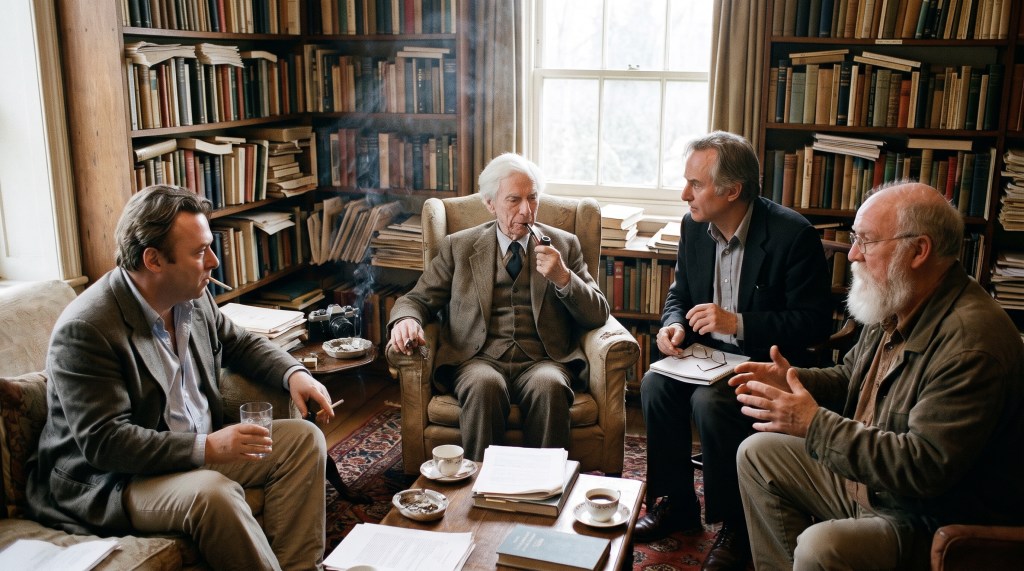
Atheism and the philosophy of mind by Zia H Shah MD
My argument is that the Quran’s diagnosis of istighnāʾ, the human being who “sees himself as self-sufficient” (96:7), explains the documented record better than any rival account. A cosmos that answers to no one tends to produce thinkers who see little reason to answer to anyone, and the four leading voices of modern unbelief show this pattern in their own words and conduct.
- The “brute fact” cosmology of Russell, Hume and Carroll denies that the universe is accountable to anything beyond itself. The Quran treats this as the intellectual form of istighnāʾ (perceived self-sufficiency), and in 96:6–7 it names that as the root of transgression (ṭughyān).
- Primary sources show a recurring pattern of self-assurance, not proof of personal wickedness. Examples are Russell’s casual account of ending his marriage, Dawkins’s “unpleasant character” rhetoric and “Abort it and try again” tweet, Hitchens’s boast of “burning the candle at both ends”, and Dennett’s “brights” label and “user-illusion” account of consciousness.
- Surah At-Tin (95:1–8) and the accountability verses (45:24, 23:37, 36:78, 75:3–6, 96:6–8, 25:43, 83:10–14, 107:1–3) consistently pair denial of the Creator with denial of the Day. When the Judge is removed, the ego takes the judge’s seat. Each of these men also had real virtues (fallibilism, courage, wonder), and an honest critique has to acknowledge them.
Abstract
This essay argues that belief in God, at its best, leads to humility, and that atheistic physicalism leads to an apparent self-sufficiency and a loosening of felt accountability. It starts from the “brute fact” position: the claim, made by Bertrand Russell in his 1948 BBC debate with Frederick Copleston, anticipated by David Hume’s Dialogues Concerning Natural Religion, and restated by the physicist Sean Carroll, that the universe simply exists without external cause or ultimate explanation. Four short biographies follow: Russell, Richard Dawkins, Christopher Hitchens and Daniel Dennett. They draw only on documented statements and conduct, to show that humility was never these men’s forte. The essay then reads this material through Surah At-Tin (95:1–8), in which humanity is created “in the best of moulds” and then returned to “the lowest of the low” except for those who believe and act righteously. It follows with a thematic reading of the Quranic verses that link denial of the Creator to denial of resurrection, judgment and accountability. Finally, it identifies the Quranic concept of istighnāʾ (96:6–7), seeing oneself as self-sufficient, as the common root of brute-fact cosmology, the worship of personal desire (25:43; 45:23) and, in its latest form, the claim that consciousness itself is an illusion. The epilogue ends by acknowledging the strongest replies these thinkers’ defenders can offer. The aim is engagement, not caricature. Arabic is given for every verse cited, followed by the 1934 translation of Abdullah Yusuf Ali.
I. The Universe as Brute Fact
Every worldview has to stop somewhere. The theist stops at a necessary Being whose existence explains itself. The atheist who declines that stopping point usually ends up at what philosophers call a brute fact: something that is simply the case, with no further reason.
Bertrand Russell. The classic modern statement came in a debate broadcast on the BBC Third Programme in 1948, later reprinted in Why I Am Not a Christian (1957). ditext Frederick Copleston, the Jesuit historian of philosophy, pressed the argument from contingency: if every being in the world depends on something else, the totality must depend on a being that contains in itself the reason for its existence. Russell answered that “the concept of cause is not applicable to the total.” thedailyhatch When Copleston asked whether he agreed with Sartre that the universe is “gratuitous,” Russell replied: “I should say that the universe is just there, and that’s all.” ditext Copleston’s reply has outlived the broadcast. A statement that there is no cause, he said, should come at the end of an inquiry, not at the beginning. ditext Russell had not refuted the question. He had declined to ask it.
David Hume. Russell’s move goes back to Hume (1711–1776). In Part IX of the Dialogues Concerning Natural Religion, published posthumously in 1779, the character Cleanthes answers Demea’s a priori argument with what later logicians would call a charge of the fallacy of composition. Once each particular in a series has been explained, he says, it is unreasonable to ask for a cause of the whole: “the uniting of these parts into a whole, like the uniting of several distinct counties into one kingdom… is performed merely by an arbitrary act of the mind.” gutenbergstanford On this view the universe is not a thing that needs a cause. It is a name for a collection.
Sean Carroll. The physicist Sean Carroll has given the position its most careful recent form. His 2018 paper “Why Is There Something, Rather Than Nothing?”, written for the Routledge Companion to the Philosophy of Physics and posted as arXiv:1802.02231, lists five candidate answers: creation, a metaverse, a principle, coherence and brute fact. It concludes that every attempt must “bottom out in a set of brute facts; the universe simply is, without ultimate cause or explanation.” arxivmichaelgstrauss Carroll argued the same in public against William Lane Craig at the Greer-Heard Forum in New Orleans on 21 February 2014. In his own post-debate summary he wrote that the demand for “causes” and “explanations” is “completely inappropriate” for modern fundamental physics. preposterousuniverseskeptical-science He developed the larger naturalist picture in The Big Picture (2016) and returned to the question in his Mindscape podcast (Episode 9, August 2018), saying that if there is any answer, “the answer is, there isn’t an answer.” preposterousuniverse
This is a serious philosophical position, held by serious people, and I will treat it as such. But a Quranic reader notices something about its posture. The brute-fact thesis is not a conclusion forced by evidence. It is a decision about where explanation is allowed to stop, and the decision is to stop at oneself and one’s own cosmos. The Quran has a name for that posture, and it is not a flattering one.
II. Four Lives: Humility Was Never Their Forte
What follows is not a moral audit of four men’s private lives. It records public, documented conduct and statements, and I try to keep the record separate from my interpretation of it. I make the case that humility was never their forte. I do not claim they were incapable of it.
1. Bertrand Russell (18 May 1872 – 2 February 1970)
Bertrand Arthur William Russell, third Earl Russell, was orphaned young and raised by his grandmother at Pembroke Lodge. He studied mathematics and moral sciences at Trinity College, Cambridge. With Alfred North Whitehead he wrote Principia Mathematica (1910–1913), and he is counted among the founders of analytic philosophy. He was imprisoned in 1918 for pacifist writings and received the Nobel Prize in Literature in 1950. His popular works include Why I Am Not a Christian (1927 lecture) and A History of Western Philosophy (1945).
The record of his self-regard is largely his own. In his Autobiography (1967–1969) he describes ending his first marriage, to the American Quaker Alys Pearsall Smith, in a single sentence that readers have found unsettling ever since: during a bicycle ride in 1902, “I realised that I no longer loved Alys.” philosophynowphilosophersmag He admits in the same passage that he then justified himself to her “by criticisms of her character.” wikiquoteblogspot Ray Monk, his principal biographer, concludes that Russell “massively exaggerates” how sudden the revelation was. Alys, by contrast, stayed devoted to him for the rest of her life. philosophersmagkingdablog Russell married four times: Alys (1894), Dora Black (1921), Patricia Spence (1936) and Edith Finch (1952). philosophynow His affairs, including those with Lady Ottoline Morrell and Lady Constance Malleson, are documented in his own letters.
His theology followed the same pattern. Asked what he would say if, after death, he found himself before God, Russell is widely reported to have replied, “Not enough evidence, God! Not enough evidence!” Honesty requires a caveat here. The earliest documented source is Leo Rosten’s memoir-interview in Saturday Review/World (23 February 1974), where the wording is milder: “Sir, why did you not give me better evidence?” quotepark Either way, the creature imagines summoning the Creator to account, not the reverse. In Quranic terms that is the precise inversion of dīn, the Day on which every soul is brought before its Lord.
2. Richard Dawkins (born 26 March 1941)
Clinton Richard Dawkins was born in Nairobi, studied zoology at Balliol College, Oxford, and took his doctorate under the Nobel laureate Niko Tinbergen. The Selfish Gene (1976) made him famous, The Blind Watchmaker (1986) consolidated his reputation, and from 1995 to 2008 he held Oxford’s Charles Simonyi Professorship for the Public Understanding of Science. The God Delusion (2006) sold 3.3 million copies worldwide by 2018, according to The Guardian, which also reported 13 million downloads of an unofficial Arabic PDF. It set the tone of the “New Atheism.”
His rhetoric is not designed for humility. Chapter 2 of The God Delusion opens by declaring that “the God of the Old Testament is arguably the most unpleasant character in all fiction.” In the same book he recounts telling a Dublin audience that the damage done by clerical sexual abuse was “arguably less” than the damage of a Catholic upbringing. newrepublic At a Liberal Democrat conference fringe meeting in September 2009 he said of religious indoctrination of children: “That is wicked, that is evil, that is child abuse.” politics With Dennett, he launched the “Brights” label for naturalists in The Guardian on 21 June 2003. the-brights
His Twitter career added a further record. On 20 August 2014 a user (@InYourFaceNYer) said she would face “a real ethical dilemma” if pregnant with a child with Down syndrome, and Dawkins replied: “Abort it and try again.” He also tweeted that it “would be immoral to bring it into the world.” The next day, in a post on richarddawkins.net titled “Abortion & Down Syndrome: An Apology for Letting Slip the Dogs of Twitterwar,” he apologised for “a new feeding frenzy.” In the same post he repeated that “the moral and sensible choice would be to abort” and blamed critics’ “wanton eagerness to misunderstand.” The Down’s Syndrome Association replied that people with the condition “can and do live full and rewarding lives” and that it did not believe Down’s syndrome “in itself should be a reason for termination.” Earlier, in 2013, he provoked a separate controversy by tweeting that Trinity College, Cambridge, had won more Nobel Prizes than all the world’s Muslims. The documented pattern is a man certain that his reasoning entitles him to pronounce with finality on the worth of other people’s faith, children and lives.
3. Christopher Hitchens (13 April 1949 – 15 December 2011)
Christopher Eric Hitchens was born in Portsmouth and read Philosophy, Politics and Economics at Balliol College, Oxford. He became a celebrated essayist for The Nation, Vanity Fair and The Atlantic. His books include The Missionary Position: Mother Teresa in Theory and Practice (1995), God Is Not Great: How Religion Poisons Everything (2007), the memoir Hitch-22 (2010) and the posthumous Mortality (2012). He died of oesophageal cancer in Houston. NPR
The subtitle of his best-known book (How Religion Poisons Everything) is a totalizing claim that no careful historian would make about any human institution. His campaign against Mother Teresa began with the Channel 4 documentary Hell’s Angel (1994) and the book that followed. It went as far as testifying as a hostile witness, a self-described “devil’s advocate,” in the Church’s inquiry into her beatification. Free Inquiry (2016) dates that testimony to 2001, before the body of the Archdiocese of Washington, D.C. Other accounts give 2003, possibly because British press coverage that January called him the Vatican’s “Devil’s Advocate.” In October 2003, the month of her beatification, he called her “a fanatic, a fundamentalist, and a fraud” in Slate (“Mommie Dearest”). Whatever the merits of his specific criticisms of her clinics and donors, his choice of an aged nun who served the dying as his target, together with the sexual pun in his title, shows a polemicist who enjoyed the fight for its own sake.
He was also candid about his appetites. Announcing his cancer in Vanity Fair in September 2010 (“Topic of Cancer”), he wrote that he had been “knowingly burning the candle at both ends and finding that it often gives a lovely light.” In the same essay he wrote that he had been “taunting the Reaper.” spiritcrossingNPR A physician reads this with sympathy, but also notices the posture. Even the body’s limits were treated as an opponent to be out-argued.
4. Daniel Dennett (28 March 1942 – 19 April 2024)
Daniel Clement Dennett III was born in Boston, studied at Harvard, and took his DPhil at Oxford under Gilbert Ryle. For decades he taught at Tufts University, where he co-directed the Center for Cognitive Studies. His major works include Consciousness Explained (1991), Darwin’s Dangerous Idea (1995), Freedom Evolves (2003), Breaking the Spell: Religion as a Natural Phenomenon (2006) and From Bacteria to Bach and Back (2017). With Dawkins, Hitchens and Sam Harris he was known as one of the “Four Horsemen” of New Atheism.
His op-ed “The Bright Stuff” in The New York Times (12 July 2003) began: “The time has come for us brights to come out of the closet.” edge Critics, including the philosopher Michael Rea, pointed out at once that the label implies everyone else is dim. Rea argued that a genuinely tolerant atheist would refuse it. albertmohler Breaking the Spell proposed treating religion as a natural phenomenon to be studied, and in practice to be managed, by its intellectual betters. probe
His most consequential claim concerned the mind itself. In Consciousness Explained, Dennett argued that consciousness is a kind of “user-illusion,” a term borrowed from computer-interface design. thequran In his 1988 essay “Quining Qualia” he argued that the felt qualities of experience, as philosophers usually conceive them, do not exist. Critics called the book “Consciousness Ignored” or “Consciousness Explained Away,” and David Chalmers suggested, half in jest, that Dennett wrote like a philosophical zombie. Dennett was not chastened. A year after publication, by his own account, he wished he had been “more daring.” Wikipediamountainsrivers Fairness requires noting that he resented the charge that he denied consciousness outright, and that sympathetic readers interpret “illusion” as denying only a particular theory of consciousness (the “Cartesian Theater”). Scientific AmericanSubstack Even so, a worldview that begins by making the cosmos a brute fact has ended by making the knower a convenient fiction.
III. Surah At-Tin: The Best of Moulds and the Lowest of the Low
Surah At-Tin is a Meccan surah of eight verses. Wikipedia It opens with four oaths, by the fig, the olive, Mount Sinai and the secure city of Mecca, which classical commentators linked to the lands of the prophets. quranmyislam The oaths then turn to their object, the human being.
وَٱلتِّينِ وَٱلزَّيْتُونِ ١ وَطُورِ سِينِينَ ٢ وَهَـٰذَا ٱلْبَلَدِ ٱلْأَمِينِ ٣
By the Fig and the Olive, And the Mount of Sinai, And this City of security,- (95:1–3) shiachat
لَقَدْ خَلَقْنَا ٱلْإِنسَـٰنَ فِىٓ أَحْسَنِ تَقْوِيمٍ ٤
We have indeed created man in the best of moulds, (95:4) shiachat
ثُمَّ رَدَدْنَـٰهُ أَسْفَلَ سَـٰفِلِينَ ٥
Then do We abase him (to be) the lowest of the low,- (95:5) islamonline
إِلَّا ٱلَّذِينَ ءَامَنُوا۟ وَعَمِلُوا۟ ٱلصَّـٰلِحَـٰتِ فَلَهُمْ أَجْرٌ غَيْرُ مَمْنُونٍ ٦
Except such as believe and do righteous deeds: For they shall have a reward unfailing. (95:6)
فَمَا يُكَذِّبُكَ بَعْدُ بِٱلدِّينِ ٧
Then what can, after this, contradict thee, as to the judgment (to come)? (95:7)
أَلَيْسَ ٱللَّهُ بِأَحْكَمِ ٱلْحَـٰكِمِينَ ٨
Is not Allah the wisest of judges? (95:8)
(Yusuf Ali renders aḥkam al-ḥākimīn as “wisest of judges.” Many translators give “most just of judges,” and both senses are present in the Arabic root ḥ-k-m.) quran
The structure is a diagnosis. Taqwīm (perfect proportion, upright stature) is the state of the human being as designed: endowed with reason, speech, moral sense and, as al-Qurtubi notes, an upright form unlike the creatures that go about face-down. quran The fall to asfal sāfilīn is not a cosmic accident. It is what happens to this finely tuned creature when faith and righteous action (īmān and ʿamal ṣāliḥ) are removed. The exception in verse 6 locates the cure exactly. quran
Then verse 7 asks: what, after this, makes you deny the Dīn? The question is aimed at the person who has seen the evidence of his own exquisite construction and still denies that the Constructor will call him to account. The surah’s logic is that the best of moulds implies a purpose, a purpose implies a standard, and a standard implies a Judge. Deny the Judge and the standard dissolves. Once the standard dissolves, the self becomes its own measure, and that is the beginning of the descent.
Here the brute-fact cosmology and the biographies meet. Russell’s “just there, and that’s all” removes the Judge from the cosmos. His imagined rebuke of God (“not enough evidence”) seats the creature on the bench. The surah’s closing question, Is not Allah the wisest of judges?, is precisely the question that every brute-fact metaphysics has decided in advance not to ask.
IV. Denial of the One, Denial of the Day: The Quranic Pattern
Across the Meccan surahs, denial of God’s sole lordship (tawḥīd) and denial of the Return (al-maʿād) almost always appear together. The verses below group into four themes.
A. The Creed of the Dahriyya: “Nothing but Time”
وَقَالُوا۟ مَا هِىَ إِلَّا حَيَاتُنَا ٱلدُّنْيَا نَمُوتُ وَنَحْيَا وَمَا يُهْلِكُنَآ إِلَّا ٱلدَّهْرُ ۚ وَمَا لَهُم بِذَٰلِكَ مِنْ عِلْمٍ ۖ إِنْ هُمْ إِلَّا يَظُنُّونَ
And they say: “What is there but our life in this world? We shall die and we live, and nothing but Time can destroy us.” But of that they have no knowledge: they merely conjecture. (45:24) namazzamani
Yusuf Ali’s note on this verse says the phrase “suggests the materialist philosophy that Matter and Time are eternal.” alim This is the Quran’s portrait of the brute-fact worldview fourteen centuries before Russell. The universe and its processes are simply there, and death is the work of impersonal dahr. The Quran does not answer with a counter-assertion. It answers with an epistemic charge: they have no knowledge; they merely conjecture. The brute fact is presented as a conclusion, but it is a guess.
إِنْ هِىَ إِلَّا حَيَاتُنَا ٱلدُّنْيَا نَمُوتُ وَنَحْيَا وَمَا نَحْنُ بِمَبْعُوثِينَ
“There is nothing but our life in this world! We shall die and we live! But we shall never be raised up again!” (23:37)
وَقَالُوٓا۟ إِنْ هِىَ إِلَّا حَيَاتُنَا ٱلدُّنْيَا وَمَا نَحْنُ بِمَبْعُوثِينَ
And they (sometimes) say: “There is nothing except our life on this earth, and never shall we be raised up again.” (6:29)
B. Forgetting One’s Own Creation: The Argument from Bones
وَضَرَبَ لَنَا مَثَلًا وَنَسِىَ خَلْقَهُۥ ۖ قَالَ مَن يُحْىِ ٱلْعِظَـٰمَ وَهِىَ رَمِيمٌ
And he makes comparisons for Us, and forgets his own (origin and) Creation: He says, “Who can give life to (dry) bones and decomposed ones (at that)?” (36:78) surahquran +2
قُلْ يُحْيِيهَا ٱلَّذِىٓ أَنشَأَهَآ أَوَّلَ مَرَّةٍ ۖ وَهُوَ بِكُلِّ خَلْقٍ عَلِيمٌ
Say, “He will give them life Who created them for the first time! for He is Well-versed in every kind of creation!-” (36:79)
The key phrase is wa nasiya khalqahu, “and he forgets his own creation.” A physician sees this daily: the person who takes for granted the embryology that formed him, the immune system that defends him and the neurons that let him doubt. The denier of resurrection is not short of evidence. He is short of memory and of gratitude.
وَقَالُوٓا۟ أَءِذَا كُنَّا عِظَـٰمًا وَرُفَـٰتًا أَءِنَّا لَمَبْعُوثُونَ خَلْقًا جَدِيدًا
They say: “What! when we are reduced to bones and dust, should we really be raised up (to be) a new creation?” (17:49)
أَيَحْسَبُ ٱلْإِنسَـٰنُ أَلَّن نَّجْمَعَ عِظَامَهُۥ بَلَىٰ قَـٰدِرِينَ عَلَىٰٓ أَن نُّسَوِّىَ بَنَانَهُۥ بَلْ يُرِيدُ ٱلْإِنسَـٰنُ لِيَفْجُرَ أَمَامَهُۥ يَسْـَٔلُ أَيَّانَ يَوْمُ ٱلْقِيَـٰمَةِ
Does man think that We cannot assemble his bones? Nay, We are able to put together in perfect order the very tips of his fingers. But man wishes to do wrong (even) in the time in front of him. He questions: “When is the Day of Resurrection?” (75:3–6) quranyusufaliknowthequran
This passage is the hinge of my thesis. Verse 5 exposes the motive behind the intellectual doubt of verse 3: bal yurīdu al-insānu li-yafjura amāmahu, “rather, man wishes to continue in sin ahead of him.” Ibn Kathir records Ibn ʿAbbas’s gloss: man says, I will sin now and repent later. al-awailmyislam Denial of resurrection is presented not as a neutral finding but as a convenience. If there is no reckoning, nothing stands in the way of what one wants.
أَيَحْسَبُ ٱلْإِنسَـٰنُ أَن يُتْرَكَ سُدًى
Does man think that he will be left uncontrolled, (without purpose)? (75:36)
Sudā is the word for a camel left to wander unherded. It describes the brute-fact universe from the inside: a cosmos with no shepherd, and a self that answers to nothing.
C. Istighnāʾ: Self-Sufficiency as the Root of Transgression
كَلَّآ إِنَّ ٱلْإِنسَـٰنَ لَيَطْغَىٰٓ أَن رَّءَاهُ ٱسْتَغْنَىٰٓ إِنَّ إِلَىٰ رَبِّكَ ٱلرُّجْعَىٰٓ
Nay, but man doth transgress all bounds, In that he looketh upon himself as self-sufficient. Verily, to thy Lord is the return (of all). (96:6–8)
These verses come from the surah traditionally regarded as containing the first revelation, and they state the Quran’s psychology of unbelief in its most compact form. Wikipedia The Tunisian exegete Ibn ʿAshur notes that the sīn and tāʾ of istaghnā intensify the meaning: not merely being wealthy, but feeling oneself to be in need of nothing. He describes how the delusion feeds on itself until it becomes a settled trait, “where there is no restraint from religion or sound reflection.” e-quran The grammar is also telling. An raʾāhu means “that he sees himself.” e-quranksu The self is both the one who sees and the thing seen. It is a closed circuit, which is exactly what a brute-fact cosmos looks like when it is projected onto the individual. Verse 8 answers the delusion with the Return: ilā rabbika al-rujʿā.
يَـٰٓأَيُّهَا ٱلْإِنسَـٰنُ مَا غَرَّكَ بِرَبِّكَ ٱلْكَرِيمِ ٱلَّذِى خَلَقَكَ فَسَوَّىٰكَ فَعَدَلَكَ فِىٓ أَىِّ صُورَةٍ مَّا شَآءَ رَكَّبَكَ كَلَّا بَلْ تُكَذِّبُونَ بِٱلدِّينِ
O man! what has seduced thee from thy Lord Most Beneficent?- Him Who created thee. Fashioned thee in due proportion, and gave thee a just bias; In whatever Form He wills, does He put thee together. Nay! but ye do reject Right and Judgment! (82:6–9)
Al-Infitar repeats the logic of At-Tin almost word for word. The creature fashioned in due proportion (fa-sawwāka fa-ʿadalaka, the taqwīm of 95:4) is deceived (gharra) and ends by denying the Dīn.
وَيْلٌ لِّكُلِّ هُمَزَةٍ لُّمَزَةٍ ٱلَّذِى جَمَعَ مَالًا وَعَدَّدَهُۥ يَحْسَبُ أَنَّ مَالَهُۥٓ أَخْلَدَهُۥ
Woe to every (kind of) scandal-monger and-backbiter, Who pileth up wealth and layeth it by, Thinking that his wealth would make him last for ever! (104:1–3)
أَلْهَىٰكُمُ ٱلتَّكَاثُرُ حَتَّىٰ زُرْتُمُ ٱلْمَقَابِرَ
The mutual rivalry for piling up (the good things of this world) diverts you (from the more serious things), Until ye visit the graves. (102:1–2)
The “wealth” that breeds istighnāʾ need not be gold. It can be reputation, intellect, scientific prestige or a bestselling contrarian persona. Al-Qurtubi already recorded the gloss that one may become self-sufficient “by clan, supporters and helpers.” ksugreattafsirs A modern equivalent would be self-sufficiency through followers, citations and applause.
D. Desire as God: The Ego Enthroned
أَرَءَيْتَ مَنِ ٱتَّخَذَ إِلَـٰهَهُۥ هَوَىٰهُ أَفَأَنتَ تَكُونُ عَلَيْهِ وَكِيلًا
Seest thou such a one as taketh for his god his own passion (or impulse)? Couldst thou be a disposer of affairs for him? (25:43) quran +3
أَفَرَءَيْتَ مَنِ ٱتَّخَذَ إِلَـٰهَهُۥ هَوَىٰهُ وَأَضَلَّهُ ٱللَّهُ عَلَىٰ عِلْمٍ وَخَتَمَ عَلَىٰ سَمْعِهِۦ وَقَلْبِهِۦ وَجَعَلَ عَلَىٰ بَصَرِهِۦ غِشَـٰوَةً فَمَن يَهْدِيهِ مِنۢ بَعْدِ ٱللَّهِ ۚ أَفَلَا تَذَكَّرُونَ
Then seest thou such a one as takes as his god his own vain desire? Allah has, knowing (him as such), left him astray, and sealed his hearing and his heart (and understanding), and put a cover on his sight. Who, then, will guide him after Allah (has withdrawn Guidance)? Will ye not then receive admonition? (45:23)
Note the placement. Verse 45:23, about the one who deifies his hawā, sits immediately before 45:24, the creed of the Dahriyya. The Quran puts the worship of the ego and the brute-fact cosmology side by side because they are the same act seen from two directions. When God is removed from the top of the hierarchy of being, the space does not stay empty: the self moves into it. Note also the phrase ʿalā ʿilm, “with knowledge.” This is not the error of the ignorant. It is the error of the learned.
E. The Moral Fruit: From Denying the Day to Neglecting the Orphan
وَيْلٌ يَوْمَئِذٍ لِّلْمُكَذِّبِينَ ٱلَّذِينَ يُكَذِّبُونَ بِيَوْمِ ٱلدِّينِ وَمَا يُكَذِّبُ بِهِۦٓ إِلَّا كُلُّ مُعْتَدٍ أَثِيمٍ إِذَا تُتْلَىٰ عَلَيْهِ ءَايَـٰتُنَا قَالَ أَسَـٰطِيرُ ٱلْأَوَّلِينَ كَلَّا ۖ بَلْ ۜ رَانَ عَلَىٰ قُلُوبِهِم مَّا كَانُوا۟ يَكْسِبُونَ
Woe, that Day, to those that deny- Those that deny the Day of Judgment. And none can deny it but the Transgressor beyond bounds the Sinner! When Our Signs are rehearsed to him, he says, “Tales of the ancients!” By no means! but on their hearts is the stain of the (ill) which they do! (83:10–14)
Al-Mutaffifin turns the usual modern framing around. We tend to assume that unbelief causes bad conduct. The Quran says rān, a rust or stain of accumulated deeds, also causes unbelief. Denial is a result as well as a cause. The dismissal “tales of the ancients!” has a modern counterpart in the confident relegation of revelation to “Bronze Age myth.”
أَرَءَيْتَ ٱلَّذِى يُكَذِّبُ بِٱلدِّينِ فَذَٰلِكَ ٱلَّذِى يَدُعُّ ٱلْيَتِيمَ وَلَا يَحُضُّ عَلَىٰ طَعَامِ ٱلْمِسْكِينِ
Seest thou one who denies the Judgment (to come)? Then such is the (man) who repulses the orphan (with harshness), And encourages not the feeding of the indigent. (107:1–3) ayahsurahquran
Surah Al-Ma’un defines the denier of the Dīn by his treatment of the vulnerable, not by his metaphysics. Few verses in scripture are more pointed for a modern reader who has watched a famous intellectual advise a stranger, in a 140-character tweet of 20 August 2014, to “abort it and try again.”
زَعَمَ ٱلَّذِينَ كَفَرُوٓا۟ أَن لَّن يُبْعَثُوا۟ ۚ قُلْ بَلَىٰ وَرَبِّى لَتُبْعَثُنَّ ثُمَّ لَتُنَبَّؤُنَّ بِمَا عَمِلْتُمْ ۚ وَذَٰلِكَ عَلَى ٱللَّهِ يَسِيرٌ
The Unbelievers think that they will not be raised up (for Judgment). Say: “Yea, By my Lord, Ye shall surely be raised up: then shall ye be told (the truth) of all that ye did. And that is easy for Allah.” (64:7)
V. From Brute Universe to Illusory Self
There is a logical progression here that the Quran anticipates and that modern philosophy has carried out step by step.
- The cosmos is a brute fact (Hume, Russell, Carroll). Nothing stands above the universe to which it must answer.
- Therefore the human being is a brute fact within it. He has no taqwīm, no design and no purpose, only the products of blind processes, sudā, left to wander.
- Therefore there is no Day. If there is no designer, there is no standard, and if there is no standard, there is no judgment (45:24; 23:37).
- Therefore the self is sovereign. Hawā becomes ilāh (25:43; 45:23), and istighnāʾ becomes a philosophy instead of a passing temptation (96:7).
- Finally, the self dissolves. The knower who refused to be a creature is redescribed as a “user-illusion.”
The last step is the strangest and the most revealing. The worldview that started by putting the human mind in God’s place as the final judge of what counts as evidence ends by denying that the mind is what it appears to be. Hume himself, in the Treatise, could find no self, only “a bundle or collection of different perceptions.” Dennett’s illusionism is the mature fruit of that seed. In Surah At-Tin’s terms, this is asfal sāfilīn reached by argument: the creature made in the best of moulds talks himself down to a ghost in the machinery, and then out of existence.
The theist’s humility is not a mood. It is a metaphysical position: I am not the explanation of myself. The atheist’s self-sufficiency is likewise not just a temperament. It follows from the metaphysical position that nothing is the explanation of anything ultimately, and so I answer to no one. This does not mean every theist is humble or every atheist arrogant. Plainly they are not, and the Quran is severe with the arrogant among believers. It means that the logic of each position pulls in a particular direction, and that the documented lives of the movement’s most celebrated voices show that pull.
VI. Thematic Epilogue: Istighnāʾ and the Way Back
Bring the threads together. Russell looked at the whole of existence and said it was “just there, and that’s all.” He looked at a marriage of eight years and, on a bicycle, found that it was over. He looked toward his Maker and prepared a complaint about the evidence. Dawkins looked at the God of Abraham and found an “unpleasant character,” looked at believing parents and found abusers, and looked at an unborn child and found a moral error to be corrected. Hitchens looked at religion and found that it “poisons everything,” looked at a nun among the dying and found a fraud, and looked at his own body and boasted that the candle burned beautifully at both ends. Dennett looked at believers and called his own side the “brights.” Then he looked inward, at the one thing every human being knows directly, and called it an illusion.
The Quran has a single word for the common thread: istighnāʾ, an raʾāhu istaghnā, “that he sees himself as self-sufficient.” It is the posture of the brute-fact cosmos turned into a personality, and the posture of the personality projected onto the cosmos. Surah Al-ʿAlaq places it at the root of ṭughyān, the transgression of bounds. Surah Al-Jathiya shows where it leads: from hawā as god (45:23) to dahr as the only destroyer (45:24). Surah Al-Qiyamah exposes its motive: man wishes to sin ahead of him (75:5). Surah Al-Ma’un shows its fruit: the orphan pushed away (107:2). And Surah At-Tin shows its end: the best of moulds returned to the lowest of the low (95:4–5), except for those who believe and do good.
The cure the Quran prescribes is not a better argument. It is a better posture: the recollection of one’s own creation (36:78), the acknowledgment that one is not one’s own explanation, and the expectation of the Return (96:8). Humility, in this sense, is not self-abasement. It is accuracy about what one is. The scientist who marvels at the cell and stops before asking whose cell it is has done nine-tenths of the work of worship. The last tenth is the hardest, because it means giving up the judge’s seat.
Is not Allah the wisest of judges? The question is not rhetorical in a cheap sense. It invites every reader, theist or atheist, to reconsider who has been sitting in that seat.
A Word for the Defense
An honest essay must give the other side its best reply. Russell’s defenders will note that he called himself an agnostic in strict philosophical terms. philosophynow He spent much of his later life campaigning against nuclear war, and he consistently held that beliefs should be proportioned to evidence, which is a kind of intellectual humility before the facts. Dennett’s admirers will point out that he read his critics closely, revised his views publicly, and saw himself as attacking only a mistaken theory of consciousness, not experience itself. Hitchens’s friends, including the evangelical geneticist Francis Collins, who stood by him through his illness, remember a man of real physical and moral courage who denounced tyrants of every stripe and faced death without self-pity. thewartburgwatch Dawkins’s readers rightly credit him with conveying the beauty of the natural world to millions, and his sense of wonder at evolution’s intricacy is closer to the Quranic tafakkur (reflection on creation) than he would admit. Each of these virtues is real. My claim is not that these men lacked virtue. It is that their virtues were held in a frame that could not explain or ground them, and the Quran’s word for living inside such a frame is istighnāʾ.





Leave a Reply