
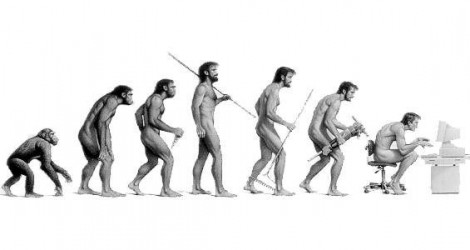
Presented by Claude for Zia H Shah MD
No Quranic verse and no authentic (sahih or hasan) hadith teaches a 7,000-year age of humanity, still less repeating 7,000-year cycles of “Adams.” There is one nuance. Several 7,000-year narrations do exist in secondary Sunni collections and early histories, but the classical hadith critics themselves graded them very weak or fabricated. The empirical record also leaves no room for a “present human race” that began about 6,000 years ago, and it shows no 7,000-year resets. That record includes fossils, genomes, archaeology, and dating archives that record individual years.
- Scripture and Hadith: The Quran gives no age for the world, no 7,000-year scheme, and no cycles of Adams. Verses 22:47, 32:5 and 70:4 say that God’s time cannot be measured against ours; they are not about world history. The 7,000-year narrations are the Ibn Zimal dream report (in al-Tabarani and al-Bayhaqi), the Anas report (in Ibn ‘Adi), and a report from Ibn ‘Abbas, not the Prophet, in al-Tabari’s Tarikh. Ibn al-Qayyim, Ibn Hajar, Ibn Rajab, Ibn Kathir, Qadi ‘Iyad and al-Albani graded them very weak or fabricated. The idea itself is a Jewish and Christian “world-week” doctrine (Sanhedrin 97a, Barnabas, Irenaeus, Lactantius) that entered Islamic historiography.
- Ahmadiyya literature: Mirza Ghulam Ahmad taught the doctrine explicitly and repeatedly. It appears in Lecture Lahore and Lecture Sialkot (both 1904, Ruhani Khaza’in vol. 20), Haqiqatul Wahi (1907), Tohfa-e-Golarhviyyah (1902) and the Malfuzat. His claims were:
- Adam lived about 6,000 years ago: 4,739 lunar years before the Prophet’s death, by an abjad reading of Surah al-‘Asr.
- Each human “race” has a 7,000-year lifespan.
- Earlier cycles and “Adams” may have existed.
- He himself is the “last Adam,” born at the end of the sixth millennium.
- Evidence:
- Anatomically modern humans date to 315,000 ± 34,000 years ago, by thermoluminescence dating at Jebel Irhoud (Hublin et al., Nature 2017).
- People were at Madjedbebe in northern Australia by about 65,000 years ago (Clarkson et al., Nature 2017).
- At Leang Karampuang in Sulawesi, people painted a narrative scene of human-like figures and a pig by 51,200 years ago (Oktaviana et al., Nature 2024).
- Göbekli Tepe was built about 9600 BCE.
- Continuous tree-ring, ice-core and varve chronologies run tens of millennia without a break.
Abstract
This study has five parts:
- It tests the claim that neither the Quran nor the Hadith mentions 7,000-year cycles of humanity.
- It collects the main statements of the doctrine in Ahmadiyya Muslim Community literature, with citations.
- It sets the doctrine against the evidence of evolutionary biology, genetics, archaeology and geochronology.
- It sketches the picture of the human past that these disciplines and world literature actually give.
- It closes with reflections on revelation, interpretation and empirical knowledge.
On the Quran, the claim holds without qualification. On the Hadith, it holds for authentic material. A family of 7,000-year reports exists, but the very tradition that transmitted it rejected it. The main reason was that it would let anyone calculate the Hour, which the Quran reserves to God.
In Ahmadiyya literature, the doctrine is central to the founder’s argument for the timing of his own mission. It combines four elements:
- a reading of Q 22:47 in which each divine “day” is a millennium;
- the Judaeo-Christian world-week;
- an abjad (letter-number) calculation of Surah al-‘Asr;
- a distinctive extension: humanity existed before “our” Adam, possibly through many earlier 7,000-year cycles with their own Adams.
That extension anticipated, in a sense, the discovery of deep human antiquity. But it set the start of the “present race” at about 4000 BCE, which the evidence does not support. The broader history of ideas shows that dividing time into sacred ages is a near-universal way of giving moral shape to history. Examples include the yugas, the Zoroastrian millennia, Hesiod’s ages of metals, the Maya Long Count, Ussher’s chronology and Ibn Khaldun’s dynastic cycles. The 7,000-year doctrine belongs to that family, not to natural history.
Key Findings
- No Quranic basis. The Quran gives no age for the world or for humanity. It describes creation in six “days” (ayyam), not seven. Its “thousand years” verses compare divine and human time in passages about judgment and divine command. It insists that only God knows the time of the Hour (7:187, 31:34, 33:63).
- No authentic Hadith basis, though weak and fabricated reports exist. The best-known report is the Ibn Zimal al-Juhani dream narration: “the world is seven thousand years, and I am in its last thousand.” It appears in al-Tabarani’s al-Mu’jam al-Kabir and al-Bayhaqi’s Dala’il. Ibn Hajar called its chain “very weak,” Ibn Rajab said its chain “is not sound,” and al-Albani graded it fabricated. hdith Ibn al-Qayyim listed the 7,000-year report among the “most obvious of lies.” bakkah
- The idea is pre-Islamic. It comes from the rabbinic and patristic “world-week”: six millennia of history followed by a Sabbath millennium. Muslim chronographers such as al-Tabari and al-Suhayli partly absorbed it.
- The Ahmadiyya doctrine is explicit, and Ahmad’s argument rests on it. Mirza Ghulam Ahmad used it to argue that the Promised Messiah had to appear at the turn of the seventh millennium from Adam. He wrote that the Quran “has mentioned it very clearly.” The Quranic text does not support that claim.
- There are real internal tensions. The same body of writing says “the present human race originated from Adam, our common ancestor,” and also that Adam “was not the first man.” It cites “authentic ahadith” that the hadith critics rejected. It also claims that Jews and Christians agreed the present millennium was the seventh, which their calendars did not show (see Part II.D).
- The evidence does not support the chronology. There is no sign of a new human population, civilisation, or cognitive or spiritual “reset” around 4000 BCE, and no 7,000-year breaks repeating before it. Human history appears as one continuous, branching story about 300,000 years deep, within a hominin lineage several million years old.
Part I. The Quran and the Hadith
1. What the Quran says — and does not say
Verse 22:47. “They ask thee to hasten the punishment; but God will never fail His promise. And verily a day with thy Lord is as a thousand years of your reckoning.” The context is the disbelievers’ taunting demand for immediate punishment. The verse answers that divine time is not human time: what seems a delay to them is nothing to God. It speaks of divine patience and of the gulf between the two time scales. It does not give a conversion factor for world history.
Verse 32:5. “He directs the affair from the heaven to the earth; then it ascends to Him in a Day whose measure is a thousand years of what you count.” Classical exegetes debated whether this concerns the angels’ ascent, the Day of Judgment, or the course of divine governance. Ahmadiyya exegesis reads it as a prophecy that Islam would decline for a thousand years after its first three centuries. A letter from the present Ahmadiyya Khalifa (10 February 2022) states: “This verse states that Muslims will continue to weaken in the world for a thousand years.” alhakam This is an interpretation, not the plain sense of the text, and the verse says nothing about seven millennia or the age of humanity.
Verse 70:4. “The angels and the Spirit ascend to Him in a Day the measure of which is fifty thousand years.” If the “day = thousand years” rule of 22:47 were a literal conversion, 70:4 would produce a different arithmetic that contradicts it. That is why most exegetes treated both verses as images of divine grandeur rather than as calendar data.
The six days. The Quran repeatedly says creation took place in six days (7:54, 10:3, 11:7, 25:59, 32:4, 50:38, 57:4). The seventh “day” of the world-week scheme has no Quranic counterpart. The Quran also explicitly denies that God grew weary (50:38). That is a pointed rejection of the idea of God resting on the Sabbath, on which the world-week depends.
Surah al-‘Asr (103). “By Time [or: the afternoon], surely man is in a state of loss, except those who believe and do good works, and exhort one another to truth and to steadfastness.” myislam The surah contains no numbers. A numerical reading needs an outside device: the abjad or jummal system, in which each Arabic letter has a numerical value. It also needs conventions about which letters to count:
- written versus pronounced letters;
- whether to count the definite article;
- how to treat hamza and doubled consonants;
- whether to use the Eastern or the Maghribi table of values.
The abjad method is a medieval and early-modern esoteric practice. It is not a principle of interpretation established by the Prophet or the Companions. I have not independently recomputed the surah’s value. The point is about method: different conventions give different totals, so the result cannot bind anyone.
Adam as khalifa (2:30). “I am about to place a vicegerent (khalifa) on the earth.” Ahmadiyya writers rightly note that khalifa can mean “successor,” alhakam and classical exegetes themselves debated whom Adam succeeded. alislam The verse leaves room for readings in which humans existed before Adam. It says nothing about 7,000-year spans.
Verdict on the Quran: the premise holds fully. No verse teaches a 7,000-year age of the world or of humanity, or cycles of humanity.
2. The Hadith: what exists, and how it was graded
Here the premise needs precision. There is no authentic hadith on the subject, but there are reports.
(a) The Ibn Zimal al-Juhani dream report. Al-Tabarani transmits it in al-Mu’jam al-Kabir through this chain:
- al-Walid ibn ‘Abd al-Malik ibn Musarrih al-Harrani,
- from Sulayman ibn ‘Ata’ al-Qurashi al-Harrani,
- from Maslama ibn ‘Abd Allah al-Juhani,
- from his uncle Abu Mashja’a ibn Rib’i,
- from Ibn Zimal.
Al-Bayhaqi also has it in Dala’il al-Nubuwwa, and al-Suhayli cites it in al-Rawd al-Unuf. In the report, the Companion dreams of the Prophet on a pulpit with seven steps, and the Prophet interprets the dream: “As for the pulpit you saw with seven steps, with me on its highest step — the world is seven thousand years, and I am in its last thousand.” The gradings:
- Ibn Hajar, Fath al-Bari 11/358: “its chain is very weak” (isnaduhu da’if jiddan). hdith
- Ibn Rajab, Fath al-Bari: “its chain is not sound.” hdith
- Al-Dhahabi, Mizan al-I’tidal, lists Sulayman ibn ‘Ata’ among narrators who were criticised. In al-Dhahabi’s al-Mughni, one narrator in the chain is called “ruined, accused of fabrication” (halik, uttuhima bi’l-wad’).
- Al-Albani, Da’if al-Jami’ no. 3013: fabricated (mawdu’). hdith
(b) The Anas report. “The life of the world is seven days of the days of the Hereafter,” with Q 22:47 appended. Ibn ‘Adi transmits it in al-Kamil through al-‘Ala’ ibn Zaydal. ‘Ali ibn al-Madini said al-‘Ala’ “used to fabricate hadith,” and Abu Hatim and Abu Dawud called him matruk (a narrator whose reports are abandoned). Grade: very weak or fabricated.
(c) The Ibn ‘Abbas report. “The world is one week of the weeks of the Hereafter, seven thousand years.” Al-Tabari opens his Tarikh al-Rusul wa’l-Muluk with it. islamonline It is mawquf: it is attributed to Ibn ‘Abbas, not to the Prophet. Its chain includes Abu Talib Yahya ibn Ya’qub, whom al-Bukhari called munkar al-hadith (a narrator of objectionable reports). It also includes Hammad ibn Abi Sulayman, about whom Ibn Hajar noted reservations. Even if it were authentic as a statement of Ibn ‘Abbas, it would be a Companion’s opinion, not revelation. It may well have been drawn from Jewish and Christian (“People of the Book”) material.
(d) The related “half-day” report. Abu Dawud transmits a report from Sa’d ibn Abi Waqqas expressing the hope that God would grant this community a reprieve of “half a day.” That half-day was explained as 500 years, and the report was read together with the 7,000-year scheme. Its chain is broken (munqati’): Shurayh ibn ‘Ubayd never met Sa’d.
(e) Authentic hadiths that were pulled into the scheme.
- “I and the Hour have been sent like these two,” said while joining the index and middle fingers (Bukhari, Muslim).
- Ibn ‘Umar’s parable that, compared with earlier communities, the Muslim community’s span is like the time from ‘Asr (mid-afternoon) to sunset (Bukhari).
Both are authentic, and both express nearness and relative proportion. Neither gives a number. Qadi ‘Iyad noted that some people tried to turn the gap between the two fingers into a fraction of a 7,000-year total. He said they “relied on reports that are not sound,” and added that events had already disproved them.
The classical critique. In al-Manar al-Munif (around p. 80), Ibn al-Qayyim lists the signs that a report is fabricated. One sign is that it contradicts the explicit Quran, “like the hadith about the length of the world, that it is 7,000 years and that we are in the seventh thousand. This is from the most obvious of lies, since had it been authentic, everyone would know that there remain only 251 years.” He meant 251 years from his own time; he died in 751 AH. He cites the Quranic verses that reserve knowledge of the Hour to God (7:187, 33:63). Others took the same line:
- Ibn Kathir held that only God knows how much of the world has passed or remains. He added that the figures in Israelite and People-of-the-Book sources had been “confused and mistaken,” as more than one scholar had noted. islamweb
- According to Shuaib Ally of SeekersGuidance, Ibn Hazm, Ibn al-‘Arabi and al-Sakhawi regarded such reports as fabricated.
- Ibn Hajar remarked drily that three more centuries had passed since Qadi ‘Iyad’s refutation. seekersguidance
Al-Suyuti’s treatise. Not every scholar rejected the scheme. Al-Tabari “accepted that the world is seven thousand years,” and al-Suhayli supported him with the Ibn Zimal report. islamonline Al-Suyuti wrote al-Kashf ‘an mujawazat hadhihi al-umma al-alf (in al-Hawi li’l-Fatawi, vol. 2) to calm fears that the world would end in 1000 AH. He collected the 7,000-year reports and concluded that the community would outlast its first millennium, but not by as much as 500 years. That implies an end before about 1500 AH. As of October 2026 we are in 1448 AH. The treatise shows how seriously some scholars took the framework. It also shows why the framework fell into disrepute: every dated application of it has expired.
Classical chronographers did not agree on the numbers. According to Stephen Lambden’s survey of Islamic chronological schemes:
- al-Tabari favoured about 6,500 years from Adam to Muhammad; ucmerced
- Ibn al-Munajjim reckoned 6,216 years from Adam’s fall to the Hijra; ucmerced
- Ibn Qutayba and al-Maqdisi gave figures around 7,800 years. ucmerced
Mirza Ghulam Ahmad’s figure of 4,739 lunar years is therefore not the recovery of a settled tradition. It is a new figure, much shorter than the classical ones.
Verdict on the Hadith: the premise needs one clarification. There is no authentic hadith on 7,000 years. There is no hadith of any grade on repeated 7,000-year humanities with multiple Adams. But weak and fabricated 7,000-year reports do circulate in al-Tabarani, al-Bayhaqi, Ibn ‘Adi, al-Tabari, al-Suhayli and al-Suyuti. The tradition’s own critics rejected them on grounds of both their chains of transmission (isnad) and their content (matn).
3. The pre-Islamic world-week
- Talmud, Sanhedrin 97a. Rav Katina: “Six thousand years the world will exist, and one [thousand] it will be desolate.” A related teaching in the same passage compares this to the sabbatical year, citing Isaiah 2:11 and Psalm 90:4 (“a thousand years in Your sight are as yesterday”). The Tanna de-Bei Eliyahu divides the 6,000 years into 2,000 of “chaos,” 2,000 of Torah, and 2,000 of the Messianic age.
- Epistle of Barnabas 15 (c. 100–130 CE): “in six thousand years the Lord will bring all things to an end… he shall rest on the seventh day.” blueletterbible
- Irenaeus, Against Heresies 5.28.3: “in as many days as this world was made, in so many thousand years shall it be concluded.”
- Lactantius, Divine Institutes 7.14: the world will last six thousand years, followed by a thousand-year reign.
- Augustine (City of God 20.7; 22.30) deliberately reduced the scheme to six symbolic “ages,” in opposition to belief in a literal coming millennium. Bede’s Six Ages of the World followed him.
Part II. The Seven-Thousand-Year Doctrine in Ahmadiyya Literature
Note on sources: Quotations come from the Community’s official English translations as published on alislam.org, alhakam.org and reviewofreligions.org. Ruhani Khaza’in (RK), the collected Urdu, Arabic and Persian works, is cited wherever those sources give references. Page numbers can differ between the 1984 and 2008 RK editions. Where I could verify a passage only through a hostile secondary site, or not at all, I say so.
A. Mirza Ghulam Ahmad (1835–1908)
1. Lecture Lahore (delivered 3 September 1904), RK vol. 20, pp. 184–186 (official English translation, Lecture Lahore, Part II):
“i.e., ‘A day in the sight of God is like a thousand years according to your reckoning.’ Since the days are seven, we infer from this verse that this world is also meant to last seven thousand years, counting from the particular Adam whose descendants we are. We learn from the Holy Quran that other worlds have existed before us, though we do not know what kind of people inhabited them. But it seems that an era of the world lasts for seven thousand years — as a symbol of which the days have been fixed at seven, each standing for a thousand years. We cannot say how many such cycles the world has gone through and how many Adams may have appeared in their own times, but it is certain that, since God is the Eternal Creator, the world must also be eternal as a species, though not in its forms and manifestations… But the Holy Quran tells us that God is the Eternal Creator Who, if He so wills, may destroy the heaven and earth billions of times and create them anew just as before. God has informed us that the present human race originated from Adam, our common ancestor who came after the previous ‘races’, and this human race has an age of seven thousand years… alhakam It has been decreed by the Divine law that every ‘race’ has a life span of seven thousand years, and it is to highlight this fact that the seven days have been ordained for man. Thus, the time ordained for the children of Adam is seven thousand years, five of which had already passed by the time of our Holy Prophet(sa), as shown by the numerical value of the words of Surah Al-‘Asr. By now six thousand years of this era have gone and a thousand years remain. It has been prophesized, not only by the Holy Quran but by many earlier scriptures, that the last Messenger who will appear in the likeness of Adam, and will be named the Messiah, will appear at the end of the sixth millennium, just as Adam was born towards the end of the sixth day.” alhakam +2
The same lecture assigns each millennium a moral character:
“First millennium: for the spread of guidance and virtue. Second millennium: for dominance of Satan. Third millennium: for the spread of guidance and virtue. Fourth millennium: for the dominance of Satan. Fifth millennium: for the spread of virtue (this was the millennium in which our lord and master the Holy Prophet(sa) appeared…). Sixth millennium: for the release and dominance of Satan (this millennium extends from the end of the third century of the Islamic era to the beginning of the fourteenth). Seventh millennium: for the supremacy of God and His Messiah… We are now at the head of the seventh millennium and there is no room for any other Messiah to come after this, because there are only seven millennia that have all been divided into good and evil. All Prophets have spoken of this division whether in passing or in detail. But the Holy Quran has mentioned it very clearly, and from this we deduce the prophecy about the Promised Messiah.” alhakamalislam
2. The 1904 English rendering (“My Claim to Promised Messiahship,” Review of Religions, vol. 3, no. 9, September 1904). This translation, made in the same year as the Lahore lecture, is clearer still on cycles:
“Therefore, the seven days mentioned in the Holy Qur’an indicate seven thousand years which represent the present age from Adam to the end spoken of in the holy books of God. I do not mean to say that seven thousand years is the whole time from the beginning to the end of the world, for from the Holy Qur’an it appears that the world existed before the Adam spoken of in the Holy Book. Of course we cannot say who the people were that lived upon earth then because we have no details in our hand. But it appears that one cycle of this world lasts for seven thousand years and hence also the seven days, each day standing for a thousand years. We cannot say through how many such cycles the world has passed up to this time, and how many Adams have passed away before our own Adam(as). As God has ever been the Creator, therefore we believe that His creation must have existed always in one form or another… He has told us that from the Adam who is our ancestor to the end of this cycle, there is a period of seven thousand years, which are as seven days with God. The Holy Prophet Muhammad… appeared in the fifth thousand after Adam or in the fifth day of this cycle. This is indicated in the chapter entitled the ‘Asr (Afternoon) the letters of which, according to the mode of reckoning numbers from letters, represent the number of years which had elapsed from Adam(as) to the time of the revelation of that chapter to the Holy Prophet(saw). According to this calculation six thousand years have now elapsed from Adam(as), and a period of one thousand years more would complete this cycle.” reviewofreligionsreviewofreligions
3. Lecture Sialkot (2 November 1904), RK vol. 20, pp. 207–208:
“Yet another proof of the authenticity of his Prophethood is that the scriptures of all the Prophets(as) as well as the Holy Quran show that, from Adam to the end, God has ordained the age of the world to be seven thousand years, with a thousand year periods both for light and for darkness… Then came the fifth millennium, which was the age of guidance. The advent of our Holy Prophet(sa) took place in this millennium… the sixth millennium is the time of darkness and evil. This thousand-year period starts three hundred years after the Hijrah and ends at the turn of the fourteenth century. The Holy Prophet(sa) had designated those belonging to the sixth millennium as Faij-e-A’waj [The misguided horde]. The seventh millennium in which we live is that of light and guidance. Since it is the last millennium, it was inevitable that the Imam of the latter days should be born at the turn of this millennium. After him, there is no Imam and no Messiah except the one who comes in his image, for in this millennium the world comes to an end, as all the Prophets(as) have testified… Even the Christians and the Jews do agree that, counting from the time of Adam, the present millennium is the seventh. God has disclosed to me the time of Adam, as calculated upon the numerical values of the letters of Surah al-‘Asr. This too proves that we are now in the seventh millennium. All Prophets(as) are in agreement that the Promised Messiah would be born at the end of the sixth millennium and make his appearance at the turn of the seventh, for he would be the last to come, as Adam was the first.” alhakam +2
4. Haqiqatul Wahi (1907), RK vol. 22 (English: The Philosophy of Divine Revelation, pp. 252–253):
“The Jewish and the Christian prophecy that is inferred from the Bible affirms it; namely, that the Promised Messiah will be born at the end of the sixth millennium from the birth of Adam. According to the lunar calendar, which is the original calendar of the People of the Book, my birth took place at the end of the sixth millennium – and the birth of the Promised Messiah had, since the beginning of time, been preordained by God to take place at the end of the sixth millennium because the Promised Messiah is Khatamul-Khulafa [the seal of the Khulafa] and the last ought to have similarity with the first. Since Hazrat Adam(as) was born in the last part of the sixth day, it was necessary with respect to the parallelism that the last vicegerent – who is the last Adam – should also be born at the end of the sixth millennium. This is because each day of the seven days of God equals 1,000 years, as Allah Himself says: [22:48]… Authentic ahadith also bear out that the Promised Messiah would be born in the sixth millennium. (God Almighty has disclosed to me that, according to the Jumal [Abjad] system of numbers, the numerical value of the letters constituting Surah al-Asr indicates the number of years that have passed since the beginning of Adam up to the Holy Prophet… In accordance with this blessed surah, when calculated up to this age, the seventh millennium has now started. And according to this calculation, my birth has taken place in the sixth millennium.)… Muslims who were gifted with spiritual visions have foretold that the Promised Messiah – who is the last Khalifa and Khatamul-Khulafa – is like Adam in that he would be born at the end of sixth Millennium, just as Adam was born at the end of the sixth day.” alhakam
5. Tohfa-e-Golarhviyyah (1902), RK vol. 17. A critical secondary website reproduces these passages, quoting them from the 2009 English Tadhkirah. I could not check them against the Tadhkirah itself, so treat the wording as provisional.
“God Almighty has disclosed to me through a vision that on the basis of the value of the letters comprised in surah al-‘Asr, the time from the birth of prophet Adam or the beginning of the universe to the blessed period of the Holy Prophet —that is, including all 23 years of his prophethood—amounts to a total period of 4739 lunar years, that is to say from the beginning of our very universe to the death of the Holy Prophet.” (Tohfa-e-Golarhviyyah, pp. 93–95; RK 17, pp. 251–252)
I am including the images of actual Urdu text, so the readers, who know Urdu can verify that the translation is not misleading in any way. The text is not only presenting the duration from the Prophet Adam to the Prophet Muhammad, may peace be on him, to be 4739 lunar years, but also the same duration from the beginning of the universe. So, apparently, in Mirza Ghulam Ahmad’s view the start of our universe and arrival of Adam to our planet happened at the same time:
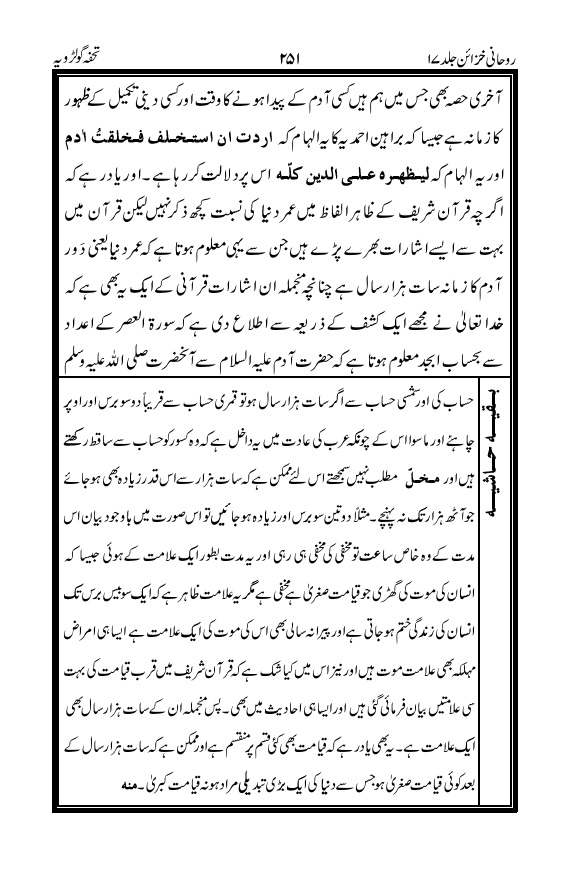
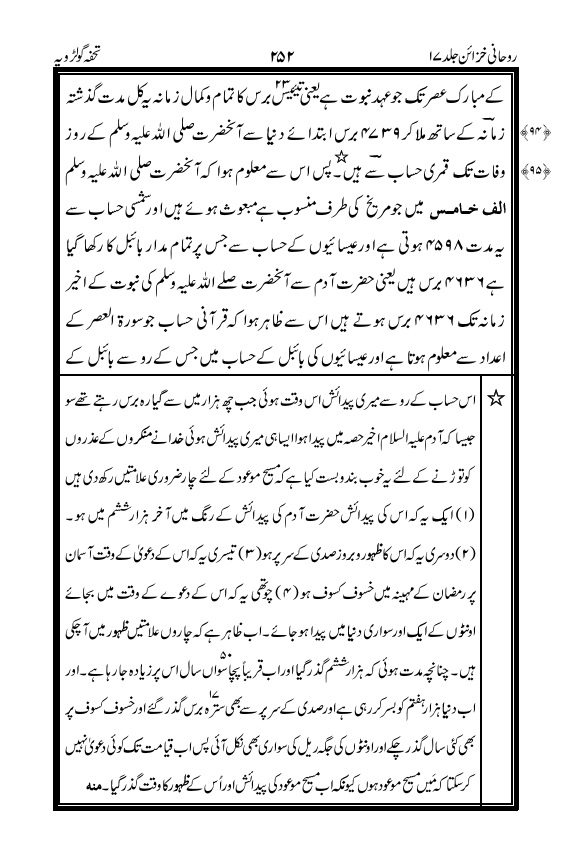
In case any devout apologist denies that in Mirza Ghulam Ahmad’s view the start of our universe and arrival of Adam to our planet happened at the same time, I am including another assertion of the same in the beginning of the following page:
Even a child can understand that Sahih and continuous Hadiths state that the age of this universe, that is from Hazrat Adam till the very end is declared to be seven thousand years.(cited as RK 17, p. 248)
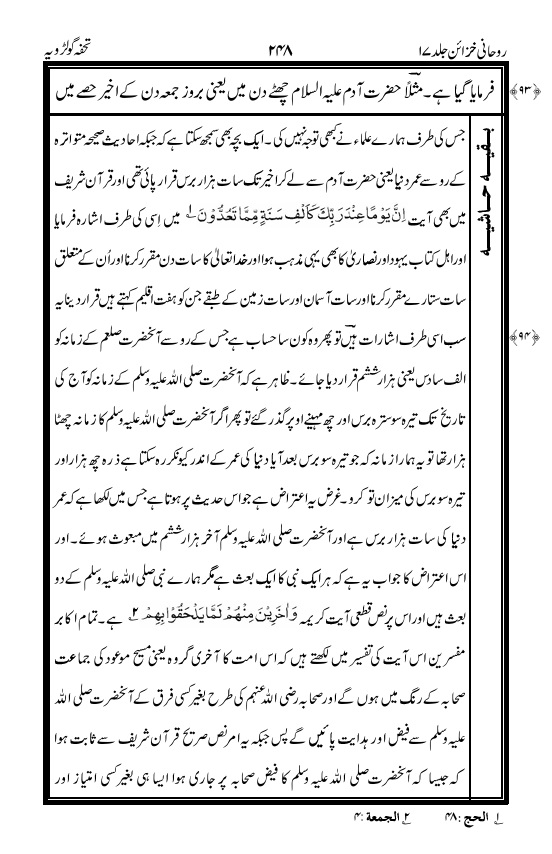
On the previous page he states the age according to the solar calendar in addition to the lunar calender:
“By the solar count, the period from Adam to the Holy Prophet… comes to 4598 years as disclosed by God Almighty to me.” (cited as RK 17, p. 247)
The Urdu page is shared as image again:
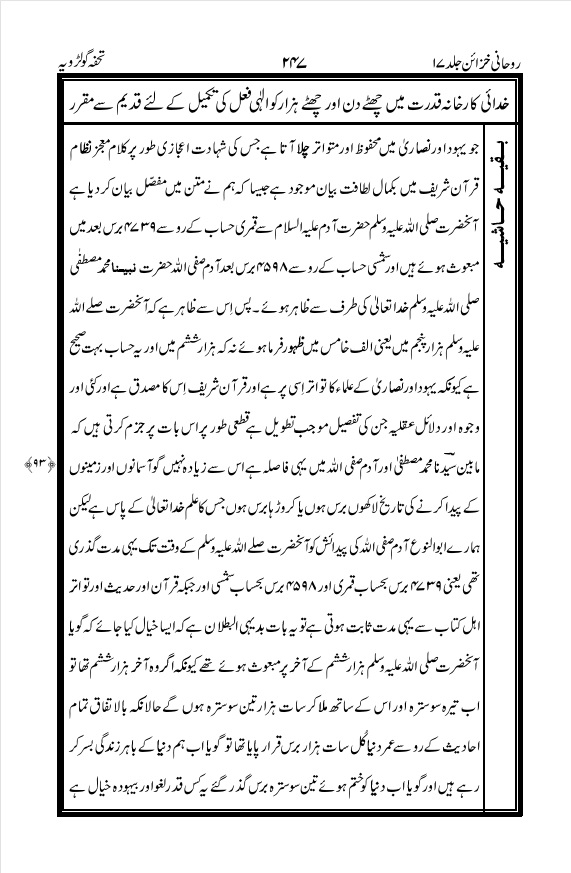
I have included the images of actual Urdu text again, so the readers, who know Urdu can verify that the translation is not misleading in any way.
From these references it is very apparent that Mirza Ghulam Ahmad’s view was the same as Young Earth Christians. They believe the Earth and universe were created by God between 6,000 and 10,000 years ago, based on a literal interpretation of the Book of Genesis. [1, 2]
Core Beliefs
- Six-Day Creation: Proponents believe God created everything in six literal, 24-hour days. [1, 2]
- No Pre-Fall Death: Adherents maintain that physical death, suffering, and disease entered the world only after Adam and Eve sinned, meaning there was no death or animal suffering for millions of years before humanity. [1, 2]
- The Global Flood: Major geological layers and the fossil record are interpreted as the result of Noah’s catastrophic worldwide flood rather than millions of years of uniformitarian geology. [1, 2]
- Rejection of Macroevolution: While microevolution (adaptation within a species) is accepted, common descent and biological evolution are rejected as contrary to scripture. [1, 2]
Origins and Organizations
- Modern Movement: While various historic theologians held recent creation views, the modern Young Earth creationism (YEC) movement gained major traction through the 1961 publication of The Genesis Flood by John Whitcomb and Henry Morris. [1, 2]
- Prominent Groups: The largest organizations promoting this viewpoint include Answers in Genesis (which operates the Creation Museum in Kentucky) and the Institute for Creation Research. [1, 2]
6. Malfuzat, vol. 10, p. 551 (1984 edition; other editions give p. 426). This comes from a conversation with an English visitor in Lahore in May 1908. Here, he seems to be contradicting what he had earlier written in his book Tohfa-e-Golarhviyyah in 1902:
“I do not believe this, nor do I follow the Torah in this matter, that this world had its beginning six or seven thousand years ago with the birth of Adam, and that there was nothing before that as if God was idle. Nor do I propose that the entire human race, which is present in different regions of the world at this time, is the progeny of that same last Adam. I believe that the human race was present even before this Adam, as is evident from the words of the Holy Quran… Khalifa means ‘Successor’. From this, it becomes clear that the creation existed even before Adam. Therefore, I cannot say if people of America and Australia, etc., are from the progeny of this last Adam or from the progeny of some other Adam.” alhakamalislam
B. The Khalifas and official commentary
Hakeem Noor-ud-Din (Khalifatul Masih I). I found no statement of his on the 7,000-year scheme that I could verify in the sources available to this research. This is a gap in the research, not evidence that he said nothing.
Mirza Bashiruddin Mahmud Ahmad (Khalifatul Masih II) and the Five Volume Commentary. The official alislam.org explanation of Adam follows the line of the Five Volume Commentary and Tafsir-e-Kabir on verse 2:31. It states:
“Adam lived about 6000 years ago. He is popularly believed to be the first man created by God on Earth. However, this view is wrong. The world has passed through different cycles of creation, and civilization, and Adam (peace be upon him), the progenitor of the present human race, is only the first link in the present cycle, and not the very first man in God’s creation. It does not, however, mean that the race, which lived before Adam (peace be upon him), was entirely swept away before he was born. Most likely, there had remained a small degenerated remnant of the old race and Adam (peace be upon him) was one of them. God then selected him to be the progenitor of a new race and the precursor of a new civilization.” alislamalislam
An Indian Ahmadiyya presentation of the Tafsir-e-Kabir commentary on 2:31 adds that Adam “was born from a father and mother” and therefore cannot be “the first man.” lightofislam
Mirza Tahir Ahmad (Khalifatul Masih IV), Revelation, Rationality, Knowledge and Truth (1998). This work accepts biological evolution as guided by God. A commonly cited summary describes that guidance as “more like a strategic game of chess than a game of dice.” The book treats Adam as the first person to receive revelation, not the first biological human. A widely circulated Ahmadiyya summary puts it this way: “Hadhrat Adam (as) was not the first human being, but was the first human being whose intellect was capable of accepting and bearing the responsibility of revelation.” This is a significant shift. The emphasis moves from a biological “race” with a 7,000-year lifespan to a spiritual and prophetic dispensation. The founder’s chronological claims, however, are not withdrawn.
A popular restatement on the official site. An article on alislam.org (Ch. Khalid Saifullah Khan, Al-Huda, Australia, March 1997) uses the 4,598-solar-year figure to compute that “Adam was born 5,985 years ago,” counting from 1997. That is roughly 3988 BCE.
C. The Lahore Ahmadiyya view
Maulana Muhammad Ali’s History of the Prophets (“Adam”) states:
“The Holy Quran does not state when Adam was born or how he was born; it does not even state that he was the first man. The great Muslim divine, Muhammad ibn Ali al-Baqir… is reported to have said that ‘millions of Adams passed away before our father Adam.’ Ibn Arabi… writes in his great work The futuhat, that forty thousand years before our Adam there was another Adam.” alahmadiyya
I found no Lahore Ahmadiyya restatement of the 7,000-year arithmetic itself. The Lahore emphasis falls on the theme of a humanity before Adam, drawing on Shi’i and Sufi precedents, rather than on the count of millennia.
D. Internal tensions, stated plainly
- “Common ancestor” vs. “not the first man.” Lecture Lahore says the “present human race originated from Adam, our common ancestor.” alhakam The Malfuzat says Ahmad “cannot say” whether Americans and Australians descend from “this last Adam or… some other Adam.” alhakam The alislam.org commentary has Adam emerge from a “degenerated remnant” of an older race. These are three different models:
- Adam’s descendants replaced the earlier humans;
- it is uncertain who descends from whom;
- Adam was chosen from within a continuing older population.
- The Quran “has mentioned it very clearly.” In fact, every derivation needs extra premises that the Quran does not supply:
- the “day = 1,000 years” equation, applied literally;
- a seventh day, which the Quran does not mention (it says six);
- an abjad calculation, which the Quran does not authorise.
- “Authentic ahadith” bear it out. As Part I shows, mainstream hadith critics graded the relevant reports very weak or fabricated.
- “Even the Christians and the Jews agree… the present millennium is the seventh.” The calendars of the time did not show this:
- In 1904 the Jewish calendar stood at about 5664–5665 AM, which is the sixth millennium.
- Ussher’s chronology put 1904 about 5908 years after creation, also in the sixth millennium.
- Only reckonings based on the Septuagint, such as Eusebius’s (about 5200 BCE for Adam), place 1904 later than that, and they put it in the eighth.
- “The world comes to an end” in this millennium vs. “the world must also be eternal as a species.” These fit together only if “world” means “this cycle.” That reading turns the scheme into a theory of repeated humanities, which is exactly what Part III tests.
Part III. Why History, Evolutionary Biology and Archaeology Give No Support
The doctrine makes three claims that can be tested:
- (i) a “present human race,” “new race,” or “new civilization” began with an Adam about 6,000 years ago (about 3988 BCE on the community’s own figure);
- (ii) human history comes in 7,000-year cycles, each with its own Adam;
- (iii) periods of “guidance” and “Satanic dominance” alternate by millennium.
Claim (iii) is a moral and theological reading and cannot strictly be tested. Still, it fits poorly with the actual “sixth millennium,” roughly 900–1880 CE. That was the age of Ibn Sina, al-Ghazali, Ibn Rushd, Rumi and Ibn Khaldun, and of the great Ottoman, Safavid and Mughal civilisations — hard to describe as a “dominance of Satan.” Claims (i) and (ii) are empirical, and the evidence weighs strongly against both.
1. Deep time is measured, not assumed
- Radiocarbon, calibrated against the international IntCal curve, reaches back about 55,000 years.
- Dendrochronology (counting overlapping annual tree rings) gives an unbroken calendar for about 12,000 years in Central Europe.
- Ice cores. The Greenland GICC05 timescale counts annual layers back about 60,000 years, and Antarctic cores reach back about 800,000 years.
- Lake varves (annual sediment layers), such as those of Japan’s Lake Suigetsu, span tens of millennia.
- Luminescence and uranium-series methods date sediments and cave deposits well beyond the range of radiocarbon.
These methods rest on different physics, and they agree with one another. None shows a break, reset or anomaly near 4000 BCE, or at 7,000-year intervals before it.
2. Anatomically modern humans are about 300,000 years old
The Jebel Irhoud fossils (Morocco) were dated by thermoluminescence to 315,000 ± 34,000 years. Hublin and colleagues described them in Nature (2017), and a companion dating paper by Richter, McPherron and colleagues appeared in the same issue. The fossils combine a modern face and teeth with a more archaic braincase. Florisbad (South Africa, about 260,000 years) and Omo Kibish (Ethiopia, about 233,000 years) show that Homo sapiens emerged across Africa as a whole.
Older still are Homo erectus (from about 1.9 million years ago) and the australopithecines (e.g., “Lucy,” about 3.2 million years). The earliest candidate hominins date to about 6–7 million years ago. On the doctrine’s own arithmetic, 300,000 years would contain about 43 successive 7,000-year “cycles.” Yet the anatomical and genetic record shows one continuous lineage, not dozens of separate humanities each founded by an Adam.
3. Genetics: one continuous, interbreeding population
- Mitochondrial “Eve” and Y-chromosome “Adam.” These are single lines of descent, not a single couple. Each is the most recent common ancestor of one stretch of DNA: mitochondrial DNA, inherited from the mother, and the Y chromosome, inherited from the father. The two lived tens of thousands of years apart, and both more than 100,000 years ago. Neither was the only human of their time.
- Effective population size. Reconstructions from whole genomes never show the human population falling to two. A 2023 Science paper (Hu et al.) analysed genomes from 3,154 present-day people and proposed the most severe bottleneck yet suggested. It found about 1,280 breeding individuals between about 930,000 and 813,000 years ago, a bottleneck that “lasted for about 117,000 years and brought human ancestors close to extinction.” In a companion Perspective, Nick Ashton and Chris Stringer cautioned that the idea “needs to be tested against the archaeological and fossil human evidence.” Even on this reading it was a population, not a couple, and it predates Homo sapiens. No method shows a bottleneck around 6,000 years ago.
- Interbreeding with archaic humans. Non-Africans carry about 1–2% Neanderthal DNA. Iasi, Chintalapati and colleagues (Science 2024) used 58 ancient and 275 present-day genomes to identify “a single extended period of Neanderthal gene flow that occurred ~47,000 years ago and lasted for ~7000 years,” that is, about 50,500–43,500 years ago. Sümer and colleagues (Nature 2024), using the earliest modern-human genomes from Ranis and Zlatý kůň, independently arrived at about 47,000 years ago. Melanesians and Aboriginal Australians also carry Denisovan ancestry. These signals pass continuously through the very populations the doctrine would assign to separate cycles.
- An honest nuance: genealogical vs. genetic ancestry. Mathematical modelling (Rohde, Olson and Chang, Nature 2004) suggests something surprising about family trees. Because they merge quickly, the most recent genealogical common ancestor of everyone alive today may have lived only a few thousand years ago. So a person living about 6,000 years ago could be a genealogical ancestor of all living humans without passing detectable DNA to most of them. This does not rescue the Ahmadiyya scheme as written, which speaks of a new “race” and “civilization” founded at that point. But it does mean that a purely genealogical, prophetic Adam about 6,000 years ago cannot be ruled out on logical grounds.
4. Archaeology: continuous occupation long before “Adam”
- Australia: occupation at Madjedbebe by about 65,000 years ago (Clarkson et al., Nature 2017). Some archaeologists accept only about 50,000.
- Sulawesi: a narrative cave painting of human-like figures and a pig, dated to at least 51,200 years ago (Oktaviana et al., Nature 2024). nihnih
- Chauvet Cave (France): paintings from about 36,000 years ago. Lascaux: about 17,000 years ago.
- The Americas: Monte Verde (Chile), about 14,500 years ago; the White Sands footprints (New Mexico), about 21,000–23,000 years ago.
- Göbekli Tepe (Türkiye): large enclosures of T-shaped stone pillars, built by hunter-gatherers from about 9600 BCE (about 11,600 years ago), according to radiocarbon work by Dietrich, Schmidt and colleagues.
- Jericho: the stone tower, built before pottery was in use, dates to about 8000 BCE. Çatalhöyük: about 7100–5900 BCE.
- Mehrgarh (Balochistan): farming from about 7000 BCE, in Ahmad’s own region of South Asia.
5. No break at about 4000 BCE
The community’s figure places Adam about 4,598 solar years before 610 CE, alislam that is, about 3988 BCE. That is strikingly close to Archbishop Ussher’s 4004 BCE. It is also exactly where the archaeological record is densest and most continuous:
- In Egypt, the Naqada culture runs without a break from about 4000 BCE into the First Dynasty (about 3100 BCE).
- In Mesopotamia, the Ubaid and Uruk periods lead directly into the earliest cuneiform writing (about 3300–3200 BCE).
- In the Indus region, the sequence runs from Mehrgarh through the Early Harappan period to the mature cities (about 2600 BCE).
- In China, Yangshao settlements span about 5000–3000 BCE.
In all these regions, pottery traditions, house forms, burial customs, domesticated crops and animals, and local genetic ancestry continue across 4000 BCE. Large regional population movements did occur, but they were gradual and drew on existing populations. None was a global new beginning.
6. No repeated extinctions and re-creations
If humanity had come in 7,000-year cycles, with each new Adam inheriting a “degenerated remnant,” we would expect signs that recur at roughly regular intervals:
- collapses of genetic diversity;
- breaks in technology;
- gaps in occupation across continents;
- turnovers in the shape of fossil skeletons.
The record shows something quite different. Africa’s Middle Stone Age technologies developed over hundreds of thousands of years. The later transitions — Upper Palaeolithic, Mesolithic, Neolithic — were gradual and happened at different times in different regions. They were driven by climate, population change and innovation. The end of the last Ice Age, about 11,700 years ago, matters far more than any 7,000-year rhythm. The one candidate “near-extinction,” about 900,000 years ago, is debated, happened only once, and predates Homo sapiens. There is no pattern of periodic resets at all.
Bottom line: the scheme’s concession that humans existed before Adam fits, in principle, with deep human antiquity. Its specific chronology — a new race and civilisation founded about 4000 BCE, within repeating 7,000-year humanities — has no support in history, evolutionary biology or archaeology.
Part IV. The Picture from Biology, Archaeology, History and World Literature
1. The scientific narrative
- Hominins split from the chimpanzee lineage about 6–7 million years ago. Upright-walking australopithecines flourished 4–2 million years ago, and the genus Homo appeared about 2.8–2.0 million years ago.
- Homo erectus spread across Africa and Eurasia from about 1.9 million years ago. The use of fire is attested by at least about 1 million years ago.
- Homo sapiens emerged across Africa by about 300,000 years ago, through networks of connected populations. Symbolic behaviour — ochre, shell beads, engraved patterns — is evident by about 100,000–75,000 years ago at sites such as Blombos Cave.
- Out of Africa. All living non-Africans descend from a main dispersal about 60,000–50,000 years ago. These people:
- interbred with Neanderthals about 47,000 years ago, and with Denisovans in Asia;
- reached Sahul (Australia and New Guinea) by 65,000–50,000 years ago;
- reached the Americas by at least about 20,000 years ago;
- were painting figurative art by about 51,200 years ago.
- The Neolithic. After the last Ice Age, agriculture was invented independently in at least 7–10 centres. These include the Fertile Crescent (about 11,500 years ago), China, New Guinea, Mesoamerica, the Andes, the African Sahel and eastern North America. Monumental ritual architecture (Göbekli Tepe) came before full farming, and permanent villages grew into towns. aminext
- Writing and states. Writing was invented about 3300–3200 BCE in Mesopotamia and Egypt. It was invented later, and independently, in China (about 1200 BCE) and Mesoamerica (about 600 BCE). “History” in the documentary sense is therefore only about 5,000 years old — less than 2% of our species’ existence.
This last point helps explain the appeal of a “6,000-year humanity.” Written memory reaches back only about that far, so a chronology built from texts will naturally stop at about 4000 BCE. Several traditional starting points all cluster near the dawn of writing:
- Ussher’s creation date (4004 BCE);
- the Jewish Anno Mundi (3761 BCE);
- the traditional start of the Kali Yuga (3102 BCE);
- the zero date of the Maya Long Count (3114 BCE);
- the Ahmadiyya Adam (about 3988 BCE).
They mark the edge of remembered history, not the origin of humanity.
2. How world literatures conceive ages and cycles
- Hindu yugas and kalpas. Four yugas — Krita (Satya), Treta, Dvapara and Kali — each shorter and less virtuous than the one before. A full cycle of four (mahayuga) lasts 4.32 million years. A kalpa, one day of Brahma, is 1,000 mahayugas, or 4.32 billion years. By tradition, the Kali Yuga began in 3102 BCE. This is the most expansive cyclical cosmology in world literature.
- Zoroastrian world history. The Bundahishn describes 12,000 years in four phases of 3,000 years, with Zarathustra appearing at the start of the last. Saviour figures born after his death (Ushedar, Ushedarmah, Saoshyant) appear at successive millennia. This is the closest parallel in structure to a millennium-by-millennium alternation of good and evil that ends with a final saviour.
- Greek. Hesiod’s Works and Days describes five ages: gold, silver, bronze, heroes and iron. Plato’s Timaeus describes periodic floods and fires that wipe out civilisations. The Stoics taught that the world is periodically consumed by fire (ekpyrosis) and then recurs, endlessly.
- Mesopotamian. The Sumerian King List assigns the kings before the Flood reigns totalling 241,200 years in the standard Weld-Blundell version, then much shorter reigns after it. It is an early model of distinct ages “before and after.”
- Maya. The Long Count measures a world-age of 13 bak’tuns (about 5,125 years) from 3114 BCE. Its completion in December 2012 prompted modern apocalyptic speculation that has no basis in Maya texts.
- Jewish and Christian. The world-week (Part I), the rabbinic Anno Mundi (beginning 3761 BCE), the six ages of Augustine and Bede, and Ussher’s Annales (1650), with creation in 4004 BCE.
- Islamic. Muslim chronographers (al-Tabari, Ibn Qutayba, al-Mas’udi, al-Maqdisi) inherited the biblical framework and disagreed widely on its numbers. Isma’ili and Ikhwan al-Safa’ cosmologies developed cycles (dawr, kawr) of prophets and imams. Some Sufi and Shi’i traditions (Ibn ‘Arabi, al-Baqir) taught that there were earlier Adams.
- Ibn Khaldun’s Muqaddimah (1377) offers a naturalistic cycle. Dynasties rise on group solidarity (‘asabiyya), grow soft in luxury, and fall within about three to four generations, roughly 120 years. It is a cycle of social science, not of cosmology.
3. Where the 7,000-year doctrine fits
Mirza Ghulam Ahmad’s scheme is an inventive combination of five sources:
- the Judaeo-Christian world-week, which supplies the structure of seven thousand-year periods;
- a Zoroastrian-like alternation of good and evil millennia;
- Sufi and Shi’i “many Adams” traditions, which supply the humanity before Adam and the idea of cycles;
- abjad numerology, which supplies the date of Adam;
- a modern apologetic aim: answering the Christian picture of a God idle before creation, and the Arya Samaj critiques, with a God who creates eternally.
Its forward-looking element was its explicit rejection of a 6,000-year-old world and a 6,000-year-old humanity, which put it ahead of many of its contemporaries. Its weak point was that it kept a calendar derived from scripture for the “present race,” at the very moment when geology, palaeontology and later genetics were dissolving such calendars.
Epilogue: Revelation, Interpretation, and the Testimony of Stones
The history traced here is, at bottom, a history of interpretation under pressure. A verse about divine patience — “a day with thy Lord is as a thousand years” — was turned into a key for converting sacred time into calendar time. Rabbis, Church Fathers, some Muslim chronographers and, finally, the founder of the Ahmadiyya movement all used it that way. Each conversion produced a date, and each date expired: the anxieties of 1000 AH, Ibn al-Qayyim’s “251 years remaining,” al-Suyuti’s limit of 1500 AH. The hadith critics saw the danger first. Their objection was theological: a tradition that lets anyone calculate the Hour cannot be faithful to a revelation that reserves that knowledge to God.
Mirza Ghulam Ahmad’s contribution cuts both ways. Against the Christian chronologists of his day, he insisted that God “has ever been the Creator,” that “this Adam was not the first man,” and that Americans and Australians might descend from “some other Adam.” Later fossils and genomes would broadly vindicate those intuitions. Yet he joined that openness to an exact numerical chronology drawn from abjad and the world-week, and made it a proof of his own mission. That chronology cannot survive contact with Jebel Irhoud, Madjedbebe, Sulawesi, Göbekli Tepe, or the unbroken year-by-year archives of trees, ice and lake mud.
For a physician and teacher, the lesson may be familiar from clinical reasoning: a strong prior should yield to independent lines of evidence that converge. When an interpretation of a text conflicts with what the world shows, it is usually the interpretation that needs revising — not the text, and not the world. Shuaib Ally of SeekersGuidance puts the classical principle well: “revealed texts are interpreted in a manner that accords with known facts, not in ways that contradict them.” Read that way, the Quran’s silence on the age of humanity is not a gap to be filled with numerology. It is a restraint that leaves the deep past to be read, as the Quran itself urges, by those who “travel through the earth and see how He originated creation” (29:20). The stones, bones and genomes have now been read. They tell a story far longer than seven thousand years, and people of faith can still hear it as part of creation’s testimony.





Leave a Reply