
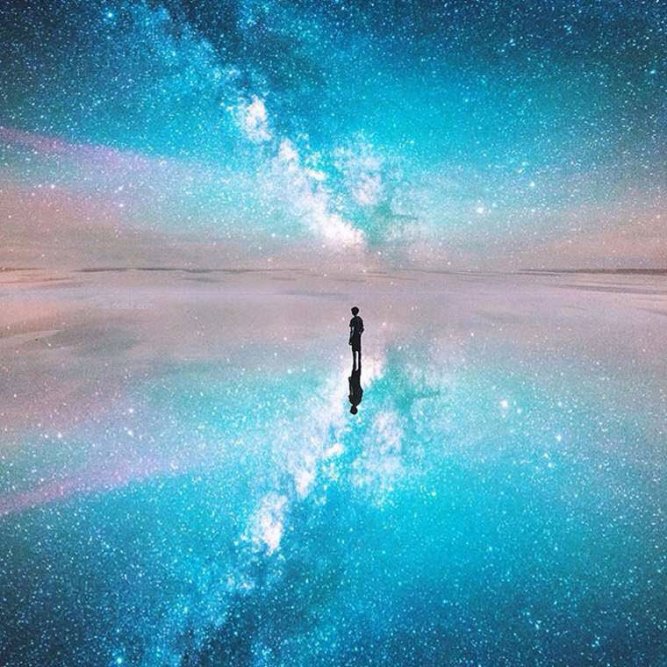
Presented by Gemini by Zia H Shah MD
Qur’an 14:48 describes the cosmos being transformed into “another earth” and other heavens, not simply wiped out. That makes the verse fit the open questions of modern cosmology better than either a bare “heat death” or a bare “Big Crunch.” Physics can describe how this universe decays or collapses. It cannot describe what God makes of it next, and that is the point the verse addresses.
- The verse teaches transformation, not just annihilation. The verb tubaddalu (“will be changed/replaced”) and the phrase ghayra al-arḍ (“other than the earth”) led to a long classical debate: is the change one of essence (dhāt) or of attributes (ṣifāt)? The leading exegetes left both meanings open. Muhammad Asad says plainly that Qur’anic eschatology means “fundamental, cataclysmic transformation,” not “reduction to nothingness.”
- Science is less sure how the universe ends than it was a few years ago. The standard picture is a Big Freeze, driven by dark energy (roughly 68–69% of the cosmic energy budget). DESI’s 2024–2025 data hint that dark energy is weakening (2.8–4.2σ, below the 5σ discovery threshold), and this has brought recollapse back into serious discussion. One Cornell model gives the universe a total lifespan of about 33 billion years. Whichever ending holds, physics describes the end of this order and cannot rule out a new one.
- The verse’s main weight is theological and ethical. When creation dissolves, everyone stands “fully exposed” (barazū) before “the One, the Prevailing” (al-Wāḥid al-Qahhār). Higher-dimensional physics (string/M-theory, brane-worlds) offers a useful but unproven way to picture “another earth” as a reality with different dimensions. It is offered here as illustration, not proof.
1. Abstract
Sūrat Ibrāhīm 14:48 closes a Meccan warning about divine justice with an image of cosmic re-creation: “On the Day the earth will be changed into another earth, and the heavens [as well], and they will come forth before Allah, the One, the Prevailing.” quran This commentary reads the verse at three levels.
- Textually, it compares ten English translations, starting with Muhammad Asad. It looks at how translators render tubaddalu, ghayra al-arḍ, barazū and al-Qahhār.
- Exegetically, it reviews the classical tafsīr tradition (al-Ṭabarī, al-Zamakhsharī, al-Rāzī, al-Qurṭubī, Ibn Kathīr) and its central question: is the change one of essence or of attributes? It also covers the prophetic reports: the “white, pure earth like a loaf of bread,” ʿĀʾisha’s question about where people will be (answer: “on the Ṣirāṭ”), and the same question put by a rabbi.
- Scientifically and philosophically, it sets the verse beside current cosmology: the Big Freeze, the Big Crunch revived by DESI, the Big Rip, vacuum decay, Penrose’s conformal cyclic cosmology and Dyson’s “Time Without End.” It takes up contingency, entropy, the kalām argument, re-creation and personal identity, and the question of cosmic meaning.
Finally, it develops Zia H. Shah’s thesis that the Qur’an points to a new, possibly higher-dimensional order rather than mere extinction. The conclusion is that 14:48 opens a “new dimension” in two senses. One is a re-created cosmos that physics can neither confirm nor rule out. The other is a moral dimension in which every soul is made fully visible before the One God.
2. The Verse: Text and Transliteration
Arabic (Uthmani script):
يَوْمَ تُبَدَّلُ ٱلْأَرْضُ غَيْرَ ٱلْأَرْضِ وَٱلسَّمَـٰوَٰتُ ۖ وَبَرَزُوا۟ لِلَّهِ ٱلْوَٰحِدِ ٱلْقَهَّارِ alimalim
Transliteration: Yawma tubaddalu al-arḍu ghayra al-arḍi wa-s-samāwātu, wa barazū li-llāhi al-Wāḥidi al-Qahhār.
| Arabic | Transliteration | Gloss |
|---|---|---|
| يَوْمَ | yawma | (On the) Day |
| تُبَدَّلُ | tubaddalu | will be changed / exchanged / replaced (passive, Form II of b-d-l) |
| ٱلْأَرْضُ | al-arḍu | the earth |
| غَيْرَ ٱلْأَرْضِ | ghayra al-arḍi | (into) other than the earth |
| وَٱلسَّمَـٰوَٰتُ | wa-s-samāwātu | and the heavens (plural) |
| وَبَرَزُوا۟ | wa barazū | and they will come forth / emerge into full view (past tense used for a certain future) |
| لِلَّهِ | li-llāhi | before / unto God |
| ٱلْوَٰحِدِ | al-Wāḥidi | the One |
| ٱلْقَهَّارِ | al-Qahhāri | the Prevailing, the Irresistible, the All-Subduing |
3. Ten English Translations (Asad First)
The requested source, IslamAwakened’s comparison page (https://islamawakened.com/quran/14/48/translations/), blocked automated retrieval. Each rendering below was therefore checked against IslamAwakened’s summary listing and against mirror compilations: Alim.org, Quran.com, MyIslam, QuranLang and quran.wwpa.com.
- Muhammad Asad (The Message of the Qur’an, 1980): “[His promise will be fulfilled] on the Day when the earth shall be changed into another earth, as shall be the heavens, and when [all men] shall appear before God, the One who holds absolute sway over all that exists.” islamawakenedalim
- Abdullah Yusuf Ali (1934): “One day the earth will be changed to a different earth, and so will be the heavens, and (men) will be marshalled forth, before Allah, the One, the Irresistible;” myislamdeen
- Marmaduke Pickthall (1930): “On the day when the earth will be changed to other than the earth, and the heavens (also will be changed) and they will come forth unto Allah, the One, the Almighty,” wwpaalim
- Sahih International (1997): “[It will be] on the Day the earth will be replaced by another earth, and the heavens [as well], and all creatures will come out before Allah, the One, the Prevailing.” githubquran
- M. A. S. Abdel Haleem (Oxford, 2004): “One Day—when the earth is turned into another earth, the heavens into another heaven, and people all appear before God, the One, the Overpowering—” myislam
- A. J. Arberry (The Koran Interpreted, 1955): “Upon the day the earth shall be changed to other than the earth, and the heavens and they sally forth unto God, the One, the Omnipotent.” islamawakenedinoor
- M. H. Shakir: “On the day when the earth shall be changed into a different earth, and the heavens (as well), and they shall come forth before Allah, the One, the Supreme.” wwpainternetmosque
- Maulawi Sher Ali (Ahmadiyya): “On the day when this earth will be changed into another earth, and the heavens too; and they will appear before ALLAH, the One, the Most Supreme.” quranlang
- Mustafa Khattab (The Clear Quran, 2015): “˹Watch for˺ the Day ˹when˺ the earth will be changed into a different earth and the heavens as well, and all will appear before Allah—the One, the Supreme.” quranquran
- Seyyed Hossein Nasr et al. (The Study Quran, 2015): “On that Day the earth shall be changed into other than the earth, and the heavens [too], and they will appear before God, the One, the Paramount.” quranlang
Other renderings worth noting:
- Hilali–Khan: “…will appear before Allah, the One, the Irresistible.” wwpainternetmosque
- Amatul Rahman Omar (Ahmadiyya): “Beware of the day when this earth will be changed into another earth and the heavens (as well shall be superseded by other heavens).” wwpa
- Muhammad Sarwar: “the earth and the heavens will be replaced by another earth and heavens.” wwpainternetmosque
- George Sale (1734): “men shall come forth from their graves to appear before the only, the mighty God.” quranWikipedia
- Mawdūdī: “the heavens and the earth shall be altogether changed; when all will appear fully exposed before Allah.” myislam
4. Translation Notes: What the Differences Reveal
a) Tubaddalu: “changed,” “turned into,” or “replaced”? The root b-d-l covers both alteration and substitution.
- Most translators (Asad, Yusuf Ali, Pickthall, Arberry, Shakir, Sher Ali, Khattab, Nasr) write “changed.” This keeps the ambiguity of the Arabic open.
- Abdel Haleem’s “turned into” stresses metamorphosis.
- Sahih International (“replaced by“) and Sarwar lean toward substitution. Amatul Rahman Omar’s “superseded” goes further still.
In effect, each choice quietly takes a side in the classical dhāt/ṣifāt debate (Section 6).
b) Ghayra al-arḍ: “another earth” or “other than the earth”?
- Pickthall, Arberry and Nasr keep the literal “other than the earth,” which stresses that the new earth is not this one.
- “Another earth” (Asad, Abdel Haleem, Sahih International, Sher Ali) and “a different earth” (Yusuf Ali, Shakir, Khattab) stress continuity of kind: it is still an earth, a ground to stand on.
The Arabic holds both at once. That tension between continuity and discontinuity is the philosophical heart of the verse.
c) The heavens. The Arabic adds wa-s-samāwāt by ellipsis, without repeating the verb. Abdel Haleem (“the heavens into another heaven”) and Sale (“into other heavens”) spell out what is implied. The transformation is cosmic, not only planetary.
d) Barazū. Baraza means to come out into open, unobstructed view; a barāz is an open plain. The classical glosses agree:
- Al-Tafsīr al-Muyassar: creatures “come out of their graves alive, made manifest (ẓāhirīn), to meet God.” surahquransurahquran
- Al-Saʿdī: they emerge “in a place where nothing of them is hidden from God.” surahquransurahquran
- The past tense used for a future event is a known Qur’anic way of signalling that the event is certain.
e) Al-Qahhār. Translators give “Irresistible,” “Almighty,” “Omnipotent,” “Supreme,” “Overpowering,” “Prevailing,” “Paramount” and “the Subduer.” Wikipedia Asad’s “the One who holds absolute sway over all that exists” is the most theologically explicit: qahr here means sovereignty over existence itself.
f) Asad’s commentary. Asad alone opens with “[His promise will be fulfilled],” which ties the verse to 14:47 (“do not think that God will fail to fulfil the promise which He gave to His apostles”). rahnuma Al-Zamakhsharī made the same grammatical point. He read yawma either as a substitute (badal) for the “Day” of 14:44 or as the time-frame of the retribution in 14:47. islamweb
Asad’s note 63 on this verse reads, in part: “This is an allusion to the total, cataclysmic change, on the Last Day, of all natural phenomena, and thus of the universe as known to man… Since that change will be beyond anything that man has ever experienced or what the human mind can conceive, all the Qur’anic descriptions—in the next two verses as well as in many other places—of what is to happen on that Last Day” must be understood allegorically. alim
His note 90 on 20:105–107 cites 14:48 by name: “In the eschatology of the Qur’an, the ‘end of the world’ does not signify an annihilation—i.e., reduction to nothingness—of the physical universe but, rather, its fundamental, cataclysmic transformation into something that men cannot now visualize. This is brought out in many allegorical allusions to the Last Day, e.g., in 14:48.” alim
That is the anchor for this commentary’s thesis: the Qur’an’s end-time is a transformation, not a deletion.
5. Context Within Sūrat Ibrāhīm
Sūrat Ibrāhīm is a late Meccan sura. Wikipedia Its closing section (14:42–52) answers an implied complaint: why do oppressors prosper? The answer is that judgment is deferred, not denied. God “only gives them respite until a Day when eyes will stare in horror” (14:42), and He will not break His promise to His messengers (14:47). Verse 48 names the setting of that Day. Verses 49–50 then describe the guilty “bound together in fetters.” thelastdialogue
Earlier in the sura, 14:19 prepares the ground: “Do you not see that God created the heavens and the earth in truth? If He wills, He can do away with you and bring a new creation.” muslimconverts A God who created “in truth” (bi-l-ḥaqq) can also re-create, so injustice does not get the last word.
6. Classical Tafsīr: Essence or Attributes?
6.1 Al-Rāzī frames the debate
In Mafātīḥ al-Ghayb, Fakhr al-Dīn al-Rāzī (d. 1210) writes: “Tabdīl admits two meanings: either the essence (al-dhāt) remains and its attribute is exchanged for another, or the first essence passes away (tafnā) and another essence comes into being.” He gives examples of each: quran-tafsir
- Change of form: “I changed the ring into a signet,” meaning it was melted and recast. surahquran Compare 25:70: God “will change their evil deeds into good deeds.” quran-tafsir
- Change of substance: “I changed the dirhams into dinars.” Compare 4:56 (“We shall replace their skins with other skins”) surahquran and 34:16 (“two other gardens”). quran-tafsir
He then reports the two camps:
- Change of attributes. He attributes this to Ibn ʿAbbās: “It is that same earth, except that its attributes are altered: its mountains are moved away, its seas burst forth, it is levelled so that no crookedness or curvature is seen in it.” He adds a report from Abū Hurayra that God “stretches it like the stretching of ʿUkāẓī leather.” The heavens change through “the scattering of their stars, their splitting, the folding-up of their sun, the eclipse of their moon.” quran-tafsir
- Change of essence. He attributes this to Ibn Masʿūd: “an earth like pure white silver, upon which no blood has been shed and no sin committed.” quran-tafsirsurahquran
Al-Rāzī reports an argument some made for the first view: “the earth will be changed” assumes there is still an earth to undergo the change. He links that view to theologians who held that at the Resurrection God “does not annihilate essences and bodies, but only their attributes and states.” He then offers his own tentative suggestion: “It is not far-fetched to say that the changing of the earth and heavens means God makes the earth Jahannam and the heavens the Garden.” He cites 83:7 and 83:18 in support. quran-tafsir
6.2 Al-Ṭabarī, al-Zamakhsharī, al-Qurṭubī, Ibn Kathīr
- Al-Ṭabarī (d. 923) records the disagreement.
- One group held that the earth becomes “a white earth like silver.” Ibn Masʿūd described “a white, pure earth upon which no sin has been committed… barefoot, naked, standing, bridled by their sweat.” Mujāhid said: “an earth as if of silver, and the heavens likewise.” islamwebislamweb
- Another group, through al-Rabīʿ ibn Anas from Kaʿb, held that “the heavens will become gardens and the place of the sea will become fire.” islamweb
- Al-Zamakhsharī (d. 1144), al-Kashshāf: “the Day this earth you know is exchanged for another earth… Tabdīl is alteration (taghyīr), and it may be in essences, as when you say ‘I changed the dirhams into dinars’.” He cites ʿAlī (“an earth of silver and heavens of gold”) and al-Ḍaḥḥāk. He also notes a variant reading, nubaddilu: “We change.” islamweb Al-Bayḍāwī, who largely follows him, concludes: “the verse admits both” (wa-l-āya taḥtamiluhumā). islamweb
- Al-Qurṭubī (d. 1273) says “many people” held the change to be one of attributes: hills levelled and the land stretched out. He classifies ʿAlī’s report as “a change of the very substance (tabdīl li-l-ʿayn).” surahquran The attributions conflict: al-Rāzī places Ibn ʿAbbās in the attributes camp, while al-Qurṭubī quotes him for “an earth of white silver.” ksu
- Ibn Kathīr (d. 1373): the promise is fulfilled “on the Day the earth will be changed to an earth other than this earth that we know and recognize.” alim Later, al-Saʿdī states flatly: “this change is a change of attributes, not of essence.” surahquransurahquran Ibn Ḥajar records the issue as a genuine disagreement among the salaf. blogspot
Assessment. The tradition never settled the question. Al-Zamakhsharī, al-Bayḍāwī and al-Rāzī judged that the verse admits both readings. Muftī Muḥammad Shafīʿ’s Maʿārif al-Qurʾān combines them in sequence: the earth’s features change at the first trumpet, and people are then moved to another earth for the reckoning. quran The Qur’an commits to radical change with some continuity, not to a particular physical mechanism.
6.3 The prophetic reports
- Sahl ibn Saʿd (Bukhārī and Muslim): “On the Day of Resurrection people will be gathered on a white earth, reddish-white, like a loaf of pure flour (qurṣat al-naqī), with no landmark on it for anyone.” ksusurahquran
- Abū Saʿīd al-Khudrī (Bukhārī and Muslim): “The earth will be a single loaf of bread which the Compeller (al-Jabbār) will turn over in His hand as one of you turns over his bread on a journey, as hospitality for the people of Paradise.” hadithanswerssurahquran
- ʿĀʾisha (Muslim; Tirmidhī, ḥasan ṣaḥīḥ; Ibn Mājah): “I was the first of people to ask the Messenger of God about this verse… Where will people be on that Day? He said: ‘On the Ṣirāṭ.’” quranoquranx Another version reads: “You have asked me about something no one of my community has asked me about before: people will be on the bridge over Jahannam.” surahquran
- Thawbān (Muslim): A Jewish rabbi asked, “Where will people be on the Day the earth is changed into other than the earth, and the heavens?” The Prophet replied: “They will be in darkness, short of the bridge (fī al-ẓulma dūna al-jisr).” surahquran The rabbi went on to ask other questions, including about the child’s resemblance to its parents. He ended: “You have spoken the truth, and you are indeed a prophet.” islamqaksu
- Jābir (al-Ḥākim): “The earth will be stretched like leather.” quranblogspot
What the hadith add.
- During the transition, people are not on this earth at all. They are on the Ṣirāṭ, a threshold between orders of reality.
- The new ground has no landmarks, so human property and monuments are gone.
- The images of “bread” and “silver” suggest a change of substance and of purpose.
All three fit the idea of a passage from one order of being to another.
7. The Qur’anic Constellation
Dissolution of the present order:
- The sun “folded up,” the stars falling, until “every soul will know what it has brought” (81:1–14).
- The sky cleft and the graves overturned (82:1–4).
- The earth “stretched out,” casting out what is within it (84:1–5).
- The earth “yields up its burdens” and “relates its news” (99).
- The earth left “a level, barren plain, in which you see no crookedness or curvature” (20:105–107).
- The mountains crumbled to “scattered dust” (56:4–6).
- The heaven heaving and the mountains moving away (52:9–10).
Cosmic folding and re-creation:
- “On the Day We roll up the heavens like the rolling up of a scroll for writings: as We began the first creation, so shall We repeat it” (21:104). al-islamgoodreads
- “The heavens rolled up in His right hand” (39:67). surahquran
- “God originates creation and then repeats it… then God will bring forth the later creation” (29:19–20).
- “We are surely expanding it” (51:47).
- The heavens and the earth were “a joined mass, and We split them apart” (21:30).
Only God remains:
- “All that is on it will perish; and there remains the Face of your Lord” (55:26–27).
- “Everything perishes except His Face” (28:88).
- The closest parallel to 14:48, with the same root b-r-z and the same two divine names: “The Day they come forth (bārizūn)… ‘Whose is the kingdom this Day?’ ‘God’s, the One, the Prevailing’” (40:16).
Paradise: “a Garden whose breadth is the heavens and the earth” (3:133; 57:21). thequran
The overall movement runs from dissolution, to repetition of creation, to God alone remaining, to a Paradise as wide as the heavens and the earth.
8. Scientific Perspectives: How Does a Universe End?
8.1 The Big Freeze (heat death)
In the leading scenario, expansion continues forever and ends in a heat death: no thermodynamic free energy, maximum entropy, and no further processes. skyatnightmagazineWikipedia Accelerating expansion was discovered in 1998. CNN Perlmutter, Schmidt and Riess received the 2011 Nobel Prize “for the discovery of the accelerating expansion of the Universe through observations of distant supernovae.” thequran The acceleration is attributed to dark energy, roughly 68–69% of the energy density in ΛCDM. theconversation Older figures such as 73% reflect estimates made before the Planck mission. thequran
Tamara Davis’s widely republished timeline:
- Galaxies beyond our Local Group fade from view in about 100 million years. theconversation
- Star formation stops in about 1–100 trillion years. thequran
- The last stars burn out at about 120 trillion years. thequran
- Most remnants are swallowed by supermassive black holes by about 10²⁰ years. phys
- If protons decay, ordinary matter is gone by about 10⁴⁰ years. phys
- Black holes evaporate through Hawking radiation after some 10¹⁰⁰ years. phys
What remains is “nearly a vacuum,” cold and dark. phys Shah set this scenario beside 46:3 (“We have not created the heavens and the earth… but with truth and for an appointed term“) in “The Big Freeze and the Holy Qur’an.” He argued that the Qur’an spoke of a finite cosmos at a time when elite philosophy held the universe to be eternal. thequranthequran
8.2 The Big Crunch, revived by DESI
In a Big Crunch, gravity wins: expansion reverses, galaxies merge, temperatures soar, and everything collapses toward a singularity. dailygalaxyepfl After 1998 this looked all but excluded. CNN
The Dark Energy Spectroscopic Instrument (DESI) reopened the question.
- April 2024: first-year results hinted that dark energy is not constant. NPR
- March 2025: DR2 used three years of data on nearly 15 million galaxies and quasars. lbl Combined with CMB, supernova and weak-lensing data, it gave a preference for evolving dark energy of 2.8σ to 4.2σ, depending on the supernova sample. noirlab
- Seshadri Nadathur (DESI): “It’s not just that the data continue to show a preference for evolving dark energy, but that the evidence is stronger now than it was.” lbl
- Mustapha Ishak (DESI co-chair) told NPR that dark energy appears to be weakening while matter is not, which bolsters the case for a crunch. NPR
Two further developments followed:
- Henry Tye (Cornell) and collaborators, in the Journal of Cosmology and Astroparticle Physics, fitted DES and DESI data with an ultralight-axion model. The fit implies a negative cosmological constant. The universe would reach its maximum size in about 11 billion years and collapse at a total age of about 33.3 billion years. Tye: “For the last 20 years, people believed that the cosmological constant is positive, and the universe will expand forever. The new data seem to indicate that the cosmological constant is negative, and that the universe will end in a big crunch.” researchgate +2
- A Yonsei University team (CNN, November 2025) argued that supernova brightness is biased by the age of the progenitor stars. If so, acceleration may already have stopped. Young-Wook Lee: “Even two years ago, the Big Crunch was out of the question.” CNNdailygalaxy
Calibration. None of these results reaches 5σ. noirlab Critical reviews find DR2 favours dynamical dark energy at about 3σ or less for most dataset combinations, and they note tensions between datasets. arxiv +3 Tye’s figure comes from one model and is not a measurement. Overall, the Big Freeze remains the default, but the fate of the universe is again an open question. sacerdotussentinelmission
Shah argued in June 2025 that the image of the heavens being “rolled up” in 21:104 sits more naturally with collapse followed by renewal. thequranthequran The DESI results make that reading more defensible, though it remains unproven.
8.3 The Big Rip and vacuum decay
- Big Rip. If dark energy strengthens (“phantom” energy, w < −1), expansion would eventually tear apart galaxies, atoms and finally spacetime. theconversation +2 DESI’s trend toward weakening dark energy points away from this.
- Vacuum decay. Our vacuum may be only metastable; Higgs and top-quark measurements suggest it is. If so, a bubble of “true vacuum” could expand at nearly light speed and rewrite the laws of physics inside it. sentinelmission The expected lifetime is vastly longer than the universe’s present age.
Vacuum decay is the closest physical analogue to tubaddalu al-arḍu ghayra al-arḍ. The same spacetime would acquire different laws, a change of ṣifāt so total that the result is “other than” what came before. The analogy is illustrative only: physics describes a blind catastrophe, while the Qur’an describes a purposeful re-creation.
8.4 Transformation after heat death: Penrose and Dyson
- Roger Penrose’s Conformal Cyclic Cosmology (CCC). After all mass has decayed and every black hole has evaporated, the universe “forgets” scale. Its infinitely expanded future can then be rescaled into the Big Bang of a new aeon, so the heat death of one universe becomes the birth of the next. Penrose has claimed signatures of a previous aeon in the cosmic microwave background (“Hawking points” and concentric rings). Other researchers find these consistent with ΛCDM, and CCC remains contested. physicsforumsphysicsworld
- Freeman Dyson, “Time Without End” (Reviews of Modern Physics 51, 1979, pp. 447–460). In an open universe, “life and communication can continue for ever, utilizing a finite store of energy, if the assumed scaling laws are valid.” He concluded: “In the open cosmology, history has no end.” Dyson later acknowledged that “in an accelerated universe everything is different,” because a residual horizon temperature defeats his strategy. semanticscholar +2
Penrose shows that physics itself can describe a heat-dead universe turning into a new one, a naturalistic shadow of “another earth.” Dyson shows how hard it is for anything in this order to secure an endless future by itself. Endlessness, if it comes, must be given by God.
9. “Another Earth” and Extra Dimensions: Shah’s Thesis
9.1 The thesis
This section builds on Zia H. Shah’s writings in the “Extra Dimensions” category at The Glorious Quran and Science. Physical cosmology describes the decay (Big Freeze) or collapse (Big Crunch) of this universe. Qur’an 14:48 describes the earth and heavens changed into another earth and other heavens. That points to transformation or new creation, possibly into a reality with more dimensions, not to mere annihilation. The verse “opens a new dimension”: the Day may come before or after the Freeze or the Crunch, and its claim concerns what lies beyond either.
9.2 The physics and scripture Shah draws on
Sources include “The Quranic Paradise and the Extra Dimensions of Our Universe,” “From Our Expanding Universe to the Extra-Dimensions,” “The Architecture of Omniscience” and “Omnipresence, Omniscience, and Extra Dimensions.” thequran
Physics:
- From Kaluza–Klein to string theory. Extra dimensions can be compactified, curled up too small to see. Superstring theory needs ten dimensions and M-theory eleven. thequran The extra dimensions are “everywhere,” curled up at every point. Wikipediathequran
- Brane cosmology. Our universe would be a 3-brane in a higher-dimensional “bulk.” Gravity leaks into the bulk, which could explain why it is so weak. thequran +2
- ADD large extra dimensions (1998). Arkani-Hamed, Dimopoulos and Dvali proposed extra dimensions large enough to be tested through missing energy at colliders, micro black holes, and deviations from the inverse-square law. thequran
- Flatland. A lower-dimensional being cannot perceive a higher dimension, even one present everywhere. thequranthequran
Scripture:
- 3:133 and 57:21. A Paradise “as wide as the heavens and the earth” yet unseen is naturally placed “in totally separate dimensions.” thequranthequran
- Bukhārī 6488. “Paradise is closer to one of you than the strap of his sandal, and so is the Fire.” thequran Something vast yet that near is what an orthogonal dimension would be.
- The Heraclius report (Nasr, Study Quran). Asked where the Fire is, the Prophet replied: “Glory be to God! Where is the night when the day comes?” thequran
- Al-ghayb (6:59, 6:73). Real but imperceptible domains of creation. thequran
- 58:7. “There is no secret conversation of three but He is their fourth.” Divine omnipresence suggests a reality not confined to three dimensions. thequran
9.3 Applying the thesis to 14:48
- “Other than the earth,” yet still “an earth.” Re-embedding reality in higher dimensions would be continuous with this world yet radically other. A change in dimensional attributes would amount to a change in what the world is, which recasts the dhāt/ṣifāt dilemma.
- “On the Ṣirāṭ,” “in darkness short of the bridge.” Humanity stands between manifolds, belonging to neither earth.
- A Paradise filling the transformed cosmos. Al-Rāzī’s suggestion (the heavens become the Garden, the earth Jahannam) and Kaʿb’s report (“the heavens become gardens”) read as early intuitions that the re-created cosmos is the Hereafter. surahquran
Mawdūdī’s Tafhīm al-Qurʾān on 14:48 is close to this. Between the trumpets, he writes, “the present form and aspect of the earth and the heavens shall be transformed and a new physical system with new physical laws will come into existence. That will be the world of the Hereafter.” surahquran Qur’an 56:61 adds that God will “re-create you in a form you do not know.”
9.4 Honest limits
Shah himself notes that “no conclusive experimental evidence has been found to confirm the existence of extra dimensions.” thequranthequran LHC searches and short-range gravity tests have found nothing. The extra-dimensional reading is therefore a coherent model that removes an apparent impossibility, not a confirmation. A believer’s case should not rest on a conjecture that may change, any more than earlier commentators’ cases should have rested on Ptolemaic spheres.
10. Philosophical Dimensions
10.1 Contingency
Every scenario (freeze, crunch, rip, decay) shows a universe that need not be as it is and will not remain so. In Ibn Sīnā’s terms the universe is mumkin al-wujūd, a possible existent, dependent on the wājib al-wujūd, the Necessary Existent. Qur’an 55:26–27 compresses this into one image: all is fānin (perishing), “and there remains the Face of your Lord.” Cosmology supplies the details.
10.2 Entropy and the arrow of time
Entropy rises and heat death is the limit. Kelvin’s “heat death paradox” follows from this: an infinitely old universe would already be dead, so the universe must have begun in a low-entropy state. Wikipedia Penrose estimated the improbability of that initial state at 1 in 10^(10^123).
Mirza Tahir Ahmad’s Revelation, Rationality, Knowledge and Truth (1998) argues from the Second Law that the universe had a beginning and will have an end, and therefore needs a transcendent Creator. He links this to Qur’anic eschatology. themuslimtimes
Verse 14:48 adds what thermodynamics cannot: time is not halted at maximum entropy but redirected into a new creation. Polkinghorne makes a similar point: the new creation “must not be subject to the thermodynamic drift to decay… otherwise we would live again simply to die again.” vdoc
10.3 The kalām argument at both ends
The argument runs: whatever begins to exist has a cause; the universe began; so it has a cause. Verse 14:48 extends the logic to the end. What began contingently can end contingently, and the One who created ex nihilo can renew ex vetere, from the old. “As We began the first creation, so shall We repeat it” (21:104). islamweb Repetition is “easier” than origination (30:27). Re-creation therefore needs no new principle, only the same dependence on God exercised again.
10.4 Personal identity and re-creation
Al-Rāzī’s two options map onto modern views of resurrection identity:
- Continuity of substance (ṣifāt). God “does not annihilate essences and bodies, but only their attributes.” This resembles reassembly. quran-tafsir
- Re-creation (dhāt). Identity is secured by God’s knowledge and will. Polkinghorne calls the soul the “information-bearing pattern,” “remembered by God and re-embodied in the new creation.” studocu Compare 50:4: “with Us is a Book that preserves.” Shah develops a parallel informational argument on 100:10. thequran
The cosmos and the person undergo the same kind of change: radical transformation with identity preserved. The earth “with no landmark” erases every external marker of identity. Only the inner record remains, and that is exactly what is brought into the open (barazū).
10.5 Is a heat-dead universe meaningless?
Russell wrote that “all the labours of the ages… are destined to extinction.” Weinberg wrote that “the more the universe seems comprehensible, the more it also seems pointless.” The Qur’an disagrees: “We did not create the heavens and the earth and what is between them in play” (21:16); “Did you think We created you in vain?” (23:115).
The disagreement is about where value is stored, not about physics. If value is stored in the universe, the universe’s death destroys it. If it is stored with God, that death is the moment value is revealed. That is the sequence of 14:48: the cosmos changes, then all come forth. Qur’anic teleology does not need the universe to last forever. It needs God to.
10.6 Al-Wāḥid, al-Qahhār
Al-Rāzī explains the pairing: before a single overpowering sovereign, no one can take refuge with anyone else (cf. 40:16). quran-tafsir
- Al-Wāḥid answers multiplicity. When the plural cosmos and its imagined lords dissolve, only the One remains.
- Al-Qahhār answers resistance. Entropy, gravity, dark energy and quantum decay all lie under His qahr. Whatever “wins” between dark energy and gravity, God prevails over both.
The pairing appears wherever false gods are dismantled: 12:39 (“Are many lords better, or God, the One, the Prevailing?”), 13:16, 38:65 and 39:4. In 14:48 the dismantling is cosmic.
11. Theological Dimensions
11.1 Judgment and barāz
The context (14:42–52) gives the purpose of the transformation as justice. On this earth power hides behind walls, wealth, armies and the ambiguity of history. On the flat white earth “with no landmark” (20:107, “no crookedness or curvature”) there is no hill to stand on and no valley to hide in. The cosmic change exists to make moral truth visible.
11.2 Transience and permanence
Only God is everlasting in Himself; the Garden and the Fire endure by His will. A cosmos that can be “changed into other than itself” is not divine. This rules out Aristotelian eternalism, which al-Ghazālī opposed in the Tahāfut, and it rules out naturalism that treats the universe as ultimate. “Everything perishes except His Face. His is the judgment” (28:88).
11.3 Ahmadiyya and broader modern Muslim readings
- Mirza Tahir Ahmad, fourth caliph of the Ahmadiyya Muslim Community. Revelation, Rationality, Knowledge and Truth (1998) grew from a 1987 Zurich lecture. It stresses the Qur’an’s account of “the beginning of the universe to its ultimate end” philpapersWikipedia and argues for a finite universe from entropy. themuslimtimes Ahmadiyya writers (e.g., Al Hakam) have read 21:104’s “rolling up” as gravitational collapse toward a singularity, likened to matter spiralling into a black hole. alhakam Sher Ali’s “this earth” and Amatul Rahman Omar’s “superseded by other heavens” reflect an emphasis on real cosmic transformation, often read alongside spiritual and social revolutions.
- Mawdūdī: “a new physical system with new physical laws.” surahquran
- Asad: a “transformation into something that men cannot now visualize.” alim
- A modern explanatory note (Qur’an Wiki): “We do not know how this happens, nor are we aware of the nature of the new earth or the new heavens… The statement only gives us an impression of God’s might.” quran-wiki
These writers differ widely, yet they agree that 14:48 describes a transformation into an order beyond present knowledge.
12. Parallels in Other Scriptures and in Science–Theology Dialogue
12.1 Scripture
- Isaiah 65:17: “I create new heavens and a new earth; and the former shall not be remembered.” slideshare Isaiah 66:22: “As the new heavens and the new earth… shall remain before me… so shall your seed and your name remain.”
- 2 Peter 3:10–13: “The elements shall melt with fervent heat… Nevertheless we, according to his promise, look for new heavens and a new earth, wherein dwelleth righteousness.” Wikipedia Promise followed by renewal followed by righteousness mirrors 14:47–48.
- Revelation 21:1: “a new heaven and a new earth: for the first heaven and the first earth were passed away.” Wikipedia Revelation 6:14 (“the sky receded like a scroll”) parallels Qur’an 21:104. goodreads
Christian theology splits along the same dhāt/ṣifāt line. Some read “new” (kainos) as renewal; others read 2 Peter’s “melting” as replacement. Wikipedia The Abrahamic scriptures share a common grammar of the end: the Creator re-creates, and the new creation is the setting of justice.
12.2 Theologians and scientists
- John Polkinghorne, The God of Hope and the End of the World (2002). The new creation is “not a second creation ex nihilo, but… a resurrected world created ex vetere,” with “a new form of ‘matter’… so endowed with strong self-organising principles that the second law will no longer apply.” studocuvdoc This is close to al-Rāzī’s middle path: the creation continues while its laws are transformed.
- Robert John Russell, “Eschatology and Scientific Cosmology: From Deadlock to Interaction” (Zygon, 2012). He treats the “freeze or fry” predictions as a real challenge, surveys Pannenberg, Moltmann, Peters, Edwards and Polkinghorne, and argues that the new creation involves both continuity and radical discontinuity. wiley
- Dyson and Tipler (the “Omega Point”) sought endlessness within physics. Polkinghorne criticized this as reducing eschatology to cosmology, adventistbiblicalresearchWikipedia and the Qur’anic view agrees: hope rests on the Creator, not on loopholes in thermodynamics.
- Penrose is not a theist, yet CCC shows that a dead cosmos becoming a new one is not scientifically incoherent.
13. Thematic Epilogue: The Day of Full Visibility
Ibrāhīm, after whom this sura is named, looked at a star, the moon and the sun, and as each set he said, “I do not love things that set” (6:76). The sura that bears his name ends with the setting of everything. Not one star but the heavens are changed; not one earth but the earth becomes “other than the earth.” Whatever sets cannot be God, and in the end everything sets except His Face.
Cosmology, in its own language, confirms the intuition. On present estimates the stars go out in about a hundred trillion years and the black holes evaporate by about 10¹⁰⁰ years. If the DESI hints hold, the heavens may instead be “rolled up” within tens of billions of years. Either way the cosmos has an “appointed term.” Physics cannot say what happens to meaning at the end of that term. The verse can.
It says four things:
- The end is a change, not a blank. Tubaddalu: the God who began creation repeats it.
- The new order exceeds present imagination. It is “other than the earth,” perhaps a reality of more dimensions, as wide as the heavens and the earth yet nearer than a sandal-strap.
- The transition is a bridge. Humanity stands on the Ṣirāṭ, in the darkness between worlds, carried only by its deeds.
- Everything becomes visible. Barazū: the landmarks are gone and every soul stands in the open before al-Wāḥid al-Qahhār, the One who holds absolute sway over all that exists.
For a physician, the verse is a lesson in entropy and grace. Everything we build runs down; every hospital ward confirms the Second Law. But running down is not the last chapter. The universe is not a clock left to stop but a scroll its Author will roll up and write again. The fitting response is neither cosmic despair nor scientific triumphalism. It is to live now, on an earth with landmarks, as someone who will soon stand on an earth without any.
“All that is on it will perish; and there remains the Face of your Lord, full of Majesty and Honour.” (Qur’an 55:26–27)
Process note: The required enrichment step did not complete; both submissions exceeded the tool’s length limit. Hedged figures (e.g., dark energy at “roughly 68–69%”) are therefore given as found in the cited sources.


Leave a Reply