
Presented by Gemini for Zia H Shah MD
Audio teaser: God Knows Your Future Without Forcing It
Abstract
The enduring debate regarding the compatibility of divine foreknowledge and human libertarian free will represents one of the most profound intersections of metaphysics, theology, and the philosophy of mind. Critics of theistic frameworks—particularly those operating from contemporary atheistic and deterministic paradigms—frequently posit that absolute divine omniscience logically precludes genuine human agency, inevitably leading to a state of theological fatalism. This comprehensive research report provides an exhaustive examination of this paradox, challenging the dogmatic assertion of contradiction by illuminating the profound epistemological limitations inherent in human comprehension. By drawing upon the explicit Qur’anic articulation of epistemic boundaries regarding the human soul (Rūḥ), alongside contemporary paradoxes in quantum mechanics such as the Conway-Kochen Free Will Theorem, this analysis establishes that human knowledge is intrinsically and intentionally restricted. Against this backdrop of epistemological humility, the report systematically evaluates the most robust historical and contemporary philosophical frameworks that reconcile divine foreknowledge and free will. It provides a deep textual and conceptual analysis of the Boethian and Thomistic models of divine timelessness, the Ockhamist semantic distinction between hard and soft facts regarding the past, and the intricate Molinist architecture of middle knowledge (scientia media). Furthermore, structural analogical reasoning—most notably the Swiss train timetable analogy—is deployed within a dedicated section to conceptually and definitively decouple infallible foreknowledge from causal determinism. Finally, the report integrates Islamic epistemological concepts, particularly the Sufi paradigm of Kashf (spiritual unveiling), to demonstrate how transcendent truths operate beyond the confines of pure sequential rationalism. Ultimately, this report synthesizes a cohesive, cross-tradition paradigm wherein God’s exhaustive, infallible foreknowledge and human libertarian accountability exist in a perfectly harmonious, non-contradictory tandem.
The Dogma of Determinism and Epistemic Arrogance
The foundational premise of the atheistic critique against the compatibility of divine foreknowledge and human free will almost uniformly rests on an assumption of complete epistemic competence. This is the unstated belief that human rational faculties, bound by four-dimensional spacetime and localized sequential logic, are adequately equipped to fully map the mechanics of an infinite, transcendent omniscience and the exact ontology of conscious agency. Operating from this framework, critics insist that if a deity knows an event will happen before it occurs, the event is locked into a rigid chain of pre-imposed causal necessity.
However, this dogmatic approach frequently ignores the limits of its own epistemic foundation. Ancient theological texts and modern physical sciences concurrently demonstrate that human knowledge is profoundly limited, particularly concerning the fundamental nature of consciousness and the foundational mechanics of physical reality. To assert that divine omniscience absolutely negates human free will is to impose a highly localized, human understanding of time, knowledge, and causation onto a transcendent Being—committing what philosophers of religion recognize as a profound categorical error. Before resolving the paradox of foreknowledge and freedom, one must first establish the boundaries of human comprehension.
The First Epistemic Horizon: The Mystery of the Soul and Consciousness
In Islamic theology, the profound mystery of human consciousness and agency is perfectly encapsulated in the Qur’anic revelation concerning the soul or spirit (Rūḥ). The classical exegesis (Tafsir) of the Qur’an records that the Jewish scholars of Medina advised the polytheists of the Quraish to test the Prophet Muhammad by asking him three highly specific questions to verify his prophethood. They asked him regarding the People of the Cave, the traveler Dhul-Qarnayn, and, most elusively, the true nature of the soul.
According to the narrations of Abdullah ibn Mas’ud, recorded in the Sahih collections of Al-Bukhari and Muslim, the Prophet was walking in an unpopulated part of Medina when a group of Jews approached him and posed the question regarding the Rūḥ. The Prophet stood silent, leaning on a palm-leaf stalk, waiting for divine revelation (Wahy). The resulting revelation explicitly established an absolute, divinely ordained boundary on human comprehension regarding the essence of conscious life:
وَيَسْـَٔلُونَكَ عَنِ ٱلرُّوحِ ۖ قُلِ ٱلرُّوحُ مِنْ أَمْرِ رَبِّى وَمَآ أُوتِيتُم مِّنَ ٱلْعِلْمِ إِلَّا قَلِيلًا
“And they ask you, [O Muhammad], about the soul. Say, ‘The soul is of the affair of my Lord. And mankind have not been given of knowledge except a little.’” (Qur’an 17:85).
Exegetes such as Ibn Kathir, Al-Razi, and Abul A’la Maududi emphasize that the Rūḥ belongs entirely to the domain of divine command (ālam al-amr*), transcending the measurable, physical world of creation (*ālam al-khalq). The verse serves as a profound epistemological humbling of the human intellect. It explicitly implies that the essence of consciousness, personal identity, and the locus of human free will—the soul itself—are intrinsically shielded from comprehensive human understanding.
This theological limitation perfectly mirrors the modern scientific and philosophical impasse known as the “Hard Problem of Consciousness”. Despite mapping the brain’s neural correlates, physicalist sciences have entirely failed to biologically or neurochemically reduce the subjective, qualitative experience of consciousness into mathematical or physical equations. Dualism, physicalism, and panpsychism all attempt to define the mind, yet none can fully resolve how immaterial subjective experience—and by extension, the libertarian free will that governs moral choice—arises from or interacts with physical matter without invoking profound, unresolvable mysteries. The literal reading of Qur’an 17:85 aligns flawlessly with this impasse: the reality of the soul is beyond worldly physics, and the knowledge granted to humanity regarding it is deliberately minuscule. Therefore, attempting to mathematically or logically disprove the freedom of the soul based on human conceptions of temporal knowledge is an exercise rooted in a flawed, overconfident epistemology.
The Second Epistemic Horizon: Quantum Reality and the Free Will Theorem
This epistemic limitation is not merely confined to the theology of the mind; it extends deep into the empirical bedrock of physics. In classical Newtonian physics, the universe was viewed as a strictly deterministic clockwork. If one knew the position and momentum of every particle, one could theoretically predict the entire future of the universe. This mechanistic view historically fueled atheistic fatalism and the rejection of free will. However, the advent of quantum mechanics introduced fundamental indeterminism at the subatomic level, entirely shattering classical determinism.
The depth of this indeterminacy was mathematically formalized in 2006 when Princeton mathematicians John H. Conway and Simon B. Kochen published the “Free Will Theorem”. The theorem is designed to prove that if human experimenters possess genuine free will, then the subatomic particles they measure must also exhibit a fundamental form of uncaused agency.
Conway and Kochen constructed their proof on three experimentally verifiable, uncontroversial axioms of physics:
- The “Fin” Axiom: There is a maximal finite speed for the propagation of information, meaning no signal can travel faster than the speed of light, preserving local causality.
- The “Spin” Axiom: The squared spin component of certain spin-one elementary particles, when measured in three mutually orthogonal directions, will always yield the results in a permutation of exactly two 1s and one 0.
- The “Twin” Axiom: It is possible to entangle two elementary particles and separate them by vast distances so that they yield the exact same squared spin results when measured in parallel directions by two independent observers.
The theorem logically demonstrates that if two separated scientists freely choose which orthogonal direction to measure their respective particles, the particles’ responses cannot possibly be predetermined by any prior history or “hidden variables” in the universe. Because no information can travel fast enough between the two distant particles to coordinate a response based on the scientists’ spontaneous choices, the particles themselves must be generating their states on the fly. Conway and Kochen demonstrated that the universe is continually actualizing in an undetermined manner, establishing that if human free will exists, the universe itself is fundamentally non-deterministic at its core.
Furthermore, mathematical physicists like Henry Stapp have expanded upon this to formulate a “Quantum Mind” framework. Stapp argues that consciousness is not a passive, inert byproduct of neural activity but an active agent that poses specific “questions” to the physical universe. According to the standard von Neumann interpretation of quantum mechanics, a quantum wave function exists in a superposition of all possibilities until an observer interacts with it. Stapp posits that conscious choice dictates the timing and nature of this interaction, triggering the quantum Zeno effect in the brain’s synapses to hold specific thought patterns in place. Because the laws of physics cannot determine which question the conscious observer will ask, genuine causal power and libertarian free will are afforded to the mind.
The convergence of Qur’anic epistemology (the unfathomable nature of the soul) and quantum physics (the fundamental indeterminism of physical reality) exposes the deep flaws in the atheistic critique of free will and omniscience. Critics demand that God’s foreknowledge operate within a rigid, deterministic, quasi-Newtonian chain of causation. Yet, both the metaphysical reality of human consciousness and the physical reality of the subatomic universe utterly defy such simplistic deterministic reductionism.
Theological Fatalism and the Modal Fallacy
Having established the profound limits of human knowledge, the report must systematically deconstruct the core philosophical argument that atheists and determinists use to claim that divine omniscience contradicts free will. This argument is known as theological fatalism.
The structure of the theological fatalist argument traces back to antiquity and relies heavily on the Principle of the Necessity of the Past and the Transfer of Necessity Principle (TNP) within modal logic. The formal argument proceeds as follows:
- Supposition of Infallible Foreknowledge: Yesterday, God infallibly believed that a human agent, $X$, will perform action $A$ tomorrow.
- Necessity of the Past: If an event occurred in the past, it is now strictly necessary that it occurred. It is fixed and unchangeable. Therefore, it is now-necessary that yesterday God held the belief that $X$ will do $A$.
- Definition of Infallibility: Necessarily, if God infallibly believes $X$ will do $A$, then $X$ will do $A$.
- Transfer of Necessity Principle (TNP): In modal logic, if a premise $p$ is necessary, and the conditional implication (if $p$ then $q$) is necessary, then the consequent $q$ must also be necessary. (Formalized as: $\Box p, \Box(p \supset q), \therefore \Box q$).
- Fatalistic Conclusion: Therefore, it is now-necessary that $X$ will do $A$. Because it is necessary, $X$ has no alternate possibilities. If $X$ cannot do otherwise, $X$ does not act freely.
Philosophers of logic point out that this argument frequently commits a “modal fallacy” by conflating the necessity of the consequence (necessitas consequentiae) with the necessity of the consequent (necessitas consequentis). It is logically necessary that if God knows $A$ will happen, the consequence is that $A$ will happen. However, it does not follow that $A$ itself is an intrinsically necessary event. The event $A$ remains contingent upon the agent’s free choice, and God’s knowledge is simply the infallible cognitive reflection of that future contingent choice.
To formally resolve this paradox and defeat the fatalist argument, Christian and Islamic scholasticism produced three major philosophical architectures: the Atemporal (Boethian/Thomistic) solution, the Temporal-Logical (Ockhamist) solution, and the Counterfactual (Molinist) solution.
The Atemporal Synthesis: Boethius and Thomas Aquinas
The classic, most historically influential defense of the compatibility of God’s omniscience and human free will originates from the 6th-century Roman philosopher Anicius Manlius Severinus Boethius. Imprisoned and awaiting execution, Boethius composed The Consolation of Philosophy, a sweeping dialogue between himself and the personification of Lady Philosophy, exploring fate, providence, and the nature of God.
Atemporal Eternity and the Eternal “Now”
In Book V of the Consolation, Boethius identified the root of theological fatalism as a fundamental, anthropomorphic misunderstanding of the nature of divine cognition and time itself. The human mind is inextricably bound by temporal progression; it experiences reality sequentially—as a past that is gone, a present that is fleeting, and a future that is not yet real. Consequently, humans project this sequential temporality onto God, assuming God “looks ahead” into a chronologically distant future to “fore-know” an event.
Boethius countered this by defining God’s eternity not as infinite time extending infinitely backward and forward, but as the complete, simultaneous, and perfect possession of boundless life. God is entirely atemporal. He exists outside the sequential flow of time altogether, occupying an eternal and unchanging present—the nunc stans (the eternal “now”). Because God is not bound by temporal progression, He does not literally “fore-see” events before they happen. Instead, all events across the entire spectrum of cosmic history—past, present, and future—are immediately and simultaneously present to the divine gaze in a single, comprehensive glance.
Conditional Necessity vs. Simple Necessity
To defeat the fatalist claim that observation implies causation, Boethius introduced a critical metaphysical distinction between two distinct types of necessity: Simple Necessity and Conditional Necessity.
- Simple Necessity: This necessity is rooted in the intrinsic nature of a thing. For example, it is a simple necessity that all humans are mortal, or that the sun rises in the sky. This necessity dictates the event regardless of human will or choice; it happens because its fundamental nature demands it.
- Conditional Necessity: This necessity arises not from the nature of the thing itself, but purely from the addition of a condition—specifically, the condition of observation or knowledge. Boethius uses the famous analogy of observing a man walking voluntarily. If an observer sees the man walking, it is “conditionally necessary” that the man is walking (because the observer’s vision cannot be deceived about what is objectively happening in their present field of view). However, this observational necessity does not compel the man to walk. The man is walking by his own libertarian free choice, and he could have chosen to sit.
When God views human actions in His eternal present, those actions acquire conditional necessity (they must happen because God perfectly sees them happening), but they entirely lack simple necessity. The human agent acts freely within the temporal sequence, and God infallibly observes the free act as it occurs in its temporal moment, which is simultaneously gathered into God’s atemporal eternity. Therefore, divine knowledge tracks reality; it does not force it.
The Thomistic Refinement of Causality
In the 13th century, the great scholastic theologian Thomas Aquinas adopted the Boethian atemporal framework and refined it through the lens of primary and secondary causality, creating a model that heavily influenced both Christian and Islamic philosophical theology.
Aquinas argued that God’s role as the omnipotent Creator means He is the primary, principal cause of all existence, upholding the universe in being at every moment. However, God’s primary causality does not override, bypass, or annihilate secondary causes (the natural actions of creatures). Rather, primary causality empowers secondary causes to act according to their own specific natures.
God’s providence is so perfect that He moves necessary causes to act necessarily, and He moves contingent causes (such as human free wills) to act contingently and freely. God’s eternal knowledge of a free act does not strip the act of its contingency. Instead, God’s providential causality ensures that the human will operates freely. The eternal vision of God knows what the agent will freely choose, preserving both the absolute sovereignty of God and the moral accountability of the human agent.
The Temporal-Logical Defense: William of Ockham and Soft Facts
While the Boethian and Thomistic models resolve the paradox by stepping completely outside of time, the 14th-century scholastic philosopher and logician William of Ockham approached the problem from within temporal logic. Ockham focused heavily on the semantic nature of propositions about the past and the logic of temporal language.
The fatalist argument relies absolutely on the “Necessity of the Past”—the premise that what has happened is now fixed, immutable, and entirely outside of human control. Ockham (and later modern proponents of Ockhamism like Marilyn McCord Adams) agreed that the past is generally fixed, but he drew a brilliant, paradigm-shifting distinction between two types of historical propositions: “Hard facts” and “Soft facts”.
- Hard Facts (Strictly Past): These are propositions that are genuinely, solely, and strictly about the past, with absolutely no logical dependence on the future. For example, the statement “Julius Caesar was assassinated in 44 BC” is a hard fact. It is historically self-contained. No matter what anyone does today or tomorrow, that fact remains true. Hard facts carry the absolute necessity of the past.
- Soft Facts (Relational Past): These are propositions that are grammatically or nominally formulated about the past, but their truth value inherently and logically depends on an event that has not yet occurred in the future. For example, if someone said in 1900, “The largest global conflict in history will occur in 1939,” that statement was a fact in 1900, but its truth was “soft” because it depended entirely on the events of 1939 actually coming to pass.
Ockham argued that God’s prior beliefs about future contingent actions are soft facts. If God infallibly believed in the year 1900 that agent $X$ will freely choose action $A$ in 2026, the truth of God’s belief in 1900 is logically and causally dependent on what agent $X$ actually does in 2026. Because God’s past belief points inherently to a future free action, it is a soft fact, and therefore, it does not inherit the unchangeable, unavoidable “hardness” of the past.
Ockhamism posits that human agents maintain the counterfactual power to act otherwise. If agent $X$ were to freely choose action $B$ instead of $A$ in 2026, then God—being perfectly omniscient—would have eternally held the belief that $X$ would choose $B$. The agent’s present free choice retroactively determines the content of God’s past infallible belief, without implying that the agent actually reaches back in time to alter a hard, physical past. Thus, the Transfer of Necessity Principle fails, and theological fatalism collapses because it erroneously treats God’s past foreknowledge as a causally closed hard fact, when logically, it is a relationally open soft fact.
The Counterfactual Architecture: Molinism and Scientia Media
Perhaps the most logically intricate and aggressively defended modern framework for the compatibility of exhaustive divine sovereignty and libertarian free will is Molinism. Developed by the 16th-century Spanish Jesuit theologian Luis de Molina in his seminal 1588 text, Concordia (The Harmony of Free Will with the Gifts of Grace, Divine Foreknowledge, Providence, Predestination, and Reprobation), Molinism introduced a revolutionary concept into philosophical theology: Scientia Media, or Middle Knowledge.
The Three Logical Moments of Divine Omniscience
Molinists systematically categorize God’s omniscience into three logically ordered moments. It is crucial to understand that these moments are not separated chronologically by time (as God is eternal), but are ordered by logical priority, much like how the premises of a syllogism logically precede the conclusion.
- Natural Knowledge (Scientia Naturalis): In this first logical moment, God comprehends all necessary truths (such as mathematics and logic) and all sheer possibilities. He knows every single feasible world He could possibly create, and everything that could possibly happen within them. This knowledge is independent of God’s will and does not depend on any free actions of creatures.
- Middle Knowledge (Scientia Media): This is Molina’s stroke of genius. Logically prior to the divine decree to create the universe, God knows exactly what every possible free creature would freely choose to do in any possible set of circumstances. These propositions are known in contemporary analytic philosophy as “Counterfactuals of Creaturely Freedom” (CCFs). For example, God knew before creating the world that “If David were in the city of Keilah, and Saul came down, the citizens of Keilah would freely choose to hand David over to Saul”. This knowledge is contingent upon the free choices of creatures, yet it is known by God logically prior to His creative decree. It sits perfectly in the “middle” between His natural knowledge of all possibilities and His free knowledge of actualities.
- Free Knowledge (Scientia Libera): Armed with His Middle Knowledge of how every free agent would react in any scenario, God freely and sovereignly decrees to actualize one specific world out of all feasible worlds. Following this sovereign decree, God possesses Free Knowledge—the exhaustive, infallible foreknowledge of exactly what will actually happen in the created world.
Through the mechanism of Middle Knowledge, God exercises meticulous and absolute providence. He perfectly orchestrates human history by seamlessly arranging the precise circumstances in which He already knows creatures will freely and voluntarily choose to act in a manner that brings about His ultimate decrees. God does not coerce the will; He simply actualizes the specific universe where the free will aligns with the providential outcome.
Molinism has experienced a massive resurgence in contemporary analytic philosophy of religion. Alvin Plantinga famously utilized the concept of Middle Knowledge and CCFs to construct his landmark “Free Will Defense,” effectively dismantling the logical problem of evil by proving that it is logically possible that God could not create a world containing free creatures who never choose to do wrong (due to the phenomenon of “transworld depravity”).
William Lane Craig popularized the system within contemporary Protestant apologetics in his book The Only Wise God, arguing that Molinism is the only system that fully respects both biblical sovereignty and human agency. Furthermore, theologians like Kenneth Keathley, in his book Salvation and Sovereignty: A Molinist Approach, introduced the “ROSES” paradigm—a Molinist theological framework designed as an accessible alternative to the rigid determinism of Calvinism’s TULIP, effectively bridging Reformed theology and Arminian open theism. Thomas P. Flint’s The Divine Providence: The Molinist Account serves as the definitive contemporary academic defense of the traditional Catholic Molinist perspective.
The Grounding Objection: William Hasker’s Critique
Despite its profound elegance, Molinism is not without fierce academic critics. The most prominent and damaging critique leveled against Molinism is the “Grounding Objection,” rigorously championed by philosopher William Hasker in his seminal work, God, Time, and Knowledge (1989).
Hasker’s critique targets the very foundation of Middle Knowledge: the truth value of Counterfactuals of Creaturely Freedom. The Grounding Objection states that for any proposition to be true, there must be a metaphysical reality that makes it true—a “truth-maker” or grounding reality.
Because CCFs describe what a non-existent, merely hypothetical creature would freely do in a hypothetical scenario that may never actually happen, Hasker contends there is absolutely no metaphysical ground—no concrete object, no physical state of affairs, no determining law of nature, and no actualized free will—to make these counterfactual propositions true logically prior to the creature’s existence. If CCFs lack truth-makers, they are simply non-sensical propositions devoid of truth value. Consequently, God cannot know them, and the entire Molinist architectural edifice collapses.
Modern Molinists have mounted several robust defenses against the Grounding Objection. Some scholars suggest that the grounds for the truth value of CCFs are the pre-existent, unactualized essences or concepts of the individuals that reside eternally in the divine mind. In this view, God comprehensively understands the unique essence of the creature so perfectly that He knows exactly how that essence would freely respond in any situation. Other Molinists, following the lead of philosopher Trenton Merricks, reject the strict ontological requirements of the Grounding Principle altogether. They argue that CCFs do not require concrete physical truth-makers; they are simply brute, irreducible facts about the nature of reality. They are true not because of an object, but simply because that is how the free creature would act if placed in that circumstance.
| Defense Framework | Primary Historical Proponent(s) | Primary Mechanism of Reconciliation | View of Time and Divine Knowledge |
| Atemporal / Timelessness | Boethius, Thomas Aquinas | Distinction between simple and conditional necessity; primary vs. secondary causality. | God is entirely outside of time; views all history simultaneously in a single, eternal “now.” |
| Temporal-Logical (Ockhamism) | William of Ockham, Marilyn McCord Adams | Semantic distinction between hard facts (strictly past) and soft facts (nominally past but dependent on future). | God exists in time (or interacts temporally); His past beliefs are contingent upon the agent’s future free choices. |
| Counterfactual (Molinism) | Luis de Molina, Alvin Plantinga, W.L. Craig | God possesses Scientia Media (Middle Knowledge) of what any agent would freely do in any given circumstance. | God knows counterfactuals logically prior to the creative decree, orchestrating providence without violating freedom. |
Analogical Decoupling of Foreknowledge and Agency
To strip these dense theological and philosophical arguments of their abstraction, structural analogies serve as incredibly powerful tools to conceptually decouple the “infallible knowledge of an event” from the “causation of an event.” Atheistic dogmatism repeatedly conflates the two. The following analogies, requested explicitly for their clarity, definitively demonstrate how infallibility of knowledge does not logically necessitate coercive determinism of action.
1. The Swiss Train Timetable and the Driver
Consider the highly punctual, meticulously organized railway system of Switzerland. A station master at the Zurich Hauptbahnhof possesses an official timetable that accurately states a specific intercity train will arrive at platform 4 at exactly 12:04 PM. For the sake of the analogy, assume the timetable is completely infallible in its predictive power; the train will arrive at that precise second without exception.
However, it is abundantly clear to any rational observer that the timetable itself exerts absolutely no causal force on the physical mass of the train. The ink printed on the paper schedule does not turn the steel wheels, combust the engine, or engage the pneumatic brakes. The actual cause of the train arriving precisely at 12:04 PM is the physical exertion of the machinery and, crucially, the autonomous execution and agency of the train driver adjusting the speed, monitoring the signals, and navigating the tracks.
In this framework, the timetable represents God’s perfect foreknowledge; the driver represents human libertarian agency. The foreknowledge is completely accurate precisely because it reflects what the free agent will actually do. The knowledge tracks the action; the knowledge does not cause the action. The schedule is right because the driver acts, not the other way around.
2. The Elevated Observer (The Boethian Hilltop)
Imagine a winding mountain road deeply carved into a canyon where travelers cannot see beyond the next curve. Two travelers, entirely unaware of each other, are walking from opposite directions toward a blind intersection. From their localized, temporal perspective on the ground, their future meeting is entirely unknown, unwritten, and entirely contingent upon their continuous free choices to keep placing one foot in front of the other.
Now imagine a third observer situated on a high, elevated peak above the mountain, looking down at the entire road network simultaneously. The elevated observer sees both travelers in a single gaze and knows with absolute, infallible certainty that they will meet at the intersection in exactly five minutes. The observer possesses perfect foreknowledge of the event. Yet, the observer’s elevated gaze does not physically push the travelers, nor does it override their free will to stop walking, rest, or turn around. The elevated observer’s knowledge is completely causally inert, perfectly mimicking Boethius’s concept of the divine eternal present, where observation secures certainty without imposing necessity.
3. The Infallible Barometer
Suppose an advanced meteorologist invents a perfectly infallible barometer. When the atmospheric pressure on the barometer drops to a specific, unique metric, it is 100% mathematically guaranteed that a severe, destructive storm will arrive within exactly 24 hours. The barometer has never been wrong and, by definition of its perfection, can never be wrong.
When the barometer drops, it provides perfect, unassailable foreknowledge of the impending storm. However, the barometer itself does not cause the storm. The storm is caused by a complex interplay of independent variables: atmospheric pressure systems, temperature differentials, and moisture currents. The barometer simply reflects the absolute reality of those impending independent variables. Similarly, God’s omniscient mind perfectly reflects the future reality of human choices without being the causal mechanism that forces those choices into existence.
4. The Time-Traveling Historian
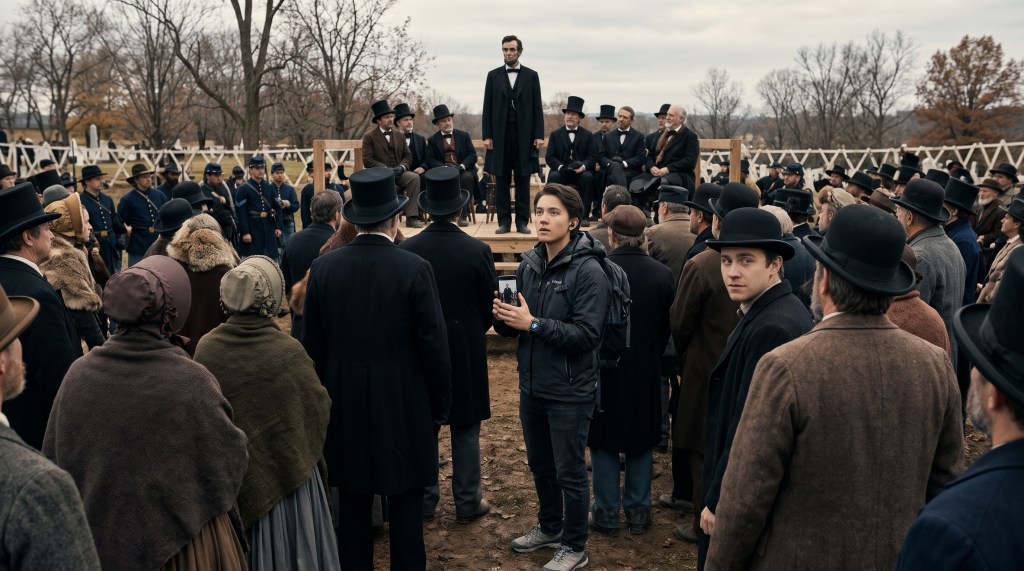
Imagine a human historian from the year 2026 who steps into a time machine and travels back to November 19, 1863, to stand in the crowd and witness Abraham Lincoln deliver the Gettysburg Address. Through intense historical study, the historian knows exactly what Lincoln will say, down to the exact syllable, pause, and inflection.
As Lincoln stands at the podium and speaks, the historian possesses infallible foreknowledge (from Lincoln’s temporal perspective) of the entirety of the speech. Yet, the historian’s presence in the crowd and his absolute, unyielding knowledge of the upcoming words do not turn Lincoln into a biological automaton. Lincoln is still freely composing, feeling, and delivering his thoughts in real-time. The historian’s knowledge is derived backward from the reality of Lincoln’s free act, demonstrating irrefutably that a conscious entity can possess perfect knowledge of an event without being the causal author of it.
5. The Author and the Interactive Holograph
Consider a brilliant software programmer who creates an advanced, sentient artificial intelligence (AI) inside a highly realistic holographic simulation. The programmer designs the AI with genuine libertarian free will—the ability to choose between alternate possibilities. Because the programmer has intimately designed the core behavioral algorithms, understands the environmental inputs, and completely grasps the psychological parameters of the AI, the programmer can predict with 100% accuracy how the AI will respond when presented with a choice between opening a red door and a blue door.
The programmer knows, unequivocally, that the AI will freely choose the red door. The programmer’s knowledge is exhaustive and flawless. Yet, the choice remains entirely generated by the AI’s internal, autonomous processing matrix. The creator’s comprehensive understanding of the creature enables perfect predictability without requiring any coercive manipulation or deterministic override.
Islamic Epistemology and Synthesis: Beyond the Rational Veil (Kashf)
While Western analytical philosophy relies heavily on logic, modal syntax, and empirical reasoning to reconcile foreknowledge and free will (as seen in Ockhamism and Molinism), classical Islamic theology and Sufi epistemology present a distinct, profound supplementary paradigm. This Islamic paradigm addresses the limitations of human rationality explicitly, arguing that the ultimate harmonization of divine sovereignty and human agency is fundamentally inaccessible to the pure intellect alone.
In the orthodox Islamic tradition, the tension between divine pre-decree (Qadar) and human agency is recognized, with the Ash’ari school historically positing the theory of Kasb (acquisition), wherein God creates the acts but humans “acquire” them through will. However, it is within the Sufi epistemological tradition that the paradox is truly transcended through the concept of Kashf (unveiling, discovery, or revelation).
Kashf denotes a suprarational, privileged inner knowledge bestowed upon the seeker through intense spiritual purification, asceticism, and divine grace, whereby the restrictive veils separating the finite human intellect from infinite divine realities are lifted. According to renowned scholars and mystics such as Abu Hamid Al-Ghazali and Muhyiddin Ibn ‘Arabi, while rational theology (Kalam) can establish the logical possibility of God’s existence and defend against basic paradoxes, it hits a definitive, insurmountable ceiling when attempting to dissect the exact mechanics of the Divine Will.
Al-Ghazali categorized Kashf as an epistemological tier existing far above rational proofs. He described it as a direct, luminous intuition where the attributes of God are encountered internally, completely bypassing the mediation of sequential logic and linguistic limitations. Ibn ‘Arabi further expanded on this, arguing that authentic, transformative knowledge of God (ma’rifa) does not arise from abstract, Aristotelian reasoning, but through direct mystical experience and spiritual tasting (dhawq).
From this epistemological vantage point, when the human intellect confronts the apparent paradox of God’s exhaustive pre-decree and human accountability, it perceives a contradiction only due to its localized, temporal, binary processing. The intellect cannot simultaneously hold absolute determinism and absolute freedom. However, through Kashf, the mystic witnesses the unity of existence (Wahdat al-Wujud) and perceives how the Divine Reality seamlessly upholds the multiplicity of creation without absorbing, coercing, or negating the functional reality of human choice.
Interestingly, this Islamic mystic framework synergizes remarkably well with the Western models. Ibn ‘Arabi’s concept of a’yan thabita (the fixed entities or eternal archetypes of creatures in God’s knowledge prior to creation) bears a striking metaphysical resemblance to the Molinist concept of Counterfactuals of Creaturely Freedom and the divine knowledge of unactualized essences. Both traditions assert that God knows exactly who the creature is and what the creature will do, independent of temporal creation.
Ultimately, from the perspective of Islamic epistemology, the atheistic demand that God’s nature must conform flawlessly to human logical syntax is seen as the ultimate epistemic overreach—a doomed attempt to pour the infinite ocean of divine reality into the finite, fragile vessel of human cognition. The resolution of free will and omniscience is not a puzzle to be solved by the intellect, but a transcendent reality to be witnessed by the purified heart.
Thematic Epilogue
The insistence by deterministic and atheistic critics that divine foreknowledge constitutes an inescapable death knell for human free will is, at its core, an argument built upon the shifting sands of assumed epistemic supremacy. As demonstrated by the Qur’anic withholding of the ultimate nature of the Rūḥ and the startling, reality-bending revelations of quantum indeterminacy via the Conway-Kochen Free Will Theorem, human knowledge is bounded by profound, impenetrable horizons. It is a fundamental philosophical fallacy to utilize a highly localized, sequential, Newtonian understanding of causality to dictate the operational limits of an infinite, transcendent Creator.
Through the timeless, atemporal gaze posited by Boethius and Aquinas, the semantic and logical nuances of soft facts introduced by William of Ockham, and the intricate providential architecture of Molinist Middle Knowledge, it is philosophically, logically, and theologically demonstrably coherent that God can possess exhaustive, infallible foreknowledge while perfectly preserving genuine libertarian human agency.
As vividly illustrated by the train driver and the timetable, knowledge of a destination does not drive the engine. God’s omniscience is the perfect, luminous reflection of reality in its totality—a reality in which human beings are granted the staggering, consequential dignity of authoring their own moral choices within the sovereign theatre of existence. The harmony of absolute divine providence and authentic human accountability remains entirely intact, not as a contradiction to be solved by lesser logic, but as a transcendent synthesis awaiting comprehension.





Leave a Reply