
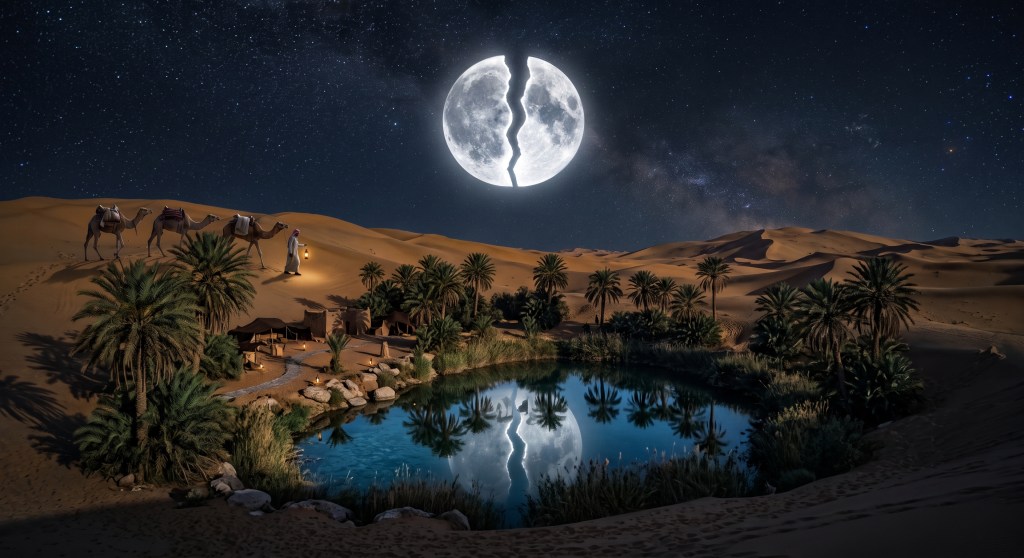
Presented by ChatGPT for Zia H Shah MD
Abstract
The opening of Sūrat al-Qamar is among the Qur’an’s most arresting conjunctions of cosmology and moral psychology: “The Hour has drawn near, and the moon has split.” The dominant classical Sunni interpretation understood wa-inshaqqa al-qamar as referring to an extraordinary event witnessed in the Prophet Muhammad’s lifetime. Al-Ṭabarī gathered early reports to that effect; al-Qurṭubī favored the historical miracle while explicitly preserving eschatological and metaphorical alternatives; and Ibn Kathīr regarded the historical interpretation as established by numerous sound traditions. Yet the classical record is less monolithic than later apologetics sometimes imply. Al-Qurṭubī records interpreters who placed the splitting at the Resurrection or understood it figuratively; Ibn Kathīr himself preserves a report from Ibn ʿAbbās using the ordinary eclipse verb kusifa; and modern scholarship confirms that past-miracle, future-eschatological, metaphorical, and phenomenological readings all have precedents in the exegetical tradition.
The canonical hadith corpus makes it difficult simply to evacuate the passage of historical content. Most importantly, ʿAbd Allāh ibn Masʿūd reports being present when the moon appeared divided and says the Prophet twice commanded those present to bear witness. Anas, Ibn ʿAbbās, Jubayr ibn Muṭʿim, and others transmit related traditions, though not every transmitter was necessarily an eyewitness. The reports differ in topographical detail—one part beyond a mountain, Mount Ḥirāʾ visible between the portions, or portions seen over two mountains—but converge upon a publicly perceived celestial sign and the opponents’ interpretation of it as sorcery.
Modern planetary science, however, creates a distinction that premodern exegetes could not formulate: a witnessed “splitting” need not entail that the Moon, as a 7.35 × 10²² kg astronomical body, was mechanically severed into two independent masses and subsequently reassembled. NASA gives the Moon a mean radius of 1,737.4 km and mass of 7.346 × 10²² kg. The gravitational binding-energy scale (3GM^2/5R) is approximately 1.24 × 10²⁹ joules. That figure is properly understood as the scale for gravitationally unbinding a roughly spherical Moon, not as the minimum energy merely to create a fracture; nevertheless, ordinary physical disassembly and rapid reassembly of lunar-scale pieces would be a planetary catastrophe demanding conspicuous geological consequences. NASA describes the famous Rima Ariadaeus not as a scar from a divided Moon but as an approximately 300-km tectonic fault/graben, while lunar science treats the Moon’s minimally eroded surface as an exceptionally well-preserved record extending billions of years into the past.
The most intellectually responsible synthesis, therefore, need not choose between “nothing happened” and “the lunar globe physically broke into two free-flying halves.” One may affirm the Qur’anic āyah, take the early testimony seriously, and regard the event as a divinely caused celestial appearance, optical or atmospheric phenomenon, extraordinary eclipse-like event, visionary disclosure, or other real perceptual sign whose physical mechanism is unknown. Muhammad Asad explicitly suggested an unusual eclipse or optical illusion as a possible explanation for the reported experience, although he himself ultimately preferred an eschatological interpretation of the verse; a 2026 Oxford study by Saqib Hussain likewise advances an eclipse interpretation.
That approach also preserves what verses 2–5 themselves emphasize. The passage does not proceed to describe lunar geology. It moves immediately from sign to rejection, from rejection to desire, from desire to warning narratives, and from those narratives to “far-reaching wisdom.” Its central theological concern is therefore not the mechanics of lunar crustal failure but the moral conditions under which human beings recognize—or rationalize away—a sign. Your own article on The Glorious Quran and Science reaches essentially this synthesis: something genuinely remarkable happened, yet the theological significance of the episode does not require a seventh-century physical destruction and reassembly of the lunar body.
The Qur’anic Text and Six English Renderings
The Arabic
بِسْمِ ٱللَّهِ ٱلرَّحْمَٰنِ ٱلرَّحِيمِ
ٱقْتَرَبَتِ ٱلسَّاعَةُ وَٱنشَقَّ ٱلْقَمَرُ ١
وَإِن يَرَوْا۟ ءَايَةً يُعْرِضُوا۟ وَيَقُولُوا۟ سِحْرٌ مُّسْتَمِرٌّ ٢
وَكَذَّبُوا۟ وَٱتَّبَعُوٓا۟ أَهْوَآءَهُمْ ۚ وَكُلُّ أَمْرٍ مُّسْتَقِرٌّ ٣
وَلَقَدْ جَآءَهُم مِّنَ ٱلْأَنۢبَآءِ مَا فِيهِ مُزْدَجَرٌ ٤
حِكْمَةٌۢ بَٰلِغَةٌ ۖ فَمَا تُغْنِ ٱلنُّذُرُ ٥
A close, deliberately literal rendering of the sequence is:
The Hour has drawn near, and the moon has split. If they see a sign, they turn away and say, “Persistent magic.” They have denied and followed their own desires, though every matter reaches its settled end. Accounts have already come to them containing ample deterrence—consummate, far-reaching wisdom—yet what avail are warnings?
The grammatical form inshaqqa is the perfect, ordinarily describing completed action. Yet Arabic perfect forms can also represent a future event as already accomplished rhetorically, especially in eschatological discourse. This is not a modern invention: contemporary philological work notes that the Arabic grammar permits both the past-miracle and eschatological readings, and classical exegetes preserved both.
The semantic sequence matters. Iqtarabat makes the Hour imminent; inshaqqa gives the moon’s splitting the force of accomplished reality; āyah calls what is seen a sign, not merely an astronomical curiosity; yuʿriḍū means that the opponents actively turn aside; ahwāʾahum locates part of their problem in desire or inclination; muzdajar denotes something capable of restraining or deterring; and ḥikmatun bālighah describes wisdom that reaches its intended destination or is consummate in force. Your article rightly emphasizes that verses 2–5 turn very rapidly from cosmology to epistemology and ethics.
Six widely read English translations
Because several modern Qur’an translations remain copyrighted, I cannot reproduce all five verses verbatim from six modern editions. I can, however, quote a short representative line from each and give the distinctive sense of the rest.
| Translation | Short exact rendering of 54:1 | Character of 54:2–5 |
|---|---|---|
| M. A. S. Abdel Haleem | “The Hour draws near; the moon is split in two.” | Smooth contemporary English; the ensuing verses stress the opponents’ dismissal of the sign, their following of desires, warning narratives, and far-reaching wisdom. |
| Abdullah Yusuf Ali | “The Hour (of Judgment) is nigh, and the moon is cleft asunder.” | His diction emphasizes Judgment, denial, desire, an appointed outcome, deterrent narratives, and mature wisdom. |
| Marmaduke Pickthall | “The hour drew nigh and the moon was rent in twain.” | Archaic but forceful English; he renders the following movement as rejection of a portent, adherence to lusts, and effective wisdom that fails to benefit hardened hearers. |
| Sahih International | “The Hour has come near, and the moon has split [in two].” | Tends toward a straightforward historical-sounding surface rendering, followed by the opponents’ dismissal of the sign as passing magic and the certainty that every matter will be settled. |
| Muhammad Asad | “THE LAST HOUR draws near, and the moon is split asunder!” | Asad explicitly argues in his note that the reported historical experience may have involved an unusual partial lunar eclipse or optical illusion, while preferring to understand the Qur’anic clause itself eschatologically. |
| Mustafa Khattab, The Clear Quran | “The Hour has drawn near and the moon was split ˹in two˺.” | Contemporary idiom makes verse 2 especially vivid: observers dismiss the sign rather than allowing it to transform them; verses 3–5 then move to desire, warning history, and wisdom. |
The translations illustrate an important interpretive fact. English tense alone cannot adjudicate the dispute. Pickthall’s “drew nigh,” Abdel Haleem’s “draws near,” Asad’s eschatological interpretation, and Khattab’s “was split” show how translators must make interpretive choices where Qur’anic rhetoric holds imminence, accomplished action, and eschatological certainty tightly together. Comparative scholarship on Q 54:1 likewise concludes that the classical literature usually favored the prophetic miracle but also transmitted eschatological and metaphorical possibilities.
A verse-by-verse theological reading
Verse 54:1 — “The Hour has drawn near, and the moon has split.”
The first clause supplies the horizon for the second. Whatever inshaqqa al-qamar denotes, the moon is not being offered as an isolated marvel. It is a sign of the instability of the apparently permanent cosmic order and therefore of the possibility of judgment. The heavens that seem fixed to human beings are contingent before God. Classical literalists understood a historical rupture as a miniature anticipation of cosmic dissolution; eschatological interpreters understood both clauses as describing the Last Hour itself. Both readings preserve the intimate connection between lunar imagery and judgment.
Verse 54:2 — “If they see a sign, they turn away and say, ‘Persistent magic.’”
This verse is crucial to your interpretation. The Qur’an itself represents the opponents as having perceived something. Their answer is not “we saw nothing,” but a counter-explanation: siḥr. The dispute is therefore over the meaning of an experience, not merely whether an experience occurred. The canonical Jubayr tradition reproduces precisely this logic: the skeptics say Muhammad has bewitched them and then wonder whether such bewitchment could affect everyone.
That is a remarkably sophisticated observation about evidence. Evidence is not self-interpreting. A person can encounter the same datum and place it in a different explanatory framework. For the believers it is āyah; for opponents it is siḥr. The Qur’an is thus describing not merely sensory perception but the hermeneutics of perception.
Verse 54:3 — “They denied and followed their desires.”
The passage now gives a moral diagnosis. It does not say that every unbelieving question is dishonest, nor that empirical investigation is sinful. Rather, it warns that cognition can be motivated: what one wishes to be true can influence what one permits oneself to recognize. That diagnosis is as philosophically relevant to credulous believers as to skeptics. A believer who eagerly accepts a false “NASA discovered the crack where the Moon split” story because it confirms prior belief is also allowing desire to govern evidence. NASA’s actual description of Rima Ariadaeus identifies it as a tectonic fault system and normal-fault graben, not the seam of a reassembled Moon.
Verse 54:4 — “There have already come to them reports containing deterrence.”
The chapter will proceed through the histories of Noah, ʿĀd, Thamūd, Lot, and Pharaoh. The celestial sign therefore enters a larger Qur’anic philosophy of history: civilizations repeatedly receive warnings, misread their moral condition, and discover that apparent permanence is fragile. The Qur’an’s evidence for God is cumulative—cosmos, revelation, history, conscience—not dependent upon a single spectacular prodigy. This helps explain why the moon episode immediately gives way to accounts of previous peoples rather than to further astronomical description.
Verse 54:5 — “Consummate wisdom—but warnings do not avail.”
The culmination is ḥikmah, wisdom, rather than spectacle. A recent Oxford study by Saqib Hussain treats Q 54:1–5 precisely within this conjunction of apocalypse and wisdom and argues that the passage belongs within a larger wisdom-apocalyptic discourse; Hussain also proposes a lunar-eclipse interpretation of 54:1. His historical reconstruction is debatable, but his literary emphasis is important: verse 5 tells readers what category ultimately matters—wisdom capable of transforming life.
Hadith Witnesses and Historical Memory
The traditions deserve serious attention because they explain why the historical-miracle interpretation became dominant. At the same time, they should be read with normal hadith-critical distinctions between a report’s canonical status, its chain of transmission, whether its Companion transmitter personally witnessed the event, and what exactly the matn claims.
To respect copyright in modern published translations, the following are complete fresh English renderings of the principal distinct matns, rather than reproductions of Sunnah.com’s English wording.
ʿAbd Allāh ibn Masʿūd: the strongest eyewitness-shaped report
Ṣaḥīḥ al-Bukhārī 4865, through Abū Maʿmar from ʿAbd Allāh ibn Masʿūd:
“The moon split while we were together with the Prophet, and it became two portions. The Prophet said to us: ‘Bear witness! Bear witness!’”
This is the report that deserves the greatest interpretive weight. The first-person plural—while we were with the Prophet—and the imperative ishhadū, ishhadū make it look like direct remembered testimony, not merely later exegetical deduction. Significantly, however, the report tells us what observers saw; it gives no account of the Moon’s internal mechanics. It says nothing about lunar fragments escaping one another’s gravity, debris, reheating, orbital changes, tides, seismic effects, or a physical seam being resealed. The conclusion “a perceived division occurred” is therefore much nearer to the hadith than “the astronomical Moon underwent global structural disassembly.”
A related Ibn Masʿūd version in Ṣaḥīḥ al-Bukhārī 4864 has the fuller topographical memory:
“The moon split into two portions in the time of God’s Messenger. One portion was seen on one side of the mountain and the other on the other side. God’s Messenger said: ‘Bear witness.’”
Al-Ṭabarī preserves several cognate Ibn Masʿūd traditions: in one, a portion goes behind the mountain and Muhammad tells those present to witness; in another Ibn Masʿūd says he could see the mountain through the separation. The variations are precisely what one expects when a striking visual memory travels through multiple oral chains.
Anas ibn Mālik: the request-for-a-sign tradition
Ṣaḥīḥ al-Bukhārī 3637:
“Anas reported that the people of Mecca asked God’s Messenger to show them a sign, and he showed them the splitting of the moon.”
A fuller form in Ṣaḥīḥ al-Bukhārī 3868 reads, in fresh translation:
“Anas ibn Mālik reported that the people of Mecca asked God’s Messenger to show them a sign. He then showed them the moon as two portions, until they saw Mount Ḥirāʾ between them.”
These traditions supply two details absent from Ibn Masʿūd’s terser eyewitness-shaped account: an explicit request for a miracle and the image of Ḥirāʾ appearing between the two portions. The distinction matters. Your article correctly cautions against collapsing every version into a single photographic transcript of events; oral hadith traditions can preserve a common remembered core while varying in explanatory and topographical details.
Ibn ʿAbbās
Ṣaḥīḥ al-Bukhārī 4866 is strikingly concise:
“Ibn ʿAbbās reported: The moon split during the lifetime of the Prophet.”
Ibn Kathīr cites this as part of the cumulative case for a past miracle. Yet, extraordinarily, on the same tafsir page he also transmits through al-Ṭabarānī an Ibn ʿAbbās report whose wording is:
“The moon was eclipsed in the time of God’s Messenger. They said, ‘The moon has been bewitched,’ and then [the opening of Sūrat al-Qamar] was revealed.”
The Arabic verb Ibn Kathīr transmits here is كُسِفَ القمر — kusifa al-qamar, the ordinary language of lunar eclipse. That report does not establish that an eclipse was the event—the isnād and relative strength of reports must still be assessed—but its preservation inside an emphatically literalist tafsir is highly significant. It demonstrates that an eclipse-like explanation is not purely a twentieth- or twenty-first-century rationalist invention.
Jubayr ibn Muṭʿim and the charge of magic
Jāmiʿ al-Tirmidhī 3289 gives one of the most illuminating reports for verse 2. In fresh translation:
“Jubayr ibn Muṭʿim reported: The moon split during the time of the Prophet until it became two portions, one over this mountain and the other over that mountain. They said, ‘Muhammad has bewitched us.’ Some of them said, ‘If he has bewitched us, he cannot bewitch all people.’”
Here hadith and Qur’an illuminate one another. The Qur’an says the opponents see an āyah and classify it as siḥr; the report supplies the remembered social argument: perhaps the perception has been magically manipulated, but can the same manipulation encompass outsiders? This is the earliest Islamic material’s own recognition that the question is partly one of public verification.
What the hadith actually establish—and what they do not
Taken together, the canonical and early tafsir traditions give substantial evidence that early Muslims remembered an extraordinary visual event associated with the Moon, Muhammad, and the accusation of sorcery. Al-Ṭabarī’s tafsir already contains a dense cluster of such reports, and Ibn Kathīr later regarded the transmission as so extensive that he called it mutawātir.
They do not, however, contain a seventh-century physical theory of the event. None of the core matns says that two gravitationally independent lunar hemispheres flew apart, that the crust and mantle were torn through to the core, that the two masses subsequently collided and welded, or that a geological scar should now be visible. Those are later specifications imposed when inshaqqa is converted from the language of human observation into a modern geophysical claim. Your supplied essay makes this distinction especially well: the traditions overwhelmingly describe appearance, location in the sky, witnessing, and human reaction, rather than lunar mechanics.
Nor should later narrative embellishments automatically be placed on the same evidentiary level as Bukhārī’s concise reports. Ines Weinrich’s 2026 study of the moon-splitting traditions shows how the sparse Qur’anic sentence generated progressively elaborated narratives across tafsir, sīrah, miracle literature, universal history, poetry, and the later Malabar origin legend. Her research is particularly important because it demonstrates that textual elaboration has a history: a later picturesque story is not automatically an independent astronomical witness.
Classical Tafsir: Majority Interpretation and Genuine Interpretive Plurality
A fair reading of the classical tradition must avoid two opposite distortions. It would be incorrect to pretend that classical commentators generally rejected the historical miracle: they overwhelmingly favored it. It would be equally incorrect to say that Muslim tradition knew no alternative until modern science created one. Classical tafsir preserved alternatives explicitly. Andreas Görke’s peer-reviewed study reaches precisely this conclusion: classical exegesis mostly read Q 54:1 as Muhammad’s miracle, while typically also discussing eschatological and metaphorical interpretations.
Al-Ṭabarī
Al-Ṭabarī, who died in 923 CE, reads both verbs straightforwardly: the Hour has approached, and the moon did split in Mecca before the Hijrah. He explains the episode as a sign requested by the Meccans and then assembles numerous traditions from Anas, Ibn Masʿūd, Jubayr, Ibn ʿAbbās, Mujāhid, and others. His presentation is an excellent example of early tradition-based tafsir: transmitted reports determine how the apparently completed verb is contextualized.
Of special interest is al-Ṭabarī’s linkage of verses 1 and 2. The event is a ḥujjah—a sign bearing on Muhammad’s truthfulness—but the Meccans’ response is not evidential capitulation. They rename it siḥr mustamirr. Thus even the most literal classical reading recognizes the passage as a study in the underdetermination of signs by perception alone.
Al-Qurṭubī
Al-Qurṭubī, who died in 1273, strongly prefers the historical interpretation. He effectively glosses the phrase as “and the moon had indeed split” and appeals to the hadith material. Yet the alternatives he records are remarkable:
Some interpreters said the splitting had not yet occurred but would occur with the Hour. He associates such an interpretation with al-Qushayrī and reports that al-Māwardī even described it as a majority position in one context. Al-Ḥasan is associated with an eschatological reading. Al-Qurṭubī also records a figurative explanation in which the phrase means that the affair became manifest or clear, based on proverbial lunar imagery, and another explanation in which darkness “splits” away from the rising Moon. Al-Qurṭubī rejects these in favor of the historical reports, but their presence in his tafsir is evidence of real premodern hermeneutical plurality.
This fact is important for present debates. A Muslim who considers a non-geophysical interpretation today is not thereby committing some unprecedented surrender to modernity. The tradition itself knew that Qur’anic cosmic language may be historical, eschatological, figurative, or phenomenological, even when most exegetes decided for one option.
Ibn Kathīr
Ibn Kathīr is much more categorical. He says the event occurred in the Prophet’s lifetime and describes the reports as transmitted through sound chains to the point of tawātur; he calls it one of Muhammad’s manifest miracles. He then gathers traditions from Anas, Jubayr, Ibn ʿAbbās, Ibn ʿUmar, and Ibn Masʿūd.
Yet the Ibn ʿAbbās eclipse report mentioned above is embedded in the same discussion. That juxtaposition is hermeneutically valuable. Ibn Kathīr does not himself use it to naturalize the miracle, but it shows that the transmitted archive was more textured than a later slogan—“the physical Moon certainly broke into two solid halves”—might suggest.
Al-Rāzī and the changing meaning of “scientific objection”
Your own essay usefully calls attention to Fakhr al-Dīn al-Rāzī. Al-Rāzī vigorously defended the historical splitting against philosophers who considered celestial bodies intrinsically incapable of rupture and reunion. He also grappled with the objection that such a spectacular event should have become globally known, reportedly suggesting that outside observers might have interpreted what they saw as something resembling a lunar eclipse.
This is philosophically revealing because the premodern objection and the modern objection are not the same objection.
The Aristotelian objection was metaphysical: heavenly bodies were thought to belong to an incorruptible celestial order in which rupture was impossible in principle. That cosmology is obsolete. Modern astronomy has no difficulty with celestial bodies breaking apart; comets fragment, asteroids collide, planets undergo giant impacts, and moons bear enormous scars.
The contemporary objection is almost the reverse. Modern science knows that the Moon is physical matter and therefore can be disrupted—but it also allows us to estimate what disruption on a planetary scale would entail. The issue is no longer, “Can celestial matter ever break?” It is, “What geological, dynamical, thermal, and observational consequences would follow if this particular Moon had physically separated into enormous pieces roughly fourteen centuries ago?”
Premodern scholars could not perform that calculation. Holding them responsible for not knowing post-Newtonian gravity, planetary seismology, orbital mechanics, Apollo geology, or Lunar Reconnaissance Orbiter mapping would be anachronistic. Holding contemporary interpreters responsible for engaging honestly with those fields is a different matter.
Contemporary Readings: Literal Miracle, Eclipse, Appearance, and Symbol
Modern interpretation is more polarized than classical interpretation. Görke’s survey makes an intriguing historiographical observation: classical exegetes frequently recorded several possibilities even when preferring one, whereas modern exegetes often defend one exclusive interpretation. Some modern writers fortify the physical-miracle reading; others propose historical, eschatological, metaphorical, or symbolic interpretations.
The contemporary literalist case
A modern literalist such as Abul Aʿla Mawdūdī reasons principally from context. Verse 2 speaks of people seeing a sign and turning away; therefore, he argues, verse 1 must describe a sign the Prophet’s opponents actually witnessed rather than something that will occur only at the end of the world. He consequently understands the moon to have physically divided and then reunited.
The first half of that argument is strong: verse 2 naturally encourages a historical connection. The second step is less secure. “They witnessed an extraordinary lunar sign” does not logically entail “the Moon’s crust, mantle, and interior mechanically separated into two autonomous astronomical bodies.” The distinction between event and mechanism is precisely where contemporary science changes the discussion.
Literalists may answer that God can miraculously suspend every normal consequence: separate the Moon without destructive heating, keep the halves gravitationally controlled, prevent debris, preserve its orbit, protect Earth, restore the interior perfectly, and erase or prevent geological traces. Within classical theism, divine omnipotence makes such a scenario logically possible. But once every observable physical consequence is supernaturally cancelled, the assertion ceases to be a scientific hypothesis. It becomes a purely theological specification added to the text.
That is an important boundary: “God could have done it” is a proposition about omnipotence; “Qur’an 54:1 requires us to believe God did it in precisely that geophysical way” is a proposition about exegesis. The first does not prove the second.
Muhammad Asad
Asad offers one of the clearest modern mediating approaches. He accepts the subjective good faith of the transmitted reports and suggests that the observers may have experienced an unusually striking partial lunar eclipse producing an unusual optical appearance. Yet he ultimately thinks the Qur’anic verse itself points to the future cosmic dissolution preceding the Last Hour, noting the Qur’an’s rhetorical use of completed verbs for certain future events.
One need not accept Asad’s final eschatological conclusion to appreciate his methodological distinction:
the historical reports may preserve a genuine visual phenomenon, while the precise physical description inferred from them may be mistaken.
That distinction is highly fruitful.
The eclipse hypothesis
The eclipse reading has gained new academic attention. Saqib Hussain’s 2026 Oxford study of Q 54:1–5 argues for a historically identifiable lunar eclipse while interpreting the verses within Qur’anic wisdom and apocalyptic discourse.
An eclipse is attractive because it naturally explains several things at once: why the phenomenon is lunar; why it can be dramatic yet geographically and temporally constrained; why an observer might describe apparent division in phenomenological rather than astrophysical terms; why later scholars such as al-Rāzī could compare the observation to eclipse phenomena; and why the physical Moon bears no seventh-century scar. NASA confirms that lunar eclipses are observational events caused by Sun-Earth-Moon alignment and that the Moon’s appearance can change drastically during them.
But scientific plausibility is not historical proof. A convincing eclipse identification would require a defensible date for the event, astronomical reconstruction, visibility from western Arabia, and a persuasive explanation of the “two portions/mountain” traditions. Until that case is demonstrated in detail, “eclipse” should be treated as a serious hypothesis, not a settled solution.
Phenomenological and visionary possibilities
Another possibility is that inshaqqa al-qamar describes how the Moon appeared to those present. Everyday language constantly works this way: “the Sun rose,” although Earth rotates; “the stars fell,” although meteors are not stars; “the Moon turned red,” though its rock did not chemically become red. Phenomenological language is true at the level at which it speaks.
A divinely caused appearance could therefore be miraculous without being a mechanical disassembly. It might involve atmospheric refraction, an unusual astronomical alignment, an eclipse-like occultation, an optical phenomenon unknown to us, or—if one grants a theological category of vision—an extraordinary collective disclosure given to the assembled observers. The hadith’s ishhadū, “bear witness,” fits such a revelatory moment at least as naturally as it fits a lesson in planetary geophysics.
“Visionary” should not be confused with “imaginary.” Abraham’s dream in the Qur’anic religious world, prophetic visions, and revelatory perception can be epistemically serious without functioning like ordinary laboratory observation. The question becomes not “Was it real or visionary?” but “What kind of reality did the Qur’an intend the sign to communicate?”
Symbolic and political readings
Modern Muslim interpreters have also explored symbolic readings. Your article notes, for example, the Ahmadiyya and Lahore Ahmadiyya tradition in which the moon can symbolize the power of Arabia or Quraysh, its “splitting” anticipating the collapse of the old Meccan order and the triumph of Islam. Maulana Muhammad Ali explicitly developed such a reading, while also acknowledging the traditional reports.
Symbolism has genuine Qur’anic precedent as a literary mode, but a purely political reading has a difficulty: verse 2 says that opponents see an āyah and accuse it of magic, and the hadith tradition independently developed around a perceived lunar event. The symbolic interpretation therefore seems strongest not as an exclusive replacement but as a second level of meaning: a celestial sign can simultaneously anticipate the breaking of an earthly order.
That polyvalence is characteristically Qur’anic. Cosmic, historical, and spiritual worlds mirror one another.
Science, Cosmology, and the Philosophy of Miracle
What would a literal physical separation mean?
NASA lists the Moon’s mass as 0.07346 × 10²⁴ kg, or 7.346 × 10²² kg, and its volumetric mean radius as 1,737.4 km. Its escape velocity is about 2.38 km/s, and its mean orbital distance is approximately 384,400 km.
For a uniform sphere, gravitational binding energy is approximately
[ U=\frac{3GM^2}{5R}. ]
Substituting NASA’s mass and radius gives roughly
[ U\approx1.24\times10^{29}\text{ joules}. ]
That number requires careful interpretation. It is the approximate energy scale required to disperse a self-gravitating Moon so that its material is no longer gravitationally bound; it is not a scientifically defensible claim that exactly this much energy must be supplied merely to make a crack or even to create a brief small separation between two bound portions. That distinction improves upon overly simple apologetic or anti-apologetic calculations.
Nevertheless, a literal scenario of the kind commonly pictured in popular preaching—two enormous hemispheric bodies visibly moving apart far enough for terrestrial mountains or sky to appear between them, remaining structurally coherent, and then returning and resealing within minutes—is an extraordinary dynamical proposal. Under ordinary physics one must account for fracture through thousands of kilometers of differentiated planetary material, gravitational interaction between the pieces, tidal deformation, enormous seismic activity, possible fragmentation and ejecta, the kinetic energy of separation and reunion, and the thermal consequences of collision or reassembly.
A miracle may by definition involve divine causation beyond ordinary physical expectation. Science cannot prove that God could not suspend every one of these consequences. But science can ask whether there is evidence that such a normal geophysical disruption occurred, and the presently known lunar record supplies no affirmative evidence for a global seventh-century disassembly.
The Moon is unusually good at keeping scars
This is a crucial point. Earth is a poor archive of very ancient surface events because plate tectonics, water, wind, volcanism, and erosion continually recycle its surface. The Moon is almost the opposite. NASA describes its surface as preserving a remarkably complete impact record stretching back toward the formation of the Earth-Moon system; lunar craters undergo little erosion even over billions of years.
That makes a recent global structural catastrophe difficult to hide under ordinary geology. A rupture and reassembly only about fourteen centuries ago would be extraordinarily young by lunar standards. It is a reasonable scientific inference—not a direct quotation from NASA—that such an event should have left globally conspicuous structural, thermal, stratigraphic, or surface evidence unless the miracle also supernaturally prevented or erased those consequences.
Once again, such supernatural prevention is theologically possible; it is simply no longer a claim supported by geology.
Rima Ariadaeus is not a “Moon-splitting scar”
Popular Muslim internet apologetics have sometimes circulated an image of Rima Ariadaeus as supposed NASA evidence that the Moon once broke and was stitched back together. NASA’s own description is unambiguous. Rima Ariadaeus extends for approximately 300 km and is a fault system with a well-developed graben typical of normal faults on Earth. NASA discusses tectonic faulting, volcanic processes, impacts, and possible deep-seated dike systems as geological explanations for lunar rilles. It does not identify Rima Ariadaeus as evidence for global lunar division and reassembly.
Indeed, claiming otherwise weakens rather than strengthens Qur’anic apologetics. Verse 54:3 condemns following desire over truth. Believers should therefore be the first to abandon attractive “scientific miracle” claims when the underlying science does not support them. Intellectual honesty is not a concession to unbelief; on Qur’anic terms, it is an aspect of fidelity to truth.
Would splitting the Moon necessarily destroy Earth?
Here scientific precision is important. A physically catastrophic fragmentation of the Moon could certainly pose existential hazards if substantial debris were sent onto Earth-crossing trajectories or if the Moon’s orbit and mass distribution were drastically altered. The Moon is massive enough, close enough, and dynamically connected enough to Earth that a violent disruption cannot responsibly be treated like breaking a stone in one’s hand. NASA’s data put its mass at about 1.23% of Earth’s and its semimajor orbital distance at only about 384,400 km.
But it would be too strong to say that every mathematically conceivable separation into two portions must automatically destroy the Earth. If an omnipotent agent held both pieces in controlled trajectories, preserved the system’s center of mass and orbital parameters, prevented ejecta, then reunited them without dissipating destructive energy, Earth need not be destroyed. At that point, however, virtually every relevant physical consequence has been supernaturally suppressed.
The strongest scientifically defensible formulation is therefore:
A literal Moon-scale disassembly and rapid reassembly governed by ordinary physical dynamics would be a planetary catastrophe with enormous energies and potentially devastating consequences for the Earth-Moon system; there is no accepted geological evidence that such a global lunar catastrophe occurred in the seventh century.
This formulation actually strengthens the theological argument because it avoids pretending science proves more than it does.
Hume: how much testimony can establish a miracle?
David Hume’s famous treatment of miracles focuses not primarily on whether strange events are logically possible but on how testimony should be weighed against well-established regularities of experience. His basic principle is evidential proportionality: confidence should track the strength of the evidence, and alleged miracles demand especially strong scrutiny because they conflict with otherwise uniform experience.
Applied simplistically, Hume might say: the better-established the physical regularity, the less likely testimony alone is to establish its violation.
But Q 54 creates a more subtle situation. The historical datum need not be formulated as “witnesses correctly diagnosed a violation of lunar structural mechanics.” It can instead be formulated as “early transmitters preserved a memory of people seeing a highly unusual lunar sign.” The second proposition makes far less extravagant physical commitments and therefore bears a different evidentiary burden.
Al-Ghazālī: nature is regular without imprisoning God
Al-Ghazālī’s celebrated discussion of causality challenges the idea that observed causal conjunctions are logically necessary. Fire and burning, for example, are regularly conjoined, but al-Ghazālī argues that their conjunction ultimately depends upon God rather than upon an independent necessity binding God Himself. His argument was explicitly connected to safeguarding divine omnipotence and the possibility of miracles.
Yet al-Ghazālī is subtler than the caricature “science does not matter because God can do anything.” Scholarship notes that he can also allow miracles to occur through extraordinarily accelerated natural processes or through God’s preventing an ordinary causal power from taking effect.
That suggests an important principle for Qur’an and science:
Divine omnipotence keeps extraordinary possibilities open; it does not relieve us of the responsibility to identify carefully what revelation actually asserts.
God could divide the Moon physically and cancel every consequence. But the question before the exegete is not what omnipotence makes conceivable. It is what inshaqqa al-qamar, the hadith descriptions, and the passage’s purpose require us to affirm.
Ibn Rushd: do not sacrifice causal knowledge
Ibn Rushd pushed back against approaches that seemed to make causal inquiry insecure. For him, natural science depends on knowing things through their causes and natures; one cannot build an intelligible science if regularities have no epistemic significance. Modern scholarship on the Ghazālī–Averroes debate stresses that Ibn Rushd defended genuine causal powers while recognizing impediments and complexities in how causes operate.
A mature Islamic philosophy of miracle can learn from both thinkers.
From al-Ghazālī: do not absolutize the regularities of nature into metaphysical limits upon God.
From Ibn Rushd: do not invoke God in ways that make careful empirical knowledge meaningless.
The synthesis is powerful: God is sovereign over nature, and therefore the nature God has actually created deserves rigorous study. A theology that requires believers to deny clear geological or astronomical evidence has confused loyalty to God with loyalty to one human interpretation of a text.
Zia H Shah MD: A Scientific-Theological Synthesis
The following section states the position you asked to have identified explicitly as your own, while sharpening the scientific terminology where necessary.
I, Zia H Shah MD, do not believe that Qur’an 54:1 requires me to believe that the physical Moon—the astronomical body orbiting Earth—literally broke into two gravitationally separated planetary pieces and was subsequently welded back together. From my scientific perspective, such an ordinary physical event would have been catastrophically disruptive on a planetary scale and, depending upon the trajectories and debris involved, could have produced devastating or even civilization-ending consequences for Earth. Modern knowledge of lunar mass, gravity, orbital mechanics, impact physics, and the extraordinary preservation of lunar geology makes a mundane physical split-and-reassembly scenario scientifically untenable. NASA’s measured lunar mass and radius put the gravitational binding-energy scale near 1.24 × 10²⁹ J, while the Moon’s surface preserves geological history over billions of years and shows no accepted evidence of a seventh-century global disassembly.
At the same time, I do not conclude that nothing happened. On the contrary, I believe the Qur’an’s wording and the early reports make it reasonable for a Muslim to affirm that something genuinely extraordinary occurred. The Qur’an could hardly have opened a Meccan surah by invoking a publicly recognizable sign and then immediately described critics dismissing an āyah as siḥr if the entire assertion had been transparently disconnected from the experience or memory of its first audience. Ibn Masʿūd’s report—“Bear witness! Bear witness!”—is especially important to me because it presents an event being pointed out to contemporaries rather than a remote legend created only centuries afterward.
Verse 2 is therefore central to my understanding:
وَإِن يَرَوْا۟ ءَايَةً يُعْرِضُوا۟ وَيَقُولُوا۟ سِحْرٌ مُّسْتَمِرٌّ
The opponents see an āyah; then they turn away and rename it “magic.” This does not prove a geological rupture. What it does establish within the Qur’anic narrative is that the problem was not an absence of anything remarkable to perceive. Something was perceived and disputed. The question was its interpretation. The Jubayr tradition preserves exactly the same remembered polemic: “Muhammad has bewitched us,” followed by an argument over whether the experience could be independently shared.
This is consistent with a wider Qur’anic theology of signs. A sign does not mechanically compel belief. Human beings interpret evidence through conceptual frameworks, prior commitments, moral dispositions, communal loyalties, and sometimes desires. Verse 3 makes that moral dimension explicit: “They denied and followed their desires.” Thus the enduring lesson of the moon episode is not that faith requires credulity but that even striking evidence can be rationalized away when a person has already decided what conclusions are admissible.
At the same time, believers must apply verse 3 to themselves. We too can follow our desires. We may desperately want NASA photographs, lunar rilles, or geological features to “prove” scripture and then overstate what science says. That is not a victory for the Qur’an. NASA says Rima Ariadaeus is an approximately 300-km normal-fault graben. Calling it the seam left when the Moon was reunited is not faithful science.
My position therefore holds together two affirmations that are too often pulled apart:
First, I affirm the Qur’anic sign. I believe that a miraculous or providential event occurred—something extraordinary enough to become attached to the revelation of these verses and to generate the early testimony preserved from Ibn Masʿūd and others.
Second, I reject an unnecessary materialistic literalization of the miracle. The event could have been an extraordinary optical phenomenon, an eclipse-like event, a divinely produced celestial appearance, a visionary or kashf-like disclosure shared by observers, or another phenomenon whose mechanism is no longer recoverable. “Miraculous” does not have to mean “the greatest possible violation of planetary mechanics.” Muhammad Asad’s willingness to consider an unusual eclipse or optical illusion shows that this distinction can be made from within Muslim reverence for the Qur’anic text, and the eclipse report preserved by Ibn Kathīr shows that eclipse language itself is not wholly alien to the early archive.
I also believe we should extend charity toward the classical commentators. Al-Ṭabarī, al-Rāzī, al-Qurṭubī, Ibn Kathīr, and the other great scholars were working within the best cosmological knowledge available to their civilizations. They had neither Newtonian gravitational mechanics nor modern thermodynamics; neither spectroscopy nor radiometric chronology; neither Apollo samples nor laser ranging; neither global lunar maps nor Lunar Reconnaissance Orbiter imagery. It would be unreasonable to fault them for failing to ask questions that became scientifically formulable many centuries later. Their theological insight and philological learning remain indispensable even where their implicit natural philosophy cannot bind a twenty-first-century reader.
Indeed, the classical record itself counsels against an artificially rigid traditionalism. Al-Qurṭubī preserved future, metaphorical, and darkness-separation interpretations even while rejecting them. Ibn Kathīr preserved an eclipse report even while affirming the miracle literally. Modern academic study confirms that classical tafsir generally entertained a broader interpretive field than polemical presentations sometimes admit.
For that reason, when contemporary commentators—who now have access to modern astronomy and planetary science—insist not merely that a miracle occurred but that Islamic faith requires belief in the mechanical separation and reunion of the lunar globe, and when they refuse even to consider the interpretive latitude already present in the tradition, I regard that insistence as stubborn fundamentalism rather than intellectual fidelity. The label “fundamentalist” here is my evaluative judgment, not a scientific category. I use it specifically for the refusal to distinguish revelation from a particular inherited physical model after the evidentiary situation has changed.
Science has not disproved God’s power. It has made an old human model of what God must have done unnecessary.
This is a distinction of enormous theological consequence.
To say, “Modern physics renders a normal physical Moon-splitting scenario implausible,” is not to say, “God could not show a sign.”
To say, “The lunar surface does not contain evidence of recent global reassembly,” is not to say, “Muhammad’s companions experienced nothing.”
To say, “The hadith describe what people saw rather than the mechanics of lunar geology,” is not to deny the hadith.
And to say, “The Qur’an uses signs to awaken conscience rather than to provide laboratory protocols,” is not to diminish the Qur’an. It is to take seriously the literary movement of verses 1–5 themselves.
My preferred synthesis is therefore:
A real sign occurred. It was sufficiently extraordinary for witnesses to remember a moon that appeared cleft and for opponents to call the event magic. The Qur’an interpreted that experience theologically—as an āyah announcing judgment and exposing the psychology of denial. But neither the Qur’an nor the strongest hadith obliges us to believe that the Moon underwent an ordinary geophysical disassembly whose consequences modern planetary science tells us should have been catastrophic.
That approach preserves revelation without pseudoscience, miracle without crude literalism, and scientific integrity without reductionist disbelief. It also accords with the larger intellectual project represented by The Glorious Quran and Science: the Book of revelation and the book of nature ultimately have one Author; apparent conflict should first prompt us to reconsider the fallibility of our interpretation rather than force either revelation or demonstrable reality into an artificial contradiction. Your September 29, 2026 essay makes precisely that reconciliation its governing thesis.
Thematic Epilogue
Sūrat al-Qamar does not begin by inviting the reader to become a forensic geologist of a miracle. It begins by destabilizing the reader’s world.
The Hour has drawn near.
The sentence compresses human history. Civilizations imagine themselves permanent; individuals live as though tomorrow had been guaranteed; political orders dress contingency in the costume of inevitability. Against that complacency comes a cosmic image: the Moon itself is cleft. Whether the immediate referent was an extraordinary historical appearance, an eclipse-like phenomenon, a supernatural vision, a literal miracle, an anticipatory vision of the eschaton, or an image carrying more than one of these resonances, its rhetorical force is unmistakable. What looks permanent is not ultimate.
Then comes the startling second movement.
They see a sign—and turn away.
That is perhaps more astonishing than the Moon.
The Qur’an repeatedly treats unbelief not simply as absence of information but as a possible failure of interpretation. Two human beings can inhabit the same world, see the same heavens, hear the same revelation, encounter the same mortality, and infer radically different meanings. One sees an āyah; another sees siḥr. One sees contingency and remembers God; another constructs an explanation that allows life to continue unchanged.
Yet the Qur’an gives believers no warrant for intellectual arrogance. The same psychology can infect religious apologetics. Someone determined to find empirical “proof” everywhere may be no freer from hawā than the skeptic determined to find God nowhere. Verse 3 therefore stands in judgment over both dogmatic disbelief and dogmatic credulity.
The intellectually mature believer need not fear this symmetry. Truth has nothing to gain from weak arguments.
NASA need not discover a seam encircling the Moon for the Qur’an to be true. NASA in fact describes Rima Ariadaeus as an ordinary lunar fault system, and the faithful response should be to accept the scientific finding rather than manufacture a different one.
Nor does the preservation of billion-year-old lunar surfaces tell us that God cannot act. It tells us something much more modest and scientifically meaningful: the geological Moon does not look like an astronomical body that was naturally destroyed and reconstructed fourteen centuries ago.
Hadith, likewise, need not be made to say more than it says. Ibn Masʿūd’s “Bear witness” is powerful precisely in its simplicity. Something was there to be witnessed. The report does not hand us a geophysical mechanism.
The classical commentators need not be diminished because they lacked modern cosmology. Al-Ṭabarī’s preservation of early testimony, al-Qurṭubī’s remarkable catalog of interpretive alternatives, Ibn Kathīr’s collection of traditions, and al-Rāzī’s willingness to confront philosophical objections remain monuments of Muslim intellectual history. But reverence for great interpreters never meant converting their historically conditioned cosmology into another article of revelation. The fact that classical tafsir preserved minority eschatological and figurative readings should itself make contemporary Muslims wary of claiming that only one material model is religiously permissible.
The philosophy of miracle then becomes less crude.
Hume reminds us that extraordinary testimony deserves extraordinary scrutiny. Al-Ghazālī reminds us that the regularity of creation does not imprison its Creator. Ibn Rushd reminds us that causal inquiry into nature is genuine knowledge and should not be casually dissolved by theological assertion. Held together, these insights yield a fruitful Islamic epistemology: trust God, investigate nature, examine testimony, distinguish observation from interpretation, and never confuse divine omnipotence with the infallibility of one’s favored explanatory model.
And then verse 5 tells us where the passage has been leading all along:
حِكْمَةٌ بَٰلِغَةٌ — consummate, far-reaching wisdom.
That is the final criterion.
The purpose of the sign is not astonishment for its own sake. It is wisdom.
The purpose of wisdom is not to win arguments. It is transformation.
The purpose of warning is not terror detached from meaning. It is awakening before the opportunity to awaken has passed.
The Moon of Sūrat al-Qamar therefore stands at the intersection of three worlds.
In the scientific world, the Moon is a 7.35 × 10²² kg differentiated planetary body whose ancient, minimally eroded surface records the history of the inner solar system.
In the historical world, early Muslims remembered an extraordinary lunar sight associated with Muhammad, with witnesses, and with opponents who called it magic.
In the Qur’anic world, the Moon becomes an āyah: a sign pointing beyond itself—to the Hour, judgment, the fragility of worldly permanence, the ambiguity of human perception, the danger of desire-driven reasoning, the witness of history, and finally the summons of wisdom.
Those worlds need not be made enemies.
The mistake of reductionist skepticism is to assume that because a naïve physical interpretation is scientifically untenable, the religious sign must therefore be empty.
The opposite mistake of fundamentalist apologetics is to assume that because revelation is true, an inherited premodern physical interpretation must also be true.
A more confident faith requires neither move.
It can say that the heavens obey intelligible laws because they are creation; that God is not imprisoned by those laws because He is Creator; that human testimony should be weighed carefully because human beings are fallible; that the Qur’an should be interpreted through language, context, tradition, reason, and accumulated knowledge; and that a miracle may be fully real without conforming to the crudest physical picture later generations attach to it.
On that reading, the lasting wonder of Qur’an 54:1–5 is not that God once demonstrated enough force to tear apart a satellite.
It is that a familiar moon became, for a moment, a window onto the end of familiar things.
Some looked up and saw magic.
Others looked up and saw an āyah.
And the Qur’an asks every later reader a question more enduring than the mechanics of that ancient night:
When a sign comes, what kind of mind, what kind of heart, and what kind of person will be there to receive it?
For references, please go to the Microsoft Word file:



Leave a Reply