
Jinn Archaea and Human Origins in the Quran
Scientific philosophical and theological commentary on Quran 15 verses 26 and 27 and Quran 55 verses 10 to 23
Presented by ChatGPT for Zia H Shah MD
Abstract
Quran 15:26–27 places the creation of humanity from earthly material beside the earlier creation of al-jānn from an intensely hot fire. Classical Muslim commentators generally understood the second statement as referring to an unseen order of personal beings. A modern interpretive proposal, developed in Ahmadi Muslim commentary and advanced in the contextual approach associated with Zia H Shah MD, reads this creation language as an allusion to ancient, ordinarily invisible life, especially Archaea. This essay develops the scientific, philosophical, and theological possibilities of that proposal while distinguishing linguistic evidence, biological findings, and interpretive inference. The Arabic root j-n-n concerns concealment, but etymology alone cannot establish a microbial referent. Modern biology nevertheless supplies a remarkable background: an ancient microbial Earth, archaeal participation in the ancestry of eukaryotic cells, bacterial contributions through mitochondrial endosymbiosis, and extraordinary adaptations to heat. Read through guided evolution, these discoveries can deepen reflection on humanity’s dependence upon a history vastly older than itself. A complementary commentary on Quran 55:10–23 follows the movement from earth and vegetation to humanity, al-jānn, the meeting of waters, and the biological production of pearls and coral. The resulting argument supports an intellectually serious theology of continuity, providence, and gratitude without presenting a proposed interpretation as an established scientific translation of revelation.
Textual note: All Quranic verses discussed are reproduced in full Arabic, using ordinary Arabic orthography. The English renderings are prepared for this essay; they are interpretive aids rather than claims to reproduce every nuance. Standard surah and verse numbering is used.
The two verses and their central question
Quran 15:26
وَلَقَدْ خَلَقْنَا الْإِنْسَانَ مِنْ صَلْصَالٍ مِنْ حَمَإٍ مَسْنُونٍ
We certainly created the human being from sounding clay, from altered dark mud.
Quran 15:27
وَالْجَانَّ خَلَقْنَاهُ مِنْ قَبْلُ مِنْ نَارِ السَّمُومِ
And al-jānn We created before, from the fire of scorching heat.
These brief statements place human existence within a larger history of creation. Humanity is connected to the earth, and its arrival is preceded by another creation. The contrast invites reflection on material origins, temporal priority, and the relationship between the familiar human world and a reality ordinarily hidden from human sight. Yet the verses give neither dates nor a biological mechanism. Any detailed reconstruction must therefore identify which elements arise from the text and which are supplied by an interpretive framework. Arabic text and translations at Quran.com.
The expression ṣalṣāl evokes clay that has dried sufficiently to sound when struck; ḥamaʾ refers to dark mud, while masnūn received several explanations, including altered or shaped material. Nār al-samūm evokes intensely penetrating, scorching heat. The language belongs to the tangible world of earth, moisture, drying, and heat, but classical exegetes understood it within a creation account that also includes unseen personal beings. Ibn Kathīr preserves several explanations of the clay expressions and reads the earlier creation as that of the jinn. Al-Ṭabarī likewise discusses fiery origins and identifies al-jānn in this setting with the progenitor of the jinn, including reports connecting that figure with Iblīs. Ibn Kathīr on 15:26–27; al-Ṭabarī on 15:27.
A contemporary reader who accepts evolutionary history can ask a further question: might this juxtaposition evoke humanity’s emergence from an earthly biological history preceded by microscopic life associated with conditions of extraordinary heat? The question is fruitful because it joins the text’s language of concealment, priority, and heat to real features of the living world. It remains a proposal about reference and significance. The Arabic does not itself name a cell, a genome, or a taxonomic domain.
What the language of concealment permits
The relevant Arabic root, j-n-n, has a semantic connection with covering or concealment. A janīn is concealed within the womb. A jannah is a garden associated with covering vegetation, and, in religious usage, Paradise. Forms from the same root describe covering, a shield, and other kinds of hiddenness. The Quranic Arabic Corpus documents the distribution of these related forms and distinguishes jinn, jinnah, and jānn. The exact noun in both creation passages examined here is al-jānn. Quranic Arabic Corpus root dictionary.
This linguistic relationship matters, but it has limits. Words acquire conventional meanings that cannot simply be replaced by the broadest meaning of their roots. Calling a fetus janīn does not make every hidden object a fetus; similarly, the connection between jinn and concealment does not establish that every unseen entity is a jinn. Microscopic organisms, concealed political actors, and an unseen order of personal beings may all involve hiddenness, but the move from that shared feature to a particular interpretation requires contextual evidence.
Shah’s contextual approach makes this requirement central. In his discussion of jinn passages, he proposes that some references concern human communities or influential people who are concealed, socially distant, or otherwise outside the immediate knowledge of the audience. Such readings seek to explain the discourse through the circumstances and agency of human listeners. They should be understood as interpretations to be assessed passage by passage, rather than as the ordinary dictionary definition of every occurrence. Zia H Shah, “Unveiling the Jinn”.
The final surah provides an instructive test:
Quran 114:1
قُلْ أَعُوذُ بِرَبِّ النَّاسِ
Say: I seek refuge in the Lord of humankind,
Quran 114:2
مَلِكِ النَّاسِ
the King of humankind,
Quran 114:3
إِلَهِ النَّاسِ
the God of humankind,
Quran 114:4
مِنْ شَرِّ الْوَسْوَاسِ الْخَنَّاسِ
from the evil of the whisperer who withdraws,
Quran 114:5
الَّذِي يُوَسْوِسُ فِي صُدُورِ النَّاسِ
who whispers into the hearts of humankind,
Quran 114:6
مِنَ الْجِنَّةِ وَالنَّاسِ
from among the jinn and humankind.
The surah concerns protection from destructive influence. A contextual human reading can draw attention to manipulation exercised through concealed intermediaries, intimidating leaders, or persuasive social networks. This is a morally illuminating application. Nevertheless, the verse does not explicitly say “political leaders,” and its final conjunction is also naturally read as naming jinn and humans as distinct sources of whispering. An argument for concealed human groups must explain why those groups receive a separate designation alongside humankind. Social invisibility or a contrast between hidden and overt influence could supply that explanation, but it remains an interpretive step. Sūrat al-Nās.
Other passages intensify the challenge because they portray articulate listeners:
Quran 72:1
قُلْ أُوحِيَ إِلَيَّ أَنَّهُ اسْتَمَعَ نَفَرٌ مِنَ الْجِنِّ فَقَالُوا إِنَّا سَمِعْنَا قُرْآنًا عَجَبًا
Say: It has been revealed to me that a company of the jinn listened and said, “We have heard a wondrous Quran.”
Microorganisms do not listen to recitation and make theological declarations. A contextual naturalistic approach must therefore distinguish different referents: concealed human listeners in a passage of speech, and possibly hidden primordial life in a passage of origins. That flexibility may be defensible, but it also increases the evidential burden. The reader needs a reason for each proposed shift. The existence of several possible applications of hiddenness is the beginning of an argument, not its completion. Quran 72:1.
The surrounding passage joins nature and accountability
The contextual case for a reading about natural history deserves careful attention. The preceding verses range across the heavens, earth, vegetation, provision, winds, rain, life, and death:
Quran 15:16
وَلَقَدْ جَعَلْنَا فِي السَّمَاءِ بُرُوجًا وَزَيَّنَّاهَا لِلنَّاظِرِينَ
We have indeed placed constellations in the sky and adorned it for those who look.
Quran 15:17
وَحَفِظْنَاهَا مِنْ كُلِّ شَيْطَانٍ رَجِيمٍ
And We have guarded it from every accursed devil,
Quran 15:18
إِلَّا مَنِ اسْتَرَقَ السَّمْعَ فَأَتْبَعَهُ شِهَابٌ مُبِينٌ
except one who steals a hearing, whom a clear flaming projectile pursues.
Quran 15:19
وَالْأَرْضَ مَدَدْنَاهَا وَأَلْقَيْنَا فِيهَا رَوَاسِيَ وَأَنْبَتْنَا فِيهَا مِنْ كُلِّ شَيْءٍ مَوْزُونٍ
And the earth We spread out, placed firm mountains within it, and caused to grow in it every kind of thing in due measure.
Quran 15:20
وَجَعَلْنَا لَكُمْ فِيهَا مَعَايِشَ وَمَنْ لَسْتُمْ لَهُ بِرَازِقِينَ
And We placed in it means of livelihood for you and for those whom you do not provide for.
Quran 15:21
وَإِنْ مِنْ شَيْءٍ إِلَّا عِنْدَنَا خَزَائِنُهُ وَمَا نُنَزِّلُهُ إِلَّا بِقَدَرٍ مَعْلُومٍ
There is nothing whose treasuries are not with Us, and We send it down only in a known measure.
Quran 15:22
وَأَرْسَلْنَا الرِّيَاحَ لَوَاقِحَ فَأَنْزَلْنَا مِنَ السَّمَاءِ مَاءً فَأَسْقَيْنَاكُمُوهُ وَمَا أَنْتُمْ لَهُ بِخَازِنِينَ
And We sent the winds as bearers of fertility, then sent water down from the sky and gave it to you to drink; you are not its keepers.
Quran 15:23
وَإِنَّا لَنَحْنُ نُحْيِي وَنُمِيتُ وَنَحْنُ الْوَارِثُونَ
It is We who give life and cause death, and We are the inheritors.
Quran 15:24
وَلَقَدْ عَلِمْنَا الْمُسْتَقْدِمِينَ مِنْكُمْ وَلَقَدْ عَلِمْنَا الْمُسْتَأْخِرِينَ
We certainly know those among you who have gone before, and We certainly know those who come after.
Quran 15:25
وَإِنَّ رَبَّكَ هُوَ يَحْشُرُهُمْ إِنَّهُ حَكِيمٌ عَلِيمٌ
Your Lord will surely gather them together; He is wise, knowing.
The text offers a vision of dependence. Human livelihood belongs within a world that sustains other beings as well. Water is received rather than ultimately possessed. Life and death take place within a knowledge that encompasses successive generations. These themes make the following statement about human origins part of a sustained reflection on creation, provision, and the limits of human control. Quran 15:16–25, beginning at 15:16.
It would, however, misdescribe the passage to call it exclusively natural science. Its references to devils, guarded hearing, and final gathering place spiritual and moral realities within the same discourse. Immediately after the two central verses, the narrative continues:
Quran 15:28
وَإِذْ قَالَ رَبُّكَ لِلْمَلَائِكَةِ إِنِّي خَالِقٌ بَشَرًا مِنْ صَلْصَالٍ مِنْ حَمَإٍ مَسْنُونٍ
And when your Lord said to the angels, “I am creating a human being from sounding clay, from altered dark mud,”
Quran 15:29
فَإِذَا سَوَّيْتُهُ وَنَفَخْتُ فِيهِ مِنْ رُوحِي فَقَعُوا لَهُ سَاجِدِينَ
“When I have fashioned him and breathed into him of My spirit, fall down before him in prostration.”
The classical understanding is consequently not an arbitrary insertion into an otherwise secular account. The passage already joins cosmic order to a drama of spiritual significance. A modern evolutionary interpretation gains credibility by explaining that integration, rather than treating the presence of theology as an intrusion. Its strongest claim is that divine creation can include an intelligible natural history and that human significance need not depend upon biological discontinuity. Quran 15:28–29.
The proposal that al-jānn evokes ancient microbial life
The identification with Archaea has a recognizable modern precedent. In the chapter “The Jinn” in Revelation, Rationality, Knowledge & Truth, Mirza Tahir Ahmad connected the creation passage with ancient organisms described at the time as archaebacteria. This establishes the proposal’s place within a particular stream of modern Muslim interpretation. It does not establish widespread exegetical agreement. Some scientific explanations in that older discussion also require revision in light of modern microbiology. Mirza Tahir Ahmad, “The Jinn”.
Developed carefully, the argument has three connected elements. First, microscopic life is hidden from unaided human vision, giving a plausible point of contact with the root of jinn. Second, microbial life long preceded human beings, corresponding to the explicit priority expressed by min qablu, “before.” Third, some archaeal organisms flourish in extraordinarily hot environments, creating a suggestive correspondence with the language of scorching fire. These features together make Archaea a more focused candidate than an unspecified appeal to “invisible things.”
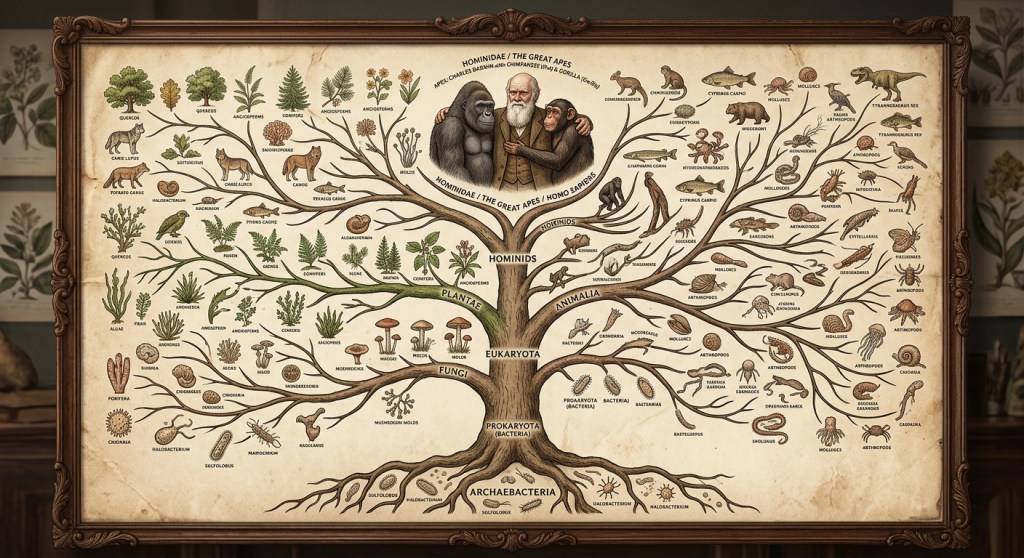
Guided evolution adds a fourth consideration: ancient microorganisms are relevant to human origins. They are part of the history from which human cellular life emerged. The juxtaposition of humanity and an earlier hidden creation can thus acquire genealogical significance for a modern reader. What first appears to be an isolated statement about another order of beings can be contemplated as an invitation to consider the concealed depth of our own natural history.
The argument nevertheless has a precise logical limitation. The verse says that al-jānn was created earlier; it does not say that human beings descended from al-jānn. Moreover, bacteria are also microscopic and ancient, and some tolerate considerable heat. Hiddenness, priority, and thermal adaptation do not uniquely identify the archaeal domain. The proposal is therefore best developed as a contextual theological reading whose scientific background is substantial, while its exact identification remains conjectural.
What Archaea are
Archaea are cellular organisms, most familiar as microscopic single cells without a membrane-bound nucleus. Their visual resemblance to bacteria once encouraged their classification together. Ribosomal RNA comparisons changed that picture. In 1977, Carl Woese and George Fox demonstrated a deep evolutionary distinction involving the organisms then called archaebacteria. The discovery was not the first observation of such microbes; it was recognition that their molecular ancestry required a major rethinking of life’s classification. “Archaea” is now the appropriate name. Woese and Fox, 1977.
Several structural features help distinguish them. Archaeal membranes characteristically contain ether-linked, branched isoprenoid lipids, whereas bacterial and eukaryotic membranes predominantly use ester-linked fatty-acid lipids. Some archaeal lipids span the membrane as a monolayer. Archaeal cell walls lack bacterial peptidoglycan; many have protein surface layers, and some have other wall materials. They contain DNA, RNA, ribosomes, and sophisticated metabolic machinery, despite lacking the typical eukaryotic nucleus and organelle system. These are distinctions within material, biochemical life. OpenStax, “Unique Characteristics of Prokaryotic Cells”.
Their ecological diversity is equally significant. Methanogens produce methane through particular metabolic pathways, often in oxygen-free settings such as sediments and animal digestive systems. Extreme halophiles thrive at high salt concentrations. Thermophiles prefer high temperatures, while thermoacidophiles combine heat tolerance with adaptation to acidity; the two terms are not interchangeable. Other archaea inhabit ordinary-temperature oceans, soils, and animal-associated environments. Archaea participate in carbon and nitrogen cycling and cannot be defined simply as inhabitants of volcanic extremes. University of California Museum of Paleontology, introduction to Archaea; Society for Archaeal Biology.
Their invisibility is relative to human perception, not an absence of physical reality. Microscopy, cultivation, sequencing, and biochemical experiments make their properties accessible to investigation. This supplies an important philosophical lesson: what is unseen by the unaided eye may be deeply consequential and empirically knowable. It does not follow that every religious use of “unseen” refers to the microscopic world. The analogy concerns the limitations of ordinary perception, not an identity between all kinds of hidden existence.
An ancient microbial Earth and a shared ancestry
The broad scientific chronology strongly supports the priority of microbial life over humanity. It does not support a simple sequence in which Archaea alone occupied Earth and subsequently produced bacteria. Bacterial and archaeal lineages diverged very early from a shared ancestral population conventionally discussed under the name LUCA, the last universal common ancestor. LUCA was not necessarily the first organism, and it should not be equated with a modern archaeon. One genomic reconstruction published in 2024 placed LUCA around 4.2 billion years ago, while making explicit the assumptions and uncertainty involved in that estimate. It also reconstructed a biologically complex organism within an ecosystem. Moody and colleagues, 2024.
Ancient rocks preserve evidence of microbial life extending back billions of years, while the timing and interpretation of the earliest traces remain debated. The fossil record and molecular clocks address different evidence and carry different uncertainties. Consequently, a date for the earliest surviving evidence should not be presented as an exact date for life’s origin. Nor should one assign a precise duration to an exclusively prokaryotic world by subtracting two contested dates and treating the result as settled.
The secure point for this commentary is the immense temporal separation: microbial evolution was already ancient when the lineage leading to human beings appeared. Eukaryotic cells arose within that earlier biological world. This places human history inside a much longer history of cells, metabolism, ecological interaction, and inheritance. The word “before” in the verse is compatible with that depth, although it does not specify its duration.
The connection becomes more striking at the cellular level. Research on Asgard archaea has strengthened the view that the eukaryotic host lineage emerged from within archaeal diversity. Genomes described in 2015 contained homologues of proteins associated with important eukaryotic cellular functions. Subsequent phylogenetic work has investigated the precise relationship between eukaryotes and particular Asgard branches. Broad archaeal affinity is strongly supported; the exact branching pattern remains a subject of active research. Spang and colleagues, 2015; Eme and colleagues, 2023.
The phrase “two-domain tree” refers to this evolutionary arrangement: the primary cellular divisions are Bacteria and Archaea, with eukaryotes emerging within the archaeal side. It does not mean that the practical distinction between archaeal and eukaryotic cells has disappeared. Nor does it imply that a presently living Asgard species is our unchanged ancestor. Living archaea have their own long evolutionary histories.
Observations of cultured Asgard organisms make the discussion more concrete. Work on Candidatus Lokiarchaeum ossiferum revealed an actin cytoskeleton and elaborate cellular protrusions. Such findings help researchers investigate antecedents of cellular complexity. They do not show a modern archaeon turning into a human cell, and they do not settle every step of eukaryogenesis. The organism in that study grew at approximately 20°C, a useful reminder that archaeal relatives relevant to this discussion need not be extreme heat lovers. Rodrigues-Oliveira and colleagues, 2023.
Eukaryotic ancestry also has an essential bacterial component. Mitochondria descend from a bacterial endosymbiont related to the alphaproteobacterial lineage. During the development of that association, genes were lost or transferred, functions became integrated, and the partners became a new cellular system. The exact route by which the partners first associated remains debated; a simple picture of a fully developed engulfing cell swallowing a bacterium should not be mistaken for an observed account of the original event. Eukaryotic ancestry is thus both archaeal and bacterial, a history of descent combined with biological partnership. Nagies and colleagues on the prokaryotic ancestry of eukaryotic genes; Eme and colleagues on models of eukaryotic origins.
For a theology of guided evolution, this mixed inheritance is especially suggestive. Human individuality rests upon an ancient history of dependence and cooperation. Our bodily existence is continuous with forms of life that possess none of our present capacities for moral reflection, language, or worship. A believer can understand that continuity as the means through which divine creativity becomes manifest over time. Biology establishes the relationships; the judgment that this history expresses divine purpose belongs to theological reasoning.
Fire heat and the limits of biological analogy
The most vivid point of contact between the proposed interpretation and microbiology is the existence of hyperthermophilic archaea. Takai and colleagues reported repeated cell proliferation by Methanopyrus kandleri strain 116 at 122°C under pressure of 40 megapascals. This is a specific experimental result under specified conditions, not a claim that all archaea grow at that temperature. Growth must also be distinguished from briefly surviving heat exposure. At high pressure, water can remain liquid above its boiling point at ordinary atmospheric pressure. Takai and colleagues, 2008.
Heat-adapted cells require coordinated protection of membranes, proteins, and nucleic acids. Suitable lipid structures help maintain a functional boundary. Protein stability, folding systems, and cellular repair help preserve metabolism. RNA must maintain the structures necessary for protein synthesis. None of these adaptations is a single universal trick possessed identically by every archaeon; they are products of particular evolutionary histories.
Recent work adds a precise example to the discussion. A 2025 study by Garcia-Campos and colleagues used broad profiling of RNA modifications to investigate temperature-sensitive changes in ribosomal RNA. In the hyperthermophilic organisms examined, regulated chemical modifications contributed to maintaining ribosome function under extreme conditions. This gives empirical substance to the idea that survival in intense heat depends on intricate molecular organization. It should not be extended into a claim that every archaeal species uses the same pattern of regulation. University of Regensburg’s account of the study; paper in Cell.
These discoveries enrich the image of life in a world of scorching conditions. They also define the analogy’s boundary. An archaeon is not made of flame. It is a water-dependent, carbon-based organism with ordinary chemical constituents. Archaea are living cells, not prebiotic precursors to life. Thermophiles do not generally obtain metabolic energy simply by absorbing environmental heat. Their energy comes from usable chemical reactions, or other biological energy-harvesting processes, within an environment whose temperature they must tolerate. Hydrothermal systems can supply chemical disequilibria that metabolism exploits; the distinction between heat and chemical free energy matters.
Nor do heat-loving organisms alive today prove that the first organisms inhabited the hottest environments now known to support life. Present-day adaptations cannot be projected unchanged into the remote past. An organism’s ancient lineage does not make every current trait primordial.
If “from fire” is applied to Archaea, therefore, it must be understood through an environmental or figurative interpretation: life emerging within, or adapted to, a world associated with intense heat and energetic geochemical processes. That is a conceivable reading, but it is not the straightforward biochemical meaning of the phrase. The counterpart “from clay” similarly invites reflection on earthly origin without supplying a laboratory account of the origin of the first cell.
Guided evolution as a theological framework
Guided evolution understands evolutionary processes as participating in divine creation. It need not require the replacement of natural selection, mutation, genetic drift, ecological interaction, or endosymbiosis with unexplained interventions. The theological claim is that the existence, intelligibility, and fruitfulness of the natural order can be understood in relation to divine wisdom. A scientific account of mechanisms and a theological account of ultimate dependence can address different questions about the same history.
Two brief passages are relevant to this framework:
Quran 71:14
وَقَدْ خَلَقَكُمْ أَطْوَارًا
And He has created you in stages.
Quran 71:17
وَاللَّهُ أَنْبَتَكُمْ مِنَ الْأَرْضِ نَبَاتًا
And God has caused you to grow from the earth as a growth.
Stages and growth supply a vocabulary hospitable to development. They do not independently specify common descent, population genetics, or the age of Earth. Shah’s discussion of growth from the earth makes room for this distinction: the language can support reflection on guided evolution without functioning as a technical statement of Darwinian theory. The interpretive force comes from compatibility within a larger understanding of creation, rather than from extracting a complete scientific model from a few words. Shah, “He Grew You from the Earth Like a Plant”; Quran 71:17.
Once that framework is adopted, the suggestion that al-jānn evokes ancient hidden life becomes more intelligible. Its role is to extend the contemplation of human origins backward into a microbial world. Yet guided evolution does not logically require that identification. A believer could accept common descent while retaining the classical interpretation of jinn as a distinct unseen creation. Conversely, accepting a contextual human reading in some jinn passages does not by itself establish the archaeal reading in a creation passage.
This distinction strengthens the theology by making its commitments clear. Faith in a Creator need not stand or fall with a contested identification of an Arabic noun. The stronger argument concerns the coherence of a universe in which matter becomes living organization, living organization develops historical continuity, and human beings acquire capacities to understand that history and respond morally to it. Such a view can accommodate further discoveries without requiring the Quran to be rewritten as each phylogenetic tree is revised.
Guidance also raises philosophical questions that a serious account should acknowledge. Evolution includes extinction, predation, suffering, and contingency. Calling the process guided does not explain these away. A theological response must consider creaturely vulnerability, the consequences of a law-governed world, the limits of human perspective, and the relationship between earthly history and ultimate justice. Likewise, biological randomness describes properties of processes or their relationship to fitness; it does not, by itself, settle whether existence has an ultimate purpose. Purpose is neither demonstrated nor refuted merely by using the scientific word “random.”
The earth and its inhabitants in Surah al Rahman
The complementary passage in Sūrat al-Raḥmān enlarges the field of attention. It brings land, vegetation, human origins, al-jānn, celestial order, waters, and precious marine products into one sustained appeal to gratitude:
Quran 55:10
وَالْأَرْضَ وَضَعَهَا لِلْأَنَامِ
And the earth He laid out for its creatures.
Quran 55:11
فِيهَا فَاكِهَةٌ وَالنَّخْلُ ذَاتُ الْأَكْمَامِ
In it are fruit and date palms with enclosing sheaths,
Quran 55:12
وَالْحَبُّ ذُو الْعَصْفِ وَالرَّيْحَانُ
and grain with its husks, and fragrant plants.
Quran 55:13
فَبِأَيِّ آلَاءِ رَبِّكُمَا تُكَذِّبَانِ
Then which of your Lord’s blessings will you both deny?
The opening word for earth’s beneficiaries is al-anām, “creatures” or “beings.” It is not al-anʿām, the word for livestock. Cattle may be included among the earth’s creatures, but this verse does not specifically name them. That distinction improves the ecological reading: the earth is presented as a dwelling for a wider community of life, followed by particular examples of vegetation and provision. Ibn Kathīr likewise explains al-anām broadly in terms of the creatures inhabiting the earth. Ibn Kathīr on 55:10–13.
The botanical details are concrete. Fruit nourishes; the date palm bears its reproductive structures within protective coverings; grain possesses structures beyond the edible kernel; aromatic plants engage the senses. These verses encourage attention to organisms as organized living beings. They do not enumerate plant taxa or describe photosynthesis, yet contemporary botanical knowledge can enlarge appreciation of the processes through which these familiar gifts arise.
The earth’s generosity also precedes human ownership. Within the passage’s theological vision, people receive a place in an already provisioned world. An evolutionary perspective deepens that recognition: human food depends on organisms, environments, and inherited biological capacities whose histories extend far beyond human civilization. Gratitude becomes an acknowledgment of dependence rather than a decorative response to abundance.
Clay fire and the dual address
Quran 55:14
خَلَقَ الْإِنْسَانَ مِنْ صَلْصَالٍ كَالْفَخَّارِ
He created the human being from sounding clay like pottery,
Quran 55:15
وَخَلَقَ الْجَانَّ مِنْ مَارِجٍ مِنْ نَارٍ
and He created al-jānn from a flame of fire.
Quran 55:16
فَبِأَيِّ آلَاءِ رَبِّكُمَا تُكَذِّبَانِ
Then which of your Lord’s blessings will you both deny?
The pairing recalls the central passage in Sūrat al-Ḥijr. Here clay is compared to pottery, and the fiery expression is mārij min nār, often rendered as a smokeless or mingled flame. The lexical imagery can support the same modern meditation on earthly embodiment and an earlier hidden biological world associated with heat. It does not become a different kind of scientific statement merely because the pairing is repeated. Ibn Kathīr on the creation pairing.
The arrangement of subjects also needs careful handling. Plants appear before humanity, and humanity before al-jānn, whereas the earlier creation passage expressly places al-jānn before humanity. The order in Sūrat al-Raḥmān is therefore not a chronological evolutionary sequence. It is a rhetorical arrangement of signs and blessings. Its force lies in bringing different dimensions of creation into relation, repeatedly asking the audience to recognize their source.
The repeated question is grammatically dual: “your Lord” and “you both” address two recipients. The classical identification of those recipients as humans and jinn has a strong basis within the surah, which later says:
Quran 55:33
يَا مَعْشَرَ الْجِنِّ وَالْإِنْسِ إِنِ اسْتَطَعْتُمْ أَنْ تَنْفُذُوا مِنْ أَقْطَارِ السَّمَاوَاتِ وَالْأَرْضِ فَانْفُذُوا لَا تَنْفُذُونَ إِلَّا بِسُلْطَانٍ
O company of jinn and humankind, if you are able to pass beyond the regions of the heavens and the earth, then pass; you will not pass except with authority.
This address presents a substantial difficulty for a uniform microbial interpretation. Archaea are not moral respondents who acknowledge or deny blessings. An advocate of the proposed reading must therefore explain a shift between primordial life in the creation image and morally responsible recipients in the refrain, or offer a defensible account of personification. Neither solution should be treated as self-evident. The textual unity of the surah gives the classical reading an advantage on this specific question. Quran 55:33.
The most sustainable modern proposal is consequently modest in its lexical claim and expansive in its contemplative reach. The clay-and-fire pairing may be explored in conversation with the history of embodied life, while the surah’s immediate moral address is allowed its full weight. This produces a philosophical and theological commentary informed by science, without forcing every sentence into one biological identification.
Horizons waters and the meaning of a boundary
Quran 55:17
رَبُّ الْمَشْرِقَيْنِ وَرَبُّ الْمَغْرِبَيْنِ
Lord of the two easts and Lord of the two wests.
Quran 55:18
فَبِأَيِّ آلَاءِ رَبِّكُمَا تُكَذِّبَانِ
Then which of your Lord’s blessings will you both deny?
Quran 55:19
مَرَجَ الْبَحْرَيْنِ يَلْتَقِيَانِ
He released the two waters, meeting together;
Quran 55:20
بَيْنَهُمَا بَرْزَخٌ لَا يَبْغِيَانِ
between them is a barrier; they do not transgress.
Quran 55:21
فَبِأَيِّ آلَاءِ رَبِّكُمَا تُكَذِّبَانِ
Then which of your Lord’s blessings will you both deny?
The two easts and two wests have been understood in relation to the differing extremes of sunrise and sunset across the year. The larger theological point is ordered variation: a world changes without becoming unintelligible. The movement to the meeting waters extends that theme to the relation between distinction and encounter. Classical commentary on 55:17–20.
These verses do not themselves specify that one body of water is fresh and the other salt. Another passage does:
Quran 25:53
وَهُوَ الَّذِي مَرَجَ الْبَحْرَيْنِ هَذَا عَذْبٌ فُرَاتٌ وَهَذَا مِلْحٌ أُجَاجٌ وَجَعَلَ بَيْنَهُمَا بَرْزَخًا وَحِجْرًا مَحْجُورًا
And He is the One who released the two waters, this one sweet and refreshing and this one salty and bitter, and placed between them a barrier and a forbidding separation.
Reading the passages together supports reflection on freshwater and marine environments. It does not justify claiming that fresh water and salt water never mix. In estuaries, differences in density can produce stratification, while river flow, tides, wind, and turbulence govern the extent of mixing. A salt wedge or salinity gradient is a dynamic physical structure, not an impermeable wall. NOAA’s account of estuarine circulation describes several degrees and patterns of such mixing. Quran 25:53; NOAA on estuarine circulation.
The word barzakh can therefore invite reflection on separation, limits, and maintained distinctions without being converted into a claim that oceanography would contradict. Classical explanations also varied, including geographical separation by land. A contemporary commentary should identify a physical analogy as an analogy and preserve the wider poetic and theological significance of ordered waters.
Ecologically, the meeting is as important as the distinction. Different salinities support different communities, and transition zones become places of exchange. The text directs attention to an inhabited world whose boundaries can structure relationships. Its repeated refrain asks what human beings make of that world when they recognize that its conditions are received rather than self-created.
Pearls coral and the living production of beauty
Quran 55:22
يَخْرُجُ مِنْهُمَا اللُّؤْلُؤُ وَالْمَرْجَانُ
From them both emerge pearls and marjān.
Quran 55:23
فَبِأَيِّ آلَاءِ رَبِّكُمَا تُكَذِّبَانِ
Then which of your Lord’s blessings will you both deny?
Marjān is commonly translated “coral,” although classical explanations also include kinds or sizes of pearls. Retaining the Arabic term in the rendering acknowledges that interpretive history. On the familiar pearl-and-coral reading, the passage calls attention to precious materials produced by living organisms. It does not identify all marine gemstones as marjān, nor does it require every named product to occur equally in every kind of water. Quran 55:22; classical explanations of marjān.
The association between both kinds of water, nourishment, and ornament is explicit elsewhere:
Quran 35:12
وَمَا يَسْتَوِي الْبَحْرَانِ هَذَا عَذْبٌ فُرَاتٌ سَائِغٌ شَرَابُهُ وَهَذَا مِلْحٌ أُجَاجٌ وَمِنْ كُلٍّ تَأْكُلُونَ لَحْمًا طَرِيًّا وَتَسْتَخْرِجُونَ حِلْيَةً تَلْبَسُونَهَا وَتَرَى الْفُلْكَ فِيهِ مَوَاخِرَ لِتَبْتَغُوا مِنْ فَضْلِهِ وَلَعَلَّكُمْ تَشْكُرُونَ
The two waters are not alike: this one is sweet and refreshing, pleasant to drink, and this one is salty and bitter. Yet from each you eat fresh flesh and extract ornaments that you wear. And you see ships cleaving through it, so that you may seek of His bounty and perhaps give thanks.
Freshwater pearl-producing mussels make the reference to ornament from fresh waters especially intelligible to a modern reader. The connection does not require inventing freshwater populations of precious marine coral. Different aquatic habitats contribute different gifts. Quran 35:12.
Pearls illustrate biomineralization: organisms organize mineral material. Their formation involves secretory tissue in a pearl sac, often following tissue disturbance; the familiar grain-of-sand story is an oversimplification. Cultivation uses tissue grafts, sometimes with bead nuclei. Pearls may have nacreous or non-nacreous structures. GIA, pearl description.
The diversity of pearl-producing animals gives biological specificity to the passage’s invitation to look:
| Organism | Habitat and representative pearl material |
| Akoya oysters, Pinctada fucata and the closely associated martensii designation | Marine oysters associated with cultivated Akoya pearls, often white or cream; Japan and China are important centers. |
| Pinctada maxima | Tropical marine oysters producing South Sea pearls, including white, silver, and golden varieties; cultivation includes Australia, Indonesia, and the Philippines. |
| Pinctada margaritifera | Black-lipped marine oysters producing Tahitian pearls with dark body colors and varied overtones; French Polynesia is especially associated with them. |
| Haliotis species | Abalone are marine gastropods; rare pearls can display strong iridescence and irregular forms. |
| Aliger gigas, formerly Strombus gigas | The Caribbean queen conch produces non-nacreous pearls, often pink, sometimes with a distinctive flame-like optical structure. |
| Melo melo | A marine gastropod of Southeast Asian waters, producing rare non-nacreous pearls, often orange. |
| Freshwater mussels in Unionidae, including Hyriopsis cumingii | Freshwater animals producing pearls in varied shapes and colors; China is a major center of cultivation, including ponds and lakes. |
The principal cultured categories are described by GIA; its research on queen conch pearls also explains their distinctive non-nacreous appearance. The scientific names are examples for the modern commentary, not organisms named individually in the Arabic verse. GIA on cultured pearl varieties; Fritsch and Misiorowski on queen conch pearls.
The contrast between an oyster pearl and a conch pearl also guards against a misleading simplification. “Pearl” does not always mean a sphere of nacre. Biological structures can produce different optical effects through different arrangements of mineral and organic components. The scientific explanation makes the object more interesting: beauty has a material history within an organism.
Other materials broaden this reflection, while remaining examples supplied by natural history rather than additional translations of the verse:
| Material | Biological origin and important distinction |
| Precious coral | Corallium rubrum and related precious corals are colonial animals whose mineral skeletons supply jewelry material, often red or pink. They are distinct from mollusks and tropical reef-building corals. |
| Ammolite | Iridescent fossil ammonite shell, especially associated with deposits in Alberta. This is a geological preservation of ancient biological material, rather than a gem being produced by a living ammonite today. |
| Mother-of-pearl | Nacre lining the shells of many mollusks; it can be cut or carved for ornaments and inlays. It is shell material, rather than a separate pearl within the animal. |
| Polished opercula called Shiva’s Eye | The mineralized protective lids of certain marine gastropods, including turban snails; these are anatomical structures, not pearls. |
Ammolite is particularly evocative because it brings deep time into the contemplation of beauty. The ammonite lived, its shell was buried, and geological processes preserved material that later people recognize as a gem. GIA’s study of Canadian ammolite identifies the fossil shell source and its mineral character. The term “organic gem” here means biologically derived; it does not imply that the whole object consists of organic molecules. Pearls, shell, and precious coral contain substantial mineral components. Mychaluk and colleagues, “Ammolite”; Gem-A on precious coral.
There is a striking thematic relationship between clay and pearl. In the first, the human body is recalled to its earthly material origin. In the second, living organization transforms environmental constituents into a structure of unusual beauty. Both discourage a sharp separation between supposedly inert matter and meaningful life. For the believer, divine generosity can be contemplated through the processes themselves: the building of a shell, the growth of a colony, the persistence of a lineage, and the emergence of perception capable of appreciating them.
A disciplined argument for continuity and gratitude
The commentary now supports several conclusions of differing kinds. The text clearly presents human beings as created, materially dependent, and situated among other creations. It clearly gives al-jānn temporal priority in Sūrat al-Ḥijr. Modern biology independently establishes ancient microbial life and a profound archaeal and bacterial contribution to eukaryotic ancestry. The proposal that the Quranic noun specifically denotes Archaea connects these facts through an interpretive judgment. Its attraction is real, but its evidential status differs from the facts it brings together.
The strongest philosophical contribution of the proposal may be its resistance to human self-sufficiency. Human beings are late arrivals whose bodies carry inherited capacities from organisms they cannot ordinarily see. The strongest theological contribution is a way of understanding divine creativity through continuity: the Creator’s wisdom can be contemplated in a world whose processes generate new forms across immense spans of time. The strongest ethical contribution follows from the refrain of Sūrat al-Raḥmān: knowledge of dependence can become gratitude, and gratitude can become care for the conditions of life.
This approach also gives scientific investigation a constructive place within religious reflection:
Quran 29:20
قُلْ سِيرُوا فِي الْأَرْضِ فَانْظُرُوا كَيْفَ بَدَأَ الْخَلْقَ ثُمَّ اللَّهُ يُنْشِئُ النَّشْأَةَ الْآخِرَةَ إِنَّ اللَّهَ عَلَى كُلِّ شَيْءٍ قَدِيرٌ
Say: Travel through the earth and consider how He began creation. Then God will bring forth the final creation. God is capable of all things.
The verse connects looking into the beginning of creation with a theological horizon extending beyond present life. It does not prescribe a modern research method, yet its invitation to observation and consideration sits comfortably with a serious interest in rocks, organisms, and evolutionary history. Inquiry can become a form of attentiveness to the world the believer understands as created. Quran 29:20.
Intellectual responsibility belongs within that same posture:
Quran 17:36
وَلَا تَقْفُ مَا لَيْسَ لَكَ بِهِ عِلْمٌ إِنَّ السَّمْعَ وَالْبَصَرَ وَالْفُؤَادَ كُلُّ أُولَئِكَ كَانَ عَنْهُ مَسْئُولًا
Do not pursue that of which you have no knowledge. Hearing, sight, and the heart—all of these will be called to account.
A careful reader can therefore affirm the value of the archaeal interpretation while refusing to overstate it. Its merits include its attention to natural history, its recognition of hidden biological dependence, and its capacity to deepen guided-evolution theology. Its difficulties include the specificity of the proposed lexical identification, the presence of personal agency in other jinn passages, the dual moral address of Sūrat al-Raḥmān, and the metaphorical treatment required by “from fire.” Naming those difficulties makes the interpretation reviewable and intellectually durable. Quran 17:36.
Respect for classical commentators is compatible with exploring this modern possibility. Their readings arose from linguistic, transmitted, and theological considerations that deserve examination on their own terms. Belief in an unseen creation does not entail rejection of evolution, and rejection of popular stories about ghosts does not prove a microbial exegesis. The productive discussion concerns evidence, meaning, and the relation between revelation and the world, rather than a contest of labels.
Thematic epilogue
The movement from hidden cells to human reflection, and from meeting waters to pearl and coral, discloses a world richer than unaided perception suggests. The smallest organisms can participate in the ancestry of the largest questions. A cell invisible to the eye may help illuminate the material history of the eye itself. A mollusk, occupied with the ordinary processes of living, can produce a surface in which human beings perceive extraordinary beauty.
Read through guided evolution, Quran 15:26–27 invites contemplation of an earthly humanity whose emergence belongs to a vast preceding history. The proposed identification of al-jānn with Archaea gives that contemplation a distinctive scientific focus, provided the interpreter remembers the difference between a fruitful reading and a demonstrated translation. The theological insight need not be diminished by that restraint. A creation capable of yielding life through intelligible processes remains, for faith, creation.
Sūrat al-Raḥmān carries this reflection toward gratitude. Earth is inhabited before it is owned. Food grows through powers people receive before they understand them. Waters sustain different communities of life. Precious beauty emerges from bodies unlike our own. The repeated question asks whether familiarity will make these gifts invisible, or knowledge will make them newly visible.
The appropriate response is neither to fear the hidden world nor to claim certainty beyond the evidence. It is to investigate patiently, interpret honestly, and receive existence with humility. In that spirit, the ancient cell, the sounding clay, the growing plant, and the luminous pearl become occasions for a single act of attention: recognizing that human life stands within a creation it did not begin, does not sustain alone, and has good reason to cherish.
For references go to Microsoft Word file:





Leave a comment