
Presented by Claude for Zia H Shah MD
ABSTRACT This essay offers a philological, scientific, philosophical, and theological commentary on Qurʾān 15:26–27 (Sūrat al-Ḥijr), read within its immediate context (15:16–25), and an embellishing meditation on Qurʾān 55:10–23 (Sūrat al-Raḥmān). Its central thesis, developed most fully by the physician-writer Zia H. Shah MD and rooted in the interpretive tradition of the Lahore and Qadiani Ahmadiyya as well as Muhammad Asad, is that the root meaning of jinn (ج-ن-ن, “to cover, conceal, hide”) licenses a family of context-dependent readings, and that in 15:27 and 55:15 the al-jānn “created before” humankind, “from the fire of scorching wind” (nār al-samūm) / “from a confusing flame of fire” (mārij min nār), can be read as the hidden, primordial, heat-loving microbial life that preceded and seeded the evolution of complex life — specifically the Archaea (archaebacteria). We defend this reading on four grounds: the Qurʾānic insistence that these beings were created min qablu (“before”); the pervasive Qurʾānic motif of staged, guided creation (e.g., 71:14, 71:17, 24:45, 21:30, 32:7–9); the textual coherence (naẓm) of 15:16–25, a passage about cosmos and nature rather than mythology; and the correlation of “scorching fire” with hyperthermophilic archaea of hydrothermal vents and a hot early Earth. We marshal the modern science of Archaea (Woese and Fox 1977; the two-domain/eocyte model; Asgard archaea and eukaryogenesis; the chimeric eukaryotic cell; LUCA at ~4.2 Ga; the 122 °C growth record of Methanopyrus kandleri) and, for Sūrat al-Raḥmān, the biology of the two-seas barrier (barzakh) and of the organic gems — pearls and coral — “brought forth” from living mollusks and cnidarians. Throughout we present the classical reading (jinn as morally responsible unseen beings created from smokeless fire) fairly, register the strongest objections to the naturalist reading (55:33; 72:1; 6:130; 51:56; the Iblīs narrative of 15:27–44), and show how the polysemy defence answers them. We conclude that the reading is a legitimate exercise of taʾwīl that magnifies rather than diminishes the tawḥīd and gratitude that are the surahs’ true burden.
═══════════════════════════════════
I. INTRODUCTION: THE HIDDEN AND THE REVEALED
Two verses of Sūrat al-Ḥijr stand at the hinge of the Qurʾān’s account of the origin of the two “weighty” species, humankind and jinn. In the received Uthmānī text:
وَلَقَدْ خَلَقْنَا ٱلْإِنسَٰنَ مِن صَلْصَٰلٍ مِّنْ حَمَإٍ مَّسْنُونٍ ﴿٢٦﴾ وَٱلْجَآنَّ خَلَقْنَٰهُ مِن قَبْلُ مِن نَّارِ ٱلسَّمُومِ ﴿٢٧﴾
“And We did certainly create man out of clay from an altered black mud. And the jinn We created before, from scorching fire.” (15:26–27, Sahih International)
Muhammad Asad renders the pair: “And, indeed, We have created man out of sounding clay, out of dark slime transmuted — whereas the invisible beings We had created, before that, out of the fire of scorching winds.” Sher Ali (the Ahmadiyya translation) has: “And surely, We created man from dry ringing clay, from black mud wrought into shape. And the Jinn We had created before from the fire of hot wind.”
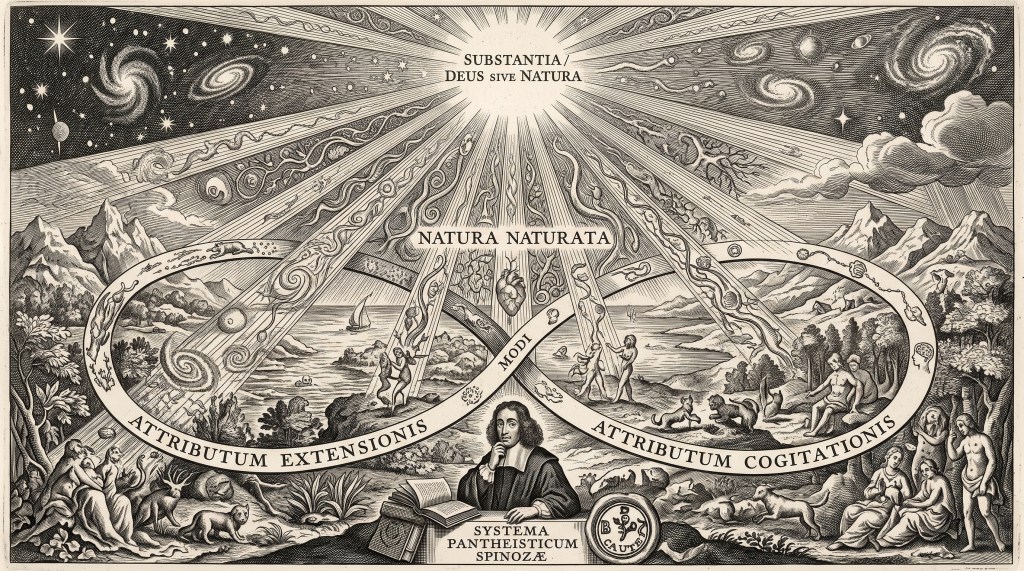
The pivot of the whole discussion is a single Arabic root. The word jinn (جِنّ) and its cognate al-jānn (الجانّ) derive from the triliteral root ج-ن-ن (j-n-n), whose primary sense is “to cover, to conceal, to hide.” From this one root Arabic builds an entire semantic universe of concealment: janīn (جنين), the embryo hidden in the womb; jannah (جنّة), the garden so densely canopied that its floor is hidden, hence Paradise; junnah (جُنّة), a shield that covers; majnūn (مجنون), the madman whose reason is veiled; junūn (جنون), madness; and janna (as verb) “he covered with darkness,” as in the Qurʾān’s own usage of Abraham “when the night covered him” (fa-lammā janna ʿalayhi al-layl, 6:76). As Edward William Lane’s Arabic-English Lexicon records, jinn denotes not only spirits but “anything concealed” — through darkness, distance, status, or time. This is the linguistic key the naturalist commentators turn: whatever else jinn are, the word names first of all the hidden — and the microscopic world is precisely the historically hidden domain of life.
This essay takes that key seriously. It argues, following Zia H. Shah MD (Chief Editor of The Muslim Times and thequran.love, “The Glorious Quran and Science”) and a lineage of modern commentators, that once one accepts — as these commentators do — that the Qurʾān describes a staged, guided emergence of life, the most coherent reading of “the al-jānn We created before” is a reference to the hidden, primordial, heat-associated microbial life that antedated humankind and, through the long chain of evolution, lies at the cellular root of our own being: the Archaea.
═══════════════════════════════════
II. THE VERSES AND THEIR CONTEXT (15:16–27)
A cardinal principle of the naturalist reading is naẓm — the coherence and flow of the passage. The single line about al-jānn (15:27) does not fall in a vacuum; it is the culmination of a sustained meditation (15:16–25) on the heavens, the earth, and the natural order. The Uthmānī text with the Sahih International rendering:
وَلَقَدْ جَعَلْنَا فِى ٱلسَّمَآءِ بُرُوجًا وَزَيَّنَّٰهَا لِلنَّٰظِرِينَ ﴿١٦﴾ “And We have placed within the heaven great stars and have beautified it for the observers.” (15:16)
وَحَفِظْنَٰهَا مِن كُلِّ شَيْطَٰنٍ رَّجِيمٍ ﴿١٧﴾ “And We have protected it from every devil expelled [from mercy].” (15:17)
إِلَّا مَنِ ٱسْتَرَقَ ٱلسَّمْعَ فَأَتْبَعَهُۥ شِهَابٌ مُّبِينٌ ﴿١٨﴾ “Except one who steals a hearing and is pursued by a clear burning flame.” (15:18)
وَٱلْأَرْضَ مَدَدْنَٰهَا وَأَلْقَيْنَا فِيهَا رَوَٰسِىَ وَأَنۢبَتْنَا فِيهَا مِن كُلِّ شَىْءٍ مَّوْزُونٍ ﴿١٩﴾ “And the earth — We have spread it and cast therein firmly set mountains and caused to grow therein [something] of every well-balanced thing.” (15:19)
وَجَعَلْنَا لَكُمْ فِيهَا مَعَٰيِشَ وَمَن لَّسْتُمْ لَهُۥ بِرَٰزِقِينَ ﴿٢٠﴾ “And We have made for you therein means of living and [for] those for whom you are not providers.” (15:20)
وَإِن مِّن شَىْءٍ إِلَّا عِندَنَا خَزَآئِنُهُۥ وَمَا نُنَزِّلُهُۥٓ إِلَّا بِقَدَرٍ مَّعْلُومٍ ﴿٢١﴾ “And there is not a thing but that with Us are its depositories, and We do not send it down except according to a known measure.” (15:21)
وَأَرْسَلْنَا ٱلرِّيَٰحَ لَوَٰقِحَ فَأَنزَلْنَا مِنَ ٱلسَّمَآءِ مَآءً فَأَسْقَيْنَٰكُمُوهُ وَمَآ أَنتُمْ لَهُۥ بِخَٰزِنِينَ ﴿٢٢﴾ “And We have sent the fertilizing winds and sent down water from the sky and given you drink from it. And you are not its retainers.” (15:22)
وَإِنَّا لَنَحْنُ نُحْىِۦ وَنُمِيتُ وَنَحْنُ ٱلْوَٰرِثُونَ ﴿٢٣﴾ “And indeed, it is We who give life and cause death, and We are the Inheritor.” (15:23)
وَلَقَدْ عَلِمْنَا ٱلْمُسْتَقْدِمِينَ مِنكُمْ وَلَقَدْ عَلِمْنَا ٱلْمُسْتَـْٔخِرِينَ ﴿٢٤﴾ “And We have already known the preceding [generations] among you, and We have already known the later [ones to come].” (15:24)
وَإِنَّ رَبَّكَ هُوَ يَحْشُرُهُمْ ۚ إِنَّهُۥ حَكِيمٌ عَلِيمٌ ﴿٢٥﴾ “And indeed, your Lord will gather them; indeed, He is Wise and Knowing.” (15:25)
The argument from coherence is this: verses 16–25 concern stars and constellations, the spread earth and its mountains, the balanced growth of vegetation, provision and ecosystems (“those for whom you are not providers”), the water cycle and pollinating winds, life and death, and the succession of generations. It is a nature passage, not a demonology. Into this flow verses 26–27 introduce the origin of the two species. On the naturalist reading, the text moves seamlessly from cosmos → earth → plants → ecosystems → the giving of life and death → the origin of humankind from clay and of the hidden ones “before” — a descent that maps onto the actual order of natural history: universe, planet, and life. To insert here a single, unmotivated line about ghosts or demons is, on this view, to break the naẓm; to read al-jānn as early, hidden life restores it.
═══════════════════════════════════
III. PHILOLOGY OF THE KEY TERMS
- Ṣalṣāl (صلصال). The philological authorities gloss ṣalṣāl as “dried clay that emits a sound (like pottery) when struck.” Asad notes it is used in the Qurʾān exclusively of the creation of man and connotes both the “brittleness of his existence” and, since it “rings,” the faculty of articulate speech. The pairing with fakhkhār (“baked pottery”) in 55:14 confirms the sense.
- Ḥamaʾ masnūn (حمإ مسنون). Ḥamaʾ is “dark, fetid mud” or “dark slime”; masnūn carries a double sense — “altered/transmuted (in composition)” and “moulded into shape” (so al-Rāzī, cited by Asad). Asad captures both with “dark slime transmuted.” The Rowwad translators gloss: “Ṣalṣāl: clay left to ferment and turn hard so that it clinks when tapped on; Ḥamaʾ: transformed or blackened clay; Masnūn: the smell of which has turned foul.” The imagery is of matter chemically altered over time and then shaped — a phrasing to which the guided-evolution reading returns.
- Al-jānn (الجانّ). Grammatically a collective/neuter singular for the jinn kind; some lexica also note a sense of “agile snake.” Lisān al-ʿArab (Ibn Manẓūr) preserves an old tradition that “creatures called jānn lived on earth” before the present inhabitants. Crucially for our reading, the verse uses al-jānn, “the hidden kind,” and marks it with min qablu.
- Min qablu (من قبل). “Before” — before humankind. This adverb is the load-bearing word of the whole thesis: the hidden ones came first. On the classical reading this means the fiery jinn preceded Adam; on the naturalist reading it registers the plain fact of natural history that microbial life preceded humanity by billions of years.
- Nār al-samūm (نار السموم). Samūm derives from the root س-م-م and denotes an intensely hot, penetrating wind — the desert simoom. Lane and the classical lexica emphasize penetration and fineness: Abū ʿUbayda is cited that samūm is fire that “penetrates the pores due to its fineness.” Maulana Maududi notes pointedly: “As samūm is not wind, nār-i-samūm will mean flame of intense heat and not of fire” — i.e., the emphasis is on scorching heat, not ordinary flame. Ibn Kathīr records the report of Ibn Masʿūd that this is “one of the seventy parts” of a fierce fire. The naturalist reading fastens on the semantic core — intense, penetrating heat — and correlates it with the thermal environments of the earliest life.
- Mārij min nār (مارج من نار), 55:15. Mārij is glossed by older lexica as “a mixture of fire,” “a flame mixed with the black substance of fire,” “a confusing flame.” Asad renders the whole “a confusing flame of fire.” The two descriptions — nār al-samūm (scorching, penetrating heat) and mārij min nār (a mixed, flickering flame) — are the Qurʾān’s two characterizations of the substance of the hidden ones.
═══════════════════════════════════
IV. THE CLASSICAL INTERPRETATION AND THE MODERN ALTERNATIVES
A. The classical consensus. The great mufassirūn — al-Ṭabarī, Ibn Kathīr, al-Rāzī, al-Qurṭubī — overwhelmingly understood jinn/al-jānn as a distinct order of sentient, morally accountable, invisible beings created from smokeless fire before Adam, of whom Iblīs is either one (per Ḥasan al-Baṣrī, who identified Iblīs with al-jānn) or the father of the shayāṭīn while al-jānn fathers the jinn (the majority view). This is treated as part of belief in the ghayb (the unseen). It is intellectually honest to say plainly: this is the mainstream reading, and Zia H. Shah himself concedes that “classical scholars almost unanimously affirm jinn’s existence.”
B. The polysemy of jinn in the Qurʾān itself. The naturalist case does not begin with science but with the Qurʾān’s own varied usage. The word is demonstrably not univocal:
- In Sūrat al-Nās (114:6) humankind is warned of the whisperer “min al-jinnati wa al-nās” — “from among jinn and men” — where jinn is set beside, and parallel to, human beings, and many read a class of concealed/hidden human agents (schemers, hidden powers).
- Muhammad Asad, in Appendix III of The Message of the Qurʾān (“On the Term and Concept of Jinn”), writes that “in the usage of the Qurʾān … the term jinn has several distinct meanings,” most commonly “spiritual forces or beings which, precisely because they have no corporeal existence, are beyond the perception of our corporeal senses,” but “occasionally, the term jinn is used … to denote those elemental forces of nature — including human nature — which are concealed from our senses inasmuch as they manifest themselves to us only in their effects but not in their intrinsic reality.” Strikingly for our purposes, Asad continues that jinn is also applied to “certain sentient organisms of so fine a nature and of a physiological composition so different from our own that they are not normally accessible to our sense-perception,” and adds: “we know, of course, very little as to what can and what cannot play the role of a living organism.”
- On 72:1 Asad glosses jinn as possibly “hitherto unseen beings … strangers who had never before been seen.” Maulana Muhammad Ali (Lahore Ahmadiyya) reads several Qurʾānic jinn as human beings of one description or another. Mirza Bashir-ud-Din Mahmud Ahmad (Khalīfat al-Masīḥ II), in the Ahmadiyya commentary (Urdu Tafsīr-i Kabīr; English Five Volume Commentary compiled by Malik Ghulam Farid), gave several reasons why the Qurʾānic jinn are not the demons of popular imagination — arguing, for instance, that many Qurʾānic uses of jinn denote foreigners, aliens, or people hidden from the masses, and noting that when the Prophet is told to say “O mankind” (7:158) rather than “O mankind and jinn,” a separate species is not in view.
The methodological upshot: the same word carries context-dependent meanings. In a passage of moral address (72; 55:33; 6:130) jinn may denote accountable unseen beings or hidden humans; in a passage of natural history (15:26–27; 55:15) the root sense of “hidden [life]” may be operative.
C. The archaebacteria thesis. Building on this polysemy, Zia H. Shah MD proposes that “jinn, according to the Islamic tradition, may also mean … archaebacteria, which emerged at least 3.5 billion years ago and live in environments that resemble conditions existing when the earth was young, which may have [had a] role in the evolution of life on our planet.” The al-jānn “created before … from the fire of scorching wind” is read as the hidden, heat-loving microbial life that preceded humankind.
═══════════════════════════════════
V. THE FOUR PILLARS OF THE READING
Pillar 1 — “Before” (min qablu). The verse’s own adverb asserts temporal priority. In natural history, prokaryotic life preceded humanity by an immense span. The earliest generally accepted isotopic traces of life date to ~3.7 billion years ago (Ga) and fossil stromatolites to ~3.5 Ga; the Last Universal Common Ancestor (LUCA) is now dated, by Moody et al. (Nature Ecology & Evolution, 12 July 2024, doi:10.1038/s41559-024-02461-1), to ~4.2 Ga (credible interval 4.09–4.32 Ga) — “a complex prokaryote-grade anaerobic acetogen that was part of an ecosystem,” living just ~340 million years after Earth formed. The hidden ones were, indeed, “created before.”
Pillar 2 — Guided evolution across the Qurʾān. The reading presupposes, and is presupposed by, the many verses these commentators read as describing staged creation:
- “What is the matter with you that you do not attribute to Allah [due] grandeur while He has created you in stages (aṭwāran)?” (71:14): وَقَدْ خَلَقَكُمْ أَطْوَارًا
- “And Allah has caused you to grow from the earth a [progressive] growth” (71:17): وَٱللَّهُ أَنۢبَتَكُم مِّنَ ٱلْأَرْضِ نَبَاتًا
- “And Allah has created every moving creature from water…” (24:45): وَٱللَّهُ خَلَقَ كُلَّ دَآبَّةٍ مِّن مَّآءٍ
- “…We made from water every living thing?” (21:30): وَجَعَلْنَا مِنَ ٱلْمَآءِ كُلَّ شَىْءٍ حَىٍّ
- “…and He began the creation of man from clay; then He made his posterity out of an extract of despised fluid…” (32:7–9): وَبَدَأَ خَلْقَ ٱلْإِنسَٰنِ مِن طِينٍ ثُمَّ جَعَلَ نَسْلَهُۥ مِن سُلَٰلَةٍ مِّن مَّآءٍ مَّهِينٍ
- “Has there [not] come upon man a period of time when he was not a thing [even] mentioned?” (76:1): هَلْ أَتَىٰ عَلَى ٱلْإِنسَٰنِ حِينٌ مِّنَ ٱلدَّهْرِ لَمْ يَكُن شَيْـًٔا مَّذْكُورًا
On this reading, once creation-in-stages from water and clay is granted, a line noting that hidden life came “before” is not an anomaly but the missing first chapter of the same story.
Pillar 3 — Coherence (naẓm). As shown in §II, 15:16–25 is a nature passage. The naturalist reading keeps 15:26–27 within that register; the mythological reading introduces a genre-break. The text, these commentators argue, “flows more profoundly” for the believer in guided creation than for a creationism populated by ghosts and demons.
Pillar 4 — “Scorching fire” and the hot early Earth. The heat-motifs (nār al-samūm, mārij min nār) correlate with the thermal cradle of early life: a hot young planet, submarine volcanism, and hydrothermal vents where hyperthermophilic archaea flourish today. This is the point at which philology meets microbiology.
═══════════════════════════════════
VI. THE SCIENCE OF ARCHAEA
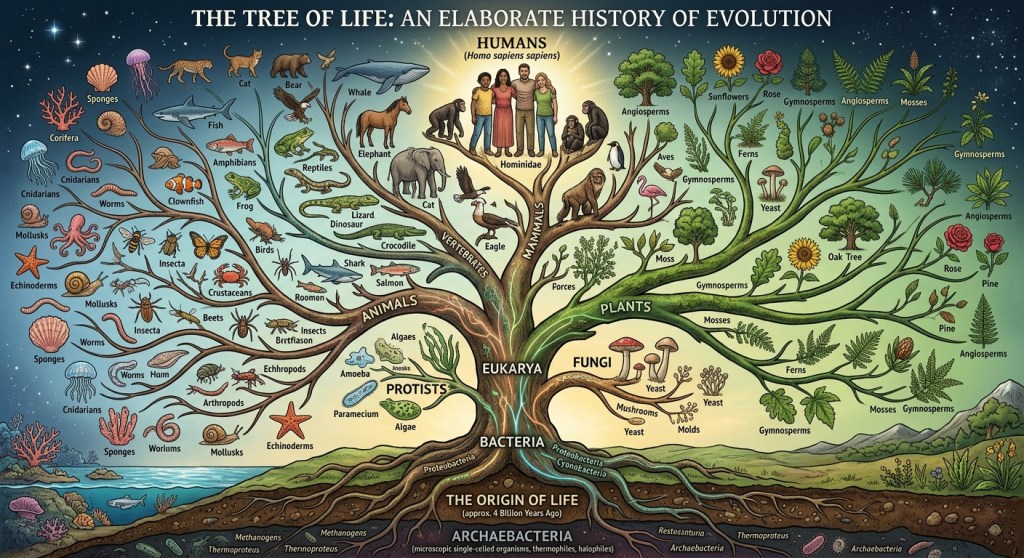
A. A third domain, hidden until 1977. In 1977 Carl R. Woese and George E. Fox, using 16S ribosomal RNA as a “molecular chronometer,” discovered that what had been lumped together as “prokaryotes” in fact comprised two profoundly different lineages, and proposed a tree of life with three domains: Bacteria, Archaea (initially “archaebacteria”), and Eukarya (their 1977 PNAS paper, “Phylogenetic structure of the prokaryotic domain: the primary kingdoms,” PNAS 74(11):5088–5090). The evolutionary biologist Jonathan Eisen aptly called the archaea “a ‘hidden’ third major branch in the tree of life” — a phrase that resonates with the very etymology of jinn. The genetic gulf between Archaea and Bacteria is, at the molecular level, larger than that between humans and plants.
B. What Archaea are. Archaea are single-celled prokaryotes: no nucleus, no membrane-bound organelles. But they are biochemically distinct from Bacteria in ways that fit “extreme, hidden” life:
- Cell walls lack peptidoglycan (murein); some methanogens have pseudopeptidoglycan (pseudomurein), in which N-acetyltalosaminuronic acid replaces N-acetylmuramic acid, joined by β(1,3) rather than β(1,4) linkages. Many archaea use protein S-layers instead.
- Membranes are unique: isoprenoid hydrocarbon chains linked by ether bonds to sn-glycerol-1-phosphate — the mirror-image stereochemistry of the ester-linked, fatty-acid, sn-glycerol-3-phosphate membranes of Bacteria and Eukarya. Many thermophiles form glycerol dialkyl glycerol tetraethers (GDGTs): 40-carbon biphytanyl chains spanning the whole membrane as a rigid monolayer, giving very low ion leakage across extremes of temperature and pH. This is the molecular secret of their stability in harsh conditions.
- Hyperthermophiles additionally deploy reverse gyrase (introducing positive supercoils that stabilize DNA against heat), thermostable proteins, and specific ribosomal-RNA modifications.
C. The three ecological types. Methanogens (produce methane; swamps, sediments, animal guts); halophiles (salt lakes and brines); and thermoacidophiles/hyperthermophiles (hot springs, acidic solfataras, hydrothermal vents).
D. The temperature record-holders. Hyperthermophilic archaea define the known upper temperature limit for life. Pyrolobus fumarii, isolated from a black-smoker wall at the TAG site on the Mid-Atlantic Ridge (3,650 m depth), grows between 90 and 113 °C (optimum 106 °C) and survives one-hour autoclaving at 121 °C; its describers reported that it “represents a novel group of archaea, extending the upper temperature limit for life to 113°C” (Blöchl et al., Extremophiles 1997, 1:14–21, doi:10.1007/s007920050010). The record was then extended by Geogemma barossii “strain 121,” isolated from the Mothra hydrothermal vent field in the NE Pacific, which completes its life cycle at 121 °C — remarkable, as Kashefi & Lovley noted, “because sterilization at 121°C … is a standard procedure, shown to kill all previously described microorganisms,” and it remained viable (though non-growing, i.e. biostatic) after exposure to 130 °C (Science 301(5635):934, 15 Aug 2003, doi:10.1126/science.1086823). The current growth record: Methanopyrus kandleri strain 116, isolated from a black smoker in the Kairei hydrothermal field on the Central Indian Ridge, which proliferates at 122 °C under 20 MPa hydrostatic pressure (Takai et al., PNAS 2008, doi:10.1073/pnas.0712334105): “Elevated hydrostatic pressures extend the temperature maximum for possible cell proliferation from 116 °C at 0.4 MPa to 122 °C at 20 MPa.” ADS Under pressure, water remains liquid far above its surface boiling point — the literal habitat of “the fire of scorching heat.”
E. Hydrothermal vents and the origin of life. A leading family of origin-of-life hypotheses (William Martin and Michael J. Russell, e.g., “Hydrothermal vents and the origin of life,” Nature Reviews Microbiology 6:805–814, 2008; the alkaline-vent / Lost City model) locates the emergence of metabolism at submarine hydrothermal systems, where H2–CO2 redox chemistry and natural proton gradients across thin mineral walls could have driven the first carbon and energy metabolism. ResearchGate Genetic reconstructions (e.g., Martin’s 2016 analysis) portray LUCA as a thermophilic, hydrogen-feeding anaerobe of just such a setting. The “fire of scorching wind” and the vent cradle of life are, on the naturalist reading, one and the same sign.
F. From Archaea to us: the chimeric human cell. Here the reading deepens from “before” to “ancestral.” The three-domain tree is giving way to a two-domain (eocyte) model in which eukaryotes — and therefore plants, animals, and humans — arose from within the Archaea. In 2015 the Lokiarchaeota (now Promethearchaeaceae) were discovered by metagenomics near the “Loki’s Castle” vent field in the Arctic (Spang et al., Nature 2015); together with Thor-, Odin-, Heimdall- and other lineages they form the Asgard archaea, the closest known archaeal relatives of eukaryotes, rich in “eukaryotic signature proteins.” In 2020 the first Asgard archaeon was cultured after a decade’s effort — Candidatus Prometheoarchaeum syntrophicum strain MK-D1 (Imachi et al., Nature; “Isolation of an archaeon at the prokaryote–eukaryote interface”) — a tiny, slow-growing anaerobe. Phylogenomics continues to refine where within Asgard eukaryotes branch (e.g., debates over Hodarchaeales/Heimdallarchaeia in 2023–2025 analyses).
Crucially, the eukaryotic cell is a chimera. Its informational machinery — DNA replication, transcription, and translation (TATA-binding protein, TFIIB, histones) — is archaeal in character; its energy organelle, the mitochondrion, descends from an engulfed alphaproteobacterial endosymbiont PubMed Central that underwent massive endosymbiotic gene transfer to the host nucleus (leaving the mitochondrial genome “just a ghost of the original”). As Nobs, MacLeod, Wong and Burns put it in Trends in Microbiology (2022, doi:10.1016/j.tim.2021.11.008), “Eukaryotes can be considered a chimera; a combination of archaeal and bacterial features that result in the cellular complexity and distinctive characteristics that defines eukaryotes.” Thus the human being, in the trunk of his cell, descends from an archaeal host. The “hidden ones created before us” are not merely our temporal predecessors but, on the science, our lineal cellular forebears — a reading that lends 15:26–27 an astonishing double sense: humankind from clay; the hidden ones from fire, before; and the one from the other.
G. Honesty about the timeline. Intellectual honesty requires several caveats, which strengthen rather than weaken the essay’s credibility. (i) Archaea did not exist alone before Bacteria; the two prokaryotic domains diverged very early from LUCA and coexisted in microbial mats for well over a billion years. The claim is not that archaea uniquely came first, but that hidden prokaryotic (and specifically archaeal) life long preceded humanity and stands at our cellular root. (ii) Eukaryotes appear comparatively late: the oldest widely accepted body fossils are ~1.65–1.75 Ga acritarchs (Grypania spiralis at ~1.85–2.1 Ga is a candidate); molecular-clock estimates for the last eukaryotic common ancestor cluster around 2.0–1.8 Ga. So roughly a billion-plus years of an exclusively prokaryotic, “hidden” world preceded complex life. (iii) The identification of al-jānn with Archaea specifically (rather than prokaryotes generally) is an interpretive inference, not a demonstrable fact; its warrant is the “scorching fire” motif plus the archaeal ancestry of eukaryotes.
═══════════════════════════════════
VII. EMBELLISHING SECTION: SŪRAT AL-RAḤMĀN 55:10–23
Sūrat al-Raḥmān is the Qurʾān’s great hymn of ālāʾ (favours), punctuated by the refrain fa-bi-ayyi ālāʾi rabbikumā tukadhdhibān addressed in the dual to the two “weighty” species. Verses 10–23 parade the gifts of the living earth and sea, and — exactly as in Sūrat al-Ḥijr — set the creation of humankind from pottery-clay beside the creation of al-jānn from a flickering flame. The Uthmānī text with Sahih International:
وَٱلْأَرْضَ وَضَعَهَا لِلْأَنَامِ ﴿١٠﴾ “And the earth He laid [out] for the creatures.” (55:10)
فِيهَا فَٰكِهَةٌ وَٱلنَّخْلُ ذَاتُ ٱلْأَكْمَامِ ﴿١١﴾ “Therein is fruit and palm trees having sheaths [of dates].” (55:11)
وَٱلْحَبُّ ذُو ٱلْعَصْفِ وَٱلرَّيْحَانُ ﴿١٢﴾ “And grain having husks and scented plants.” (55:12)
فَبِأَىِّ ءَالَآءِ رَبِّكُمَا تُكَذِّبَانِ ﴿١٣﴾ “So which of the favors of your Lord would you deny?” (55:13)
خَلَقَ ٱلْإِنسَٰنَ مِن صَلْصَٰلٍ كَٱلْفَخَّارِ ﴿١٤﴾ “He created man from clay like [that of] pottery.” (55:14)
وَخَلَقَ ٱلْجَآنَّ مِن مَّارِجٍ مِّن نَّارٍ ﴿١٥﴾ “And He created the jinn from a smokeless flame of fire.” (55:15)
فَبِأَىِّ ءَالَآءِ رَبِّكُمَا تُكَذِّبَانِ ﴿١٦﴾ “So which of the favors of your Lord would you deny?” (55:16)
رَبُّ ٱلْمَشْرِقَيْنِ وَرَبُّ ٱلْمَغْرِبَيْنِ ﴿١٧﴾ “[He is] Lord of the two sunrises and Lord of the two sunsets.” (55:17)
فَبِأَىِّ ءَالَآءِ رَبِّكُمَا تُكَذِّبَانِ ﴿١٨﴾ “So which of the favors of your Lord would you deny?” (55:18)
مَرَجَ ٱلْبَحْرَيْنِ يَلْتَقِيَانِ ﴿١٩﴾ “He released the two seas, meeting [side by side].” (55:19)
بَيْنَهُمَا بَرْزَخٌ لَّا يَبْغِيَانِ ﴿٢٠﴾ “Between them is a barrier [so] neither of them transgresses.” (55:20)
فَبِأَىِّ ءَالَآءِ رَبِّكُمَا تُكَذِّبَانِ ﴿٢١﴾ “So which of the favors of your Lord would you deny?” (55:21)
يَخْرُجُ مِنْهُمَا ٱللُّؤْلُؤُ وَٱلْمَرْجَانُ ﴿٢٢﴾ “From both of them emerge pearl and coral.” (55:22)
فَبِأَىِّ ءَالَآءِ رَبِّكُمَا تُكَذِّبَانِ ﴿٢٣﴾ “So which of the favors of your Lord would you deny?” (55:23)
A. The living earth (55:10–12). Al-anām is a collective for all living creatures (Baydawi: “everything having a soul”); the earth is “laid out” not for humans only but for all life — a Qurʾānic ecology. Then a catalogue of botanical life: fruit; the date-palm with its akmām (the sheath, kumm, that covers and fosters the fruit as a womb fosters an embryo — the imagery of concealment again); grain with its ʿaṣf (husk/chaff); and rayḥān (fragrant, aromatic plants). This is the visible world of higher life.
B. Clay and flame again (55:14–15). As in 15:26–27, the human is from ṣalṣāl — here explicitly “like fakhkhār (fired pottery)” — and al-jānn from mārij min nār, “a confusing flame of fire.” The parallelism between the two surahs is exact and deliberate, and the naturalist reading treats 55:15 identically to 15:27: the hidden, flame-associated, early life.
C. The two easts and two wests (55:17). Classically, the seasonal extremes of sunrise/sunset (solstitial points) or the daily east/west, expressing God’s dominion over the whole ambit of light — the theatre within which life’s photosynthetic and circadian order runs.
D. The two seas and the barrier (55:19–20). Maraja al-baḥrayn — “He let loose the two seas [that] meet,” yet “between them a barzakh they do not overpass.” The natural correlate is the halocline/pycnocline at estuaries and straits, where fresh river-water and denser salt-water meet but resist immediate mixing because of density and salinity gradients, so that a dynamic “barrier” persists (as observed, for instance, at great river mouths and in the Strait of Gibraltar). These interfaces are zones of exceptional biological productivity — ecological barzakh zones — and, notably for the theme of hidden life, are teeming with microbial communities, including halophilic and other archaea that thrive precisely at salinity and chemical boundaries. The “hidden ones” inhabit the very barrier the verse names.
E. Pearls and coral (55:22): the gems of life. “From both of them emerge al-luʾluʾ (pearl) and al-marjān.” Two exegetical and scientific points converge here into a theological one.
(1) The lexical debate over marjān. The classical commentators split: per Ibn ʿAbbās, Qatāda, Ibn Zayd and al-Ḍaḥḥāk, marjān means small pearls; per ʿAbdullāh ibn Masʿūd, it means coral. Surahquran Maʿārif al-Qurʾān notes marjān is “a hard substance formed from coral which has branches like trees.” Quran.com Tafsīr al-Jalālayn/Ibn Kathīr describe it as “red pieces of shell, or small pearls.” Either way, both referents are organic, biogenic gems — products of living creatures, not minerals crystallized in rock.
(2) The “both seas” problem and freshwater pearls. Classical objectors noted that pearls and coral were thought to come only from salt water, yet the verse says “from both.” Some harmonized by saying the sweet and salt mix at the sea, Quran.com or that pearls form where rain enters oysters. Quran O Modern biology vindicates the plain sense: pearls are produced by freshwater mussels as well as marine oysters. The triangle-sail mussel Hyriopsis cumingii (family Unionidae) is the mainstay of China’s freshwater pearl industry; China supplies over 95 percent of the world’s total freshwater pearl output (Gems and Jewelry Trade Association of China, 2007 — roughly 1,600 tonnes), with H. cumingii and its hybrids the dominant species; North American Unionidae (e.g., Amblema) and Margaritifera also produce pearls. So both the sweet-water and salt-water realms genuinely “bring forth” pearls.
(3) The biology of organic gems. A pearl forms when an irritant lodges in a mollusk’s mantle, which secretes a pearl sac that lays down concentric layers of nacre — microscopic aragonite (CaCO₃) platelets, roughly hexagonal, ~0.4–0.5 µm thick, cemented by the organic protein conchiolin; interference of light at the platelet boundaries produces the “orient.” Skyjems As Encyclopædia Britannica states, “Mother-of-pearl is primarily composed of aragonite, a crystalline form of calcium carbonate, that makes up 95 percent of its weight. The remaining 5 percent is made up of organic materials, including conchiolin (a protein), peptides, glycoproteins, chitin, and lipids.” The living diversity is vast:
- Nacreous marine pearl oysters (genus Pinctada): Akoya (Pinctada fucata, Japan/China); South Sea (Pinctada maxima, the largest species, Australia/Indonesia/Philippines); black-lipped/Tahitian (Pinctada margaritifera, French Polynesia, first cultivated there in 1961).
- Freshwater mussels (Unionidae): Hyriopsis cumingii (China), Margaritifera, Amblema (North America).
- Non-nacreous “porcelaneous” pearls with a flame structure: the queen conch (Aliger gigas, formerly Strombus/Lobatus gigas, Caribbean) yields pink flame pearls, described by GIA as “known for their exquisite pink coloration, flame structure, and porcelaneous luster”; the Melo melo sea snail (Volutidae, Southeast Asia — Myanmar, Vietnam, Indonesia) yields prized orange flame pearls. These are calcium-carbonate concretions whose “flame” arises from parallel elongated crystals.
- Abalone (Haliotis): baroque, intensely iridescent blue/green/pink pearls (often “horn”- or “tooth”-shaped) from the layered aragonite of the shell.
- Precious coral (Corallium rubrum): a colonial marine cnidarian (Octocorallia/Anthozoa), Frontiers harvested in the Mediterranean, whose gem is a hard, red skeleton — composed, per peer-reviewed studies, of high-magnesium calcite PubMed Central (a precise point: unlike aragonitic pearls, red coral is calcite, colored red by carotenoid pigments).
- Related organic gems: ammolite, the iridescent aragonite of fossilized ammonite (Placenticeras) shells from the Late Cretaceous Bearpaw Formation of Alberta, GIA recognized as a gemstone by the CIBJO Colored Stones Commission in 1981; mother-of-pearl itself; and the calcified operculum “Shiva’s eye” of turban snails (Turbinidae). Skyjems
The theological point is the essay’s true target: whereas ordinary gemstones (diamond, ruby, sapphire) form by geological process deep in the earth, the gems of Sūrat al-Raḥmān are made by life. Pearl and coral are the jewelry of living creatures — the mantle’s patient answer to an irritant, the polyp’s slow architecture of calcium carbonate. Set immediately after the creation of humankind and the hidden ones, and the sign of the two-seas barrier where microbial life flourishes, the pearls-and-coral verse crowns a passage about the creativity of life with the beauty that life secretes. The hidden becomes the radiant: the concealed irritant is transmuted, layer by layer, into the pearl — an emblem, one might say, of the whole Qurʾānic movement from ghayb to āya, from the hidden sign to the manifest favour.
═══════════════════════════════════
VIII. PHILOSOPHICAL DISCUSSION
A. Method: taʾwīl, polysemy, and the limits of concordism. The reading is an exercise of taʾwīl grounded in a genuine feature of the sacred language — the multivalence of the root ج-ن-ن — not an arbitrary overlay. Classical uṣūl recognizes that a word (lafẓ) can bear multiple valid senses (wujūh), disambiguated by context (siyāq) and coherence (naẓm). The naturalist reading claims only that in nature-passages the root sense “hidden [life]” is contextually licensed, while conceding that in moral-address passages other senses obtain. This is disciplined polysemy, not equivocation. The essay must also guard against the pitfalls of concordism — the temptation to force transient science onto scripture, or to treat the Qurʾān as a science textbook. The proper claim is weaker and safer: not that 15:27 “predicted” archaea, but that a text whose plain sense is “hidden ones, created before, from scorching heat” is remarkably hospitable to what we now know of early, thermophilic, hidden life, and that this hospitality is itself a sign (āya) for those “who reflect.”
B. The argument from coherence (naẓm). The strongest philosophical support is internal, not external: the reading is chosen because it best preserves the unity of 15:16–27 and 55:10–23 as meditations on creation. A reading that keeps a passage generically unified is, ceteris paribus, to be preferred to one that fractures it. This is a hermeneutical, not a scientific, argument, and it stands even for a reader indifferent to microbiology.
C. Guided evolution versus blind chance versus young-earth creationism. The essay positions itself against two extremes. Against young-earth creationism (and the “man made in an instant, with ghosts and demons for company” picture), it urges that the Qurʾān’s own language — aṭwār (stages), anbata … nabātan (caused to grow like a plant), khalq min māʾ (creation from water), min qablu (before) — reads more naturally as staged emergence. Against metaphysical Darwinism’s claim of blind, purposeless chance, it insists on taqdīr — divine measure (“We do not send it down except according to a known measure,” 15:21) — evolution as the tool, not the rival, of providence (sunnat Allāh). The fine-tuning of extremophile biochemistry (ether-linked tetraether membranes, reverse gyrase) that lets life persist at 122 °C is offered as a teleological sign, though the essay should note that fine-tuning arguments are contested and are here presented as a devotional reading of the data, not a knock-down proof.
D. The unseen (ghayb) and the microscopic. Philosophically, the reading reframes the ghayb. Much of what earlier generations could only file under “the unseen” — the microbial world, the deep-time past, the cellular interior — is precisely the historically hidden that instruments have since unveiled. The jinn as “the hidden ones” thus becomes a category that tracks the moving frontier of human perception: “eyes do not see what the mind does not know.” The essay should be careful, with al-Ghayb theology, that unveiled natural entities (microbes) are created beings, not God’s inviolable secrets; naming archaea as a referent of a “hidden” term does not exhaust or trespass the ghayb proper.
E. The chain of being and the humility of human origins. If humankind is “from clay” and the hidden ones “from fire, before,” and if biology finds the archaeal cell in the trunk of our own, then the verses teach a profound humility: the crown of creation is kin to the pond-scum and the vent-microbe. Yet the same passage that humbles (clay, slime, a chimeric cell) also exalts — for it is immediately followed by the divine breath (15:28–29). Dignity and humility are held together.
═══════════════════════════════════
IX. OBJECTIONS AND REPLIES
The essay must state the strongest objections plainly.
Objection 1 (moral accountability). Many verses address jinn as morally responsible: “O company of jinn and mankind, if you are able to pass beyond the regions of the heavens and the earth, then pass…” (55:33); the whole of Sūrat al-Jinn (72:1: “Say, it has been revealed to me that a company of the jinn listened…”); “O company of jinn, you have [misled] many of mankind” (6:128–130); and “I did not create the jinn and mankind except to worship Me” (51:56). Microbes cannot worship or be judged. Reply: the polysemy thesis does not claim jinn means microbes everywhere — precisely the opposite. In these moral-address contexts jinn denotes accountable unseen beings (or, per Muhammad Ali/Asad, hidden humans); only in the natural-history contexts (15:27; 55:15) is the “hidden life” sense proposed. Asad’s own gloss on the moral address (yā maʿshar al-jinn) as “you who are in close communion with [evil] invisible beings” illustrates how the multiple-meaning proponents handle these verses.
Objection 2 (the Iblīs narrative). 15:27 is immediately followed (15:28–44) by God’s command to the angels to prostrate to Adam, Iblīs’s refusal, and (per 18:50) his being “of the jinn.” Does not the flow identify the al-jānn of 15:27 with Iblīs’s kind, an accountable being? Reply: the naturalist reads the two units as distinct registers joined by the shared theme of origins — 26–27 stating the material origins of the two species (clay; hidden fiery life), 28–44 turning to the moral drama of Adam and Iblīs. On the polysemy view, that the same word jinn recurs in both is unproblematic, since the word’s sense is fixed by each context; Iblīs’s moral rebellion belongs to the second register. It is fair to acknowledge this is the objection with the most textual bite, and that the classical reading has the easier time with the juxtaposition.
Objection 3 (novelty and the burden of tradition). No classical authority read al-jānn as microbes. Reply: true, and unsurprising — the microbial world was itself hidden until the nineteenth and twentieth centuries; Archaea until 1977. The reading claims not that the salaf held it but that the text bears it and that new knowledge legitimately opens new wujūh, a principle the tradition itself allows (cf. the Qurʾān’s invitation to “travel through the earth and observe how He began creation,” 29:20).
═══════════════════════════════════
X. THEOLOGICAL DISCUSSION
A. Tawḥīd and creation through process. The deepest burden of both passages is tawḥīd — that the one Creator (al-Raḥmān, “the Most Gracious,” the surah’s opening word) is the sole author of every stage. Reading the “hidden ones” as early life does not naturalize God out of the picture; it magnifies the sweep of His creative act, from LUCA at the vents to the human addressed by revelation. Creation through sunnat Allāh (God’s constant “way,” His regular processes) is not deism but the Qurʾān’s own idiom: “the fertilizing winds,” the “known measure,” the seas that meet — law as the signature of the Lawgiver.
B. Nature as signs (āyāt). In this theology the microbe, the pearl, the halocline, and the star are all āyāt — signs to be read. The archaeal cell surviving at 122 °C is a verse in the “book of nature” that the Qurʾān repeatedly bids us read alongside the recited Book. The essay’s whole method rests on the harmony of the two books.
C. The refrain of favours. Sūrat al-Raḥmān’s relentless fa-bi-ayyi ālāʾi rabbikumā tukadhdhibān turns cosmology into gratitude. Every item — grain and date-palm, the two seas, pearl and coral — is an ālāʾ, a favour, and the fitting response is not merely to know but to thank. Science supplies the mechanism; revelation supplies the meaning and the summons to shukr.
D. Human dignity and the divine breath. The clay of 15:26 is completed by the breath of 15:28–29: وَإِذْ قَالَ رَبُّكَ لِلْمَلَٰٓئِكَةِ إِنِّى خَٰلِقٌۢ بَشَرًا مِّن صَلْصَٰلٍ مِّنْ حَمَإٍ مَّسْنُونٍ ﴿٢٨﴾ فَإِذَا سَوَّيْتُهُۥ وَنَفَخْتُ فِيهِ مِن رُّوحِى فَقَعُوا۟ لَهُۥ سَٰجِدِينَ ﴿٢٩﴾ “And [mention] when your Lord said to the angels, ‘I will create a human being out of clay from an altered black mud. And when I have proportioned him and breathed into him of My [created] soul, then fall down to him in prostration.’” (15:28–29)
Theologically, this is decisive for the reading’s orthodoxy: however humble and processual the material origin — clay, slime, and (on the science) a chimeric archaeal-bacterial cell — the human being is constituted as human by the divine in-breathing (nafkh al-rūḥ), the reflection of divine attributes that makes him worthy of the angels’ prostration. Guided evolution of the body and special dignity of the soul are, on this account, complementary, not contradictory. The humility of origins (“from scorching fire, before”) and the exaltation of destiny (“of My spirit”) are the two truths the passage holds in a single breath.
═══════════════════════════════════
XI. THEMATIC EPILOGUE: FROM THE HIDDEN TO THE RADIANT
The root ج-ن-ن gathers under one sign the embryo in the womb, the garden of Paradise, the shield, the veiled reason, the night that covers — and the jinn. Its single meaning is concealment. Read through that lens, Qurʾān 15:26–27 and 55:14–15 tell of two creations: the human, shaped from ringing clay and dark, transmuted slime; and the hidden ones, made “before,” “from the fire of scorching wind,” “from a confusing flame.” For the classical tradition these hidden ones are the unseen, accountable beings of the ghayb. For a modern tradition running from Maulana Muhammad Ali and Mirza Bashir-ud-Din Mahmud Ahmad through Muhammad Asad to Zia H. Shah MD, the root sense of “the hidden” — together with the adverb “before,” the motif of “scorching heat,” and the Qurʾān’s larger grammar of staged, water-born, earth-grown creation — opens a further, breathtaking possibility: that the verse gestures toward the hidden, heat-loving, primordial microbial life that science calls Archaea, discovered only in 1977 as “a hidden third branch” of the tree of life, thriving at 122 °C in the very hydrothermal fire that may have cradled life, and standing, through the chimeric eukaryotic cell, at the cellular root of humankind itself.
This essay has defended that reading as a legitimate and fertile taʾwīl, while conceding the mainstream reading its due and granting that the Iblīs narrative gives the objector real purchase. What is not in doubt — on any reading — is the passages’ burden. Sūrat al-Ḥijr descends from stars to earth to plants to the origin of life and thence to the divine breath that dignifies the human; Sūrat al-Raḥmān ascends from the laid-out earth and its grain and date-palms, through the meeting seas, to the pearl and the coral that living creatures secrete, all under the drumbeat question: which of your Lord’s favours will you deny? Whether the “hidden ones” are spirits of the unseen or the archaea of the abyss, the movement of the text is the same: from ghayb to āya, from the concealed to the disclosed, from the irritant buried in the mantle to the pearl that catches the light. The proper end of the knowledge — microbial or metaphysical — is not mastery but shukr: gratitude to al-Raḥmān, Lord of the two easts and the two wests, who gives life and causes death, and in whose “known measure” the hidden and the radiant are one continuous favour.
═══════════════════════════════════
SELECT REFERENCES (scientific and Islamic scholarly sources)
- Woese, C.R. & Fox, G.E. (1977). “Phylogenetic structure of the prokaryotic domain: the primary kingdoms.” PNAS 74(11):5088–5090.
- Blöchl, E., et al. (1997). “Pyrolobus fumarii, gen. and sp. nov., … extending the upper temperature limit for life to 113 °C.” Extremophiles 1:14–21, doi:10.1007/s007920050010.
- Kashefi, K. & Lovley, D.R. (2003). “Extending the upper temperature limit for life.” Science 301(5635):934, doi:10.1126/science.1086823.
- Takai, K., et al. (2008). “Cell proliferation at 122 °C … Methanopyrus kandleri strain 116 …” PNAS 105:10949–10954, doi:10.1073/pnas.0712334105.
- Moody, E.R.R., et al. (2024). “The nature of the last universal common ancestor and its impact on the early Earth system.” Nature Ecology & Evolution, doi:10.1038/s41559-024-02461-1.
- Spang, A., et al. (2015). Lokiarchaeota (Nature); Imachi, H., et al. (2020). “Isolation of an archaeon at the prokaryote–eukaryote interface” (Nature).
- Martin, W., Baross, J., Kelley, D., Russell, M.J. (2008). “Hydrothermal vents and the origin of life.” Nature Reviews Microbiology 6:805–814.
- Nobs, S.-J., MacLeod, F., Wong, H.L., Burns, B.P. (2022). “Eukarya the chimera: eukaryotes, a secondary innovation of the two domains of life?” Trends in Microbiology, doi:10.1016/j.tim.2021.11.008.
- Encyclopædia Britannica, “Archaea” and “Mother-of-pearl”; peer-reviewed reviews of archaeal ether lipids (PMC); GIA Gems & Gemology (queen conch, melo, abalone pearls; ammolite); Frontiers in Marine Science (Corallium rubrum).
- Muhammad Asad, The Message of the Qurʾān, Appendix III (“On the Term and Concept of Jinn”).
- Mirza Bashir-ud-Din Mahmud Ahmad, Tafsīr-i Kabīr / The Holy Qurʾān with English Translation and Commentary (Five Volume Commentary, compiled by Malik Ghulam Farid).
- Tafsīr Maʿārif al-Qurʾān (55:22); Tafsīr Ibn Kathīr (15:26–27; 55:22); Lane’s Arabic-English Lexicon (roots ج-ن-ن; س-م-م).
- Zia H. Shah MD, “Jinn: Do They Exist?” and related essays, The Muslim Times / thequran.love.
- Arabic Qurʾānic text verified against the Uthmānī orthography (quran.com / tanzil.net).
For references go to PDF file:




Leave a comment