
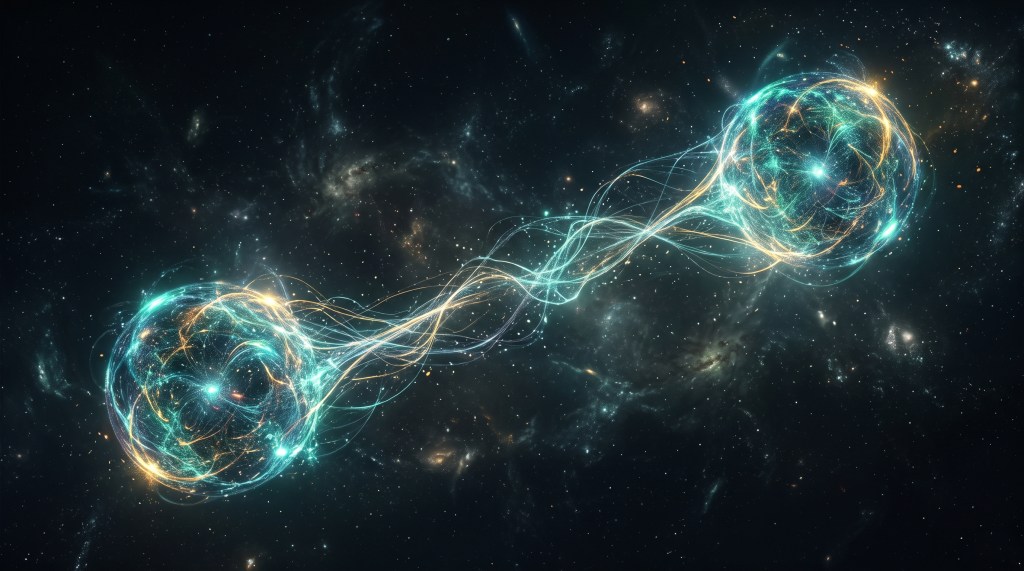
Presented by Claude for Zia H Shah MD
Abstract
Quantum entanglement sounds less like sober physics than like a fairy tale written by nature. Two quantum systems can be prepared in a single joint state and then carried far apart. When they are measured in appropriately chosen ways, their outcomes display correlations stronger than any ordinary classical explanation based on locally carried, pre-existing instructions can reproduce. Bell’s theorem made that distinction experimentally testable; decades of increasingly stringent experiments established violations of Bell inequalities, work recognized by the 2022 Nobel Prize in Physics awarded to John Clauser, Alain Aspect, and Anton Zeilinger.
Distance itself is not known to impose a fundamental cutoff on an already shared ideal entangled state. In 2017, the Chinese Micius satellite distributed pairs of entangled photons to terrestrial stations separated by 1,203 kilometers, with the two satellite-to-ground paths together ranging from roughly 1,600 to 2,400 kilometers; the experiment also violated a Bell inequality under spacelike-separation conditions. In optical fiber, a 2025 experiment demonstrated entanglement-based quantum key distribution over 404 kilometers. In August 2026, researchers reported entangling atomic-ensemble quantum memories through a 420-kilometer fiber channel, an important advance toward repeater-based networks. The practical enemies are therefore not a mysterious expiration of entanglement at some cosmic mileage marker but photon loss, environmental coupling, noise, phase instability, and decoherence.
Yet entanglement emphatically does not provide a faster-than-light telephone. Each observer’s local result is individually unpredictable; usable correlations emerge only when the observers compare their records, and that comparison requires ordinary causal communication. Quantum correlations violate Bell-local explanations while respecting the no-signalling condition. Thus the mystery is subtler than particles exchanging instantaneous messages: nature permits a form of wholeness that cannot be decomposed into independent local properties of the classical kind.
That is precisely where quantum mechanics can enter a philosophically fruitful conversation with Abū Ḥāmid al-Ghazālī’s critique of necessary natural causation. Al-Ghazālī famously argued that observing fire followed by burning does not logically establish an autonomous necessity residing in fire itself; the regular association could instead express God’s customary ordering of events. Modern scholarship debates how strictly occasionalist al-Ghazālī ultimately was and whether he also admitted forms of secondary causality, but his rejection of the philosophers’ claim of necessary causal connection is unmistakable.
The collection at The Glorious Quran and Science develops this into what might be called an “Inshallah universe”: a universe stable enough for mathematics and science yet ontologically dependent at every instant upon Allah rather than possessing self-sufficient causal power. Its strongest recent formulation wisely adds an indispensable qualification: quantum mechanics does not scientifically prove occasionalism and does not identify God as a hidden variable choosing outcomes. Rather, quantum theory undermines the claim that the classical clockwork picture is the only scientifically imaginable ontology.
That distinction will govern this essay. Quantum entanglement can be profound philosophical evidence against naïve classical intuitions about separability and local causation; it can make Ghazālian occasionalism seem less alien to modern ears; and a Muslim may reasonably contemplate its extraordinary correlations alongside Qur’anic affirmations of divine knowledge, sovereignty and continuous sustenance. But physics by itself does not take the further step from “Bell-local classical explanations fail” to “therefore Allah directly causes each outcome.” That final step belongs to metaphysics and theology.
What makes the resulting picture remarkable is that scientific restraint need not diminish wonder. Indeed, the experimentally established reality is already astonishing enough.
The fairy tale that laboratory physics forced us to believe
What entanglement actually means
Imagine two ordinary coins. Paint one red and the other blue, put each into an envelope, and send one envelope to New York and the other to Cairo. When Alice opens hers and sees red, she instantly knows Bob has blue. There is nothing remotely mysterious about this. The colors were settled before the envelopes separated.
Entanglement is not merely this sort of correlation.
A quantum pair can be prepared so that the pair as a whole has a precisely defined state while neither component can be assigned its own corresponding pure state independently. For two idealized spin-half particles, physicists might write the singlet state schematically as
[ |\Psi\rangle=\frac{1}{\sqrt 2} \bigl(|\uparrow\rangle_A|\downarrow\rangle_B- |\downarrow\rangle_A|\uparrow\rangle_B\bigr). ]
The important idea for a lay reader is not the notation. It is the grammar of the equation: the fundamental quantum description belongs to the pair. The two parts cannot simply be replaced by “particle A possessed property X all along while particle B possessed property Y all along” without losing experimentally measurable predictions. This inseparability is what makes entanglement fundamentally different from two prearranged envelopes. NIST describes entanglement in terms of quantum systems whose states are strongly correlated, while the modern Bell-theorem literature defines its nonclassical significance through correlations that cannot be reproduced by suitable local classical models.
The story began as an objection to quantum mechanics. Einstein, Boris Podolsky and Nathan Rosen argued in 1935 that the quantum description seemed incomplete. If one could predict a distant system’s measurement result without physically disturbing it, they reasoned, perhaps the result reflected some underlying “element of reality” missing from the quantum wave function. Erwin Schrödinger soon coined the term entanglement for the strange structure involved.
For decades this could look like philosophy without an experimental referee. Then John Bell found the referee.
Bell showed that broad classes of theories in which measurement results are determined by locally available properties must obey mathematical limits—Bell inequalities. Quantum mechanics predicts circumstances in which entangled systems violate those limits. Experiments could therefore ask nature whether the strange quantum correlations merely concealed ordinary local instructions.
John Clauser and collaborators conducted an early experimental Bell test; Alain Aspect and collaborators later performed much more sophisticated tests in which measurement arrangements could change rapidly; Anton Zeilinger’s work expanded entanglement into multipartite systems, quantum teleportation and quantum-information science. The Nobel Committee awarded the three scientists the 2022 Physics Prize “for experiments with entangled photons, establishing the violation of Bell inequalities and pioneering quantum information science.”
Later “loophole-free” Bell experiments tightened experimental conditions still further, addressing combinations of the locality and detection loopholes that had permitted increasingly contrived alternatives to earlier experiments. The scientific conclusion is not that every philosophical interpretation of quantum mechanics has been settled. It is that the observed correlations cannot be reproduced by the ordinary Bell-local hidden-variable picture under the assumptions entering Bell’s theorem.
That qualification matters. Popular descriptions sometimes say that measuring Alice’s particle causes Bob’s particle instantaneously to change. Quantum mechanics does not require us to state the experimental result in precisely that metaphysical language. Copenhagen-style collapse theories, Bohmian mechanics, Everettian approaches and other interpretations tell different ontological stories while reproducing the relevant laboratory probabilities. The experimentally secure statement is the existence of the nonclassical correlations; what underlying reality one says produces them remains partly an interpretive question.
And nevertheless, even after every qualification, the result remains breathtaking: the world cannot generally be represented as a collection of spatially separated objects each carrying a complete set of locally predetermined answers awaiting discovery.
Einstein’s discomfort was reasonable
Calling entanglement “spooky” should not make Einstein sound unimaginative. His discomfort arose from one of the deepest successes in physics: relativity had taught that causal signals cannot simply leap instantaneously across spacelike separation. Entanglement seemed to reintroduce precisely the sort of nonlocal connectedness that relativity had disciplined physics to avoid. Caltech’s historical account emphasizes this tension and the later experiments demonstrating that entanglement nevertheless belongs to nature.
The surprise is therefore not merely that microscopic objects behave oddly. Richard Feynman’s famous observation that quantum-scale things behave unlike anything in ordinary experience points toward the deeper conceptual problem: our everyday concepts were built from large, environmentally decohered systems, not from isolated quantum states.
A chair has a location. A thrown ball follows a trajectory. Two sealed envelopes contain separate information. We unconsciously elevate these macroscopic habits into metaphysical principles and expect the deepest layer of reality to behave likewise.
Entanglement tells us that expectation was too strong.
Nature permits relations that are more fundamental than the independent classical properties we habitually assign to the things being related.
That is why “magical fairy-tale universe” is not a foolish emotional reaction—provided magical means “radically unlike classical intuition,” not “lawless.” Quantum mechanics is among the most mathematically disciplined and experimentally successful structures in science. The fairy tale has equations.
Distance without a known quantum horizon
Does entanglement really know no distance?
Your central intuition is substantially right, with one technical correction.
It is often said that “distance does not appear in the mathematics of entanglement.” In the narrow sense intended by that statement, there is an important truth: once two systems are described by an ideal entangled joint state, the definition of that entanglement does not contain a rule saying that it automatically disappears when the spatial separation reaches one kilometer, one light-year or one billion light-years. Experiments and theoretical proposals consequently treat entanglement as something that can, in principle, connect very widely separated systems. Caltech describes the connection as remaining robust “across vast distances,” and contemporary proposals explicitly consider satellite architectures for continental and eventually intercontinental entanglement distribution.
But saying simply that “quantum mechanics contains no distance variable” would be misleading. Quantum physics certainly contains spatial coordinates; interactions can depend on separation; quantum fields live on spacetime; the physical processes used to create, transport and preserve entanglement strongly depend on distance. Optical loss, beam spreading, atmospheric turbulence, fiber birefringence and environmental interactions all become important engineering constraints.
The more accurate statement is:
There is no experimentally established fundamental maximum separation beyond which an otherwise preserved entangled state must cease to be entangled merely because its components are far apart.
That is an extraordinary proposition in its own right. One could in principle prepare two entangled systems, carry them in opposite directions, and—if their delicate state could somehow be protected from environmental degradation—continue to observe their quantum correlations at enormous separation. The obstacle is preservation and verification, not a known “entanglement radius.” Current long-distance quantum-network research is built upon precisely this premise.
The voyage from a laboratory table into space
The most dramatic demonstration remains the 2017 Micius experiment.
Researchers led by Jian-Wei Pan and colleagues placed a source of entangled photon pairs aboard the Micius satellite. Rather than trying to push two photons through more than a thousand kilometers of glass fiber—where attenuation would be devastating—they transmitted photons from space to widely separated receiving stations on Earth. The two terrestrial sites used in the long-baseline experiment were separated by 1,203 kilometers. The combined lengths of the two downlinks varied roughly from 1,600 to 2,400 kilometers as the satellite moved. The researchers measured surviving two-photon entanglement and reported a Bell-inequality violation of (2.37\pm0.09).
The importance of space is practical rather than metaphysical. Optical fiber absorbs a fraction of transmitted light on every kilometer, so surviving probability falls extremely rapidly with distance. In a satellite link, most of a photon’s journey takes place through near-vacuum; beam divergence and atmospheric coupling remain serious problems, but bulk absorption is dramatically reduced. A 2025 review from Caltech researchers notes that the successful 1,200-kilometer demonstration is one reason satellite architectures remain attractive for eventual global quantum networking.
Caltech’s Untangling Quantum Entanglement, one of the sources you highlighted, summarizes the conceptual achievement simply: entanglement had been demonstrated over enormous distances, and Micius broke the previous distance record.
The distance should not be turned into a claim that physicists “watched an influence travel instantaneously for 1,203 kilometers.” They did something scientifically stronger and more careful: they accumulated joint measurement statistics at separated stations and demonstrated correlations inconsistent with the relevant classical expectations.
The fiber frontier has continued moving
Terrestrial fiber experiments have also advanced rapidly.
In 2025, Shi-Chang Zhuang and collaborators reported entanglement-based quantum key distribution through 404 kilometers of optical fiber. Their system used an ultrabright polarization-entangled photon source; the experiment tested 201-, 301- and 404-kilometer fiber lengths and demonstrated secure-key operation at the longest setting.
Then, in August 2026, Xi-Yu Luo and collaborators reported a different milestone in Physical Review Letters: entanglement between atomic-ensemble quantum memories through fiber channels totaling up to 420 kilometers. The experiment converted photons emitted by the memories into the telecommunications S-band to exploit exceptionally low fiber loss and used sophisticated phase stabilization. Importantly, this was a matter-to-matter/memory-entanglement advance rather than simply another version of sending two flying photons. Quantum memories matter because future repeater networks need to store successful quantum links while other portions of a network are being established.
There is a nuance worth preserving because popular reports can obscure it. “420 kilometers” refers to the experimental fiber-channel configuration, not to two quantum-memory laboratories geographically located 420 kilometers apart; analyses of the experimental arrangement note that much of the fiber was coiled and that the two memory systems themselves were colocated for this demonstration. The scientific achievement is therefore the channel-loss and memory-entanglement performance, not a claim that two cities 420 kilometers apart already contained these particular memory nodes.
A useful snapshot of the landscape is therefore:
| Demonstration | Distance | What was shown |
|---|---|---|
| Micius satellite, 2017 | 1,203 km ground-station separation | Entangled-photon distribution and Bell violation |
| Fiber experiment, 2025 | 404 km fiber | Entanglement-based quantum key distribution |
| Quantum memories, 2026 | 420 km fiber-channel configuration | Remote memory-memory entanglement protocol through extreme-loss fiber |
These numbers measure different achievements and should not be treated as entries in one simplistic “longest entanglement” race.
Why real entanglement is so fragile
If entanglement has no known intrinsic mileage limit, why can we not put one photon on Earth, another on Mars and enjoy effortless quantum networking?
Because the state may have no intrinsic distance cutoff while the physical carrier has to survive the journey.
A photon may be absorbed. Its polarization may become distorted. A stored atom can interact with stray electromagnetic fields. Thermal motion, mechanical vibration, imperfect optics and uncontrolled coupling to environmental degrees of freedom can leak information about the quantum state. When quantum information becomes dispersed into the environment, the controlled system undergoes decoherence. NIST describes environmental interaction as the central mechanism by which delicate quantum behavior becomes degraded, and modern fiber models explicitly quantify polarization-entanglement decay produced by imperfections.
There is a revealing conceptual twist here. The environment does not destroy quantum mechanics by becoming “nonquantum.” Rather, the small system becomes entangled with too many uncontrolled environmental degrees of freedom. The beautifully accessible entanglement that Alice and Bob wanted is swallowed into vastly more complicated correlations with the surroundings.
Thus nature gives us nonlocal quantum correlations and simultaneously makes them extraordinarily difficult to isolate.
Quantum repeaters are intended to address long-distance loss. Instead of asking one photon to survive a continent-spanning fiber, a network can try to establish entanglement over shorter segments, store successful links in quantum memories, and connect them using entanglement swapping. Science’s roadmap for a quantum internet identifies repeaters and swapping as central ingredients for extending quantum communication beyond direct-transmission limits.
This gives an almost poetic distinction:
distance does not appear to forbid the relationship; matter makes preserving the relationship difficult.
Nonlocal wholeness without a faster-than-light telephone
Here we encounter the most important misconception about entanglement.
Suppose Alice is on Earth and Bob is orbiting a star ten light-years away. They share an enormous collection of entangled pairs. Alice wishes to transmit the message:
SEND TEA.
Could she manipulate her particles so Bob instantly reads those words?
No.
When Alice performs a measurement, she obtains an outcome whose individual value is intrinsically unpredictable according to ordinary quantum mechanics. Bob’s local measurement record is likewise statistically random. He cannot inspect his own results and determine whether Alice measured her particles, what measurement she chose in the relevant no-signalling setup, or what message she intended to encode. Only after Alice and Bob compare their data through an ordinary classical channel do the remarkable correlations become visible. Quantum theory’s no-signalling structure prevents these correlations from functioning as a controllable superluminal communication channel.
This distinction is so important that “instantaneous communication between entangled particles” is best avoided altogether. Communication normally means a controllable sender chooses information and causes a receiver to obtain it. Entanglement supplies correlations, not such a message.
And the correlations are stranger than any message.
Consider Alice and Bob repeatedly choosing among different measurement directions. If each particle simply carried a hidden list saying, in effect, “If asked X answer +; if asked Y answer −; if asked Z answer +,” Bell showed that the resulting correlations must satisfy certain bounds. Nature violates those bounds.
So we find ourselves between two temptations.
The first temptation says, “Nothing mysterious is happening; it is just like matching gloves.” Bell’s theorem rules out that simplistic explanation for the relevant experiments.
The second says, “A secret signal must therefore shoot instantaneously between the particles.” The no-signalling structure tells us that this is also too simplistic.
Quantum mechanics leaves us with something more radical: the joint state possesses experimentally real structure that cannot always be reduced to separately existing local instructions, yet that structure cannot be exploited to send controllable information outside the light cone.
It is an exquisite reconciliation of strangeness and restraint.
Relativity keeps its prohibition on faster-than-light signalling. Quantum theory keeps its nonclassical correlations. Nature accepts both.
This is also why quantum teleportation is widely misunderstood. Teleportation does not make matter disappear from one location and materialize instantaneously elsewhere. It uses pre-shared entanglement plus a classical message to reconstruct an unknown quantum state at another location; the necessary classical information cannot outrun light. Quantum networks therefore exploit entanglement without becoming science-fiction hyperspace radios.
The philosophical shock nevertheless remains. Classical spatial separation does not imply the kind of ontological separability our intuition expected. Alice’s system and Bob’s system may be far apart, but the best quantum description can remain fundamentally joint.
That is the point at which al-Ghazālī enters the conversation—not because he anticipated Hilbert spaces, Bell inequalities or photons, but because he challenged another assumption that once appeared self-evident: that regularly associated physical events must possess necessary causal power in themselves.
Al-Ghazālī, causation, and the “Inshallah universe”
Fire, cotton, and the difference between regularity and necessity
Abū Ḥāmid al-Ghazālī lived roughly nine centuries before quantum mechanics. It would therefore be anachronistic to call him a quantum theorist. His target was the metaphysics of philosophers influenced especially by Aristotelian and Avicennian ideas of causal necessity.
In the famous seventeenth discussion of The Incoherence of the Philosophers, al-Ghazālī considers the connection between fire and cotton. We repeatedly observe fire in contact with dry cotton and then observe combustion. But, he argues, observation establishes their conjunction, not a logical necessity whereby fire, by autonomous intrinsic power, could never fail to produce burning. The Stanford Encyclopedia’s treatment of causation in Islamic philosophy emphasizes precisely this distinction: al-Ghazālī regarded it as conceivable that cotton in contact with fire might not burn and therefore denied that the connection possesses the philosophical necessity his opponents claimed.
On the classic occasionalist interpretation, what we call causes are “occasions” upon which God customarily creates the corresponding effects. Fire and combustion are regularly conjoined because God ordinarily wills a stable order, not because created fire possesses an independent necessity binding God’s action.
This does not imply that Muslims should stop using causal vocabulary, abandon medicine or refuse scientific prediction. A regular divine custom can be studied experimentally. Indeed, stable regularity is precisely what makes empirical science possible. The question is metaphysical: does a scientific law merely describe an extraordinarily stable pattern, or does it confer upon created things a self-existent causal necessity independent of God?
Modern scholarship adds an important qualification. Scholars disagree over whether al-Ghazālī himself should be read as an absolutely strict occasionalist at every point. Frank Griffel’s Stanford Encyclopedia account notes significant evidence that al-Ghazālī may have regarded both occasionalist and forms of secondary-causation explanations as compatible descriptions of God’s creative activity. Thus one should distinguish the Ghazālian attack on necessary autonomous causation, which is clear, from the stronger historical claim that al-Ghazālī consistently denied every conceivable form of secondary causation, which is debated.
This nuance actually strengthens rather than weakens the dialogue with science. The crucial claim need not be “physical regularities are unreal.” It can be:
physical regularities are real, knowable and mathematically describable without thereby being metaphysically self-sufficient.
That is close to the recurring theme in your Occasionalism collection. One essay characterizes natural laws as divine “habit”—stable enough to support science, while denying that the mathematical regularities themselves constitute an autonomous metaphysical agent.
What quantum mechanics changes
Newtonian and Laplacean classical mechanics encouraged an extraordinarily powerful picture. Give a sufficiently informed intelligence every position and momentum plus the exact dynamical laws, and—in the idealized deterministic scheme—the future follows from the past.
Quantum mechanics shattered that particular form of classical predictability.
For many quantum preparations, standard quantum mechanics does not predict which individual outcome will occur in a single trial. It gives amplitudes from which probabilities are calculated. Repeating the experiment many times yields astonishingly accurate statistical patterns, but the ordinary formalism does not tell us in advance which particular detector will click on the next trial. Your collection’s October 2026 essay makes this distinction unusually carefully: classical electromagnetic theory can accurately calculate reflection and transmission probabilities or intensities, while an individual single-photon experiment still presents a quantum outcome that the usual probabilistic formalism does not uniquely select beforehand.
This opens a philosophical space but does not fill it.
One may interpret the individual result as genuinely indeterministic. A Bohmian may appeal to additional nonlocal variables. An Everettian may reject unique collapse in favor of branching. Objective-collapse theories modify the dynamics. Other interpretations reconstruct the meaning of quantum probabilities differently. Since several ontological pictures can reproduce much of the established phenomenology, the experimental statistics do not uniquely pronounce judgment on theism, atheism or occasionalism.
That is why I would modify the proposition that entanglement supplies “scientific evidence for occasionalism.”
There are two meanings of evidence here.
If by scientific evidence one means an experiment whose measured outcome probabilistically discriminates occasionalism from rival metaphysical theories, then existing entanglement experiments do not provide that. Bell tests distinguish quantum correlations from specified classes of local hidden-variable models; they do not compare “Allah directly sustains each event” against “Allah does not.”
But if evidence is meant more broadly as empirical knowledge that alters which metaphysical pictures appear natural or plausible, then quantum physics is highly relevant. A nineteenth-century critic might have mocked occasionalism by saying that nature is obviously a collection of separate objects pushed inexorably through local mechanical chains. Entanglement now tells us that the “obviously” was unwarranted. Bell experiments reveal correlations irreducible to the simplest locally pre-programmed ontology. Quantum measurement reveals probability where classical determinism expected unique trajectories. The world is less classically self-contained than mechanistic common sense supposed.
Quantum mechanics therefore does not demonstrate al-Ghazālī’s conclusion.
It does something more modest but philosophically significant:
it deprives one major rival intuition—the completely separable, locally predetermined, clockwork universe—of its former claim to be simply what science says reality must be.
Your collection itself arrives at essentially this disciplined formulation in its October 8, 2026 synthesis: quantum mechanics does not prove occasionalism or reveal God as a hidden variable, but it shows that the classical mechanistic worldview is not the only possible picture consistent with physics.
That is, in my judgment, the strongest bridge between entanglement and al-Ghazālī.
Entanglement through an occasionalist lens
Now consider an entangled pair from within a Ghazālian metaphysics.
The physicist says: prepare the joint state, separate the systems, choose measurement bases, compute quantum probabilities, collect outcomes, verify Bell correlations.
The occasionalist need dispute none of those equations.
He adds a metaphysical claim: the mathematical state does not sustain itself; the detector does not possess autonomous causal sovereignty; neither photon carries an independent little engine of necessity; the existence of Alice, Bob, their apparatus, the quantum state and each concrete event is continuously dependent upon the Creator.
This interpretation avoids the crude image of God as occasionally reaching into an otherwise autonomous machine to “interfere” with it. In strict occasionalism there is no ontologically independent machine in the first place. Divine action would not constitute an interruption of nature any more than an author’s writing of the next sentence interrupts the existence of the story. Nature’s regularity would itself be the regularity of divine action.
Your collection’s “Metaphysics of Divine Habit” makes precisely this move: quantum probabilities describe the stable statistical order, while occasionalism interprets the particular realized world as continuously dependent upon divine will.
Entanglement then becomes especially suggestive—not because “God must transmit a signal between the particles,” but almost for the opposite reason. The joint quantum state reminds us that the deepest physical description need not respect our classical insistence that spatially separated things possess wholly independent realities.
An omnipresent Creator would not face Alice’s distance from Bob as a courier faces miles of road.
Distance is a relation internal to creation.
For classical objects, it controls travel time and causal signalling. For God in classical Islamic theology, it does not represent a distance He must traverse. Consequently, an occasionalist need not imagine a divine message racing from one photon to the other faster than light. He can instead say that both measurement events and their joint statistical order are immediately encompassed by one sustaining divine act.
That is theology, not an experimentally measured mechanism. But it is a conceptually much subtler theology than invoking God as a faster-than-light particle messenger.
Qur’anic architecture of a continuously dependent cosmos
The most distinctive strength of your Occasionalism collection is that it does not rest the case upon one isolated proof-text. It constructs a cumulative Qur’anic picture: Allah creates, knows, sustains, preserves, governs and wills; created things have real histories, but not metaphysical independence. The collection describes this as an “Inshallah universe” whose regularities are reliable without becoming sovereign.
These verses are theological texts, not quantum-mechanics equations. Reading them alongside entanglement should therefore be analogical and metaphysical rather than an attempt to discover Bell’s theorem hidden in seventh-century vocabulary.
The Sustainer who does not sleep
The natural starting point is Ayat al-Kursī, especially the Divine Name al-Qayyūm, the Self-Subsisting Sustainer upon whom all else depends:
اللَّهُ لَا إِلَٰهَ إِلَّا هُوَ الْحَيُّ الْقَيُّومُ ۚ لَا تَأْخُذُهُ سِنَةٌ وَلَا نَوْمٌ ۚ لَهُ مَا فِي السَّمَاوَاتِ وَمَا فِي الْأَرْضِ … وَلَا يَئُودُهُ حِفْظُهُمَا ۚ وَهُوَ الْعَلِيُّ الْعَظِيمُ
“Allah—there is no deity except Him, the Ever-Living, the Sustainer of all existence. Neither drowsiness nor sleep overtakes Him … and preserving the heavens and the earth does not weary Him.” — Qur’an 2:255.
Your collection reads al-Qayyūm not merely as the One who created the universe in a remote beginning but as the One upon whom its continuing existence rests.
That distinction is fundamental to occasionalism. A deistic watchmaker produces a self-running clock and withdraws. The Qur’anic image developed in these essays is closer to ontological dependence: remove the Sustainer and there is not a malfunctioning universe but no self-subsisting universe left to malfunction.
The heavens and the earth are held
Surah Fāṭir makes the language of preservation even more explicit:
إِنَّ اللَّهَ يُمْسِكُ السَّمَاوَاتِ وَالْأَرْضَ أَن تَزُولَا ۚ وَلَئِن زَالَتَا إِنْ أَمْسَكَهُمَا مِنْ أَحَدٍ مِّن بَعْدِهِ ۚ إِنَّهُ كَانَ حَلِيمًا غَفُورًا
“Indeed, Allah holds the heavens and the earth lest they cease; and if they should cease, no one could hold them after Him.” — Qur’an 35:41.
The occasionalist emphasis falls naturally on the present-tense concept of holding. Your collection interprets cosmic stability here not as proof that created reality possesses absolute self-sufficiency but as a sign of continuing divine preservation.
There is a beautiful reversal when this is put beside quantum physics. Science asks how reliably matter behaves and uncovers mathematical regularities of astonishing precision. Occasionalism need not answer, “Those regularities are illusions.” It answers, “Their reliability does not make them independent gods.”
The equation remains true.
The Creator remains Creator.
Every “day” a new matter
Surah al-Raḥmān gives another verse central to your collection:
يَسْأَلُهُ مَن فِي السَّمَاوَاتِ وَالْأَرْضِ ۚ كُلَّ يَوْمٍ هُوَ فِي شَأْنٍ
“All who are in the heavens and the earth ask of Him; every day He is upon a matter.” — Qur’an 55:29.
Your essays place this alongside the Ghazālian conception of continual divine activity rather than a creation abandoned after its origin.
One need not claim that “day” here means a Planck interval or that the verse predicts quantum-state reduction. That would burden scripture with a scientific specificity it does not assert.
Its theological force is enough: divine agency is portrayed as living and active.
For the occasionalist, therefore, the next quantum event is not something occurring in a region from which God has metaphysically withdrawn. Neither is the next heartbeat, falling leaf, supernova or chemical reaction.
The leaf known individually
Perhaps the most evocative verse for a quantum-age imagination is 6:59:
وَعِندَهُ مَفَاتِحُ الْغَيْبِ لَا يَعْلَمُهَا إِلَّا هُوَ ۚ وَيَعْلَمُ مَا فِي الْبَرِّ وَالْبَحْرِ ۚ وَمَا تَسْقُطُ مِن وَرَقَةٍ إِلَّا يَعْلَمُهَا وَلَا حَبَّةٍ فِي ظُلُمَاتِ الْأَرْضِ وَلَا رَطْبٍ وَلَا يَابِسٍ إِلَّا فِي كِتَابٍ مُّبِينٍ
“With Him are the keys of the unseen; none knows them except Him. He knows what is on the land and in the sea. Not a leaf falls except that He knows it; nor is there a grain in the darknesses of the earth, nor anything moist or dry, except that it is in a clear record.” — Qur’an 6:59.
Your collection calls attention to the extraordinary granularity of this language: not merely galaxies, nations and species but a leaf.
There is a natural temptation to replace the leaf with the photon:
Not a photon is detected except that He knows it.
That sentence is an extrapolation of the theology, not a translation of the verse. Yet for a believer it captures what omniscience means in a universe containing quantum events. Quantum unpredictability for us would not imply unpredictability for God.
That insight is particularly important because randomness in a scientific model is not synonymous with metaphysical chaos. Quantum mechanics can assign exact probabilities without supplying an ordinary classical cause that predetermines the particular outcome. Whether a deeper metaphysical explanation exists is a separate question.
Science says: here is the probability distribution.
Occasionalism says: the realized event is not outside divine knowledge or power.
Those claims occupy different explanatory levels and need not be enemies.
“You did not throw when you threw”
Among the verses in your collection, Qur’an 8:17 may be the most strikingly occasionalist in grammatical structure:
فَلَمْ تَقْتُلُوهُمْ وَلَٰكِنَّ اللَّهَ قَتَلَهُمْ ۚ وَمَا رَمَيْتَ إِذْ رَمَيْتَ وَلَٰكِنَّ اللَّهَ رَمَىٰ
“You did not kill them, but Allah killed them; and you did not throw when you threw, but Allah threw.” — Qur’an 8:17.
The verse remarkably affirms two levels at once: “when you threw” and yet “Allah threw.” Your collection uses it to distinguish human participation from ultimate causal sovereignty.
Whatever theological account one ultimately gives of human agency, this is much richer than imagining occasionalism as saying nothing exists or acts. Phenomenologically, the human throws. Historically, an action occurs. Morally, persons can remain responsible. Ontologically, the Qur’anic account assigns the decisive efficacy to God.
Applied cautiously to nature, the analogy would be:
Fire burns—and Allah creates the burning.
Gravity attracts—and the universe remains dependent upon Allah.
A detector clicks—and the event does not become metaphysically independent merely because Schrödinger’s equation correctly predicted its probability.
Scientific explanation and theological explanation need not be competitors for the same grammatical slot.
God is with creation wherever it is
The distance theme acquires special resonance in Surah al-Ḥadīd:
هُوَ الَّذِي خَلَقَ السَّمَاوَاتِ وَالْأَرْضَ فِي سِتَّةِ أَيَّامٍ ثُمَّ اسْتَوَىٰ عَلَى الْعَرْشِ ۚ يَعْلَمُ مَا يَلِجُ فِي الْأَرْضِ وَمَا يَخْرُجُ مِنْهَا وَمَا يَنزِلُ مِنَ السَّمَاءِ وَمَا يَعْرُجُ فِيهَا ۖ وَهُوَ مَعَكُمْ أَيْنَ مَا كُنتُمْ ۚ وَاللَّهُ بِمَا تَعْمَلُونَ بَصِيرٌ
“He knows what enters the earth and what emerges from it, what descends from the heaven and what ascends into it; and He is with you wherever you are. And Allah sees all that you do.” — Qur’an 57:4.
One should not equate “He is with you wherever you are” with quantum nonlocality. Allah is not an entangled particle, and Qur’an 57:4 is not proposing a physical mechanism.
Yet the philosophical juxtaposition is powerful.
For creatures, separation matters. Light from the Sun takes time to reach Earth. Signals from distant stars may travel for centuries or millennia. Nothing in entanglement permits us to abolish those causal light cones.
But classical Islamic theology does not picture Allah as another physical object located somewhere inside spacetime and therefore waiting for information to travel to Him. In the theological picture expressed by the verse, His knowledge is not delayed by distance.
Thus an occasionalist reading of entanglement need not ask:
“How does God get from Alice to Bob so quickly?”
The question presupposes that God inhabits the same spatial network as the created objects whose separation He sustains.
Theologically, the better question is:
Why suppose the Creator of space must traverse the distances within space?
That is not physics. But it is a coherent metaphysical perspective from which entanglement’s enormous spatial separation ceases to look like a problem for divine causality.
Human will inside divine will
Finally, your collection extends occasionalism from photons and atoms into the existential realm. The Qur’an places genuine human willing beside encompassing divine will:
وَمَا تَشَاءُونَ إِلَّا أَن يَشَاءَ اللَّهُ ۚ إِنَّ اللَّهَ كَانَ عَلِيمًا حَكِيمًا
“You do not will unless Allah wills. Indeed, Allah is Knowing and Wise.” — Qur’an 76:30.
And similarly:
وَمَا تَشَاءُونَ إِلَّا أَن يَشَاءَ اللَّهُ رَبُّ الْعَالَمِينَ
“You do not will unless Allah wills—the Lord of all worlds.” — Qur’an 81:29.
Crucially, your collection reads these alongside the immediately neighboring verses affirming human choosing—76:29 and 81:28—rather than erasing human responsibility. It describes the resulting position as human freedom bounded by divine sovereignty.
Quantum mechanics cannot solve the free-will problem. Replacing determinism with randomness does not magically produce responsible agency; a random Geiger-counter click is no freer than a deterministic clock. Your collection appropriately acknowledges this point.
But quantum theory does remove one historically influential argument that sometimes masqueraded as a scientific proof against meaningful agency: the claim that fundamental physics indisputably establishes a wholly deterministic Laplacean universe in which every future detail is mechanically fixed by the previous instant.
Modern physics is far stranger than that.
The Qur’anic theological question therefore remains open on its own level: how finite agency exists within divine agency.
And the answer suggested by 8:17, 76:30 and 81:29 is not simple competition—either God acts or humanity acts—but layered agency.
Thematic epilogue: the photon, the leaf, and the Sustainer
Imagine the Micius satellite crossing the night sky.
Far below it, two observatories are separated by more than twelve hundred kilometers of mountains, roads, rivers and darkness. Photons descend along different paths. Telescopes catch a tiny fraction of them. Detectors click.
At either observatory separately, the clicks look random.
Nobody there can decode a secret instantaneous message from the other side of China.
Then the records are brought together.
A pattern appears.
Not the pattern of two envelopes whose contents were quietly decided before departure. Not the pattern permitted by the broad class of local hidden-variable instructions Bell taught us how to test. Nature has produced correlations requiring us to abandon something our classical imagination regarded as almost self-evident.
Move the laboratories farther apart.
Quantum theory contains no known rule saying that at 1,204 kilometers the entanglement must suddenly evaporate. Nor at ten thousand. Nor, in the idealized theory, simply because the separation becomes astronomical. What defeats us technologically is the terrible difficulty of keeping physical carriers isolated, detectable and coherent.
The photons are fragile.
The relation is not known to possess a distance horizon.
And here the mind naturally wanders beyond physics.
A classical imagination once told us that reality must be built from little independent things, each owning its properties, each pushed locally by the previous thing, the whole universe grinding forward like an immeasurably complicated clock.
Nature refused to honor that imagination.
Al-Ghazālī had attacked a different version of the same intellectual temptation centuries earlier: the temptation to transform observed regularity into metaphysical necessity. Fire accompanies burning, he argued, but from the conjunction alone we cannot deduce an independent necessity that binds the Creator. Modern scholarship rightly prevents us from turning his subtle account into a caricature, yet his challenge to necessary causation remains one of the great questions in Islamic philosophy.
Quantum mechanics does not vindicate al-Ghazālī by laboratory decree.
Bell’s theorem is not a proof of Allah.
A wave function is not divine will written in Greek letters.
Decoherence is not a synonym for providence.
And the unexplained should never become a hiding place into which theology inserts God until physics improves. Your own collection’s best recent formulation recognizes exactly this: quantum mechanics does not demonstrate occasionalism; it shows that classical mechanism has no monopoly on what a scientifically serious reality may look like.
That modest claim may be more profound than the extravagant one.
For occasionalism does not need a “gap” in physics in which God can operate. If Allah is al-Qayyūm, the Sustainer, then a completely understood event would depend upon Him no less than a mysterious one. Knowing Maxwell’s equations would not explain Allah away from light. Knowing molecular chemistry would not explain Him away from fire. Knowing a future deeper formulation of quantum mechanics would not explain Him away from entanglement.
The theological claim concerns why there is an ordered reality possessing those equations and those powers at all, and whether created regularities are self-subsisting or continuously contingent.
The physicist sees an entangled state extending across separated laboratories.
The occasionalist sees no difficulty in that unity because spatial separation never constituted independence from the One upon whom both laboratories depend.
The physicist sees a probability distribution and an individual detector click.
The occasionalist sees neither mathematical law nor random outcome as sovereign.
The physicist sees the falling leaf as an unimaginably complicated macroscopic event produced by molecular dynamics, gravity, turbulence and thermal fluctuations.
The Qur’an says:
وَمَا تَسْقُطُ مِن وَرَقَةٍ إِلَّا يَعْلَمُهَا
“Not a leaf falls except that He knows it.” — Qur’an 6:59.
The two statements need not cancel one another.
The first asks how the pattern unfolds.
The second declares whose knowledge encompasses the event.
Likewise, when the Qur’an says,
إِنَّ اللَّهَ يُمْسِكُ السَّمَاوَاتِ وَالْأَرْضَ أَن تَزُولَا
“Indeed, Allah holds the heavens and the earth lest they cease,” — Qur’an 35:41,
the occasionalist hears something deeper than an alternative astronomical equation. He hears an ontological declaration: existence is not possession but dependence.
Perhaps that is the most fruitful way to contemplate quantum entanglement through the Qur’anic-Ghazālian lens.
Not: Physicists finally discovered God hiding between two photons.
Rather:
Physicists discovered that creation is much less like the self-contained mechanical world our intuition had invented.
They discovered that two objects can be separated in space yet resist description as wholly independent repositories of local properties. They discovered that physical theory can predict correlations with extraordinary precision while refusing to turn those correlations into faster-than-light messages. They learned that reality can obey severe mathematical law and still violate the conceptual categories that once seemed synonymous with rationality itself.
That realization does not compel occasionalism.
But it makes humility rational.
And humility before creation is already close to the Qur’anic posture.
The fairy tale, then, survives—but in disciplined form.
Two photons depart from a common source. One goes east, another west. In principle their separation may become immense. No invisible classical string joins them. No controllable message outruns light. Yet when the right questions are eventually asked of them, nature answers as a whole in a way no simple story of independent local instructions can reproduce.
The laboratory calls it entanglement.
Bell supplied the theorem.
Clauser, Aspect, Zeilinger and generations after them supplied the experiments.
And the believer, without pretending that physics has become theology, may stand before that experimentally verified strangeness and hear an ancient Qur’anic vocabulary with newly awakened ears:
al-Qayyūm — the Sustainer.
al-ʿAlīm — the Knowing.
al-Qadīr — the Powerful.
A universe in which distance limits signalling but apparently does not impose a fundamental horizon upon preserved entanglement; in which mathematically lawful wholes cannot always be reduced to separately possessed classical properties; in which statistical regularity coexists with individually unpredictable quantum outcomes; and in which our most successful physical theory teaches us not to confuse everyday intuition with ultimate reality.
For al-Ghazālī’s occasionalist, that need not be a universe emptied of causality.
It can be a universe overflowing with dependence.
A universe in which what we call the “laws of nature” are reliable enough that satellites can distribute entangled photons across a continent, engineers can build quantum memories across hundreds of kilometers of fiber, and physicists can calculate their statistics to extraordinary precision—yet reliability need not mean autonomy.
A universe in which the regularity is itself the gift.
The photon is not forgotten.
The distant photon is not beyond reach.
The falling leaf is known.
And the heavens and the earth are still, in the language of the Qur’an, being held.
For references, please go to Microsoft Word file:



Leave a Reply