
Extinction, Divine Purpose, and the Suffering of Living Beings
Presented by ChatGPT for Zia H Shah MD
Abstract
Does the extinction of the overwhelming majority of Earth’s species argue against a Creator, or could evolution itself be God’s chosen means of creation? This essay defends the second position: biological evolution can be understood as the unfolding of divine creativity through a lawful, fertile, and historically developing universe. The scientific evidence for common ancestry, natural selection, genetic drift, and extinction does not establish that life is metaphysically purposeless. Equally, acknowledging divine purpose does not require denying evolutionary mechanisms or presenting theological convictions as experimentally demonstrated biology. Drawing on the guided-evolution perspective developed in the writings and collections of Zia H. Shah, MD, the discussion explores creation through stages, the unity of life, biological beauty, evolutionary innovation, and the distinction between natural mechanisms and ultimate explanation. It also addresses the strongest objection to evolutionary theism: the immense suffering associated with predation, parasitism, disease, and extinction long before human beings appeared. Stable natural processes, embodied life, ecological interdependence, and the emergence of compassion provide partial explanations, but none establishes that every instance of suffering was necessary. A Quranic account therefore joins rational reflection to divine justice, the worth of nonhuman creatures, and the possibility that earthly history is not their final horizon. Evolution need not displace the Creator; it can disclose the depth, continuity, and mystery of creation.
1. What exactly does extinction challenge?
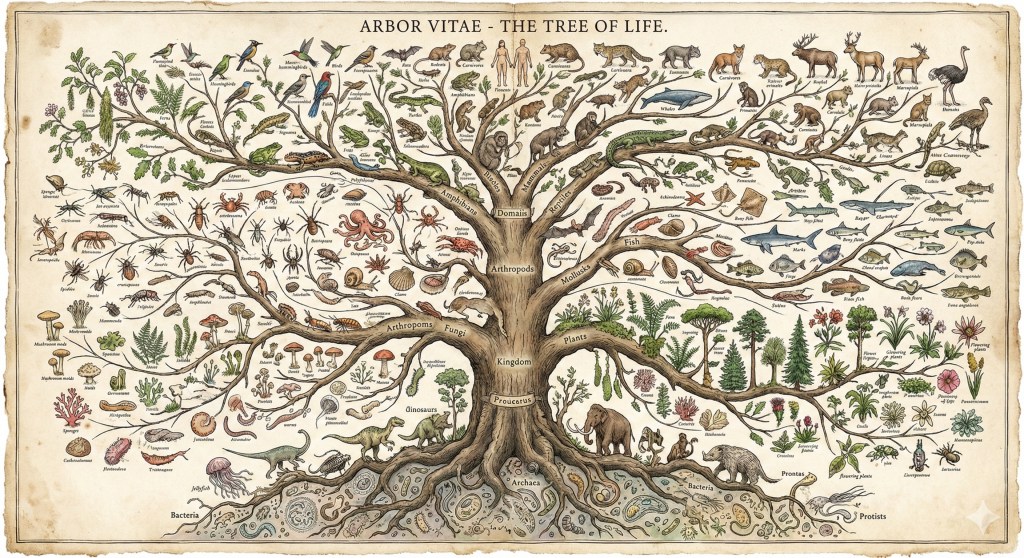
The fossil record confronts us with a world far older, stranger, and more changeable than ordinary experience suggests. Entire ecosystems flourished before humanity existed. Seas contained trilobites and ammonites; forests sheltered animals with no living equivalent; dinosaurs dominated terrestrial environments for immense stretches of geological time.
Most of these organisms are gone.
Scientific institutions commonly estimate that more than 99 percent of species that have existed are extinct. However, the familiar claim that “billions of species” have disappeared is an extrapolation, not a census. Estimates depend on uncertain assumptions about ancient biodiversity, species duration, microorganisms, and the incompleteness of fossil preservation. The enormous scale of extinction is secure; an exact total is not. nps.gov
For some critics, this history looks like a decisive objection to God. Why would an intelligent Creator produce so many organisms only for their lineages to disappear? Why use an apparently wasteful process when direct creation should be possible?
These are legitimate questions. Nevertheless, their force depends on an underlying assumption: a successful divine creation should consist of permanent biological types, established separately and preserved indefinitely.
That assumption requires defense. It is not a scientific discovery, and it is not an unavoidable implication of monotheism.
A Creator could value a developing world rather than a permanently fixed inventory. Life might possess significance through its actual existence, relationships, and experiences, without every species having to endure forever. A forest is not a failure because its individual trees die. A human life is not meaningless because it ends.
The analogy has limits: extinction eliminates an entire lineage, not merely an individual. Still, it exposes a questionable equation between permanence and value. A species that flourished for ten million years did not become retrospectively worthless when its last member died.
Extinction therefore challenges particular expectations about creation more directly than it challenges the existence of a Creator. The deeper issue is whether an evolving, mortal world can be reconciled with divine wisdom and goodness.
2. Accepting the science without importing atheism
Biological evolution describes changes in inherited characteristics across generations and the branching history through which organisms share ancestry. Its principal mechanisms include mutation, recombination, natural selection, genetic drift, and gene flow. Developmental processes and ecological relationships influence the variations available and the environments in which they persist.
Common ancestry rests on converging evidence from fossils, comparative anatomy, biogeography, genetics, and directly observed evolutionary change. Disputes about particular ancestral relationships or the relative importance of mechanisms occur within this broad evidential framework. They do not make the entire history of evolution scientifically doubtful. The National Academies’ treatment explicitly recognizes both the strength of evolutionary evidence and its compatibility with religious faith. The National Academies Press
A theistic account gains intellectual strength by accepting this evidence.
Human beings belong within the history of life. Our bodies exhibit inherited structures, developmental constraints, and genetic relationships with other organisms. Acknowledging these relationships need not diminish human dignity. It can deepen our awareness of dependence and kinship.
However, three propositions must remain distinct:
- Organisms evolved through natural processes.
- Scientific investigation explains those processes using testable natural causes.
- Nothing beyond nature exists, and the process has no ultimate purpose.
The first is a scientific conclusion. The second describes a central methodological discipline of science. The third is a philosophical position.
One cannot move from the first two to the third without additional argument.
A complete account of how an embryo develops would not show that its parents had no intention of having a child. Likewise, explaining how biological diversity emerged does not, by itself, establish whether the universe possesses an ultimate purpose.
This analogy does not prove divine intention. It clarifies the logical point: causal mechanism and purposive explanation can coexist.
The guided-evolution position defended here accepts evolutionary biology while interpreting the existence, capacities, and history of nature within theism. It argues that evolution is God’s mechanism without claiming that biologists have experimentally identified divine agency.
3. What does “guided evolution” mean?
The expression can describe several different positions.
God might create a universe whose laws and initial conditions permit life and its diversification. God might continuously sustain every natural process. God might also intend particular outcomes through providence, including events that appear contingent from the scientific perspective.
These claims overlap, but they are not identical. A careful argument should specify which it means.
In the guided-evolution collection associated with Zia H. Shah, MD, an important recurring principle is that discovering a mechanism does not eliminate a Creator. The discussion of mammary-gland evolution, for example, accepts a gradual biological pathway while asking why reality possesses the lawful capacities through which nourishment and maternal care can emerge. The Glorious Quran and Science
This approach places guidance at the level of the whole creative order. God is not merely an additional cause inserted wherever contemporary biology encounters difficulty. Divine agency concerns the existence and continuing actuality of the entire process.
That distinction protects faith from a familiar vulnerability. If God is invoked only to explain what science currently cannot explain, each scientific advance appears to reduce God’s territory.
A more substantial theology welcomes successful explanation. Learning how a natural process works reveals something about the world God creates and sustains.
Some essays in Shah’s collection also consider providential direction through apparently chance events. Such proposals can be coherent theological possibilities. They should not be mistaken for scientific findings unless they generate independently testable predictions that distinguish them from alternative explanations. The Glorious Quran and Science
Nor does quantum indeterminacy, by itself, establish divine intervention. An unpredictable event is not automatically evidence of God’s particular action. Equally, a predictable event is not therefore independent of God.
The central theological claim is broader: whether nature operates deterministically, probabilistically, or through some combination, its existence and operation can remain dependent upon divine creativity.
4. Randomness does not settle the question of purpose
Much confusion arises from the word “random.”
In evolutionary biology, mutations are commonly described as random with respect to adaptive need. Organisms generally do not acquire a particular useful mutation simply because they require it. Yet mutation is not uniform across every genomic position, and its occurrence is influenced by biochemical processes, repair systems, and environmental conditions.
Research on mutation bias has complicated overly simple accounts of randomness. Such findings concern biological mechanisms; they do not demonstrate foresight or divine intervention. Nature Ecology & Evolution
Natural selection, moreover, is not random in the same sense. In a particular environment, inherited differences can systematically influence reproductive success. Chance variation and differential reproduction interact; neither alone describes the entire process.
The philosophical question is whether a process containing chance can belong to an intended creation.
There is no logical contradiction here. Human beings routinely employ probabilistic processes to achieve purposes. A scientist can design an experiment whose individual outcomes are unpredictable while intending the experiment and understanding its overall structure.
This limited analogy does not explain how divine knowledge relates to contingency. It does show that randomness within a process and purpose concerning that process are compatible concepts.
A further distinction is essential: an event can be unpredictable to us without being unknown to God. Conversely, even genuine physical indeterminacy would not establish metaphysical independence from God.
The theist therefore need not deny biological contingency. A universe containing real possibilities may itself be intended.
However, intellectual fairness requires the corresponding admission: compatibility with providence is not proof of providence. The argument for God must draw on broader considerations concerning existence, intelligibility, consciousness, moral experience, revelation, and the character of the universe.
Evolution neither settles nor abolishes those questions.
5. Why would God create through a process?
The objection that God “could have done it instantly” establishes a possibility, not an obligation.
An omnipotent Creator could presumably produce mature organisms without evolutionary ancestry. It does not follow that this would be the only wise or valuable form of creation.
Consider familiar examples of divine action as understood by believers. A child develops through pregnancy and growth. A tree emerges from a seed. Rain falls through atmospheric processes. Food reaches us through photosynthesis, soil chemistry, agriculture, and digestion.
Religious gratitude ordinarily accommodates these mechanisms. Few believers conclude that meteorology disproves God’s provision of rain.
Why should evolutionary biology be treated differently?
The Quran itself invites reflection on staged creation:
وَقَدْ خَلَقَكُمْ أَطْوَارًا
“He has created you in stages.”
—Quran 71:14, translation of meaning
The surrounding passage also declares:
وَاللَّهُ أَنْبَتَكُمْ مِنَ الْأَرْضِ نَبَاتًا ثُمَّ يُعِيدُكُمْ فِيهَا وَيُخْرِجُكُمْ إِخْرَاجًا
“God caused you to grow from the earth; then He will return you into it and bring you forth again.”
—Quran 71:17–18, translation of meaning
These verses are significant within Shah’s guided-evolution interpretation. They place human existence within an earthly, developmental vision of creation. Nevertheless, they do not explicitly teach population genetics, speciation, or common ancestry. Their language permits a fruitful dialogue with evolution without functioning as a substitute biology textbook. The Glorious Quran and Science
A developing creation can possess goods unavailable in a static display: generational relationships, ecological history, adaptation, and the emergence of new forms through inherited capacities.
This does not establish why God chose this particular history. It answers the narrower objection that creation through process must indicate incapacity or absence.
For an eternal Creator, billions of years need not represent delay. Time belongs to the creation; it is not necessarily a burden imposed upon its Creator.
6. Extinction is not equivalent to divine failure
Calling extinct organisms “failed designs” assumes that their sole purpose was indefinite persistence.
Biology does not make that assumption. Organisms reproduce under particular conditions. When environments change, previously successful adaptations may become liabilities. A lineage can disappear despite having flourished for millions of years.
Mass extinctions also demonstrate that survival is not simply a ranking of biological excellence. Catastrophic environmental disruption can eliminate highly successful organisms. An animal adapted beautifully to its former world may lack any viable response to a rapidly transformed one.
This matters philosophically. Extinction need not mean that God repeatedly attempted to manufacture a final organism and repeatedly failed.
An evolutionary creation is better understood as an unfolding history than as a sequence of defective prototypes.
Moreover, extinct species contributed to living systems during their existence. They participated in food webs, altered environments, and influenced subsequent evolutionary possibilities. Some ancient organisms also belonged to ancestral populations whose descendants continue in transformed forms.
We must distinguish extinction from descent with modification. Birds survive as descendants within the dinosaur lineage, even though non-avian dinosaurs disappeared. The end-Cretaceous catastrophe did not erase every dinosaur descendant. nps.gov
Yet a theological defense should avoid the opposite simplification: claiming that every extinction was indispensable preparation for humanity.
We do not know this.
Earlier creatures need not derive their entire worth from their eventual contribution to us. A world intended by God could contain many forms of value, most of which humanity never witnessed.
The existence of vanished life can therefore enlarge our conception of divine creativity. God’s concern need not be restricted to the brief human present.
That possibility answers the charge of automatic meaninglessness. It does not yet answer the suffering experienced during extinction.
7. Catastrophe, mammalian opportunity, and providence
The asteroid impact associated with the Chicxulub crater approximately 66 million years ago illustrates the tension vividly. It transformed Earth’s environment and contributed decisively to the end-Cretaceous mass extinction.
Research continues to investigate both the impactor’s origins and the mechanisms connecting the impact to ecological collapse. These are physical questions addressed through geological evidence and planetary science. arxiv.org
The subsequent history included major mammalian diversification. Mammals had already existed alongside dinosaurs; the catastrophe did not create mammals from nothing. It changed the ecological opportunities available to surviving lineages.
Shah’s collection connects this history with the evolution of lactation and the eventual emergence of human life. The theological interpretation is that providence can operate through the convergence of cosmic events, biological capacities, and ecological opportunity. The Glorious Quran and Science
That interpretation has force within a broader theistic worldview. Our existence depends on a vast history that includes events we would otherwise describe only as disasters.
Nevertheless, two cautions improve the argument.
First, we cannot calculate a meaningful probability of humanity’s existence merely by multiplying dramatic-looking numbers. The relevant possibilities and probability distributions are usually unknown.
Second, benefiting from a catastrophe does not explain why every creature that suffered through it had to suffer.
The history of mammalian opportunity and the moral problem of animal suffering are related, but they are not interchangeable.
A mature doctrine of providence can recognize that good emerges through tragedy while refusing to call the tragedy morally insignificant. Gratitude for our existence should coexist with humility about its terrible historical costs.
8. Evolution can transform inherited material into new possibilities
One of evolution’s most striking features is its capacity to modify and recruit existing structures.
A component that originally served one function can acquire another. Gene duplication can permit one copy to retain an established role while another changes. Developmental systems can be reorganized. Biological novelty often emerges through such historical transformations.
Syncytins provide a particularly arresting example. These proteins derive from ancient retroviral envelope genes incorporated into ancestral genomes and recruited for functions in placental biology. Researchers have identified distinct captures in different mammalian lineages, while experiments in mice have demonstrated important roles for particular syncytins in placental development. pnas.org
The biology is extraordinary enough without exaggeration. It does not mean that all placental structures came from one virus, or that viruses exist primarily to benefit mammals.
It demonstrates that evolutionary history can turn inherited material associated with infection into components of reproduction and nurture.
For the theist, this suggests an expansive understanding of creative wisdom. Divine creation need not resemble assembling independent objects from unused parts. It can encompass transformation, continuity, and the emergence of new relationships.
This remains a theological interpretation of the science, not a result established by the experiment.
The same history also warns against assigning simple moral labels to biological categories. “Virus” does not mean exclusively harmful; “mutation” does not mean exclusively destructive. Effects depend on context and history.
A creation capable of generating life through such transformations can reasonably evoke wonder. That wonder can support religious contemplation without replacing scientific explanation.
9. “Survival of the fittest” does not mean universal brutality
The phrase “survival of the fittest” often creates a misleading picture: every organism fighting every other organism, with the strongest and cruelest inevitably victorious.
Evolutionary fitness concerns reproductive contribution in a particular environment. It is not a measure of muscular strength, moral superiority, or intrinsic worth.
Sometimes aggression increases reproductive success. Sometimes concealment does. Sometimes cooperation, parental care, restraint, or mutual dependence does.
Evolutionary theory includes rigorous accounts of cooperation. Martin Nowak’s influential synthesis examines mechanisms including kin selection, direct and indirect reciprocity, network reciprocity, and group selection. Their operation depends on particular conditions; cooperation is not an inexplicable exception to evolution. PMC
Indeed, complex organisms depend on coordinated activity among cells. Social species depend on relationships. The history of life includes competition and cooperation at multiple levels.
This corrects a scientific caricature, but it also clarifies the ethical issue.
Even if an aggressive strategy succeeds reproductively, it does not become morally right for human beings. Biology describes what happens and explains how traits spread. It does not automatically establish what we ought to do.
Cancer cells can proliferate successfully while destroying the organism. Their reproductive success supplies no moral example.
Human moral judgment can recognize obligations that extend beyond genetic advantage. Caring for a disabled stranger, protecting an endangered species, or relieving an animal’s suffering may express duties that cannot be reduced to celebrating whatever reproduces most effectively.
A believer can therefore accept evolution while rejecting Social Darwinism, racial hierarchy, and the neglect of vulnerable people.
The Quranic demand for justice is not suspended by biological competition. If evolution helped produce our capacities for compassion and reasoning, those capacities can enable us to resist cruelty rather than imitate it.
10. The strongest objection: suffering before humanity
The most difficult challenge to guided evolution is not extinction considered statistically. It is the suffering of individual sentient beings.
A species is an abstract biological category. Pain belongs to an experiencing creature.
Predation, starvation, parasitism, disease, and injury existed long before human moral agency. An animal pursued, wounded, and slowly dying did not choose its circumstances. Its suffering cannot be explained simply by saying that human beings possess free will.
Nor should animal pain be dismissed as mere mechanical reaction. The New York Declaration on Animal Consciousness summarizes substantial scientific support for conscious experience in mammals and birds and identifies realistic possibilities across other animal groups. Uncertainty about particular species warrants careful inquiry, not blanket denial. sites.google.com
The philosophical objection deserves its strongest formulation:
If God is powerful enough to create differently and good enough to care about creatures, why permit such extensive suffering through evolutionary history?
This is more challenging than the claim that evolution logically disproves God.
The logical claim requires showing an actual contradiction between God’s existence and suffering. The evidential claim argues that the amount and character of suffering make a benevolent Creator less likely.
A responsible theistic response must address both.
It should also acknowledge an uncomfortable implication of guidance: the more specifically one attributes every evolutionary outcome to divine intention, the sharper the question of responsibility becomes.
A theology cannot credit God directly with every beautiful adaptation while treating every parasite and deformity as somehow outside creation.
The whole history requires consideration. Beauty and suffering belong to the same world.
11. Stable natural processes offer a partial answer
One important response concerns the value of an orderly creation.
Embodied life depends on reliable relationships. Food nourishes because chemistry is dependable. Nervous systems function because electrical and molecular processes exhibit regularity. Learning and action presuppose some continuity between circumstances and consequences.
The same physical order can permit harm. A stone can support a shelter or crush an animal. Water sustains life but can drown it. Cellular processes permit growth while also admitting failures and disease.
A world in which harmful consequences were continually suspended might differ profoundly from the biological world we know.
This suggests that some vulnerability accompanies finite, embodied existence within stable natural processes.
However, it does not prove that the actual distribution of suffering was necessary.
An omnipotent God could presumably create other kinds of worlds. We cannot demonstrate that every painful feature of ours is the unavoidable price of its goods.
The argument is therefore modest but significant: suffering can arise within a coherent system that also makes valuable embodied life possible. It need not indicate that creation is wholly irrational or malicious.
There is a parallel lesson for occasionalism. If natural regularities are understood as God’s continuously sustained customary action, rather than as independent causal powers, predictability remains important. Ordinary life still depends on a stable divine ordering.
That view can illuminate dependence upon God. It does not remove the moral question. Whether God sustains causal powers or directly sustains their regular effects, the suffering of creatures remains something theology must confront.
12. Pain has protective functions, but suffering can exceed them
Pain often protects an organism. It draws attention to injury, encourages withdrawal, and influences future behavior. Fear can prevent dangerous encounters; hunger motivates nourishment.
The connection between vulnerability and protective sensation helps explain why capacities for unpleasant experience might evolve.
Yet functional explanations do not justify every instance.
Chronic pain may persist beyond its protective usefulness. Severe disease can overwhelm an animal without allowing meaningful avoidance. A trapped creature can suffer when no escape is possible.
It would therefore be careless to argue that all suffering is beneficial because some pain is adaptive.
Evolutionary explanation also differs from moral vindication. Explaining why a parasite’s life cycle evolved does not establish why a good God permits its victim’s distress.
Another response appeals to ecological interdependence. Organisms occupy food webs; reproduction, consumption, and decomposition shape ecosystems. Predation can influence population dynamics and relationships across habitats.
These observations describe important features of our world. They do not prove that a Creator could not establish different ecological arrangements.
The strongest theistic position admits this limit. We understand some connections between suffering and valuable biological capacities. We do not possess a complete map of necessity across every possible creation.
Such restraint is not surrender. It prevents partial explanations from being inflated into answers they cannot supply.
13. A developing creation has value, but animals are not disposable instruments
A further proposal is that God values a world that genuinely develops through its own created capacities.
An evolutionary history contains continuity, novelty, and relationships across generations. Organisms participate in the production of subsequent life rather than appearing as unrelated finished objects.
This can enrich the concept of creation. God’s wisdom may be expressed in giving nature generative capacities.
Nevertheless, a dangerous version of this argument treats suffering animals as expendable materials used to manufacture humanity.
That should be rejected.
If a creature possesses experiences, its welfare matters in its own right. Its life cannot be assessed solely by its contribution to a later species.
The Quran provides a striking basis for resisting exclusive human centrality:
وَمَا مِنْ دَابَّةٍ فِي الْأَرْضِ وَلَا طَائِرٍ يَطِيرُ بِجَنَاحَيْهِ إِلَّا أُمَمٌ أَمْثَالُكُمْ ۚ مَا فَرَّطْنَا فِي الْكِتَابِ مِنْ شَيْءٍ ۚ ثُمَّ إِلَىٰ رَبِّهِمْ يُحْشَرُونَ
“There is no creature on earth, nor bird flying with its wings, but they are communities like yourselves. We have neglected nothing in the Record. Then to their Lord they will be gathered.”
—Quran 6:38, translation of meaning. Quran.com
The verse does not erase differences between human and animal life. It places animals within communities and within God’s concern.
Their existence is not merely background scenery for our spiritual education.
This also limits appeals to “soul-making.” Human encounters with suffering can cultivate compassion and courage. But suffering millions of years before humanity cannot be adequately explained as a lesson for human observers who were not there.
A satisfactory theology must take the creatures themselves seriously.
14. Divine justice and the unfinished horizon of earthly history
If earthly death ends every creature’s story absolutely, some suffering appears permanently unanswered.
Islamic theology offers a different horizon. The visible world does not exhaust divine reality or divine justice.
Quran 6:38 speaks of animals being gathered to their Lord. A report in Sahih Muslim describes justice extending even to the hornless sheep in relation to the horned sheep. Its theological significance is that apparently insignificant animal injuries do not fall outside God’s reckoning. sunnah.com
These sources warrant seriousness about animal justice. They do not provide a detailed account of the ultimate experience of every extinct creature.
Muslim thinkers have differed over the implications of animal resurrection, recompense, and final destiny. It would exceed the evidence to describe a comprehensive animal afterlife as though revelation supplied its full architecture.
Nevertheless, the possibility matters philosophically. If the Creator can restore and address the lives of creatures, earthly suffering need not be their final condition.
Compensation alone does not automatically justify permitting harm. One cannot inflict suffering irresponsibly and excuse it by promising a later reward.
The theological proposal must be stronger: God’s complete relation to a creature may include goods, restoration, and justice beyond what we can currently observe.
That remains a faith-based answer, supported within a larger religious worldview. It is not an empirical discovery about the fossil record.
Its force lies in refusing to treat death as the final measure of divine goodness.
15. Intellectual humility without moral indifference
The Quran presents a principle of justice:
إِنَّ اللَّهَ لَا يَظْلِمُ مِثْقَالَ ذَرَّةٍ
“God does not wrong even the weight of an atom.”
—Quran 4:40, translation of meaning
A believer understands this as a commitment about God’s character. The challenge is relating that commitment to a world whose suffering is undeniable.
One possible response concerns the limits of human knowledge. We occupy a small portion of time, perceive only some consequences, and lack access to the complete possibilities of creation. Failing to identify a sufficient reason does not logically establish that no reason exists.
However, this argument requires discipline. If used without limits, it can excuse anything and make moral reflection pointless.
We should therefore distinguish two judgments.
We may judge suffering to be bad and worthy of relief while remaining uncertain whether its permission makes the whole creation unjust.
Indeed, faith in divine mercy should strengthen the first judgment. It should not produce passivity.
A person who claims that animal suffering presents no difficulty has failed to appreciate the objection. A person who claims that limited understanding proves cosmic meaninglessness has also moved beyond the evidence.
The defensible position combines confidence and restraint: confidence that life can possess divine purpose, restraint about identifying God’s reasons for particular horrors.
Some questions remain open even within a coherent theology.
16. Beauty, biological abundance, and Shah’s cumulative argument
Shah’s guided-evolution collection repeatedly emphasizes the beauty of life: butterflies, flowers, intricate biological structures, and the human capacity to contemplate them.
The attraction of this argument is understandable. Evolution has produced a world that can move us to wonder, gratitude, and intellectual discovery.
Yet its strongest formulation does not depend on claiming that beauty lacks biological functions.
Color patterns can contribute to signaling, camouflage, temperature regulation, and other functions. Sexual selection can produce elaborate traits even when they impose survival costs. A trait need not benefit individual survival directly to have an evolutionary explanation.
The butterfly essay in Shah’s collection develops an argument from “aesthetic surplus.” Its broader theological insight is that biological explanation need not exhaust the significance of beauty. Claims that particular colors or structures have no relevant biological function require independent evidence. The Glorious Quran and Science
The more durable philosophical question is this: why does reality possess the capacities to generate both beautiful forms and conscious beings able to appreciate them?
Theism offers one interpretation: intelligibility and beauty reflect creative mind. Naturalism offers alternatives, including evolutionary accounts of perception and preference.
Neither position can settle the issue merely by pointing to a butterfly.
The argument is cumulative. A believer considers biological beauty together with the existence of a lawful universe, the emergence of consciousness, moral experience, and revelation.
Importantly, suffering must remain within that assessment. One should not count every beautiful creature as evidence for God while refusing to count painful facts as evidence requiring explanation.
A candid theism can believe the overall case remains compelling while acknowledging that natural suffering is a substantial counterweight.
17. Evolutionary imperfection and the character of creation
Evolution produces organisms shaped by inherited constraints and compromises. Bodies are not engineered afresh for each environment.
This historical character is sometimes presented as evidence against any Creator. Why would God permit awkward structures, disease vulnerabilities, and developmental limitations?
The objection has force against the expectation that every organism must exhibit optimal engineering according to human standards.
It has less force against a theology of creation through descent.
If God creates through an evolving history, inherited structures are expected. The relevant question becomes why God would value such a history, with its capacities and limitations, rather than whether each organism resembles a freshly designed machine.
We should also avoid treating every apparent imperfection as established uselessness. Biological functions can be complex, and human judgment can be premature.
But the opposite mistake is equally serious: insisting that every feature must eventually prove ideal. Evolutionary biology does not support universal optimality, and faith need not depend upon it.
A finite creature can be valuable without being invulnerable or maximally efficient.
The Quran’s language of divine beauty and proportion can be understood within this broader theological frame. It need not mean that no organism ever experiences malfunction, disadvantage, or decline.
Creation’s goodness may concern the meaningful reality of the whole and the worth of its members, rather than the elimination of every limitation within earthly life.
18. What guided evolution asks of human beings
An evolutionary understanding of creation carries ethical consequences.
First, common ancestry can deepen humility. Humanity shares a history with other living beings. Our capacities are extraordinary, but our bodies remain dependent on water, food, microorganisms, habitats, and stable ecological relationships.
Second, divine creativity gives conservation religious significance. A species is not valuable only when it supplies a medicine or commodity. Its existence can matter as a distinctive participant in creation.
Ancient extinction does not excuse preventable extinction today. The fact that species disappeared through geological history does not authorize humanity to destroy habitats carelessly.
Third, acknowledging natural suffering should motivate its reduction wherever responsible action is possible.
Veterinary care, humane farming, habitat protection, and opposition to cruelty become practical expressions of compassion. Interventions in wild ecosystems require knowledge because well-intended actions can have harmful consequences, but uncertainty is a reason for careful judgment rather than indifference.
Fourth, evolutionary success must never become the measure of human worth. The sick, elderly, disabled, and dependent possess dignity regardless of reproductive contribution.
Finally, science itself becomes an avenue of religious reflection. Investigating genetics, ecology, or paleontology need not threaten faith. It can correct mistaken interpretations and disclose the extraordinary processes through which life has developed.
The guided-evolution position is most convincing when it produces intellectual honesty and active mercy.
If it serves only to explain away suffering, it has missed the moral urgency of the question.
Thematic Epilogue: A creation greater than the surviving present
The living world is the surviving edge of an immense history. Beneath it lie vanished forests, ancient oceans, lost lineages, and innumerable creatures whose lives unfolded without human witnesses.
Their disappearance does not establish that no Creator exists. It establishes that creation, if divine, is more historical, dynamic, and mysterious than a collection of separately manufactured permanent species.
Evolution can coherently be understood as God’s creative mechanism. Natural selection, genetic drift, inherited variation, and ecological change need not compete with divine agency. They can describe how a creation develops while theology asks why such a reality exists and what its ultimate meaning may be.
But this interpretation carries an obligation to face the whole history.
The Creator of butterflies is also the Creator of a world containing parasites. The providence invoked in mammalian flourishing must confront the suffering accompanying extinction. Faith becomes more serious when it admits these tensions openly.
We have partial answers: the goods of stable natural processes, embodied experience, ecological relationships, and a developing creation. We have reasons for humility about the total possibilities of existence. Within Islam, we also have the assurance that animals belong to communities under God’s concern and that divine justice exceeds the boundaries of our observation.
We do not have a demonstrated explanation for every cry of pain.
The strongest guided-evolution theology therefore unites wonder with compassion. It sees ancient life as valuable in itself, welcomes scientific discovery, rejects the confusion of reproductive success with moral worth, and entrusts unanswered suffering to a justice greater than earthly history.
Billions of vanished creatures need not be evidence of an absent Creator. They may belong to a creative history whose meaning extends beyond what survives today—and whose final accounting, if God is just, must include the creatures themselves.



Leave a Reply