

Presented by ChatGPT for Zia H Shah MD
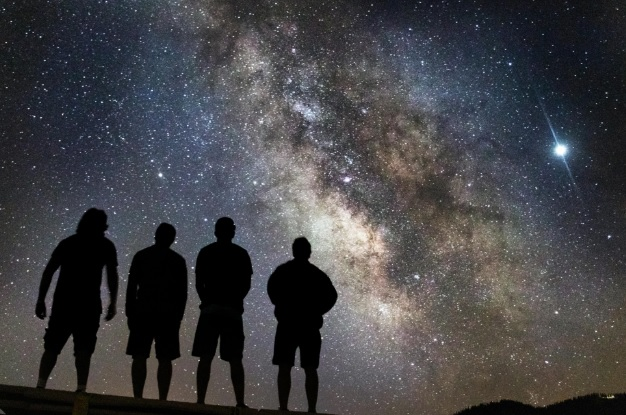
Imagine standing outside on a clear night.
Above you are stars whose light began its journey long before you were born. Beyond those stars are galaxies, and beyond the galaxies we can see lie distances that strain our imagination.
Now consider something almost as astonishing as the existence of that universe.
You can understand something about it.
A human being, living on one small planet, can write an equation on a sheet of paper and discover something true about a star.
We can study light arriving from distant space and learn about the matter that emitted it. We can calculate celestial motions. We can construct mathematical descriptions of events that no human being could ever experience directly.
The universe is immense. The human brain is small. Yet somehow, the two meet in understanding.
Albert Einstein recognized how extraordinary this is.
His insight is popularly expressed in the words:
“The most incomprehensible thing about the universe is that it is comprehensible.”
In his 1936 essay, Physics and Reality, Einstein wrote:
“The eternal mystery of the world is its comprehensibility.”
He also described the fact that the world is comprehensible as a miracle.
For those of us with a theistic inclination, this is an invitation to think deeply.
Why should reality be understandable?
Why should the universe possess an order that mathematical reasoning can uncover?
And why should beings like ourselves possess minds capable of discovering that order?
These questions do not disappear when science succeeds. Scientific success brings them into sharper focus.
Let us begin with a distinction.
An orderly universe and an understandable universe are closely connected, but they are not exactly the same thing.
A world might possess regularities so complicated that creatures within it could never discover them. Its patterns might remain inaccessible. Its underlying structure might defeat every effort at explanation.
Yet our universe permits remarkable discoveries through comparatively compact principles.
We do not need a separate theory of gravity for every falling apple and every orbiting planet.
We find relationships that connect apparently different events.
That unity is one of the deepest achievements of science.
To the theist, it is also suggestive.
If one intelligence is the ultimate source of reality, a coherent creation is something we have reason to expect.
The same Creator is responsible for the stars, the earth, and the minds that study them.
Their relationship becomes intelligible within that larger understanding.
Centuries before Einstein, Galileo described nature as a great book whose language is mathematics.
His Assayer, published in 1623, presents the universe as something that can be read, provided we learn the mathematical language through which its structure becomes accessible.
Think about that image.
A book is more than ink and paper. Its marks have relationships. There is a structure that a reader can grasp.
Of course, calling the universe a book does not, by itself, prove that it has an author. A metaphor cannot carry an entire philosophical argument.
But it directs our attention to a real question.
Why does nature admit such a powerful relationship between physical events and abstract thought?
Eugene Wigner, the Nobel Prize winning physicist, explored this puzzle in his essay, The Unreasonable Effectiveness of Mathematics in the Natural Sciences.
He described the mathematical language of physics as a gift “which we neither understand nor deserve.”
His point deserves careful attention.
Mathematics is developed through reasoning about abstract relationships. Yet some of those relationships turn out to describe the physical world with extraordinary success.
The surprise becomes especially striking when mathematical ideas developed without a particular physical application later become useful in science.
Our minds investigate possibilities.
Nature sometimes answers: yes, that structure describes something real.
We should not exaggerate this. Most mathematics does not immediately become physics. Scientists select useful models, discard unsuccessful ones, and refine their descriptions through experiment.
Nevertheless, the success remains remarkable.
Human reasoning reaches beyond the circumstances in which human beings first learned to count, measure, and survive.
We do more than recognize nearby food or avoid approaching danger.
We investigate spacetime.
We describe atomic behavior.
We formulate theories about events taking place far beyond our planet.
For the believer, this correspondence between mind and world can reasonably suggest that both arise within a deeper rational purpose.
Consider Einstein’s general theory of relativity.
Its mathematics connects gravity with the geometry of spacetime. It accounts for a previously unexplained part of Mercury’s orbital motion and predicts gravitational waves.
A century after Einstein formulated the theory, observations of merging black holes allowed scientists to test its predictions in conditions far removed from everyday human experience.
Pause over what happened.
Human beings developed a mathematical theory on earth.
Events involving distant black holes produced signals that reached our instruments.
Those signals agreed remarkably with the theory.
There is something profoundly moving about that encounter.
The universe does not simply overwhelm the human mind. It also answers its questions.
For a person open to God, such discoveries can become occasions of gratitude.
We have been given a world that can be investigated, and the capacity to investigate it.
This brings us to the Quran.
The Quran repeatedly calls attention to the relationship between creation and reflection.
In Surah Aal-e-Imran, verse 190, we read:
إِنَّ فِي خَلْقِ السَّمَاوَاتِ وَالْأَرْضِ وَاخْتِلَافِ اللَّيْلِ وَالنَّهَارِ لَآيَاتٍ لِأُولِي الْأَلْبَابِ
In the creation of the heavens and the earth, and in the alternation of night and day, there are signs for people of understanding.
The next verse describes people who remember God and reflect upon the creation of the heavens and the earth, saying:
رَبَّنَا مَا خَلَقْتَ هَٰذَا بَاطِلًا سُبْحَانَكَ
Our Lord, You have not created this without purpose. Glory be to You.
Notice the movement.
They observe.
They reflect.
They recognize significance.
Their response becomes prayer.
The Quran brings the activity of understanding into the life of faith.
For the Muslim, studying creation can be an expression of attention to the signs of its Creator.
A telescope extends our sight. Mathematics extends our reasoning. Experiment disciplines our imagination.
Used honestly, all three can deepen our appreciation of the world in which God has placed us.
In the essay published on my website, Allah, Creator of All Things, I emphasize the importance of distinguishing scientific explanations of natural processes from philosophical claims about whether those processes need an ultimate Creator.
Knowing how something happens does not automatically settle why a reality capable of that happening exists.
That distinction matters here.
Suppose we explain how a star forms.
We have gained knowledge.
Suppose we explain how a nervous system develops.
We have gained further knowledge.
Suppose we explain how brains learn patterns.
Again, our understanding has advanced.
The theist can welcome every one of these achievements while continuing to ask why there is a coherent natural order with these possibilities.
The explanation of a mechanism and the explanation of its ultimate foundation address different questions.
Someone may object: perhaps the universe is comprehensible simply because our brains evolved within it.
There is considerable force in this response.
Creatures that recognize patterns can survive more successfully. Learning where food is found, anticipating danger, and understanding cause and effect have obvious practical benefits.
An evolutionary account can help explain our capacity to navigate the world.
A thoughtful believer should acknowledge this.
But further questions remain.
Why does the natural order permit the emergence of minds capable of discovering its deeper structure?
Why can abilities developed through earthly life be extended, through language, instruments, and collective inquiry, into abstract mathematics and fundamental physics?
Evolutionary explanations contribute to our understanding of the knower. They operate within a world whose existence, regularities, and possibilities still invite philosophical reflection.
Within theism, evolution itself can belong to the Creator’s means of bringing knowing creatures into being.
Another objection is that we select the patterns we can understand.
Scientists focus on tractable problems. We remember successful theories. We build mathematics suited to observations.
That is also true.
Our achievements emerge from effort, selection, correction, and failure.
But selection alone does not manufacture successful predictions.
Nature can reject our most beautiful ideas.
An elegant equation may be wrong.
Theories become scientifically valuable when reality places constraints upon them and they survive those constraints.
Our ability to learn from those encounters is part of the wonder.
The modern study of artificial intelligence offers another helpful perspective.
Complex things often possess structure at different levels.
Parts combine into larger arrangements. Local relationships contribute to broader patterns. Learning becomes possible when those relationships can be detected and used.
This helps us understand how a complex world can still be learnable.
But it also invites the deeper question: why does reality possess so much discoverable structure in the first place?
For the theist, a rational Creator provides a unifying answer.
The order of the world and the possibility of understanding it share a common foundation.
This is a philosophical judgment. It deserves argument, and reasonable people can disagree about it.
We should therefore avoid pretending that an equation contains a hidden line that says, “Therefore, God exists.”
Nor should we enlist Einstein as though his wonder amounted to agreement with Islamic theology.
We can appreciate his insight without making him speak our creed.
The force of the argument lies in what he noticed.
Reality is comprehensible to a remarkable degree.
The theist asks whether this fact fits more naturally within a universe grounded in intelligence than within a universe whose ultimate foundation is entirely indifferent to understanding.
For me, it does.
Mind is less surprising when the source of reality possesses knowledge.
Discoverable order is less surprising when creation proceeds from wisdom.
And our search for truth acquires a deeper meaning when truth is something our Creator has enabled us to approach.
Yet faith must preserve humility.
The universe is comprehensible in part. It is not comprehensible without limit.
J. B. S. Haldane famously suggested that it is “not only queerer than we suppose, but queerer than we can suppose.”
Modern physics gives us good reason to respect that warning.
Understanding need not mean being able to form a familiar mental picture.
We may successfully calculate something that remains difficult to imagine.
We may know that a theory works while continuing to debate what it means.
Knowledge and mystery can grow together.
Every discovery reveals something and opens further questions.
A believer need not fear this.
The Creator is not exhausted by what His creatures can understand.
Nor does the incompleteness of our knowledge diminish the value of the knowledge we possess.
A small window can admit real light.
This has practical consequences for religious communities.
If we say that God created the universe, we should take the study of the universe seriously.
If we say that God gave us reason, we should use reason responsibly.
We should welcome accurate science, correct mistaken claims, and resist the temptation to turn every unanswered question into a quick proof.
Our case becomes stronger when our evidence is sound and our conclusions proportionate.
The comprehensibility of nature also carries a moral responsibility.
Knowledge gives us power.
The same capacity that helps us understand matter can help us heal disease or develop weapons.
Understanding the world does not automatically teach us how to treat one another.
That requires moral reflection, compassion, and accountability.
For the believer, the gift of understanding should produce humility and service.
We study so that we may appreciate creation, relieve suffering, and use our opportunities wisely.
Let us return, finally, to the night sky.
A human being stands beneath the stars.
The distance is overwhelming.
The darkness is immense.
Yet that person can ask a question, construct an instrument, test an explanation, and discover something true.
To me, that is an extraordinary privilege.
Einstein called our attention to the mystery of the world’s comprehensibility.
Wigner drew attention to the astonishing effectiveness of mathematics.
Galileo imagined a universe whose language could be learned.
The Quran invites people of understanding to reflect upon creation and recognize its signs.
These voices do not all offer the same theology. They converge upon something worthy of our deepest attention: reality is open, in remarkable ways, to the searching human mind.
For those inclined toward God, that openness can become a path toward Him.
We see an intelligible universe.
We discover that we can participate in its understanding.
And we recognize, with gratitude, the possibility that the One who made the world also intended that we should learn something of His wisdom through it.
So let us keep observing.
Let us keep questioning.
Let us keep correcting our mistakes.
And as our knowledge grows, let our gratitude grow with it.
Our Lord, You have not created this without purpose.
Glory be to You.




Leave a Reply