
Presented by Claude for Zia H Shah MD
Abstract
Quantum entanglement is the most fairy-tale-like fact that modern physics has ever confirmed. Two particles, once linked, behave as a single system no matter how far apart they are carried: measure one, and the other’s outcome is correlated with it instantly, whether the gap is a laboratory bench, 1,200 kilometers of sky above China, or, in principle, the width of a galaxy. Einstein called it “spooky action at a distance” and hoped it was a sign that quantum theory was incomplete. Half a century of experiments, crowned by the 2022 Nobel Prize in Physics, has shown that he was wrong: nature really is non-local in this sense, and no hidden local mechanism can explain the correlations.
This essay explains entanglement for the general reader, without equations, and walks through the landmark experiments, the record distances, and the important limits: entanglement cannot be used to send messages faster than light, and it is easily destroyed by the slightest contact with the environment. It then reads these findings alongside the occasionalism of the eleventh-century theologian Abu Hamid al-Ghazali, who taught that created things have no independent causal power and that God is the immediate cause of every event, acting by a reliable custom (sunnat Allah). Quranic verses are quoted in Arabic with translation. The argument is that entanglement does not prove God, but it dismantles the picture of a universe made of separate, self-running parts, and in doing so it removes a major obstacle to the Quranic vision of a cosmos held together, moment by moment, by One who is “with you wherever you are.”
Prologue: A Universe That Reads Like a Fairy Tale
Every culture has its stories of enchanted pairs. Two rings forged together, so that whatever befalls one is felt by the other. Twin mirrors through which lovers in distant towers see each other. A pair of candles, one in each castle, that gutter at the same instant. We tell these stories to children, and then, as adults, we file them away under “magic”: charming, meaningful, and not true.
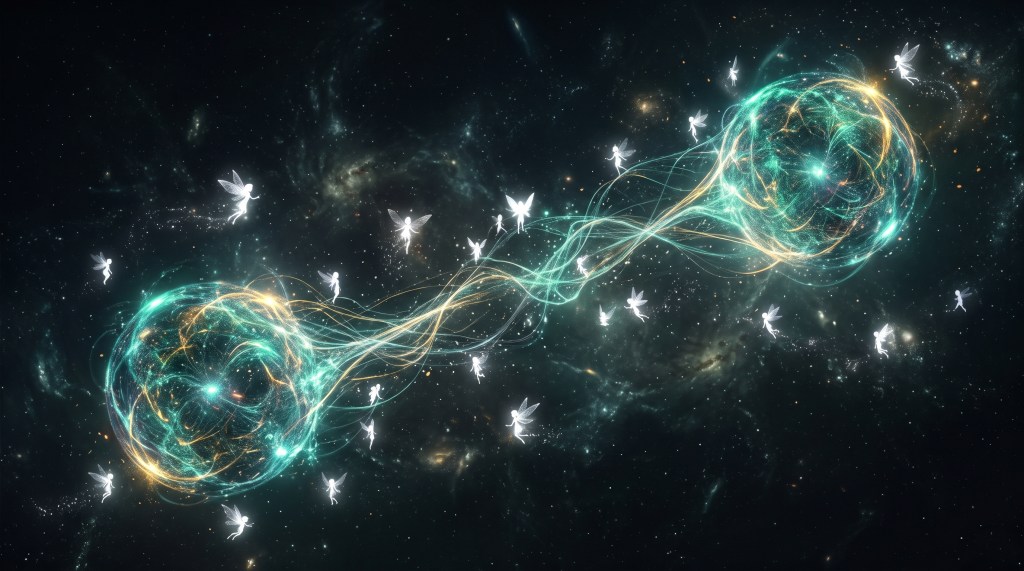
Here is the surprise. Modern physics has found something that behaves, in one precise and limited sense, very much like those enchanted pairs. Physicists call it quantum entanglement. Two tiny particles of light, two atoms, or two clouds of atoms can be prepared so that they no longer have separate identities. They become one system spread across two places. Carry one to the far side of the Earth, or put one on a satellite, and the link survives. When you measure one, the result you get is tied to the result your colleague will get on the other, however far away, and the tie does not weaken with distance.
This is not science fiction, and it is not a fringe idea. It has been tested in thousands of experiments since the 1970s, and it is now the working principle behind quantum computers, quantum encryption, and planned “quantum internets.” The 2022 Nobel Prize in Physics was awarded for the experiments that put it beyond reasonable doubt.
For a believer in a God who is present everywhere at once, this discovery has an unmistakable resonance. The Quran describes a cosmos in which nothing is truly far from its Lord, and in which distance, the great divider of the human world, is no barrier to the divine:
هُوَ ٱلْأَوَّلُ وَٱلْـَٔاخِرُ وَٱلظَّـٰهِرُ وَٱلْبَاطِنُ ۖ وَهُوَ بِكُلِّ شَىْءٍ عَلِيمٌ
“He is the First and the Last, the Manifest and the Hidden, and He has full knowledge of all things.” (Al-Hadid 57:3)
This essay has two aims. The first is to explain, in plain language, what entanglement is, how we know it is real, how far it reaches, and what it cannot do. The second is to explore why entanglement fits so naturally with the occasionalism of Imam al-Ghazali, the view that God is the direct and continuous cause of every event in creation. I will try to be careful about the difference between what physics has shown and what theology draws from it. The fairy tale is real; the question is what it is telling us.
What Entanglement Is, in Plain Language
Entanglement means that two particles share one state between them, so that neither has a complete identity of its own until one is measured.
Start with something ordinary. Suppose I buy a pair of gloves, put one in each of two boxes without looking, and mail one box to you in Karachi and keep the other in Binghamton. When I open my box and find a left glove, I know instantly that yours is the right one. Nothing mysterious has happened. The gloves were “left” and “right” all along; opening the box only revealed what was already there. Physicists call this a classical correlation, and the world is full of them.
The tempting thought is that entanglement is just a fancier pair of gloves. It is not, and the whole drama of the subject lies in that difference.
In the quantum world, small things such as photons (particles of light) and electrons do not carry all their properties around with them like labels. A photon’s polarization, roughly the direction in which its light wave vibrates, is often not settled until it is measured. Before measurement, quantum theory describes it as a superposition: a blend of possibilities, each with a definite probability, none yet actual.
Now prepare two photons together so that their polarizations are linked. The pair is in a superposition of “both horizontal” and “both vertical” at the same time. Neither photon is horizontal; neither is vertical. Only the relationship between them is defined: whatever one turns out to be, the other will match. Send them in opposite directions. When Alice measures hers and gets “horizontal,” a purely random result, Bob’s photon, wherever it is, will also yield “horizontal” if he measures it the same way.
Caltech’s magazine offers a helpful image: two “entangled” coins hidden under cups in separate rooms. Each coin is neither heads nor tails until its cup is lifted. Alice’s result is completely random, yet Bob’s always matches it. Repeat the experiment and Alice may get heads this time; Bob will get heads too.
So far this might still sound like gloves with extra steps. The real strangeness appears when Alice and Bob are allowed to measure in different ways, for example by tilting their polarizers at different angles. Then the statistics of their matches and mismatches follow a pattern that no pair of gloves, no set of hidden instruction cards, and no locally carried information could ever produce. That pattern is what John Bell discovered, and it is the subject of the next section.
Three features of entanglement are worth holding onto:
- Wholeness. An entangled pair is better described as one object in two places than as two objects with a connection. A Caltech physicist put it simply: the particles can be thought of as one object, so there is no need for them to communicate.
- Genuine randomness. Each individual outcome is unpredictable, even in principle. Only the correlation is fixed.
- Indifference to distance. Nothing in the mathematics of quantum mechanics weakens the link as the particles move apart. There is no term in the equations for how far apart they are.
“Spooky Action”: Einstein, Bell, and the Nobel Prize
Einstein thought entanglement proved quantum mechanics was incomplete; experiments since 1972 have shown that it is nature, not the theory, that defies his intuition.
In 1935 Albert Einstein, with Boris Podolsky and Nathan Rosen, published a famous paper now known by their initials, EPR. They pointed out that quantum theory predicts these perfect long-distance correlations, and they drew what seemed the obvious conclusion: the particles must be carrying hidden instructions, like the gloves, which the theory simply fails to describe. The alternative, that measuring one particle somehow settles the state of a distant partner, Einstein dismissed with a phrase that stuck: spukhafte Fernwirkung, “spooky action at a distance.” For Einstein, a sound physical world had to be local: what happens here can be influenced only by things nearby, and influences can travel no faster than light.
For almost thirty years this looked like a matter of taste. Then, in 1964, the Northern Irish physicist John Stewart Bell made it testable. Bell proved a remarkable theorem. If particles carry local hidden instructions, the correlations between measurements made at various angles can never exceed a certain mathematical limit, now called Bell’s inequality. Quantum mechanics predicts that entangled particles will break that limit. One of the two pictures had to be wrong, and an experiment could decide which.
The experiments came, and they were hard:
- 1972. John Clauser and Stuart Freedman in Berkeley performed the first practical test using entangled photons from calcium atoms. The results violated Bell’s inequality, as quantum theory predicted.
- 1982. Alain Aspect’s team in Paris added a crucial refinement: they switched the measurement settings while the photons were in flight, so that no ordinary signal could pass between the two detectors in time to coordinate them. The violation persisted.
- 1990s onward. Anton Zeilinger’s group in Innsbruck and Vienna turned entanglement into a tool, demonstrating quantum teleportation of a photon’s state and entanglement over ever-longer distances, including between the Canary Islands of La Palma and Tenerife, 144 kilometers apart.
- 2015. Three independent teams, in Delft, Vienna, and at the US National Institute of Standards and Technology, closed the remaining technical “loopholes” at the same time. The Delft experiment used electrons in diamonds placed 1.3 kilometers apart.
- 2017–2018. In “cosmic Bell tests,” physicists chose the measurement settings using the color of light from distant stars and then quasars that left their sources billions of years ago, ensuring that nothing on Earth in recent history could have arranged the outcome.
In 2022 the Royal Swedish Academy of Sciences awarded the Nobel Prize in Physics to Aspect, Clauser, and Zeilinger for these experiments. The verdict of half a century is clear: no theory in which particles carry only local, pre-set properties can reproduce what nature actually does. Either the world is non-local, or our familiar notion of objects with definite properties waiting to be revealed must be abandoned, or both. Physicists still debate which way to put it, but every option leaves the clockwork picture of separate, self-contained parts behind.
This is the deep point, and it matters for everything that follows. Entanglement is not merely a curious long-distance coincidence. It is evidence that, at the foundation of physical reality, the universe is not assembled from independent pieces that push and pull on their neighbors. It is, in some sense we do not fully understand, a whole.
No Distance Limit: From the Lab Bench to Orbit
The theory sets no upper limit on how far apart entangled particles can be, and experiments have now confirmed the link across more than 1,200 kilometers.
Why does distance not matter? In everyday physics almost every influence fades with distance: gravity, light, sound, the warmth of a fire. Their equations contain the distance explicitly, usually as a square in the denominator. The quantum description of an entangled pair contains no such term. The shared state is the same whether the particles sit a millimeter apart or on opposite sides of the galaxy. As far as the mathematics is concerned, entanglement is simply indifferent to space. That is why physicists say that, in theory, entanglement should hold across the observable universe.
The practical problem is getting fragile particles to faraway places intact. Here is how the records have grown:
| Year | Experiment | Medium | Distance |
|---|---|---|---|
| 2026 | Atomic quantum memories (USTC), Physical Review Letters | Optical fiber | 420 km total fiber |
| 2025 (preprint 2024) | Entangled photon distribution | Optical fiber | 404 km |
| 2017 | Micius satellite (USTC, Pan Jianwei) | Free space, satellite to two ground stations | About 1,200 km between stations |
| 2007 | Zeilinger group, La Palma to Tenerife | Free space over the sea | 144 km |
The headline result belongs to Micius, a Chinese quantum-science satellite named after an ancient philosopher. In 2017 it beamed pairs of entangled photons down to ground stations in Delingha and Lijiang, about 1,200 kilometers apart, and the measured correlations violated Bell’s inequality. Light traveling through the vacuum of space loses far less than light traveling through glass or thick air, which is why the record was set from orbit.
On the ground, the champions run through optical fiber. In 2024–2025 a team distributed entangled photons through 404 kilometers of fiber. Then in 2026 a University of Science and Technology of China group entangled two quantum memories, clouds of laser-cooled rubidium atoms that can store a quantum state, through a total of 420 kilometers of fiber. That is more than four times farther than earlier memory experiments. One honest footnote: the 420 kilometers is the combined length of two fiber arms, most of it coiled on spools, and the two memories sat in the same laboratory. The achievement is real and important for a future quantum internet, but it demonstrates the fiber’s reach, not two cities 420 kilometers apart.
Will entanglement ever be verified between planets, or between stars? Engineering, not physics, is the obstacle. Proposals already exist for quantum links between satellites and the Moon. Every result so far is consistent with the theory’s prediction: the link does not care how far apart its two ends are.
What Entanglement Cannot Do
Entanglement links outcomes instantly, but it cannot carry a message faster than light, and it is destroyed by the slightest careless contact with the world.
No faster-than-light telephone. This is the most common misunderstanding, so it is worth being precise. When Alice measures her photon, her result is random: heads or tails, horizontal or vertical, with even odds. She cannot choose it. Bob’s result, viewed on its own, is also a random string of outcomes. Nothing Alice does to her particle changes the statistics Bob sees on his side. The correlation exists, but it is invisible until the two of them compare their lists, and comparing lists requires an ordinary phone call, email, or radio signal, none of which can outrun light. Physicists call this the no-signaling theorem. Einstein’s speed limit on messages survives; what falls is the idea that the world is made of separate, locally complete pieces.
This subtlety matters theologically too. Entanglement is not a hidden cable along which force or information secretly flows. It is a coordination without a carrier: two events far apart that fit together perfectly although nothing passes between them. Hold onto that phrase; we will return to it.
Fragility. Entangled states are exquisitely delicate. A stray photon, a jostling air molecule, a flicker of heat, or a weak magnetic field can interact with one of the particles and spread the entanglement into the environment, where it is effectively lost. This process is called decoherence, and it is why we do not see entanglement in tables and teacups: large warm objects are constantly bumping into their surroundings. One Caltech experimentalist joked that you should not even breathe on the experiment. Distance itself does not break the link; the journey does, because the farther a photon travels, the more chances it has to be absorbed or disturbed.
Signal loss. In ordinary fiber, light fades exponentially with distance. Beyond a few hundred kilometers, almost no photons arrive. Classical signals solve this with amplifiers, but a quantum state cannot simply be copied and boosted (the no-cloning theorem forbids it). Long-range quantum networks will therefore need quantum repeaters, which use stored entanglement and a procedure called entanglement swapping to stitch short links into long ones, or satellites that relay photons through the vacuum of space.
These limits do not shrink the wonder. They locate it. The marvel is not that entanglement lets us do magic; it is that the world, underneath our sense of separateness, is knit together in a way no signal could explain.
Al-Ghazali’s Occasionalism: The Fire and the Cotton
Al-Ghazali taught that created things have no power of their own to cause effects; God creates each effect directly, on the occasion of its apparent cause, according to a reliable custom.
Abu Hamid al-Ghazali (1058–1111), born in Tus in present-day Iran and called Hujjat al-Islam, the Proof of Islam, was one of the most penetrating minds in the history of philosophy. In the seventeenth discussion of his Tahafut al-Falasifa (The Incoherence of the Philosophers), he took up a question that seems too obvious to ask: when fire touches cotton and the cotton burns, what makes it burn?
The Aristotelian philosophers of his day, following Ibn Sina (Avicenna), answered that fire has an inherent nature, a built-in power, to burn, and that given fire and cotton the burning follows by necessity. Al-Ghazali disagreed. All that observation shows, he argued, is that the burning happens together with the contact of the fire (‘indahu), never that it happens by means of the fire (bihi). We see one event followed by another, time after time; we never see a necessary connection between them. Fire is an inanimate thing without knowledge or will. The true agent who creates the blackening and the burning of the cotton is God, either directly or through the angels, at the moment of contact.
Seven centuries later the Scottish philosopher David Hume made a similar point about causation, without the theology: we observe constant conjunction, never necessity. Al-Ghazali had reached it first, and he drew a very different conclusion from it.
If fire has no independent power, why is the world so orderly? Al-Ghazali’s answer was that God acts according to a consistent custom or habit (‘ada), which the Quran calls the way or practice of God, sunnat Allah, and of which it says:
فَلَن تَجِدَ لِسُنَّتِ ٱللَّهِ تَبْدِيلًا ۖ وَلَن تَجِدَ لِسُنَّتِ ٱللَّهِ تَحْوِيلًا
“You will never find any change in the way of God, and you will never find any alteration in the way of God.” (Fatir 35:43)
The regularity of nature is therefore real and dependable. Science is possible, because God’s custom is faithful. But the laws of nature are descriptions of how God habitually acts, not chains that bind Him. When He wills otherwise, there is no contradiction, as when the fire was told to spare Abraham:
قُلْنَا يَـٰنَارُ كُونِى بَرْدًۭا وَسَلَـٰمًا عَلَىٰٓ إِبْرَٰهِيمَ
“We said: O fire, be coolness and safety for Abraham.” (Al-Anbiya 21:69)
Behind Al-Ghazali stood the Ash’ari school of theology, which held that the world is made of indivisible atoms carrying fleeting “accidents” (qualities such as color, heat, and motion) that do not last two moments on their own. The universe is therefore re-created at every instant. In an image used throughout Dr. Zia H. Shah’s collection on thequran.love, reality is less like a wind-up clock left to run and more like a film rendered frame by frame, or a lamp that shines only while current flows through it. Cut the current for an instant and the light is gone.
This is the picture Dr. Shah’s essays call the “Inshallah Universe”: a cosmos whose regularities are reliable enough to support quantum electrodynamics and medicine, but whose next moment exists, quite literally, in sha’ Allah, if God wills.
Occasionalism is often accused of making humans puppets. The Ash’ari answer is the doctrine of kasb, acquisition: God creates the act, but the human being genuinely chooses and so acquires its moral weight. Human will is real, but nested within the divine will rather than competing with it, as the Quran says:
وَمَا تَشَآءُونَ إِلَّآ أَن يَشَآءَ ٱللَّهُ رَبُّ ٱلْعَـٰلَمِينَ
“And you do not will, unless God wills, the Lord of all the worlds.” (At-Takwir 81:29)
Entanglement and the Quran: Five Resonances
Read side by side, entanglement and the Quran’s account of divine action share five themes: nearness without distance, coordination without a go-between, the uncaused particular, continuous sustenance, and the unity of creation.
1. Nearness that distance does not weaken
The single most striking fact about entanglement is that separation does not dilute it. The Quran says the same of God’s presence, in language that refuses every spatial limit:
وَهُوَ مَعَكُمْ أَيْنَ مَا كُنتُمْ ۚ وَٱللَّهُ بِمَا تَعْمَلُونَ بَصِيرٌۭ
“And He is with you wherever you are, and God sees all that you do.” (Al-Hadid 57:4)
وَلِلَّهِ ٱلْمَشْرِقُ وَٱلْمَغْرِبُ ۚ فَأَيْنَمَا تُوَلُّوا۟ فَثَمَّ وَجْهُ ٱللَّهِ ۚ إِنَّ ٱللَّهَ وَٰسِعٌ عَلِيمٌۭ
“To God belong the East and the West; wherever you turn, there is the Face of God. God is All-Encompassing, All-Knowing.” (Al-Baqarah 2:115)
A photon in Delingha and its twin in Lijiang are no less linked than two photons on a lab bench. In the same way, the believer in Binghamton and the believer in Makkah are equally near to their Lord. Entanglement does not prove this nearness, but it shows that “near” and “far” are not the final categories of physical reality either.
2. Coordination without a go-between
Recall the key lesson of the no-signaling theorem: entangled outcomes are perfectly coordinated, yet nothing travels between them. There is no cable, no messenger, no force crossing the gap. This is exactly the structure of Al-Ghazali’s fire and cotton. The fire does not send a power into the cotton; the two events are joined because one Agent creates both together. Occasionalism has always said that the connections we see in nature are not pushes passed from thing to thing but harmonies established by a single Cause. Entanglement is the first place where physics itself shows us correlations that no passing influence can explain.
إِنَّمَآ أَمْرُهُۥٓ إِذَآ أَرَادَ شَيْـًٔا أَن يَقُولَ لَهُۥ كُن فَيَكُونُ
“His command, when He wills a thing, is only to say to it ‘Be,’ and it is.” (Ya-Sin 36:82)
The divine command does not travel through space. It is simply obeyed, here and there at once.
3. The particular outcome that physics cannot decide
Each individual result of an entangled measurement is genuinely random: quantum theory gives only the odds, and Bell’s theorem rules out local hidden variables that could secretly fix it. The materialist calls this brute chance. The occasionalist, as Dr. Shah’s essays on the photon at the swimming pool argue, sees the place where the regular statistics are God’s custom and each single event is God’s act. The Quran insists that nothing is too small or too scattered for His knowledge:
لَا يَعْزُبُ عَنْهُ مِثْقَالُ ذَرَّةٍۢ فِى ٱلسَّمَـٰوَٰتِ وَلَا فِى ٱلْأَرْضِ وَلَآ أَصْغَرُ مِن ذَٰلِكَ وَلَآ أَكْبَرُ إِلَّا فِى كِتَـٰبٍۢ مُّبِينٍۢ
“Not an atom’s weight escapes Him in the heavens or on earth, nor anything smaller than that or larger, but it is in a clear Record.” (Saba 34:3)
وَمَا تَسْقُطُ مِن وَرَقَةٍ إِلَّا يَعْلَمُهَا
“Not a leaf falls but He knows it.” (Al-An’am 6:59)
The phrase “nor anything smaller than that” is striking to a modern reader who knows that the atom, dharrah, has turned out to contain smaller worlds still.
4. A world held in being, moment by moment
Entangled states must be continually protected, or the environment dissolves them in microseconds. Physics offers this as an engineering fact, not a theology. Yet it echoes the Quranic insistence that the whole cosmos persists only because it is upheld:
إِنَّ ٱللَّهَ يُمْسِكُ ٱلسَّمَـٰوَٰتِ وَٱلْأَرْضَ أَن تَزُولَا ۚ وَلَئِن زَالَتَآ إِنْ أَمْسَكَهُمَا مِنْ أَحَدٍۢ مِّنۢ بَعْدِهِۦٓ
“God holds the heavens and the earth lest they cease; and if they ceased, none could hold them after Him.” (Fatir 35:41)
يَسْـَٔلُهُۥ مَن فِى ٱلسَّمَـٰوَٰتِ وَٱلْأَرْضِ ۚ كُلَّ يَوْمٍ هُوَ فِى شَأْنٍۢ
“All in the heavens and the earth ask of Him; every day He is engaged in a new matter.” (Ar-Rahman 55:29)
And the Throne Verse names the One who never tires of this upholding:
ٱللَّهُ لَآ إِلَـٰهَ إِلَّا هُوَ ٱلْحَىُّ ٱلْقَيُّومُ ۚ لَا تَأْخُذُهُۥ سِنَةٌۭ وَلَا نَوْمٌۭ … وَلَا يَـُٔودُهُۥ حِفْظُهُمَا ۚ وَهُوَ ٱلْعَلِىُّ ٱلْعَظِيمُ
“God: there is no god but He, the Ever-Living, the Self-Subsisting Sustainer of all. Neither slumber nor sleep overtakes Him … and the preserving of them does not weary Him. He is the Most High, the Supreme.” (Al-Baqarah 2:255)
5. One creation, without seams
Physicists increasingly suspect that entanglement is not a rare laboratory effect but part of the deep fabric of things. Some theorists, as Caltech’s John Preskill has put it, describe entanglement as the glue that holds space itself together. Whatever comes of that research, the image of a universe woven of hidden connections recalls the Quran’s challenge to look for a flaw in its unity:
مَّا تَرَىٰ فِى خَلْقِ ٱلرَّحْمَـٰنِ مِن تَفَـٰوُتٍۢ ۖ فَٱرْجِعِ ٱلْبَصَرَ هَلْ تَرَىٰ مِن فُطُورٍۢ
“You will see no discord in the creation of the Most Merciful. Look again: do you see any rift?” (Al-Mulk 67:3)
وَكَانَ ٱللَّهُ بِكُلِّ شَىْءٍۢ مُّحِيطًۭا
“And God encompasses all things.” (An-Nisa 4:126)
The word muhit, “encompassing,” is apt. An entangled system cannot be described piece by piece; it must be described as a whole. The Quran describes the entire creation as encompassed, known, and held as a whole by its Creator.
Evidence or Harmony? An Honest Accounting
Entanglement does not prove occasionalism, but it removes the strongest scientific objection to it and makes the Quranic picture of an upheld, unified cosmos newly plausible.
It is important to be candid about what physics can and cannot establish, because an argument that overreaches invites easy dismissal.
What entanglement does not show. No experiment can detect God’s will as an extra ingredient in a measurement; if it could, God would be one more physical cause, which is precisely what occasionalism denies. Quantum mechanics also has several interpretations that agree on every prediction and disagree on what is “really” happening. In Bohmian mechanics, hidden variables exist but act non-locally across the whole universe. In the many-worlds view, every possible outcome occurs in branching realities, and nothing is random at all. In the Copenhagen view, the wave function is a tool for predicting results, and the question of what decides each outcome may simply have no physical answer. A naturalist can accept entanglement and remain a naturalist. The data do not force anyone to theism.
What entanglement does show. It ends a certain kind of confidence. For three centuries after Newton, the most serious objection to Al-Ghazali was that science had found a world of self-sufficient material things, each pushing its neighbors by its own inherent powers, a clockwork with no need of a Clockmaker’s hand. Ibn Rushd had already argued against Al-Ghazali that denying real causal powers in things would destroy the intelligibility of nature. Bell’s theorem and the Nobel experiments have shown that the clockwork picture is false at its foundation. Whatever reality is, it is not made of locally self-contained parts. The very feature that once made occasionalism look unscientific has dissolved.
The fair conclusion. Every interpretation of quantum mechanics now asks us to accept something that would once have sounded like metaphysics: instantaneous wholeness across space, countless unseen worlds, or outcomes with no physical cause. Among these, the occasionalist reading, that the statistical laws describe God’s faithful custom and each particular outcome is His act, is coherent, economical, and in harmony with fourteen centuries of Islamic reflection on divine action. It cannot be proven in a laboratory, but neither can its rivals. Choosing between them is a philosophical and spiritual decision, informed by many lines of evidence, of which physics is one.
This is the posture the Quran itself invites. It does not present nature as a laboratory proof that compels belief; it presents nature as ayat, signs, which speak to “people who reflect”:
إِنَّ فِى خَلْقِ ٱلسَّمَـٰوَٰتِ وَٱلْأَرْضِ وَٱخْتِلَـٰفِ ٱلَّيْلِ وَٱلنَّهَارِ لَـَٔايَـٰتٍۢ لِّأُو۟لِى ٱلْأَلْبَـٰبِ
“Indeed, in the creation of the heavens and the earth, and the alternation of night and day, are signs for those of understanding.” (Al ‘Imran 3:190)
Entanglement, honestly presented, is such a sign: not a proof that silences the skeptic, but a window through which the believer sees more clearly what the Quran has always said.
Thematic Epilogue: The Thread and the Weaver
The fairy tale of the enchanted pair turns out to be true, and its deepest lesson is not about particles but about wholeness, nearness, and the One who holds all things together.
We began with stories of twin rings and linked candles, tales we tell children and then outgrow. Physics has handed some of that wonder back to us. Two photons, born together and sent a thousand kilometers apart, still answer as one. No message passes between them; no force crosses the sky. They are not two things in touch. They are, in a way our language strains to say, one thing in two places.
It is worth pausing over how hard humanity fought this conclusion. Einstein, the greatest physicist of the century, could not accept it. It took Bell’s mathematical insight, Clauser’s first fragile apparatus, Aspect’s switching polarizers, Zeilinger’s photons over the Atlantic, and a satellite named after an ancient philosopher before the evidence became overwhelming. The universe, it turns out, is stranger and more unified than our instincts allow.
Four themes run through this story.
Wholeness before parts. Modern thought taught us to see the world as a heap of separate objects, each running on its own powers. Entanglement says the separation is not fundamental. Al-Ghazali said the same nine centuries ago, for a different reason: no creature has a power of its own; every thread of causation runs back to one Hand.
Nearness without distance. The link between entangled particles does not fade across a laboratory, a country, or, in principle, a galaxy. The Quran speaks of a nearness more intimate still: “We are nearer to him than his jugular vein” (Qaf 50:16), “He is with you wherever you are” (57:4).
Order without a messenger. Entangled outcomes fit together although nothing travels between them. In the occasionalist reading, so does all of nature: the fire and the burning, the rain and the green field, the photon here and its partner there, all coordinated by the faithful custom of the One who creates each moment.
Fragility and upholding. Entanglement lives only while it is protected, dissolving at the first careless touch. The whole creation, the Quran teaches, is like that: it exists because it is held, and it would vanish if it were let go.
None of this turns physics into scripture or scripture into physics. The laws of quantum mechanics remain what they are, testable and precise, and they deserve to be learned on their own terms. But a believer who studies them need not feel like a stranger in the laboratory. The more closely we look at the fabric of reality, the less it resembles a machine left running in an empty room, and the more it resembles a vast, finely woven tapestry whose every thread is known.
In the old stories, the enchanted rings were made by a wise craftsman who meant them to stay linked. In the true story, the thread that binds the photons, and binds us, has a Weaver too. And He has told us His name:
هُوَ ٱللَّهُ ٱلْخَـٰلِقُ ٱلْبَارِئُ ٱلْمُصَوِّرُ ۖ لَهُ ٱلْأَسْمَآءُ ٱلْحُسْنَىٰ ۚ يُسَبِّحُ لَهُۥ مَا فِى ٱلسَّمَـٰوَٰتِ وَٱلْأَرْضِ ۖ وَهُوَ ٱلْعَزِيزُ ٱلْحَكِيمُ
“He is God, the Creator, the Originator, the Fashioner. To Him belong the most beautiful names. All that is in the heavens and the earth glorifies Him, and He is the Almighty, the All-Wise.” (Al-Hashr 59:24)



Leave a Reply