

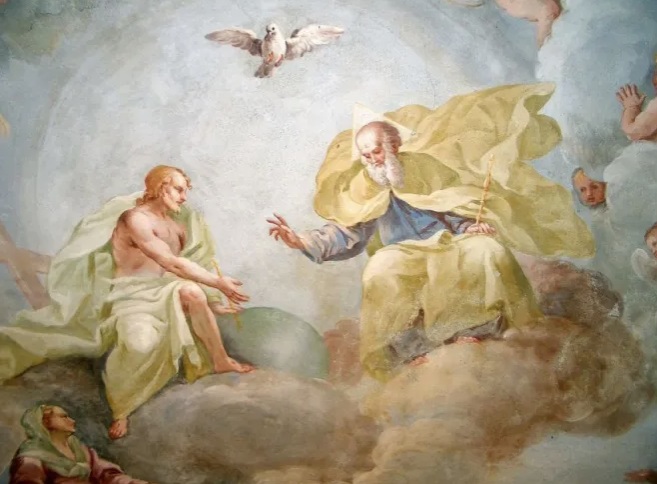
Presented by Claude for Zia H Shah MD
- The three verses form a single, coherent Quranic case for one Creator: Q 21:22 argues from cosmic order (the burhan al-tamanu’, argument from mutual hindrance), Q 31:10–11 challenges every rival to “show what they have created,” and Q 13:16 concludes that “Allah is the Creator of all things, and He is the One, the Prevailing” (al-Wahid al-Qahhar). My Islam
- Classical tafsir (al-Tabari, al-Zamakhshari, al-Razi, al-Qurtubi, Ibn Kathir) reads 21:22 as a logical proof: two conflicting omnipotent wills would ruin the cosmos, so the Creator must be one — structurally the same “mutual hindrance” reasoning grounded philosophically by al-Ghazali and Fakhr al-Din al-Razi and paralleled in Aquinas’s argument for divine unity.
- The commentary can engage Nicene Trinitarianism fairly (the doctrine of inseparable operations, opera ad extra sunt indivisa, John 1:3) while pressing the objection that a single unified creation — one set of physical laws, one genetic code — fits an absolutely simple, indivisible Creator better than “one substance in three persons.” The tamanu’ argument’s cleanest target is polytheism/tritheism; its force against orthodox Trinitarianism turns on a further premise the author must defend explicitly.
Key Findings
- All three verses are Meccan monotheistic proclamations that move from observable cosmic order to the conclusion of one Creator and one alone worthy of worship.
- The tamanu’ (mutual hindrance) argument is explicit in the classical tafsir tradition and is described by the mutakallimun as the single most important rational proof of divine unity.
- Zia H. Shah’s own articles on thequran.love and themuslimtimes.info already build a “one universe, one code, one Creator” refutation of the Trinity; this commentary extends and sharpens that project.
- The mainstream Nicene defense (inseparable operations) must be represented accurately: the Trinity claims one undivided act of creation by one God, not three cooperating creators. Missing this invites the “strawman” charge.
- Modern physics (the cosmological principle, unification of forces, the search for a Theory of Everything) and biology (the universal genetic code, LUCA) are read by religious commentators as resonant with unity — but this resonance is interpretive, not probative, and does not by itself decide between Islam and Trinitarianism.
Details
1. The Three Verses — Arabic Text and Multiple Translations
Q 21:22 (Sūrat al-Anbiyā’) Arabic: لَوْ كَانَ فِيهِمَآ ءَالِهَةٌ إِلَّا ٱللَّهُ لَفَسَدَتَا ۚ فَسُبْحَٰنَ ٱللَّهِ رَبِّ ٱلْعَرْشِ عَمَّا يَصِفُونَ Transliteration: Law kāna fīhimā ālihatun illā l-lāhu lafasadatā; fa-subḥāna l-lāhi rabbi l-ʿarshi ʿammā yaṣifūn.
- Sahih International: “Had there been within the heavens and earth gods besides Allah, they both would have been ruined. So exalted is Allah, Lord of the Throne, above what they describe.”
- Yusuf Ali: “If there were, in the heavens and the earth, other gods besides Allah, there would have been confusion in both! but glory to Allah, the Lord of the Throne: (High is He) above what they attribute to Him!”
- Pickthall: “If there were therein gods beside Allah, then verily both (the heavens and the earth) had been disordered. Glorified be Allah, the Lord of the Throne, from all that they ascribe (unto Him).”
- Abdel Haleem: “If there had been in the heavens or earth any gods but Him, both heavens and earth would be in ruins: God, Lord of the Throne, is far above the things they say.”
- Muhammad Asad: “had there been in heaven or on earth any deities other than God, both [those realms] would surely have fallen into ruin! But limitless in His glory is God, enthroned in His awesome almightiness far above anything that men may devise by way of definition.”
- Maulana Muhammad Ali: “If there were in them gods besides Allah, they would both have been in disorder. So glory be to Allah, the Lord of the Throne, being above what they describe.”
- (Maududi, Towards Understanding the Qur’an: “Had there been any gods in the heavens and the earth apart from Allah, the order of both the heavens and the earth would have gone to ruins.”) My Islam
Q 31:10–11 (Sūrat Luqmān)
Arabic (10): خَلَقَ ٱلسَّمَٰوَٰتِ بِغَيْرِ عَمَدٍ تَرَوْنَهَا ۖ وَأَلْقَىٰ فِى ٱلْأَرْضِ رَوَٰسِىَ أَن تَمِيدَ بِكُمْ وَبَثَّ فِيهَا مِن كُلِّ دَآبَّةٍ ۚ وَأَنزَلْنَا مِنَ ٱلسَّمَآءِ مَآءً فَأَنۢبَتْنَا فِيهَا مِن كُلِّ زَوْجٍ كَرِيمٍ
Arabic (11): هَٰذَا خَلْقُ ٱللَّهِ فَأَرُونِى مَاذَا خَلَقَ ٱلَّذِينَ مِن دُونِهِۦ ۚ بَلِ ٱلظَّٰلِمُونَ فِى ضَلَٰلٍ مُّبِينٍ
- Sahih International (10): “He created the heavens without pillars that you see and has cast into the earth firmly set mountains, lest it should shift with you, and dispersed therein from every creature. And We sent down rain from the sky and made grow therein [plants] of every noble kind.” (11): “This is the creation of Allah. So show Me what those other than Him have created. Rather, the wrongdoers are in clear error.” Quranic Arabic Corpus
- Yusuf Ali (10): “He created the heavens without any pillars that ye can see; He set on the earth mountains standing firm, lest it should shake with you; and He scattered through it beasts of all kinds. We send down rain from the sky, and produce on the earth every kind of noble creature, in pairs.” (11): “Such is the Creation of Allah: now show Me what is there that others besides Him have created: nay, but the Transgressors are in manifest error.” My Islam
- Pickthall (11): “This is the creation of Allah. Now show me that which those (ye worship) beside Him have created. Nay, but the wrong-doers are in error manifest.”
- Abdel Haleem (10–11): “He created the heavens without any visible support, and He placed firm mountains on the earth—in case it should shake under you—and He spread all kinds of animals around it. We sent down water from the sky, with which We made every kind of good plant grow on earth: all this is God’s creation. Now, show Me what your other gods have created. No, the disbelievers are clearly astray.”
- Muhammad Asad (10): “He [it is who] has created the skies without any supports that you could see, and has placed firm mountains upon the earth, lest it sway with you, and has caused all manner of living creatures to multiply thereon.” Islam Awakened
- Maulana Muhammad Ali (10): “He created the heavens without pillars that you see, and cast mountains on the earth lest it be convulsed with you, and He spread on it animals of every kind.”
Q 13:16 (Sūrat al-Ra’d) Arabic: قُلْ مَن رَّبُّ ٱلسَّمَٰوَٰتِ وَٱلْأَرْضِ قُلِ ٱللَّهُ ۚ قُلْ أَفَٱتَّخَذْتُم مِّن دُونِهِۦٓ أَوْلِيَآءَ لَا يَمْلِكُونَ لِأَنفُسِهِمْ نَفْعًا وَلَا ضَرًّا ۚ قُلْ هَلْ يَسْتَوِى ٱلْأَعْمَىٰ وَٱلْبَصِيرُ أَمْ هَلْ تَسْتَوِى ٱلظُّلُمَٰتُ وَٱلنُّورُ ۗ أَمْ جَعَلُوا۟ لِلَّهِ شُرَكَآءَ خَلَقُوا۟ كَخَلْقِهِۦ فَتَشَٰبَهَ ٱلْخَلْقُ عَلَيْهِمْ ۚ قُلِ ٱللَّهُ خَٰلِقُ كُلِّ شَىْءٍ وَهُوَ ٱلْوَٰحِدُ ٱلْقَهَّٰرُ
- Sahih International: “Say, ‘Who is Lord of the heavens and earth?’ Say, ‘Allah.’ Say, ‘Have you then taken besides Him allies not possessing [even] for themselves any benefit or any harm?’ Say, ‘Is the blind equivalent to the seeing? Or is darkness equivalent to light? Or have they attributed to Allah partners who created like His creation so that the creation [of each] seemed similar to them?’ Say, ‘Allah is the Creator of all things, and He is the One, the Prevailing.’” My IslamMy Islam
- Yusuf Ali: “…Say: ‘Is the blind equal to the one who sees? Or the depths of darkness equal to Light?’ … Say: ‘Allah is the Creator of all things: He is the One, the Supreme and Irresistible.’”
- Abdel Haleem (closing clause): “Say, ‘Allah is the Creator of all things, and He is the One, the Supreme.’” Quran.com
- The pivotal term is al-Wāḥid al-Qahhār — “the One, the Prevailing / the Irresistible / the Subduer / the Dominant.” This divine name-pair appears exactly six times in the Qur’an, and in every occurrence al-Qahhār is coupled with al-Wāḥid — at Q 12:39, 13:16, 14:48, 38:65, 39:4, and 40:16 — a deliberate welding of absolute unity to absolute dominion.
2. Classical Tafsir on the Tamanu’ Argument (21:22) and on al-Wahid al-Qahhar (13:16)
Al-Ṭabarī (Jāmiʿ al-bayān, d. 923). The earliest surviving running commentary. On 21:22 he explains that the two realms “would have deviated from their observed order because counteractive forces would exist among such gods, as is usually the case when there is more than one ruler — there is counteraction and a lack of consensus.” He transmits the reading on the authority of Ibn ʿAbbās. Surah Quran
Al-Zamakhsharī (al-Kashshāf, d. 1143, Muʿtazilite). His analysis is theological-grammatical. Arabic: «والمعنى: لو كان يتولّاهما ويدبّر أمرهما آلهةٌ شتّى غير الواحد الذي هو فاطرهما لفسدتا. وفيه دلالة على أمرين: أحدهما: وجوب ألّا يكون مدبّرهما إلا واحداً. الثاني: أن لا يكون ذلك الواحد إلا إيّاه وحده… لعلمنا أن الرعية تفسد بتدبير الملكين لما يحدث بينهما من التغالب والتناكر والاختلاف.» Translation: “The meaning is: had various gods, other than the One who is their Originator (fāṭir), been in charge of managing their affairs, the two [heavens and earth] would have gone to ruin. This indicates two things: first, that their manager (mudabbir) must necessarily be only One; second, that this One can be none but Him alone — because of the words ‘except Allah.’ … [Both are required] because we know that a realm falls into corruption under the management of two kings, owing to the mutual vying (taghālub), mutual rejection (tanākur), and disagreement (ikhtilāf) that arise between them.” Note that al-Zamakhsharī is a Muʿtazilite for whom tawḥīd is the first of the five principles; his reading serves that doctrine.
Fakhr al-Dīn al-Rāzī (Mafātīḥ al-Ghayb / al-Tafsīr al-Kabīr, d. 1210, Ashʿarī). Al-Rāzī develops 21:22 into the formal burhān al-tamānuʿ: if there were two gods, one might will something while the other wills its opposite, producing either a stalemate (which shows incapacity, contradicting omnipotence) or the domination of one over the other (which proves only one is truly a god). His is the most philosophically ambitious classical tafsir (32 volumes), applying Ashʿarī kalām, formal logic, and natural philosophy; he integrated Avicenna’s necessary/contingent ontology into exegesis and distinguished khalq (creation as forming and measuring) from ibdāʿ (absolute origination from nothing), the latter being God’s exclusive prerogative.
Al-Qurṭubī (al-Jāmiʿ li-Aḥkām al-Qurʾān, d. 1273, Mālikī/Ashʿarī). Verbatim core: «لو كان فيهما إلهان لفسد التدبير؛ لأن أحدهما إن أراد شيئاً والآخر ضده كان أحدهما عاجزاً… لفسدتا أي خربتا وهلك من فيهما بوقوع التنازع بالاختلاف الواقع بين الشركاء.» Translation: “Had there been two gods in them, the management (tadbīr) would fall into corruption — because if one willed a thing and the other willed its opposite, one of the two would be rendered incapable (ʿājiz)… ‘la-fasadatā’ means the two would be laid waste and those in them would perish through dispute arising from the disagreement between partners (shurakāʾ).” Al-Qurṭubī also preserves the grammatical debate that illā here carries the sense of ghayr / siwā (“other than / besides”), citing al-Kisāʾī, Sībawayh, and al-Farrāʾ.
Ibn Kathīr (Tafsīr al-Qurʾān al-ʿAẓīm, d. 1373). On 21:22: “if there were another god besides Him, the heavens and the earth would be ruined… each of them would try to subdue the other with enmity, and one would prevail over the other,” linking it to Q 23:91 (“each god would have taken away what he created, and some would have sought to overcome others”). On 31:11: everything mentioned “stems from His power of creation and control alone, and He has no partner in that.” On 13:16: “Allah affirms here that there is no deity worthy of worship except Him, since they admit that He alone created the heavens and the earth”; the “blind vs. seeing” and “darkness vs. light” images contrast the monotheist (“a light from their Lord”) with the polytheist. Quran.com
On al-Wāḥid al-Qahhār (13:16). Maududi: “the Creator of everything should logically be Unique, and every other thing must necessarily be His creation. Therefore nothing could be the equal of the Creator… Likewise, the Creator must have complete power and control over His Creation.” Al-Qahhār denotes “one who has the power to command and to keep all in a state of subservience.” The pairing with al-Wāḥid teaches that the same Being who alone creates alone dominates — unity and sovereignty are inseparable. Islamic StudiesMy Islam
Ibn Rushd / Averroes (al-Kashf ʿan manāhij al-adilla). A crucial internal-Islamic caution: Averroes systematically critiqued the Ashʿarite mutakallimūn, including their handling of God’s unicity (waḥdāniyya) through the argument of mumānaʿa (mutual hindering). He judged the kalām proofs dialectical and non-demonstrative and preferred to ground both God’s existence and unity in two scriptural-natural proofs — the dalīl al-ʿināya (providence/design) and the dalīl al-ikhtirāʿ (invention/creation). (Confirmed via Mokdad Arfa Mensia, “Regards d’Ibn Rushd sur al-Juwaynī,” Arabic Sciences and Philosophy, Cambridge University Press.) The lesson for the commentary: not every classical authority treated tamānuʿ as strict demonstration, so it should be presented as a powerful argument, not an incontestable proof.
3. The Four Articles — Their Actual Arguments
“The Singularity of Creation” (thequran.love, 21 Feb 2026, Zia H. Shah). The central thesis is that molecular biology and theoretical physics both reveal a “Singularity” incompatible with triadic foundations, aligning the cosmos with tawḥīd and undermining the Trinity.
- Biology: All life descends from a single Last Universal Common Ancestor (LUCA) and uses one universal genetic code (64 codons mapping to 20 amino acids, ~99% identical across taxa). Slogan: “If there were three creators, there would be three codes.” The article dates LUCA to “between 3.5 and 4.3 billion years ago”; the most recent phylogenomic reconstruction (Moody et al., Nature Ecology & Evolution, 2024) infers that “LUCA lived ~4.2 Ga (4.09–4.33 Ga)… LUCA had a genome of at least 2.5 Mb, encoding around 2,600 proteins,” and Quanta Magazine’s summary (20 Nov 2024) puts it starkly: “All Life on Earth Today Descended From a Single Cell… If you follow any path of ancestry back far enough, you’ll reach the same single point.” thequran
- Physics: Electroweak unification and Grand Unified Theories (SU(5)/SO(10) symmetry at ~10^16 GeV) show that the plurality of forces is a “broken symmetry” of an original unity — “the universe does not speak in three voices; it speaks in one, reflecting the absolute sovereignty of Al-Wāḥid al-Qahhār.”
- Philosophy: It deploys the burhān al-tamānuʿ and divine simplicity (basāṭa) via al-Kindī (whatever is composed of parts requires a composer and cannot be eternal/necessary; if the Persons are “essence + distinctive property,” they are composed, hence caused, hence not eternal); argues the number “three” is arbitrary (why not the 99 divine names?); and rejects Trinitarian analogies (the water/ice/steam analogy is modalism, a heresy; wave-particle duality is “manifestation,” tajallī, not personhood). It places Nicaea (325) and Chalcedon (451) as late-antique doctrinal developments.
“Can He Who Creates Be Compared to One Who Cannot Create?” (thequran.love, 20 Mar 2026, Zia H. Shah). A commentary on Q 16:10–23 built around 16:17 (“Can He who creates be compared to one who cannot create?”). It argues the verse simultaneously confronts polytheism, Trinitarian Christianity, and materialist atheism. thequran
- Against the Trinity: If Jesus is “fully human” (Chalcedon, 451), his human nature — born ~1 CE — is temporally created and could not have participated in creating a 13.8-billion-year-old universe (citing Shah’s earlier “Jesus the Perfect Man… Did Not Create Anything”). It presses Q 31:10–11’s challenge (“show Me what your other gods have created”) and quotes Ibn Kathīr and Maududi on 16:17.
- It marshals Avicenna’s Wājib al-Wujūd, al-Rāzī’s burhān, the Kalām cosmological argument (al-Ghazālī, the Borde–Guth–Vilenkin theorem, Vilenkin, W. L. Craig), fine-tuning (Penrose’s 1-in-10^10^123 initial low-entropy state, Martin Rees’s Just Six Numbers, Feynman’s “hand of God” remark on 1/137), and the universal genetic code (quoting Matt Ridley’s Genome: “All life is one”). It uses the Russell–Copleston debate on “brute facts.” thequran
- Hermeneutical key: Q 3:7 (muḥkamāt vs. mutashābihāt) — the clear verse (“only God creates”) must govern the ambiguous titles of Jesus (kalimah, rūḥ), which classical exegesis (al-Ṭabarī) reads as referring to Jesus’s mode of creation: “Jesus is a kalimah and a rūḥ in exactly the same way that Adam was.”
“One God, One Universe: Coherence of Monotheism in Philosophy, Theology, and Science” (themuslimtimes.info, 9 Mar 2025, Zia H. Shah). Its epigraph is Q 21:22. It argues monotheism supplies a “unified explanation of existence” superior to polytheism (which risks cosmic chaos from conflicting gods) and atheism (which leaves the “why” unanswered). It surveys the cosmological, teleological, and moral arguments and cites Feynman on 1/137, Newton (“This most beautiful system… could only proceed from the counsel and dominion of an intelligent and powerful Being”), Einstein (“Spinoza’s God who reveals himself in the orderly harmony of what exists”), Polkinghorne (the universe is “rationally transparent”), and Ibn al-Haytham. Notably, its theology section states the Christian position accurately: “the three Persons are not three gods, but one God in essence. The Nicene Creed begins, ‘We believe in one God.’” themuslimtimes
“Quran: Allah is the Creator of All Things, So Worship Him Only” (themuslimtimes.info, 25 Mar 2024, Zia H. Shah). Epigraph Q 6:101–103. It asks: “Could Jesus be the Creator? How could he be, if he is the literal son of God the Father?” It observes that John 1’s prologue is used to make Jesus a co-Creator “even though… the man was not born until 1–6 AD,” and that the Old Testament (three-quarters of the Bible by volume) contains no Trinity and no knowledge of Jesus, so when it speaks of God the Creator it means the Father. It supplies a table (“Who is the Creator of All Creation?”) showing that Scripture ascribes creation to “God,” “Jehovah,” “Christ” (John 1:3; Col. 1:16), and the “Holy Spirit,” presenting this multiplicity of attributions as theologically incoherent. themuslimtimes
4. Scientific Arguments for Cosmic Unity (Use as Resonance, Not Proof)
- Cosmological principle. On sufficiently large scales the universe is homogeneous (no preferred places) and isotropic (no preferred directions). Astronomer William Keel: the principle “amounts to the strongly philosophical statement that the part of the universe which we can see is a fair sample, and that the same physical laws apply throughout… the universe is knowable and is playing fair with scientists.” Homogeneity is recovered above ~100 h⁻¹ Mpc: per Wu, Lahav & Rees (“The Large-Scale Smoothness of the Universe,” Institute of Astronomy, Cambridge), “On a scale of ~100 h⁻¹ Mpc the rms density fluctuations are at the level of ~10% and on scales larger than 300 h⁻¹ Mpc the distribution of both mass and luminous sources safely satisfies the ‘Cosmological Principle’ of isotropy and homogeneity.”
- Isotropy of the microwave sky. The cosmic microwave background temperature was measured by the FIRAS instrument on COBE at 2.72548 ± 0.00057 K (Fixsen 2009); the DMR instrument first detected anisotropy at ΔT/T ≈ 1.1 ± 0.1 × 10⁻⁵ (Smoot et al. 1992) — the sky is the same in every direction to about 1 part in 100,000.
- Uniformity of physical law and constants. The gravitational constant, the speed of light, and the electromagnetic force operate identically across the cosmos. Jean-Philippe Uzan’s review (Living Reviews in Relativity) treats the fundamental constants as contingent quantities that “can only be measured,” not derived from deeper principles.
- Unification of forces / Theory of Everything. Electroweak unification (Glashow, Salam, Weinberg; Nobel Prize 1979; confirmed by the discovery of the W and Z bosons at CERN in 1983) merged electromagnetism and the weak force. Grand Unified Theories (e.g., the Georgi–Glashow SU(5) model, 1974) aim to merge the strong force with the electroweak at ~10^14–10^16 GeV; a “Theory of Everything” would further incorporate gravity. No complete unified field theory yet commands consensus — this remains an aspiration and one of the major unsolved problems in physics, not an established result. AccessScience
- Physicist-theologians. John Polkinghorne (physicist and Anglican priest): the universe is “not only rationally transparent” but “rationally beautiful,” and “a religious understanding renders the intelligibility of the Universe itself intelligible… the world as explored by science is shot through with rational beauty precisely because the mind of its Creator lies behind its wonderful order.” Paul Davies (The Mind of God): “the fact that science works, and works so well, points to something profoundly significant about the organization of the cosmos… through it all runs the familiar thread of rationality and order.” Important caveat: Davies is not a traditional theist, and Polkinghorne was a committed Trinitarian who read the very same cosmic order as evidence for the triune God, describing creation as the work of the Word and the Spirit as the “two hands” of God. The inference “cosmic unity → one Creator” therefore does not by itself refute the Trinity, and the commentary should not present it as if it does. First ThingsMetanexus
5. Philosophy of Divine Unity vs. “One Substance, Distinct Persons”
- Burhān al-tamānuʿ / dalīl al-tamānuʿ. Described by the mutakallimūn as the most important proof of unity. Key sources: al-Ghazālī’s al-Iqtiṣād fī al-iʿtiqād (The Moderation in Belief), al-Nasafī’s Tabṣirat al-Adilla, and al-Rāzī’s Asās al-Taqdīs. Structure (as reconstructed for al-Taftāzānī’s version): assume two omnipotent beings; if one wills X and the other wills not-X, then either both wills are frustrated (so neither is omnipotent) or one prevails (so the other is not a god). Either way, a plurality of omnipotent creators is impossible; a stable, harmonious cosmos therefore evidences one Creator. Substack
- Divine simplicity and the uniqueness proof. Avicenna’s Wājib al-Wujūd (Necessary Existent) must be absolutely simple: parts would be ontologically prior and would require a composer, making the whole dependent and hence not necessary. Two necessary existents would be either indistinguishable (thus identical) or distinguished by some non-necessary property (making one contingent) — so the Necessary Being is unique. Al-Kindī turned this against the Trinity: if the Persons are each “the divine essence + a distinctive characteristic” (Fatherhood, Sonship), they are composed, hence caused, hence not eternal.
- The “logical problem of the Trinity.” Analytic philosophers — and, historically, Arians and Socinians — note an apparent violation of the transitivity of identity: Father = God, Son = God, but Father ≠ Son. The Socinian John Biddle called this “an Error in counting or numbering.” Richard Cartwright’s classic essay states the dilemma sharply: if each Person is identical with the divine essence, there cannot be more than one Person; if the Persons merely share a common nature (as Peter, James, and John share humanity), there cannot be fewer than three gods. Gregory of Nyssa’s reply (that “strictly speaking there is only one man”) is widely judged unsuccessful. RoutledgeRoutledge
- The mainstream Nicene answer, represented fairly. Orthodox Trinitarianism does not posit two or three creators. Its doctrine of inseparable operations — opera Trinitatis ad extra sunt indivisa (“the external works of the Trinity are undivided”), traced to Augustine (“as the Father and Son and Holy Spirit are inseparable, so do they work inseparably”) and affirmed by Athanasius, Gregory of Nyssa, Aquinas, and the Reformed orthodox — holds that creation is one undivided act of the one God, not the cooperation of three agents (which they too would condemn as tritheism). The Father initiates, the Son acts, the Spirit perfects, but there is one will, one power, one operation: “God the Father created all things through the Son by the Holy Spirit” (Louis Berkhof). John 1:3 (“through him all things were made”) and Colossians 1:16 are read as the Son being the one “through whom” the single divine act proceeds; the distribution of distinct roles is handled by the doctrine of appropriation. Modern Reformation + 2
- Where the author’s argument must land. Because Trinitarians affirm one will and one undivided operation, the tamānuʿ/simplicity objection lands cleanly against tritheism but only reaches orthodox Nicene doctrine if the author supplies and defends a further premise: that positing three real subsistent Persons/relations within the one creative act still introduces internal composition and relationality into the Necessary Being — precisely what divine simplicity and Q 112 (al-Aḥad) exclude. The commentary is strongest when it makes this dependency explicit and argues it directly, rather than treating “one substance, three persons” as if it obviously meant “two creators.”
6. Historical/Textual-Critical Scholarship and Quranic Engagement with Christian Claims
- Development and enforcement of Jesus’ divinity. Bart Ehrman (How Jesus Became God) traces a development from a Jewish apocalyptic preacher to “God incarnate,” with the Council of Nicaea (325 CE), convened by the Emperor Constantine, declaring Jesus homoousios (“of the same substance”) with the Father — “a significant departure from the diverse Christological views of earlier centuries.” The immediate occasion was the Arius–Athanasius controversy (Arius held the Son to be a created being: “there was a time when he was not”). Precision matters: Ehrman himself argues that some of the earliest Christians already regarded Jesus as a pre-existent divine being, so the accurate claim is not that “Nicaea invented Jesus’ divinity” but that Nicaea defined and imperially enforced full consubstantiality. Overstating this weakens the commentary against informed readers. Fabrizio Musacchio
- The Nicene text (the clause targeted). “…one Lord Jesus Christ, the only-begotten Son of God… being of one substance (homoousios / consubstantialem) with the Father, by whom all things were made (per quem omnia facta sunt).” Chalcedon (451) later added that Christ is “consubstantial with the Father in respect of the Godhead, and consubstantial with us in respect of the manhood.” The 1662 Book of Common Prayer renders homoousios as “being of one substance”; the Catholic Church retains “consubstantial”; the Eastern Orthodox use “of one essence.” Andrewmbaileyepfl
- Quranic engagement.
- Q 4:171: “O People of the Scripture, do not exceed limits in your religion… The Messiah, Jesus son of Mary, was but a messenger of Allah and His word which He directed to Mary and a soul from Him… and do not say ‘Three’; desist — it is better for you. Indeed, Allah is but one God.”
- Q 5:116: God asks Jesus whether he told people to “take me and my mother as deities besides Allah.” Answering Islam
- Q 19:35: “It is not befitting to Allah that He should take a son… when He decrees a matter, He only says to it, ‘Be,’ and it is.”
- Q 9:30–31: rebukes those who say “the Messiah is the son of Allah” and who “took their rabbis and monks as lords besides Allah.”
- Scholarly caveat to pre-empt: Many Christian and academic readers observe that Q 5:116 and 4:171 appear to address a triad of God, Jesus, and Mary rather than the Nicene Father–Son–Spirit. A rigorous commentary should acknowledge this and then engage the actual Nicene doctrine (via John 1:3 and inseparable operations), which strengthens credibility and forecloses the “strawman” rebuttal.
Recommendations
- Lead with the exegetical arc, not the science. Anchor the piece in 21:22 → 31:11 → 13:16 as a single argument (cosmic order → creation-challenge → conclusion al-Wāḥid al-Qahhār), backed by the verbatim al-Zamakhsharī and al-Qurṭubī passages and al-Rāzī’s formalization. This is the most defensible core; escalate to physics and biology only afterward.
- State the Nicene view in its strongest form before rebutting it. Quote the Creed’s “by whom all things were made” and the doctrine of inseparable operations (Augustine’s “two hands”; opera ad extra sunt indivisa). Then argue that the true point of contention is not “two creators” (which Trinitarians deny) but whether real tri-personal distinction is compatible with the absolute divine simplicity that tamānuʿ and Q 112 require.
- Use science as resonance, not proof. Present the cosmological principle, the unification of forces, and the universal genetic code as consonant with tawḥīd — while explicitly flagging that Polkinghorne, a Trinitarian, read the same order as evidence for the triune God. Overclaiming (“DNA refutes the Trinity”) is the dossier’s weakest link and invites easy rebuttal. Benchmark: if a claim would be conceded equally by a Trinitarian physicist, present it as consonance, not refutation.
- Avoid the strawman trap. Concede the scholarly point that Q 5:116/4:171 seem to target a God–Jesus–Mary triad, then pivot to engaging genuine Nicene Christology (John 1:3, inseparable operations) — this is what a scholarly audience will demand and what makes the argument land.
- Be precise on Nicaea. Follow Ehrman on the development and enforcement of consubstantiality in 325 CE, but do not claim divinity was “invented” at Nicaea, since Ehrman himself dates high Christology to the earliest church. If writing for a scholarly Christian readership this precision is essential; if purely devotional, it still guards against rebuttal.
Caveats
- The strongest scientific claims in Shah’s articles range from mainstream and well-established (electroweak unification, CMB isotropy, the universal genetic code, LUCA) to speculative or contested (a completed Theory of Everything does not exist; the “net-zero energy of the universe” and “Unified Informational Field Theory” are, respectively, a debated conjecture and a fringe framework; some cited equations are non-standard). Distinguish established physics from interpretation.
- The tamānuʿ argument is a proof against multiple omnipotent wills; Nicene Trinitarians affirm one will, so its cleanest target is polytheism/tritheism. Its force against orthodox Trinitarianism depends on the added premise that tri-personal distinction entails real composition or a plurality of wills — a premise Trinitarians contest through divine simplicity and inseparable operations. Make this dependency explicit.
- Ibn Rushd notably did not treat the kalām tamānuʿ proof as demonstrative, preferring scriptural-natural proofs (ʿināya, ikhtirāʿ) — an internal Islamic caution against overselling the syllogism as a knock-down demonstration.
- The translations of al-Zamakhsharī and al-Qurṭubī above are working translations from the classical Arabic; verify against critical print editions (e.g., the standard editions of al-Kashshāf and al-Jāmiʿ li-Aḥkām al-Qurʾān) before publication.
- Dates and figures to cite carefully: LUCA ~4.2 Ga (4.09–4.33 Ga), genome ≥2.5 Mb / ~2,600 proteins (Moody et al. 2024); CMB 2.72548 ± 0.00057 K, anisotropy ~1.1 × 10⁻⁵ (Fixsen 2009; Smoot et al. 1992); homogeneity scale ~100 h⁻¹ Mpc (Wu, Lahav & Rees); electroweak Nobel 1979, W/Z discovery 1983; Nicaea 325 CE, Chalcedon 451 CE.




Leave a Reply