
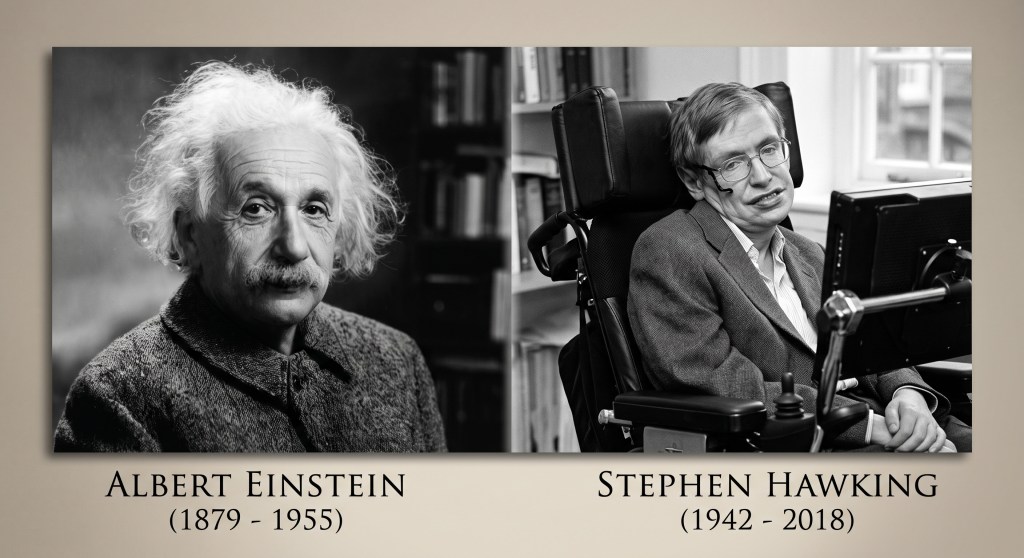
Presented by Claude for Zia H Shah MD
Abstract
Two of the twentieth century’s most searching minds — Albert Einstein and Stephen Hawking — left behind an extraordinary trail of reflections on the beauty, order, and mystery of the cosmos. Both men wrote as if seized by something larger than curiosity: a feeling close to reverence, provoked by the sheer intelligibility and elegance of nature. And yet neither arrived at the personal God of Abrahamic monotheism. Einstein settled into a diffuse, impersonal “cosmic religious feeling,” closer to Spinoza’s pantheism than to the God of Abraham, Moses, and Jesus. Hawking moved further still, eventually arguing that the laws of physics made a Creator unnecessary. This essay collects their most characteristic statements on wonder and awe, sets them beside the Qur’an’s own verses on cosmic reflection — Q 3:189–191, presented here in Arabic with five English translations — and asks a pointed question: what is it that keeps a mind stocked with wonder from making the final leap to worship? The answer, this essay argues, lies less in evidence than in posture: the difference between admiring a pattern and answering a summons.
Part I — Stephen Hawking: Wonder Without a Summoner
Hawking’s writings return again and again to beauty, rarity, and romance — but always with the universe as the subject and object of its own admiration, never as an address from beyond it.
The rarity of wonder. Hawking observed that most possible sets of physical constants would produce beautiful universes devoid of any mind capable of appreciating that beauty — a reflection from A Brief History of Time on how improbable it is that a cosmos should contain its own beholder. [1]
Endless cosmic perspective. He repeatedly urged people to look outward and upward — to meet the universe’s vastness and mystery with a child’s wonder rather than fixing their gaze on the ground beneath their feet. [1] [2]
The romance of science. For Hawking, science was never merely a discipline of cold reason; he described it as carrying its own romance and passion. [1]
A cosmic recipe, not a cosmic accident. Despite the universe’s staggering complexity, Hawking noted that everything in it reduces to three ingredients — matter, energy, and space — which he took as a sign of underlying order rather than arbitrariness. His stated ambition, in his own words, was nothing less than a complete understanding of the universe and of why it exists at all. [1] [2] [3]
Beautiful imperfection. He held that perfection is nowhere to be found in the cosmos, and that this very imperfection is the precondition for the universe — and for us — existing at all. [1] [2]
The mind that grasps the cosmos. Hawking marveled that creatures as physically insignificant as human beings, clinging to a minor planet, should nonetheless possess minds capable of comprehending the universe that dwarfs them — a capacity he treated as our defining distinction.
The ultimate quest, without a questioner to answer to. Hawking was struck that a scientifically sophisticated age had grown so indifferent to the philosophy of existence, and he pressed people to keep asking why. Famously, he closed A Brief History of Time by suggesting that a complete unified theory would let ordinary people join philosophers and scientists in discussing why the universe exists — a discovery he called the ultimate triumph of human reason, since then, in his words, we would know “the mind of God.” [1] [2] [3] [4]
It is worth noting the phrase “the mind of God” here operates as a metaphor for total physical comprehension, not as a step toward belief. In his later work, especially The Grand Design (2010), Hawking went on to argue explicitly that because a law like gravity exists, the universe can and will create itself from nothing, and that this makes it unnecessary to invoke a Creator to set the process going. Wonder, in Hawking’s hands, terminates in a self-sufficient physical law rather than in a Lawgiver.
Part II — Einstein: Wonder Sublimated Into “Cosmic Religious Feeling”
Einstein’s language is, if anything, more explicitly religious in vocabulary than Hawking’s — yet he was equally insistent that it not be read as belief in a personal God.
The most beautiful experience. In one of his most quoted formulations, Einstein held that the sense of mystery is the most beautiful thing a person can experience, and that whoever has lost the capacity to feel wonder and stand in awe is, in his words, “as good as dead.” [1]
Cosmic religious feeling as the engine of science. He went so far as to call this feeling — awe at an order behind nature that no theology defines and no dogma can capture — the strongest and noblest motive for scientific research itself. [1]
Comprehensibility as the deeper mystery. Einstein considered it astonishing not merely that the universe exists, but that the human mind — evolved for practical survival — is capable of grasping its laws at all; he called this fact itself the most incomprehensible thing about the universe. [1]
The naturalist’s involuntary reverence. He believed that anyone who studies nature closely cannot help but feel something like religious emotion, since the connections a scientist uncovers were clearly not invented by the scientist, but only found — as though by a child dependent on an authority not their own. [1]
A humility before hidden order. Einstein described his own religious feeling as a state of humble amazement at the order that pervades whatever small corner of reality our limited intelligence can reach. [1]
Fox’s recent scholarship on Einstein’s “spiritual recasting” makes an important point: Einstein deliberately unhooked wonder from theology, treating it as a beginning rather than a conclusion — a stance that keeps cosmic religious feeling permanently open-ended, never landing on a determinate divine Person to whom gratitude, obedience, or worship would be owed. [1] Einstein said so himself: cosmic religious feeling, in his account, gives rise to no definite notion of God and no theology — by design.
Part III — Qur’an 3:189–191: The Verses of Reflection
The Qur’an addresses exactly the same triggers of wonder — the heavens, the earth, the night and day, the underlying order of creation — in a sustained passage near the end of Sūrat Āl ʿImrān. These verses are traditionally associated with the ulū al-albāb, “those of understanding” or “those possessed of hearts/minds,” and with the discipline of tafakkur, reflective contemplation of creation.
Arabic Text
٣:١٨٩ وَلِلَّهِ مُلْكُ السَّمَاوَاتِ وَالْأَرْضِ ۗ وَاللَّهُ عَلَىٰ كُلِّ شَيْءٍ قَدِيرٌ
٣:١٩٠ إِنَّ فِي خَلْقِ السَّمَاوَاتِ وَالْأَرْضِ وَاخْتِلَافِ اللَّيْلِ وَالنَّهَارِ لَآيَاتٍ لِّأُولِي الْأَلْبَابِ
٣:١٩١ الَّذِينَ يَذْكُرُونَ اللَّهَ قِيَامًا وَقُعُودًا وَعَلَىٰ جُنُوبِهِمْ وَيَتَفَكَّرُونَ فِي خَلْقِ السَّمَاوَاتِ وَالْأَرْضِ رَبَّنَا مَا خَلَقْتَ هَٰذَا بَاطِلًا سُبْحَانَكَ فَقِنَا عَذَابَ النَّارِ
Five English Translations
1. Sahih International 189 — And to Allah belongs the dominion of the heavens and the earth, and Allah is over all things competent. 190 — Indeed, in the creation of the heavens and the earth and the alternation of the night and the day are signs for those of understanding. 191 — Who remember Allah while standing or sitting or [lying] on their sides and give thought to the creation of the heavens and the earth, [saying], “Our Lord, You did not create this aimlessly; exalted are You [above such a thing]; then protect us from the punishment of the Fire.”
2. Abdullah Yusuf Ali 189 — To Allah belongeth the dominion of the heavens and the earth; and Allah hath power over all things. 190 — Behold! in the creation of the heavens and the earth, and the alternation of night and day, there are indeed Signs for men of understanding. 191 — Men who celebrate the praises of Allah, standing, sitting, and lying down on their sides, and contemplate the (wonders of) creation in the heavens and the earth, (with the thought): “Our Lord! not for naught hast Thou created (all) this! Glory to Thee! Give us salvation from the penalty of the Fire.”
3. Marmaduke Pickthall 189 — Unto Allah belongeth the Sovereignty of the heavens and the earth. Allah is Able to do all things. 190 — Lo! In the creation of the heavens and the earth and (in) the difference of night and day are tokens (of His Sovereignty) for men of understanding, 191 — Such as remember Allah, standing, sitting, and reclining, and consider the creation of the heavens and the earth, (and say): Our Lord! Thou createdst not this in vain. Glory be to Thee! Preserve us from the doom of Fire.
4. M.A.S. Abdel Haleem 189 — Control of the heavens and earth belongs to God; God has power over everything. 190 — There truly are signs in the creation of the heavens and earth, and in the alternation of night and day, for those with understanding, 191 — who remember God standing, sitting, and lying down, who reflect on the creation of the heavens and earth: “Our Lord! You have not created all this without purpose — You are far above that! — so protect us from the torment of the Fire.”
5. Muhammad Asad 189 — AND UNTO GOD belongs the dominion over the heavens and the earth: and God has the power to will anything. 190 — Verily, in the creation of the heavens and the earth, and in the succession of night and day, there are indeed messages for all who are endowed with insight, 191 — [and] who remember God when they stand, and when they sit, and when they lie down to sleep, and [thus] reflect on the creation of the heavens and the earth: “O our Sustainer! Thou hast not created [aught of] this without meaning and purpose. Limitless art Thou in Thy glory! Keep us safe, then, from suffering through fire!”
Part IV — Why Wonder Stalls Short of Worship
Set side by side, the two bodies of material are not talking past each other — they are describing the same triggering stimulus. A naturalist’s mind fixed on the sky, the alternation of night and day, the order embedded in complexity, the improbability of a mind capable of grasping any of it: this is the shared starting point of Einstein, Hawking, and the ulū al-albāb of Q 3:190. All three parties feel something. The difference lies entirely in what happens next — and it is worth being precise about what the Qur’an actually adds, because it is not a further fact about the universe. It is a further posture of the self.
1. Wonder is cognitive; the Qur’anic response is volitional. Verse 190 describes the āyāt — signs — available to “those of understanding” (ulū al-albāb), which is where Einstein and Hawking both stop: intellectual recognition that the universe displays order worth marveling at. Verse 191 does something different. It layers dhikr (remembrance, invoked in every bodily posture — standing, sitting, reclining) beneath tafakkur (reflection), and then culminates in direct address: “Our Lord.” The grammatical move from third person (“signs for those of understanding”) to second person (“Our Lord, You have not created this without purpose”) is the whole distance between admiring a pattern and answering a summons. Einstein’s cosmic religious feeling is intransitive — it has no addressee. The Qur’anic verse is transitive from its very last clause onward: wonder resolves into speech directed at a Someone.
2. The refusal of a definite God is not neutral; it is a choice with a cost. Einstein said plainly that cosmic religious feeling gives rise to no definite notion of God and no theology — and treated this as the feeling’s virtue, its freedom from dogma. But indefiniteness is not simply humility; it is also a way of declining the obligations that come with a definite, personal Lord — obligations of gratitude, submission, and moral accountability. A pattern can be admired without being obeyed. A Person who says “protect us” is asking something of the one being addressed, and being addressed by name creates a claim on the one addressed in turn. It is far more comfortable to remain in the position of admirer than to move into the position of servant.
3. Hawking’s move from “unnecessary” to “absent” mistakes elegance for exclusion. The Grand Design‘s argument — that because gravity exists, the universe can create itself, so “God” is not needed to light the fuse — treats the existence of law as if it competed with the existence of a Lawgiver, rather than being itself among the most striking of the āyāt that verse 190 points to. The Qur’anic frame does not ask believers to find a gap in physical law where God might be hiding; it asks them to notice that law-governed order, rather than chaos, is running at all, and to notice that they themselves are creatures whose minds happen to be built to detect it. Removing the need for a first cause among physical causes does nothing to remove the deeper question addressed in verse 191: why is there something intelligible, ordered, and beautiful rather than nothing at all, and why does it not feel to reflective minds like it was made “for nothing” (bāṭilan)? Hawking’s own quoted intuition — that the universe’s staggering variety still reduces to a handful of ingredients “reflecting an underlying order rather than arbitrary events” — is, read plainly, closer to verse 190 than to atheism. What blocks the further step is not the physics; it is a prior commitment to stopping the inquiry at “law” rather than letting it run on to “Lawgiver.”
4. Suffering and imperfection are treated as evidence against, rather than material for, address. Hawking’s reflection that “perfection does not exist in the universe” is offered as a kind of resigned aesthetic observation. The Qur’anic worshipper, standing in the very same universe, arrives at almost the identical realization — the world is not frictionless, evil and pain are real — and responds not by dismissing a Creator but by petitioning one: “protect us from the torment of the Fire.” The presence of imperfection becomes, in verse 191, the reason for prayer rather than the reason for its absence. This is a difference in what one does with an unresolved difficulty, not a difference in how much difficulty each side is willing to concede.
5. Intellectual culture makes the personal step costly in ways the impersonal step is not. Both Einstein and Hawking wrote and worked inside scientific communities in which impersonal awe was rewarded with a Nobel-worthy vocabulary — “cosmic religious feeling,” “the mind of God” as metaphor — while a personal, submissive, praying relationship to a named Lord was coded as naive, sentimental, or professionally embarrassing. Arrogance is rarely loud; more often it is simply the quiet unwillingness to be seen taking the further, more vulnerable step that a scientifically sophisticated audience will read as regression. The Qur’an elsewhere names exactly this reluctance — the gates of mercy closing not on the ignorant but on those who knew enough to recognize a sign and turned away out of pride (cf. Q 7:40). Wonder felt in private, and wonder confessed in address to a Lord before others, are psychologically two very different acts; only the second carries social risk.
6. The Qur’anic posture insists on continuity, not a peak experience. Verse 191’s threefold “standing, sitting, and lying down” describes remembrance as a state maintained across every ordinary bodily condition — not a rare mountaintop feeling reserved for encounters with black holes or unified field equations. Einstein’s and Hawking’s wonder, by contrast, is characteristically occasioned by exceptional moments: staring into a night sky, contemplating a discovery, closing a book with a rhetorical flourish about “the mind of God.” A feeling that visits only at the extremes of intellectual or aesthetic intensity is, by its nature, episodic and can be filed away as a mood. A remembrance woven into standing, sitting, and lying down is instead a discipline — and disciplines, unlike moods, tend to produce settled conviction rather than admiration that dissipates once the telescope is put away.
None of this is offered as a slight against either man’s intellectual honesty. Both plainly meant what they said, and both said it with more searching seriousness than most believers bring to their own professed faith. The point of setting Q 3:189–191 beside them is narrower and, this essay would argue, more useful: it isolates exactly where the road forks. The fork is not a missing fact about black holes, dark energy, or the fine-structure constant. It is the moment at which a mind that has already recognized order, beauty, and improbability either turns that recognition into address — “Our Lord” — or lets it settle back into contemplation of a pattern that asks nothing of the one contemplating it.
Thematic Epilogue
Stand Einstein at his desk, marveling that thought itself can grasp the cosmos; stand Hawking at his blackboard, tracing the three ingredients from which every galaxy is made; and stand the ulū al-albāb of Sūrat Āl ʿImrān in prayer, remembering God on their feet, seated, or lying down, reflecting on the very same heavens and earth. All three have arrived, by the same route of honest attention to nature, at the same threshold: order too vast, too improbable, and too beautiful to have simply happened. What separates them is not the size of the mystery each perceived — if anything, Einstein and Hawking, closer to the mathematics than most believers will ever get, perceived it more finely than most. What separates them is a single grammatical and existential move: whether wonder is left as a sentence about the universe, or is turned, as verse 191 turns it, into a sentence spoken to the One behind the universe. “Our Lord, You have not created this without purpose” is not a conclusion physics can force on anyone. It is a response only the will can make — the same will that can, with equal freedom, choose to stop one clause short, at admiration, and call that stopping point humility. The Qur’an’s diagnosis is unsparing but not unkind: it does not accuse Einstein or Hawking of failing to see. It suggests only that seeing, however luminous, was never going to be sufficient on its own — that the last few inches between the telescope and the sajdah have always belonged to something other than evidence, and that this is precisely where every honest seeker, scientist or otherwise, eventually has to decide what to do with the wonder they cannot deny feeling.




Leave a Reply