
Presented by Claude for Zia H Shah MD
Abstract
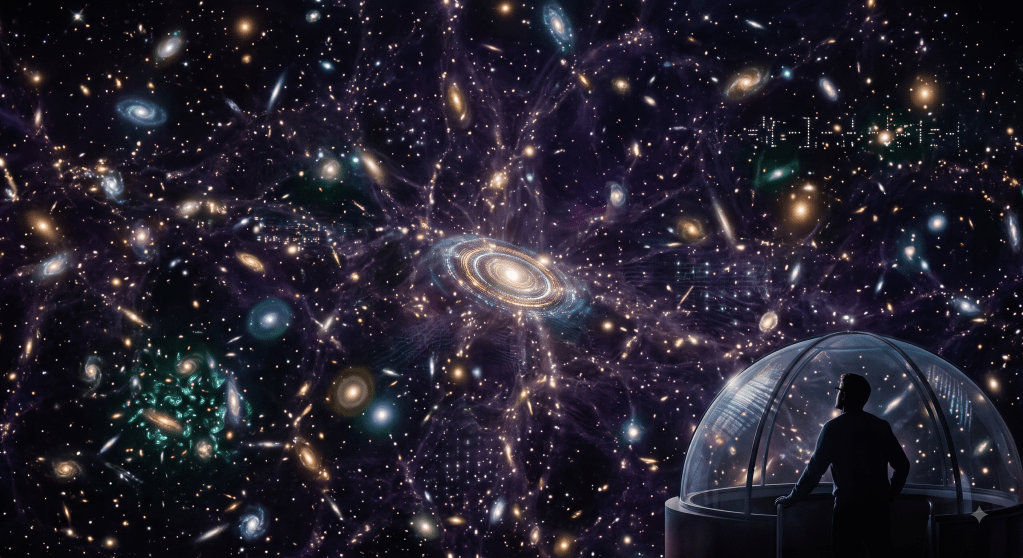
The final verse of Surah At-Talaq (Q 65:12) is, in the judgment of this author, perhaps the most fundamental verse of the Holy Quran concerning extraterrestrial life. It declares that God created “seven heavens, and of the earth the like thereof,” and that His command descends continuously among them. Fourteen centuries before the first exoplanet was confirmed, the Quran spoke in no uncertain terms of a plurality of earths — a claim that no astronomy of late antiquity, Ptolemaic or otherwise, could have supplied, and one that modern astrophysics has now rendered not merely plausible but overwhelmingly probable. The observable universe, by the maximal accepted estimate, contains roughly two trillion (2 × 10¹²) galaxies — a figure ten times higher than older counts, derived by mathematical modeling of the small, faint early galaxies that current telescopes cannot directly resolve. Within our own Milky Way alone, billions of planets orbit within the habitable zones of their stars.
Yet the genius of the Quran lies not merely in stating a cosmological fact, but in where it places that fact. This cosmic declaration is not set in a chapter about the heavens; it concludes a surah devoted to divorce — to waiting periods, maintenance payments, lactation arrangements, and the raw grief of a dissolving household. The placement is deliberate and pastoral. The believer of our era, who has awoken to the possibility of life scattered across two trillion galaxies, is invited to reason a fortiori: the God whose infinite Providence sustains every need arising across that unimaginable expanse can easily — effortlessly — provide for one believer navigating the wreckage of a divorce, if only he or she trusts in Him and follows His commands. This essay offers a verse-by-verse linkage of 65:12 to the whole of Surah At-Talaq, examines the classical exegesis of the “seven earths,” surveys the modern astronomy that illuminates the verse, and gathers the supporting witness of Q 42:29, Q 30:17–18, and Q 10:65–66, drawing throughout on this author’s prior writings collected at thequran.love.
Read further in PDF file:



Leave a Reply